Category Archives: Agriculture

Union Forests Ministry approves Kushalnagar–Madikeri rail line survey

UnionForestsKF15nov2014
With this, Mysore–Madikeri project has taken a step forward

The Mysore–Madikeri railway line project has taken a step forward with the Ministry of Environment and Forests (MoEF) issuing clearance for the survey work between Kushalnagar and Madikeri.

Meeting
This was disclosed by Railway officials at the Divisional Railway Users’ Consultative Committee meeting here on Wednesday.

The environmental clearance was received last week and the authorities plan to complete the survey and submit the report to the Railway Board by March 31, 2015.

The preliminary engineering-cum-traffic survey for the railway line was launched in December 2011, but was taken up only between Mysuru and Kushalnagar and the partial survey report was submitted to the Railway Board. Though the project was shelved by the Railway Board on grounds of being commercially unviable, the State government has evinced interest in the project and has agreed to take it up on a cost-sharing basis, apart from providing land to the Railways.

The first phase of the project entails providing railway link between Mysuru and Kushalnagar at a cost of Rs. 660 crore. It will also connect Hunsur and Periyapatna.

Interestingly, the project was included in the Railway Budget 2010–11 under the ‘socially desirable rail connectivity’.

The first proposal for providing a rail link between Mysuru and Madikeri was mooted in 1881-82, according to the Mysore Gazetteer.

Another project

On the Shivamogga–Harihar railway line project, it was pointed out that the detailed survey for the new broad-gauge line had been completed. The 76-km project is expected to cost Rs. 832 crore and will be taken up on a cost-sharing basis between the Railways and the State government. Though the Railway authorities had sought 1,000 acres of land, it is yet to be acquired.

The work can commence, provided the State government hands over adequate land to take up the work on at least a 40-km stretch, according to the officials.

Divisional Railway Manager Rajkumar Lal, Senior Divisional Commercial Manager Anil Kumar, senior officials of different departments from the Railways, and stakeholders from various districts coming under the Mysore Railway Division were present.

source: http://www.thehindu.com / The Hindu / Home> News> National> Karnataka / by R. Krishna Kumar / Mysuru – November 06th, 2014

Jamma Bane issue will be resolved soon : CM

CM Siddharamaiah, who was in Madikeri yesterday, was felicitated with a traditional Kodava headgear and Odi Kathi by Kodava Sahitya Academy President B.S. Thamaiah.

Madikeri :

The government, which has made several amendments in laws regarding the Jamma Bane issue in Kodagu, will soon resolve the issue after holding talks with stake holders and officials of the Revenue Department, declared Chief Minister Siddharamaiah here yesterday.

He was speaking after inaugurating the newly built Rs. 14.44 crore District Administration Complex and laying of foundation stone for several developmental works at an estimated cost of Rs. 26.14 crore at the Gandhi Maidan here.

Continuing, Siddharamaiah said that the new rule regarding settlement of the Jamma Bane issue, as proposed by former Speaker K.G. Bopaiah while he was in office, had already been ratified by the President of India and added that his Government was committed to resolve the issue, irrespective of the opinion of the Revenue Department.

Giving a piece of advice to officials, the CM said that failing to fulfil the aspirations of the people was as criminal an act as accepting bribes. He also instructed the officials to address the grievances of the people by utilising various facilities for smooth functioning of the offices.

Speaking on the controversial High Tension power-line passing through parts of Kodagu, the CM said that the three-member panel formed to look into the matter had submitted its report and added that the issue would be resolved after holding talks with farmers of the district.

Promises fulfilled: “Within 17 months of assuming office, my government has implemented as many as 59 of the 165 programmes announced in our manifesto for election to Assembly,” Siddharamaiah claimed and added that his government had waived off Rs. 2,500 loans taken by the farmers including an interest amount of Rs. 1,000 crore.

Website launched: Siddharamaiah also launched a website of Karnataka Arabhashe Sahitya Academy on the occasion.

source: http://www.starofmysore.com / Star of Mysore / Home> General News / Tuesday, November 04th, 2014

Karnataka nixes Kerala plan for road via Kodagu forests

Madikeri :

The Karnataka forest department has turned down a Kerala government proposal to build a road through Kodagu forests for a smoother access to Bangalore.

The decision was taken based on a report submitted by the Kodagu wildlife division’s deputy conservator of forests.

It’s learnt that the Kerala chief minister had sent in a letter to his Karnataka counterpart, suggesting carving out a road through Mundrotu forests near Talacauvery in the district. In the letter, Oommen Chandy said the distance from Kerala’s Ezhimala in Kannur district to Bangalore through Talacauvery is 376 km, and wanted a 16km stretch from the state boundary to Talacauvery for a comfortable journey.

Some 43km stretch of the road is in Kerala and the rest in Karnataka.

The Kodagu wildlife division sent in a report to its headquarters, saying construction of a road through the forests was not desirable as Mundrot forests were home to many wildlife species. Of the planned 16km road, at least 8km stretch was to scythe through the reserve forest, presenting hunters and smugglers a chance to poach trees like rosewood, nandi and jackfruit, among many others.

The Karnataka forest department nixed the proposal and communicated it to the Kerala chief minister, it’s learnt.

source: http://www.timesofindia.indiatimes.com / The Times of India / Home> City> Bangalore> Namma Metro / TNN / October 31st, 2014

Karnataka nixes Kerala plan for road via Kodagu forests

Madikeri :

The Karnataka forest department has turned down a Kerala government proposal to build a road through Kodagu forests for a smoother access to Bangalore.

The decision was taken based on a report submitted by the Kodagu wildlife division’s deputy conservator of forests.

It’s learnt that the Kerala chief minister had sent in a letter to his Karnataka counterpart, suggesting carving out a road through Mundrotu forests near Talacauvery in the district. In the letter, Oommen Chandy said the distance from Kerala’s Ezhimala in Kannur district to Bangalore through Talacauvery is 376 km, and wanted a 16km stretch from the state boundary to Talacauvery for a comfortable journey.

Some 43km stretch of the road is in Kerala and the rest in Karnataka.

The Kodagu wildlife division sent in a report to its headquarters, saying construction of a road through the forests was not desirable as Mundrot forests were home to many wildlife species. Of the planned 16km road, at least 8km stretch was to scythe through the reserve forest, presenting hunters and smugglers a chance to poach trees like rosewood, nandi and jackfruit, among many others.

The Karnataka forest department nixed the proposal and communicated it to the Kerala chief minister, it’s learnt

source: http://www.timesofindia.indiatimes.com / The Times of India / Home> City> Bangalore> Namma Metro / TNN / October 31st, 2014

Gram Panchayat least bothered about basic facilities near Abbey falls

Abbey waterfalls in Kodagu district is one of the itinerary included in the list of tourists who visit the district.

Breathtaking waterfalls, its roaring sound and beautiful cascades spring back to life with the monsoon. A large number of tourists visit the waterfalls during weekends. Inspite of the fetching income from tourism, the gram panchayat has failed to provide basic facilities for the tourists near the waterfalls.

Abbey waterfalls is situated amidst coffee plantation. It cascades down 30 to 40 feet from a hillock. The land where Abbey falls is situated belongs to a private individual.

The land belongs to Neravanda Indira. To ensure that tourists are not disappointed, she has allowed them to walk in between her estate. However, the gram panchayats have not taken any measures to ensure that no harm is done to the estate.
Those who visit the waterfalls pluck coffee plants, throw plastic carry bags, cigarettes, beedi, gutka packets and liquor bottles, she said.

Indira said “the gram panchayat had promised to lay grills to the foot road that passes through estate. However, the promises have remained only on paper. The tourists damage the plants.”

“In protest against apathy of the gram panchayat, I had even locked the main gate. To ensure that no inconvenience is met to the tourists, I started opening the small gate to allow the tourists to enjoy the beauty of nature,” she said.

“The gram panchayat fetches income by collecting parking fee. However, they are least bothered to provide toilets, drinking water and cleanliness in the region,” said tourist Subrahmanya from Shimoga.

source: http://www.deccanherald.com / Deccan Herald / Home> District / by Srikanth Kallammanavar / DHNS, Madikeri – October 19th, 2014

Coffee prices get a Brazilian boost

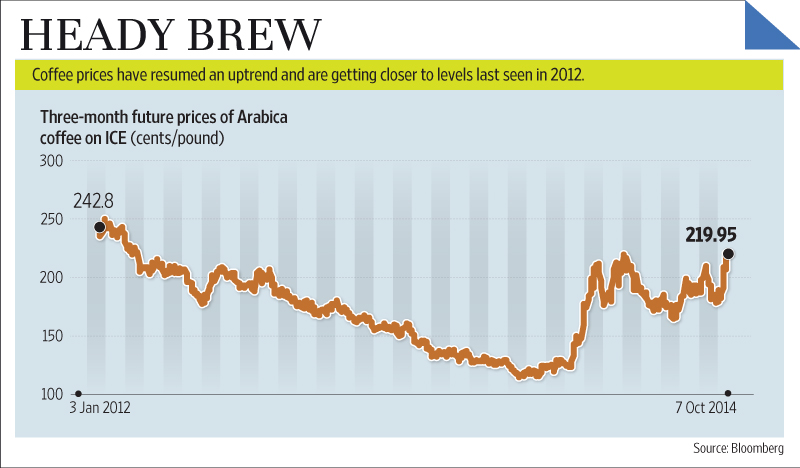
International coffee prices rose sharply this week, as fears resurfaced that Brazil’s crop could get adversely affected by a drought

A thin harvest may be bad news for Brazil but is good news for growers in other countries. Indian coffee producers are seeing firm crop trends in 2014-15. Photo: Bloomberg

International coffee prices rose sharply this week, as fears resurfaced that Brazil’s crop could get adversely affected by a drought. This comes just a fortnight after Brazil’s agricultural organization Conab released its September estimate, which had assuaged market fears and even saw prices drop.

But on Monday, the three-month forward Arabica coffee contract rose by 9.2% intra-day, according to The Wall Street Journal, and closed the day with a gain of 6.9%. This marked a two-and-a-half-year high for this contract. On Tuesday, its level was unchanged. If the news on the weather from Brazil continues to support higher prices, then this uptrend could be sustained. But recent months have seen volatile price movements; so, there is risk of a reversal, too.

GraphKF15oct2014

The International Coffee Organization’s price data show the prices of all grades of Arabica coffee have moved up, in sync with Brazil. Though Brazil’s effect is felt more by the Arabica variety, even the lower Robusta grade has perked up in October. It has recovered losses sustained in September.

A thin harvest may be bad news for Brazil but is good news for growers in other countries. Indian coffee producers are seeing firm crop trends in 2014-15. The country’s coffee crop is estimated to increase by 13.2% to 344,750 tonnes. The Arabica crop is expected to increase by 3.2%, while Robusta, which is the main local crop, is expected to rise by 18.3%.

Thus, one can expect the plantation business of growers such as Tata Coffee Ltd and CCL Products India Ltd to post good results. But this uptrend poses a challenge for coffee marketers such as Nestlé India Ltd and Hindustan Unilever Ltd (HUL). Rising input costs will force them to hike prices, which can hurt volume growth.

source: http://www.livemint.com / Live Mint / Home> Money / by Ravi Ananthanarayanan / Tuesday – October 07th, 2014

Expert panel gives go-ahead for power line; 50,000 trees in Kodagu forests will go

The figure is floated by green activists and is disputed by the authorities, though within the government agencies it varies from 2,247 to 21,000. The trees fall in the verdant forests of Kodagu and the activists could be close to the mark, admit official sources
KodaguTreeKF30sept2014

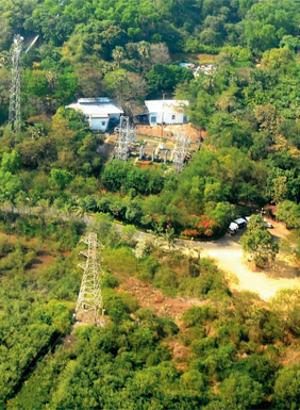
Protests and campaigns have come to a nought, and the axe is set to fall on over 50,000 trees in the evergreen deciduous forests of Kodagu with an expert panel giving its nod to the power line project meant to light up towns and villages in Kerala.

Terming the alternative routes proposed by the locals as technically and financially unfeasible, the three-member expert committee has given its go-ahead to the high power transmission line between Mysore and Kozhikode. Activists of the ‘Save Cauvery’ movement in Kodagu say the decision will ring the death knell for more than 50,000 trees.

While the Power Grid Corporation of India (PGCI) continued to maintain only 2,247 trees will be cut, deputy conservator of forests, Virajpet, has submitted an affidavit before the Green Tribunal in Chennai that a total of 21,000 trees will be felled along the alignment line proposed by PGCI. However, activists who have trekked the entire stretch using GPS coordinates argue that not less than 55,000 trees, both in private areas and on forest land, will face the axe.

Following widespread protests across Kodagu district over the large-scale clearance of forest and degradation to the fragile eco-system of the area, the state government had appointed a three-member expert committee to look into the issue and study the feasibility of possible alternative routes as proposed by the activists. The committee comprising noted elephant expert Prof Raman Sukumar of Indian Institute of Science (IISc) and Ajai Misra, Additional Principal Chief Conservator of Forests (APCCF) was headed by R S Shivakumara Aradhya of Central Power Research Institute (CPRI).

‘Other routes not feasible’

NGOs and activists had proposed alternative routes that would be less damaging to the eco-system, but the committee has stated in its report that these routes are not only detrimental to wildlife conservation, but require huge capital and are technically not feasible. According to the report, accessed by Bangalore Mirror, adopting other routes would require more forests to be cleared than what the present proposal will necessitate. Activists had suggested use of the D-line (District line dividing the two districts of Mysore and Wayanad in Kerala) passing via Nagarhole or the existing 220 KV line on the Kadakola-Kaniyampetta corridor for linking Karnataka with Kerala and Tamil Nadu in the South, besides upgrading the 110 KV corridor between Kasaragod and Mangalore.

“Alternative routes will destroy the Kodagu environment as a large number of trees will have to be cut, adversely affecting the Dubare-Devamachi reserve forest which has considerable presence of elephants and tigers. Using these routes will not only affect the tribal settlement inside forests, but also call for felling of trees in coffee estates which are part of Kodagu ‘s ecosystem. The paddy fields along the proposed line would become unfit for cultivation. The temperature of line conductors will affect coffee plants and affect the national forest policy, which envisages about 33 per cent forest and tree cover. Work in these areas would not only reduce inflow to Kaveri and its tributary Lakshmana Theertha, but also intensify the man-animal conflict,” the report said.

‘Existing lines are over-exploited’

On the prospects of using the existing corridors, the committee observed: “While the corridors are designed to carry a load of 130 MW to 140 MW, they have been used to transmit 180-200 MW of power regularly. Due to overloading, there already has been high sagging of conductors. Further, the ground clearance is low and there have been instances of elephants being subjected to fatal shocks. The Dasara elephant ‘Drona’ too had been a victim of this in the past. The existing 220 KV line runs North East-South West of Kabini for about 32 km of which 20 km is through Nagarhole forest; upgrading the line would only further disturb the ecology.”

‘Tunnelling will hit coffee estates’

Studying the feasibility of laying underground cables, the committee reported it would cost five to 20 times more than the cost of overhead transmission lines. “If the cable is laid, the ground above has to be cleared of vegetation and must be provided with access roads for maintenance. The cable has to be cooled by forced air or by way of circulating water. Further, the repair time is 25 times greater than that of overhead line repair,” the report states.

The experts clarified that laying a double circuit line along the D-line will require 130 hectares of dense tropical forest to be cleared. Besides, reactive power absorption devices have to be installed every eight to 10 km along the cable route; these sub-station-size structures requiring about 2,500 sq metres, the experts said.

‘Project crucial for Karnataka too’

Even though the line between Mysore and Kozhikode was planned under Kaiga Stage II for transferring the generated power from Kaiga to other places way back in 2007, work could not be taken up for several administrative and technical reasons. “Besides this project, there is absolutely no grid connectivity between Kerala and Karnataka. The proposed line, besides helping Kerala, will help us draw power from Koodankulam and other new stations planned along the Tamil Nadu coast. This Southern grid connectivity will help Karnataka harness more than 3,500 MW wind power generated in Tamil Nadu,” said a senior official from the energy department.

Referring to illegal clearance of forests in excess of what was permitted, the committee said, “The line route, proposed by the Power Grid Corporation, requires about 6,000 trees to be cut within a 12-km stretch of coffee plantations in Kodagu, in addition to the 2,247 trees (above 55 cm girth) already felled in that stretch.” Acknowledging clearance of forest for about 52 metres as against the permitted 46 metres along a four-km stretch, the experts suggested efforts to regenerate the natural vegetation in the stretch of land between the 46-52 metre width in Dubare and Devmachi reserved forests.” The committee has also directed the forest department to implement a conflict mitigation plan for preventing man-animal conflict in the area which will completely be funded by PGCI for a minimum of three years after completion of the project.

Reacting over the recommendations of the committee, power minister DK Shivakumar told BM, “The committee has given us a green signal to go ahead with the project. The activists, farmers have to understand this and must support the government by giving all the necessary help. There is tremendous pressure from the Centre to accomplish the project and it is more important from the energy security of the state in future. It helps us draw more and more power in a short duration time from the generating stations of Tamil Nadu. We are just waiting for the rains to stop and once the rains are officially ended, we will take up the work along the proposed corridor.”

source: http://www.bangaloremirror.com / Bangalore Mirror / Home> Bangalore> Cover Story / by Niranjan Kaggere, Bangalore Mirror Bureau / September 29th, 2014

Western Ghats report makes Karnataka planters jittery

Bangalore :

Coffee planters in Karnataka’s Kodagu district are an apprehensive lot. They believe the acceptance of the Kasturirangan report to conserve Western Ghats will make them helplessly watch their disease-afflicted crop wither away for it bans the use of pesticides in their area.

They feel they may not be able to cut down trees on their plantation in times of distress as that too would be prohibited.

The very mention of Kasturirangan report sparks off angry reactions in Kodagu district. “One cannot force small-time agriculturists to convert to organic farming and not use pesticides – it must happen gradually and voluntarily. Implementation of any report should create a win-win situation for all,” says Col CP Muthanna, president of the Coorg Wildlife Society.

A cocktail of apprehensions and genuine fears has stirred up a massive resistance to Kasturirangan report along the Western Ghats. “Forests are the lifeline of Kodagu and a huge per centage of people are dependent on them. It is therefore important to initiate a dialogue with locals before taking far-reaching decisions,” says Air Marshal (Retd) Nanda Cariappa, a resident of Kodagu.

Some experts admit some of the fears are genuine. “People still dependent on forest produce are opposing the implementation. Quite rightfully so as all this while no one raised an issue each time they went to the forest, gathered berries etc and sold them off for a livelihood. But with this classification they will not be able to do so,” said environmentalist Suresh Heblikar.

Locals are knowledgeable and have a fair idea of the topography of the place. It would be unfair to remove them from the system altogether when they have been an inclusive partner of the ecosystem for centuries together, he said.

But experts say a “deliberate campaign of misinformation” has made the Kasturirangan committee report unimplementable. They allege people with vested interests are at work and misleading the locals.

“There is a common fear among people of losing their lands with 37% of Western Ghats earmarked to be notified as Ecologically Sensitive Area (ESA). These directions have been issued under Section 5 of the Environment (Protection) Act, 1986 and related Rules which does not empower the government to acquire any land. Therefore the question of people losing their legally owned lands located either in the identified villages or outside does not arise at all,” said Wildlife First trustee Praveen Bhargav.

Environmentalists even doubt the government’s commitment to implement it as it means existing policies will have to be withdrawn. “These reports are in the interest of the common man and in favour of ecology. According to scientific findings, hilly regions should have 66% forest cover but what remains in Western Ghats is a mere 10%, which is also under attack by vested interests,” said environmentalist Panduranga Hegde, who heralded the Appiko movement to protect trees in Western Ghats.

source://www.timesofindia.indiatimes.com / The Times of India / Home> Environment> Development Issues / by Saswati Mukherjee B, TNN / January 20th, 2014

Honey park proposed at Bhagamandala

State government has already released `60 lakh
HoneyCombKF25sept2014

To bring back the glory of honey production in Kodagu, the State government has come forward to set up a honey park in Bhagamandala. The State government has already released Rs 60 lakh and primary preparations are in progress.

The Honey Park would act as a comprehensive centre for honey production and related activities. It would also endeavour to provide marketing facilities for the product in the entire State. The park will come up in Apiculture Training Centre at Bhagamandala. The Park will be maintained by food processing division of Agriculture department.

The Park will be set up to promote apiculture, which will supplement the income of the farmers. Agriculture department in-charge Secretary and Director of Horticulture department have already held talks with farmers on the structure of the Honey Park, and a proposal has been sent to the government. There are more than 10,000 farmers engaged in apiculture in Kodagu district. Apiculture has spread to Chikmagalur, Shimoga, Dakshina Kannada, Uttara Kannada, Mysore and Chamarajanagara. Owing to diseases affecting honey bees, apiculture had seen a set back in the recent years.

Apiculture was ruling the roost in Kodagu two decades ago. There were bee hives in each and every plantation. Apiculturists were getting 10 to 15 kg of honey from one bee hive. However, now it has reduced to six to seven kg honey, said Apiculturist C Madappa.

“With diseases affecting honey bees, apiculture saw a set back in the district. In the first phase, honey bees will be nurtured in the Park. Later, a research unit, museum on apiculture, honey processing unit, and an export unit will be set up.”

Along with Honey Park, a training centre will also be set up. Tribals and farmers will be trained in apiculture. The tribals will be trained in collecting honey in forests. This in turn will help in improving the economic condition, said Horticulture Department Deputy Director (in charge) S N Sudheendra Kumar.

source: http://www.deccanherald.com / Deccan Herald / Home> District / by Shrikanth Kallammanavar / Madikeri, DHNS – February 04th, 2014

Indian firm develops vaccine for Blue Tongue

Hyderabad :

Indian Immunologicals Limited (IIL) has launched a vaccine for Blue Tongue disease that affects domestic animals such as goats, sheep, cattle and camels. India is among the top victims of this disease. The mortality rate is quite high at 30 per cent.

The penta-valent vaccine Raksha-Blu protects all the five virus strains that cause the disease in India. It is priced at Rs. 5 a dose.

An arm of the National Dairy Development Board (NDDB), the IIL claims that it is the first vaccine developed indigenously for the disease.

“There are 24 viral strains prevalent in the world. In India, about five strains are predominant. Besides high level of mortality, it causes morbidity too. There has been no vaccine developed so far to protect the animals from the disease,” a company statement said here on Wednesday.

The Indian Council of Agricultural Research (ICAR) and Tamil Nadu University of Veterinary and Animal Sciences too have taken part in the development of the vaccine.

source: http://www.thehindubusinessline.com / Business Line / Home> Agri-Biz / by K. V. Kurmanath / Hyderabad – September 24th, 2014