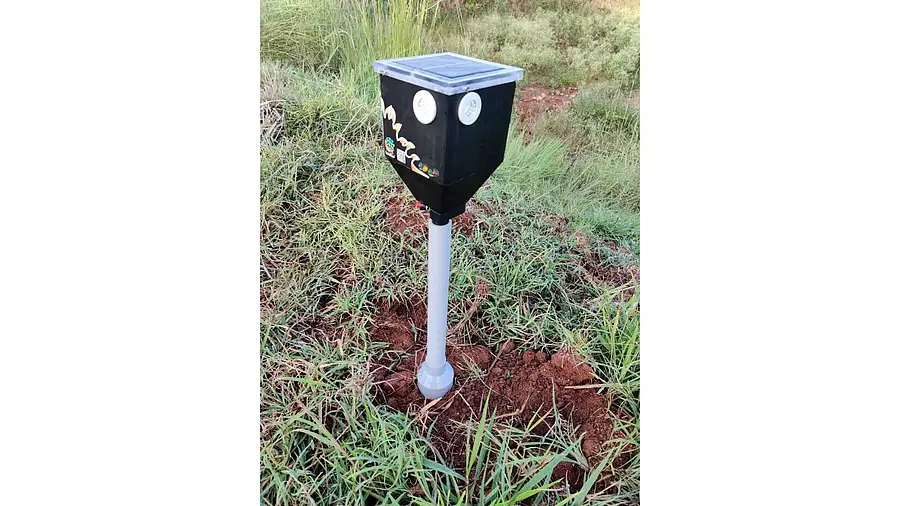
Each device features four LED lights. The lights are positioned in pairs, in such a way that from a distance they look like a pair of glowing eyes of a predator, founder S R Ayan said.
Parabraksh installed in a farm in Kanakapura.
A Bengaluren has designed a lighting system to help farmers protect their crops and livestock from wildlife, during the night. The innovative product does not harm the wild animals. Katidhan, a five-member startup located on New BEL Road, recently won an investment of Rs 1.5 crore on business reality show, Shark Tank India.
On the show, its founder S R Ayan said farmers in India lose 30-50% of their crops to wildlife. The conventional methods to keep wild animals out include installing electrical fences, planting crude bombs or spraying chemicals. Citing the dangers of such interventions, he said an elephant in Chikkamagaluru died due to electrocution by an electric fence last November.
Ayan says his product, Parabraksh, mitigates the human-animal conflict in a “humane way”. Animals are afraid of other animals and the lighting system is built around this behavioural psychology. “Each device features four LED lights. The lights are positioned in pairs, in such a way that from a distance they look like a pair of glowing eyes of a predator. This scares away the animal.”
The product flashes light in random patterns. Being an autonomous device, it switches on in the dark and switches off as daylight breaks. It runs on solar power but also features a USB charging port for backup.
“Four such lights are needed to protect a farm land of 1 hectare, one in each corner. You can mount them on bamboo sticks or steel poles. The height of the stick or pole will depend on the size of the animal you are targeting,” Ayan adds.
He claims Parabraksh is “over 95%” effective in repelling wild boar, nilgai, elephant, tiger, leopard, and the Himalayan bear. He shares case studies: When these lights were uninstalled from a farm in Tamil Nadu and sent for servicing, elephants returned. For a woman farmer in Maharashtra, crop losses due to wild boars have gone down by 25%. The income of a farmer in Odisha has doubled since elephant invasion stopped.
Ayan says the demand for Parabraksh was more than what his bootstrapped startup could meet, that’s why he decided to raise funds through investors.
It all started with a friend’s SOS call in 2017. “My friend was volunteering with a wildlife organisation in Ladakh. He said villagers were trying to kill the snow leopard that was attacking their livestock. He knew about my background in product design and robotics and asked if I could help,” the 33-yearold recalls.
After a pilot in Ladakh, Parabraksh hit the market in 2020. “Our first taker was a large coffee estate in Kodagu,” he says. About 1,100 units, Rs 9,500 apiece, have been sold since. A majority of the products have been sold to farming and social development collectives in Maharashtra.
“After the show, I am getting enquiries from Kanakapura, Kodagu and Hassan, which see regular elephant movement,” he says.
Monkey chaser
Sensor-based Kapikaat is another product by Katidhan, priced at Rs 5,000 and up. It emits loud sounds to repel monkeys during day time. “It is 70-75 % effective. We reckon that monkeys can get used to the source of the sound and ignore it,” says Ayan.
source: http://www.deccanherald.com / Deccan Herald / Home> India> Karnataka> Bengaluru / by Barkha Kumari / March 27th, 2024
Bird watching is one of the mediums to create awareness on environment conservation, said Dr. S.V. Narasimhan, a Birder and Author from Virajpet in Kodagu.
He was speaking after receiving felicitation at ‘A Day with Salim Ali’ event jointly organised by Mysore Science Theatre Festival Trust, Kutuhali, NCF (National Curriculum Framework) and SVYM (Swami Vivekananda Youth Movement) at Kiru Rangamandira here on Saturday.
“We Indians have always understood the importance of environment since we are worshippers of nature and see divinity in all living beings. Students should learn about nature and its conservation,” he said. A doctor by profession, Dr. Narasimhan is perhaps known to many for his passion for birds.
Bird-watcher N.R. Harsha said renowned Ornithologist Dr. Salim Ali had conducted a research on birds between November, 1939 – February, 1940 in Mysuru region and that the recent research had shown the presence of 419 species of birds in Mysuru region.
“Mysuru region has 191 local species and witnesses 129 different species of migratory birds in winter season. In addition, 53 variety of local migratory birds are also spotted in our region. Among the various species of birds found in the country, Mysuru contributes about 30.7 percent and Karnataka contributes 76 percent,” he noted.
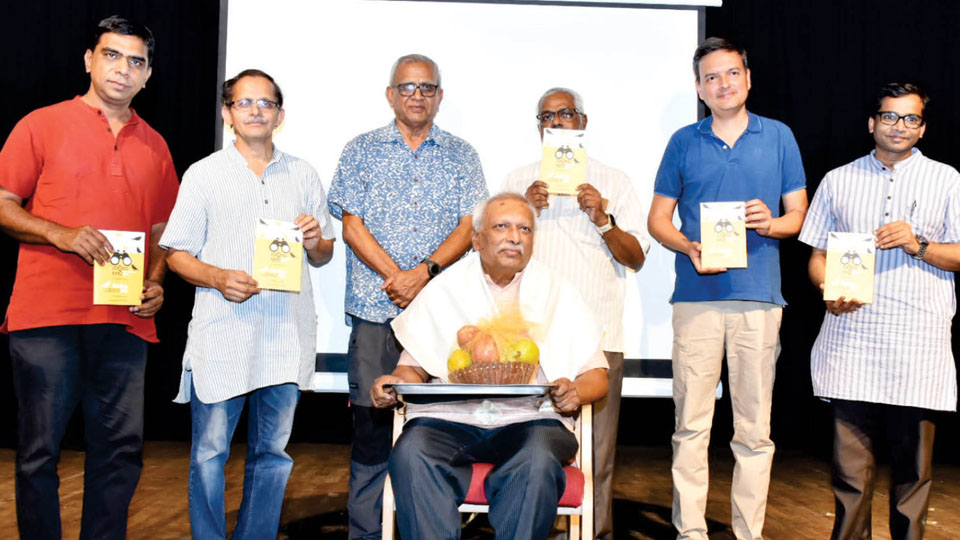
On the occasion, Kannada and English version of the book ‘Salim Ali – Wonder in the World of Birds’ (Salim Ali – Pakshi Lokada Beragu’) by Dr. M.C. Manohara/ Shashidhar Dongre were released. Artistes of Arivu Ranga staged a play while talks were delivered on ‘Salim Ali and Me’ by S. Subramanya, ‘Birds of Mysuru Region’ by N.R. Harsha and ‘Bringing Birds to People’ by Abhishek Krishnagopal.
Mysore Science Theatre Festival Trust Trustee Shashidhar Dongre, CFTRI Scientist (retd.) Kollegal Sharma, Suhail Khadar of NCF and Praveen of SVYM were present.
source: http://www.starofmysore.com / Star of Mysore / Home> News / March 25th, 2024
Price of robusta coffee has dropped due to supply shortage and global factors.
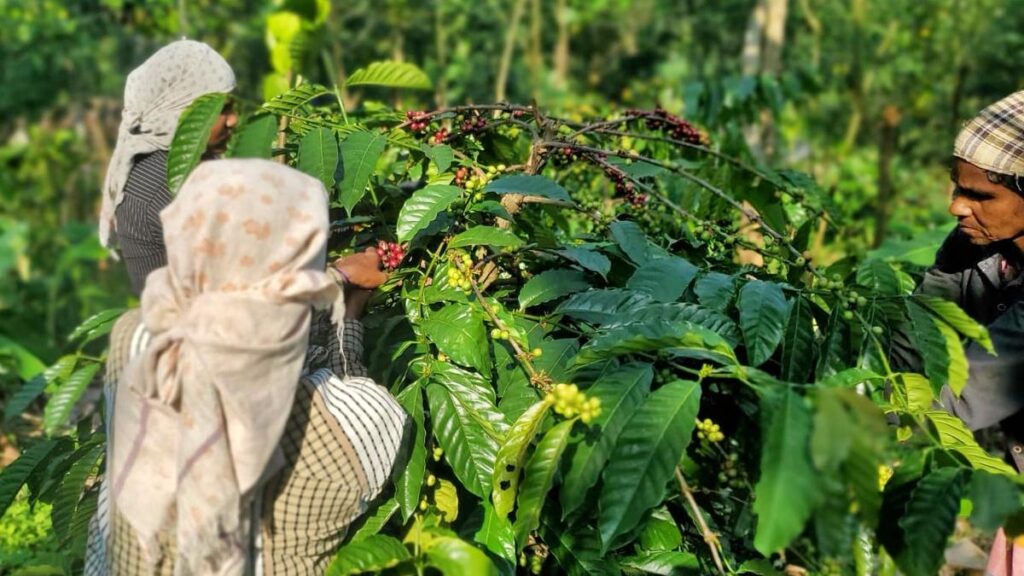
Farm workers harvesting coffee beans at a plantation in Wayanad district of Kerala. | Photo Credit: E.M. MANOJ
The robusta coffee farmers in south India are jubilant post-harvest with their produce fetching an all-time high price.
The farmgate price of raw robusta coffee berries touched a record ₹172 a kg in Wayanad market on Saturday, as against ₹115 a kg during the corresponding period last year. Meanwhile, spot price of robusta coffee beans stood at ₹315 a kg, up from ₹210 during the same period in 2023. The price was ₹80 and ₹145 a kg for raw berries and beans respectively in March 2022.
Though the harvest is almost complete, there has been a huge shortfall in the supply of coffee to the market this year, thereby contributing to the increase in coffee prices, says sources.
Multiple factors
“We expect a decline of 30% in the production of robusta this year owing to climatic vagaries, especially the scanty blossom shower in robusta growing regions last year,” sources said.
A sharp decline in production of robusta coffee — nearly 2 million bags — in Vietnam, a major Robusta coffee growing country, has also attributed to the increase in price, the sources added. Robusta coffee production in Indonesia too dipped sharply this year, the sources added.
Notably, the price of Arabica variety of coffee has dropped below the price of robusta coffee. The farmgate price of the Arabica variety coffee was ₹305 per kg on Saturday. Though the Arabica variety always fetched a premium price in the market, it is the robusta variety that is witnessing an increase due to its low availability for the first time.
Farmers suspect that the production may decline by 25% to 30% next year too owing to a dearth of backup showers in many robusta coffee growing areas in the country.
Wayanad in Kerala, which is the largest robusta coffee producing district in the country after Coorg in Karnataka, received a rainfall of 29.3 mm in the first week of January. Major parts of the district received no rain since then.
The January showers helped in the blossoming of robusta coffee plants, farmers say. But the absence of backup showers, a major factor in the formation of berries, is a concern.
According to Coffee Board of India, the total production of coffee in the country during the 2022-23 fiscal was 3,52,000 tonnes, including 2,52,000 tons of robusta coffee.
source: http://www.thehindu.com / The Hindu / Home> News> India> Kerala / by E M Manoj / March 24th, 2024
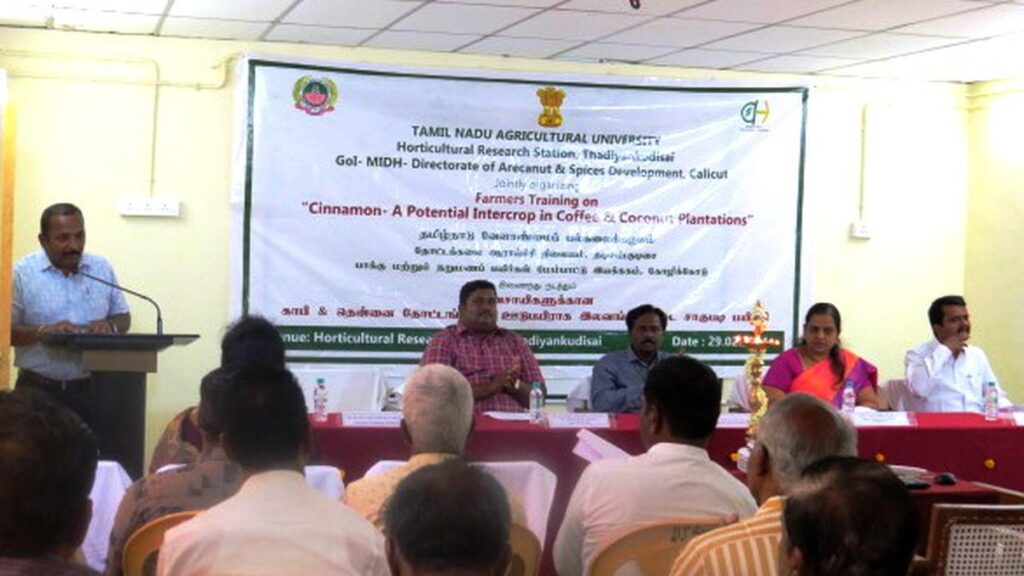
A conference on raising cinnamon under way at Horticultural Research Station, Thadiyankudisai, on the Kodaikanal hills. | Photo Credit: HANDOUT
India imports 30,000 tonnes of cassia and 1,200 tonnes of true cinnamon (Cinnamoum verum), a medicinally important tree species of subtropic regions, annually costing a foreign exchange of 850-1,000 crore rupees. With a view to tap the potential of true cinnamon cultivation as an intercrop in coffee plantations of lower Palani hills and coconut gardens on the foothills of western ghats, a one-day conference was organised at Horticultural Research Station, Thadiyankudisai on the Kodaiknal hill range, in Dindigul district under the Mission for Integrated Development of Horticulture (MIDH) scheme on February 29.
J.Rajangam, Dean, Horticultural College and Research Institute, Periyakulam, who inaugurated the conference, said India produced only 57 tonnes of cinnamon against 3.7 lakh tonnes of global production. Cinnamon can be raised as one of the remunerative companion crops of coffee to yield additional income for farmers. Advanced cultivars suitable for coconut and coffee growing tracts. He also pointed that, timely
adoption of improved techniques for bumper cropping and scope for export.
S.Senthil Kumaran, Assistant Director, Spices Board, Bodinayakkanur, said that though India exported cinnamon valued at Rs. 67.40 crore during 2022-23, the imports were valued at Rs.72.16 crore. He highlighted the scope of cinnamon cultivation and export promotional activities offered by the Spices Board of India.
M. Jayakumar, Deputy Director of Regional Coffee Research Station, Thandikudi, spoke on the importance of cinnamon in profitable coffee farming under multi-tier cropping system.
source: http://www.thehindu.com / The Hindu / Home> News> India> Tamil Nadu / by The Hindu Bureau / March 05th, 2024
MLAs want encroached lands to be leased to large holders and sanction land to small holders
Bengaluru:
Encroachment of Government land by small coffee growers in the coffee-growing regions of Kodagu was discussed in the Legislative Assembly yesterday, where Virajpet MLA A.S. Ponnanna appealed to the Government to permanently sanction the lands to their names as they are actively cultivating crops on those lands.
Participating in a discussion on the subject, Ponnanna said that small growers in Kodagu who are cultivating coffee and other crops in two to three acres of land are facing numerous problems.
“In certain areas, small coffee growers find themselves surrounded by large private plantations, with Government land in between that has been encroached upon. According to the law, land can be leased out for up to 25 acres. Large Government lands encroached upon by major growers should be leased out by the Government,” he said.
“However, small-scale growers, who only have two to three acres of land and have encroached upon small portions of Government land, require a permanent solution. The Government should sanction the encroached land in their names to provide them with a permanent relief about their holdings,” Ponnanna explained.
Earlier, Sakleshpur MLA ‘Cement’ Manju mentioned that during the tenure when R. Ashoka served as the Revenue Minister in the previous BJP Government, a decision was made to lease the encroached Government land to coffee growers for a duration of 30 years. Unfortunately, due to a change in Government, this decision was not put into action. Therefore, he urged the Government to resume the process of leasing the land for a period of 30 years.
Later, Madikeri MLA Dr. Mantar Gowda raised questions regarding why the BJP Government did not implement the leasing of land to coffee growers for 30 years. He emphasised the importance of discussing pending applications, particularly the 53rd and 57th applications, which have been awaiting decisions for 20-25 years.
He expressed satisfaction with leasing the land to Race Courses and Clubs for 30 years and wanted similar leasing to coffee growers to get permanent ownership by approving the 53rd and 57th applications. He cautioned that leasing land for 30 years could lead to future problems for the growers and suggested considering leasing the land for 99 years instead.
Intervening in the discussion, Speaker U.T. Khader said approval of land up to 3 acres for the poor could offer a permanent solution to the issue at hand.
At this point, Dr. Mantar Gowda’s father, A. Manju, who is also the JD(S) MLA from Arkalgud, intervened, questioning why the Government was hesitating to lease land to farmers while providing it for Race Courses, Resorts and Clubs.
“Why there is a delay in approving the land lease when it comes to farmers? The law prohibits leasing out land for more than 30 years. Can you take back encroached land from cultivators? It is not possible. I suggest leasing out the land to encroachers. This way, the Government would earn revenue and the lessees would benefit as well. They would also help conserve forests and contribute to the environment, he added.
Later, MLA A.S. Ponnanna spoke, urging to sanction the encroached land for small-scale coffee growers as well as to provide land for lease to large coffee growers.
What are 50th, 53rd and 57th applications?
The Bagar Hukum system, established by the State Revenue Department, requires applicants to submit Form 57 for the legalisation of agricultural land.
The Bagar Hukum scheme traces its origins back to 1980 when the Government allocated two acres of land to landless farmers for agricultural activities. However, the beneficiaries of this scheme did not receive the title deed for the land they cultivated.
Subsequently, applications were invited in the forms of Form 50 (1991), Form 53 (1999) and Form 57 (2018) under the Karnataka Land Revenue Act, 1964. The application window extended until April 2023, exclusively for those who have been engaged in cultivation for the past 15 years.
According to Madikeri MLA Dr. Mantar Gowda, who raised the issue in the Assembly, all the applications received in Form 50, Form 53 and Form 57 are pending since the last 25 years. If these applications are approved, growers can gain permanent ownership over the land.
source: http://www.starofmysore.com / Star of Mysore / Home> News / February 23rd, 2024
Coorg district, Karnataka, famed for its greenery, faces severe water scarcity. Kushalanagar taluk, hit hardest, endanger both humans and wildlife. Shrinking water sources force wild animals into villages, disrupting livelihoods. Forest officer Ratan Kumar highlights the need for contingency plans amid the crisis.
Coorg district in Karnataka, renowned for its lush greenery and diverse wildlife, is currently grappling with a severe water crisis. As the region experiences a prolonged dry spell, both human inhabitants and wild animals are facing acute shortages of drinking water.
Kushalanagar taluk, In particular, nestled amidst semi-mountainous terrain, has been hit hard by the relentless absence of rainfall. The dire situation has led to concerns not only for the local populace but also for the myriad species of wildlife inhabiting the area.
Covering a vast expanse of 24,278.88 hectares, the forests of Kushalanagar Zone, including reserves like Dubare and Anekadu, are home to a rich assortment of animals and birds, including tigers, leopards, elephants, deer, and sambar. Traditionally reliant on water sources such as the Kaveri River, Chiklihole Reservoir, and Harangi Reservoir, these creatures now find themselves confronting parched landscapes. The Kaveri River has dwindled to a mere trickle, while the Chiklihole Reservoir stands desiccated, leaving behind barren canals.
Within the forested areas, a handful of lakes remain, albeit with diminishing water levels. The scorching sun, with temperatures averaging between 29 to 30 degrees Celsius, poses a grave threat as it hastens the evaporation of these remaining water bodies.
The repercussions of this water scarcity extend beyond the confines of the forests. With wild animals compelled to seek sustenance elsewhere, instances of encroachment into nearby villages and coffee plantations have surged. Farmers, reliant on these plantations for their livelihoods, now face disruptions in their daily activities, compounded by labour shortages as workers are deterred by the unpredictable presence of wild animals.
Responding to inquiries, Ratan Kumar, the Forest Officer for Kushalanagar Zone, maintains that there is no immediate shortage of water within his jurisdiction. However, he acknowledges the pressing need for contingency plans should the situation worsen.
source: http://www.newsable.asianetnews.com / Asianet Newsable / Home> English News> Karnataka / by Vinay Kumar Patil / February 20th, 2024
Unique rural wedding: Peepal tree and gooseberry sapling united in matrimony for village welfare.
A peepal tree and a gooseberry sapling being married off at Kadagadalu village of Madikeri taluk on Monday
Madikeri :
Hundreds participated in a unique wedding ceremony hosted in the rural part of Kodagu. A tree and a sapling were wedlocked in a spiritual matrimony as the residents prayed for the welfare of their village.
A peepal tree and a gooseberry sapling were married off in a ritualistic ceremony at Kadagadalu village of Madikeri taluk. The rituals were hosted for the welfare of the village under the guidance of a priest from Kasaragod district. The wedding ceremony was organized by the Botlappa Youth Association of the village.
The association was established in the village in 1993. As it completed 10 years in 2003, the members planted a peepal tree in the village premises as it was bestowed a spiritual status, the association members shared. In 2012, as per the advise of an astrologer, they carried out a thread ceremony for the peepal tree when it turned nine years old. The astrologer had also suggested that the tree be married when it turns 21 years.
It is believed that deities Vishnu, Shiva and Brahma reside within the Peepal tree, which is associated to great sacrosanct values in rural areas. While Peepal tree was personified as a groom, a saree was draped around the gooseberry sapling and ‘kanya dhana’ and other rituals were observed in par with the Hindu wedding.
source: http://www.newindianexpress.com / The New Indian Express / Home> Karnataka / Express News Service / February 06th, 2024
Revenue Minister Krishna Byre Gowda chairing a meeting of his department in Madikeri on Monday. | Photo Credit: SPECIAL ARRANGEMENT
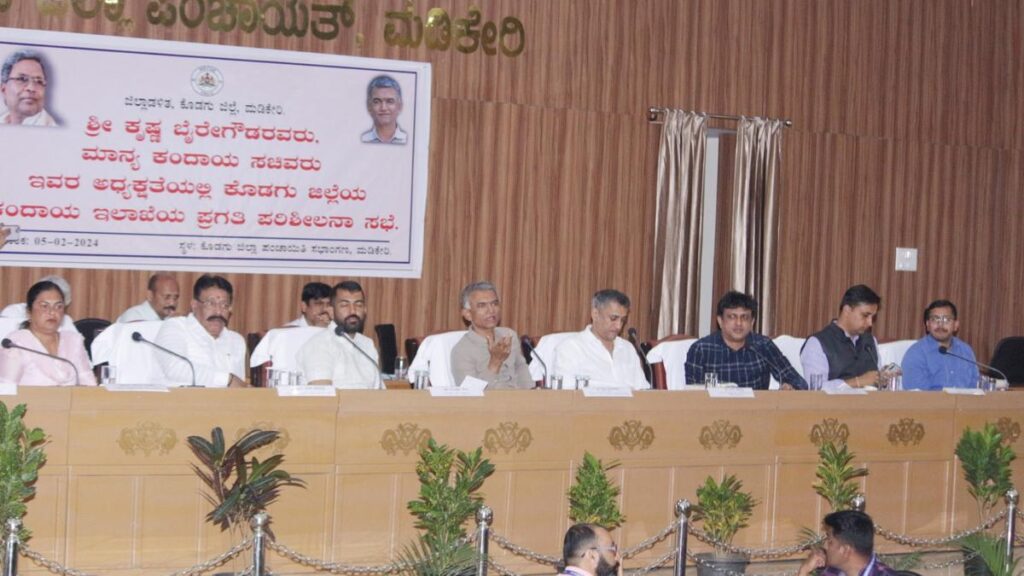
Minister for Revenue Krishna Byre Gowda on Monday asked the district administration in Kodagu to conduct a survey of Jamma Bane land in the district. The survey was pending for many decades and the Jamma Bane landholders needed a pahani (RTC). In this connection, the authorities have to take steps for conducting the survey, he added.
The Minister was speaking during a meeting in Madikeri in connection with various issues concerning the Revenue Department. The Revenue Department related works were also reviewed by the Minister.
Since the Jamma Bane land holders do not have RTCs, they were not getting loans from banks and also facilities from the government. The people engaged in farming need to be given the RTCs. Therefore, the survey work has to be taken up, the Minister told the officers in categorical terms.
As many as 25,000 people in Kodagu are engaged in agriculture in Jamma Bane land. The land was in the name of one person in the land holder’s family. Others in the family also needed RTCs. So, survey of the land holds the key, the Minister argued.
If there was any dispute in connection with the land, the survey can be taken up directly of the respective land. The matter can be placed in the gram sabha and a solution can be found with the help of the local villagers, Mr. Gowda suggested.
The Minister said the Jamma Bane land survey has to be taken up on a war-footing, and added that the tahsildar and the assistant director of land records have to expedite the work, roping in additional surveyors for the tasks.
The Minister said the latest gadgets will be provided for the survey work. The licenced surveyors can be used for the task. The work has to be completed at the earliest, the Minister told the district administration.
A report can be prepared (after the survey) for addressing any issue over the land. Thereafter, an order from the government will be issued for issuing the RTCs, Mr. Gowda said.
A permanent solution has to be found to the issue as the government was committed to providing additional surveyors and the gadgets for completing the survey work.
He advised the officers to overcome the opinion that the Revenue Department and the Land Records Department were different. This is a joint survey which needs to be done by both the departments, Mr. Gowda asked.
The tahsildars, deputy tahsildars, village accountants, revenue officers, assistant commissioners and all in the department have to work as a team and get the survey done. The government hoped to extend facilities to Kodagu farmers and sanction relief. In this regard, the problems need to be addressed at the earliest.
The first instalment of crop loss relief has to be given to farmers in the district. If any names are missing, they will be incorporated and relief will be extended to them too.
The Minister told the authorities not to mismanage the drought funds and drinking water needs to be provided to all the households during summer.
MLAs Mantar Gowda and A.S. Ponnana were present.
Deputy Directors of Land Records Srinivas said Kodagu has 24 licensed surveyors besides 15 government surveyors.
Tahsildar Praveen Kumar said there have been disputes with regard to the Jamma Bane land. While the cases are being settled in some places, the parties are not coming forward in some places for settling the disputes.
source: http://www.thehindu.com / The Hindu / Home> News> India> Karnataka / by The Hindu Bureau / February 05th, 2024
I have been to many places in all continents except Antarctica and South America, but I think the most beautiful place in the world is Kodagu (also known as Coorg).
Maybe it is because my ancestors came from here and as they say:
There is no place like home.
In the old days of my grandfathers time (before Independence), everybody made a living growing organic rice and organic oranges.
In fact they never even called it organic farming, they just called it farming.
It was the only method of farming they knew and it was handed over to them by their ancestors who followed it for millennia before the introduction of the “wonder” of the FUKUS inspired “Green Revolution“.
People also had cows and sheep and goats.
Coffee was still an unknown and little explored crop.
Only the wretched FUKUS colonists were practicing large coffee and tea plantations.
The common people of Kodagu had no knowledge or interest in coffee plantations, and were more concerned with organic paddy and organic oranges which they simply called paddy and oranges.
In fact my grandfather paid Rs 5000 in the 1930s to buy paddy fields that could have fetched him a 500 acre coffee estate today.
Kodagu paddy was world class and gave rise to many local rice mills which flourished and exported rice all over South India especially to Kerala.
Kodagu oranges were famous all over India.
The independence, grace, beauty and vivaciousness of Kodava women is also well known and remains true even to this day.
Kodava soldiers were famous all across India and this remains true even today.
The first Bharatiya general of the newly independent Army of Bharat was a Kodava General KM Kariappa.
Many Kodava boys dont join the Army anymore.
Most of them aspire to be work as software engineers for IT/BT coolies and then go to America on H1B visa and then work their way to a green card and enjoy the American “dream” which actually still remains a dream even in America and does not ever come to reality.
The British introduced coffee and pepper to Kodagu.
To establish these plantations, they destroyed multiples of a hundreds of thousands acres of pristine forests.
The Kodagu of the old days was not such an idyllic place though it was a place of great natural beauty and still remains so.
There were Nayakas first ruling Kodagu.
These were tribal chieftains who were Kodavas.
There were frequent wars between the Nayakas.
In fact many old settlements in Kodagu were fortified and had moats or huge earthen walls.
There were no banks in those days and people buried their wealth in their farms or their Nayakas farm to protect from grabbing by the other Nayakas.
There is a lot of hidden treasure in Kodagu.
One fault of the not just the Kodavas, but all people of Bharat is that they can never accept one from their own community as their leader.
So the Kodavas were gradually conned into accepting Haleri Rajas as their king.
Just like the rest of Bharat were gradually conned into accepting the British as their rulers.
Some of the Haleri Rajas were good but the last batch of them were dumbass tyrants.
They had many spies and were whimsical and killed people at their whims and fancies.
If they found a Kodava leader against them or even had the slightest unfounded suspicion, they would behead him in public and string up his body, kill all the male members, burn his house, confiscate his lands, and capture his women and then make these women marry the Poleyas, the traditional lower caste servants in Kodagu.
Tipu Sultan also invaded Kodagu and was repulsed by divine intervention by honeybees that chased him out of a Shiva temple (Male Sartav) he planned to attack.
So he conned 60000 Kodavas to come unarmed to a peace meeting at Devati Parambu, and then poisoned their food and captured and converted many of those left.
Thanks to Tipu, Devati Parambu became the Auschwitz of the Kodavas.
Never mind the genocide at Devati Parambu, a “freedom fighter” deserves a state holiday even in the region he committed genocide in.
People think Tipu Sultan fought against the British for the freedom of Bharat.
This is a fallacy.
He was not fighting for the freedom of Bharat, but just for his kingdom.
Like most Bharatiya kings fighting each other, Tipu Sultan fought against many Bharatiya kings too.
And he took the help of French colonists to do this.
In fact there was no such thing as Bharat after the fall of the Ashokan empire, which also owes its illustrious origins to the wisdom and inspiration of Kautilya.
Bharat was just a bunch of kingdoms fighting each other, mainly for greed of land, wealth and power.
Fighting over religion was not the main reason.
It was an added bonus, but it would never have occurred if the kings were not first interested in greed for land, wealth and power.
Coming back to Tipu Sultan, in addition to Kodavas , he also fought against Marathas, Mallus and Mangaloreans.
He forcibly converted his war captives to Islam and committed many war crimes and genocide against his captives and his defeated enemies.
After Tipu Sultan was defeated, back came the Haleri Rajas and they got crazier and more tyrannical by the day.
So the British decided to invade Kodagu and kick out the Raja.
Both my Mom’s and Dad’s families fought on the side of the Raja.
The British bribed the Rajas generals, Apparanda Bopu Diwan and Cheppudira Ponnappa Diwan to switch sides and this helped the British win the war.
Masti Venkatesha Iyengar has written an excellent book called Chikaveera Rajendra covering this critical period in Kodagu history.
The book is available only in Kannada since the English version is now out of print.
G Richter has also written an excellent book on Kodagu :
Manual of Coorg: A Gazetteer of the Natural Features of the Country, and the Social and Political conditions of its inhabitants.
As it happens in any war, the winners take all especially from the losers.
So the families that sided the British did well and those that opposed the British had their lands take from them and distributed to the British supporters.
The saying is that those that sided with the British got Umbli(Jagir lands), and those against the British got Kambli (blankets to cover them when they cut the lantana bushes).
There were also many Kodavas who became wannabe British Coconuts, and some of them even converted to Christianity and many of them adopted British names.
Guddera Appaya was from our village and a neighbour of my Dad’s family.
He led the first war of rebellion against the British.
Kodavas and Gowdas are the traditional land owning families in Kodagu.
These Gowdas are not Fumble Harmer type rude and crude Gowdas, but more cultured Gowdas from South Kanara.
Actually even the Gowdas were later imports.
Kodavas were so busy fighting and killing each other, that their lands became neglected and so they invited Gowdas from Sulya to help them maintain their lands.
The genocide done by Tipu Sultan also contributed to the reduction of the Kodava population, which also led to more Gowdas being invited to Kodagu.
In fact Kodagu was bigger than it was today.
It extended to Sulya and Periyapatna.
Kodavas and Gowdas got along much better in the old days.
Today there are sectarian forces trying to divide the Kodavas and Gowdas.
The land holding system of Kodagu is unique and must be followed all across Bharat.
Here, family property(Jamma land) cannot be sold without the consent of the other members of the family.
Only self earned or Sagu property can be sold without the consent of the family.
All members of the family have a right to Jamma Land.
Kodavas still remain a tribal and agricultural people with regard to our festivals and naad nammes(village festivals).
Animal sacrifice is still practiced in many naad nammes.
I went to the Tere festival on the second day of our Naad namme when I was a small child (I was about 7 or 8 years old) and have never gone to the second day Tere festival since.
The possessed person who is talking to God, drinks bottles of neat raw alcohol, walks barefoot on hot coals, cuts off the heads of live chickens and pigs and drinks their raw blood
It is a most interesting sight to see if you have a strong stomach.
Kodavas are born and raised with guns and swords and we worship our guns and our traditional swords.
There are many mysteries of the origins of the Kodavas.
But some knowledgeable people like Lt Col KC Ponnappa say that we have Kurdish origins and that we are part of Alexanders army from the Kurdish areas that he had conquered before coming to Bharat.
Lt Col KC Ponnappa wrote an excellent book A Study of the Origin of Coorgs which is now out of print.
An even more interesting theory has been put by Mookanda Kushalappa that we that we have links with the Yazidis.
That means like the Yazidis, Kodavas may also have originated from Mittani.
But I have talked to Kodavas who have been to Kurdistan, and they say there is no doubt that Kodavas have come from the area of Kurdistan in the manner of our looks, dress, some cultural terms matching the local Kurds.
Obviously religions practices and customs have changed significantly, since the whole Middle East is now a Muslim area, whereas Kodavas predated the Islamic Era.
One of the few still existing pre-Islamic tribes still in Kurdistan are the Yazidis.
And from what little I know of the Yazidis, they also worship Subramanya like the Kodavas.
Like the Kodavas, the Yazidis also worship 6 male Gods of Nature and one female Goddess of Nature as their main Gods.
I am not sure if the Yazidis are also ancestor worshipers like the Kodavas.
Of course, since the Yazidis happened to have the misfortune of retaining their culture in an otherwise Islamic region, that too with the most puritan and hardcore form of Islam, they are considered as “devil” worshipers.
Horrible crimes against women and genocide against women was committed against the Yazidis, by the real devils – ISIS – that most memorable bunch of cowardly mask wearing semi-literate, perverted, sadistic, sex starved thugs, with a fondness for Toyota trucks, guns, sex slaves, young boys, young girls and sheep.
I would not be surprised if the Kodavas traced their roots, it had some link back to the Yazidis.
I have seen many common things between the people of the Middle East and the Kodavas.
Both have treasure boxes called Sanduka, both men wear vastras (bandanas), both carry daggers and both have a fondness for hunting.
Maj Gen Codanda K Karumbaya, SM (Retd) has written a very interesting article about Kodagu – Kodavas through the Ages.
There is a very long but nice video about the Kodavas.
Youtube
Now Kodagu is changing for the worse.
Today most farmers in Kodagu gain most of their income from coffee and pepper.
The old ways of organic oranges and organic paddy is lost.
This has serious implications for Kodagu farmers who have only concentrated on growing coffee and pepper, a lot of which is exported.
Coffee and pepper are now globally traded and their price is fixed by the global market and we have to compete with other global suppliers.
If there is a fall in commodity prices because of the currently failing global economy, a lot of farmers in Kodagu will be in trouble.
This had happened earlier in the mid 1990s.
The price of coffee fell and people sold their estates and found jobs in Bangalore.
In fact my cousin told me it was so bad that even the banks stopped repossessing the cars of car loan defaulters in Kodagu because the banks had no place to park so many repossessed cars.
In the 1940s, paddy was sold for Rs 3 a batti (65 kgs)and 10 grams of gold was Rs 45.
So basically in the 1940s, 975 kg of paddy bought you 10 grams of gold.
Today 975 kg of paddy (9.75 quintals) will sell forRs 14600 or 4.85 grams of Gold (@Rs 30000/10gm of gold and Rs 1500/quintal of paddy as of 5/5/2017).
As you can see it is not profitable to grow rice anymore and that is why the Kodagu farmers have shifted to coffee and pepper.
Farmers all over the watershed areas of the Western ghats (Kodagu, Malenad) the sources of two major rivers the Kaveri and the Thunga are abandoning the cultivation of rice and letting their fields fallow or if they are near tourist spots and towns, they are converting their paddy fields to resorts and sites.
If you ask any specialist in rain water harvesting and ground water recharging, rain fed and river overflow flooding based organic paddy cultivation is very nature friendly and helps a great deal in maintaining the water table not only in the surrounding areas, but more importantly in the rivers.
It also is a source of support for wonderful fauna like koile meen (a small tasty fish), crabs, frogs and other things.
This also provided the base for a wonderful feast of traditional Kodava food.
It also minimizes serious flooding and controls flash floods.
This abandonment of traditional rain fed paddy harvesting has dangerous implications for the Kaveri and Thunga rivers and will finally affect the Mandya farmers and IT/BT Coolies and Builder/Real Estate Mafia in the Silly Con City.
IT/BT/SEZ coolies and Real Estate Mafia in the Silly Con city, playing in their infinity swimming pools and golf courses which have sucked out all the groundwater in the Silly Con city, will not understand the importance of Kodagu.
Kaveri RiverOn the banks of the Kaveri River
The Kaveri River, the holiest and most life sustaining river, the Ganga of the South, originates in Kodagu.
If Kodagu is infiltrated by the black money builder and real estate and resort mafia as it is rapidly happening now, the Kaveri river will cease to exist in 10 years.
I have personally seen the effects of this decline of the Kaveri in Coorg.
In my dads days he said that even in the peak of summer if you wanted to cross the river at my place, it came up to his chest.
Now even my 6 year old nephew can wade across the Kaveri river at my village.
Can you imagine what would happen to not just the Silly Con City , but entire South India if the Kaveri River ceases to exist?
With increasing interest as a tourist destination, a lot of outsiders with black money from the Silly Con city, Tamil Nadu, Andhra and other areas are investing in Kodagu.
These outsiders have no respect for the traditional culture, heritage and environment of Kodagu.
They are only interested in financial return and speculation.
They want to make money in the fastest way possible even if it means destroying a pristine environment that had lasted for millenniums and which is the main source of the Kaveri River.
They are converting paddy fields into resorts and sites, and building villas in coffee estates by cutting down the priceless natural forests.
This has raised the land prices in Kodagu and encouraging locals also to cut their trees and convert their lands to layouts and resorts.
Deverakadus (Gods forests and sacred groves) are being encroached upon.
This is mainly because of selfish Representative DFI’s who are more interested in vote gathering than saving Deverakadus.
They promise free houses to ever willing so called “deprived” classes and even outsiders and even illegal immigrants from Bangladesh, and destroy Deverakadus to build these houses.
Kodagu used to be a separate state.
If the Kaveri River is to remain as the river as it was known and still have some hope of continuing to provide sustenance to the whole of South India, Kodagu must become a separate state again with strict land laws like Himachal Pradesh.
Currently only the Kodavas are agitating against a separate state and they have a very parochial agenda of only the Kodava people.
There are many other traditional communities living in Kodagu.
If Kodagu is to become a separate state all the traditional communities living in Kodagu, not just the Kodavas and Gowdas, but even the Poleyas and Kurubas should have a say in the running of Kodagu.
In fact, in the entire Western Ghats, the Gadgil Committee report must be implemented.
I have read the Gadgil Committe report.
However there are some flaws in the Gadgil Committee report, not in the main list of activities but in the regulated list.
Looking at this report, I think like all Committee reports, especially those devised by University professors, the Gadgil committee report also gave more weight to University Professors academic recommendations instead of including the ground realities faced by the local people on the ground.
If the report really has to be implemented, it must first take into account the ground realities faced by farmers on the ground.
Most farmers do not have an opposition to the banning of the main list of activities.
However a lot of them have opposition to the list of regulated activities.
Even minor current day farming practices like building farm roads and digging ponds and drawing electric wires through their farms come under the cover of regulated activities.
It is very easy to say regulated activities, but considering the corruption in Bharat, any regulation is just a means for officials to take bribes and a drain on residents who are forced to give bribes to break the regulations.
However if the above flaws are corrected, the Gadgil Report is most ideal because it primarily calls for local participation by ordinary informed, enlightened and selfless local people to implement this report.
It is the selfish vested interests of devious Dalal Street Pimp/Lala Businessmen and Representative DFIs, and ignorant self proclaimed middlemen of God, who incite the ignorant locals in these regions to protest against the Gadgil Report.
A country road in Kodagu
Here is article in the Hindu by Professor Gadgil himself slamming the ignorant Kasturirangan report.
Land should only be purchased among locals in Kodagu or those who have roots in Kodagu or have stayed twenty five years in Kodagu or those outsiders who will practice only traditional organic agriculture of Kodagu and provide permanent agricultural employment to 1 labourers/5 acres.
New land purchase must only be used for agricultural, plantation or forest conservation use.
No new land purchased any be converted from agricultural or plantation use to non agricultural use.
No further forest land should be converted to any other use.
All previously encroached forest lands must be taken back and converted back again into forests.
The forests should consist of actual forest trees which traditionally existed in the area, not teak and commercial plantations that our so called government “forest” “conservationists” and authorities consider as “forests”.
Forests are for the benefit of Nature, not for the benefit of man.
So the trees and vegetation that benefit Nature and animals only should be planted.
Instead of just planting Silver Oak, planters should be encourage to plant other forest trees on their land on the condition that they can cut it and sell it after 25 years.
Bamboo plantations must be planted along all river banks to discourage sand mining and also to encourage water recharging and river rejuvenation.
Further subsidies and incentives should be given to encourage local landholders to preserve their lands as forests and sanctuaries.
If one wishes to purchase land just for conservation of nature and environment and will not sell it for hundred years they also should be able to purchase land.
No ecotourism projects should be allowed for outsiders, non Kodagu residents, corporates and large outside investors in any form, even joint ventures and joint developments.
If it is found that a local is benami fronting for an outsider or those who do not have roots in Kodagu, then the property should be confiscated and an amount of 5 times the project and investment cost must be recovered from the outside investor and 2 times the land cost must be recovered from the local who benami fronted the project.
If they cannot pay the above amounts, then their other assets should be seized and auctioned to recover the amount due.
Minor ecotourism projects can be allowed for locals who have stayed there at least 20 years, but all these ecotourism projects must first get government approval and then approval from the local village panchayat and gram sabha.
Conversion of agricultural and plantation land and purchase of such land (greater than 0.5 acres) in Kodagu must be strictly regulated and discouraged and taxed heavily if it is converted to resorts and villas.
This is especially for areas more than 2 acres, and for areas that previously had at least 30% tree cover on them and were more than 1 km from any town limits.
Built up area of these resorts must not exceed 1% of the land area or a maximum of 1/2 acre for the entire plot.
This should especially apply to non locals who purchase this sort of land to convert it.
In any case, exempting current residential areas, not more than 0.05% of the area of the Kodagu district and entire Western Ghats and other environmentally sensitive areas, should be allowed to be further conversion for any purpose other than residential use.
Also the residential use will be on the condition that the property converted to residential use must be occupied as a primary residence within 5 years after date of conversion to residential use.
The residential Floor to Area (FAR) ratio should be a maximum of 1 subject to a maximum of 8000 sqft per acre with a maximum area of 1 acre per farm upto 100 acres and 3 acres per farm upto 500 acres and 4 acres per farm above 1000 acres.
This includes all labour quarters and farmhouse and other residential purposes.
In addition an area can be used for livestock of upto 10000 sft/acre upto a maximum of 1 acre per farm regardless of the size of the farm.
Paddy fields should not be left fallow.
Deverakadus must be strictly protected and rejuvenated.
Tourist resorts especially by outsiders (non Kodagu residents), should not be allowed.
Home stays can be allowed with a maximum of 8 rooms in a joint venture with local residents.
To subsidise and encourage existing local individual Kodagu land holders, especially small and medium land holders to follow the above suggestions, a National subsidy fund must be created by imposing a tax cess on the downstream beneficiaries of Kaveri River.
Even existing local corporate land holders should be given a 40% subsidy if they follow the above practices.
This tax cess will be imposed lightly on the middle class and above residents of the downstream cities, but more heavily on the Real Estate developers, other industries and IT/BT/SEZ/Industrial parks and other such major exploiters and beneficiaries of the Kaveri River, not just in the Silly Con City, but all along the watershed of the Kaveri River.
The above conditions of tax cess and subsidy should apply not just to Kodagu but to the entire Western Ghats and all ecologically and environmentally areas in Bharat, especially the catchment areas of major rivers.
Kodagus still remains one of the safest places in Bharat.
I have seen women walking alone in the dark on unlit roads even at 12 in the midnight.
But nowadays there are reports of single women and old people being attacked when they stay alone in their houses.
This could be because of the influx of outside labour from Bihar, Orissa, Assam, Bangladesh and other places.
I am very worried about the influx of labour from these places.
Most of Assam, Bangladesh, Jharkhand, Bihar and Orissa is very unsafe and some of the people there are of a very violent sort and have very misogynistic and unscrupulous attitudes compared to the traditional local residents of Kodagu.
In fact all over the South , the people are much more disciplined, polite and less misogynistic than the Northern states.
The danger to safety in Kodagu is also because of unchecked and unregulated tourism.
Whenever a place becomes a tourist attraction, there are two sorts of people who land up to see the place:
Families who come to enjoy the place, but can only come on weekends and long holidays.
Third class porkis (rogues or scoundrels), who are usually bachelors and men with bad marriages, not really interested in the beauty of the place.
They just want a quiet and cheap place not to far away from their hometown where they can remain unrecognised and indulge in the most fundamental of perversions that third class porkis are fond of – gambling, drinking and whore mongering.
Unfortunately Kodagu has become a cheap tourist attraction instead of a family destination.
This has also attracted a lot of third class porkis like I have described above and this is changing the previously safe environment of Kodagu.
The poleyas, yeravas and kurubas are the traditional labour of Coorg but they drink too much.
Many people in Kodagu, even rich and educated Kodavas drink too much.
Too much drinking is a curse not just in Kodagu, but entire Bharat.
There is a misconception that Kodavas are “Hindus“.
Kodavas are not “Hindus“.
Most Kodavas themselves have been ignorantly modifying our religion to become more Hindu.
The Kodavas of the old days and even now worship their ancestors and Nature and the mighty Gods of Nature.
The Kodavas and other tribals of Bharat are the true inheritors of the Rig Veda which also mainly worships the Gods of Nature and praises the wonder of Nature.
That is why I like my Kodava community way.
We worship Nature and our ancestors, we have no Gods, we have no priests, we have no Vedas and Shlokas.
Our ancestors and Nature are our Gods.
Worship of Nature, the most sublime gift of Brahman is true worship of God.
When we die, we are cremated and our ashes are spread across the farm or put into a river.
There are no public cemeteries. There are no public grave stones. There is nothing in public. Every memorial is by the families and on their private lands only.
There are only public cremation grounds that too restricted to the clan of the person.
We probably are the only community in Bharat to have Ainmanes.
The roots of Kodavas are very strong, the roots of most Bharatiyas are very strong though the new generation of Bharatiyas is trying hard to abandon their roots and follow the rootless Americans.
A person must have roots.
With roots comes a love for the land and its people, not the love for money.
A person with strong roots will never sacrifice his land and people for the sake of money.
A person with strong roots will realise that the best way to worship our ancestors is to leave to our children what our ancestors fought even with the cost of their lives for to give to us.
There is an old Native American saying:
We did not inherit this earth from our ancestors, We have borrowed it from our children.
Note:
I am not a full blooded Kodava – my mom’s mom was a Keralite Christian Army Doctor – so that makes me 1/4 Mallu Kutti.
My Grandmom and Granddad met at Quetta, Balochistan, before Independence.
They were both serving at Quetta, in the only true bastion of secularism in Bharat, the Indian Army.
Most Keralites and Kodavas I know are very smart and down to earth people.
They are calm and humble, and even if they are well accomplished, they dont talk big about themselves.
This is very unlike almost all of our Representative DFI’s who rigorously follow the saying:
“Chaar Aane Ka Murgi, Bara Aane ka masala” (Four annas chicken, 12 annas masala)
source: http://www.aryadharma.world / Home> Articles / by Dhyan Appachu Bollachettira
District secretary has told officials to prepare proposals for essential works and submit them during the CM’s visit; measures to be taken for securing ‘GI’ tag for Coorg honey.
Siddaramaiah | Photo Credit: File Photo
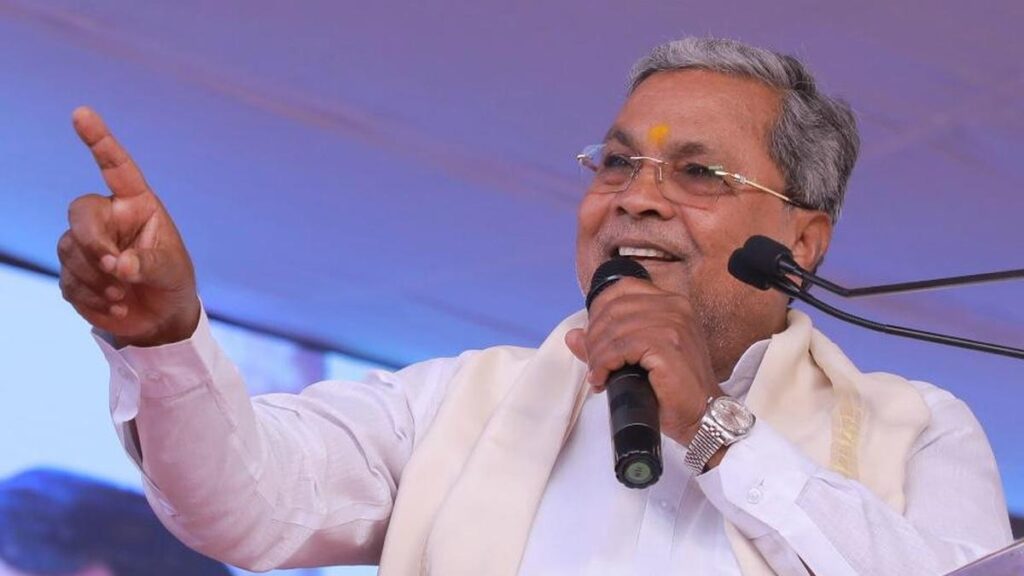
Chief Minister Siddaramaiah will be visiting Kodagu on January 25 to participate in the launch of various development works.
In view of the visit, district officials have been asked to prepare proposals for works that are essential for the district, and submit the reports. In this connection, secretary in-charge of Kodagu district N.V. Prasad held a meeting with officials in Madikeri on Saturday. He also reviewed the progress of various development works.
Mr. Prasad asked the officials to prepare a proposal for establishing a law college in Kodagu as the district currently lacks one.
Under a programme, law graduates belonging to SC/STs will get a financial assistance of ₹10,000 a month for a period of two years. However, no graduates from Kodagu are available for availing the benefit, said Social Welfare Department Deputy Director Shekar. The official brought this to the notice of the Secretary.
When District Surgeon Nanjundaiah said there is no college for physiotherapy courses in Kodagu, the secretary asked him to submit a proposal.
During his visit, Mr. Siddaramaiah will inaugurate a KSRTC depot in Kushalnagar and also launch various development works. The heads of various departments shared details on the programmes scheduled in their respective departments that are going to be launched. Indira canteens will also be launched.
An official from ITDP said Kodagu has 11 ashram schools, nine hostels, one Morarji Desai School and one Eklavya Model School. In total, 1,500 students are studying in these schools. After SSLC, a hostel for the students under ITDP was necessary, he added.
Honne Gowda’s suggestion was considered by the secretary who asked him to submit a proposal in this regard.
He also sought land for landless tribals in every GP.
The deputy director of the Department of Horticulture was asked to explore the possibilities of securing a GI tag for honey that is marketed under the name ‘Coorg Honey’. It’s an initiative of the farmers’ consortium and the matter will be discussed with the group, the DD told the meeting.
The district secretary also collected details on the progress of the guarantee schemes, including Shakti, and others.
source: http://www.thehindu.com / The Hindu / Home> News> India / by The Hindu Bureau / January 21st, 2024
WELCOME. If you like what you see "SUBSCRIBE via EMAIL" to receive FREE regular UPDATES.
Read More »