“During pre-monsoon, I spotted a couple of Giant African Snails on coffee plants and I got rid of them.
Giant African Snails feed on leaves and a branch of coffee plants in Handli village
Madikeri :
With the arrival of the monsoon, coffee growers of Handli village near Shanivarasanthe in north Kodagu are fighting a harmful invasive species. The Giant African Snails have invaded a majority of the estates in the village with coffee growers struggling to rid the estates of these pests.
“During pre-monsoon, I spotted a couple of Giant African Snails on coffee plants and I got rid of them. Now, there is an army of these pests and they are destroying my crops — coffee, pepper vines and plantains,” Suresh Babu, a coffee grower, told TNIE.
The snails feed on stems, leaves and creepers. The farmers rued that the snails multiply quickly and there seems to be no solution in sight to get rid of them. “We are now hiring labourers to remove these snails from the plants. However, this is a disgusting job and we have to pay extra to labourers. A majority of the labourers do not want to take up this task as these snails are slimy,” said Kumar, another grower.
The residents explained that the attacks from these snails across estates have been reported every year during the wet season for five years now. While the government provided some compensation and remedy during the previous years, it is not the case now, said another coffee grower.
“There needs to be a scientific solution to this problem. Coffee Board scientists have to come up with a permanent solution to rid the estates of these snails even as government support to the affected growers is the need of the hour,” concluded Kumar.
source: http://www.newindianexpress.com / The New Indian Express / Home> States> Karnataka / by Prajna GR, Express News Service / June 12th, 2023
Mantar Gowda, MLA, directs the officials to coordinate with different departments to mitigate any extremities in weather.
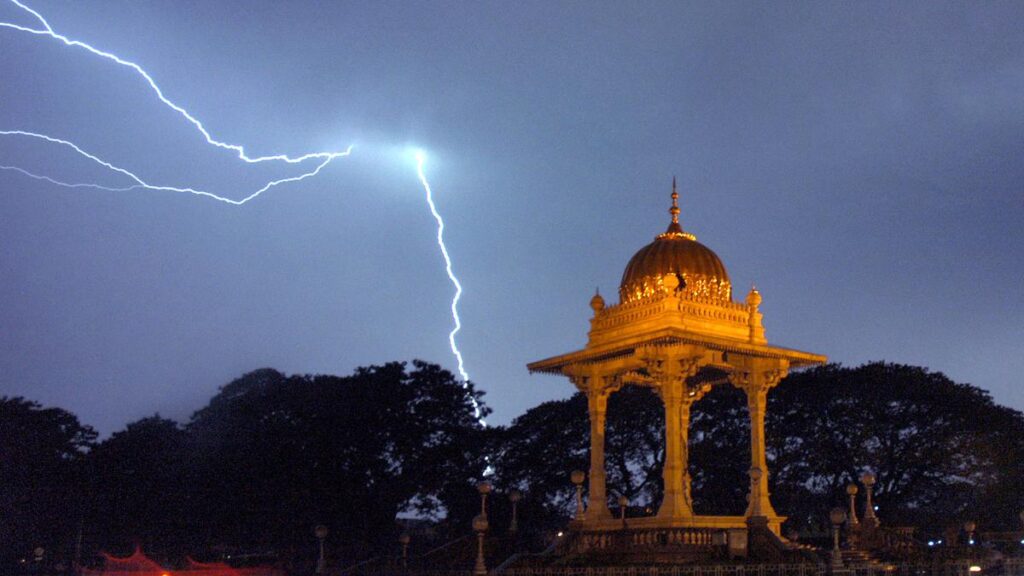
A flash of lightning illuminating the skies in Mysuru. | Photo Credit: M.A. SRIRAM
With the monsoon set to keep its tryst with Kodagu in the next few days, the authorities reviewed their preparations to meet any eventuality.
A meeting was convened in Madikeri on Friday, June 9, and Mantar Gowda, MLA, directed the officials to coordinate with different departments to mitigate any extremities in weather.
He said the revenue, forest, PWD, CESC and other departments should coordinate and ensure that they attend to any problems caused in case of a landslide, uprooting of trees or telephone and electricity poles. The teams constituted for the purpose should reach the affected spots immediately and carry out repairs or any other mitigatory exercise to tide over the crisis.
The MLA said relief centres should be stocked with basic necessities and be equipped to deal with flood victims who could be shifted from their villages.
The officials were also instructed to counsel those affected by floods and infuse psychological strength in them and professional counsellors should be roped in with the assistance of Department of Health.
The nodal officers in charge of different relief centres should ensure coordination among different wings and branches of the district administration, said Mr. Gowda.
The authorities were directed to impress upon the people living in the vulnerable areas to be ready to relocate at short notice. The Chamundeshwari Electricity Supply Corporation (CESC) personnel were directed to ensure that electricity poles that are uprooted are immediately replaced and power supply restored at the earliest. Similarly, the forest department staff were asked to be on alert to clear the roads of any uprooted trees to pave way for traffic movement.
The district health officer was directed to monitor for any outbreak of water-borne diseases during monsoon and ramp up the preparations to handle any epidemic. The Education Department officials were instructed to ensure that no classes are conducted in schools identified to be in dilapidated conditions.
The ZP CEO Shekar said that meetings have been conducted at the Gram Panchayat levels and 19 schools have been identified for conversion as relief centres if need be. The principals of the respective schools will also function as nodal officers, he added.
There is a helpline at every Gram Panchayat and volunteers will also be deployed in case of any emergency, said the official.
Shantilal Jatia, heading the NDRF at Kodagu, said that a team of 24 personnel are stationed in the district and they would be ready for deployment at any time in case of emergency.
source: http://www.thehindu.com / The Hindu / Home> News> India> Karnataka / by The Hindu Bureau / June 09th, 2023
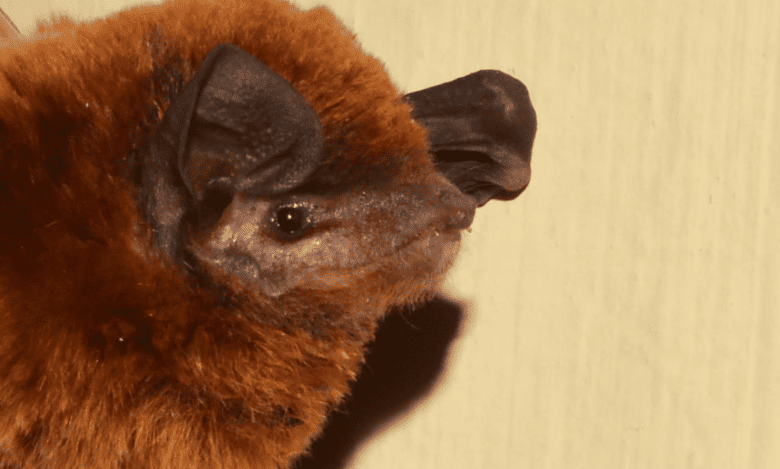
According to the researchers, with the discovery of the new species, the number of bent-winged bats in India has increased from 4 to 5.
OU scientist discovers new species of Bat (Photo: Twitter)
Hyderabad:
Eminent zoology scientist from Osmania University Dr Bhargavi Srinivasulu, along with her son, Aditya Srinivasulu, has discovered a new species of bat from Karnataka’s Coorg.
The mother-son duo have named their discovery, ‘Miniopetrus srinii Srini’s Bent-winged Bat’, discovered in a cave in Makuta of Kodagu district (Coorg).
The research papers were submitted on Saturday and the expert committee cleared the papers and conferred the rare honour.
“We collected the specimens of bats from a large subterranean cave in the dense jungles of Western Ghats in Makuta, we doubted that this could be a cryptic species of bat, which we had tentatively identified as the Small Bent-winged Bat,” said Dr Bhargavi.
Found in southern Europe, Africa, Madagascar, Asia, Australia, New Caledonia and Vanuatu, Bent-winged Bats are small-sized bats that live in large colonies of a few hundred individuals in caves.
According to the researchers, with the discovery of the new species, the number of bent-winged bats in India has increased from 4 to 5.
The specimens of bats were collected from a large subterranean cave in the dense jungles of the Western Ghats in Makuta. The Small Bent-winged Bat is reported from the Nicobar Islands, peninsular India, Nepal and Northeast India.
Talking about the multiple works they undertook in discovering the new bats, Dr Bhargavi said, “Our research on Andaman bats has revealed that the fauna on the islands are genetically different from those on mainland India. We conducted morphological, cranial, echolocation and genetic studies to determine the relationship between the Makuta specimens and others.”
A peer-reviewed scientific mega journal for animal taxonomists named Zootaxa has published the description of the new species that were named in honour of Prof C Srinivasulu, a bat biologist working at the varsity.
source: http://www.siasat.com / The Siasat Daily / Home> News> Hyderabad / by News Desk / May 29th, 2023
Our travel diary from a weekend of bliss at this 125 acre property nestled in the hills of Madikeri.
Baalelle restaurant at The Ibnii in Coorg
Waking up to the sound of birds chirping and the gentle lap of water is what mornings are like at our pool villa at The Ibnii. Turns out we forgot our swimsuit. But a deterrent this is not. With not a soul in sight, except the stunning views of lush green trees that tower up high and coffee plantations in the distance — a 7am dip feels a bit surreal. The air is chilly but the water is warm. Given it is temperature controlled, this is the case even at midnight, we soon discover, much to our delight. For now however, we realise it is our moral imperative to simply soak in the moment. Phone off. Soul turned on. One hundred and twenty five acres of pristine forest land embraces us in response.
Some moments like the one above are suspended in time. While others are steadily threaded into a highlight reel of our days spent at this wellness resort nestled in the hills of Madikeri, Coorg. Right on top of this list is when Priyanka, who is showing us around the property, over a walk, plucks an orange flower and promptly pops it whole, into her mouth. “It’s edible, I eat one every morning,” she says, most matter-of-factly, as though this is as common as a bowl of oats. We are keen to pop a morning flower too! The nasturtium, as it is called, is mild and sweet with an unexpected kick of spice at the end. Definitely our most memorable palate adventure, although the kitchen’s Pandi Curry, comes in a close second.
At the pool villa
Mindful eating To keep waste to a minimum, we find out that this resort has a unique policy — guests need to pay Rs 100 for every 10 grams of food they waste. Bold, but effective we realise, as we find ourselves doubly mindful about what we put on our plate from the buffet. That said, if you do end up paying for food wasted, it is heartening to find out that the funds are donated to an orphanage in Madikeri. Meanwhile, another big surprise is that the drinking water at The Fig, the resort’s multi cuisine restaurant, quite literally comes from the air. We spot a robust air water purifier that does the job in the corner one afternoon, after returning from a relaxing hour spent at the spa. En route, we recall spotting a family of sunbathing monkeys, so perhaps all species at this resort take ‘rest and recharge’ quite seriously.
Forest restoration With an awareness that all natural ecosystems are vanishing all over the world at an alarming rate, the resort has committed a third of its property for the purpose of restoration of forest. Sherry Sebastian, one of the founders of The Ibnii says, “Bringing back a complex ecosystem such as this one within the Western Ghats is a slow process. We have more than 50 species of trees already growing here but the whole understory is choked mostly by coffee plants that are growing densely. We have taken up the mammoth task of selectively removing the invasive plants so natural regeneration can happen.” She adds, “Additionally, this area will be used as a resource to educate our guests about the importance of the natural world.”
Breathe in
■ Electric cars and buggys are used on the property to keep the air clean ■ Guests are privy to a live air quality index monitor at the reception ■ Drinking water at the restaurant is quite literally bottled from moisture in the air with the use of an air water purifier
Kodava lessons A bit of trivia for folks looking at a getaway here soon, apart from nature walks and regional cuisine, you get impromptu language lessons in the local Kodava tongue, courtesy names like Baalelle (banana leaf) for their vegetarian restaurant or Pattole Palome (a collection of Kodava folklore), which is the name of the green building it is housed in. Kaldi Kappee, the resort’s award-winning lakeside coffee shop, however, has been named after the Ethiopian shepherd who discovered coffee beans back in 850 CE. As the story goes, he noticed his goats nibbling on some wild berries, following which they pranced around with more energy than ever, making him curious enough to try the berries himself.
Coffee date While on the subject of coffee, don’t miss the resort’s coffee trail. Ours encompasses the different stages of berries and coffee making and ends with the grand reveal of a prized jar of dried ‘civet poop’. The civet cat better known as the Kopi Luwak roams free on the premises and for conservation purposes, the coffee from their droppings is not sold or monetised. But we do get the unique experience of holding some premium poop in our hands (pre washed of course). And then we’re told to do the oddest thing — shake it. We hold it up to our ear and shake to hear the softest jingle of coffee beans inside.
While civet coffee isn’t available at the resort itself, here’s a golden nugget of trivia for any coffee lover. Apart from those nutty flavour notes, this luxury brew is a great choice for folks who suffer from uncomfortable bouts of acidity. Given that it is essentially pre-digested by the civet cat, you can enjoy your cuppa with no reservations. We have to admit, this coffee date, poop et al, is perhaps one of our most ‘memorable’ and is definitely a change of pace from the Tinder experience.
The Ibnii is a 12 hour drive from Chennai. Accommodation at INR 18,000 onwards.
source: http://www.indulgexpress.com / Indulge Express, The New Indian Express / Home> Travel / by Sonali Shenoy / May 19th, 2023
The passions that have been running high over the Cauvery have eclipsed that the river’s birthplace is in Kodagu district, where it is an integral part of the lives of the Kodavas, but not in terms of drinking water.
Journalist and author PT Bopanna has eloquently spoken about what the Cauvery means to the Kodavas, one of the communities of people who live within Kodagu district. The identity of the Kodavas is deeply linked with the river, which rises in Talacauvery. Ironically, Madikeri city, the district headquarters, frequently faces a drinking water problem.
“The Rs 230-crore Harangi project has been conceived for the benefit of politically powerful Mysore and Hassan districts. Though the Harangi Dam (in picture) is in Kodagu and the major catchment area of the Cauvery is also in Kodagu, the irrigation potential from the project for Kodagu is a measly 607 hectares, out of the 54,591 hectares of total irrigation potential,” Bopanna says on his website Coorgnews.in.
He pointed out that 1,909 acres of land in 13 villages had been submerged by the construction of the Harangi dam in Somwarpet taluk.
“See, we don’t benefit from the Cauvery at all. Every year the river floods and the roads get blocked. We are always inconvenienced by the Cauvery. We just want our basic water needs met, and it’s a small place,” Bopanna says.
Although people are worried about drinking water supply from the Cauvery, Bopanna says that in Kodagu, people are worried more about a larger problem.
“I’m worried about deforestation,” Bopanna says. Falling in the Malenadu region, Kodagu district houses 4,102 sq km of the Western Ghats, making it look as if a green carpet is spread across the land. It is one of the least populated districts in the state.
Referring to the 400kv power line from Yelwal in Mysuru to Kozhikode in Kerala, a distance of 55m, Bopanna said: “This government-sponsored deforestation needs to stop.”
According to some estimates, 55,000 trees will be cut in thick forest areas to set up the line. Activists have alleged that a few thousand trees have been cut in violation of the law.
“When trees were being cut for that power line, not a single politician made any noise. They weren’t bothered. This clearly reveals their short-sightedness and their lack of understanding about the effects of deforestation. Rainfall has become erratic in the region,” Bopanna says.
He advocates a complete ban on tree felling and the conversion of agricultural land for commercial purposes. “But Kogadu’s politicians depend on the timber lobby and sand mining. They have not allowed a discussion on the Kasturirangan report.”
Now he’s worried. Drought-like conditions that occurred only once in five years in the past, are now almost an annual feature. “We need to save the Western Ghats to save the Cauvery (for all of us). That’s the core issue.”
source: http://www.thenewsminute.com / The News Minute / Home> News> Cauvery Dispute / by Aneesha Sheth / September 22nd, 2016
The RTI further revealed that the Bhadravathi forest division in Shivamogga did not spend a single rupee on afforestation since 2015.
The RTI further revealed that the Bhadravathi forest division in Shivamogga did not spend a single rupee on afforestation since 2015. (Representational)
From 2015 to 2022, the Karnataka Forest Department spent Rs 1.98 crore and Rs 49,95,067 on afforestation in Kushalnagar and Bhagamandala forest ranges, respectively. The two forest ranges are located in Kodagu district. The figures were shared by the department in response to an RTI filed by The Indian Express.
The RTI further revealed that the Bhadravathi forest division in Shivamogga did not spend a single rupee on afforestation since 2015.
The amount spent on afforestation includes maintenance of the forests. However, some of the officials within the forest department opined that the forest department should concentrate on afforestation in the drier parts of Karnataka rather than spending crores in the Western Ghats.
“The Western Ghats has many naturally regenerated seedlings. The department should have pumped funds in greening the dry regions of Karnataka like Vijayapura, Raichur, Gadag and Koppal. These regions have less than 5 per cent green cover. Even in the Dakshina Kannada region, a huge amount is spent on afforestation,” a senior Indian Forest Service (IFS) officer of the Karnataka Forest Department said on condition of anonymity. Notably, a response from Dakshin Kannada forest region is still awaited.
Every year, Kodagu faces floods and huge loss of property and human lives.
Amount spent on afforestation in Bhagamandala range
2015-2016: Rs 15,82,293
2016-2017: Rs 3,10,974
2017-2018: Rs 3,66,500
2018-2019: Rs 14,33,305
2019-2020: Rs 4,03,750
2020-2021: Rs 3,02,865
2021-2022: Rs 3,35,720
2022-2023: Rs 2,59,660
Amount spent on afforestation in Kushalnagar range
2015-2016: Rs 11.17 lakh
2016-2017: Rs 12.90 lakh
2017-2018: Rs 24.66 lakh
2018-2019: no data
2019-2020: Rs 27.90 lakh
2020-2021: Rs 66 lakh
2021-2022: Rs 14.47 lakh
2022-2023: Rs 44 lakh
source: http://www.indianexpress.com / The Indian Express / Home> News> Cities> Bangalore / by Aksheev Thakur / Bengaluru – April 30th, 2023
Tourists park by the waterfalls on the Bhagamandala-Karike Road and litter the area with plastic and liquor waste.
A forest checkpost at Karike in Kodagu district
Madikeri :
Not just inter-state, now even intra- and inter-district vehicles will have to pay an entry fee at the forest gates of Nagarahole in Kodagu. The forest department took this step to put an end to the rampant dumping of garbage and littering in forest areas in the district.
Kodagu Chief Conservator of Forests Murthy BNN pointed out that it had become a herculean task for the department to control littering and dumping of garbage in forest fringes. “But after we introduced strict checking and entry fee at Nagarahole Gate, the dumping of huge quantities of waste materials brought from Kerala into Kodagu forests has been controlled,” he said.
Entry fee will also now be collected at Makutta Gate in South Kodagu where garbage was being dumped from Kerala and surrounding areas. To prevent unauthorised parking and littering, the forest department is conducting regular vigil in forest areas that lead to popular tourist spots.
Tourists park by the waterfalls on the Bhagamandala-Karike Road and litter the area with plastic and liquor waste. “This is causing an adverse effect on the wildlife and the department is conducting stringent checks to control this,” he said.
source: http://www.newindianexpress.com / The New Indian Express / Home> States> Karnataka / by Express News Service / April 15th, 2023
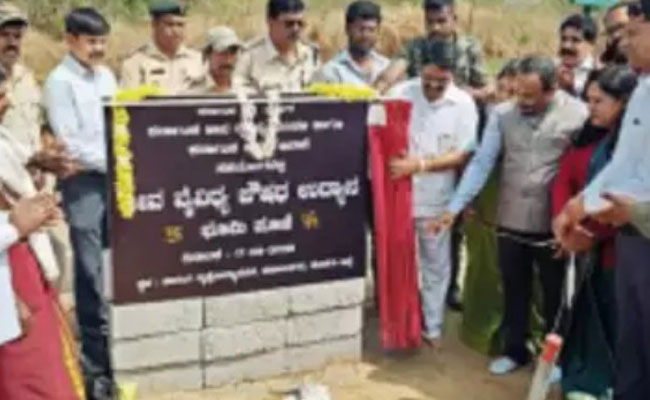
The work to develop the first biodiversity park of the state was launched in Harangi, by laying the foundation stone on Friday.
Legislator Appachu Ranjan, who conducted the ‘bhoomipooja’ for the biodiversity park work, said, “India is the biggest exporter of medicinal herbs. The new park will help us.”
He said that a medicinal herbal park will also be opened in Bhagamandala soon.
“Medicinal plants are needed to cure diseases. Also, the environment will be healthy if there is enough greenery,” he pointed out.
Karnataka Biodiversity Board chairperson Napanda Ravi Kalappa, who presided over the ceremony in Harangi, said that a master plan of building a model medicinal garden in the district was readied by the Board. The park is also being launch to conserve the richness of the flora of Kodagu, he added.
“The Karnataka Biodiversity Board intends to establish similar parks in every panchayat of Kodagu. The Coorg Mandarin used to be an exclusive plant to Kodagu, but is virtually not to be found anywhere now. Research is now being conducted to promote this species,” Kalappa said.
Conservationists hope to connect people and the dwindling fish species, to save streams, rivers and otters.
Volunteers conduct survey of the stream to look for signs of Koilemeen and Small Clawed Otters
Madikeri :
Food has a way of bringing people together. Raising awareness using a local delicacy to protect streams and the ecosystem of Kodagu is the unique ‘Koilemeen Project’ — an initiative by conservationist Gopakumar Menon. To understand the motto of the project, it is important to first understand that koilemeen is the Kodava name for freshwater fish, commonly known as Spiny Loach, with the scientific name ‘Lepidocephalichthys thermalis’.
A local variety found in streams and water-filled fields of Kodagu, the koilemeen used to be a popular delicacy in Kodava households during the monsoon. However, the numbers have dwindled over the years due to various reasons, and this is where the ‘Koilemeen Project’ comes into the picture.
The objective is to involve the local community in the conservation of streams and rivers, by connecting the people to their once-popular koilemeen dish, Gopakumar explains. “In the past two decades, there has been a precipitous drop in the availability of Koilemeen. We spoke to several coffee planters and a fish trader in Virajpet, who shared his worry due to the non-availability of koilemeen,” he said.
He explained that the use of chemicals in agriculture and horticulture has severely affected the koilemeen population, which also indicates that stream and river waters are being polluted by chemicals. “Increased use of weedicides, pesticides and other fertilisers have affected the koilemeen, and indicates that our water is polluted. The project addresses the loopholes and tries to bring awareness in the community,” he added. Illegal sand mining across the streams of Kodagu has also affected the koilemeen population.
These tiny fish breed on sand, and with sand illegally mined for commercial purpose, it has affected their numbers. “The fish spawn across paddy fields (during monsoon) and other shallow streams, and swim upstream post the monsoon. However, the use of chemicals, sand mining and deposits of plastic waste across the streams has affected the fish. The project is trying to sensitise locals and get them involved. For the community, koilemeen is an easy logo to enable the conservation process,” he shared.
The group is active across social media platforms, and wants youngsters from the district to get involved in the conservation project. The project team meets small groups of planters and raises awareness on the need to stop the extensive use of chemicals. “We tell planters and farmers about the correct method to use chemicals. We are creating awareness on the hazardous use of weedicide and urging them to use fewer chemicals, while ensuring there is at least a 20-ft gap from the chemical-sprayed area and water source,” he explained.
While the project’s main objective is to protect the streams of Kodagu, the focus is not just the tiny koilemeen fish. The bigger picture includes small clawed otters – a Schedule 1 species under the Wildlife Protection Act, whose habitat is found by freshwater streams of Kodagu.
Small beings in the ecosystem, like small clawed otters, have the same protection right as elephants or tigers, but are less talked about though their existence touches the level of endangerment. Since koilemeen are occasionally hunted, it is being used as a mascot to protect the small clawed otters in their natural habitat of freshwater streams and rivers.
The team — geared in gumboots and equipped with GPS — heads out to survey streams to find signs of small clawed otters. “The signs or presence of otters indicate good health of the ecosystem. We look for droppings or spraint of otters and are collecting data on their habitat,” explained Yashas S, a master’s student, a volunteer for the project. He stresses the need to conserve the riparian habitat to protect small clawed otters.
The project aims to collect research material on the otters, and find ways to protect them from being poached. “The diet of an otter includes crustaceans and koilemeen. Our aim is to protect the prey which will help conserve the predator. Protecting the prey also means protecting the streams,” explained Gopakumar.
Alongside the community conservation initiative, the project is conducting a baseline analysis on the otter habitat, which will help take an intelligent step towards their conservation.
Purpose of the project
To involve the community in conservation of fresh water streams, rivers of Kodagu. Enable conservation by connecting community to their once-favourite delicacy. Protect koilemeen, the prey, in freshwater streams.
Urge planters to opt for organic farming, stop use of harmful weedicides Protect, conserve vand conduct analysis on small clawed otters, the predator.
source: http://www.newindianexpress.com / The New Indian Express / Home> Good News / by Prajna GR, Express News Service / Februry 26th, 2023
She sits inside a cage, goes down 25-feet deep well to bring back the feline after darting
Mysore/Mysuru:
One of the most challenging and dramatic animal rescue missions has been accomplished by a Kodagu-born veterinarian Dr. Pandikanda Meghana Pemmaiah, now settled in Mangaluru.
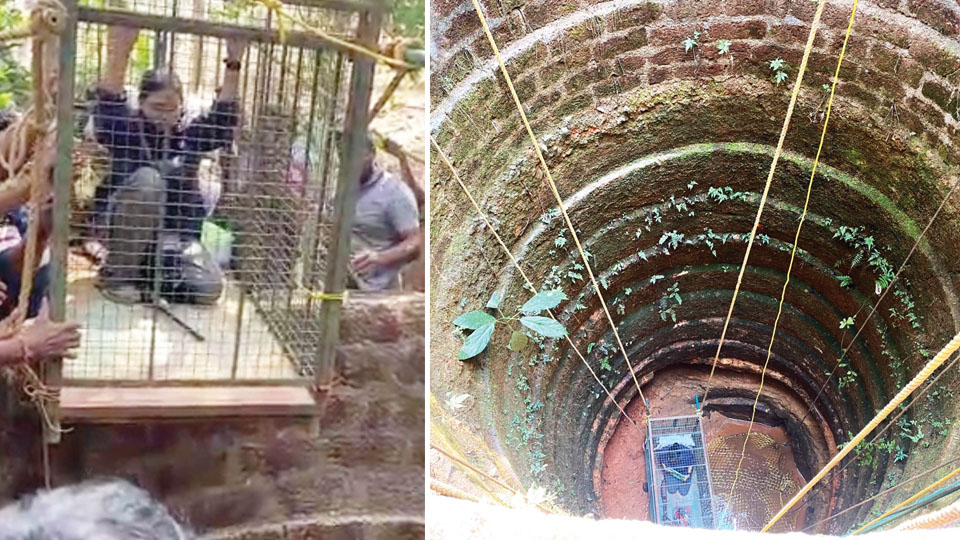
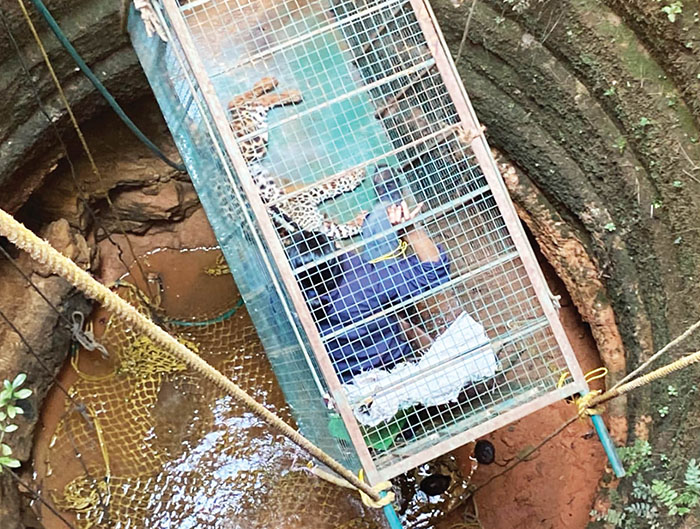
She recently saved a leopard that had fallen inside a 25-feet deep well and performed the act by sitting inside a cage that was lowered into the well to sedate the leopard that was stuck there and starving for 36 hours. She was able to pull the one-year-old feline into the same cage in a tense and dare-devil two-hour rescue operation. Her husband Dr. Yashaswi Naravi too was a part of the rescue mission.
In fact, it was 31-year-old Dr. Meghana, who volunteered to go down the well. She told Star of Mysore that though she was scared as it was deep inside the well and the leopard was not visible from the top, the adrenaline rush to save the starving and stuck animal overcame the fear.
The incident took place near a house in Niddodi near Kateel in Dakshina Kannada, about 35 km from Mangaluru. “We got a call at 9 am on Feb. 12 from the Forest Department. We are a team from Chitte Pilli, a Wildlife Rescue and Research Centre in Mangaluru and the team comprises me, my husband and experts Dr. Prithvi Salian and Dr. Nafisa Kousar. We reached the place at 11 am with some necessary equipment for the rescue,” she said.
After successfully tranquillising the big wild cat, Dr. Meghana being pulled up along with the tranquillised leopard inside the cage.
Failed attempts
The Forest Department had tried to rescue the feline with a ladder and a cage, as in other instances the trapped leopard had walked into the cage when it was lowered inside a well. However, this leopard was unwilling to move, she added.
The leopard was not visible from the top and it had taken shelter at a cosy spot that was shaped like a cave-like cavity — to avoid falling into the water — inside the sturdy well that was built with stones. The leopard was aggressive when attempts were made by the Department to drain the well water.
“Later, a different strategy was adopted and it was decided to lower a cage carrying a person to tranquillise the leopard and bring it back. We had no other choice and someone had to do it. I volunteered despite the dangers involved,” Dr. Meghana revealed.
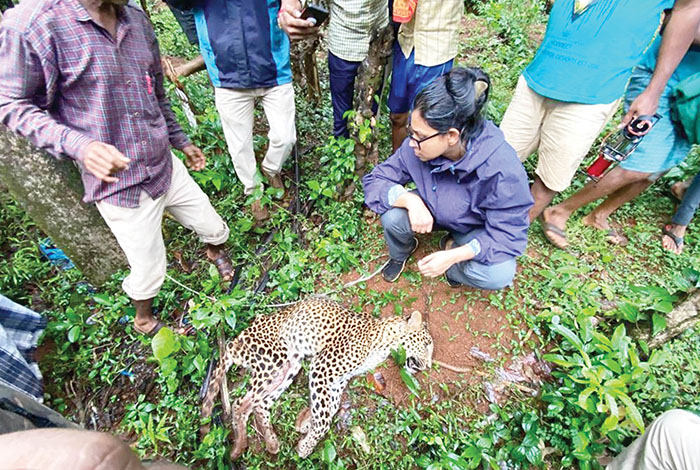
The leopard being treated after capturing in Mangaluru.
A risky mission
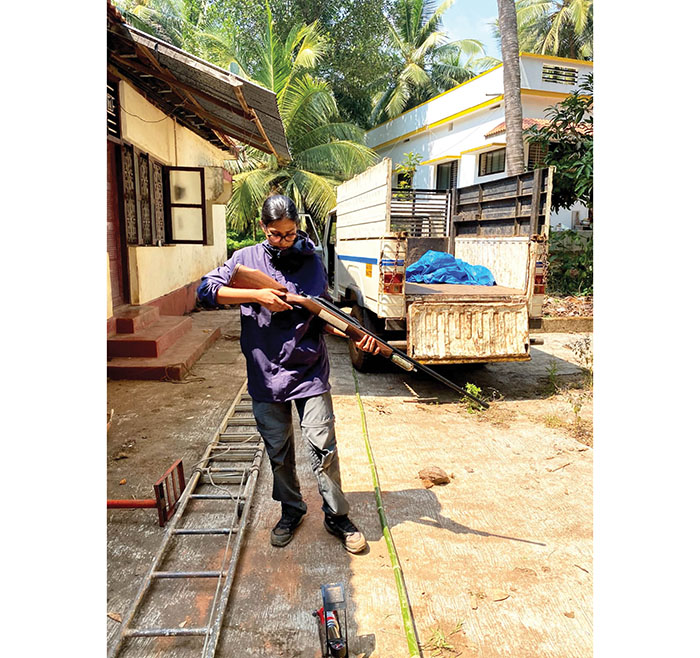
The cage was lowered by villagers, volunteers and the Forest Department staff in a coordinated action and with Dr. Meghana holding the tranquilliser gun. “We did not have a visual of the leopard and as such, it was a risky mission as no one had a clue as to how the leopard would react,” she said.
“I waited patiently for a sight of the leopard as the cage was lowered gradually and finally I could spot the animal around 10 to 15 feet inside the well and it was growling at me though it looked exhausted without food and water. I had very little time and hence aimed the dart at the animal and shot at it. Luckily, it was a precision shot and the dart hit the feline’s thigh in the first attempt itself,” Dr. Meghana said.
Meghana had carried about three to four syringes containing the sedating medicine as she did not know about its weight, size, health and other parameters for darting it. If she missed the aim the first time, she could well refill the tranquilliser gun with the second shot but the leopard could have moved away from the initial close proximity and there was more probability of her missing the shot.
Growling leopard
“In fact, I had to sit inside the cage for over 15 minutes for the dart to take effect and the leopard was right in front of me. It was growling and looking at me. Slowly, the sedation process began and I tried to pull it to the cage but could not. Another youth got inside the well and helped me and we both put the 25-kg leopard inside the cage. It was a leopardess. Now when I look back, sometimes I fear what could have happened if something had gone wrong,” she said.
So tense was the situation after the dart was fired that Dr. Meghana sat motionless inside the cage as any movement or noise would disturb the leopard and it would take a long time for the animal to get sedated. Finally, the feline fell unconscious after over 15 minutes. After the leopard was lifted back to the ground, it was checked and the vets found no external injury marks.
“It was a healthy leopard but was exhausted. After administering the required medicines for the feline to rejuvenate and get back its strength so that it has the capacity to hunt on its own, it was handed over to the Forest Department that released it back to the wild,” Dr. Meghana said.
Passion for wildlife keeps her going
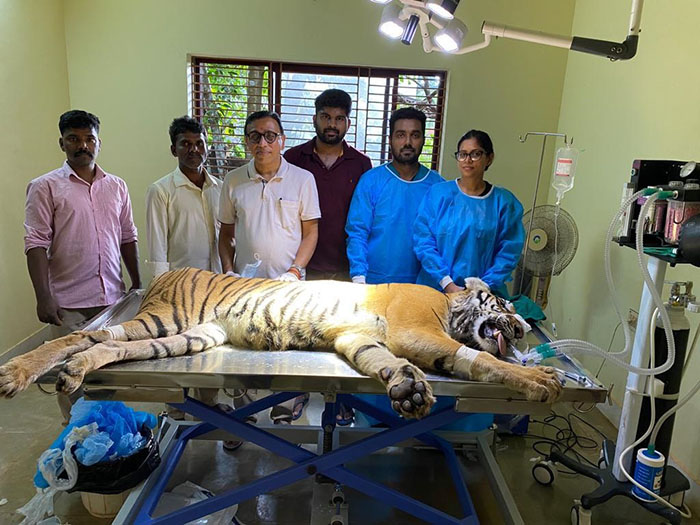
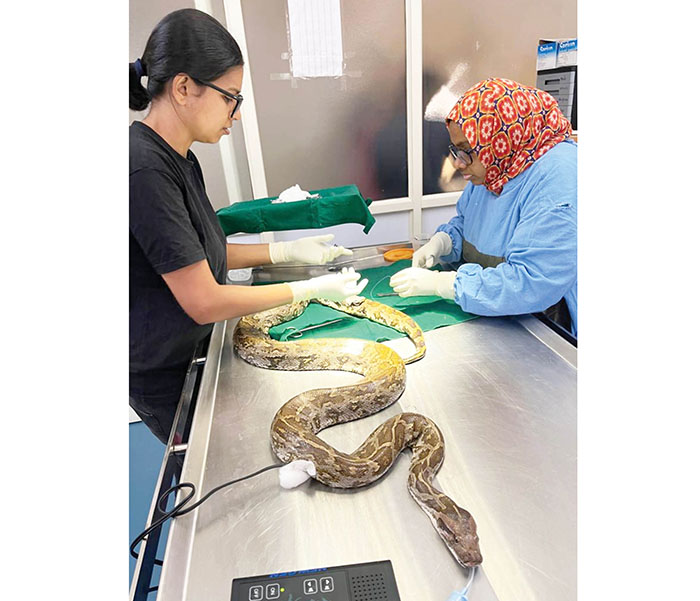
Wildlife rescue operations are nothing new for Meghana and she has been a part of many rescue operations in the last six years in Karnataka. She has been a part of many missions where she has rescued and treated tigers, owls, star tortoises, pariah kites, crows, pigeons, birds and even pythons.
“Passion about wildlife, increasing human-animal conflicts and the resulting rescue mission keeps me going. I dread to see an animal suffering due to injuries,” she said.
Every year, she does almost 10 darting procedures after following the scientific process and protocols. But this was the first time she had to get down into a well, sitting inside a cage to rescue a leopard. She hails from Halugunda village near Virajpet in Kodagu district and studied in Bengaluru.
Dr. Meghana treating a python.
After completing her PUC from Christ College, Dr. Meghana did her BVSc followed by MVSc in Wildlife and Surgery from Veterinary College, Bengaluru. The next four years, she worked in People For Animals (PFA) as a senior veterinarian and this gave her on-hand exposure to animal rescue and medication.
Her father late Pandikanda M. Pemmaiah was a retired Superintendent of Police and her mother P.P. Sarasu and rest of the family live in Bengaluru. She married veterinarian Dr. Yashaswi Naravi of Mangaluru and both have been working at Chitte Pilli — a Wildlife Rescue and Research Centre.
source: http://www.starofmysore.com / Star of Mysore / Home> News> Top Stories / February 21st, 2023
WELCOME. If you like what you see "SUBSCRIBE via EMAIL" to receive FREE regular UPDATES.
Read More »