Category Archives: Green Initiatives / Environment

‘Forest must to balance nature’

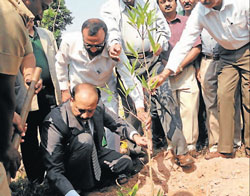
District and Sessions Judge Ashok G Nijagannavar said that the forests help in maintaining balance in nature.

Speaking at World Forest Day organised by forest department and Western Ghat Task Force at Aranya Bhavana in Madikeri, he said “at least 30 per cent of the land should be covered with forest in the country.

With the increase in the demand, the forests are getting vanished in the country. There is a need to protect at least the forests which are found at present.”

Zilla Panchayat President Ravi Kushalappa said 37 per cent of the land in Kodagu is covered with forest.

There is a need to grow trees in schools and colleges

Conservator of Forest Brijesh Kumar Deekshith, DCF K S Anand, Deputy Commissioner Dr N V Prasad, ZP CEO N Krishnappa and others were present.

source: http://www.DeccanHerald.com / Home> District / DHNS / Madikeri, March 21st, 2012

Energy: Madikeri CMC chooses unconventional path

Windmill installed to tackle power crisis

The government has been supporting the production of electricity through unconventional sources of energy like solar and wind power.

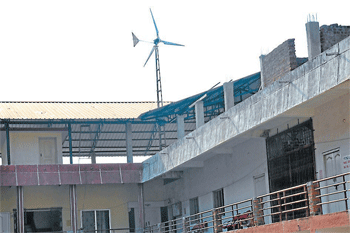
Madikeri CMC has found an unconventional way of overcoming erratic supply of power. A windmill has been installed on the CMC premises to generate electricity.

Madikeri town is 4,000 metre above the sea level. As a result the wind factor would be constant in Madikeri. With this, the CMC expects to slash down its electricity bills.

The idea of windmill originated two years ago and the 2.1 kv windmill started functioning from that time. It provided electricity to light up few bulbs in the CMC building.
As the demand for electricity increased, the CMC has decided to install three to four windmills at a cost of Rs 47.50 lakh under Chief Minister’s Small and Medium Town Development Scheme.

It has been planned to produce 5.1 kv electricity from each windmill. The CMC office requires 5 kv electricity daily. Two windmills have already been installed near the CMC office. The authorities have planned to install another windmill near water filter house at Stone Hill. The final decision has not been taken, said CMC commissioner N M Shashikumar.

CMC president H M Nandakumar said: “The CMC pays Rs 50 lakh as electricity bill annually. The windmill will help to reduce the electricity bill. At the same time, there is no question of disruption in power supply.”

The work on installing windmill will be taken up at the earliest, said the commissioner

source: http://www.DeccanHerald.com / Home> District / by Srikanth Kallammanavar / Madikeri, DHNS / March 14th, 2012

Tata Coffee Plantation Trails celebrates International Women’s Day

A woman efficiently plays the ever changing role of a daughter, wife, mother, entrepreneur, builder and moulder of a nation’s destiny. Plantation Trails is honoured to offer all lady guests a special treat on their special day.

It is the spirit of Womanhood that has inspired generations and we at Plantation Trails would like to celebrate this spirit on the occasion of International Women’s Day. A woman efficiently plays the ever changing role of a daughter, wife, mother, entrepreneur, builder and moulder of a nation’s destiny. Plantation Trails is honoured to offer all lady guests a special treat on their special day.

The celebration would begin from March 1 to March 31, 2012. Every group with at least one woman guest, who makes a booking at Plantation Trails calling on + 91 (080) 23560761 or E-mails: reach.plantationtrails@tatacoffee.com gets to enjoy a special package at Coorg & Chikamagalur.

Christine F. Jamal, Vice President Corporate, Tata Coffee Limited said, “ Woman have played a crucial role over the ages nurturing the social and functional ties of society thus being the real architects in building the strong pillars of human civilization. Their role and tireless contribution across the various stages of life is enormous and immeasurable. Plantation Trails respects women and there can be no better occasion to honour them than on International Women’s Day.”

source: http://www.IndiaInfoline.com / IndiaInfoline> Markets> News> Other News / March 06th, 2012

Landscape Garden at Madikeri Gaddige

Madikeri:

The Gaddige in the town here (mausoleums of the erstwhile rulers of Kodagu), which had been in the news for all the wrong reasons – vandals setting its main door on fire, encroachments, haven of illicit activities, etc – is finally being spruced up to attract tourists who are already making a beeline to Kodagu district.

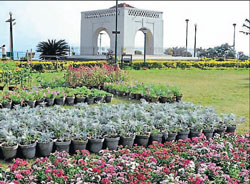
The Madikeri Urban Development Authority (MUDA) has prepared a plan to develop four acres of land around the Gaddige into a landscape garden at a cost of Rs. 45 lakh, MUDA Chairman Shejil Krishnan told SOM yesterday. At present, 35 granite benches have been erected around the Gaddige area and a walkway has been created around the proposed garden, said Shejil, adding that after the famous Raja Seat, this will be the second botanical garden in the town. Ornamental plants have been planted, lawns have been laid and a lotus pond has also been created on the vacant land. The variety of ornamental plants have been brought from SNV Nursery in Rajamundry of Hyderabad. Landscaping for the garden is being done by Bangalore-based Green Stays Landscaping Company and the works are being supervised by the company’s Planning Officer M.S. Sudhir.

Plans are on the anvil to include a children’s play park too in the garden, said Shejil.

The land belonging to Gaddige has been fenced off and the main entrance has been renovated. Works are on to mount the stone statues of elephants on to concrete platforms.

Despite all these development works, it is an irony that the Department of Archaeology seems to be oblivious.

The Gaddige are protected monuments that come under the Karnataka Ancient & Historical Monuments & Archaeological Sites and Remains Act of 1961.

Gaddige has two identical square structures, which are the tombs of the kings and their queens. They are close to each other, built in Indo-sarcenic style. A small tomb by the side of these structures is of their Guru or royal priest Rudrappa. It was built in 1834.

source: http://www.StarofMysore.com / General News / January 09th, 2012

Walk, smell the coffee

Pushpanath ‘Push’ Krishnamurthy is tired. A campaigner with Oxfam, UK, he is just back from a fortnight-long, 540-km walk across Karnataka for what he calls “climate justice”. “After walking 30-40 km every day for half a month, it’s tiring to not walk anymore,” he says, leaning back in his chair at the office of the Centre for Social Markets, a Bangalore-based non-profit that promotes climate change dialogue and socially sustainable entrepreneurship, where he is currently on an externship.

In a white chikankari kurta and jeans, his face framed by a cloud of unruly salt-and-pepper hair, Krishnamurthy looks every bit the eccentric Gandhian. He is brimming with stories from his journey, timed to coincide with the UN climate conference in Durban, South Africa.

“I met 30,000 people in 16 days. Hordes of people joined me on various legs of the walk, welcomed me into their homes, shared their stories, fed me and garlanded me. I felt like Bono without the sunglasses,” he says, laughing. Krishnamurthy began his walk, backed by CSM and the Karnataka Growers’ Federation, on November 25 in the hills of Chikmagalur, descending two thousand feet in the next few days to pass through Hassan, Coorg and Hunsur and finally arrive at Mysore. Along the way, farmers and coffee growers filled him in on the climatic variance of the past few years and how it was affecting their crops. He visited villages ravaged by unseasonable bouts of rain and explained in chaste Kannada the correlation between human activity and climate change. He blogged every day and gave interviews to radio and local papers, attracting a posse of supporters aged seven to 80. “Most of them hadn’t heard of the Durban talks. They thought I was a crazy old man. Some called me a parisara vaadi, a climatologist. I told them I am just a regular guy with irregular hair,” he says, lightheartedly.

source: http://www.indianexpress.com / IE> Story / by V Shoba / December 18th, 2011

Coming in the line of hunters, he became a frontline warrior of forests

In Coorg, where men once loved hunting, K M Chinnappa broke the tradition by turning his gun to protect the forests. Anita Pratap captures the spirit of the man, and Mahesh Bhat his image

By Anita Pratap and Mahesh Bhat

Hunting was a way of life in the verdant forests and foothills of the Western Ghats in Karnataka’s Coorg area. It was an integral part of tradition, folklore, manhood, sport, food and commerce.

From poor, forest-dwelling tribesmen to the flamboyant royalty and courtiers in bustling Mysore, everyone loved hunting. But one man stood tall to end this way of life. His name is K.M.Chinnappa.
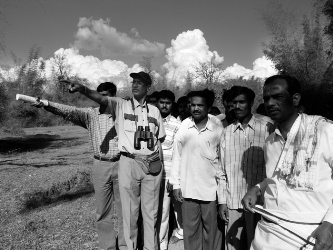
K M Chinnappa was the Range Forest Officer of Nagarahole for over two decades and was single-handedly responsible for making it one of the finest national Parks of India

Born in 1941 in Kumtur village near Nagarhole to a soldier who fought in the First World War, Chinnappa spent his youth roaming the forests of his ancestral land, listening to birds, watching the cavalcade of animals in their habitat, absorbing the every day miracles of the rich eco-system.

An enduring love for nature was thus born in him. Like his father, he too would become a mustachioed soldier. But with a difference. He would become a gun-toting, frontline warrior of the forests, dedicated to protecting wild life. Says he simply: “Wildlife is the purpose of my life.’

In 1967, he joined the Nagarhole National Park as a forester. The park was in ruins. Hunting had taken its toll. There were hardly any deer left, forget tigers and other big game. To cultivate rice, villagers had encroached on the swamps – the beloved play-ground of the elephants.

Tribesmen lived in clusters deep within the park to collect forest produce, ranging from honey to berries. Livestock herders grazed their cattle on the park’s grasslands. Hunters preyed on animals and birds.
Poachers hunted tigers for their skin; elephants for their tusks. Timber logging was a thriving mafia business. Sandalwood smugglers roamed with abandon.

The destroyers of Nagarhole’s environment used a range of weapons – hunters shotguns, tribesmen used snares and livestock herders used poison. Wild life protection laws were weak and the Forest Department concentrated on logging, misguidedly uprooting the diversity of natural vegetation to replace them with the monocultures of teak.

Rued Chinnappa: “If this devastation continued, I was dead certain that there would be no wild life left in Nagarhole in 30 years.”

He became a one-man army to reverse this process. And he succeeded. In less than a quarter of a century, Nagarhole revived, expanding from a 250 sq km part to 640 sq kms.

The poachers have retreated, the encroachers have gone and the hunters are virtually extinct, restoring Nagarhole to its rightful inhabitants – tigers, panthers, leopards, sloth bears, jackals, wild boars, porcupines, hares, langur and varieties of deer.

In the bad old days, tigers had to roam 200 sq kms before they could find prey. Now they can find it within 12 sq kms. The elephants are back where they belong: in the lush swamps and bamboo groves. The trick? Explains Chinnappa: “All you have to do is to stop human interference. Just leave the forests alone and they will regenerate themselves”.

Chinnappa was the right man at the right time. In 1972, in the wake of a groundswell of opinion generated by several leading Indian conservationists, then Prime Minister Indira Gandhi took a slew of measures to protect the environment.

Several laws were enacted and sanctuaries in Kanha, Corbett, Ranthambore, Bandipur and Nagarhole among others were pulled back from the brink of destruction.

Forest departments had new direction, muscle and teeth. Still, keeping the humans out of the forests was not easy. Chinnappa paid a high personal price to fulfil his mission to safeguard Nagarhole. He was arrested, jailed, transferred. His home was burned down. But he has no regrets. Says he with his characteristic robust optimism: “What’s the use of just going to office. I led a colourful life.”

To protect wild life, Chinnappa had to take on a range of human beings who lived on the wild side of life. He captured a large number of poachers and smugglers and filed court cases against them. But they were all acquitted in no time and were back to their wicked ways.

He realized he would have to terrorize them, make it really dangerous for them to hunt and poach. He took up the gun and did not hesitate to shoot. He recalls: “No body used high-calibre guns. I had only a 12 bore rifle. And I used only buckshot. But at that time, it was enough.”

He remembers the legend of a tribesman whom the locals nicknamed “parari Thimma” – vanishing Thimma. He was a notorious poacher who nimbly eluded forest guards. Chinnappa began tracking him and one day shot at him. And then he vanished forever!

Chinnappa became the local legend. Supporters hailed him as a hero, the phantom of the jungles. Poachers called him “The Devil” who stalked their hunting grounds.

Chinnappa used his immense knowledge of forest trails, tracking spoor, jungle craft, fabled night vision and stealth maneuvers to ambush the poachers and hunters. Guided by moonlight, he silently crept upon the forest brigands and opened fire. And the old way of life began to end.

But not without resistance. In no time, the threatened “vested interests” – profiteering poachers, unscrupulous smugglers, wealthy hunters, criminals, mafia operators and politicians all ganged up against Chinnappa.

In 1993 after voluntarily retiring from Karnataka Forest department, Chinnappa started Nagarahole Wildlife Conservation Education project reaching out to the local students, youth and the public.

Even the villagers rose in revolt. For Chinnappa, life took a curious turn. On the one hand, the regeneration of Nagarhole won high praise. He bagged the Karnataka Chief Minister’s Gold Medal in 1983, received an award from the Wildlife Conservation Society and foreign environmentalists showered glowing tributes in books and magazines.

His spartan way of life, incorruptibility and military discipline became legendary. Says Ullas Karanth, a leading wildlife biologist: “Chinnappa is a man of integrity. He is tough, efficient and incredibly courageous in the face of grave physical danger. His accomplishments in Nagarhole are undoubtedly a major milestone in the history of Indian wildlife conservation.”

He was admired and respected by his peers. But some of the locals feared and hated him. In 1988, one of Chinnappa’s guards publicly shot a local coffee planter who had killed and eaten his pet samba deer.

The dispute spun out of control and soon local poachers instigated a public agitation, accusing Chinnappa of masterminding the murder. Bowing to political pressure, Chinnappa was arrested and jailed for 12 days. Eventually he was cleared of all charges and reinstated

But vested interests continued to persecute him. He was implicated in the killing of a poacher in 1992 and a riot erupted. A frenzied mob ransacked the Forest Department’s buildings, burnt vehicles, assaulted staff, set fire to large swathes of forest land and set ablaze Chinnappa’s ancestral home.

Once again, he was cleared of all charges, but this time, Chinnappa decided to quit. He could understand why the poachers, smugglers and politicians ganged up against him. But the fact that they could enlist the support of villagers had a profound impact on him.

He realized he needed to move to another plane of conservation: education. He had to make the locals realize the practical and moral imperative to protect their environment. It was not merely the job of foresters. It was a collective responsibility.

And so in 1993 he retired prematurely from the Forest Department and started his NGO, the Nagarhole Wildlife Conservation Education Project to educate the local people and especially the children on the need to protect the environment.

His motto was simple: “Without humans, the forest will flourish. Without forests, we humans cannot flourish.” Through forest camps, discussions and slide shows, he opens the doors to a magical kingdom of flora and fauna, encouraging children to take delight in observing nature instead of hunting animals.

His mission also involves fighting legal cases. As President of Bangalore-based NGO, “Wildlife First”, Chinnappa and a group of conservationists documented the ecological devastation caused by the iron ore mine operators in Kudremukh. In retaliation, they were slapped with 12 criminal cases.

Says Bittu Sehgal, editor of environment magazine, ’Sanctuary’: “Law suits are filed by those who have money or power on their side to prevent public minded citizens from ‘interfering’.” The cases dragged on for years and wound up in the Supreme Court, which ordered the closure of the mines in December 2005.

Chinnappa’s accomplishments are all the more laudable because they were won against the stiffest odds. He endured setbacks, difficulties, threats, attacks, vilification, arrests and court cases.

But, remarkably, he has emerged unscathed, his innocence, courage, dedication, honour and optimism intact. He is completely devoid of bitterness. He chooses to forget the troublemakers who made life so difficult for him and his loyal wife Radha, but remembers fondly the senior officers and lowly guards who stood by him.

Through all his trials and tribulations, one thing remained undiminished: his sheer will to save the forests. With deep conviction he says: “If you have the will, you can do wonders.”

Today, Chinnappa derives enormous satisfaction from the guns – the yesteryear symbol of manhood – that lie rusting in many a Coorgi home. Cheering the end of that bygone era are the sights and sounds of a promising new life, symbolized by the swaying foliage and barking deer.

(Extract from the book ‘Unsung’ by Anita Pratap and Mahesh Bhat)

source: http://www.theweekender.com / Home> Causes> Gun Reversal /vol. 2, issue. 50 / 16-22 December, 2011
Suzlons environment campaign PALS crosses one million members

Launched about four months ago by Suzlon the Pure Air Lovers Society (PALS), registered over one million members. Suzlon is claiming that PALS is among the fastest growing campaigns of its kind in the country, exceeding an average of over 9,000 registrations per day.

PALS is a movement to emphasise the importance of clean air, while helping to educate people on how to live a more environmentally responsible life. The PALS campaign website provides innovative informational and educational tools for engagement with the campaign.

The website hosts tools like the PUC check reminder, carbon calculator, carpooling information, list of green vendors among others.

The campaign, launched in Mumbai, has expanded across 86 cities, with New Delhi now leading registrations, followed by Mumbai and Bangalore.

Commenting on the campaign, Suzlon Group’s global head of brand Dharini Mishra said, “This has been a hugely successful campaign. In the beginning we saw participation from 18-24 years-old age group, but we have seen broad based interest and participation spreading into the 25-34 year old bracket.

Interestingly, people who went to graduate school are over-represented at PALS and this is skewed towards metros in the country. We are confident that registration with PALS is only going to grow and this will fuel a more conscientious and empowered people”.

PALS is supported by likes of Milind Soman, Anil Dharker, Gerson da Cunda, RJ Malishka and Nikhil Chinappa among otheres. PALS first initiative GaadiBandh focused on educating people on the importance of turning off vehicles at signals thereby helping to reduce pollution emissions from idling vehicles in Pune.

PALS is a movement to emphasise the importance of clean air, while helping to educate people on how to live a more environmentally responsible life. The PALS campaign website provides innovative informational and educational tools for engagement with the campaign.

The website hosts tools like the PUC check reminder, carbon calculator, carpooling information, list of green vendors among others.

The campaign, launched in Mumbai, has expanded across 86 cities, with New Delhi now leading registrations, followed by Mumbai and Bangalore.

Commenting on the campaign, Suzlon Group’s global head of brand Dharini Mishra said, “This has been a hugely successful campaign. In the beginning we saw participation from 18-24 years-old age group, but we have seen broad based interest and participation spreading into the 25-34 year old bracket.

Interestingly, people who went to graduate school are over-represented at PALS and this is skewed towards metros in the country. We are confident that registration with PALS is only going to grow and this will fuel a more conscientious and empowered people”.

PALS is supported by likes of Milind Soman, Anil Dharker, Gerson da Cunda, RJ Malishka and Nikhil Chinappa among otheres. PALS first initiative GaadiBandh focused on educating people on the importance of turning off vehicles at signals thereby helping to reduce pollution emissions from idling vehicles in Pune

source: http;//www.articels.economictimes.indiatimes.com / News> News by Industry / by Mitul Thakkar, ET Bureau / December 13th, 2011

The Recyclists

Recycling ideas

Although Indians have traditionally reused and recycled, the waste bin is a relatively recent, modern and largely urban phenomenon.Sameer Shisodia speaks to a few people who are doing their best to reverse the trash menace


Over my first couple of trips to the certifiably developed US of A, I came back with two enduring images — the first was large parking lots with hundreds of cars parked in front of every mall, office, block of apartments and just about everywhere, and the other was cool people sipping ‘soda’, or coffee, from gigantic paper cups with lids, and then chucking those — usually with about half the contents still in there — into huge bins that you could find just about anywhere! I presume hordes of us came back home with such symbols of development. The trash can quickly rose up the ranks of development indices. Our economic growth brought along with it the idea of disposable incomes, consumption cycles, large supply chains, packaging and in tow behind all this, mountains of trash both inside and around the city!

However, in the Indian context, the idea of garbage, and the waste bin, is a relatively recent, modern and largely urban one. People used to rarely need to throw stuff away, and pretty much everything had another use, or was recycled into something else, after its primary use was done with. Even amidst the growing affluence and numbers of trash cans, there is thankfully a bunch who, at their core, have not felt comfortable with this change in behaviour and are doing not only their own personal damnedest to reverse the trash menace, and sometimes even changing mindsets around them.

Dr Meenakshi Bharath was always uncomfortable with the heaps of garbage and especially the heaps of it lying around Bangalore that were making many people fall ill — with dengue and chikungunya. In 2008 she first started segregating waste and composting at her own house, and also tackling it at a city level to impact policy making through an organisation called Solid Waste Management Round Table that she’s involved with. “Over the last two years about 1,500 kgs of food waste at home has been converted into wonderful manure and an equal amount of dry waste has been sent for recycling. The 5,000 tonnes of garbage generated in Bangalore is eminently manageable if all of us take the responsibility of segregating it at the point of generation”, she says.

Poonam Bir Kasturi is one of the pioneers of home composting — on all fronts of creating products for it, educating people through information and even a garbage tour of Bangalore which helps one connect with what happens to what one throws away. Her company, Daily Dump, has been creating products and services to easily compost wet organic waste at home — even if you just have a corner in a balcony. This itself reduces the volume of your waste significantly, and you produce something that can improve the quality of soil around you a lot! Poonam herself believes in more wholesome, local choices which automatically imply less wastage in the whole cycle of production and consumption — “I prefer to spend less, repair more, reuse more and when I buy try and buy more local, more fresh and less packaged.”

But it is also efforts of folks who do regular jobs, but just passionately follow better waste management at home which help.

To her surprise, Usha Srinath found the amount of garbage generated at home go down by 60 per cent merely through reuse of plastic packets when shopping, giving away boxes etc. to those who could make use of it, and composting. She’s very conscious and proud of the way of life she grew up with — much like the rest of India — where consumption was more or less related to need, and recycling was second nature irrespective of one’s economic status. “I often wonder how we dropped our traditional Indian practices that were intrinsically so eco-friendly. And am amused that now we have to re-learn them from the West!” she adds.

Similarly, Deepa Mohan has grown up in the pre-plastic-packaged times, and values the then natural thrift of the home-maker and the Indian culture of “jugaad” which has always helped reduce waste. However, she also noticed, over time, the growing aspirational value of consumption. “Some of the things I routinely did — taking the bus instead of the car, cycling to do my daily shopping, recycling envelopes by turning them inside out, bath-with-a-bucket instead of a shower, and cloth diapers instead of disposable ones for my baby — these started to be snidely referred to as ‘being cheap’. Now I find more and more that these are ‘cool’ things to do!”

So is there a wider acceptance of what was traditionally acceptable thrift, and is now the ecologically right set of choices?

Reena Chengappa and Anu Gummaraju have been instrumental in setting up Second To None, a community that is not just promoting recycling and upcycling – the creation of objects of art and utility out of waste — but also helping organise markets and facilitating commercial activity around this. This has already found resonance with a wide audience.

Yet, it’s early days for this mindset. Reena has heard it all — from questions about practicality, to those about the weirdness and the snobbishness of it all. However, she’s happy about how folks are accepting it — “All’s well now and folks are willing to look at this choice as an option”. Sejal Shah, who creates and promotes eco-friendly upcycled jewelry, has received a lot of encouragement from people, but only a lukewarm response from actual buying customers.

Even at home, it’s often a crusade. Chidambaram Subramaniam faced a bunch of challenges in both his efforts, and the reaction of people at home when the maggots in the compost bin multiplied and crawled in one day! Over time, his persistence with composting, and creating a kitchen garden in his balcony have not only found converts at home, but evoked curiosity amongst the neighbours as well.

At our local convenience store, one sees more people come in with their own bags. There was news of an apartment complex winning an award for its waste management efforts. Kids at school are carrying home the message that plastic is bad. Yes, these are mere dents in the armour of the marketing and packaging machinery that just injects so much into our lives that we end up wasting, but these are good signs and we might see bigger change if folks like Meenakshi succeed in bringing about positive changes in policy.

It’s good to know that for a growing tribe of Bangaloreans, taking garbage out of sight is not getting it out of mind.

Getting started

* Daily Dump: http://dailydump.org or help with composting at home

* Zero Waste Management Group: http://groups.google.com/group/zwm-blr for advice on how to help your community adopt better waste practices

*Bangalore’s own flea market: http://secondtononemarket.wordpress.com/

Eco-tips

What can you do to reduce your contribution to Bangalore’s growing landfills?

*Segregate! keep the kitchen (organic) waste separate from the dry waste (paper, plastics)

*Composting. This will ensure the organic waste – which is 60% water – is actually turned into beneficial nutrients for your garden

*Reuse. See what you don’t really need to throw away. Or what someone around you could reuse. Think hard before putting anything into a bin.

*Recycle. It’s amazing how much can be recycled. Talk to the neighbourhood gujari guy.

*Carry your own bags wherever you go shopping. Including multiple small ones for the veggies at large grocery stores.

*Avoid bottled water. Carry a bottle from home, and refill.

*Buy things you ‘need’, not just ‘want’.

source: http://www.deccanherald.com / Home> Supplements> Living /

‘Nature walk in coffee land’ reaches Madikeri

Madikeri, Dec 4, DHNS:

The ‘nature walk in coffee land’ organised to create awareness on environment from Bababudangiri reached Madikeri on Sunday.

The jatha was led by Krishnamurthy Pushpanath. The jatha reached Sampigekatte at 9.30 am.

The jatha was welcomed by skating children with flowers. District Congress Committee President B T Pradeep, Jaya Karnataka district president Rabin Kuttappa, Kodagu Growers Federation member B T Dinesh, Madhu Bopanna and others were present.

The jatha passed through Gandhi Maidan in Madikeri. After garlanding the statue of Gandhi, Krishnamurthy said, “There is a need to protect Western Ghats and Malnad to check global warming. It is our duty to protect Western Ghats.

There is a need to create awareness among the public on the need to protect Western Ghats from destruction. With the global warming, there has been increase in temperature by one or two degree every year. The increase in temperature will affect coffee. If this continued, then coffee plants may not survive by 2030.”

Kodagu Growers Federation’s Dr Pradeep said “the coffee plantations absorb carbon dioxide. Hence, the coffee growers are protecting the nature. The Centre should support the coffee growers.” The jatha left for Bhagamandala from Madikeri.

source: http://www.deccanherald.com / Home> District / Monday, December 05th, 2011

Dash of creativity gives secondhand stuff the edge

In keeping with Bangalore’s ongoing celebration of all things recycled, the Flea Market at Jaaga fit the bill.

The event was organised by Second to None, a group that encourages people to buy and sell used products.

The flea market organised in Bangalore by the NGO Second to None encouraged people to buy and sell used products. Photo Ashwini N. The Hindu
“The idea behind the flea market was to provide a space for people to sell and buy secondhand material without going to the trouble of marketing or advertising. With different choices, customers buy items at a lower price than a new one, and which are in just as good a condition,” explains Anu Gummaraju, a founders of the organisation with Reena Chengappa and Shilpa Kamath.

The atmosphere was informal, yet the event created awareness among visitors about the simplicity of turning ‘waste to wealth’. Angad Gummaraju, a 14-year-old, took great pleasure in teaching kids — and grown-ups — how to make jewellery boxes and lamp holders in fifteen minutes through origami.

How did he learn to make these trendy accessories? “YouTube,” he quips, demonstrating just how easy it is to be ecofriendly and resourceful while having fun.

About thirty participants were seen exhibiting their wares at the stalls. Belaku, an NGO, had brought in bags, notebooks and trendy jewellery made out of recycled paper by disadvantaged village women.

Papier-mache artiste Rabi Ratnakar’s lamps and vases were a crowd-puller. “These are completely safe and extremely kid friendly,” he says.

Taantra Cakes sold preservative-free cupcakes. “This makes them more durable. The taste of the cakes gets better and they are healthier even without refrigeration,” explains Taantra Cakes owner Chaitali Singh.

Old books, clothes, bags, even photographs, found space in shoppers’ bags. Second to None is hoping to make every third Sunday ‘flea market Sunday’ so that more people can participate in the “recyclathon”.

source: http://www.thehindu.com /by Madhavi Shivaprasad / News> Cities> Bangalore / November 17th, 2011