Recycling ideas
Although Indians have traditionally reused and recycled, the waste bin is a relatively recent, modern and largely urban phenomenon.Sameer Shisodia speaks to a few people who are doing their best to reverse the trash menace

Over my first couple of trips to the certifiably developed US of A, I came back with two enduring images — the first was large parking lots with hundreds of cars parked in front of every mall, office, block of apartments and just about everywhere, and the other was cool people sipping ‘soda’, or coffee, from gigantic paper cups with lids, and then chucking those — usually with about half the contents still in there — into huge bins that you could find just about anywhere! I presume hordes of us came back home with such symbols of development. The trash can quickly rose up the ranks of development indices. Our economic growth brought along with it the idea of disposable incomes, consumption cycles, large supply chains, packaging and in tow behind all this, mountains of trash both inside and around the city!
However, in the Indian context, the idea of garbage, and the waste bin, is a relatively recent, modern and largely urban one. People used to rarely need to throw stuff away, and pretty much everything had another use, or was recycled into something else, after its primary use was done with. Even amidst the growing affluence and numbers of trash cans, there is thankfully a bunch who, at their core, have not felt comfortable with this change in behaviour and are doing not only their own personal damnedest to reverse the trash menace, and sometimes even changing mindsets around them.
Dr Meenakshi Bharath was always uncomfortable with the heaps of garbage and especially the heaps of it lying around Bangalore that were making many people fall ill — with dengue and chikungunya. In 2008 she first started segregating waste and composting at her own house, and also tackling it at a city level to impact policy making through an organisation called Solid Waste Management Round Table that she’s involved with. “Over the last two years about 1,500 kgs of food waste at home has been converted into wonderful manure and an equal amount of dry waste has been sent for recycling. The 5,000 tonnes of garbage generated in Bangalore is eminently manageable if all of us take the responsibility of segregating it at the point of generation”, she says.
Poonam Bir Kasturi is one of the pioneers of home composting — on all fronts of creating products for it, educating people through information and even a garbage tour of Bangalore which helps one connect with what happens to what one throws away. Her company, Daily Dump, has been creating products and services to easily compost wet organic waste at home — even if you just have a corner in a balcony. This itself reduces the volume of your waste significantly, and you produce something that can improve the quality of soil around you a lot! Poonam herself believes in more wholesome, local choices which automatically imply less wastage in the whole cycle of production and consumption — “I prefer to spend less, repair more, reuse more and when I buy try and buy more local, more fresh and less packaged.”
But it is also efforts of folks who do regular jobs, but just passionately follow better waste management at home which help.
To her surprise, Usha Srinath found the amount of garbage generated at home go down by 60 per cent merely through reuse of plastic packets when shopping, giving away boxes etc. to those who could make use of it, and composting. She’s very conscious and proud of the way of life she grew up with — much like the rest of India — where consumption was more or less related to need, and recycling was second nature irrespective of one’s economic status. “I often wonder how we dropped our traditional Indian practices that were intrinsically so eco-friendly. And am amused that now we have to re-learn them from the West!” she adds.
Similarly, Deepa Mohan has grown up in the pre-plastic-packaged times, and values the then natural thrift of the home-maker and the Indian culture of “jugaad” which has always helped reduce waste. However, she also noticed, over time, the growing aspirational value of consumption. “Some of the things I routinely did — taking the bus instead of the car, cycling to do my daily shopping, recycling envelopes by turning them inside out, bath-with-a-bucket instead of a shower, and cloth diapers instead of disposable ones for my baby — these started to be snidely referred to as ‘being cheap’. Now I find more and more that these are ‘cool’ things to do!”
So is there a wider acceptance of what was traditionally acceptable thrift, and is now the ecologically right set of choices?
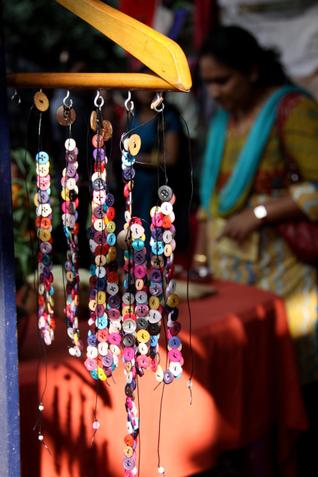
Reena Chengappa and Anu Gummaraju have been instrumental in setting up Second To None, a community that is not just promoting recycling and upcycling – the creation of objects of art and utility out of waste — but also helping organise markets and facilitating commercial activity around this. This has already found resonance with a wide audience.
Yet, it’s early days for this mindset. Reena has heard it all — from questions about practicality, to those about the weirdness and the snobbishness of it all. However, she’s happy about how folks are accepting it — “All’s well now and folks are willing to look at this choice as an option”. Sejal Shah, who creates and promotes eco-friendly upcycled jewelry, has received a lot of encouragement from people, but only a lukewarm response from actual buying customers.
Even at home, it’s often a crusade. Chidambaram Subramaniam faced a bunch of challenges in both his efforts, and the reaction of people at home when the maggots in the compost bin multiplied and crawled in one day! Over time, his persistence with composting, and creating a kitchen garden in his balcony have not only found converts at home, but evoked curiosity amongst the neighbours as well.
At our local convenience store, one sees more people come in with their own bags. There was news of an apartment complex winning an award for its waste management efforts. Kids at school are carrying home the message that plastic is bad. Yes, these are mere dents in the armour of the marketing and packaging machinery that just injects so much into our lives that we end up wasting, but these are good signs and we might see bigger change if folks like Meenakshi succeed in bringing about positive changes in policy.
It’s good to know that for a growing tribe of Bangaloreans, taking garbage out of sight is not getting it out of mind.
Getting started
* Daily Dump: http://dailydump.org or help with composting at home
* Zero Waste Management Group: http://groups.google.com/group/zwm-blr for advice on how to help your community adopt better waste practices
*Bangalore’s own flea market: http://secondtononemarket.wordpress.com/
Eco-tips
What can you do to reduce your contribution to Bangalore’s growing landfills?
*Segregate! keep the kitchen (organic) waste separate from the dry waste (paper, plastics)
*Composting. This will ensure the organic waste – which is 60% water – is actually turned into beneficial nutrients for your garden
*Reuse. See what you don’t really need to throw away. Or what someone around you could reuse. Think hard before putting anything into a bin.
*Recycle. It’s amazing how much can be recycled. Talk to the neighbourhood gujari guy.
*Carry your own bags wherever you go shopping. Including multiple small ones for the veggies at large grocery stores.
*Avoid bottled water. Carry a bottle from home, and refill.
*Buy things you ‘need’, not just ‘want’.
source: http://www.deccanherald.com / Home> Supplements> Living /

 The survey will be carried out in association with revenue department. Speaking to presspersons here on Tuesday, Kodagu Circle Conservator of Forest K B Markandeya said “government had earmarked Rs 8 lakh to preserve Devarakadu. The government had also assured to release additional Rs 20 lakh.”
 These are ancient groves that are deeply revered by the communities that live in their vicinity. The groves, which are hubs of biodiversity, are called devara kadus, found largely in the State’s Kodagu region.

 Air Marshal Cariappa, son of Field Marshal K M Cariappa, topped a poll conducted by www.coorgtourisminfo.com, the first news portal of Kodagu, to select the Coorg Person of the Year. The others who were in the reckoning for the title, include another hardcore environmentalist and President of the Coorg Wildlife Society, Col C P Muthanna (retd) and New York-based novelist Sarita Mandanna, who has been given the largest advance by Penguin India ever paid to a debut novelist for her novel ‘Tiger Hills,’ set in Kodagu.
 Garden lovers start planting dahlia saplings during the onset of rainy season. The flower, which gets rebirth every rainy seasons, start blooming within a month. It does not require any extra care to grow dahlia flowers in the garden. The very speciality of dahlia is that its flowers are not only attractive and colourful, but also are dfferent in terms of size.
 A dahlia plant grown from its root gives flowers of bigger size. A combination of sand and soil will be suitable for the dahlia plants to grow. The plant will give more flowers, if organic manures were used. Timely pruning will make the plant more strong and also will produce more flowers.
