Coffee cupping, exhibition of coffee berries to be held.
The Coffee Board of India, in association with Way Win, a farmer-producer company in the coffee sector in Wayanad, and Vikaspaedia, an initiative of the Union Ministry of Electronics and Information Technology, is organising various programmes to mark International Coffee Day on October 1.
Ports Minister Kadannappally Ramachandran will inaugurate the programme at the Town Hall here at 10 a.m. on the day.
Coffee Board Deputy director (Research) Vijayalakshmi will deliver the keynote address on the occasion.
Coffee cupping, a practice of observing the tastes and aromas of different brewed coffee varieties, would be the major attraction of the programme, organisers said in a release here on Thursday.
Exhibition of various types of coffee berries will also be held.
source: http://www.thehindu.com / The Hindu / Home> National> Kerala / by Staff Reporter / Kalpetta – September 28th, 2018
Ties up with National Institute of Public Finance and Policy for study on impact of subsidies on industry
Bengaluru :
The Coffee Board is to celebrate International Coffee Day on October 1 with a slew of partnerships. The board has roped in consulting firm Ernst & Young to prepare a strategy – “The Future of Coffee-Road Map”.
The National Institute of Public Finance and Policy will conduct a ‘Study of subsidies on coffee Industry’. Finally, the board plans to open 150 incubation centres under the Niti Aayog’s Atal Innovation Mission.
According to a senior board official, Ernst & Young would outline a strategy to improve the overall coffee sector performance across the value chain, from production to consumption, by analysing production challenges and proposing need-based interventions to strengthen small coffee growers, proposing a strategy for effective positioning of Indian coffee in the global and domestic markets, and technological interventions to overcome identified challenges.
The study would include assessment of production level challenges, value chain analysis, effective positioning of Indian coffee and drawing up a conceptual framework with technological interventions.
Impact of subsidies on coffee industry
The National Institute of Public Finance and Policy is to help in assessing the impact of various subsidies extended by the Coffee Board to farmers and exporters. The assessment report would consider how far the government incentive schemes have helped the overall coffee sector, in terms of both production as well as productivity, with suggestions on policy-level interventions required to help scale up overall coffee production as well as exports.
The key topic areas would include assessing the extent of outlay provided to implement ICDP, examining the impact of incentive schemes on production, productivity and quality of coffee, understanding implementation issues at the ground level and providing inputs to the government with regard to continuation of existing schemes as well as identifying the relevant incentive mechanism for the grow of the sector.
Atal Innovation Mission
The Centre has set up the Atal Innovation Mission (AIM) in the NITI Aayog to promote a culture of innovation and entrepreneurship in India. Towards creating world-class incubation facilities across various parts of India with suitable physical infrastructure in terms of capital equipment and operating facilities, coupled with the availability of sectoral experts for mentoring the start-ups, business planning support, access to seed capital, industry partners, training and other relevant components required for encouraging innovative start-ups, AIM is supporting the establishment of Atal Incubation Centres (AICs) that would nurture innovative start-up businesses in their pursuit to become scalable and sustainable enterprises.
For this, the AIC-CCRI Foundation for Entrepreneurship Development is being established at the Coffee Board’s head office in Bengaluru. The incubator, spread over an area of 10,000 square feet, would possess world-class infrastructure to provide space, product development laboratories, meeting rooms, auditoriums and contemporary IT infrastructure to incubatees.
The incubator would be supported by teams of national and international mentors to provide mentoring services to incubatees. Besides supporting the incubatees in Bengaluru, the AIC would also support virtual incubates through a network of partner institutions located across the country. The incubator would offer pre-incubation as well as accelerator services for coffee and agri-based start-ups. It is expected that AIC-CCRI Foundation for Entrepreneurship Development would result in the establishment of at least 150 innovative scalable businesses in the coffee and agribusiness sector in the next five years. This would contribute to growth in domestic demand for coffee and the overall development of the Indian coffee sector.
source: http://www.thehindubusinessline.com / Business Line / Home / by Anil Urs / September 28th, 2018
It won’t be wrong to say that for most of us, starting the day with a freshly brewed cup of coffee is what we look forward to! This beverage has the power to kick-start our day and instantly switch our work-mode on. It’s a beverage over which we socialise, something that is a go-to for an instant mood uplifting.
Coffee production in India is big in the South Indian states; with Karnataka accounting for 71%, followed by Kerala with 21% and Tamil Nadu producing 5%. Indian coffee is said to be the finest coffee grown in the world, with a large part of our production (80%) exported through the Suez Canal to Russia, Spain, Netherlands and France.
Let’s look at where the magic beans are cultivated down South:
Araku Valley, Andhra Pradesh
Araku Valley is a hill station in the Visakhapatnam district of Andhra Pradesh. Spread along the Eastern Ghats, the place is inhabited by different types of tribes that contribute in growing coffee in the region. In fact, the tribals have their own brand of brilliant organic coffee called Araku Emerald. Apparently, the first by a tribe in India. Other regions in Andhra Pradesh where some great coffee is produced are Chintapalli, Paderu and Maredumilli.
Coorg, Karnataka
Coorg is home to many coffee plantations that produce a good amount of the country’s Arabica and Robusta varieties. If you’d like to stay in close proximity of the plantations, then staying in one of the properties or home-stays within these plantations would be a great idea. Some options are Rainforest Retreat at Mojo Plantation, Tata Coffee’s Plantation Trails, Silver Brook Estate, and Comfort Homestay. November is a great time to visit because that’s when berry picking is in full swing.
Chikmagalur, Karnataka
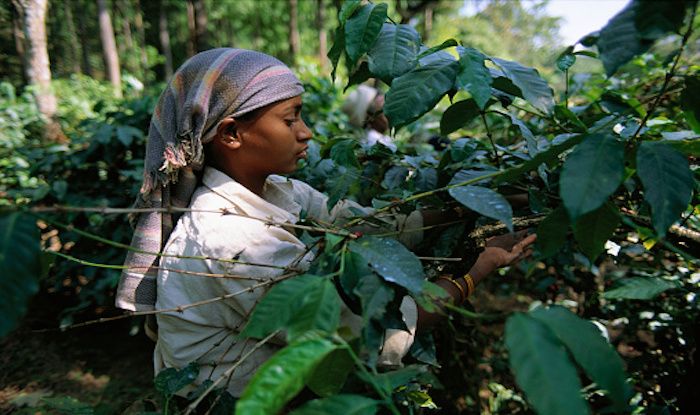
Image Courtesy: Getty
Apparently, Chikmagalur is first place where coffee was introduced in India. Located in the foothills of Mullayanagiri range, it is touted as the coffee land of Karnataka. Its geography and climate makes it one of the largest coffee estates in Karnataka followed by Kodagu, Coorg and Hassan. Kerehaklu Eco Retreat is a great place to stay at because it houses 275 acres of lush green coffee plantation.
Wayanad, Kerala
One of the green, beautiful hills of Malabar region, Wayanad is located in the mountains of the majestic Western Ghats. The pleasant climate here is responsible for the ever-green forests, flowing lakes, some amazing flora and fauna and of course a variety of coffee plantations. The main varieties in the region include Rubusta and Arabica.
Yercaud, Tamil Nadu
The small, young hill station is located in the Shevaroys range of hills in Tamil Nadu. Yercaud is known for its orange groves, and fruit, spice and major coffee plantations. A perfect place to stay is the Glenrock Tea Estates because it’s a property with a fully-functioning coffee estate, which means you can witness the entire coffee-making process with a tour of their plantation. The Nilgiris District, Coonoor and Kodaikanal are other places in Tamil Nadu known for their coffee plantations.
source: http://www.india.com / India / Home> News Travel / by Charu Chowdhary / September 26th, 2018
With donors from across the state contributing to CM’s Relief Fund, exclusively released to Kodagu district, over Rs 62 crore has been collected as on September 20.
Madikeri :
Following the natural disaster in Kodagu district, the numerous families that had lost houses and other properties were handed over Rs 3,800 – Rs 1,800 for clothing and Rs 2,000 for utensils and other household goods (per family)- under SDRF/NDRF guidelines.
Since the damage has been severe and the process of permanent rehabilitation will take some more time, the district administration including Deputy Commissioner Sreevidya P I and Kodagu District Minister Sa Ra Mahesh had proposed a request to the State government to increase the amount from meagre Rs 3,800/- per family to Rs 50,000, in a letter dated 28 August.
While the State and National Disaster Fund guidelines do not allow any changes to be made to the gratuitous funds, the state revenue department had stepped into people’s aid and had forwarded the proposal of releasing Rs 50,000/- each for the distressed families from the Karnataka Chief Minister Relief Fund-Natural Calamity 2018. The proposal, which was forwarded to CM H D Kumaraswamy was later forwarded to the Cabinet Committee for approval, which has now been sanctioned.
With donors from across the state contributing to CM’s Relief Fund, exclusively released to Kodagu district, over Rs 62 crore has been collected as on September 20. As many as 1,156 families have been directly affected by natural disaster and 186 houses have been damaged completely, 530 houses have been damaged severely and 404 houses have undergone partial damage.
While Rs 320 crore has been allotted to Karnataka under SDRF, an additional state fund of Rs 400 crore is provided to the state.
source: http://www.newindianexpress.com / The New Indian Express / Home> States> Karnataka / by Express News Service / September 22nd, 2018
The board has launched on pilot basis a number of tech measures to help the 3.66 lakh coffee growers in the country.
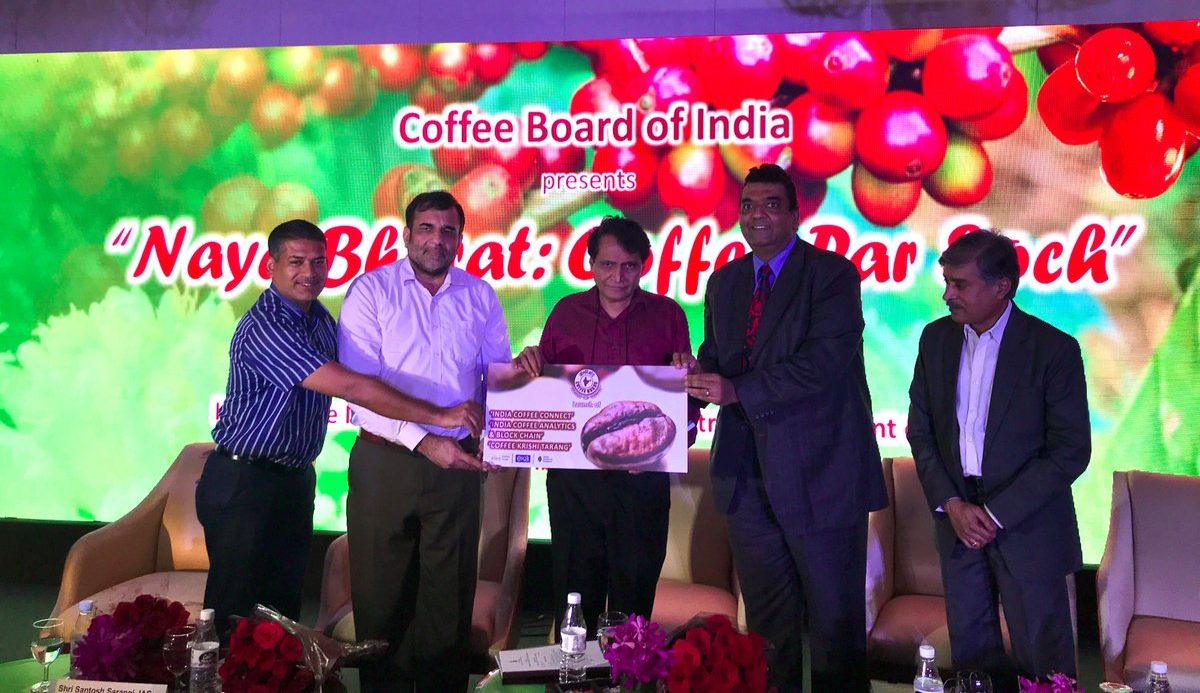
Suresh Prabhu (C) at the Naya Bharat event | @CoffeeboardI/Twitter
New Delhi:
Drones, geo-tagging and a number of mobile apps are among the technological measures the government-run Coffee Board is set to introduce to improve productivity and revenue.
The board, which is under the commerce ministry, set the process in motion last week, when Suresh Prabhu, the Commerce and Industries Minister, formally launched the ‘Coffee Connect’ app.
The app will collect data from coffee plantations in the country through inbuilt geo-tagging which will help generate information about plantation location, plant material and age.
“For the first time in the 75 years of India’s Coffee Act, 1942, we are trying to infuse new technologies that will enhance productivity and yield for farmers,” said Coffee Board Secretary and CEO, Srivasta Krishna.
Krishna emphasised on the need to grow “smart coffee”, using concepts such precision agriculture and smart agriculture to maximise yields from the existing coffee growing regions.
The board hopes that these technological measures will help increase profits of farmers, particularly in the export markets.
‘Way to hike profits’
According to Krishna, a cup of Indian coffee sells for $3 to $4 in the US, of which an Indian farmer gets only 5 cents. With technology, he said, this could rise to 10 cents.
The move comes amid fears that the next season could see the coffee output drop to its lowest in two decades due to the unprecedented rains in the two top crop producing regions in the country – Kodagu in Karnataka and Wayanad in Kerala.
According to a Bloomberg report, output in the year starting October 1 may be about 25 per cent lower than the 3,16,000 metric tons estimated by the Coffee Board for 2017-18.
Coffee is cultivated by 3.66 lakh coffee farmers in the country, 98 per cent of whom are small farmers. Typically, a small farmer is one who owns less than 25 acres.
Apps galore and a call centre
The ‘Coffee Connect’ app is among a number of apps that the board has already launched on a pilot basis.
The app allows users to get in touch with the coffee board’s extension officers, who provide services to coffee farmers.
At present, there are 170 Coffee Board extension personnel — or one extension officer per 2,153 farmers.
The app, officials hope, will enable better information exchange between Coffee Board personnel and those on the ground.
The board has also launched, on a pilot basis, a suite of apps to provide solutions to challenges in rainfall, pests and diseases.
Some of the app features are hyper-local weather forecasting, early detection of coffee crop pests such as the White Stem Borer and predicting the probability of Leaf Rust disease.
This app also has a blockchain-based market-place that allows coffee growers and farmers to directly deal with customers, including multinational firms.
“These are all wonderful efforts. These tech solutions, however, need more effort, and push from all stakeholders to make them really effective,” said Mohan Alwares, a coffee grower from Mudigere in Karnataka.
Alwares lauded the blockchain-based market but urged the board to increase awareness of it.
Rajeev Chaudhary, general manager and the chief risk officer, Agriculture Insurance Company of India, said such measures will hold the board in good stead.
“The Coffee Board’s various tech implementations including the pilot blockchain-based marketplace would make it a frontrunner among the other boards for crops in India. Other boards, however, will most likely follow suit”.
Drones Used
Another proposal that the board is exploring promoting is the use of drones in agriculture.
At the board’s event last Tuesday, several drone start-ups presented proposals, arguing that their use will improve the efficiency of pesticide use and spray.
“A farmer might take 2-3 hours to spray an acre with pesticide; a drone will do this in less than 10 minutes,” said Rahat Kulshreshtha, the CEO of the drone start-up Quidich Innovation Labs. “Using drones we found that 30 per cent less pesticide can be used and since it can be done remotely, farmers are saved from the harmful effects of direct contact with pesticides”.
Alwares, however, isn’t sure that drones will help in coffee plantations in India. “Unlike in Brazil where coffee is grown in open cultivation, in India coffee is largely a crop grown in shade,” he said. “If a coffee plant is 5 feet tall, there are trees as tall as 50 to 100 feet growing over it to provide shade. So I’m not entirely sure how drones can be used.”
Chaudhary of the Agriculture Insurance India foresees drones being increasingly used in other crops. He says drones for aerial surveillance will be especially helpful in monitoring high-value and high-risk crops such as cotton, groundnut, soybean and plantation crops like tea. Agri insurance companies will likely make more drone purchases he said, adding that Maharashtra leads the pack in this sector.
source: http://www.theprint.in / The Print / Home> Governance / by Regina Nihindukulasuriya / September 13th, 2018
Before the rains started, coffee planters in Coorg were talking of a good crop —the plants were well rested after a lean year and went through the process of blossoming and forming fruits. That settled, seasonal certainty is gone with the wind and merciless lashings of torrential rain.
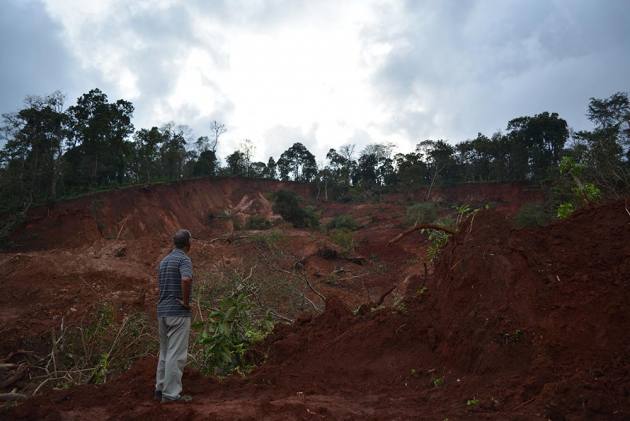
HELPLESS / A planter contemplates nature’s carnage where once existed a fecund patch / PHOTOGRAPH BY AJAY SUKUMARAN
A fully-done crossword puzzle is on the table next to Chitra Subbaiah who confesses that she could forego reading the newspaper, but not the crossword. We are in the cottage of a home-stay in Madapura, north Coorg, resplendent in the evening sun—the first day in two months that the rain has let up. It brings some relief from fear. Chitra, nearing eighty, recounts a painful experience with great fortitude. “You have to do some mental jugglery, you know. You can’t curse your fate.” She’s staying in a friend’s cottage because her home, in the neighbouring village of Hattihole, now lies beneath a pile of earth which slid down the hillside, burying everything she owned.
“Wiped out, totally. I don’t have one pin. There is nothing to say there was a house,” she tells Outlook. All she could reach out for in time were her spectacles, medicines and some gold the workers from her coffee estate had entrusted her with safekeeping. The workers’ quarters on her coffee estate too went down. Fortunately, they had time to move out. She points to others in the same situation. “At least I can rent a house and stay. What about so many others, who have nothing,” she asks.
Before the rains started this year, coffee planters in Coorg were talking of a good crop—the plants were well rested after a lean year and went through the process of blossoming and forming fruits.
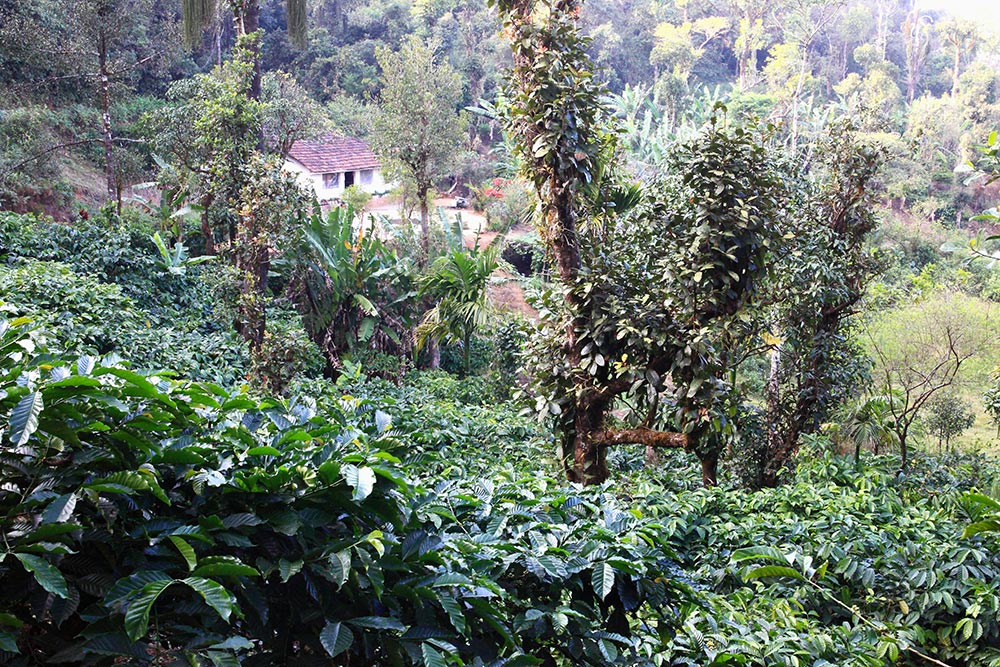
The scene at a typical Coorg coffee estate / PHOTOGRAPH BY GETTY IMAGES
That settled, seasonal certainty is gone with the wind and merciless lashings of torrential rain. It rained heavily through July and August in this region of south Karnataka bordering Kerala. Then, in late August, came a series of punishing cascades of sodden earth. Now, there’s a trail of ruin in these charming hills, where landslides have swept off whole villages, re-arranged estates and shattered its economy. With immediate rescue measures tapering off, one question hangs limply in the air: where do you start picking up the pieces?
“I can’t plant anything now on my land, that’s for sure,” says K.U. Erappa, standing in his camouflage gumboots in a relief camp inside Madikeri’s old fort where, grouped with several families, he has been staying for days now. “All that’s left of my coffee plants are just stalks,” Erappa says. His ageing mother walks up to say, “We had a small house, but it was pretty.” Their grief is palpable. Erappa owned a few acres of coffee and paddy in Mukkodlu, one of the hardest-hit places in north Coorg, in the vicinity of district capital Madikeri. Much of Coorg is remote, away from the main-travelled roads. Like others, Erappa has been going back to salvage what he could. His three children, like most kids from his village, have been sent away to a temporary residential facility in a school in Ponnampet town at the southern end of the district. “We never dreamt Coorg would come to this,” says N. Bose Mandanna, a planter from Suntikoppa.
Right now, a full picture of the damage isn’t available, though it is being estimated. Planters like Mandanna reckon that at least 5,000-7,000 acres have been wiped off in the landslides. For the plants still standing, there’s the danger of wet feet and black rot—water-logging at the base of the plant that strangulates it, causing leaves to fall off. “When leaves are lost, next year’s crop is also lost,” says Mandanna. Coorg, with about one lakh hectares in cultivation, accounts for close to 40 per cent of India’s coffee production. The 2017-18 post-blossom estimate was 1,33,500 metric tonnes, most of which is exported, Italy being a top destination. To make matters worse, prices, say market watchers, have been at historic lows. Brazil is harvesting a good crop this year and so will Columbia and Vietnam.
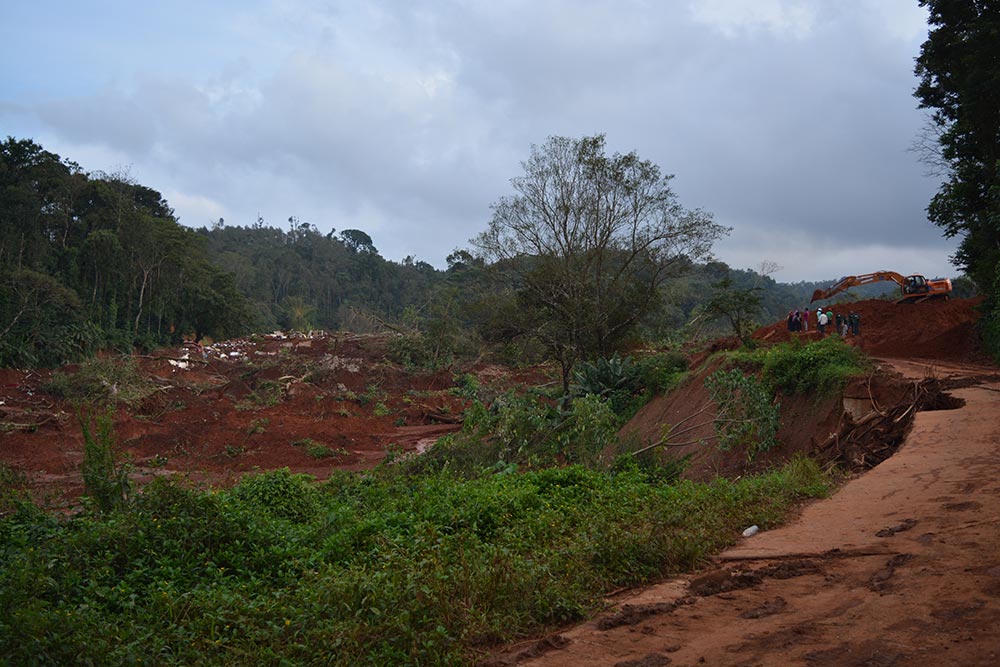
The desolation on the spot after the landslide / PHOTOGRAPH BY AJAY SUKUMARAN
“International prices have gone (down) to levels last seen in 2006. We are getting a lot less now, if you factor in the inflation,” says Ramesh Rajah, president of the Coffee Exporters Association. Prices depend on the big three producers—Brazil, Columbia and Vietnam—which account for over 70 per cent of the global production. “Only if there are supply shocks in the big three will there be impact in international prices. India can lose one third or even half its production and the international market is not going to blink,” says Rajah.
In the mid-nineties, Coorg coffee saw a boom when prices rose because of a supply shortage in Brazil whose production, apart from being vulnerable to frost, was considered inefficient then. The boom years lasted a decade until trends began to reverse. Owing to hilly terrain, Coorg can’t mechanise the way Brazil did. So, it has been grappling with high labour costs. Nor can other crops be sown, as coffee plants need trees for shade. Many Kodavas, as Coorg’s natives are called, concede the difficulty in maintaining plantations. The symptoms, many say, have been showing—an ageing population, a younger generation that has been migrating to cities and bits of land being sold to meet expenses, the latter contributing to a social churn in the highlands. This devastating blow came on top of all this.
The future, many say, is bleak. First, the question of land lost, by no means an easy task, given the complexities that involve verifying claims, boundaries and so on. “Let the government acquire the property. See the record, settle them,” says planter Mittu Chengappa, who’s also a Karnataka Congress general secretary. His suggestion, that the government acquire private land ravaged by landslides for afforestation so that owners can begin afresh elsewhere, has been voiced by many. Unlike neighbouring Chikmagalur—where coffee was first grown in India—there are more small growers in Coorg, many owning only a few acres.
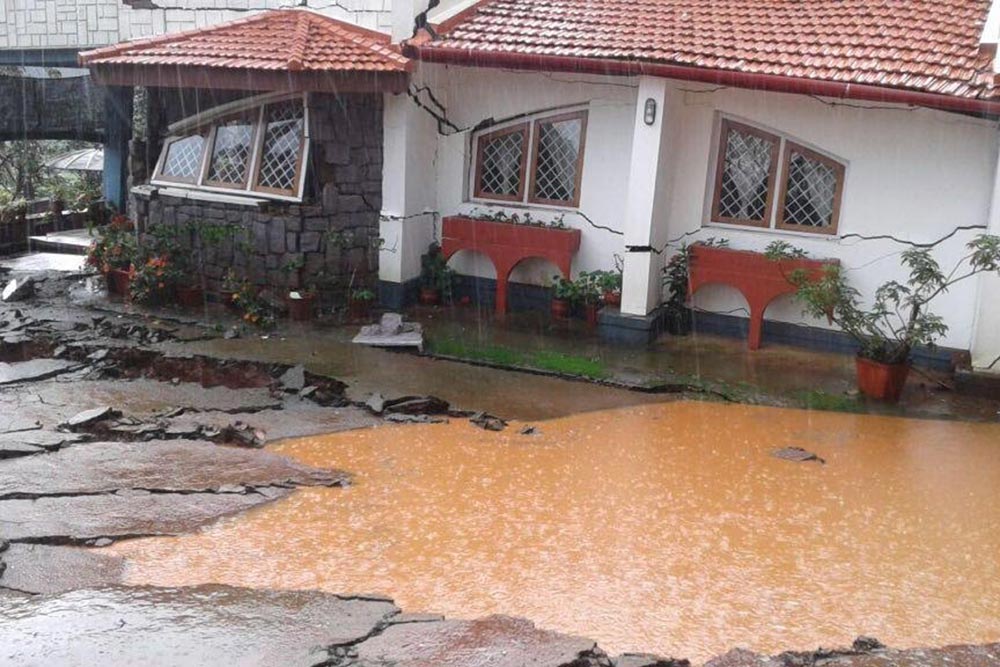
Chitra Subbaiah’s house in her estate in Hattihole village
Even for those who didn’t lose land, replanting will be a big financial burden, says Rajah. Besides the upfront cost, it would mean a five-year wait for yields. “So, how will they sustain themselves for five years? What does he do about infrastructure within the farm, workers’ houses, his house?” asks Rajah. Coffee planters have always weathered difficult years, but the destruction this year is unprecedented. “Some years, the crop yield is sharply lower because of lack of rain or excess rain. But this is the first time we have actually seen this sort of damage where infrastructure is damaged. It’s going to be very difficult in the short term,” reckons Rajah. In the long term, he says, every producing country is bleeding, so things can be pulled back to a degree by increasing efficiency. Of course, primary rehabilitation remains a priority; the process of replanting will take place slowly.
“The other thing is the labourers are not coming back. We are still in a state of flux, a dilemma as to what’s going to happen. There are a lot of issues, it’s very fluid,” says Nanda Belliappa, a coffee grower from Hattihole who has to now walk half a kilometre inside his property to reach his house, as the road leading to it is blocked. The Hatti, a stream outside his gate—where once a Malayalam film was shot—has beached fallen tree trunks ashore. “The neighbours’ coffee plants and trees are on our road…it’s unbelievable,” says his wife Anitha. In villages in these parts, the conversations go from rain to earthquake—many planters say they heard loud booms and felt tremors, but officials say no seismic event was captured.
Bose Mandanna too says he won’t be so pessimistic as to say that the coffee industry won’t claw back. But he’s doubtful about the prospects of a full recovery in North Coorg. “This area cannot come back in a hurry,” he says. Last weekend, as the evening drew on, Madikeri wore a deserted look—tourism has stalled and hotels are ordered not to take in travellers for some time. “Every night, there’s fear that the hill will come down on your head,” says Mandanna. The Kodava harvest festival Kailpodh, when they worship their guns, went by this week. Says Mandanna, “Nobody was interested in the festival. Coorg has become like a funeral parlour.”
source: http://www.outlook.com / Outlook / Home> The Magazine> Business / by Ajay Sukumaran / September 17th, 2018
Old-timers and environmentalists blame tourism for the devastating floods in Kodagu
Shattered hopes: As many as 1,206 houses and 278 government buildings were damaged in the Kodagu floods | Bhanu Prakash Chandra
IF THE RAINS had not wreaked havoc in Kodagu, Karnataka’s coffee country would be preparing for ‘Kail Murta’, a festival in which the Kodavas worship their weapons. But, the district, which got battered by flash floods and landslides that took 12 lives and rendered more than 1,500 families homeless, is now left with just one weapon: resilience.
On the midnight of August 15, torrential rains started pounding Kodagu. The hills cracked up and tumbled down, and the rivers swallowed everything on their way—century-old houses, brand-new homestays, tiny tea shops, lush green paddy fields, vast stretches of coffee plantations, forests, livestock, bridges and vehicles. Incessant rains submerged low-lying areas in Kushalnagar, Somwarpet and Madikeri, pilgrimage centres like Talacauvery and Bhagamandala, and major bridges like Bethri, while landslides along the national highways turned those into death traps.
By the time the district administration launched rescue operations, the communication lines were cut off and most villages had become inaccessible. Heavy rains, tough terrain and scattered habitations made rescue operations a daunting task even for the armed forces and the National Disaster Response Force. Many people were hungry and exhausted when the rescue teams finally reached them.
Manu Madappa from Mukkodlu village said around 40 people took refuge in his homestay for three days. But with no help arriving, they decided to trek to Madikeri. “We covered a distance of 20km, walking in the rain on a muddied path, and made it to a relief camp in Madikeri,” he said.
As many as 51 relief centres have been opened across the district, sheltering 7,594 people as on August 22. NGOs have ensured an uninterrupted flow of relief material to these camps. The Kodava Samaj in Bengaluru and Mysuru are the nerve centres for organising relief material.
Local MP Pratap Simha, who was part of the rescue operations, said the devastation was unimaginable. “Incessant rains prevented airlifting of stranded people although three Army choppers were on standby. After I sent an SOS to Defence Minister Nirmala Sitharaman, the Army unit from Karwar was rushed in,” he said. “The relief centres are working well, and our next big challenge is rehabilitation. We will need huge cash donations to rebuild homes.” According to the Karnataka State Natural Disaster Monitoring Centre, 1,206 houses and 123 kilometres of roads have been damaged, 58 bridges and culverts have collapsed, 278 government buildings and 3,800 electric poles and transformers have been severely damaged.
Chief Minister H.D. Kumaraswamy, who conducted an aerial survey, said the infrastructure damage alone amounted to Rs 3,000 crore. “A team of engineers from the Border Roads Organisation and the Army engineering task force have been called in to clear roads and restore them,” said Kumaraswamy. “A team from the National Geophysical Research Institute, Hyderabad, is conducting geotechnical studies to ascertain the causes of landslides. We have deputed two IAS probationers to fasten the process of identifying the lands for rebuilding 2,000 temporary homes.” he said.
The government has promised Rs 3,800 per family, along with essential groceries as immediate relief. The chief minister has promised the affected people work under the National Rural Employment Guarantee Act and offered to issue provisional documents for those who have lost their Aadhaar and ration cards and title deeds. “Rs 5 lakh will be given to the family of the deceased. Special classes and books for children are also being planned,” said Kumaraswamy.
The rainfall was unprecedented, but old-timers and environmentalists said the alarming plight of Kodagu was the fallout of the booming tourism industry. G.S. Srinivas Reddy, director of the Karnataka State Natural Disaster Monitoring Centre, said Kodagu received 103 per cent more rainfall than normal this year.
U.M. Poovaiah, editor of Brahmagiri, a Kodava weekly, said he had never seen or heard of such devastation in the history of Kodagu. “This is the fallout of unregulated tourism that has razed down the hills to make roads to homestays. The riverbed has been encroached upon. Unplanned construction has pushed the district to the edge. The authorities are to blame for the influx of tourists and atrocities against nature in this once-pristine district. We want unlicensed homestays and construction activity to be stopped,” said Poovaiah.
The Coorg Wildlife Society, too, blamed the severe stress on Kodagu because of the change in land use and unbridled tourism. In a letter sent last May to Prime Minister Narendra Modi, the CWS wrote, “Kodagu provides almost 50 per cent of the total inflow into Cauvery, which is the lifeline of South India, and provides water to over 80 million people and 600 major industries across the region. The food, water and economic security of southern India hinges largely on Cauvery River. It is therefore in national interest to preserve the Kodagu landscape and protect its ecosystems.”
Colonel (retd) C.P. Muthanna, president of CWS and co-ordinator of the Save Kodagu and Cauvery campaign, said more than 2,800 acres of paddy fields, coffee plantations and highlands were converted to residential layouts, sites, commercial complexes and resorts between 2005 and 2015. “Kodagu’s fast-paced urbanisation will turn it into a slum,” said Muthanna. Earlier this year, he had urged the Karnataka government to regulate tourism in the region and demanded an audit of water and waste and sewage management in the resorts. “While Kodagu has a population of 5.5 lakh, the number of tourists goes up to 13 lakh,” he said.
A report by the Centre for Ecological Sciences, Indian Institute of Science, Bengaluru, said massive deforestation and monoculture plantations caused the landslides. “Trees hold the top soil and also absorb and regulate the flow of rainwater. But deforestation for construction of roads and power lines have resulted in soil erosion,” said T.V. Ramachandra of the centre. “If the government wants to avert disasters, it should not take up any mega projects.”
source: http://www.theweek.in / The Week / Home> The Week> Cover Story / by Prathima Nandakumar / September 02nd, 2018
After rains, coffee planters in Kodagu are gripped by the fear of black rot disease and berry droppings. Spices like black pepper and cardamom produced in the coffee estates have also perished, beside paddy fields being washed away.
The district, which is known for its coffee production worldwide, may have abysmally low coffee and agriculture output this year. The coffee growers, especially small planters, will be hit by the black rot disease, increase in berry droppings and fungal disease to the crop.
Naj Chengappa, a coffee planter, said, “The disease will affect both Arabica and Robusta coffee due to excess rainfall. The most striking symptoms are blackening and rotting of the leaves and tender berries.”
The growers are already worried about falling coffee prices in the past two years. The diseases following the flood will add to their sufferings. Black pepper crop, grown extensively in coffee plantations in the district, also suffers from droppings and fungal diseases. Cardamom is grown in parts of North Kodagu. The crop has suffered heavy damages due to landslides and flood. “Since there is no proper sunlight in Kodagu for almost a month now, this will cause fungal disease to coffee, black pepper and cardamom grown particularly in the North Kodagu areas like Madikeri, Napoklu, and Somwarpet,” said Naj.
According to Kaibulira Harish Appaiah, president of Kodagu Growers’ Association, the rain this year has caused 60% loss for coffee and pepper crops in the district. “Due to rain-related disease to coffee, 98.5% small growers will be affected. The crop requires at least two years to recover from rain-related diseases.” “The government has to waive the loans of farmers and come out with relief packages to compensate for the crop damages,” he said. According to sources in the Horticulture department, an estimated 47,000 hectares of arecanut plantations have been affected due to heavy rain. Arecanut is majorly grown in DK, Uttara Kannada, Kodagu, Chikkamagaluru and Shivamogga. “The rain has caused fungal diseases in arecanut crop, which will affect the output this year,” said Y S Patil, horticulture department commissioner.
source: http://www.deccanherald.com / Deccan Herald / Home> State / by Darshan Devaiah B P, DH News Service / Bengaluru – August 22nd, 2018
A one-time fee for distribution in the US has become a drag on the profitability of Eight O’Clock Company, a coffee company owned by Tata Coffee Ltd, a subsidiary of Tata Global Beverages Ltd.
During an analyst call, Tata Coffee managing director and CEO Sanjiv Sarin said the impact on Ebitda is “a necessary one” and is largely driven by a listing requirement in the trade in the US for distribution.
“The temporary hit has happened,” said Sarin, without disclosing the quantum of the listing fee.
In 2017, Tata Coffee through Eight O’ Clock Coffee (EOC) had signed an agreement with Keurig Green Mountain, Inc. for manufacturing, sale, licensing and distribution of EOC coffee in K-cup pods for use in Keurig brewers.
Keurig had agreed to pay royalty on the sale of EOC K-cup pods in certain channels and EOC agreed to pay co-packing fee to Keurig in certain other channels, as per a regulatory disclosure in March 2017.
K Venkataramanan, executive director – finance, and CFO, while addressing the analyst call, said, “The new arrangement is kind of settling down”.
EOC, held through company’s overseas subsidiary Consolidated Coffee Inc, recorded higher sales with a total income of $39.64 million in the April-June quarter of the current fiscal compared to $28.86 million in the year-ago period, while the consolidated pre-tax profit for the quarter under review was lower at Rs 41 crore as against Rs 63 crore in the same period last year partially due to one-time exceptional expenses in the US operation, a recent press release said.
Meanwhile, profits of Tata Coffee were also impacted due to lower realisation from its tea and pepper segments. The company reported a consolidated net profit of Rs 31.22 crore in Q1FY19, a decline of 30.4% over the same period last fiscal.
Sarin said that pepper has been a focus area and a “strategic growth driver”.
According to him, the overall domestic production of pepper has exceeded by around 14% and Vietnamese pepper was trading at a significant discount to Indian origin pepper.
However, despite the minimum import price restriction of Rs 500 per kg, pepper prices have dipped from Rs 403 a kg at the beginning of the quarter to Rs 372 per kg at the end of the quarter, he said, adding that the market price drop has been quite steep and “has severely impacted profits”.
Tata Coffee announced its first quarter result on July 26. In a press release, the company had said the plantation segment has reported revenue of Rs.73 crore in the first quarter of the current fiscal as against Rs 74 crore in the year-ago period. The operating profit was Rs 5 crore in Q1FY19 as against Rs.18 crore in the corresponding period on the back of lower tea and pepper realisations.
Sarin also said that the weather in Annamalai, where its tea estates are located has been “extremely adverse”. Continuous rainfall has impacted crop output, and is “one of the major impacts on Tata Coffee’s overall quarterly profits”.
However, to mitigate the impact, it is maximising its bought-leaf operation and has also brought in multiple cost optimisation measures, Sarin said, adding that the strategic step of converting one of its crush-tear-curl (CTC) factories into orthodox has also helped garner better realisations.
Filling the cup
Eight O’ Clock had signed an agreement with Keurig Green Mountain for sale of its coffee in K-cup pods for use in Keurig brewersKeurig had agreed to pay royalty on sale of EOC K-cup pods in certain channels whereas EOC agreed to pay co-packing fees to Keurig in certain other channels.
source: http://www.dnaindia.com / DNA / Home> Business / by Soumonty Kanungo / July 31st, 2018
Chasing the perfect brew Sundar Subramaniam, Executive Director of Mirra’s Coffee | Photo Credit: S_SIVA SARAVANAN
As Mirra’s Idhu Namma Veetu Kaapi now steps into the new age with its latest filter coffee variants, we look back at the company’s 100-year-old legacy.
“I promise, you will keep coming back for more,” declares Sundar Subramaniam with a confident smile. The executive director of Mother Mirra Group of Companies offers me a fragrant brew, made with coffee powder from Mirra’s Idhu Namma Veetu Kaapi brand. The group recently launched three variants of filter coffee. It’s limited to retail in Tamil Nadu and Puducherry for now, but Sundar is bursting with plans.
“We are marketing Mirra’s Coffee with the line ‘I want you to buy my coffee once’… we plan to give away free brass coffee davara sets with every packet soon. And, there will soon be wet sampling at malls and stores.”
Mother Mirra’s Coffee has a 100-year-old legacy. It comes from the house of the first Asian planter, PPR Subramaniam (Sundar’s great-grandfather) and his Virakesari Plantations. PPR was an entrepreneur and journalist from Avanipatti village, in the Sivagangai district of Tamil Nadu. He also started Virakesari, the first Tamil newspaper in Sri Lanka in the 1930s, to give a voice to the rights of plantation workers.
“Back home, our community was often associated with the money-lending business. My great-grandfather set a new path. He moved to Sri Lanka at a time when plantations were still owned only by the British and the Scottish,” Sundar says with pride.
Later, PPR moved to Malaysia, where he bought more plantations. “My grandfather Sundarakesari continued the tradition and owned plantations in Coorg. My father S Subramanian followed suit,” says Sundar, now settled in Coimbatore.
Today, their plantation AA — or Premium Arabica — variety of beans is exported to countries within Asia and beyond. They also have a line-up of Arabica and Robusta with varying ratios of chicory content in them.
“Our wholesale market is thriving. We also sell online on Amazon, Flipkart, Paytm, and Big Basket, something I introduced after I took over in the last six months. My focus is on digital marketing. We are getting a good response from our active social media pages too.” The group has also branched into budget homes and service apartments.
“I did my masters in business marketing at Cornell University in New Zealand. I wanted to work abroad, but my father had other plans. He met me at Singapore and handed me my return ticket to Coimbatore,” laughs Sundar.
What followed was the launch of the retail brand. They added more German machineries to the factory at Coorg and introduced three new products — pure coffee (100% premium Arabica), premium filter coffee (with 15% chicory) and Gold (with 47% chicory). A network of 350 dealers ensures that the filter coffee reaches stores in Coimbatore, Madurai, Chennai and Puducherry. “In a couple of months, we want to start exporting to Singapore and New Zealand.” They also plan to enter the Sri Lankan market, from where it all began. A particular street in Colombo, from where Virakesari was born, still goes by the name Chettiar Street, to honour his great-grandfather.
Among new products, a green coffee is in the offing. Sundar also plans coffee counters at airports: where one can sow coffee, roast, grind and brew a perfect davara.
source: http://www.thehindu.com / The Hindu / Home> Life & Style> Food / by K Jeshi / July 20th, 2018
WELCOME. If you like what you see "SUBSCRIBE via EMAIL" to receive FREE regular UPDATES.
Read More »