Category Archives: Coffee, Kodagu (Coorg)

39% of India’s coffee is from Kodagu

Representative image / TOI

Madikeri :

Kodagu contributed 39% of India’s total coffee production with 1.37 metric tonnes (MTs) during 2015-16, according to post-monsoon estimates by the Coffee Board. The total area of coffee production in the district includes 76,953 hectares of robusta cultivation and 27,969 hectares of Arabica.

The estimates also revealed that coffee production in Karnataka touched 2.53 lakh MT, which is 72% of the country’s total production. Chikkmagaluru contributed 83,810 MT and Hassan 31,825 MT.

According to sources from the board, India’s coffee production during the period was 3.5 lakh MT, an increase of 7% from the previous year. Production of Arabica variety rose by 10% (9,800 MT), while the Robusta variety saw an increase of 5.76% (13,200 MT).

Contributions from other states include Kerala – 68,650 MT, Tamil Nadu – 18,125 MT, Andhra Pradesh – 9,100 MT; Odisha – 600 MT and north eastern states – 185 MT.

The total area of coffee cultivation in the country stands at 4.23 lakh hectares, of which 2.30 lakh hectares is in Karnataka.

source: http://www.timesofindia.indiatimes.com / The Times of India / News Home> City> Mysore / TNN / July 09th, 2016

Indian Writer Gets Gourmand Award for World’s Best Book on Coffee

City-based freelance journalist and author P T Bopanna’s book ‘The Romance of Indian Coffee’ has been chosen as the world’s best book on coffee at The Gourmand World Awards function at Yantai in China.

The book, earlier shortlisted for the finals of the ‘Best in the World’ books under the ‘coffee books’ category, was picked from the entries of 64 countries, according to Bopanna.

‘The Romance of Indian Coffee’ was published in 2011, and takes a 360-degree view of Indian coffee.

The final results were announced recently in which the book was ranked first, followed by entries from the United States and Brazil in the second and third places respectively, Bopanna said in a release here.

Spain headquartered The Gourmand International every year honours the best food and wine books, printed or digital, as well as food television with the awards open to publishers in all languages and countries.

The Gourmand Awards celebrate global cookbook and wine book publishing, and feature many world-renowned chefs each year.

Bopanna has authored five books and runs a few Kodagu-centric websites and recently produced a documentary film titled ‘Discover Coorg’.

source: http://www.outlookindia.com / Outlook / Home> The Newswire> Books & Culture / PTI / June 28th, 2016

Starbucks Plans to Debut Small-Lot Coffee From This Tea-Growing Country

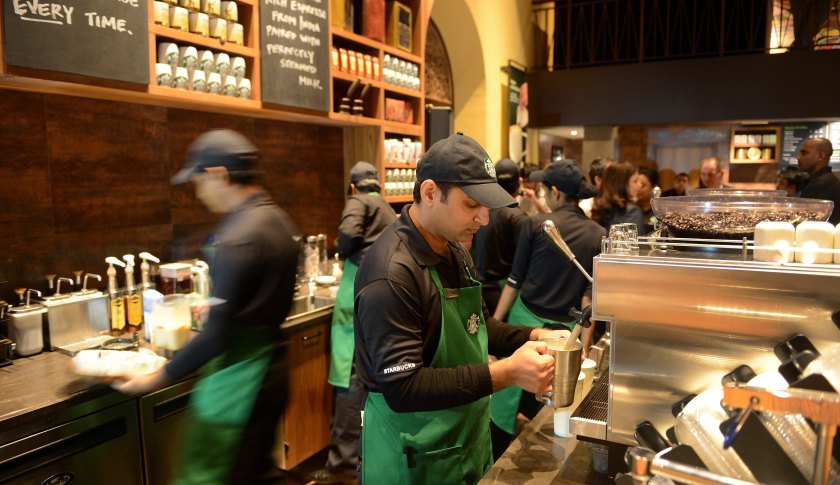
Staff work behind the counter of India's first newly-inaugurated Starbucks outlet in Mumbai on October 19, 2012.  / Photo-  PUNIT PARANJPE/AFP/Getty Images)
Staff work behind the counter of India’s first newly-inaugurated Starbucks outlet in Mumbai on October 19, 2012. / Photo-
PUNIT PARANJPE/AFP/Getty Images)

It’s also one of the coffee chain’s fastest-growing markets.

Starbucks for the first time will sell single-origin, premium coffee from India in the United States as part of its effort to support coffee production in the country better known for its tea.

Starbucks SBUX -0.23% for a limited time later this year will sell a small-lot arabica coffee from the Tata Nullore Estates in India’s Coorg coffee growing area. The coffee will be roasted and sold at Starbucks’ Reserve Roastery and Tasting Room in Seattle. The price was not disclosed.

John Culver, group president for Starbucks Coffee China/Asia Pacific, told Reuters that the aim is for this to be the “first step in what we hope will be many reserve coffees coming out of India.”

It’s also one of the coffee chain’s fastest-growing markets.

India, which produces both robusta and arabica, is the world’s sixth-largest coffee producer. Its coffee output has increased 16% over the past 5 years, according to International Coffee Organization (ICO) data.

India’s estimated 2015/16 harvest is expected to be 5.83 million 60-kg bags of coffee, according to ICO.

The country is one of the coffee chain’s fastest-growing markets. Starbucks’ India, an equal joint venture between Starbucks and Tata Global Beverages Limited, has grown to 84 stores across six cities in India since its start in 2012.

Starbucks India, which so far has served only 100% arabica coffee grown and roasted in India, will also begin offering Kenyan and Sumatran coffee soon, Culver said.

source: http://www.fortune.com / Fortune / Home> Retail> Coffee / by Reuters / June 27th, 2016

Coffee from Coorg to find its way into Starbucks in Seattle

CoorgCoffeeKF27jun2016

Mumbai :

Coffee grown at the Tata Nullore Estates located in Coorg will now be available at Starbucks in Seattle. This is the first time Starbucks will offer a single-origin coffee from India in the US.

This is part of the multiple new initiatives decided in a meeting between the Chairman and Chief Executive Officer of Starbucks Coffee Company, Howard Schultz, and Chairman, Tata Sons Ltd, Cyrus Mistry, at the iconic Starbucks Reserve Roastery and Tasting Room in Seattle.

“For the first time, Starbucks will offer a single-origin coffee from India in the US, giving customers from outside the country a unique opportunity to experience a rare, small-lot coffee from the Tata Nullore Estates located in the beautiful Coorg coffee growing area of India. Starbucks Reserve Tata Nullore Estates will be the first coffee from India to be roasted at the Starbucks Reserve Roastery and Tasting Room and will only be available at this Seattle location later this year,” said a press statement.

Starbucks also announced plans to increase its coffee roasting capacity for supplying its stores in India and, over time, select markets around the globe. Since Tata Coffee Ltd opened its doors to a roasting and packaging plant in Kushalnagar in Coorg, Karnataka, in 2013, this facility has steadily increased its roasting capabilities. Today, it roasts the Starbucks India Estates Blend and Espresso Roast coffees and will soon expand to include both Kenyan and Sumatran coffees for Starbucks stores throughout India.

“We are proud to work with Starbucks, a company which shares our commitment to both the coffee growing regions and the coffee farmers to ensure we meet the global demand for high-quality coffee over the long-term,” said Mistry.

Starbucks also announced it will soon take flight on Vistara, India’s fastest growing full-service airline, later this year. Starbucks’ fresh brewed coffee service will be exclusively available on all Vistara flights. A joint venture between Tata Sons and Singapore Airlines, Vistara operates more than 457 flights weekly to 17 destinations across India and, in June celebrated the milestone of flying two million travellers.

Starbucks will also extend its Teavana specialty tea brand to India this December. Starbucks also plans to expand the availability of Himalayan Mineral Water, bottled by Tata Global Beverages, beyond Starbucks stores in India to Singapore later this year, as the companies explore opportunities to introduce the bottled water brand to stores across Starbucks China and the Asia-Pacific region.

Schultz and Mistry committed to come together to provide young people in India valuable skills training over the next five years through Tata STRIVE, an initiative aimed at arming youth with skills for employment, entrepreneurship and community enterprise.

source: http://www.thehindubusinessline.com / Business Line / Home> Companies / The Hindu Bureau / Mumbai – June 27th, 2016

Scientist brews a green idea to give coffee growers their due

Arshiya Bose, founder, Black Baza Coffee

Bengaluru:

Verdant forests, picturesque mountains, lush coffee plantations — for many, Coorg is the perfect place to unwind. However, it was a different quest which took Arshiya Bose to the coffee land. A PhD holder in geography and environmental science from the University of Cambridge, she visited Coorg as part of a research project. Her mission — to make coffee production environment-friendly.

Realizing not all is well with the current production process — use of pesticides, exploitation of farmers, growth of coffee in the sun instead of shade — Arshiya, 32, started looking for ways to make it sustainable. She wanted to address these problems by adopting a holistic approach that ensures the well-being of both the environment and the coffee producers. The result — Black Baza Coffee, an entrepreneurial idea currently being incubated at the NS Raghavan Centre for Entrepreneurial Learning (NSRCEL), IIM Bangalore. The centre mentors innovators and supports their ventures.

During her research, Ashriya got the opportunity to work with forest dwellers and tribal communities in the Western Ghats, which helped her get closer to her goal. “I studied the social and environmental impacts of coffee production and found there were a number of problems no one was doing anything about. Traditionally, coffee in India has been grown under the shade of trees. But now, it is grown directly under the sun’s harsh rays, which adversely impacts biodiversity. Also, the trade market is extremely unfair to the producers, with the exploitation levels being very high. To fix the loopholes in the social and environmental ecosystem, I started Black Baza Coffee,” said Arshiya, who has tied up with many producers.

So far, the Kolkata resident has got 35 coffee producers on board, of whom 31 are marginal farmers from Biligiriranga Hills in Chamarajnagar. All of them are small growers —they own farms spanning less than 25 acres. “Under our partnership, we promise to buy coffee from farmers, support them through agronomic training and quality improvement and build safeguards for unforeseen price crashes. Many small growers are exploited and we hope to be the most fair buyer of their product ensuring they get their due,” said the young entrepreneur.

Explaining the potential of the idea, professor Suresh Bhagavatula, chairperson, Entrepreneurial Ecosystem Development, NSRCEL, IIMB said, “Coffee is among the top five most popular legally traded products in the world, including oil. It is a $90 billion industry and supports about 75 million people. While India is among the top 10 coffee-producing nations, it accounts for about 3.5% of the world exports. Unlike the rest of the world where sustainability and fair trade are becoming important for consumers, it is yet to catch on in India”.

“Black Baza Coffee would like to market the produce from farmers who practice sustainable methods for production. Consumption of coffee in India has started to increase, which will make it more feasible for ventures such as BBC to be established and serve the local markets as well,” Suresh added.

MUTUAL BENEFIT

We make conversational agreements with farmers and enter into a mutual understanding with them to grow coffee under certain kinds of trees, restrict the use of pesticides and protect their water resources. In return, Black Baza Coffee guarantees to buy coffee from these farmers at a higher premium

source: http://www.timesofindia.indiatimes.com / The Times of India / News Home> City> Bangalore / Shilpa Baburaj, TNN / May 25th, 2016

Pre-monsoon rainfall perks up coffee growers

To restrict further crop damage caused by dry weather

Bengaluru :

The recent pre-monsoon rainfall in key coffee growing regions of Karnataka and Tamil Nadu is expected to help restrict damage to the 2016-17 crop, which has been impacted by the prolonged and higher than usual temperatures and delayed blossom showers.

The rainfall over the past few days has provided some relief to growers of arabicas, the premium and mild coffee variety, besides being seen as beneficial for the pepper crop, largely grown as a key intercrop in the coffee estates and arecanut plantations in the region.

“The plantation districts of Coorg, Chikmagalur and Hassan have received widespread rains over the past few days. The rainfall will help contain the damage caused by the delayed arrival of blossom showers,” said Baba PS Bedi, Chairman of the Karnataka Planters Association.

Blossom rain

Timely arrival of pre-monsoon showers is crucial for the blossoming of the coffee floral buds. Traditionally, the robusta and arabica variety growing areas should receive pre-monsoon showers for a good blossom by March 15 and April 15 respectively.

However, the blossom showers were delayed this year and were erratic in some areas, thereby hurting the prospects of the robusta variety. “It is too early to quantify the impact of delayed showers on robustas,” Bedi said.

Though some growers had taken up sprinkler irrigation for the robustas, the inadequate availability of water due to deficient rainfall in the last two years did pose a challenge to them. The coffee growing regions started receiving widespread rainfall from the first week of May, and some regions continue to receive rains. “It rained even today,” said N Bose Mandanna, a large grower in Suntikoppa near Madikeri in Coorg, on Thursday.

The rain has helped Arabica blossom and the crop should be good, provided there is no significant incidence of the pest – the white stem borer, Mandanna said. However, the delayed rainfall has already hurt the prospects of robustas in some areas, which cannot be reversed.

“It has been raining in most of the growing areas in Karnataka where coffee has blossomed,” said Y Raghuramulu, Director of the Balehonnur-based Central Coffee Research Institute. The rain should help in setting of the crop. Even the coffee growing areas of Tamil Nadu have received rain since last week, which is very good for the arabica crop, he said.

Crop estimate

“If only the rains had arrived two to three weeks earlier, there would not have been much impact,” Raghuramulu said, adding that the Coffee Board has started the estimating the crop size for 2016-17 based on the blossom, which is likely to be finalised by end-June.

After two years of good harvest, coffee is facing an off-year for the 2016-17 season starting October. The Coffee Board has estimated the 2015-16 crop at 3.5 lakh tonnes, a 7 per cent increase over the previous year’s 3.27 lakh tonnes.n

source: http://www.thehindubusinessline.com / Business Line / Home> Economy> Agri-Business / by Vishwanath Kulkarni / May 12th, 2016

For the love of coffee

Is the modern day coffee cultivation threatening our biodiversity? Read on to find out how you can responsibly source your favourite morning cuppa

It’s the quintessential breakfast drink, the morning elixir, the ambassador for good days and the one drink with absolute power to wake you up. Yes, our morning cuppa coffee is what we all look forward to wake us up from a slumber hangover.

But, what if we didn’t have coffee anymore? Or, if the modern day production of coffee is impacting forests and wildlife, in turn, affecting our consumption? Alarming isn’t it?

ArshiyaBoseKODAGU03may2016

Arshiya Bose has set out on a quest to responsibly source coffee without making an imprint on our environment. She started Black Baza Coffee in an attempt to save biodiversity. Technically, coffee is grown under a marquee of trees.

But, because of deforestation, coffee is now grown under direct sunlight, giving way to monoculture which affects our biodiversity levels drastically. “After my Ph. D., I started spending time at coffee landscapes in India, mostly Coorg,” says Arshiya, a wildlife scientist.

“We found that compared to other parts of the world where forests had been clear-felled to grow coffee, India had retained forest trees and planted coffee underneath the shade of these trees. This meant that coffee farms in India have supported all kinds of beautiful biodiversity for decades. The challenge arises because, since the 1970s onwards, many farms have been removing shade trees in the hope of better coffee yields. The trade-off here is that the yields of coffee are actually higher when coffee is grown under direct sun (which is why in high coffee producing nations like Brazil, Vietnam etc., there are no shade trees). This was the problem we were trying to address. How can we make it economically viable for farmers to grow a more ecologically-friendly coffee?”

The first step involves identifying farms in places like Kodagu and B.R. hills, based on factors like potential of the farm to support biodiversity and willingness to participate in conservation projects. A conservation agreement is then drawn up with the farms that include maintaining 100 trees per acre, protection of water sources, restricting the usage of chemical pesticides and maintaining 60-80 per cent shade cover which means no cutting of tree branches.

“In 2009 I met a young scientist – Claude Garcia, a French, who spoke fairly good Tamil,” recalls Arshiya. “He told me: ‘if we can’t achieve biodiversity-friendly farming with coffee we probably can’t achieve with any other farming system either’. That sentence stuck on as I believe that coffee is the perfect crop to experiment with. Coffee gets the attention of people and then becomes a way to engage someone who previously never cared about conservation. I always say: we want to bring conservation to everybody’s breakfast table.”

Black Baza Coffee is already available at natural and health food stores, where they partner with like-minded cafes and institution who would want to serve great coffee with a story.

The bean cause -  Working together for that perfect cuppa
The bean cause – Working together for that perfect cuppa

Aesthetic packaging and cheeky questions on their cover makes Black Baza Coffee a unique product. “What does moth-friendly coffee taste like?” “What does Otter-friendly coffee taste like?” – are some of the questions you get to see on their packages. “All of our coffee varieties are a tribute to the charismatic plant and wildlife species that share the Western Ghats landscape with coffee,” says Arshiya, “For example, the Otter coffee comes from two riverside farms in Kodagu where we are protecting the Cauvery River from effluents and degradation of riverside vegetation. The Luna Moth is a magnificent indicator of ecological health as well. So while we could test our coffees in the lab for chemical residues etc. (which we do), we also go out to the farm and count Luna moths or Ficus trees or Otters because these species tell us the whole ecological picture – lab tests don’t tell us whether farms are biodiversity-friendly or not.”

Black Baza Coffee now works with 30 farmers and there are over three lakh small-medium growers in India. While Arshiya isn’t sure about the future of the model in India, she is positive and fiercely relentless about being a major coffee player that makes biodiversity-friendly coffee a household staple instead of an exception.

source: http://www.thehindu.com / The Hindu / Home> MetroPlus / by Rehna Abdul Kareem / May 03rd, 2016

Bangalore Based Startup – Aromas of Coorg, Brewing Business with Coffee

When Friedrich Durrenmatt once said “It is surely easier to confess a murder over a cup of coffee than in front of a jury.” he quite simply put across the magic of a good cup of brewing coffee!

AromasofCoorgKODAGU29apr2016

Fresh, strong, steaming hot and hassle-free service are some of the words which come to your mind when you think of coffee and vending serivces, and these very words are the part of Aromas of Coorg’s philosophy.

In conversation with Abhilasha Dafria for YourStory, A.Chithra Uthappa, co-founder of Aromas of Coorg, tells us how they, at AOC, are full of fresh ideas, believe strongly in quality and customer satisfaction and have the best designed products for their customers so that they get the maximum value for their money.

Afterall, science may never come up with a better office communication system than the coffee break!

Hi Chitra, tell us about yourself and an introduction to Aromas of Coorg

Aromas of Coorg has been in business of Beverage solutions since 2009 & coffee cultivation for more than 3 decades. Our passion is to provide the most technology driven, innovative beverage solutions to both businesses and consumers.

I, A.Chithra Uthappa, am the founder & Managing Director of Aromas of Coorg and I’m an MBA from MIT MAHE University, Manipal and B.B.M From Mysore University. I have worked with large corporates like Kotak Mahindra Bank, Aditya Birla Minacs and iSeva/e4e. All my corporate roles have been with fast growing sunrise industries and have played significant roles in building the businesses and growing the companies to the next level. In my last assignment with the start-up open2save, I was a key team member and was instrumental in setting up new business channels ground-up.

Radhakrishnan M, my co-founder & Head of Operations is a seasoned professional with over a decade’s experience in large corporate before he set-up his own company, Aromas of Coorg. He has worked with large corporate like Dell, Infosys, Manpower Inc. etc and has extensive experience in building and managing businesses including sales, building teams and organizations. He is an MBA from Loyola College, Chennai and B.Sc. from Madras University.

So what triggered this idea?

There are four important factors that made our idea into a company, ie, My husband’s passion and support for my entrepreneurship, my son, our roots from Coorg and the corporate exposure.

First and foremost, to become an entrepreneur was always the dream of my husband and me … this is what we wanted to be. I was on sabbatical for my child and during the break; I conceived the business idea too! We decided that this would be the right opportunity to start something on our own sitting at home. This is where it all started.
We are basically from Coorg and we have been into coffee cultivation for more than three decades. This was the primary driver why we chose to build something unique in this space and we thought out of the box. Having worked with corporate for more than a decade we understand this world well and we were able to quickly identify the opportunity.

Thus the birth of “Aromas of Coorg”, as we wanted our company to bear the name “Coorg” in some part and also wanted a name where our targeted customers can easily relate to it. Quite naturally the first thing that attracts anybody to any form of food is the “Aroma”. That is how we finalized on the name “Aromas of Coorg” and this also marked our entry into the beverage solutions for corporate, institutions, etc.

Since when are you operational? How big is your team? Are you looking at hiring?

We are fully operational since August 2009. We are currently a 40 member team. Yes, definitely, we are looking to strengthen our sales force and simultaneously our operational support staff will have to go hand in hand with every new client that gets added.

What is your clientele like?

We service range of clients like large corporate across multiple cities to a one location company as well. We have a well spread out client base across industries and geographies.

Where are you based and where are your clients from?

We are based in Bangalore and are currently supporting clients in Bangalore, Mysore, Tumkur, Nelamangala, Hosur and Chennai. However, we are not present in retail segment at this point of time.

Where do you have your manufacturing units? Which cities do you provide the home-delivery services?

Our manufacturing unit is also in Bangalore; currently we provide home delivery service only within Bangalore city limits.

How does the supply chain work?

We are currently able to manage the supply chain internally, our raw materials are procured from different locations and the respective vendors manage the supply chain of the respective products. All these products come to our processing units in Bangalore from where the supply of finished products to the respective clients is managed by full time employees of AOC. Machines are manufactured under our complete supervision.

Did you fund-raise to start up? If not, are you looking at getting funded now?

We used our personal money and angel money. We are looking to get funding for our future expansions.

How does the revenue module work?

We work both on variable and a fixed pricing model where clients can pay based on usage or based on usage+ a fixed monthly costs. The pricing model is designed with the motive of win-win for us and clients.

So what were the challenges you faced while starting up? Tell me about your initial hurdles.

First and foremost challenge was how to differentiate ourselves from the others; there were several big brands and more than enough small vendors. We really had to come up with a differentiator from the existing. This is the stage were we re-invented our traditional filter coffee. The wave of western form of coffee was so popular that everybody is racing towards the Cappuccino, Espresso, latte, etc.

Timing was tough; given it was the time of deep recession, all around you there were companies going under losses, almost all the corporate were planning for major cost cutting, and so on. It was also very difficult for us to penetrate the companies with our new concept and service offerings.

Of course our innovative thinking helped us make good inroads. We took this to our advantage and came up with our very own filter coffee which is truly Indian, especially south Indian, and presented to the corporate the first of its kind fully-automated Vending machines which serves authentic filter Coffee and freshly brewed Tea. In our very first Demo we knew that we hit the nail on the head with our concept.

Are there other players in the market doing similar things? What are your key differentiators?

Yes there are several big names in the market providing beverage service, Coffee day, Fresh & Honest, Tata Cafe, Hindustan lever, etc. Our USP is our focus on technology, our zeal to innovate and our relentless passion for quality. Our Vending machine is the first its kind which is fully automated to serve freshly brewed authentic filter Coffee & freshly brewed Tea on a single press of the button. We are the first company in India to build coffee vending machine with both HOT & COLD option in the same machine. We are looking at adding more features around quality assurance here.

Our Coffee is a blend of six varieties of finest coffees beans hand picked from our own cultivation and we apply expert science, combined with traditional artistry, in order to maximize the flavor attributes of each roast. Our coffee roasting process is tuned to develop coffee flavors to the fullest for flavor profile, aroma and overall character in the cup. These factors make us the pioneers and front runners in providing the most hygienic and finest Coffee but at the same time affordable vending service provider in the market today.

Can you share with us some interesting trends about the market that you are trying to capture?

The market is looking for continuous innovation and personalization as much as possible.

An interesting trend is enhanced customer awareness and focus on health drinks like badam milk, green tea, milk shakes, horlicks etc. In some clients these new drinks are consumed lot more than traditional tea and coffee.

What are the challenges of scale in this business and how do you prepare to cope with them?

The biggest challenge in scaling is to maintain the same levels of service and quality. This is B2B2C market and end consumers decide what they finally like to drink. Having a continuous feedback loop and connection with end consumers is another critical aspect of this business.

Where and how do you see yourself going ‘bout this?

We aim to build our company to PAN India multi format Beverage Company. To serve 1 lacs cups a day is our immediate 12 months target.

For more information, please visit their website: http://aromasofcoorg.com/

– Abhilasha Dafria

source: http://www.yourstory.com / Your Story.com / Home> Entrepreneur / Team YS / by Abhilasha Dafria / December 30th, 2011

Coffee Growers Feel the Heat

Somwarpet :

The rising temperatures and a lack of rain have caused a desperate situation for coffee growers.

According to an estimate, nearly 30 per cent of the coffee plantations received blossom showers during March and April, while the remaining 70 per cent are yet to receive the first rainfall.

This situation might have a bearing on the prices of coffee and pepper in the coming season.

Last year, the total production of coffee in the country was 3.5 lakh tonnes while the district produced around 1.6 lakh tonnes of coffee, on an area of 1.10 lakh hectares. According to sources, this year, coffee production will be reduced by at least 20 per cent, due to insufficient and delayed rain, as well as rising temperatures.

Madikeri Coffee Board deputy director Ananth Kumar said delayed rain adversely affected young coffee plants and crop this year.

He said the Coffee Board will conduct pre-monsoon surveys in the month of May every year, to ascertain the production.

He said growers should maintain shade in estates, as temperatures had risen to 32 degrees in some parts of the district, causing dryness of soil.

In some dry areas where annual rainfall is below 50 inches, young plants wilted and died, even under the shade of trees.

In Banavara, Abburkatte, Yedavare and Yedavanadu, coffee growers are worried about crops wilting and dying. Coffee grower M L Ravi from Aigoor said growers are in distress owing to falling prices of coffee, and that delayed rains have added to their woes.

He said last year 50 kg Arabica coffee sold at Rs 10,000-Rs 10,200, but now, the price had fallen to Rs 8,200.

source: http://www.newindianexpress.com / The New Indian Express / Home> States> Karnataka / by Coovercolly Indresh / April 22nd, 2016

Delayed blossom showers, rising mercury rob coffee crop of aroma

CoffeeKF20apr2016

Bengaluru :

The unusually high temperatures and the delay in arrival of pre-monsoon or blossom showers could shrink the robusta coffee crop for the 2016-17 season, starting October.

Growers in the key regions of Coorg and Chikmagalur are concerned over the delay in pre-monsoon showers, crucial for blossoming of the coffee floral buds, and fear that it could impact robusta output by up to a fourth.

Blossom showers and subsequent backing showers are crucial for a good crop. Traditionally, the robusta and arabica areas should receive pre-monsoon showers by March 15 and April 15, respectively, for a good blossom.

“The blossom shower has been very sporadic and scanty this year and it is definitely going to affect the crop, both robusta and arabica,” said Baba PS Bedi, Chairman of the Karnataka Planters’ Association.

“Small growers, who cannot afford to take up sprinkler irrigation, are going to be hit hard,” Bedi said, adding that the planters’ association will soon urge the State government to take up cloud seeding to create artificial rain in the key growing regions.

Water crisis
Though most of the robusta area is irrigated, with growers deploying sprinklers to irrigate their estates without waiting for the blossom showers, the lack of sufficient water storage this year has turned out to be a cause for concern.

Two back-to-back droughts triggered by successive deficient monsoons have created water stress thereby affecting the availability for irrigation, Bedi added.

“The delay in blossom showers and the prevailing unusually high temperatures across all the growing regions is a real cause of worry. It will have a significant impact on the crop loss, but it is too early to quantify the impact,” said Y Raghuramulu, Director of the Balehonnur-based Central Coffee Research Institute (CCRI).

The Coffee Board is expected to take up crop assessment sometime in mid-May.

In addition, the depleting shade pattern in some areas is aggravating the problem this year, Raghuramulu added.

“The situation is terrible in South Coorg. With temperatures ruling 2-3 degrees higher than normal, there is a fear of coffee plants dying in some areas,” said N Bose Mandanna, a planter in Suntikoppa, near Madikeri. About 30 per cent of the robusta area is impacted by the delayed rainfall, he added.

“The overall situation is not comfortable. Though it has rained in some pockets, the quantum of rainfall is not sufficient. The water stress and high temperatures will affect the blossom, thereby impacting the crop,” said Nishant Gurjer, a planter in Chikmagalur.

Plants under pressure
Another factor that could affect the output this year is stressed out plants. “In the last two years, we have been picking some good crop. As a result, the plants are relatively stressed and the output could be impacted,” Gurjer added.

The Coffee Board has estimated the 2015-16 crop’s output at 3.5 lakh tonnes, a 7 per cent increase over the previous year’s 3.27 lakh tonnes.

source: http://www.thehindubusinessline.com / Businessline.com / Home> Economy> Agri Business / Vishwanath Kulkarni / Bengaluru – April 19th, 2016