Category Archives: Coffee, Kodagu (Coorg)

Weak economy spurs demand for low-priced coffees

Drop in prices hurts realisations even as shipments see 18% growth in March quarter

coffeeKF29mar2016

Bengaluru :

Sluggish economic conditions in part of Europe and West Asia is triggering demand for the low-priced coffees such as the robusta cherry and instant varieties as consumers in these regions are seen shifting to the cheaper beverage, exporter said.

The trend is reflected in the increased shipments of these varieties from India over the past three months.

Higher shipments
“We are noticing a trend that buyers in Europe and the Gulf Countries are seen buying more of cheaper coffees than in the past,” said Ramesh Rajah, President of the Coffee Exporters Association.

The shift in preference in the Gulf nations could be influenced by the drop in oil prices.

Permits rise
Total coffee permits issued by the Coffee Board for the January 1-March 24 period were up around 18 per cent at 90,274 tonnes (76,567 tonnes in corresponding last year), primarily driven by a surge in shipments of robusta cherry and the instant variety.

Permits issued for robusta cherry were up 32 per cent at 40,618 tonnes (30,756 tonnes), while for instant coffee shipments including that of re-exports, the permits issued were up 13 per cent at 25,299 tonnes (22,416 tonnes) for the period.

For the robusta parchment or the washed robusta, which command a premium in the world market, the permits issued dropped around 23 per cent to 5,822 tonnes (7,595 tonnes).

Changing preferences
However, the premium variety arabica parchment saw an increase in demand at 15,099 tonnes (11,837 tonnes).

Coffee Board officials also attributed the increase in demand for robusta cherry and instant coffee to some extent to the shift in consumer preferences to cheaper varieties in markets such as Europe.

An early harvest of robustas has also contributed to the increase in shipments as more coffee was available for exporters with growers, especially the smaller ones, preferring to sell their produce as prices continued to remain volatile.

An official with a global trading house attributed the jump in the January-March quarter shipments to an early robusta crop this year and also to the front-loading of sales by the producers, wherein growers sold off their produce as soon as it was ready to sell a few weeks ago.

But now, the market arrivals have slowed down as growers – especially the larger ones – are beginning to hold back their produce, the official said.

The harvest of robusta is complete and the growers, especially the Arabica producers are looking forward the blossom showers in the week ahead.

Export realisations
Though the March quarter shipments have been good, the earnings are likely to be under pressure due to lower prices.

The per tonne realisation has dropped considerably to ₹1,55,077 in March quarter as compared to ₹1,77,660 in the corresponding period last year.

Exporters are a bit sceptical of sustaining the growth trend in shipments in the year ahead.

“The near term order books are good, but there is slackness in the medium to long-term,” Rajah said.

The Coffee Board has pegged the 2015-16 crop at 3.5 lakh tonnes – a seven per cent increase over the previous season’s 3.27 lakh tonnes.

source: http://www.thehindubusinessline.com / Business Line / Home> Economy> AgriBusiness / by Vishwanath Kulkarni / Bengaluru – March 28th, 2016
Planters feel relieved as Karnataka scraps agriculture income tax

Bengaluru :

In a relief to the beleaguered coffee, tea and rubber growers in Karnataka, the State government has proposed to abolish the agriculture income tax with effect from April 1, 2016.

“There is a long standing demand of growers of coffee, tea, rubber and other plantation crops to abolish Agricultural Income Tax. I propose to abolish Agricultural Income Tax with effect from 1st of April 2016,” Karnataka Chief Minister Siddaramaiah said presenting the State Budget for 2016-17 here on Friday.

With this, Karnataka, the largest coffee producer, has followed the neighbouring Tamil Nadu, which had abolished agriculture income tax way back in 2004. Even Kerala has provided a relief to the planters community by exempting the income tax for a year in 2016-17.

Karnataka’s latest move will provide relief to about two dozen companies such as Tata Coffee and Bombay Burmah Trading Corporation that operate coffee, tea and rubber plantations in the State besides thousands of individual coffee growers. Plantation companies had to pay a 35 per cent tax on their net income in the State and the total outgo in the State is estimated at around ₹20 crore.

“It is a good news for the plantation industry and will give us a boost,” said Baba PS Bedi, Chairman of the Karnataka Planters’ Association (KPA). Bedi further said the proposed move would provide some relief for the plantation sector that is becoming unviable, reeling under the impact of declining realisations and rising input costs.

Though Karnataka had suspended the agriculture income tax for individual growers way back in 2004 when the coffee prices had touched a 100-year-low of around 0.40 cents per pound, the growers had to wait for the notification every year exempting the income tax. “It was a kind of Damocles Sword hanging on our head. Now, with this budgetary announcement, we need not have to worry at all,” said N Bose Mandanna, a large grower at Suntikoppa.

K Kurian, Managing Director of Devon Plantation & Industries Ltd, said the move would help the plantation companies to re-invest in developing their estates in the long run.

Besides providing a higher allocation of ₹4,344 crore to the agriculture department, Karnataka is targeting to distribute ₹11,000 crore in agriculture loan to 23 lakh farmers in the State. To implement the new crop insurance scheme during 2016-17, the State has earmarked ₹675.38 crore.

source: http://www.thehindubusinessline.com / Business Line / Home> Markets> Commodities / by The Hindu Business Line Bureau / March 18th, 2016

Is 100% FDI in coffee a boon or a bane?

Coffee growers in Kodagu, Chikkamagaluru and Hassan districts are, however, apprehensive.Many want to know the measures taken to protect small and marginal farmers, who constitute 90% of growers in Karnataka.

Bengaluru :

When coffee growers in Karnataka were going through a rough patch due to labour shortage, elephant menace and unprecedented fall in prices, the Centre in November last year allowed 100 % FDI in five plantation crops: Coffee, rubber, cardamom, palm oil and olive oil. The decision, meant to rejuvenate the sector, is expected to have a huge impact on Karnataka, which accounts for 70% of India’s coffee production.

As of now, 100% FDI is allowed only in tea plantation. “Relaxed FDI norms will help coffee and cardamom growers since it is expected to bring in big overseas investors and retail giants besides enhanced technology utilization, automation, research, management and production of value-added products. Permitting foreign investment will also boost India’s coffee exports offering better prices for growers here, ” says Coffee Board chairperson Leena Nair.

Coffee growers in Kodagu, Chikkamagaluru and Hassan districts are, however, apprehensive. Many want to know the measures taken to protect small and marginal farmers, who constitute 90% of growers in Karnataka. Some coffee growers’ associations are holding talks to oppose the move as they fear small growers would be forced to sell their estates to foreign investors. Their entry may prove detrimental for small coffee planters, who may not be able to match the wages and technology of foreign players.

“The Centre should have held consultations and allayed fears before allowing FDI. But they have done in it in a hush-hush manner and kept us in the dark, making us believe that there is a hidden agenda,” says NK Pradeep, a Coffee Board member from Chikkamagaluru. Former Coffee Board vice-chairman Sannuvanda Kaverappa says a parliamentary committee that visited Chikkamagaluru last year to interact with coffee growers left in a huff. Nair allays all fears of growers saying: “The small-grower segment need not worry as enough safeguards have been provided and the Centre and the state government can always reject any FDI proposal in their segment.”

A Coffee Board executive says FDI will benefit coffee growers. The measure is expected to make the coffee industry vibrant like the tea sector, which opened gates for foreign investments in 2002. “Rather than starting a new venture, foreign investors may partner with existing plantations or trading companies. FDI will help boost developmental activities such as replanting, rejuvenation and R&D that need huge funding. It may also help in upgradation, modernization and automation of coffee-processing, curing, marketing,” he adds.

source: http//:www.retail.economictimes.indiatimes.com / ETRetail.com / Home> Industry / February 12th, 2016

Bean there, drone that… Coffee planters for an eye-in-the-sky to assess crop health

CoffeeKF06feb2016

Coffee plantation owners keen to use drones to assess crop health

Mumbai:

Enabled by unmanned aerial vehicles (UAVs), drones are leading agricultural data collection and facilitating precision analysis in agriculture globally, helping to improve crop yield.

Though the use of drones by civilians is as yet restricted in India, speakers at a recent coffee seminar urged the government to allow these hi-tech machines to help detect the health of the crop.

Apart from their military use, millions of farmers across the country could use drones and the new emerging technology to boost production and efficiency in their farms.

“We are on the cusp of a new era of farming, where precision agriculture practices can offer a new approach to crop management. We now have a technique that wrings out waste and uses data to maximise crop yields and profits. UAV technology is reshaping farming,” said Jaisimha Rao, coffee plantation owner and entrepreneur.

Game changer

Passionate about technology and agriculture, Rao noticed the lack of data-driven decision making while working on his family’s coffee plantation. He decided to combine the versatility of UAVs and computers, and ensure algorithms to analyse crops. Aiming to bridge the gap, Rao, who holds a Bachelors degree in Electrical and Computer Engineering from the Carnegie Mellon University, founded TartanSense. The company uses UAVs to capture and analyse aerial imagery.

Blanket restrictions

“Flying drones and gathering data is a game changer for agriculture, and especially for large plantations like coffee. How we can use this technology in India is the moot point, since the Directorate General of Civil Aviation (DGCA) has restricted the use of drones,” he said.

Pointing out that the “blanket restriction by the DGCA to operate drones would kill the enthusiasm of start-ups” such as his, Rao said his drones had worked in Indonesia, Japan as well as in the US, with drones costing upwards of $100,000.

Speaking about the new technology, Sanjiv Sarin, Managing Director and CEO, Tata Coffee, who was moderating the talk, said, “We are entering the future of the coffee industry. The Coffee Board can work for government clearances to use drones in agriculture.”

Though coffee is shade-grown among silver oak trees, Rao said, “drones will soon be able to look at a tree and avoid it. Over the next 6-12 months, we are going to have an UAV that can fly under the canopy, measure each and every coffee bush and get data for the planter. Canopy penetration will be the true essence of precision farming.”

Big data

Agricultural drones are UAVs used for precision agriculture, which is a modern method of farming globally that uses big data, aerial imagery and other means to optimise efficiency.

The drone collects the crop’s image and makes a colour coded map based on its health, which is then assessed by the UAV firm.

Drones are helping assess the exact nature and area of crop damage during natural calamities, and are helping save huge amounts.

Stating that a lot of people are fascinated by drones, Rao said the real value add “is not the hardware, which is about how to fly them and get the data, but to analyse it and benefit the farmer.”

Detailing the functioning of the UAV, Rao said, “Our drone flies for about 20 minutes, and then the battery is dead. It can survey about 150 acres. We send the images up to the cloud, and can then stitch the data into a nice map. Once you get the image and sensor data in a map, one can get an actionable report and help the farmer. This is where the real skill lies.”

source: http://www.thehindubusinessline.com / Business Line / Home> Economy> Agri Business / by Amrita Nair-Ghasalla / Mumbai – February 05th, 2016

Rajpath redolent with the aroma of coffee country

CoffeeKODAGU05feb2016

Bengaluru :

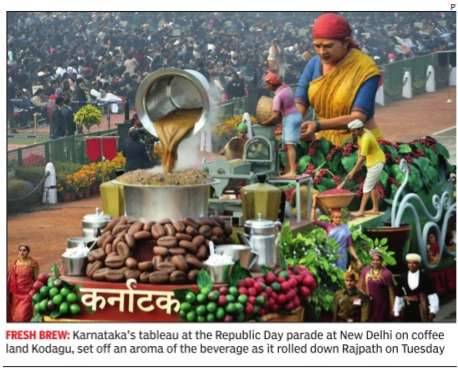
The flavour of Kodagu permeated the Republic Day parade in New Delhi as Karnataka’s tableau rolled down Rajpath. The tableau `Kodagu, The Land of Coffee’ was one of the star attractions at the parade.

The tableau didn’t just grab eyeballs, it filled the chilly Delhi air with the delightful aroma of freshly brewing coffee. This was done using a gas container to blow coffee essence into the air.

The tableau was a thematic presentation of litterateur HL Nage Gowda’s Kannada literary work `Bettadinda Battalige’, which means “from the hills to your cup”.

As it neared the VIP enclosure at the parade, Union minister DV Sadananda Gowda stood up to cheer, prompting wife Datty to join in. He was followed by minister HN Ananth Kumar and wife Tejaswini, who clapped loudly as it passed by. Eight women and two men from Kodagu danced, while a couple dressed in traditional Kodava attire walked along. Coffee plants, the harvest, grinding and mixing coffee at different levels of production, were some of the depictions.

HomelandKF05feb2016

source: http://www.timesofindia.indiatimes.com / The Times of India / News Home> City> Bangalore / TNN / January 27th, 2016

Flavour of Kodagu coffee at international contest

‘The Romance of Indian Coffee’ is the Indian entry to the Gourmand International (Book) Award this time

The jacket of the book ‘The Romance of Indian Coffee’ written by journalist P.T. Bopanna.

The Indian entry to the Gourmand International (Book) Award this time is on what until recently was a south Indian addiction: coffee.

With the coffee culture proliferating across India, thanks to chains like Starbucks, Barista and Café Coffee Day, the routine act of consuming the black decoction stirred in milk, as most people do, and with or without sugar – which again is a personal choice – has acquired an uber-cool image among the Gen Y.

Bengaluru-based journalist P.T. Bopanna has brought alive this unique trait in his book The Romance of Indian Coffee , now shortlisted for the Gourmand International Award, where it will vie for the top honours among coffee books from Brazil, France, China, Thailand, and the U.S., to name a few.

Hailing from Kodagu, which is the home of coffee in India, it was natural for Mr. Bopanna to feel inspired to write on the brew which has a universal appeal.

“My earlier works were Kodagu-centric, but I found a wider canvas in coffee which is also related to Kodagu,” said Mr. Bopanna.

“The book traces the history of coffee in India with interesting titbits about the brew and how its cultivation in the shade lends it a unique flavour, unlike coffee grown in the open in most other countries,” explained Mr. Bopanna, who believes that making coffee is an art. Notwithstanding the proliferation of coffee bars, the best filter coffee, he said, was still prepared in the bylanes of Chennai and elsewhere in Tamil Nadu.

The contribution of Ivor Bull, a British planter, who introduced intercropping and is a legend among the locals, has been highlighted in the book as also recipes for making coffee liqueur.

But ironically, he notes that Kodavas, who market home-grown coffee to the rest of the world and have spanned a coffee culture in India, have taken after the British and prefer tea!

There are entries from as many as 64 countries for the Gourmand awards, started in 1995 as a celebration of global cookbook and wine book publishing. The final results will be announced on May 28 at Yantai, China.

source: http://www.thehindu.com / The Hindu / Home> National> Karnataka / by R. Krishna Kumar / Mysuru – January 31st, 2016

TUMMY TRAVELS – Coffee break in Somwarpet

It is a nerve-jangling bus ride to this Coorg town, named for its ‘Monday market’, but there’s a headily fragrant perfect cup at the end of it

If I have a hunch I take it seriously. Although my Kannada skills are somewhat limited, I figure that Somwarpet, the name of a tiny town in Karnataka’s Coorg hills, means ‘Monday market’. So being a bit of a shopaholic, I naturally decide to go there on a Monday.

As the bus rattles along winding jungle roads and occasionally through vast coffee plantations, past villages, and on narrow bridges across rivers flowing rather lazily, I worry a little. The only guidebook I found that mentioned Somwarpet was the 1870s’ Gazetteer of Coorg, according to which, “Though fully alive to their material interests, the town-people have little desire for or perhaps little faith in education after European fashion. They seem to be quite content with the knowledge of their bazaar-routine. Every Monday there is a market, hence the name of the place.” But that was when the population was 953, which has now grown to 7,218, and I have no way of knowing whether the Monday market tradition has been discontinued and replaced by modern supermarkets. The one thing I do know is that it’s a major Arabica growing region of India (at least according to Wikipedia), which for any coffee lover is a good enough reason to head that way.

The bus gets impossibly crowded, with more people piling in the closer we get to Somwarpet. An exasperated dad offloads a clutch of toddlers into my lap and for about an hour I have the poopers crawling all over me. Luckily, before there is a stampede, the bus reaches its destination.

The small town sits on a ridge surrounded by scenic, green hills. Its handful of criss-crossing streets is lined with tiny shops and old bungalows. The large, partially covered market dominates the centre. Here one gets pretty much everything from fresh produce and spices, bakery products and fried snacks, to homemade pickles, poultry and vegetables, plus things like detergents, clocks, rechargeable torches, and even clothes sold in big piles. One section is devoted to dried fish and there’s a pungent smell in the air — like walking around in a huge kitchen.

For such a small town, the market is humongous and I stroll in its crowded lanes, rapt. I seem to be the only tourist in town. Small girls turn their heads, point and giggle.

Watching the food on display makes me ravenous. I go up the main street and spot a few veg and non-veg eateries, a biriyani joint, and ancient seedy bars housed in ramshackle bungalows. But I need something more substantial than bar snacks, and I don’t quite want to wolf down my grub at a shared canteen table either, while the next customer waits for me to vacate my seat; so I turn and head downhill instead, towards the Madikeri Road. After a three-minute walk, I discover Hotel Saphali Family Restaurant adjacent to a coconut plantation. It appears to be the only proper restaurant hereabouts — meaning it has menu cards and clean restrooms.

It does not disappoint. The Coorg-style pork fry (₹100) is cooked in a very homely manner and a chicken masala with a stack of Kerala parathas comes at ₹140, plus one can have a big bottle of chilled beer for ₹100. Don’t let the local drunks put you off, for it simply seems the done thing in Somwarpet to begin tippling by noon — at least on market days. And what better way to start the week than by sharing a bottle with mates? I hear the increasingly boisterous banter from the booths surrounding the dining hall (which I have to myself). The only word I catch yelled frequently is ‘politician’. Mondays in Somwarpet can be quite a ball.

After this sublime, leisurely lunch, it is shopping time. A couple of coffee mills uphill from the bus station beckon. One is surrounded by a heady fragrance of roasting coffee. At the tiny Someshwara Coffee Works, the proprietor Mr Kumar is busy running both the roasting oven and the grinder at the same time, his shirt-front brown from coffee powder. I learn that his family has had the mill for 50 years and they have a plantation where they grow only Arabica.

Full of beans: A farmer at a coffee plantation in Coorg

While other mills offer you blends of Robusta and Arabica (and chicory), Kumar deals exclusively in Coorg Arabica. I request 2kg pure. As he grinds half of it ‘nice’, meaning fine ground, I pull out a thousand-rupee note thinking that this is going to cost a bomb, when Kumar suddenly turns and says, “520.” Then he changes his mind —“Give 500.”

I find it hard to believe that quality coffee can come as cheap as ₹250 a kg. But the scent, powerful and rich, is promising and indeed, the coffee, once I brew myself a mug at home, turns out to be the best I’ve tasted. Sipping, I’m totally blissed out. Over the next couple of weeks, it rattles my brain awake in the mornings; the sheer fragrance jumpstarts me. I realise I will have to keep returning to Somwarpet whenever my stock runs out. No matter that I have to spend hours in a jungle bus with random toddlers on my lap. It’s worth it.

Zac O’Yeah is a Bengaluru-based travel writer, literary critic and author of ‘Hari A Hero for Hire’, a comic thriller; zacnet@email. co

source: http://www.thehindubusinessline.com / Business Line – BLINK / Home> BLINK> Takeaway> Tummy Travels / by Zac O Yeah / December 18th, 2015

Green Coffee Benefits: Just Another Healthy Reason to Drink Up

greencoffee01dec312015

Whether sipped early morning to get you out of bed or downing a cup with a late-night dessert, you’ll have to agree that there isn’t a more universally loved hot beverage than coffee. Taste is a personal thing, so it’s never right or wrong. But the perfect cup is all about choosing the right beans. I found an exciting new variety that you might have not discovered yet.

The coffee bean has an adventurous life. They are actually seeds enclosed in a red berry. These are extracted and roasted that lends the incredible taste and aroma. When left in their raw form, they are used to produce green coffee. These seeds are not roasted; instead they’re soaked and then concentrated in an extract. “As natural is the flavour of the season, green coffee gets its share of limelight but in some cases roasting brings out certain oils within the bean, which enhances the nutrient profile. In its pure form, green coffee has a low caffeine content which makes it healthier,” says Mr. Radhakrishnan, Coffee planter and Coffee powder manufacturer, Aromas of Coorg, Bangalore. It’s true. This masterpiece in your mug can do more than making an optimist out of you.

greencoffee02dec312015

Why green is good

Green bean coffee extract became popular in 2012 after it was mentioned in the Dr. Oz show as a ‘magic weight- loss cure’. When roasted, coffee beans undergo numerous chemical changes. Their antioxidant levels increase, but the powers of a natural substance called chlorogenic acid decrease. This chemical is known to affect post-meal blood sugar levels, boost your metabolism, curb carb absorption and block fat accumulation – all of which aid weight loss. The chlorogenic acid content is higher when coffee beans are in their pure, natural form.

For some, drinking brewed green coffee may not be pleasant as it is slightly bitter than your regular, roasted coffee and therefore the extract is often used to make supplements. While pills and powders have never convinced me, the jury is still out.

“Green coffee might have a hand in slowing the rate of glucose release in our blood. If they are consumed before your meal, the chlorogenic acid reacts with the food and controls the amount of glucose we synthesize. This way it builds your metabolism that can lead to weight loss when coupled with a balanced diet and adequate physical activity. Everything is best when taken in its fresh and whole form as the synergy between various compounds present in the food makes it the most effective,” says Dr. Rupali Datta, Chief Clinical Dietician at Fortis-Escorts Hospital in New Delhi.

Don’t confine yourself to the hot fix. “Apart from the fact that there are claims that green coffee helps in weight loss, the simple fresh flavour of the brew can itself be quite refreshing. A good way to enjoy the young flavour of the green bean extract is to make a version of a virgin mojito out of it. Crushed ice, juice from half a lime, sprigs of fresh mint, cane or palm sugar, and some of the green coffee extract – all roughly muddled together can be an excellent day time drink,” suggests food writer and enthusiast, Priyadarshini Nandy.

She adds, “And for gym rats, a fresh smoothie to start your day is always a good idea. To make it vegan use something like almond milk, add brewed green coffee, a banana, some dates, maybe even a bit unsweetened cocoa powder, a few ice cubes and blend it on high speed. It can give your system a happy boost of energy after a workout.”

source: http://www.food.ndtv.com / NDTV Food / Home> Opinion / by Sivaganga Vasudeva, NDTV / December 30th, 2015

Tata Global launches instant coffee brand to compete with Nescafe, Bru

Tata Coffee Grand was jointly developed by Tata Global Beverages and group firm Tata Coffee , which manufactures the product, TGBL said.

Mumbai :

India’s second largest tea maker Tata Global Beverages has forayed into instant coffee business in the country by launching Tata Coffee Grand, which will compete with Nestle’s Nescafe and Hindustan Unilever’s Bru.

The instant coffee brand was jointly developed by Tata Global Beverages (TGBL) and group firm Tata Coffee, which manufactures the product, TGBL said on Monday.

The coffee beans will be primarily sourced from Tata Coffee’s plantations in South India, popular for producing Arabica and Robusta blends.

At present, the maker of Tata Tea and Tetley brands earns over 70% of its sales from tea brands while coffee business accounts for 20% through brands like Eight o’clock and Grand outside India.

source: http://www.retail.economictimes.indiatimes.com / ETRetail.com / Home> Food & Entertainment / ET Bureau / November 30th, 2015

Coffee Board of India releases job employment notification: Apply for 62 various posts

The Ministry of Commerce and Industry, Department of Commerce, Govt of India, Coffee Board of India has released an employment notification, inviting interested and eligible candidates to apply for the positions of Junior Liaison Officer and Extension Inspector through direct recruitment.

Vacancy details

Total posts: 62

Name of the posts:

Junior Liaison Officer: 20

Extension Inspector: 42

Eligibility criteria

Educational qualification:

Junior Liaison Officer: The candidates interested in applying for this post should have done graduation in Agriculture or Horticulture preferably with specialisation in Agricultural Extension preferably M.Sc. (Ag) in Agricultural Extension.

Extension Inspector: The candidates interested in applying for this post should have done graduation in Agricultural or Horticultural Sciences or Graduation in Science with Botany or Zoology as one of the subjects.

Age limit:

Junior Liaison Officer: The age of the candidates applying for this post must not exceed 30 years.

Extension Inspector: The age of the candidates applying for this post must not exceed 27 years and must be minimum 18 years.

Relaxation in age will be provided as per the government norms.

Selection procedure

An interview will be conducted for selecting the candidates.

Pay scale

Junior Liaison Officer: The selected candidates will be getting a consolidated monthly salary of Rs 6,500 to Rs 10,500.

Extension Inspector: The selected candidates will be getting a consolidated monthly salary of Rs 5,200 to Rs 20,200 with grade pay of Rs 2,800.

How to apply

The candidates interested in these posts are required to apply online at ‘indiacoffee.org’ for these posts. No other mode of application will be entertained.

Important dates

The last date for applying online is November 11

The last date for paying the application fee is November 23

source: http://www.indiatoday.intoday.in / IndiaToday.in / Home> Education> Government Jobs> Story / New Delhi – November 03rd, 2015