Hello Folks! Sorry for being absconding for this long, got caught up in the hustle of life
Anyways, here is a fresh one and I believe its perfect to make up for the “disappearance”.
The end of 2017 was a crazy one, exhausting honestly. So to rejuvenate I planned a trip to Coorg, I have heard so many good things about the place I had to see it by myself.
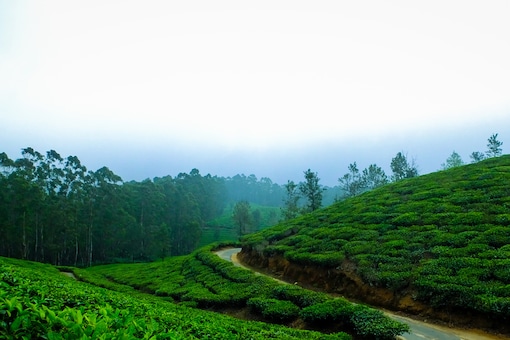
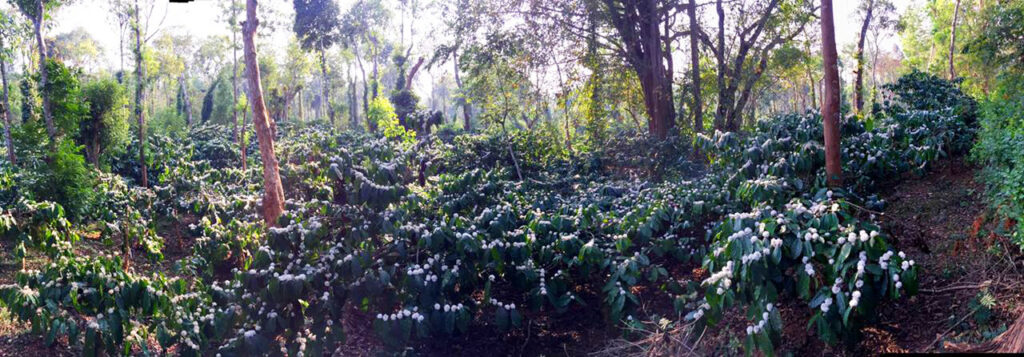
Trust me it was one of the most beautiful experiences I have ever had on a trip. The place is blessed with breathtaking landscapes and wildlife. The sun rises with the lush green view of the coffee plantation that goes on for stretches is mesmerising.
Coorg is synonym to coffee and being a coffee lover I wanted to explore. Luckily enough I had a chance to meet Mr. Bharath who runs a coffee plantation there. He is certified by coffee board of India as a Roaster and Barista and also we are members of SCAA. A very passionate man who treats coffee as his treasure.
As I went around with him exploring the coffee estates I witnessed how much love, passion and hard work goes into our early morning cuppa.
To make the best coffee available to all of us as fresh as it can get Bharath has started an online portal http://www.crazybeancompany.com/ where Natural processed coffee is available. The best part of it all is that the order can be custom roasted and grounded as per your requirement. I had to share the details afterall we all deserve our good blissful cup of coffee.
In his words –
“Farmers by birth, roasters by choice and business people by accident. We love our food and drink and we enjoy making it for others as well. There’s an old saying- “if you’re good at something don’t do it for free” so we started The Crazy Bean Company.
We can tell you that our farm in the heartland of Kodagu is irrigated by a freshwater spring, fertilised by wild animals and birds, the fruits are serenaded by classical music and caressed of their stems on maturity. Well, the classical music part isn’t true everything else is. We also follow modern, scientific and sustainable methods of farming, which means absolutely no pesticides.“
So here you go guys! Hope I am helping out some of my travellers & coffee loving friends.
Cheers !
source: http://www.apurvapriyadarshini.wordpress.com / Home> Shoe-Syrup-Shushi / posted in ‘ On the Road / by Apurva Priyadarshini / December 25th, 2017
Price of robusta coffee has dropped due to supply shortage and global factors.
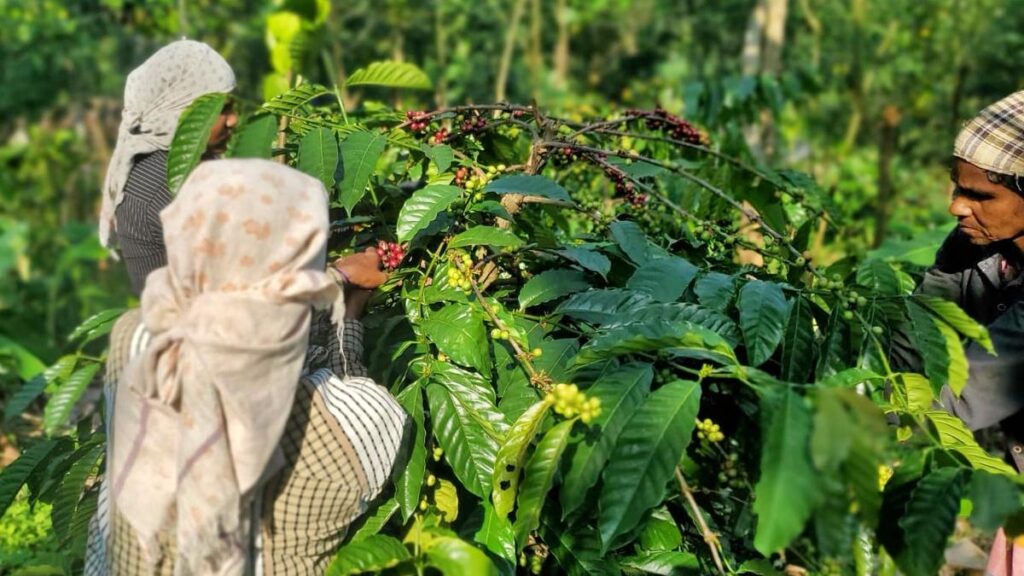
Farm workers harvesting coffee beans at a plantation in Wayanad district of Kerala. | Photo Credit: E.M. MANOJ
The robusta coffee farmers in south India are jubilant post-harvest with their produce fetching an all-time high price.
The farmgate price of raw robusta coffee berries touched a record ₹172 a kg in Wayanad market on Saturday, as against ₹115 a kg during the corresponding period last year. Meanwhile, spot price of robusta coffee beans stood at ₹315 a kg, up from ₹210 during the same period in 2023. The price was ₹80 and ₹145 a kg for raw berries and beans respectively in March 2022.
Though the harvest is almost complete, there has been a huge shortfall in the supply of coffee to the market this year, thereby contributing to the increase in coffee prices, says sources.
Multiple factors
“We expect a decline of 30% in the production of robusta this year owing to climatic vagaries, especially the scanty blossom shower in robusta growing regions last year,” sources said.
A sharp decline in production of robusta coffee — nearly 2 million bags — in Vietnam, a major Robusta coffee growing country, has also attributed to the increase in price, the sources added. Robusta coffee production in Indonesia too dipped sharply this year, the sources added.
Notably, the price of Arabica variety of coffee has dropped below the price of robusta coffee. The farmgate price of the Arabica variety coffee was ₹305 per kg on Saturday. Though the Arabica variety always fetched a premium price in the market, it is the robusta variety that is witnessing an increase due to its low availability for the first time.
Farmers suspect that the production may decline by 25% to 30% next year too owing to a dearth of backup showers in many robusta coffee growing areas in the country.
Wayanad in Kerala, which is the largest robusta coffee producing district in the country after Coorg in Karnataka, received a rainfall of 29.3 mm in the first week of January. Major parts of the district received no rain since then.
The January showers helped in the blossoming of robusta coffee plants, farmers say. But the absence of backup showers, a major factor in the formation of berries, is a concern.
According to Coffee Board of India, the total production of coffee in the country during the 2022-23 fiscal was 3,52,000 tonnes, including 2,52,000 tons of robusta coffee.
source: http://www.thehindu.com / The Hindu / Home> News> India> Kerala / by E M Manoj / March 24th, 2024
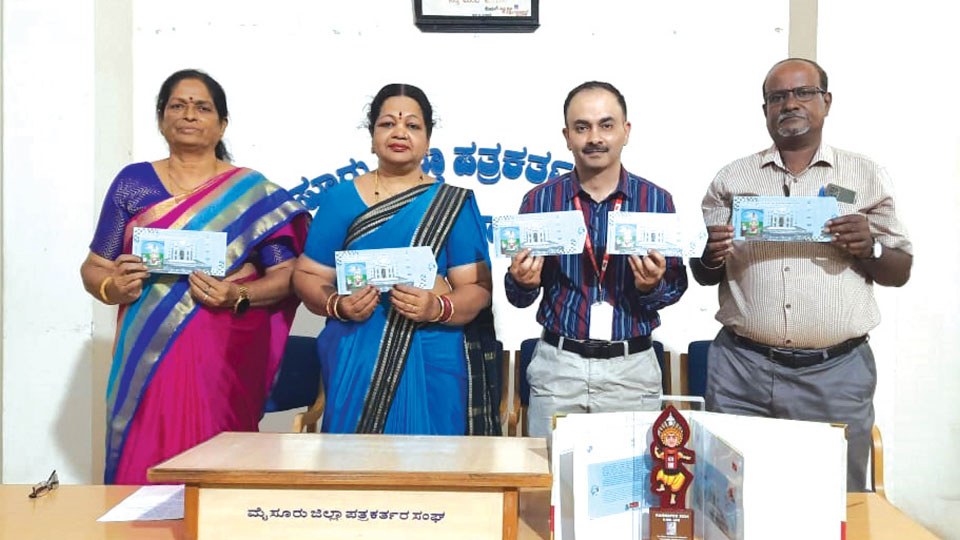
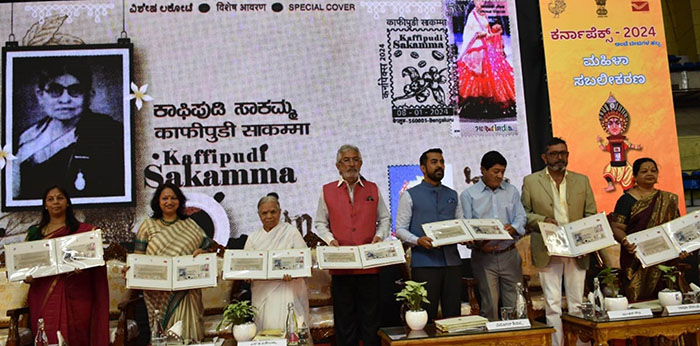
Postal covers on seashell artist Radha Mallappa from Mysuru and ‘Coffee Pudi’ Sakamma from Kodagu released
Mysore/Mysuru:
As part of its ongoing effort to redefine ‘connecting people’ in the online era, the Karnataka Postal Circle organised its annual State-level Philatelic Exhibition — 13th State-level Philatelic Exhibition, Karnapex 2024: Festival of Stamps between Jan. 5 and 8 — at Kanteerava Indoor Stadium in Bengaluru. The Festival was last held in 2019 in Mangaluru.
A total of 700 frames, with each containing multiple stamps and postal covers, were displayed and 17 stalls were put up. Postal covers on Dr. Puneeth Rajkumar, Sir M. Visvesvaraya setting up FKCCI, 100 years of Lalitha Mahal Palace, Mysuru and Mysore Sandal Soap were also released.
Notably, postal covers on ‘Kalashree’ a museum of artworks made of seashells and conches by Radha Mallappa, a resident of Hanumanthanagar in Mysuru and Karnataka’s first woman coffee entrepreneur Sakamma from Kodagu, known as ‘Coffee Pudi’ Sakamma were also released, as part of women empowerment.
Addressing reporters at Pathrakartara Bhavan on Tuesday, Mysuru Division Postal Deputy Superintendent Sunil Halepete said that Mysuru has already made a mark in the postal covers released by the Dept. in the past as postal covers of Lalitha Mahal Palace, Rashtrakavi K.V. Puttappa (Kuvempu), Mysuru Vilyadele and Field Marshal K.M. Cariappa.
This year, the Karnapex 2024 featured Radha Mallappa who has done sculptures made of seashells and conches. She has accomplished the magnificent recreation of Taj Mahal and she has been working on products of the sea since more than two decades and designed different items.
‘Coffee Pudi’ Sakamma
Beginning from the smallest flower to the giant-sized Taj Mahal, Shiva temple, church, each piece is unique and eye-catching. The 11ft x 18ft tall Ganesha idol bagged the Guinness World Records. Each artefact is better than the other one and there are over 300 models on display, he added.
Likewise, a postal cover on D. Sakamma, popular as ‘Coffee Pudi’ Sakamma, was also released. Sakamma’s name remains somewhat obscured in the records of Indian entrepreneurs. However, her venture, ‘Sakamma’s Coffee Works’ in Bangalore gained widespread recognition in the 1920s, playing a pivotal role in the early 20th century by introducing authentic cured and powdered coffee from Kodagu to the residents of the Princely State of Mysore. Widowed at the age of 18, Sakamma chose to channel her education into managing the coffee estate left by her husband, Savkar Doddamane Chikkabasappa Setty, a prosperous coffee planter from Somwarapet in Kodagu. Relocating to Bangalore, she established a coffee curing and powdering unit near Bull Temple Road in 1920. Swiftly, her distinctive coffee blend gained immense popularity across the city, making Sakamma Coffee Works an integral part of the lives of Bangaloreans.
The attractive postal covers feature Radha Mallappa and ‘Coffee Pudi’ Sakamma with imagery of their respective fields of achievements. A short description has been printed at the back of the postal cover.
Marimallappa’s PU College Educational Officer Mangala Muddumadappa, Radha Mallappa, Postal Department Sales Division Manager Sureshkumar were present at the press meet.
source: http://www.starofmysore.com / Star of Mysore / Home> News / January 11th, 2024
Beans n’ Brews Café is a popular café located in Coorg, Karnataka, India. It’s known for its relaxed and cozy ambiance, making it a favorite spot for both locals and tourists to unwind and enjoy a cup of freshly brewed coffee.
Amidst Coorg’s embrace, where coffee beans twirl, Beans n’ Brews Café, where aroma unfurls, In villanelle verses, their essence we’ll swirl.
Mocha Magic: Espresso Dreams’ Reign
In the heart of the brew, where darkness swirls, Mocha Magic, where espresso dreams reign, A velvety dance, in each cup’s domains.
Latte’s Lullaby: Milky Way’s Whirl
In the creamy stream, where milk does unfurl, Latte’s Lullaby, Milky Way’s whirl, A comforting sip, where foam’s gentle swirl.
Caramel Symphony: Macchiato’s Frame
With caramel’s kiss, where sweetness does swirl, Caramel Symphony, Macchiato’s frame, A bittersweet tale, in each sip, we proclaim.
Muffin’s Embrace: Blueberry’s Theme
By the muffin’s side, where flavors unfurl, Muffin’s Embrace, Blueberry’s theme, A crumbly delight, in each bite, we esteem.
Croissant’s Charm: Chocolate’s Gleam
In flaky layers, where butter does swirl, Croissant’s Charm, Chocolate’s gleam, A warm pastry hug, in each bite, we redeem.
Cookie’s Reverie: Oatmeal’s Beam
With a cookie’s crunch, where flavors whirl, Cookie’s Reverie, Oatmeal’s beam, A wholesome treat, in each nibble, we deem.
At Beans n’ Brews Café’s table, where moments unfurl, These dishes, in villanelle, their essence we swirl, In Coorg’s heart, where coffee’s embrace does twirl, A poetic feast, where each sip is a pearl.
A villanelle is a highly structured form of poetry known for its repetition of lines and intricate rhyme scheme. This structure challenges poets to craft poems that are both emotionally resonant and artistically intricate, making it a captivating form of poetic expression.
source: http://www.timesofindia.indiatimes.com / The Times of India / Home> News> Blogs> Lifestyle / by Food connoisseur in Symphony of Tales / September 10th, 2023
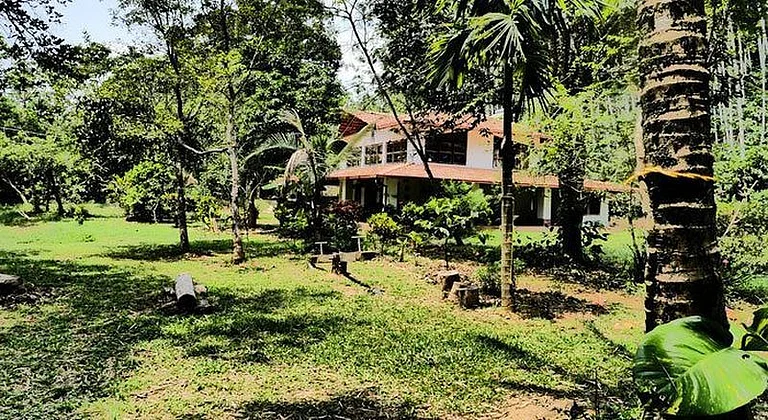
Tucked in a hidden valley down a winding clay road some 5 kilometres from Karnataka’s town of Madikeri (in the Coorg district) lies the Garden Farm. On the fringes of the valley is where the bungalow is placed, marking the beginning of a dense forest shading coffee plants. It is here a close-knit family has set up a sanctuary for fellow nature lovers, giving them a place where they can truly enjoy the beauty of the Coorg landscape without obtrusive power-lines and the cacophony of buses blaring Top Forty Kannada music. And if you don’t love nature, well, they don’t want you to find their guesthouse.
Off The Beaten Track
Even after we drove our Enfields down a long, winding forest trail with steep inclines (only jeeps and bikes can make the journey during monsoon season) and crossed a wide green valley, we could barely make out the large guest house standing 25 meters away as the view of the facade is obscured by a beautiful line of flowering trees and bushes. Basically, this valley villa could be a Pablo Escobar Bungalow, just substitute the cocaine and machine guns with a sense of true tranquility.
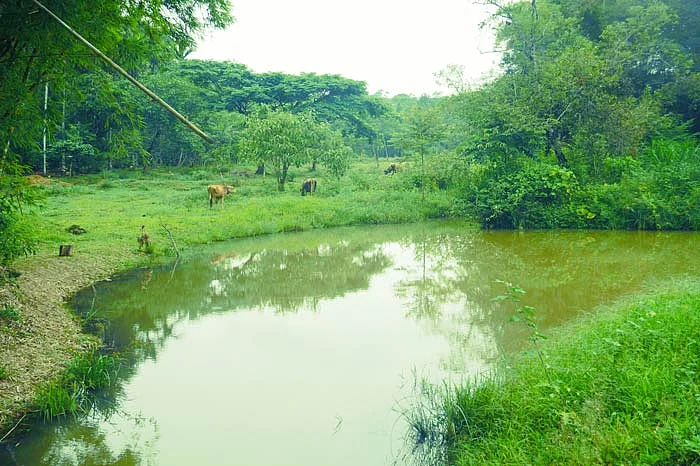
A personal pond right outside our doorstep.
Nourishing Yourself In Nature
Everything we ate and drank at the Garden Farm was locally sourced and organic, even the water. Yes, the hill station home boasted fresh mineral water from a well. At first we were skeptical, but the water was completely safe and had a naturally sweetness that is absent in packaged mineral water.
Moreover, on the property the family behind the Garden Farm grow fresh coffee, pepper, cardamom, pineapples, bananas, rice, mangosteens, jackfruit, various types of mangoes, oranges, a type of plum among myriad other plants and trees the author is clueless about.
The farm is home to a large grove of pineapples.
The caretaker of the guesthouse trotted across the valley every morning, brewed a pot of lovely coffee and was happy to take us around the many forest paths on the property, encouraging us to pluck whatever fruit struck our fancy on the stroll. However, the best part was that all our meals were delicious and straight from the farm – their pork fry was to die for.
Also, as a someone who frequently abuses beetroot for being a useless and unappetising vegetable, I devoured three portions of the cooked veggie. To sum up the experience of eating at Garden farm, our tastebuds were more than content.
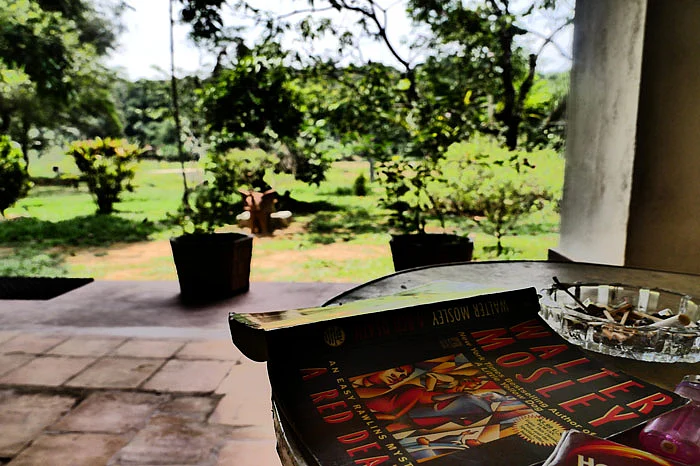
The Garden Farm was made for lazily turning the pages of novels, going on forest walks, bonding over bonfires, playing a boardgame or a bit of carrom, and fishing in the pond or stream. Not to come off as poetically pedantic, but each breath taken at the Garden Farm filled our lungs with an at ease contentment that is rarity for urban dwellers.
Leaning back with a good book and an even better view.
We saw the caretaker of the guesthouse climb to the top of a 40 foot tree with no rope that was covered in fire ants. When he came down later and crossed the valley he just beamed us his ordinary smile. It is important to say his smile is like that of a child who has secret, and I have a funny feeling each day we marvelled at that man’s life, he very politely marvelled back at ours.
The choice he made to live out his days on farm was simple and smart. To live in the midst of beauty. Our decision to live in plaster cubes with a view of an army of other plastic cubes is perhaps not the most beautiful of choices. It is not safer either. Even though we thought he was insane for climbing the tree with zero protection, the chances of him falling is most likely equal to the chance a city person will get hit by a delivery driver. Rest was not the only thing gained at the Garden Farm, a bit of perspective was also an added bonus.
Hill station happiness (The caretaker and his lovely son Kavin).
Interiors Of The Hidden Garden Cabin
Sleep at the Garden Farm meant silence took on a whole new meaning. The top part of the house was open air which meant we got a refreshing hill breeze; however, this of course meant the mosquito nets were essential.
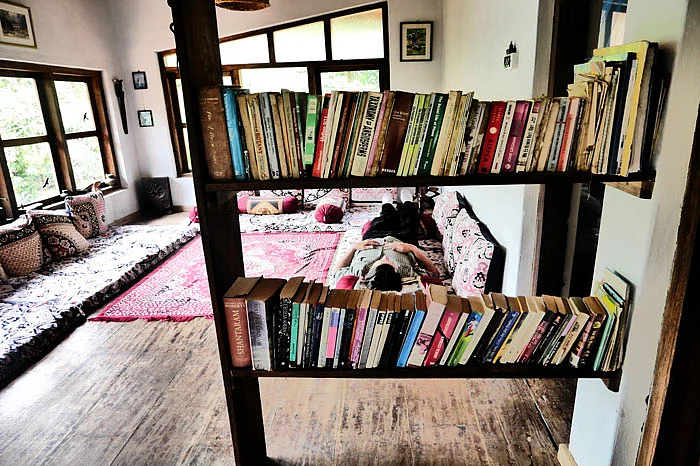
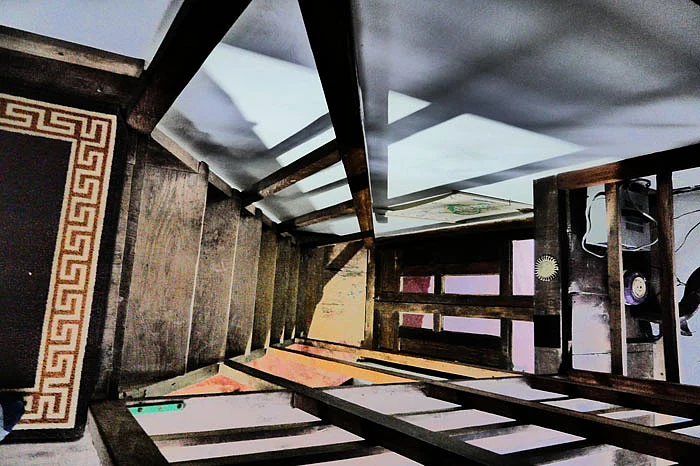
The wooden flooring and staircase made the bungalow take on a homey cabin feel. Moreover, the second floor hosted several cushioned floor mats which were perfect for afternoon naps. Also, we got to dig into a wonderful and comprehensive selection of good reads!
Afternoon nap upstairs.
Wooden staircase.
A Final Look Back
If you love nature or feel like you need some time to take in the great outdoors, the Garden Farm beckons.
Crouching amoung the bushes to try and capture a full frontal view of the home.
source: http://www.homegrown.co.in / Homegrown / Home> #HGExplore / by Julian Manning / June 08th, 2021
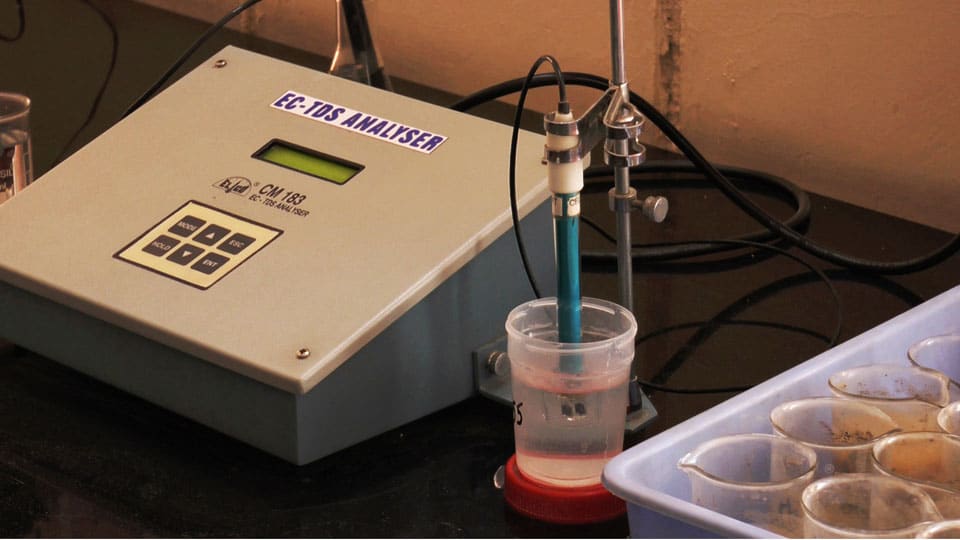
Thousands of farmers in South Kodagu now look forward to better yield as Gonikoppal gets a new digital soil testing centre. The Coffee Board launched the testing centre last week following demands of farmers and growers.
Earlier, farmers of Virajpet taluk had to travel 50 to 70 kms to give soil for testing centres at Chettalli and Koodige and both the centres are in Somwarpet Taluk. Farmers in Virajpet were deprived of a testing centre.
Coffee Board Senior Liaison Officer said it took two hours to find the potential of hydrogen (PH) value of soil and five hours to find nitrogen, phosphorus and potassium (NPK) in soil.
source: http://www.starofmysore.com / Star of Mysore / Home> News / December 28th, 2017
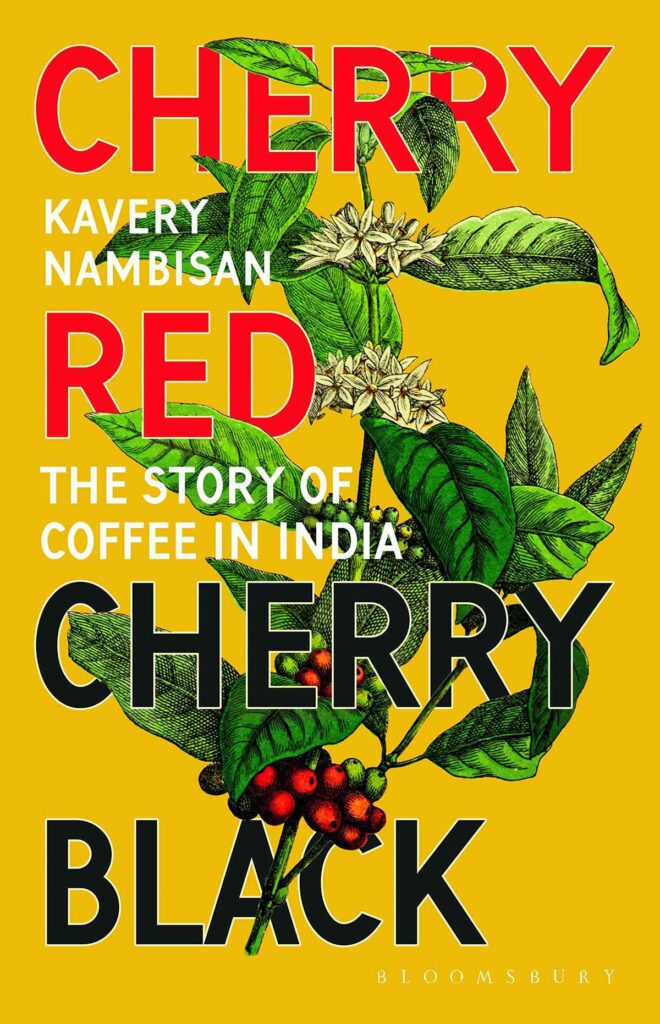
Kavery Nambisan traces the history and geography of the brew in India in her book ‘Cherry Red, Cherry Black: The Story of Coffee in India’.
At the Nellikad Coffee Estate in Pollybetta, Coorg | Photo Credit: Special arrangement
When did coffee arrive in India? How did Coorg, a rice-growing area initially, take to growing coffee in large quantities? Where does India stand as a coffee planter and exporter? Kavery Nambisan writes the history of one of the country’s most popular beverages in her new book, Cherry Red, Cherry Black: The Story of Coffee in India. In an interview, she says the history of coffee in India is closely interwoven with global history.
The story goes that an Indian merchant who went on a pilgrimage to Mecca is said to have brought some coffee seeds back with him in the early 17th century, and thus began the backyard cultivation of coffee in parts of then Mysore province, mainly Chikmagalur, Hassan and Coorg. The British saw its potential and expanded the growth of the cash crop. Having worked in the industry — she tried at her hand at berry picking when she was 15 and realised what a tough thing it is — Nambisan also outlines the challenges the industry faces.
Author Kavery Nambisan | Photo Credit: Special arrangement
You say history has everything to do with the story of coffee in India. Why?
The history of coffee is closely interwoven with global history, particularly from the 18th to the 20th century. It is believed that the stimulant effects were first discovered in Abyssinia when a goatherd noted how his goats frolicked non-stop after eating coffee berries growing in the wild. This led to its cultivation and coffee became something of an energy drink of those days. Its popularity spread to many parts of Arabia and from there to parts of Europe. An Indian merchant who went on a pilgrimage to Mecca is said to have brought some coffee beans back with him and so started the back-yard cultivation of coffee in parts of the Mysore Province, mainly, Chikmagalur, Hassan and Coorg.
By the mid-19th century the British had recognised the potential for growing coffee (and tea) on a large scale. They cut down thousands of acres of forests in these regions for this purpose. The British government which got revenue from its production and export, played a key role in regulating the sale of coffee. The two World Wars challenged the prospects of export and profits while competition from other coffee-growing countries ensured that our own plantations had to work on improving quantity and quality.
Wasn’t Coorg a rice-growing area before the prospect of expanding coffee growth brought the British to the region in large numbers?
The people of Coorg were hunter-peasants right up to the early 19th century when it was annexed by the British. Livelihood was closely tied to paddy cultivation which in turn was dependent on the monsoons. Paddy is a labour-intensive crop and needs workers prepared to work in difficult weather conditions. So the local tribespeople worked in the fields for daily wages. Coffee growing was initially very challenging, and disease often destroyed the crops. But with effective planning, research on the cause of disease, treatment and plant selection, it turned out to be very profitable.
Though the first coffee estate was set up near Mercara, why did coffee growth proliferate in southern Coorg? And what was the variety grown there?
North Coorg where coffee was initially grown receives heavy rainfall which can damage the blossoms and the young berries. Moreover, the area is mostly hilly and so coffee is grown on steep terrain. Within a few decades of cultivation, hundreds of acres of coffee plantations were thus destroyed. Many plantations closed down and some of the British planters went back to England. In Southern Coorg on the other hand, the land is gently sloping, or flat and the rains are not so severe. It is better suited for coffee cultivation. The two varieties of coffee grown are Robusta and Arabica.
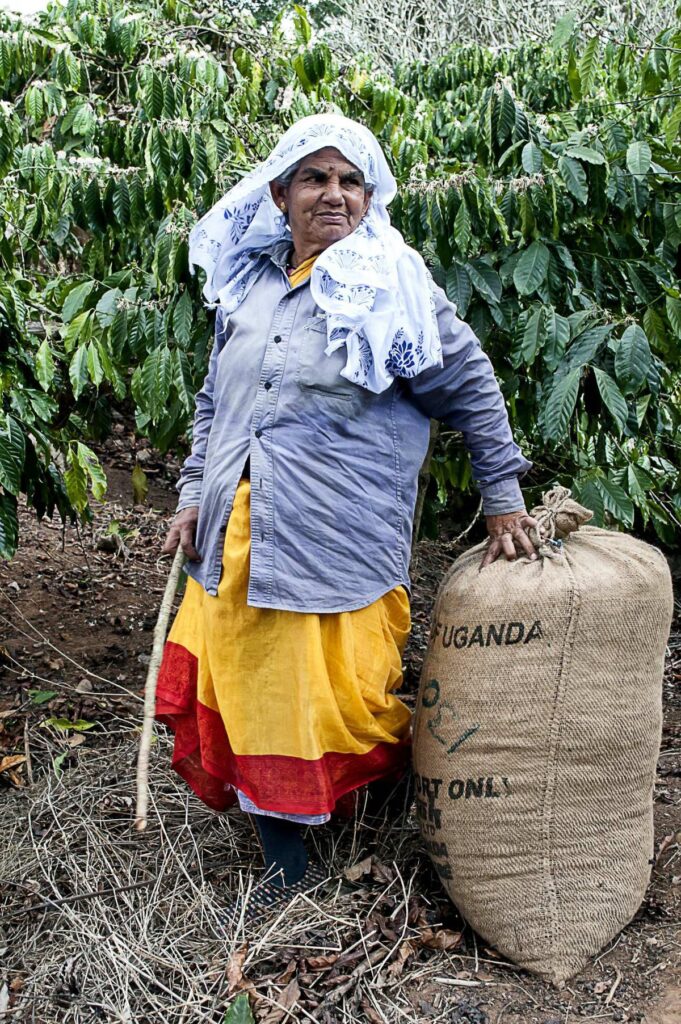
A coffee picker with a sack of harvested beans | Photo Credit: GRJGM
Please share your experience of plucking coffee berries when you were 15. How tough was it?
That was foolish bravado on my part. Perhaps also, the fact that I was of an age when I romanticised manual labour. Coffee plucking itself appears easy when a skilled worker does it. Actually, It is hard work. There are nettled shrubs and creepers that get in the way, abrading palms and scratching the arms and shins. The many insects that creep, crawl and fly will often sting. Dried coffee twigs can poke the eyes for good measure when the picker crouches beneath the bushes to pluck the berries. I was not able to pick as much as I thought I could. But the workers? They talked and laughed all day and plucked enough berries to fill a few sacks each.
Was the rapport between the local Kodavas and the British a happy one? What did they learn from each other?
I guess you could say it was a good rapport. You need to go back in history in order to understand why. Coorg (or Kodagu) was ruled by the Haleri kings for 250 years before the British annexed Coorg in 1834. Coorg was better off under the British. They got schools, dispensaries, apothecaries, etc. Importantly, there was more peace and harmony which came with better administration. Within a few decades, many of the Kodavas became literate. The British found them to be hard-working, honest and trustworthy.
___________________________
Cherry Red, Cherry Black: The Story of Coffee in India
Kavery Nambisan Bloomsbury
₹699
_________________________
What are some of the concerns about the modern coffee industry?
There are several concerns: Coffee plantations are the result of the felling of large areas of forest land, particularly in and around the Western Ghats. It is also a crop that uses pesticides and chemical fertilizers which denude the soil of its health and vigour. Organically grown coffee is a possibility, but economically it is not viable in large plantations. The climate catastrophes experienced in the last few years has led to destruction and loss of lives. We need to look at alternate ways of producing coffee so the end result is not deleterious to the environment. There are many individuals, groups and a few corporates who are experimenting with new methods. Coffee growing is no longer as lucrative as it once was and there is a need for innovation and the use of methods that are not harmful to the ecosystem.
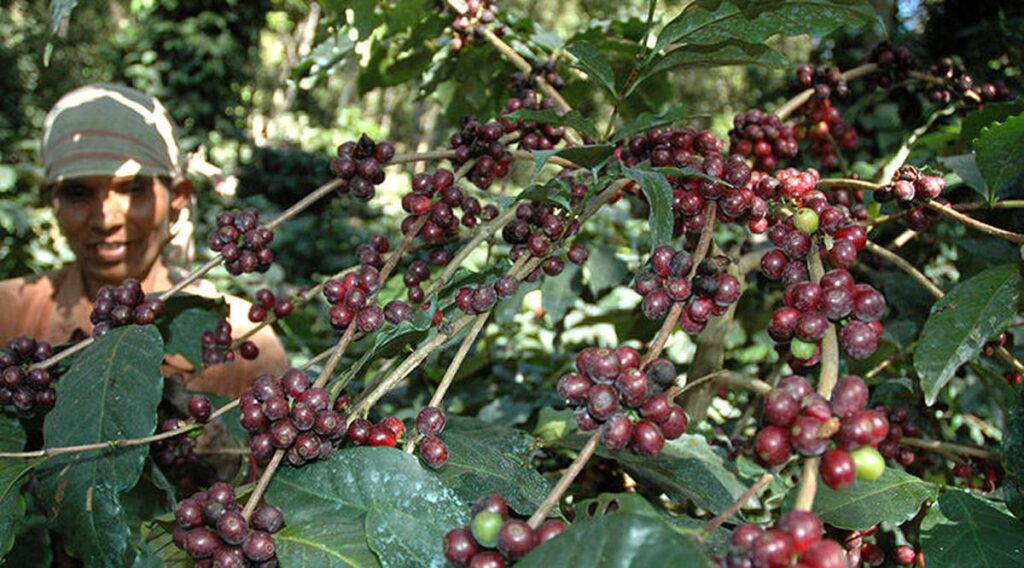
A farmer in Coorg picks riped coffee beans for pulping | Photo Credit: Sampath Kumar G.P.
From Steeping to the French Press there are many ways to make coffee and you describe them in the book, which is your favourite way to make and drink coffee?
I have been a coffee drinker all my life, naturally. I cannot start the day without coffee. I like it strong, hot and full flavoured. I use a mix of Robusta and Arabica beans, roasted at a mill nearby and powdered at home. I have three methods that I use to make coffee, depending on my mood. The Moka pot coffee, filter coffee or the simple brew, in which you heat fresh water and when it comes to boil, add the coffee powder, cover and let it steep for 2 minutes, strain and serve with hot milk and jaggery.
source: http://www.thehindu.com / The Hindu / Home> Books / by Sandipta Datta / December 09th, 2022
While coffee’s third wave is about the quality of the beans, sustainability and single origin bean-to-cup brews, the next wave will focus on cold brews, innovation, and a new approach to coffee marketing.
Credit: DH IllustrationDeepak Harichandan
I was five when I had my first taste of coffee. It was just a few drops, milky and sweet. I insisted on tasting it, as my coffee-loving mother always felt ‘refreshed’ after drinking ‘kaapi’. As a teenager, study time started with a cup of ‘good’ instant coffee. My Tamil Brahmin best friend’s paati (grandmother) introduced me to filter coffee a few years later. Raised in Delhi in the ’90s, coffee wasn’t necessarily a hot topic. There were no cafes and coffee chains then. Latte, cappuccino, and Americano were not part of my vocabulary yet.
I enjoyed my filter coffee everyday, but I rarely ventured beyond that. Over the years, I read about the coffee varieties and trends. I considered myself a coffee lover, but it wasn’t until a month ago that I realised my understanding of coffee was limited. First, I had the opportunity of visiting a coffee plantation in Kodagu. Intrigued by what I learned there, I felt compelled to attend the World Coffee Conference at Bengaluru Palace a few days later. It was in September, around International Coffee Day. It opened to me a world of coffee, with its variety of beans, processing and brewing methods, and roasts. Since then, I have signed up for coffee cupping sessions, interacted with coffee experts and sampled unusual brews.
At the India International Coffee Festival in Bengaluru 10 years ago, I got to paint with a coffee concoction. I also participated in latte art tutorials, and got to look at the latest farming equipment being used. Much has changed since.
What’s brewing?
Living in Karnataka, a state that accounts for more than 70 per cent of the country’s total coffee production, the beverage is hard to escape. Bengaluru is home to numerous cafes, besides international chains such as Costa Coffee, Starbucks and most recently, Tim Hortons.
Awareness about coffee has grown in recent years. People are clued in on the different roasts (light, medium or dark), where their beans are sourced from (estates and regions), and their flavour profiles (broadly earthy, fruity, nutty or floral).
Credit: DH IllustrationDeepak Harichandan
Arabica and robusta are the most common varieties grown in India. Arabica has a smoother and sweeter flavour, with hints of fruit, chocolate, nuts, and caramel. It is used mostly for speciality coffee. Robusta coffee is known to have a strong and bitter taste. It is earthy, with notes of burnt wood. It is the most commonly used variety in South India. Low grade robusta beans are used to make instant coffee powder. Chicory, often added to coffee powder, lends it the ‘roasted’ flavour. An excess of it can make the coffee feel stronger or bitter.
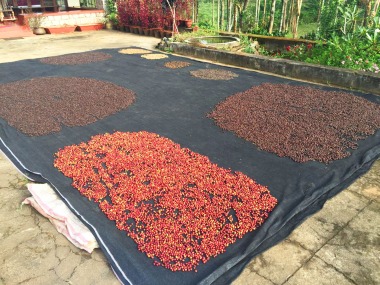
Broadly, there are two types of coffee processing — natural and washed. In the natural process, the cherry is allowed to dry out completely and fermentation is uncontrolled, as it happens inside the cherry itself. In washed processing, the pulp and skin are removed but the mucilage on the bean is broken down by the yeast and bacteria on the cherry and its skin.
A recent addition to my kitchen gear is a French press. After a wait of about five minutes, you can enjoy an aromatic cup of coffee with its oils retained. At the conference, I was introduced to other options: the pour over, aeropress, siphon, Chemex and percolator.
Home cafe
One of the stalls I visited was promoting the e-commerce platform Something’s Brewing, a part of Kaapi Machines, a company that sells coffee equipment and accessories. The start-up was born during the pandemic.
Vivek Vishwanathan, a representative of the company, took me through how I could brew a good cuppa with their Budan espresso machine, which has an inbuilt grinder. The brew, made from arabica coffee, had a heavy body and was intense on the palate. It tasted like it was processed with its oils, giving it the thick consistency that one experiences at good cafes. The machine is a time saver, he told me. He stressed the importance of the right grind size for each brewing method, the quality of coffee beans, and the importance of tamping the coffee evenly in the portafilter while brewing.
Of the many unique coffees I have tried, the bubblegum coffee and the toffee coffee from Hatti Kaapi have stayed in my mind. They brought back memories of Boomer, the strawberry-flavoured bubblegum of my childhood, and old-fashioned caramel candies.
The Coffee Board of India classifies speciality coffee into five broad categories — decaffeinated coffee (coffee with caffeine removed artificially), organic coffee (grown without using chemicals and pesticides), high grown coffee (grown at higher elevations — 4,000 ft and above), estate coffee or single origin coffees (highlighted by the special features of the estate it is grown in), and variety coffee (Indian varieties like Kents, Agaro, Cioccie, and CxR, which stand out for their quality).
Kents is a varietal of the arabica, and is known for better yield and its resistance to leaf rust, while CxR is a robusta coffee, developed for better yield and a better flavour profile. Agaro coffee is an arabica variety, mostly grown in Ethiopia. It is found in few farms in India. Cioccie is also an old Ethiopian variety.
In terms of speciality coffee, India has a long way to go, says Abhinav Mathur, managing director of Kaapi Machines. “The popularity of speciality roasters is just kicking off in our country, with companies like Blue Tokai Coffee Roasters and Third Wave Coffee Roasters getting funding,” he shared.
In the near future, beverage types will go through more innovations, he said. Abhinav says a majority of their consumers are well-travelled professionals who have sampled coffees across the world, and “the curious Gen-Z crowd who are getting started early”. “They ask many questions, some of which even we have to research. They are value and sustainability conscious, and are aware of the various flavour profiles and coffee types available now,” he added.
While coffee’s third wave is about the quality of the beans, sustainability and single origin bean-to-cup brews, the next wave will focus on cold brews, innovation, and a new approach to coffee marketing. Coffee experts say that innovation will revolve around home brewing and speciality equipment.
Farm to cup
Some are also paying attention to how their coffee is grown. I spoke to A M Ganapathy, the owner of Vivekananda Coffee Estate, a family-owned plantation in Chettalli, Kodagu. Here, regenerative agricultural practices put together by the Speciality Coffee Association, a trade body, have been diligently implemented.
The practices help improve the quality of the soil. “Increasingly, there is a demand for chemical-free coffee. Regenerative agriculture is a holistic farming system that focuses on soil health, food quality, biodiversity improvement, water and air quality. It improves soil health through practices that increase soil organic matter. It also aims at enhancing water holding capacity and carbon sequestration. The government is encouraging farmers to take up this practice,” Ganapathy explained.
The process also supports biodiversity and returns carbon and nutrients to the soil. “Soil organic carbon and soil organic matter are vital for plant growth. It also facilitates water infiltration, retention and nutrient cycling, reduces erosion, and provides habitat and food for diverse species,” he added.
Regenerative agriculture includes cover crops (that are planted to cover the soil rather than for the purpose of being harvested), integration of livestock and reduced or zero tillage, he shared. “Our annual yield is moderate and varies between three-fourth to one tonne per acre,” he said.
Taste notes
My newfound interest in brewing methods and roasts led me to sign up for a few tasting experiences. At the Starbucks Coffee outlet on Lavelle Road, Bengaluru, cupping sessions are held regularly. At one of their sessions, I tried their Diwali Blend and the Single Origin Kenya Coffee, sourced from Kenya.
At the slow coffee bar, four brewing methods awaited me — a siphon, Chemex, French press, and pour over. Though I had seen them at the Conference, I was taken by the chemistry lab-like setup. It was fascinating to watch the Diwali Blend being made in the siphon, and the Kenyan coffee in a Chemex.
The siphon is a vacuum-filtration method, which uses halogen lights to heat water. The movement of evaporated water from the lower chamber to the upper chamber and back was theatrical to watch. The Chemex is considered a hybrid brewing method. Its one-piece hourglass shape with a collar looked decorative, more than like coffee equipment.
The Diwali Blend was a blonde roast. It was sweet and aromatic (it had notes of dusted cocoa, apricot, and dried ginger). I took a whiff of the freshly ground Kenyan coffee. It was floral and fruity. When I took a sip it made my mouth water. This meant that it was highly acidic, I was told.
The brewmaster, Madhav, explained: “The brewing methods are based on how one likes one’s coffee, keeping in mind factors like intensity and taste.” Each brewing method has its own characteristics. A siphon is said to produce a delicate and aromatic cup, while the Chemex with its triple-layer paper filter makes a smooth and clean cup. The pour over method makes a cup of rich, clean and balanced coffee, and the French press is used to make a full-bodied, thick cup of coffee, where the oils are retained.
I then tasted the Sumatran coffee (a single origin coffee from Indonesia) made in a pour over. It had earthy and herbal notes. One whiff of it reminded me of the first rains of the monsoon season.
I also tasted two cold brews — one made with coarsely ground Kenyan coffee (smooth and sweet) and a nitrogen cold brew (infused with nitrogen) of the same bean, which was creamy, refreshing and smooth.
The interesting part about such cupping sessions is the number of common and not-so-common facts one comes across.
Slurping is important in the coffee world. At the handful of coffee cupping sessions I have attended, I was urged to slurp the drink. It is the best way to taste all the different flavour notes.
At another coffee cupping session at Maverick & Farmer Coffee, Halasuru, Bengaluru, I tasted a coffee I have wanted to for years — the civet coffee (it was not the original Indonesian Kopi Luwak but an Indian version of the same). Often referred to as the ‘poop coffee’, it is made from partially digested coffee cherries, eaten and defecated by a civet cat. It was from Pankajam Estate in Idukki, Kerala. This Indian version had a hint of cardamom. I was informed by Ashish D’abreo, coffee roaster and co-founder of Maverick, that the coffee plants were grown on a cardamon estate, which could possibly explain the presence of the spice note.
Acidity level, aged, body, dry, earthy, fine, flat, and grassy, were some of the terms I heard being used at these sessions. They made me realise there was so much more I needed to learn.
A Plantation Tour
A visit to Yemmigoondi estate in Pollibetta, Kodagu, owned by Tata Coffee, threw light on how these plants grow and are harvested. The plantation was spread across 1,500 acres (600 odd hectares). As I took in the view of the arabica plants on the left and the robusta plants on the right, I wondered when they would harvest. A company representative told us that robusta are stouter and grow almost twice the size of an arabica plant. “For robusta, the space maintained between two plants is around 10x10ft. After applying fertiliser and culturing, robusta starts yielding by the fifth year. Arabica gives yield by the fourth year,” he added.
I learnt that the two varieties require unique environments to thrive — robusta plants are smaller in number and need more heat. Arabica starts maturing by November, and robusta matures around December. Robusta makes up 60% of the estate’s entire crop, I was told.
Puneet Das, from Tata Consumer Products, explained that consumption of instant coffee remains high in the country. “For the south of the country, where coffee is a regular habit, hyperlocalisation as a strategy works as it has native appeal. Our new coffee decoctions like Chukku Kaapi (a popular Kerala drink made from dry ginger, black pepper and coffee powder), and the Coorg Kaapi are some examples,” he said.
What is a Wave in the Coffee World ?
It refers to a period of time in the evolution of coffee. The field has gone through several big changes and innovations. The first wave (started in the 1800s) represented a shift from coffee being a novelty drink to a commodity. In the second wave (started in the 1970s), it became a culture (characterised by the arrival of coffee chains). The third wave (started in the 2000s) revolves around consumer awareness, focus on flavour profiles and the coffee bean.
The fourth wave is said to be dominated by innovation. Coffee experts say that we are now entering the fourth wave. In coffee innovation, fermentation plays an important role in unlocking or creating new flavours. In the last decade, farmers have exprerimented with many controlled fermentation processes, while working with temperature, or introduction of yeast and bacteria from other fruits. Ashish, of Maverick, says, “In 2018, we created a fruit-fermented coffee. We introduced lightly-pulped oranges into the fermentation barrel. In another case, we extracted lactic acid from milk and added it into the fermentation, which rendered a honey flavour to the coffee,” he says. Ale yeast is also being added to fermentation barrels by many, which gives the coffee notes of beer, he adds.
Indian Market
Indian coffee is considered one of the best in the world. It fetches a high premium in the international markets. Coffee is primarily an export commodity for India, and its consumption in the domestic market is 25 to 30% of the country’s production.
Cup Facts
Brazil is the biggest coffee producing country in the world, followed by Vietnam and Colombia. India comes sixth.
Decaffeinated coffee doesn’t mean that your drink is caffeine free. The decaffeination process removes about 97% of the caffeine in the beans, but it is never 100% removed.
source: http://www.deccanherald.com / Deccan Herald / Home> Special / by Tini Sara Anien / October 28th, 2023
Low on caffeine and high on protein, mushroom coffee is having its time in the sun and the rise in Indian homegrown brands in the segment is proof.
A cup of mushroom coffee contains about half the amount of caffeine than in a regular cup of coffee | Photo Credit: Getty Images
First, there were plant-based milks, then came avocados, and now there is mushroom coffee that appears to be the new kid on the block, driving a caffeinated generation to pick up a seemingly healthier alternative.
A quick Google search suggests there is curiosity rapidly building around the product. Especially in India where brands are taking a stab at it, and are now routinely answering questions on what indeed is mushroom coffee, or most importantly, how do these two ingredients even get along? “Imagine the same taste of coffee, but with about 25-30% of the coffee powder being made of mushrooms,” says Rakesh Bhatnagar, founder of Gurugram-based Rooted Active Naturals. Launched in 2020 with the aim to bring superfoods from across the globe to India, he says, “The idea was to introduce such superfoods in an easy-to-consume, potent, and tasty manner,” adding that this approach almost immediately led him to dig deeper into the medicinal qualities of mushrooms, which became the first launch category, and continues to be their top selling one.
Variants of mushroom coffee | Photo Credit: Special Arrangement
Think your regular earthy coffee flavours, but with a dash of nuttiness and without the cons of getting acid reflux or caffeine-induced insomnia. “It became a game changer for a caffeine addict like me, who started facing some health concerns, but also felt irritable throughout the day every time I tried to quit,” says Vinay Kumar, 33, a software engineer based in Pune. Vinay has been a shroom coffee loyalist since the beginning of the COVID-19 pandemic in 2020, when longer work hours at home, coupled with little to no movement meant a sleep cycle being thrown into complete disarray. “And the caffeine was only exacerbating everything. That’s when I stumbled upon mushroom coffee online and thought I should give it a shot,” says Vinay. And he never looked back. Initially, he would mostly spot international brands online, but within a year, he found more homegrown names listed on e-commerce websites. A 100-gram pack of this joe in India is priced anywhere between ₹400 and ₹1,000, with average prices hovering around ₹600 for 100 gms.
From the 1940s
Interestingly, the origins of mushroom coffee go back to a dark time in history — the World War II era to be precise, when in the 1940s, coffee became one of the first few goods to suffer from chronic and acute shortages across Europe. Consequently, an alternative was introduced in Finland, where people started to increasingly brew and consume chaga mushroom coffee. This variety of fungi grows on the back of birch trees in cold terrains like Northern Europe, Korea, Siberia, Russia, Northern Canada, and Alaska. It has traditionally been used in these cultures and other parts of Asia as an immunity booster.
An image of the processing unit at Rooted Active Naturals | Photo Credit: Special Arrangement
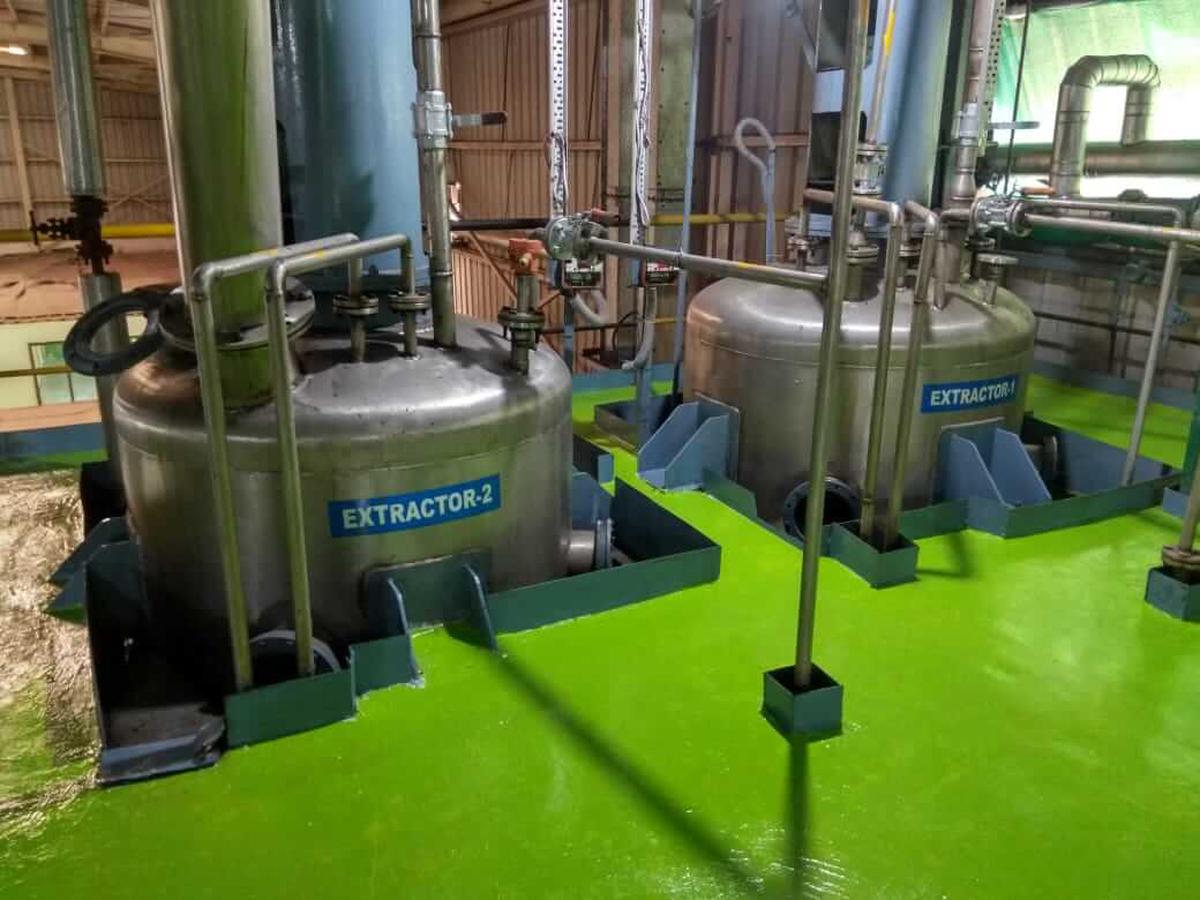
“Our mushrooms undergo purely water-based extraction. This method preserves the critical bioactive components and ensures batch-to-batch consistency. It also prevents the loss of essential mushroom properties during the extraction process,” says Shivam Hingorani, founder of Ace Blend, a Mumbai-based company born in 2019 that deals in plant-based food.
While Rooted Active Naturals uses a blend of instant Arabica coffee with a mix of lion’s mane and chaga mushroom powder in their formulation, Ace Blend adopts a slightly different route. “We blend the chosen superfoods in their effective doses with 100 percent medium roast Arabica extract,” Shivam says of his brand that garnered over 10,000 customers in the past month. “As more consumers discover the remarkable advantages of mushroom-infused products, including improved cognitive function and jitter-free energy, we expect the demand for our mushroom coffee to continue surging worldwide at a rapid pace,” he adds.
The mushroom factbox
Some commonly used mushroom extracts to prepare coffee are derived from the chaga, reishi, lion’s mane, and cordyceps variants.These variants are known as adaptogenic mushrooms, which are considered herbs that, when consumed regularly, are known to help the body deal with stress.A cup of mushroom coffee contains about half the amount of caffeine than in a regular cup of coffee.
How to brew it?
Formulated as a powder, shroom coffee is brewed the usual way, with a teaspoon of it mixed in a cup of warm water or milk with sugar, as per taste. If one wants to have it cold, just brew it the regular way and let it cool down, before serving with ice. When this writer had her first cup of a shroom coffee blend brewed in warm water without sugar, the flavours reminded her of a well-made cappuccino, but in almond milk, as it comes with that distinctly nutty punch bearing a more velvety texture.
For 25-year-old Rosanna P from Goa — a recent shroom coffee convert — the switch happened after she had a cup of the brew at a friend’s place and did not realise it. “I actually thought it was a superior brew,” the self-proclaimed coffee connoisseur says. “The texture is just silkier. And for someone who picks her beans with utmost care, this discovery really surprised me,” she says.
If one wants to have mushroom cofee cold, just brew it the regular way and let it cool down, before serving with ice | Photo Credit: Special Arrangement
Rosanna recalls hearing about shroom-coffee back in 2016 from a friend who lives in the US, and it is a fact corroborated by Chirag Kenia, Founder, and CEO at Urban Platter, a “gourmet grocery brand” headquartered in Mumbai and established in 2015. Chirag’s platform has been selling mushroom coffee since 2018, and he remembers a buzz around it since as early as 2017. “The US as a market started adopting these products very voraciously around 2017-18, which is also when we introduced it in India,” he says.
Chirag, however, believes the product has only reached a niche consumer base thus far, so the only way to scale it further is to underline its nutritional values as a superfood. “Mushrooms are such wondrous, nutrient-rich ingredients that immediately elevate any dish they are a part of,” he says, before predicting that the next big mushroom innovation will be snacks made of it. Clearly, it’s a mushroom world, and we are only living in it.
source: http://www.thehindu.com / The Hindu / Home> Food> Features / by Arshia Dhar / October 27th, 2023
Coorg’s long-standing tradition of cultivating coffee, and the warm hospitality of its people have rightfully earned it the title of India’s Coffee Capital.
The history of coffee in Coorg goes back to the 17th century.
Coorg, located in Karnataka, India, is a captivating place known for its abundant green landscapes, hilly terrain, and the delightful aroma of coffee plantations. This region, which is situated in one of India’s leading coffee-producing states, is a perfect destination for both coffee enthusiasts and nature lovers. Coorg’s long-standing tradition of cultivating coffee, its breathtaking scenery, and the warm hospitality of its people have rightfully earned it the title of India’s Coffee Capital.
In fact, when it comes to coffee production in India, the majority of it happens in the hilly areas of South Indian states, with Karnataka being the leader, responsible for 71% of the country’s coffee production, and Coorg alone contributing a significant 40% to that total.
In simple terms, the history of coffee in Coorg goes back to the 17th Century when legendary Baba Budan brought the first coffee plants to the area. He got seven coffee beans from Yemen and planted them in the Baba Budan Giri range, which marked the beginning of coffee in India. But it was during the 19th Century when the British were in charge and coffee farming in Coorg really took off. The British realized that the climate and soil in Coorg were perfect for coffee, so they started a lot of coffee plantations, and they became a big part of Coorg’s landscape.
Coorg’s coffee farms thrived because the estate owners took great care of them. They used modern techniques to grow and process coffee. Nowadays, Coorg is one of India’s biggest coffee-producing areas, and it plays a big role in India’s coffee exports. Some estates still use traditional methods to grow coffee, which keeps the original and delightful taste of this beverage alive.
Coorg’s coffee plantations focus on sustainable and eco-friendly farming methods. This means the coffee you get from there is not only tasty but also safe from pesticides and chemicals.
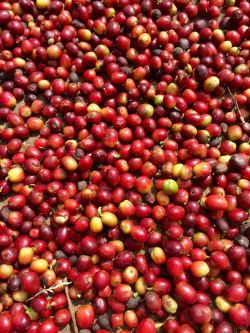
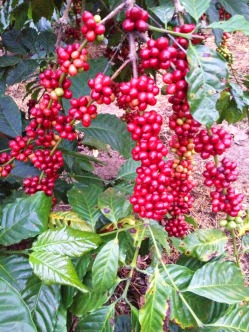
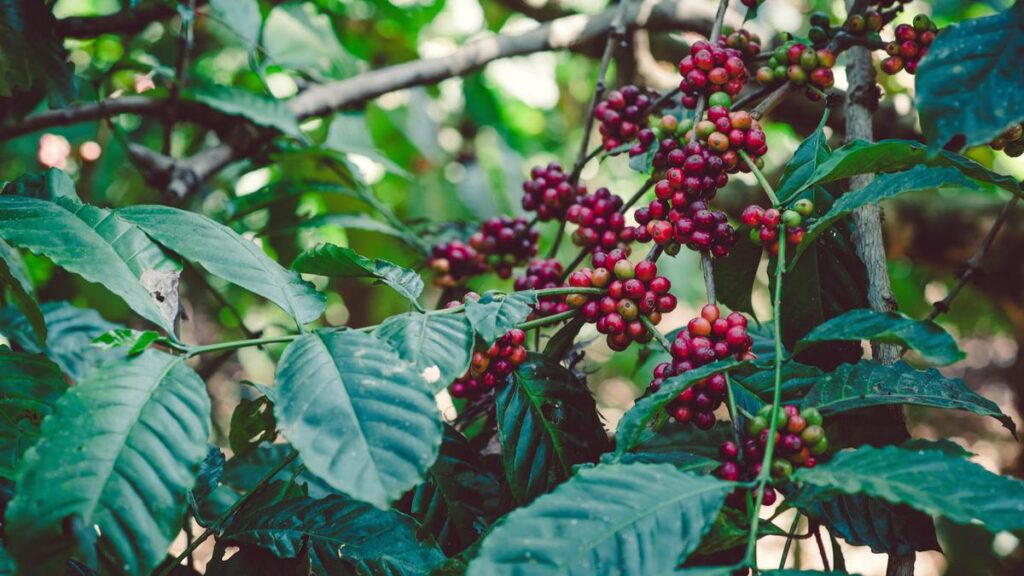
In the coffee-rich region of Coorg, India, which is not far from Bengaluru, during February, you’ll discover many coffee trees covered in red and green berries. Each of these berries contains two green beans inside. These beans are carefully chosen, sorted, and roasted in small batches to preserve their unique flavours and aromas, resulting in an outstanding cup of coffee.
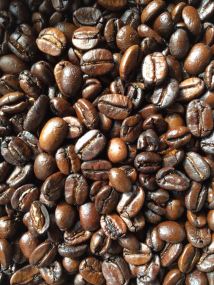
Many of the delicious and fragrant coffee beans come from coffee plantations in Karnataka. These beans are harvested, dried, roasted, and ground to create the perfect cup of coffee you hold in your hands.
source: http://www.news18.com / News 18 / Home> Lifestyle / by Nishad Thaivalappill / October 26th, 2023
WELCOME. If you like what you see "SUBSCRIBE via EMAIL" to receive FREE regular UPDATES.
Read More »











![[object Object]](https://images.deccanherald.com/deccanherald%2F2023-10%2F200fbc0f-b367-49f9-a989-f783ec11a1c9%2FExperiential_Web.jpg?format=webp&q=70&w=900&dpr=1)