Category Archives: Coffee News

25-year-old wakes up and smells the coffee; builds single origin coffee brand Cauvery Peak

With coffee consumption on the rise globally, fifth-generation entrepreneur Vishnu Rajes wants to take single origin coffee from his estate in Yercaud to homes across India with ecommerce.

At a glance:

Founded: 2017

Founders: Vijayan and Vishnu Rajes

Type of Business: Ecommerce for coffee single origin

Funding: Self funded.

Based in: Yercaud

Sector: Digital Commerce

What happens when you have a 150-year-old legacy of growing coffee? You use it to build an ecommerce business of selling coffee across the world. The GlenFell Estate Classic Arabica Coffee, of Cauvery Peak, is rated five stars on Amazon. Peruse the Cauvery Peak website, and you will find premium coffees that are gourmet standard. If you are used to coffee with chicory, Cauvery Peak isn’t for you.

But fifth-generation entrepreneur Vishnu Rajes realised that things – and the taste for coffee – were changing in India. Vishnu had been groomed to take over his family business, MSP Plantations, in Yercaud, Tamil Nadu, and continue trading coffee. But his stint abroad, at Washington College in the US, made this 25-year-old realise that the power to build a brand – and not trading – was the need of the hour.
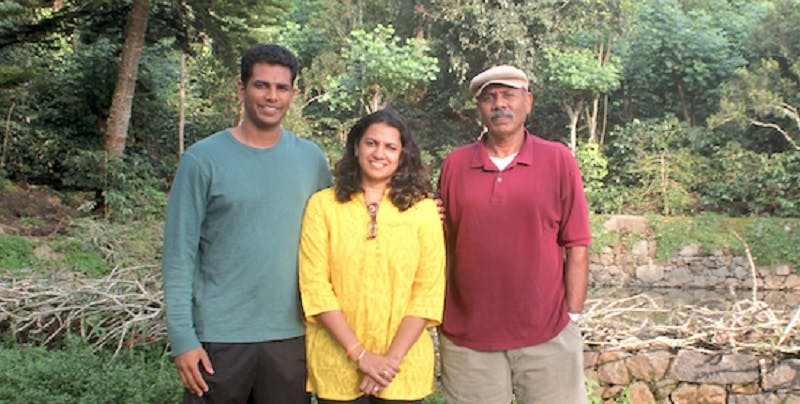
Founders of Cauvery Peak

He came back and began creating coffees at his plantation. Not long after, in mid-2017, he floated his website Cauvery Peak.

The key, though, was in the creation of the coffee.

“I realised that the market out there for connoisseurs of coffee was very large globally. Even in India, premium coffees have not been marketed very well,” says Vishnu, Co-founder of Cauvery Peak. He began sorting coffee based on their nose and palette. “The opportunity to create a brand was too large to ignore because we were supplying coffee beans to traders who were selling it to coffee companies,” he says.

However, Vishnu needed investment and told his father, Vijayan Rajes, who was keen on the idea and became the investor and co-founder. He seed funded Vishnu with Rs 50 lakh for the business.

The origins of the business
Although the family has been in the business for 75 years, after taking it off British hands, the current strain of coffee has connections to the American continent. To improve the coffee strain Vishnu’s grandfather travelled the world for a plant whose beans could add a bold flavour.

The coffee strain at the Yercaud estate is of Costa Rican origin. The story goes that Vishnu Rajes’ grandfather went to the estate of Judy Garland, the famous American actress of the forties, who advised him to procure the plant strain from Costa Rica. Ever since then, the company has been supplying coffee beans to local traders based on this plant strain from Costa Rica.

But under Cauvery Peak, the taste caters to the palate and its three varieties of coffee vary in taste and nose. Cauvery Peak serves the modern customer who is global and shops digital.

“The single estate coffee beans are planted, picked, processed, roasted, packed, and dispatched from the estate directly to you in order to ensure freshness, consistency, traceability, and quality,” Vishnu says. He adds that being online allows him to reach a wider audience. The variety’s sold on the website include single origin coffees like Shevroys Estate single origin. This coffee produces a sharp flavour profile for discerning coffee enthusiasts who love a fine aroma, crisp acidic flavour, medium body and a distinct citrus aftertaste in the cup. The Cauvery Peak Estate single origin has a sweetly round aroma, richly low-key acidity, full body. Hints of fresh- cut cedar, lemon and chocolate in the aroma. In the cup, mid toned with distinct, clean fruit leaning toward chocolate.

Then the Glenfell estate is planted with both Arabica and Robusta varieties and inter-planted with cloves, nutmeg and pepper vines.

The competition and opportunity
Vishnu is building the reach slowly. He has opened three retail outlets in Yercaud and is also supplying his coffee to six hotels across the country. Currently the brand is only nine months old and Vishnu is not worried about sales as yet. He is taking the brand to forums like the Coffee Board of India and to conferences on coffee.

Over the last year, several coffee retailing companies have been born. Startups that offer purchase of coffee online include Flying Squirrel, from Coorg and Chikmagalur region; and Blue Tokai, from Delhi. These brands bring single origin coffees to the table.

Research and Markets, in its India Packaged Coffee & Cafe Chain Market Overview, said that the packaged coffee market is expected to grow between 10-15 percent CAGR over the next five years. The report added that coffee as a segment has steadily gained share of total consumer spending on beverages over the last many years. The growth of cafe chains over the last decade has also boosted the visibility and per capita consumption of coffee among Indian consumers. Cafe Coffee Day, Barista and Tata Starbucks are some of the leading players in the cafe market.

Coffee consumption is higher in the southern part of the country. However, it is expected to increase in other regions during the forecast period. The production of Robusta coffee is much higher than Arabica in India, which is anticipated to increase in the future years. According to Franchise India, the coffee and tea industry has taken a big leap from Rs 25,166 crore in 2013 to almost Rs 41,800 crore in 2017. In less than five years, the industry has grown three-fold, bringing out a lot of business opportunities in the tea and coffee sectors. It is being predicted that the total number of organised cafe chains will increase from the 3,500 at present to almost 6,200 by 2020. These figures are a clear indication of the success brewing for interested investors.

But, for Vishnu Rajes, the journey of coffee has just begun. The reason they call their brand Cauvery Peak is because they could see the river Cauvery from the mountain top of their estate. This legacy brand has successfully gone from local to pan-Indian; and Vishnu now has plans to take it global.

Website
https://www.cauverypeakestate.com/index.php

source: http://www.yourstory.com / YourStory.com / Home> Start Ups / by Vishal Krishna / posted March 06th, 2018
Brewing higher profits and saving birds on the farm

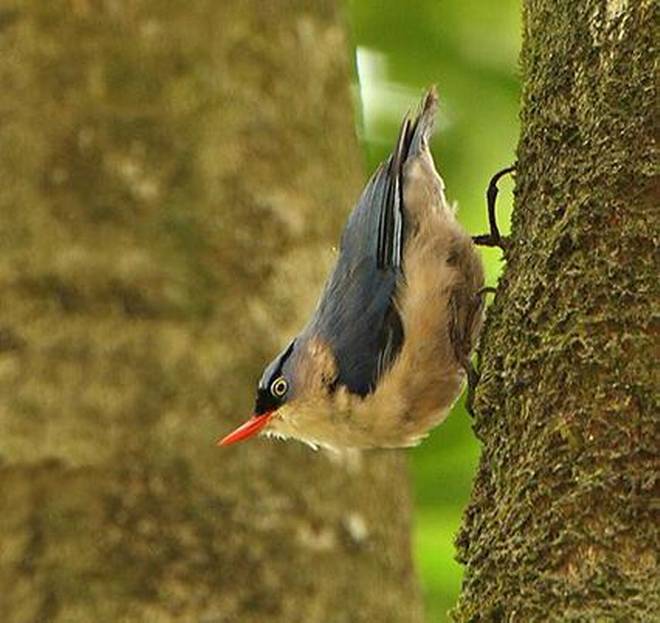
A velvet-fronted-Nuthatch in a plantation.

Arabica coffee helps both farmers and wild birds in the Ghats.

Coffee lovers may be discerning about their sweet arabica brews and the bolder robusta ones, but both types help maintain the diversity of wild birds in the Western Ghats. One, a little more than the other.

Arabica grows under the deep shade of native trees, with benefits for both farmers and birds. The surprise is that Robusta, also grown under native shade, is not far behind in the Ghats, unlike in other parts of the world.

These insights from a group of researchers were published in the journal Scientific Reports.

Native trees are cut down to grow robusta, in order to give it more sunlight, earning this coffee the tag of being inhospitable to wildlife. In Vietnam, for instance, full-sun coffee growth occurred at the expense of native trees. India too has leaned towards robusta: between 1950 and 2015, planted area under robusta grew by 840% while arabica grew by 327%.

Scientists from the Wildlife Conservation Society (WCS-India) and USA’s Princeton University compared bird diversity in 61 arabica and robusta estates across Chikkamagaluru, Hassan and Kodagu districts in Karnataka.

Some surprises

What they found is that the plantations supported 79 species of forest-dependent birds in all, but arabica estates hosted twice the number of endemic birds than robusta. They also supported more birds that depend on forests, and eat fruits, insects and other food. Interviews with 344 coffee-growers showed that arabica was more profitable, with returns of around ₹1 lakh per hectare.

Yet, surprisingly, robusta plantations also hosted high bird diversity. “To our surprise, robusta agroforests had much higher diversity of birds that are specifically adapted to the habitat than we expected,” says scientist Krithi Karanth of WCS-India, who led the study.

Since robusta farmers in the Western Ghats retain native trees, they have been able to preserve the complex canopy structure, setting them apart from others worldwide, says Ms. Karanth.

“Though the current selling rate for robusta is only around ₹3,000 for a 50-kg-bag, it is easier to grow,” explains Suresh M. D., who owns a one-acre coffee plantation of both coffee types.

source: http://www.thehindu.com / The Hindu / Home> Sci-Tech> Environment / by Aathira Perinchery / Kochi – February 16th, 2018

Indian Coffee Farmers May Have Found A Way To Make Efficient Growing More Sustainable

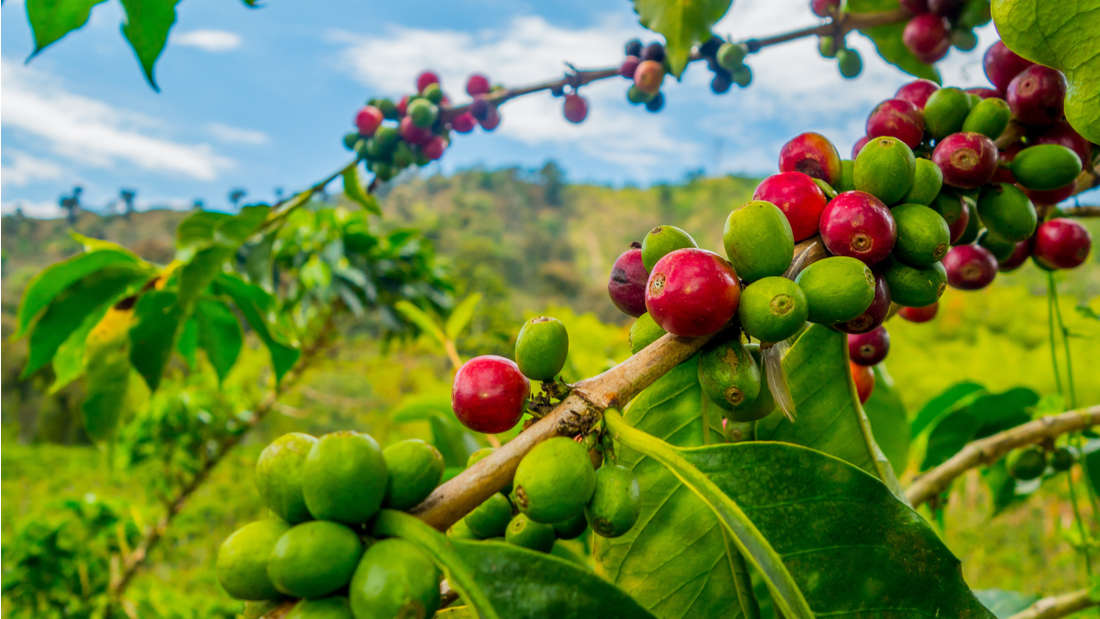
Coffee berries that contain the life-giving bean (seed) inside / Foto 5533 - Shutterstock
Coffee berries that contain the life-giving bean (seed) inside / Foto 5533 – Shutterstock

Any truly environmentally conscious coffee drinker has fretted over the massive commercial agriculture systems required for each lovely cup to appear in their waiting hands. The land-use impacts are especially hard to swallow because the bean-producing shrub grows best in tropical ecosystems – beautiful regions home to some of nature’s most fascinating creatures.

Most well-meaning connoisseurs thus exclusively consume coffee produced by the arabica variety, a shade-tolerant species that happily grow within an existing forest environment, over the other main variety, robusta, the cultivation of which usually involves clearing native trees and understory plants in order to give the coffee bushes the bright Sun and open space they desire. Given that arabica beans can be farmed using sustainable methods and they taste better than robusta, one would think that the case is closed. Unfortunately for wildlife, however, robusta dominates the worldwide coffee market because it is both cheaper and easier to grow.

According to research led by the Wildlife Conservation Society, the rising demand for coffee since 1990 has led to a 150 percent increase in coffee farmlands in India. The majority of these new farms are located within the Western Ghats (one of the Earth’s top eight biodiversity hotspots), and the growers are overwhelmingly choosing robusta.

The team’s paper, published in Scientific Reports, set out to determine how the area’s tropical forests are responding by surveying the bird species present at 344 family-owned coffee plantations. Because birds are known to be a reliable indicator of overall ecosystem vitality, the researchers expected to find that arabica farms host far more birds and a richer variety of species.

Surprisingly, they found instead that robusta plantations are actually home to a higher density of forest-specialist flocking birds, including many fruit-eating species that plants and trees rely on to disperse their seeds. The distribution of threatened species also appeared equal between the two farm types.

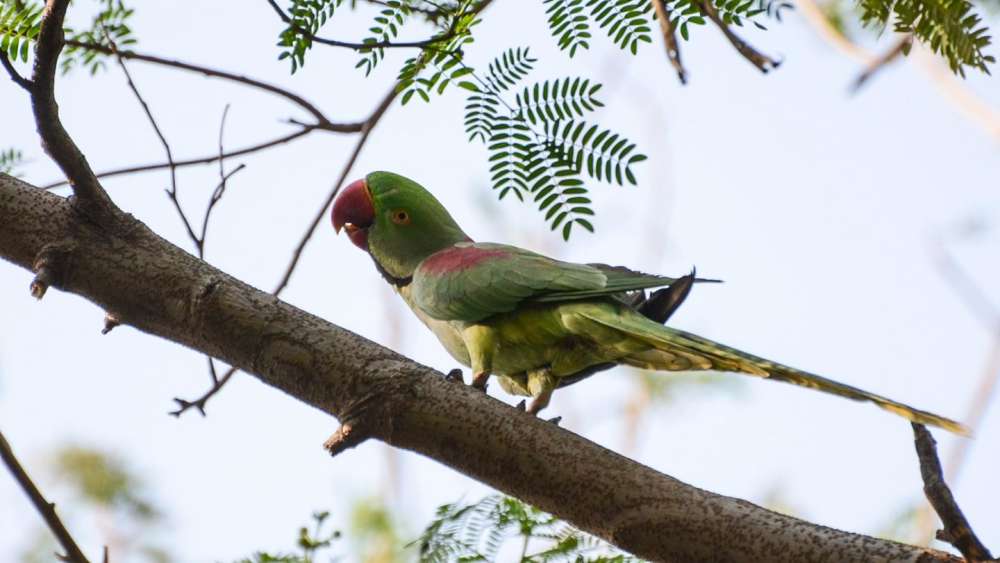
The threatened Alexandrine parakeet was found on both types of coffee farm. Photo credit Manish Kumar

On the other hand, arabica farms did have greater numbers and varieties of forest-dwelling individual birds that are only found in the Western Ghats area. Several of these species are known to be the first to disappear when a habitat is modified, suggesting that although robusta farms are not necessarily as bad as we thought, arabica growing conditions remain more favorable.

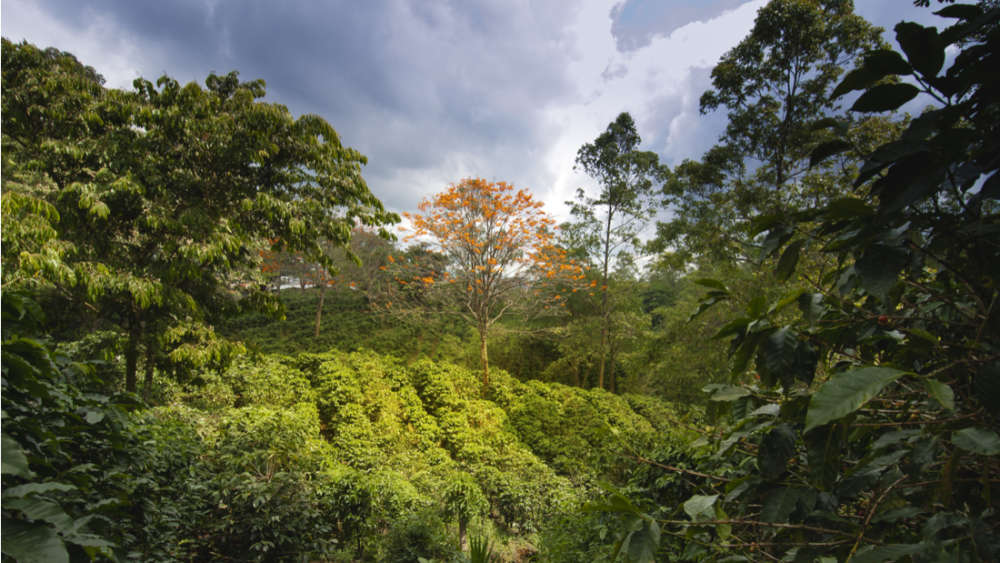
A shaded arabica farm in Costa Rica. Erkki & Hanna/Shutterstock

Few previous studies have directly compared the ecosystem impacts of arabica vs robusta, but just glancing at photographs of each type of farm leads one to believe that there’s no way that the average robusta growing operation has anything to do with the word “sustainable”.

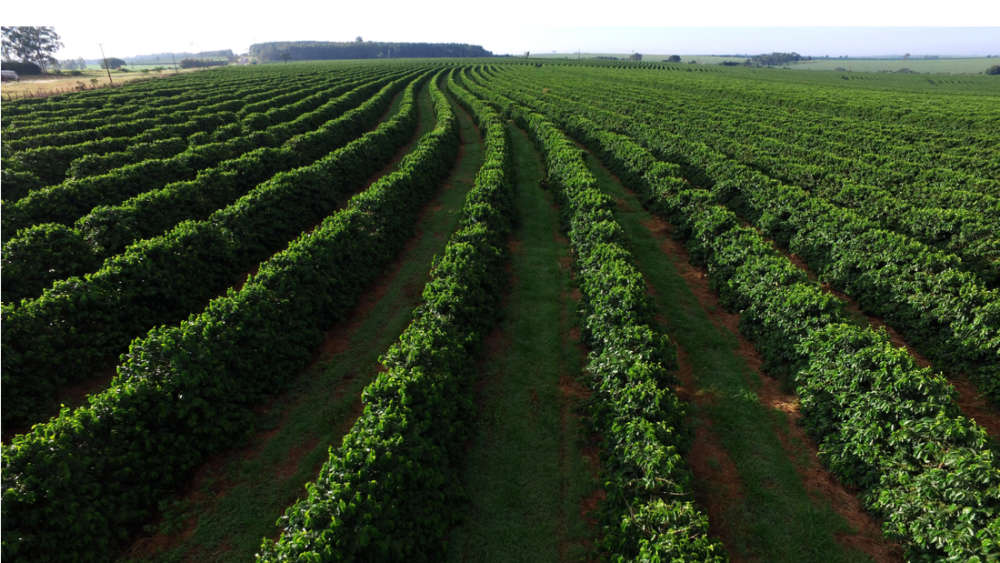
A robusta farm in Brazil. Paulo Vilela/Shutterstock

So, what are the Indian farmers doing differently than the rest of the world?

The authors observed that though most farmers in Western Ghats used conventional (non-organic) fertilizer, only 19 percent of robusta growers also used pesticides compared with 75 percent of arabica farmers – likely due to the fact that the robusta variety is naturally hardier against attack from insects and mold.

In addition, these robusta growers kept way more native trees than growers in other areas.

“In fact, the surveyed robusta agroforests possessed canopy and forest cover three times higher than shade-grown coffee farms in Indonesia,” the authors wrote.

They conclude that the results are not just good news for the birds. Several types of once-lowbrow robusta now fetch market prices that are close to those of arabica, and the farms studied suggest that competitive crop yields are possible without relying on intensive farming methods. Adding this together means that the Western Ghats farming model could provide a sweet spot for the coffee industry: Efficient, profitable, and sustainable.

source: http://www.iflscience.com / IFL Science / by Aliyeh Kovner / February 19th, 2018

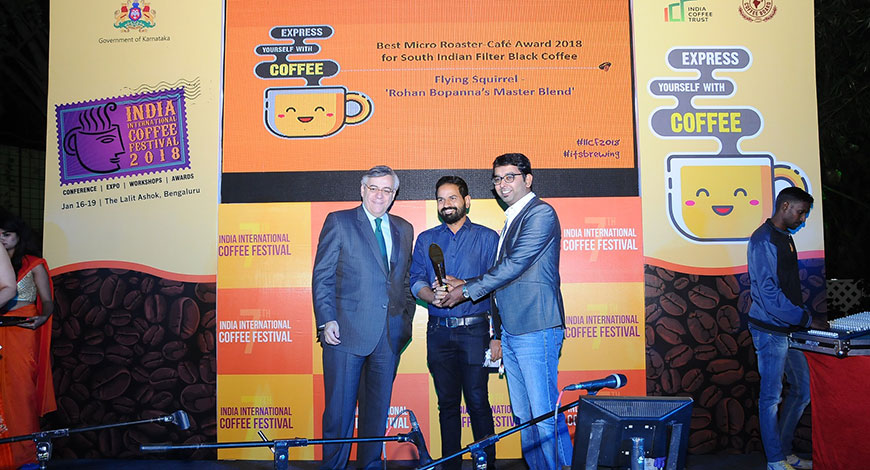
India International Coffee Festival 2018 concludes on a high note

CoffeeFestivalKF28feb2018

The theme for the event was ‘Express Yourself with Coffee’.

It highlighted the merits of coffee tourism for the coffee industry and the small farmers associated with it.

The India Coffee Trust and Coffee Board of India jointly hosted the 7th edition of India International Coffee Festival 2018 in Bengaluru for the first time. Hosted from 16- 19 January at The Lalit Ashok, the four day event included workshops, fireside chats, keynote address by various speakers representing different industry sectors and a coffee exhibition.

The event was attended by trade visitors like roasters, retailer’s distributors, café owners, policy makers, industry captains, exporters,manufacturers and host of other luminaries associated with the coffee industry.

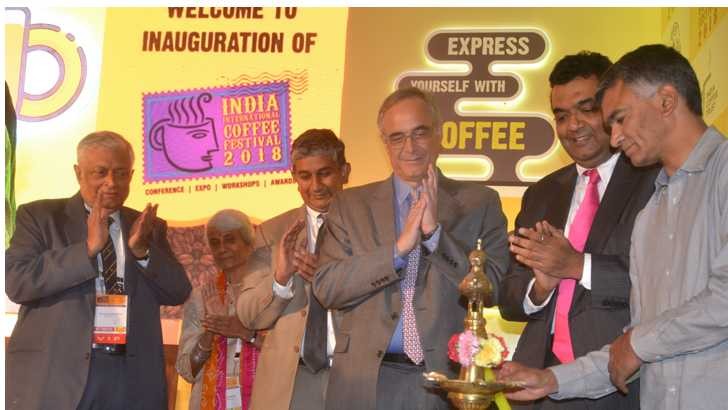
It was inaugurated by Krishna Byre Gowda, Minister for Agriculture, Government of Karnataka, along with Sudhir Sitapati, Executive Director – Refreshments, Hindustan Unilever Limited, Anil Kumar Bhandari, President, India Coffee Trust. Jose Dauster Sette, Executive Director, International Coffee Organisation, Srivatsa Krishna, IAS, Chief Executive Officer and Secretary, Coffee Board of India, Sunalini Menon, CEO, Coffee Lab Limited Trustee, India Coffee Trust.

The theme for the event focused on the lines of ‘Express Yourself with Coffee’. It highlighted coffee tourism as not just benefiting the coffee industry and the small farmers associated with it, but also to bring in the much needed growth to the tourism in the state.

Anil Kumar Bhandari said, “With this 7th edition of IICF, we are optimistic about the great ideas shared by industry experts and eminent speakers. Some exciting initiatives were also discussed during the event and we will take them up to make World Coffee Congress in 2020, a grand success.”

Srivatsa Krishna said, “Bangalore being the coffee capital of India, we are seeing this as a preparatory event leading us to the World Coffee Congress in 2020. For coffee tourism, we are also in talks with few startups for creating coffee trails which will soon be in process.”

source: http://www.voyagersworld.in / Voyager’s World / Home / by Irene Susan Eapen / February 12th, 2018

Wayanad coffee may grab a robusta spot in global market

Kochi :

The Kerala government’s decision to brand and market Wayanad coffee in the recent state budget, close on the heels of Coffee Board’s decision to apply for its geographical indication (GI), could make it the singular robusta variety from India to attract attention.

Wayanad in north Kerala grows around 50,000 to 60,000 tonnes of robusta coffee annually, making it the prominent region in the country cultivating the variety.

Most of the locations in Karnataka, the largest producer of the beverage in the country, grow both arabica and robusta beans. Just over a month ago, the Coffee Board had applied for GI status for Baba Budan Giri, Araku Valley, Coorg and Chikmagalur coffee along with with Wayanad coffee. While the first two are exclusively arabica, the latter two have both arabica and robusta.

“We are sure of receiving the GI tag for Wayanad coffee as we can easily authenticate the scientific and historic evidence for the coffee as required under GI documentation,’’ said K Basavaraj, head, quality division, Coffee Board.

Brahmagiri Development Society, a cooperative of 13,000 farmers, in Wayanad, which came into limelight with the production of various meat under the brand Malabar Meat, is gearing up to play a stellar role in the branding of Wayanad coffee too. With the Kerala government’s encouragement, it has drawn up a plan to construct IRs 60-crore instant coffee factory.

Instant coffee can be sold for Rs.3000 - 7000 per kg bringing more revenue to the growers
Instant coffee can be sold for Rs.3000 – 7000 per kg bringing more revenue to the growers

Instant coffee can be sold for Rs 3,000-7,000 per kg bringing more revenue to the growers. Besides the special aroma of Wayanad coffee, its growth in semi-forest area helps in environment protection. So, we can also factor in carbon neutrality of the region for branding,’’ said P Krishnaprasad, chairman of the society.

source: http://www.economictimes.indiatimes.com / The Economic Times / Home> ET Home> Markets> Commodities> News / by ET Bureau / February 08th, 2018

7th India International Coffee Festival 2018 reflects on experiential tourism in Karnataka

7th edition of India International Coffee Festival 2018 hosted at The Lalit Ashok, Bengaluru saw a host of activities including the coffee workshops, exhibition, keynote sessions, Fireside chat with Shri Priyank Kharge, Hon’ble Minister for IT, BT and Tourism, Government of Karnataka, Coffee Quiz Competition for Coffee enthusiasts ending the day with Café Awards ceremony.

IndiaCoffeeExbn31jan2018

The day started with workshops on ‘Role of sustainability in Post-Harvest Processing Equipment to secure the right quality, type and quantity of coffee.’ The session was led by Carlos Brando and Joao Alberto Peres Brando from Pea Marketing Ltd.

Shri Priyank Kharge, Hon’ble Minister for IT, BT and Tourism, Government of Karnatakagraced the occasion and attended a fireside chat session along with Mr. Anil Kumar Bhandari, President, India Coffee Trust where he emphasized on experiential tourism.“Today people want to experience and learn from their outings, hence experiential tourism is leading to a lot of buzz around homestays. We have offline and online strategies in place and are ready to build infrastructure and jointly manage it with associations. We have opened up 11 new eco-trails that will benefit the homestays and provide exhilarating experience to travelers,” said Shri Priyank Kharge while addressing the gathering.

He further said that, “I am privileged to have a unique opportunity to bring together information technology and biotech to further tourism in the state. I urge the startup fraternity and innovators to come forward with solutions that will help us build a sustainable tourism ecosystem in Karnataka.”

Commenting on this occasion, Anil Kumar Bhandari, President, India Coffee Trust said,“This year the festival focused on skill-building workshops, showcase of products and services, key sessions by delegates on Global Coffee Outlook and Future of Indian Coffee Sector.”

“The Indian coffee sector is growing at a rapid pace. And to sustain this growth, the dependence on government subsidies needs to come to an end,” said Shri Srivatsa Krishna, IAS, Chief Executive Officer and Secretary, Coffee Board of India.

Also, addressing a keynote session here, Jose Dauster Sette, Executive Director, International Coffee Organization said, “India is the sixth place in internal coffee consumption. In future by 2050, the production of world coffee might further decrease due to factors such as climate change that facilitates spread of pests and diseases. Both Arabica and Robusta are also negatively affected by the climate change.”

source: http://www.everythingexperiential.in / Everything Experiential – Business World / Home / by EE News Desk / January 24th, 2018

A rush of Caf Feine

The International Coffee Festival brings growers, sellers, and lovers together in the same mug

CaffeineKF20jan2018

Coffee love is serious love, and Bengaluru knows how to keep up with it. Just last month, Coffee Santhe celebrated your favourite brew with a three-day carnival. It had the best estates in India showcasing their blends and coffee-related demonstrations to coffee-related food and art.

Cut to the present. Coffee love is hogging the limelight yet again, thanks to the ongoing India International Coffee Festival (IICF) 2018. The expo, which is in its seventh edition, organised by India Coffee Trust – an NGO formed by various stakeholders of the Indian coffee fraternity, is on till Friday. And the event is dotted with different kinds of activities – from panel discussions to exhibitions by various growers.

Today, for instance, you can flaunt your knowledge of coffee at a quiz. Or, sit down for a workshop about the ‘Role of Sustainability in Post-Harvest Processing with the Right Processing Equipment to Secure the Right Quality, Type and Quantity of Coffee’ by Carlos Brando of Pea Marketing.

Over two days, you can listen to coffee experts and policy-makers talk about the trends in the coffee market, innovation in the production and packaging segment, startups making coffee ‘cooler’, alternate brewing techniques, and how to turn India into a ‘Coffee Nation’.

Jose Sette, executive director of International Coffee Organization, will speak about ‘Global Coffee Outlook – addressing challenges to meet future demand’; Dr Joseph K Kimemia, chairman of African Fine Coffee Association, will talk about ‘Initiatives on Promotion of African Coffee’; Dr Peter Baker, director of Climate Edge UK, will share his thoughts about ‘The Changing Climate for Coffee – farming in a time of extremes’; Sanjay Khajuria, senior VP (Corporate Affairs), Nestle India, will discuss the topic ‘Creating Shared Value –
How responsible business and communities work together’. The fest will also felicitate the best in the business.

Anil Kumar Bhandari, president of the India Coffee Trust, says that the coffee industry owes a lot to the country’s café culture that has grown rapidly in the past decade or so. “I need to give a little background into this festival. We started this expo in 2002, which begun in tacit with the Coffee Board, commerce industry, and ICT. However, we never asked for funds from the government because we didn’t want the show to come with strings attached.

There are only 4-5 large corporate houses that are part of this trust. Initially, it was started by a bunch of coffee growers like me, and the idea was to generate domestic consumption of coffee, and to help the growers market their coffee better. In India, 98 per cent of coffee growers are small, which means they farm on less than 10 acres. Now in 2002, the industry across the world suffered a massive slump because the global market was saturated. There was no strength in the industry to combat this deep depression. It is at that time that we considered generating a new idea – something that will increase domestic consumption – instead of the going to the government to ask for waivers and subsidies.” And this where cafes have come into play.

However Bhandari also adds that the coffee drinking habit remains mostly out of home, but “yes, it created a whole new lifestyle. Before the modern version of cafes, the smaller places had no focus, no identity, barring a few landmark places.”

Yes, the expo is quite industry-oriented. It is an ideal networking ground for people engaged in the growth, production, packaging, and promotion of coffee, or are planning to make a career switch in the direction. Nonetheless, platforms such as these provide common man a chance to learn what goes into bringing their latte, espresso, cappuccino, or the humble filter coffee to their tables.

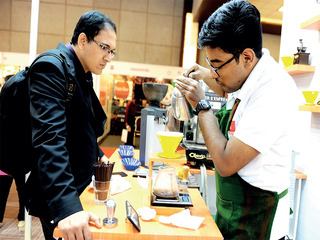
Besides these talks and coffee quiz, an exhibition is being held across two halls – Kalinga 1 and Siddhartha. On showcase are a range of coffee beans and blends, with Coffee Board of India itself displaying and selling 15 varieties (light, medium, and dark) hailing from Coorg to Chikmagalur, Araku Valley, Nilgiris and Wayanad. Plus, you can sift through coffee filters, including a cute, ceramic one. Needless to say, there’s a lot of coffee for you to sip on, from the regular instant brews to the speciality. Moreover, a few vendors will also teach you the method to making a cuppa of your choice.

Two stalls are interesting. One is selling coffee paintings – painting with coffee powder (see pic on left). It is the handiwork of Himabindu, an IT professional who’s currently on sabbatical. She has put up 30 paintings, and had managed to sell quite a few by Wednesday afternoon. The second one will have you scratch your head as it promises to print your selfie on coffee broth. The set-up will be fully operational today.

If you want to take your coffee expertise a notch up, you can enquire about the ‘Q Grader Arabica Training & Certification’ programme, which will take off towards the end of February. Or drive down to coffee estates in the state and learn about the bean-to-cup process there. You can get information at the tourism stalls.

Catch IICF 2018, January 18-19, at The Lalit Ashok, Kumara Krupa High Grounds Details: iicf.in

source: http://www.bangaloremirror.indiatimes.com / Bangalore Mirror / Home> Entertainment> Lounge / Bangalore Mirror Bureau / January 18th, 2018

Want to make India a ‘coffee nation’, Coffee Board

Bengaluru (PTI) :

The Coffee Board wants to make India a coffee nation and position it as the drink for Prime Minister Narendra Modi’s vision of New India, a top official of the board said today.

Speaking at the inaugural event of the Seventh India International Coffee Festival,Coffee Board secretary Srivatsa Krishna said, “We are positioning coffee as the drink for Prime Minister’s vision of New India.” “Chai (Tea) has been the drink for many many years and British gave tea for free at the street corners and made this country a tea drinking country. We want to make it a coffee nation,” he said.

“Today outside the southern world and the national capital and a few other state capital, nobody drinks coffee.

Can we have pure Arabica and Robusta as the drink for the tea bugs from Tier I and II cities of New India? That is the dream we are pursuing.” To achieve its goal,the board wants to make Indian coffee as famed as the Darjeeling or Shillong tea,said Krishna at the four-day event.

He said the board was working towards branding and geo-tagging Indian coffee, telling the world the unique India coffee story and sell it as a premium product.

Krishna said the Board was the first organisation in India to introduce the block chain technology into coffee in a pilot project through Eca Analytics.

Under the project, it intends to bring together growers, curers, roaster, exporters and the Coffee café.

Eca Analytics would also help the board utilize the 100 years of rainfall and soil data to help the growers.

Krishna said the board has also partnered with Harvard University to experiment with ‘precision agriculture development’.

“We are also partnering with Harvard University. Two professors,Michael Kremer and Prof Sean Paul,have come forward with something called precision agriculture development.” “Today they are working in three states of India. We are bringing them into the coffee world wherein through an IVR call working with scientists at CCRI. They can give precise advise to the grower. This will hopefully take off by the end of Q-1,” said Krishna.

On the occasion, a mobile application developed by the Coffee Board for growers and exporters was also demonstrated.

It will be formally launched two months later by the Union Commerce Minister.

PTI GMS RA APR APR .

source: http://www.newindianexpress.com / The New Indian Express / Home / PTI News / January 17th, 2018

A tech booster coming for domestic coffee industry

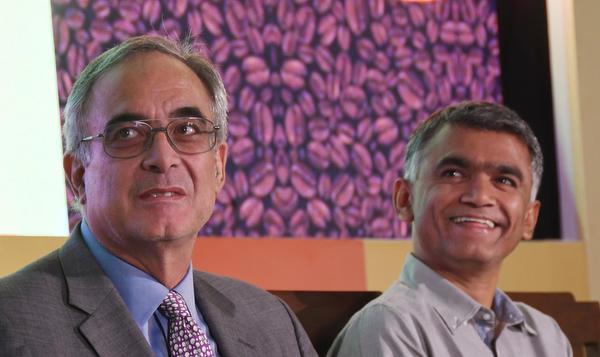
(from left) Jose Sette, ED, International Coffee Organisation; Krishna Byre Gowda, Minister for Agriculture, Government of Karnataka, at the inauguration of the India International Coffee Festival (IICF) in Bengaluru on Wednesday - Photo: SOMASHEKAR G R N
(from left) Jose Sette, ED, International Coffee Organisation; Krishna Byre Gowda, Minister for Agriculture, Government of Karnataka, at the inauguration of the India International Coffee Festival (IICF) in Bengaluru on Wednesday – Photo: SOMASHEKAR G R N

Bengaluru :

India’s coffee sector is seen getting a technology boost with the State-run Coffee Board proposing to introduce a host of initiatives ranging from blockchain to drones soon.

Coffee Board Secretary Srivatsa Krishna said the Board has partnered with Eka Analytics to introduce blockchain technologies into the coffee sector covering growers, consumers, exporters and the trade including cafes on a pilot basis.

Rainfall, soil data
Besides, the rainfall data gathered for over 100 years and soil info are being used to deliver extension and advisory services to the growers on demand through a mobile app, Krishna said at the inaugural of the 7th edition of the India International Coffee Festival.

Besides, the Board also proposes to introduce the model of Precision Agriculture Development, developed by Harvard professors Michael Kremer and Shawn Cole to the coffee sector in the country and deploy drones for crop estimation, Krishna added.

He also urged the growers to come together to promote coffee.

Krishna further said that the Board has applied for a GI tag for four coffee varieties, a move that could help position better and fetch premiums.

The four-day IICF, organised by the India Coffee Trust and the Coffee Board, is perceived to be a precursor to the International Coffee Organisation’s World Coffee Congress which India will be hosting for the first time in 2020 in Bengaluru.

India is the sixth largest producer of coffee and about 70 per cent of the country’s produce is exported to Europe and Russia among others.

Karnataka Agriculture Minister Krishna Byre Gowda, while inaugurating the festival, said the domestic market provided a big opportunity for the coffee fraternity to boost consumption.

Tax issues
Sudhir Sitapati, Executive Director-Refreshments, at Hindustan Unilever Ltd, stressed upon the need for a parity in GST between tea and coffee.

While the leaf tea attracts a GST of 5 per cent, on instant coffee it is pegged at 18 per cent.

The main objective of the festival this year is to capture the changes that are taking place in the coffee sector and to discuss issues faced by the industry and growers, said Anil Kumar Bhandari, President, India Coffee Trust.

source: http://www.thehindubusinessline.com / Business Line / Home> Economy> AgriBusiness / The Hindu Bureau / January 17th, 2018

‘Indian cuppa needs own brand for domestic, global markets’

With international prices falling due to excess production, domestic strategic brand initiative crucial.

Leading coffee growing countries like Brazil, Colombia, Vietnam and Indonesia has caused an oversupply with the prices of the commodity falling by about 30% in the global markets.

Bengaluru:

The Coffee Capital, Banga-lore, will host a four-day international coffee festival, beginning today, amidst global uncertainty over the future of the commodity. Excess coffee production from leading coffee growing countries like Brazil, Colombia, Vietnam and Indonesia has caused an oversupply with the prices of the commodity falling by about 30% in the global markets.

Indian coffee industry is at the crossroads now and the only option available for the industry is to create its own coffee brand, for the domestic and international markets, suggested Anil Kumar Bhandari, president, India Coffee Trust.

“The Ministry of Commerce should set up a special focus group for coffee, involving all stake holders in the industry, to create a profile, brand and a sophisticated communication for Indian coffee at home and outside. The government also has to sanction a fund to build a brand,’’ he said.

Prediction for climate change impact on coffee producing countries, including India, is already causing a lot of concern for coffee growers. The entire industry is worried about the rumour of Coffee Board getting restructured. The board is the only entity that holds the industry together. Also the industry hears that an Export Promotion Board is on the anvil for coffee.

Bhandari said, “India has been exporting all its surplus coffee for decades. We grow the best quality coffee, including several specialty varieties. In fact we are the only country that grows coffee under the shade of rain forests. No other country does that. Still, Indian coffee is not able to command a premium in the global markets, because we have not yet built a brand for it. So the need of the hour is to build a sophisticated campaign for our coffee and not creating another entity for exports.’’

Coffees from Central American countries, South American countries, Kenya, Ethiopia are getting premium in global markets, alth-ough none of these countries grow superior quality coffee. During last fiscal, India exported coffee worth Rs 5,600 crore, the basic price fetched at the New York Futures Exchange. “We have the potential to double the value, with the same quantity of exports, if we are able to position our coffee under specialty and premium varieties and not as bulk commodity sold at the basic price,’’ added Bhandari.

Vietnam has recently launched a five-year campaign to build its own premium coffee brand.

The country is spending some $7.5 million in this exercise.

Indonesia, with an average production of 691,000 tonnes a year, is witnessing a sudden spurt in coffee culture, followed by a mushrooming of cafes across the country. Brazil is the largest coffee producer, consumer and exporter of coffee followed by Vietnam, Indonesia and Columbia.

China is also quite bullish on coffee retailing, and it’s enthusiasm in the space is evident with every fortnight witnessing the opening of a Starbucks outlet in the country. China’s domestic coffee consumption is in the 12 to 15% range against 5 to 7% that of India.

source: http://www.asianage.com / The Asian Age / Home> Business> In Other News / by Mini Tejaswi / January 16th, 2018