Kodagu contributed 39% of India’s total coffee production with 1.37 metric tonnes (MTs) during 2015-16, according to post-monsoon estimates by the Coffee Board. The total area of coffee production in the district includes 76,953 hectares of robusta cultivation and 27,969 hectares of Arabica.
The estimates also revealed that coffee production in Karnataka touched 2.53 lakh MT, which is 72% of the country’s total production. Chikkmagaluru contributed 83,810 MT and Hassan 31,825 MT.
According to sources from the board, India’s coffee production during the period was 3.5 lakh MT, an increase of 7% from the previous year. Production of Arabica variety rose by 10% (9,800 MT), while the Robusta variety saw an increase of 5.76% (13,200 MT).
Contributions from other states include Kerala – 68,650 MT, Tamil Nadu – 18,125 MT, Andhra Pradesh – 9,100 MT; Odisha – 600 MT and north eastern states – 185 MT.
The total area of coffee cultivation in the country stands at 4.23 lakh hectares, of which 2.30 lakh hectares is in Karnataka.
source: http://www.timesofindia.indiatimes.com / The Times of India / News Home> City> Mysore / TNN / July 09th, 2016
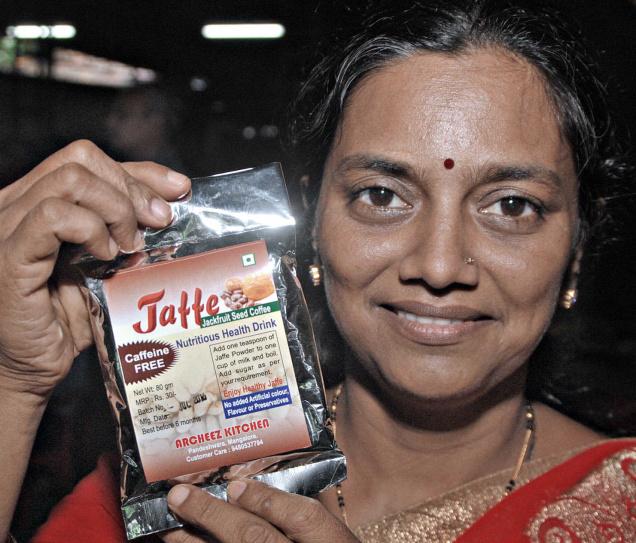
Healthy:Maithraye Shenoy displaying the ‘Jaffe powder’ made of jackfruit seeds.— Photo: H.S. Manjunath
Can powdered jackfruit seed taste like light coffee without adding any other ingredient to it?
If you cannot believe it, you ought to taste the “health drink” made by Shivanna from Sakharayapatna, of Parivarthana, a non-government organisation, in Chikkamagaluru district.
“My product is very near to coffee; it can become a substitute for coffee,” said Shivanna, who was at the jackfruit mela here on Sunday. He told The Hindu that the processed seed powder was the result of his one-year research and it was free from any stimulant like caffeine.
He said that three cups of the “health drink” could be prepared from one spoon of his new product. Shivanna has sent the sample to the Central Food Technological Research Institute, Mysuru, for analysis of carbohydrate, fibre, fat and calorie contents. “You can drink this product like you drink coffee by making its decoction,” he said.
‘Jaffe powder’
Maithraye Shenoy, a homemaker from Pandeshwara in Mangaluru, has also made a “health drink” from jackfruit seed. She has named it “jaffe powder”, which can be mixed with milk. “It was the result of a two-month research. I roast the jackfruit seed before making the product,” she said.
Meanwhile, Artocarpus Foods Pvt. Ltd., at Taliparamb, near Kannur, is already marketing jack seed powder. It can be used to make chapattis, dosas, cakes, and bread. It also makes a product from the seed as masala for chicken curry, said Shree Padre, executive editor, Adike Pathrike, a farm monthly and a crusader for jackfruit and its value-added products.
source: http://www.thehindu.com / The Hindu / Home> News> Cities> Mangaluru / Raviprasad Kamila / Mangaluru – July 04th, 2016
City-based freelance journalist and author P T Bopanna’s book ‘The Romance of Indian Coffee’ has been chosen as the world’s best book on coffee at The Gourmand World Awards function at Yantai in China.
The book, earlier shortlisted for the finals of the ‘Best in the World’ books under the ‘coffee books’ category, was picked from the entries of 64 countries, according to Bopanna.
‘The Romance of Indian Coffee’ was published in 2011, and takes a 360-degree view of Indian coffee.
The final results were announced recently in which the book was ranked first, followed by entries from the United States and Brazil in the second and third places respectively, Bopanna said in a release here.
Spain headquartered The Gourmand International every year honours the best food and wine books, printed or digital, as well as food television with the awards open to publishers in all languages and countries.
The Gourmand Awards celebrate global cookbook and wine book publishing, and feature many world-renowned chefs each year.
Bopanna has authored five books and runs a few Kodagu-centric websites and recently produced a documentary film titled ‘Discover Coorg’.
source: http://www.outlookindia.com / Outlook / Home> The Newswire> Books & Culture / PTI / June 28th, 2016
Additional Chief Secretary Dr Shrikant Baldi said today that the state government was exploring the possibility of coffee cultivation as the Coffee Board of India had already surveyed prospective areas in Kangra, Mandi, Una and Bilaspur.
Eight market yards would be set up at Mendli, Fatehpur, Annu, Bhadshali, Jukhala, Totu, Tapri and Shilai to ensure remunerative prices to growers, he added.
Speaking on National Statistics Day after releasing a document, Agriculture and Farmer’s Welfare, brought out by the Department of Economics and Statistics today, Dr Baldi said: “Besides this, the state government is bringing 4,000 hectare area under off season vegetables cultivation. Under Rs 100-crore Dr YS Parmar Kisan Swarozgar Yojana, a target had been set for constructing 4,700 poly-houses covering 8.3 lakh square meter area for which farmers get 85 per cent subsidy”.
He said the government exempted levy of market fee on all vegetables and fruits and improved varieties and rootstocks of apple, pear, cherry, walnut and strawberry were being imported and distributed to farmers, who were given 80 per cent subsidies on anti-hail nets.
For the betterment of sheep breeders, procurement price of different varieties of wool had been increased and procedure for grant of grazing permits had been streamlined, he said.
He said the Shahnehar and Sidhata irrigation projects had been completed. Under the Vidhayak Nidhi, at least Rs 20 lakh would be spent on minor irrigation works and command area development.
Under the Rajiv Gandhi Micro Irrigation Scheme, about 8,500 hectare area would be brought under drip/ sprinkler irrigation system benefiting 14,000 farmers, he added.
He said under the Dr YS Parmar Kisan Swarozgar Yojana, 85 per cent subsidy was being provided to farmers to set up poly-houses, 50 per cent assistance for setting up vermi compost units and 60 per cent subsidy on setting up of milk processing and chilling facilities to the dairy co-operative societies.
He said the Rs 1,115 crore Himachal Pradesh Horticulture Development Project would provide new technologies to the horticulturists.
source: http://www.tribuneindia.com / The Tribune / Home> Himachal> Governance / by Tribune News Service / Shimla – June 29th, 2016
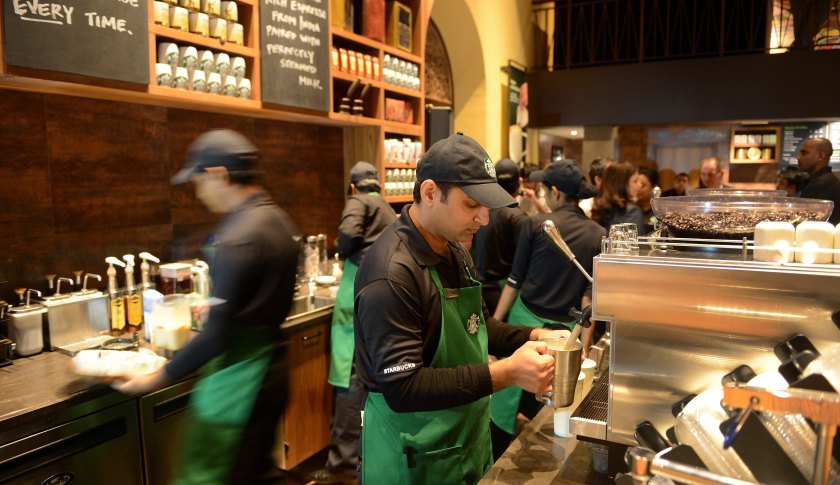
Staff work behind the counter of India’s first newly-inaugurated Starbucks outlet in Mumbai on October 19, 2012. / Photo- PUNIT PARANJPE/AFP/Getty Images)
It’s also one of the coffee chain’s fastest-growing markets.
Starbucks for the first time will sell single-origin, premium coffee from India in the United States as part of its effort to support coffee production in the country better known for its tea.
Starbucks SBUX -0.23% for a limited time later this year will sell a small-lot arabica coffee from the Tata Nullore Estates in India’s Coorg coffee growing area. The coffee will be roasted and sold at Starbucks’ Reserve Roastery and Tasting Room in Seattle. The price was not disclosed.
John Culver, group president for Starbucks Coffee China/Asia Pacific, told Reuters that the aim is for this to be the “first step in what we hope will be many reserve coffees coming out of India.”
It’s also one of the coffee chain’s fastest-growing markets.
India, which produces both robusta and arabica, is the world’s sixth-largest coffee producer. Its coffee output has increased 16% over the past 5 years, according to International Coffee Organization (ICO) data.
India’s estimated 2015/16 harvest is expected to be 5.83 million 60-kg bags of coffee, according to ICO.
The country is one of the coffee chain’s fastest-growing markets. Starbucks’ India, an equal joint venture between Starbucks and Tata Global Beverages Limited, has grown to 84 stores across six cities in India since its start in 2012.
Starbucks India, which so far has served only 100% arabica coffee grown and roasted in India, will also begin offering Kenyan and Sumatran coffee soon, Culver said.
source: http://www.fortune.com / Fortune / Home> Retail> Coffee / by Reuters / June 27th, 2016
Coffee grown at the Tata Nullore Estates located in Coorg will now be available at Starbucks in Seattle. This is the first time Starbucks will offer a single-origin coffee from India in the US.
This is part of the multiple new initiatives decided in a meeting between the Chairman and Chief Executive Officer of Starbucks Coffee Company, Howard Schultz, and Chairman, Tata Sons Ltd, Cyrus Mistry, at the iconic Starbucks Reserve Roastery and Tasting Room in Seattle.
“For the first time, Starbucks will offer a single-origin coffee from India in the US, giving customers from outside the country a unique opportunity to experience a rare, small-lot coffee from the Tata Nullore Estates located in the beautiful Coorg coffee growing area of India. Starbucks Reserve Tata Nullore Estates will be the first coffee from India to be roasted at the Starbucks Reserve Roastery and Tasting Room and will only be available at this Seattle location later this year,” said a press statement.
Starbucks also announced plans to increase its coffee roasting capacity for supplying its stores in India and, over time, select markets around the globe. Since Tata Coffee Ltd opened its doors to a roasting and packaging plant in Kushalnagar in Coorg, Karnataka, in 2013, this facility has steadily increased its roasting capabilities. Today, it roasts the Starbucks India Estates Blend and Espresso Roast coffees and will soon expand to include both Kenyan and Sumatran coffees for Starbucks stores throughout India.
“We are proud to work with Starbucks, a company which shares our commitment to both the coffee growing regions and the coffee farmers to ensure we meet the global demand for high-quality coffee over the long-term,” said Mistry.
Starbucks also announced it will soon take flight on Vistara, India’s fastest growing full-service airline, later this year. Starbucks’ fresh brewed coffee service will be exclusively available on all Vistara flights. A joint venture between Tata Sons and Singapore Airlines, Vistara operates more than 457 flights weekly to 17 destinations across India and, in June celebrated the milestone of flying two million travellers.
Starbucks will also extend its Teavana specialty tea brand to India this December. Starbucks also plans to expand the availability of Himalayan Mineral Water, bottled by Tata Global Beverages, beyond Starbucks stores in India to Singapore later this year, as the companies explore opportunities to introduce the bottled water brand to stores across Starbucks China and the Asia-Pacific region.
Schultz and Mistry committed to come together to provide young people in India valuable skills training over the next five years through Tata STRIVE, an initiative aimed at arming youth with skills for employment, entrepreneurship and community enterprise.
source: http://www.thehindubusinessline.com / Business Line / Home> Companies / The Hindu Bureau / Mumbai – June 27th, 2016
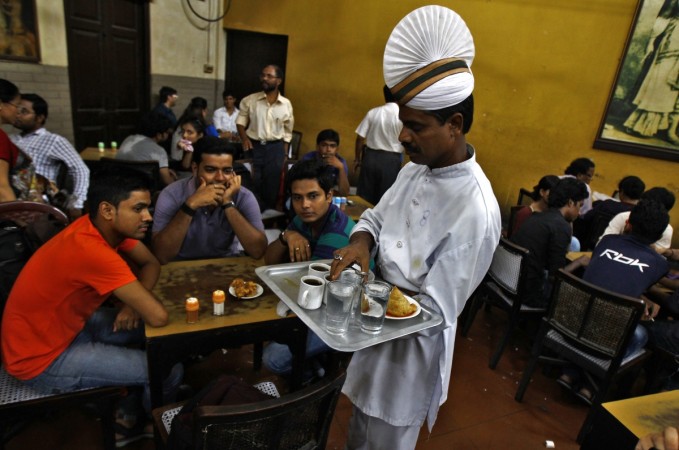
A waiter serves coffee to customers inside an Indian coffee house in Kolkata June 20, 2014 (Representational image).Reuters file
Coffee prices are at a 13-month high in international markets, after rain hit world’s largest-producer Brazil, lifting share prices of Indian coffee companies on Wednesday.
Tata Coffee was the biggest gainer at 6.21 percent on the BSE at around 2.30 p.m., followed by Tata Global Beverages and Bombay Burmah Trading Corporation.
“In Brazil it is raining too much in the Arabica areas, and this is definitely causing quality concerns,” Reuters had quoted a European physical coffee trader as saying last Friday.
An Indian coffee grower said heavy rainfall is bound to impact harvesting of coffee crop.
“Rains at the time of harvest can damage the crop as the beans will fall off. As a result, Arabica prices have been looking up in the last few days. Also, one cannot wish away the effect of drought in Brazil earlier in the year. Hence, it may not turn out to be a bumper crop as projected but not a bad crop either,” the Economic Times quoted coffee grower Anil Bhandari as saying.
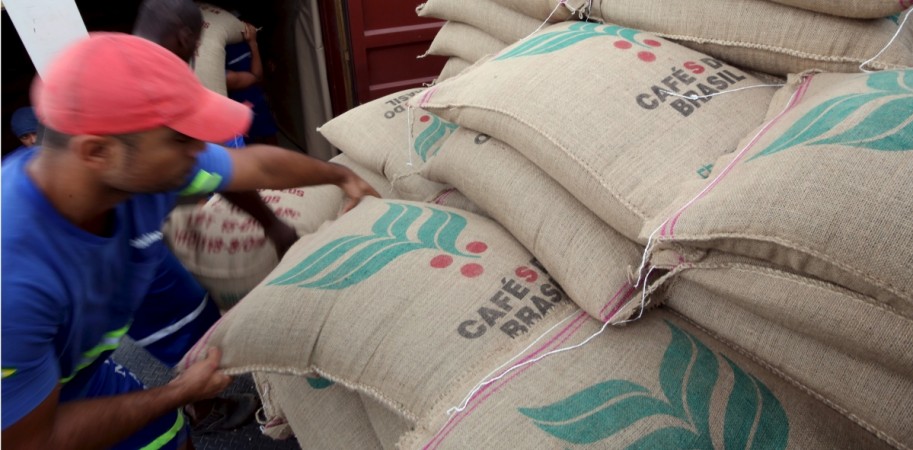
Workers load 60-kg jute bags of coffee beans for export into a container in Santos, Brazil, December 10, 2015.Reuters file
On June 17, the US Department of Agriculture (USDA) had forecast world coffee production for 2016/17 to rise by 2.4 million bags from the previous year to 155.7 million bags (60 kg per bag). The estimate was based on Arabica output in Brazil increasing to about 60 percent of total production, neutralising lower Robusta production in the country, along with Vietnam, and Indonesia.
Arabica and Robusta are two main categories of coffee worldwide. The Arabica crop determines global coffee prices.
After factoring global consumption at 150.8 million bags, the USDA said exports from Indonesia, Vietnam, Brazil and India are likely to remain lower (than last year).
India had exported 3.20 tonnes of coffee in 2015-16, up 13.39 percent from the previous fiscal.
After from being the largest producer, Brazil is also the largest exporter of coffee.
source: http://www.ibtimes.co.in / International Business Times / Home> News> Companies /by S V Krishnamachari / June 22nd, 2016
A bunch of entrepreneurs are using e-commerce to promote freshness, taste and artisanal coffee as replacement for the boring instant stuff
Matt Chitharanjan settles down on a bag of beans. He doesn’t really have much of a choice in this air-conditioned room on the first floor, because it’s packed with sacks and sacks of beans. Coffee beans.
On the ground floor, shutters down at the moment, is a café in the process of construction, set to open soon.
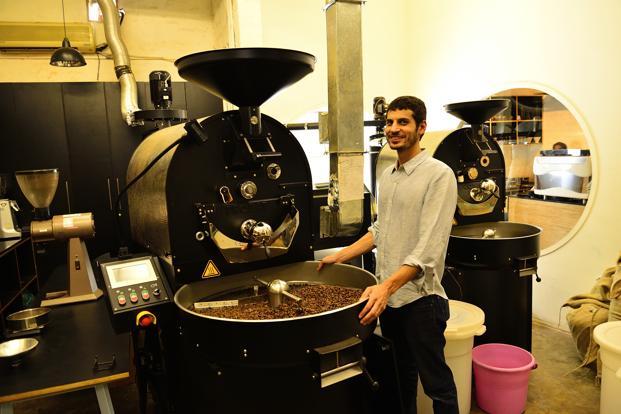
The proprietor of Blue Tokai, one of India’s new online retail coffee ventures, is taking what would seem like the next logical step, opening a café in Mumbai, at the Laxmi Woollen Mills Estate in Mahalaxmi.
He says the café-cum-roastery—they have one in New Delhi already—will allow him to introduce customers to his coffee and help logistically as a storage space for distribution in western India—Mumbai in particular—where a large number of his customers reside.
Blue Tokai is just one of the many entrepreneurial ventures that have bloomed in the past four or five years in the business of coffee. These ventures are sourcing coffee beans directly from the farms, roasting them and selling them online. The high-quality coffee they source was up until now being exported, by estate owners of rich fields in Coorg, Chickmagalur, the Nilgiris and other parts of south India, saving the poorer quality for blends and instant coffee.
Some of these new companies, many retailing online, include The Indian Bean, Flying Squirrel, Seven Beans, The Coffee Company, Black Baza and Estate Craft. Some existing sellers have expanded in scope, like Halli Berri, Kerala’s Riverine and Goa’s Sussegado. Some others, like Vero, sell espresso capsules with machines and Café Rio also does instant coffee.
Each of these new entrepreneurs believe they are doing something slightly different from the other, each trying to find a foothold in a country where coffee seems to be making a strong pitch for mug space.
Many have made their way into shelves in retail stores such as Godrej Nature’s Basket, Food Hall and Westside, and in restaurants and cafés like Indigo Deli in Mumbai and Yogi-sthaan in Bengaluru. Their combined hope is a customer would take that leap of faith, buy a bag and allow the taste to do the rest—i.e., get them to switch from instant coffee to a more brooding variety.
There is no clear indication as to why so many companies would start at the same time with broadly the same ideas. But the growth of e-commerce and global exposure may have something to do with it.
Ashish D’Abreo, one of the founding partners at Flying Squirrel, calls this India’s third wave of coffee, albeit a decade behind the US, where coffee became more of a niche product, like wine, than a commodity. The American third wave brought with it artisanal brands like Blue Bottle, Intelligentsia and Stumptown Coffee Roasters, small-scale coffee sellers more interested in freshness, free trade, organic products and sustainability while providing an alternative to the omnipresent Starbucks.
Brotherhood of brews
There is a common thread that runs through many of these ventures, including international experience and, oddly enough, a background in advertising.
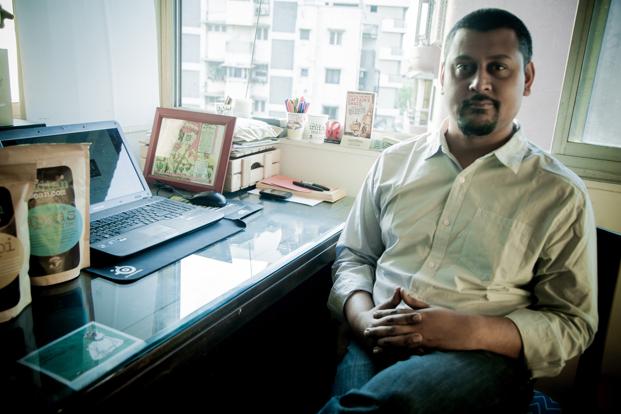
Kunal Ross, one of the partners at The Indian Bean, had a bit of a head start over his friend Chitharanjan. The former lived in Dubai, the latter grew up in the US. Ross has worked in advertising, as has D’Abreo and Sanjoy Gupta of Estate Craft. All of them loved coffee but could not find the taste they wanted in India. They spotted a gap in the market and decided to filter it.
Kunal Ross
These new-age coffee barons speak of their own specialties. Flying Squirrel, so named after the estate’s most frequently seen visitor, the Malabar squirrel, grows its own coffee on one of the partners’ 160-acre farm in Polibetta, Coorg. Blue Tokai does its own roasting, while The Indian Bean does not. D’Abreo of Flying Squirrel, too, believes in the café concept—they are going to open one in Bengaluru soon—while Ross is not sold on the idea.
Blue Tokai identifies the estates from which it sources the coffee on its packaging, for transparency. Seven Beans brings together Indian growers with Italian roasters. Black Baza’s ambition is to improve biodiversity, while Estate Craft is a single-estate coffee. Vero sources the beans and makes capsules in-house.
There is a friendly competition among growers, says Chitharanjan, and so is the case with sellers. The potential market is so large that there is no need for conflict. “There is a possibility that a number of us would drop out, but in this case, it would be one in 10,” says Ross. “Especially in metros, there is no scope for us to fail because it’s a big enough market.”
Their growth has been encouraging, but the figures are also a reflection of the newness of the business and that all of them have started from scratch. Absolute figures are difficult to come by, but Bengaluru-based Flying Squirrel has grown at 15-20% month-on-month, Mumbai-based Indian Bean at 300-400% year-on-year and New Delhi-based Blue Tokai has doubled every year, according to their respective proprietors. Venture capital firm Snow Leopard Ventures invested in Blue Tokai last year.
For others, like Dhruv Kochhar, founder of Vero, the expectation is simple. Coffee pods are a €12 billion business in the Western European coffee market alone, and logically, it should be the next thing to happen in India. “The capsule business will be like Apple in bringing change here,” he says.
Consumption-sales conundrum
At a farmers’ market in Phoenix Mills, Mumbai, over a recent weekend, budding entrepreneurs and traders braved the scorching sun to set up stands in the central courtyard, market their wares and encourage people to try. Flying Squirrel, Estate Craft and Vero had their stalls here. As did Chado, a tea company with so many varieties that they printed a booklet to list them out.
While tea consumption grew at a steady rate of 2% annually for the period 2008-13, coffee grew at 5%, says Bidisha Nagaraj, group president (marketing), Café Coffee Day, quoting a Technopak March 2015 report. “Coffee is becoming more of a fashion statement among the young and upwardly mobile in India,” she adds.
India is predominantly a tea-drinking country, with coffee restricted to the instant variety, except in the south. For a long time, the idea of brewing a cup, either by grinding the beans or using the powder in a French press or filter, has seemed tedious and time-consuming, maybe a little pretentious and perhaps even a bit intimidating.
Keshav Dev, proprietor of one of New Delhi’s long-standing coffee stores Devan’s, disagrees with Nagaraj a bit, based in his own sales. He says people prefer going to a café rather than brewing at home. Though the number of buyers haven’t really increased over the years, according to Dev, they have fallen into a demographic: Expatriates, those who have returned to India after having lived abroad, those who travel abroad frequently and the more “mature”.
That also explains why online sales for many of these companies have been higher in Mumbai, New Delhi and Bengaluru than in other places. Urban centres, with greater Internet penetration and better-connected courier services, are naturally faster at adapting to new businesses.
Café online
Cafés could become significant for the future of coffee sellers because they give instant exposure, greater visibility and allow consumers to try something before buying. But then, they are also cost-intensive, which would be difficult for the newbie entrepreneurs who work on tight budgets.
At Di Bella, a coffee chain, the air is filled with the pungent, burnt smell of brew as Ross sets up work meetings on a regular weekday afternoon. Expensive, sophisticated machines gurgle in the background, while a few customers line up at this mini outlet inside a large retail store in Bandra, Mumbai. It’s still the summer holidays—which means anxious parents trying to hold on to a mug while trying to restrain their agile children.
It is chains like these that Ross and the others are taking on, though it’s not yet a level playing field. Their “mass-produced, over-roasted, over-priced” brew—“coffee without spirit or characteristics,” D’Abreo says—drove these young entrepreneurs to start their own business for an alternative.
Ironically, it is chains like Di Bella, Starbucks and Café Coffee Day, among others, that have helped them in creating awareness. Chitharanjan explains how Starbucks’s entry into any market, made after careful research, timed correctly, causes the market to “explode”.
On whether cafes would help or not, on one side we have Dev, Chitharanjan and D’Abreo, and on the other we have Ross, who wants to stay in the online business.
Most people go to cafés to mingle and socialize in a sanitized ambience, maybe eat something, rather than to specifically consume coffee, he believes.
Chitharanjan says, “If you have to grow the market, and I don’t feel online coffee sales are going to take off hugely for some time, at least with cafés you can curate the experience.”
It’s something the Blue Tokai proprietor wants to try, as does D’Abreo, whose café will come up in Koramangala, Bengaluru, in a couple of months. To get the young and “upwardly mobile”, Dev is planning to open one as soon as his son, Siddhant Keshav, returns from his training in Vienna as a barista.
Is coffee sexier?
Coffee remains a more frequently used conversation starter than tea. You are more likely to hear someone say “let’s have coffee” than “let’s have tea”. It’s sexier, probably because of caffeine’s addictive nature and because of reported health hazards, which makes it evil and therefore more desirable.
It’s aspirational, Ross says, because there is an element of snob value attached. “These are people who are romanced by the idea of being able to brew their own and be proud of it,” says D’Abreo over the phone.
There is more of a process to making coffee at home, with or without an electrical gadget, (unless it’s instant coffee, or unless you are Tamil, with faith in stainless steel) than there is to tea, giving it an added mystique.
“It’s a richness of drinking experience, that hugging sort of aroma that coffee gives you…” says D’Abreo. “There can not be that richness in a cup of tea. It does not smell the house.”
The new breed are focused on freshness and their beans are roasted two or three times in a week, so that the bag of beans or powder you get at home has not been roasted more than a few days ago. Since coffee loses a part of its mojo in about two weeks, this becomes their calling card.
Speed of delivery is the next big step, because “if it takes five days to get you, it leaves a sour taste in people’s mouth”, says Chitharanjan.
Most of these “third-wave” coffee sellers consider education and awareness as among their responsibilities, which shows on their websites, with links to information on how to brew, gadgets to buy, etc. The Flying Squirrel sells brewing equipment and coffee kits; Blue Tokai retails grinders. They present fascinating histories of the evolution and trade of coffee, of sustainability and ethical practices.
In the end, there is also fierce ambition. “We want to be the Blue Bottle of India,” says D’Abreo.
To tea or not to tea
For Chaayos founder Nitin Saluja, the logic is really simple: Indians drink tea, so the business idea is in tea. Ahead of the opening of Chaayos’s 23rd branch in Powai, close to the Indian Institute of Technology in Mumbai, which makes it part nostalgic and part redemptive for the former student, Saluja debunks the theory that coffee is more alluring than tea.
He puts his money where his mouth is: the nearly four-year-old company has opened 18 stores in the space of a year, all in New Delhi and Mumbai—a breakneck pace. They have a 1-800 telephone number, a busy website and an app.
He explains why this business makes sense. “We are a country of chai drinkers. We have been consuming it forever. It’s a 30:1 in ratio to coffee. It was a no-brainer.”
Saluja says customers do not visit cafés for coffee, but for the ambience. “I don’t think coffee is any sexier. I think the ambience is sexy. Being a tea-drinking nation, we are not able to understand the nuances of coffee. It’s something cultural, if you were to think that it would grow over a period of time, it will take a long time. Tea can provide the notes that’s sexy.”
Chaayos is among few specialized outlets for tea, at least in Mumbai. The Taj Mahal Tea House at an old, refurbished bungalow in Bandra and Tea Trails in Fort are among the others, besides one-off stores like San-Cha. As Chaayos continues to expand and other forces start working, like Chado, tea will grow way beyond the roadside stall or tapri format. But it hasn’t been driving new conversations the way coffee has.
There’s much consolidation to happen in the coming years in the coffee business. Chitharanjan says their working capital requirement is exceeding the money they generate because they need to buy their entire year’s supply at once.
Shipping is a nightmare, he adds. He is concerned about plantations, because there is a narrow band across the world where coffee is grown and temperatures are rising. So, growers have to go higher and higher in altitude to discover new areas for growing coffee.
It’s the reason why Black Baza founder Arshiya Bose’s focus is on conservation of forests, wildlife and water, and on how growers deal with climate change.
Ross names logistics and getting a national wholesale partner as his challenges.
What brews in the future remains intriguing, but like Indian wine was more than a decade ago, Indian coffee is poised at an interesting juncture. Though alcohol has “other things to go with it”, the parallels are easy to draw: there’s discovery, there’s history and there a few brave warriors trying to blend the two.
“Sit down, enjoy, smell and taste the different things we have put in an effort to create, but unlike wine, don’t drink for the high,” says D’Abreo. “It offers much more than the effect of alcohol. There is so much more to coffee… fruitiness, sweetness, saltiness, bitterness, the smell of wet earth, blueberry, strawberry…”
“It evokes all five sensory systems,” elaborates Nagaraj. “It is more than just a beverage. It’s a state of mind.”
Comments are welcome at feedback@livemint.com
source: http://www.mintonsunday.livemint.com / Livemint.com / Home> Big Story / by Arun Janardhanan / Sunday – June 19th, 2016
India’s coffee output in the next crop year is expected to drop by around a quarter to the lowest in nearly two decades as poor rains and hot temperatures hit plantations during the crucial flowering stage, the head of an industry body said.
India is the world’s sixth-biggest coffee producer, well behind leaders Brazil and Vietnam.
Nonetheless, lower production from India could provide more support to global prices, already surging due to a drop in the output in top producer Brazil.
“Dry weather is hitting plantations in the crucial flowering stage. On a conservative basis, we are estimating a 25 percent drop in production,” Baba P. S. Bedi, chairman of the Karnataka Planters Association (KPA) told news agency Reuters.
Karnataka accounts for about 70 percent of India’s total output. India is likely to produce 350,000 tonnes coffee in the current season ending on September 30, according to estimates by the state-run Coffee Board.
With a 25 percent reduction in Karnataka, production could drop to 263,000 tonnes in the 2016/17 crop year, the lowest since 1998/99.
The Coffee Board is expected to provide its first production forecasts for 2016/17 by mid-June, said D R Babu Reddy, an agricultural economist at the Board.
India, which started coffee cultivation in 1670 with seven smuggled beans, produces mainly robusta, used primarily in instant coffee.
“Due to the back-to-back droughts, ground water has been depleted,” said Bedi, pointing to lower rainfall since the start of March on top of drought last year.
Coffee growing regions in southern India received up to 70 percent lower rainfall than normal from March to mid-May, according to the India Meteorological Department.
Higher than normal summer temperatures alongside water scarcity had badly impacted the conversion of coffee flowers into cherries, said Anil Kumar Bhandari, a large planter.
India exports three-quarters of its coffee production and production problems will dent shipments in 2016/17, said an exporter based in Bengaluru.
“This year, exporters are aggressively selling due to a recovery in global prices. Next year we will have very limited carry forward stocks,” the exporter said.
Italy, Germany and Belgium are the main buyers of India’s crop, paying a premium over global prices.
India’s coffee exports have risen 19.4 percent to 213,187 tonnes since the start of current marketing year on October 1.
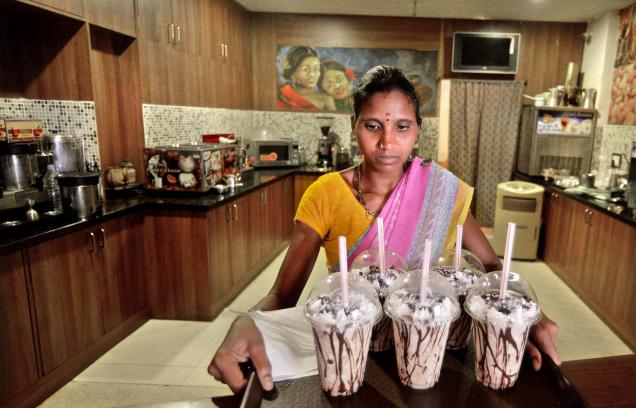
Rich brew:A tribal woman serving cold coffee at the Coffee Museum at Araku in the Agency area of Visakhapatnam district. Photo: K.R. Deepak
Flavours from all over the world tingle taste buds at museum in Araku
Wish to relish freshly brewed Araku Coffee where it is grown? The Coffee Museum at Araku is the place to be. It’s no surprise that coffee connoisseurs drive down all the way from Vizag city, 120 km away, just to relish its rich taste!
Come ‘Aashadam’ (the month when traditionally newly married bride and her mother-in-law are not allowed to stay under the same roof) young couples come in droves to the museum to spend the day exchanging sweet nothings.
The museum had been catering to discerning palates for over six decades now, say its organisers. The buzz around ‘Araku Coffee’ has been growing after it bagged awards at international competitions during the last few years. Araku Coffee once again grabbed headlines when it tickled the taste buds of Prime Minister Narendra Modi during the International Fleet Review (IFR) in Visakhapatnam.
Located right behind the Tribal Museum here, the Coffee Museum provides a wide array of coffee flavours from different parts of the globe. At first glance, visitors and tourists may dismiss it as just another museum to promote coffee consumption. They are sure to be bowled over by the rich aroma, the taste of a wide range of freshly brewed coffee varieties.
The coffee-based confectionaries are sure to leave a lingering taste of coffee in one’s mouth.
One can visualise the journey of coffee down the ages through the dioramas, photographs, and charts from ancient literature as they relish the piping hot coffee along with coffee-based snacks. Video and audio presentations on the subject add pep to the scenario.
Coffee chocolates in different flavours, concept-based chocolates with a mix of various spices, chocolate truffles, chocolate-covered coffee beans, liquid coffee-filling chocolates and baked coffee snacks can be had in the concept-based ‘Gourmet Coffee House’ section.
“We use high-quality local ingredients with international formula,” says A.S. Prakasa Rao, one of the organisers of the museum.
History of coffee
Can you hazard a guess as to who discovered coffee? You might not have, perhaps, imagined even in your wildest of dreams that coffee beans were first discovered (eaten) by goats in Ethiopia in the 7th Century AD.
A shepherd became curious on seeing his goats becoming hyperactive after eating the berries of wild plants on the hill slopes. At first he thought that they must have gone crazy. But, after observing them over a period of time, he realised there was something in the wild berries, which was giving them the kick. He carried some of the berries to the monastery and shared them with the monks. That’s how goats first discovered coffee in Ethiopia! Arab traders from Yemen carried the seeds home and were the first to cultivate the plants. The Arabs had closely guarded the secret and allowed only the roasted beans to be exported.
“Instant coffee was first introduced for Army jawans in 1901. Blended coffee (coffee/chicory mix) was introduced in 1958 only in India and France, while at other places of the world only pure coffee is used,” says Mr. Rao.
“An Indian Muslim managed to smuggle some coffee seeds and planted them at Chikmagalur in Karnataka. The Maharaja of Jeypore in Odisha was the first to introduce coffee at Araku during the 1890s. However, commercial cultivation at Araku in a big way started only during 1970s by the ITDA, Coffee Board, and AP Forest Development Corporation Limited mainly to wean away tribals from ‘podu’ (shifting) cultivation,” says Mr. Rao, who has an in-depth knowledge of various aspects of the subject.
Heritage status
The Coffee Museum at Araku is claimed to be India’s first thematic coffee museum. The museum should have acquired heritage status by now as it is being run for over six decades.
source: http://www.thehindu.com / The Hindu / Home> News> Cities> Visakhapatnam / by B. Madhu Gopal / Araku(Visakhapatnam District) – May 04th, 2016
WELCOME. If you like what you see "SUBSCRIBE via EMAIL" to receive FREE regular UPDATES.
Read More »