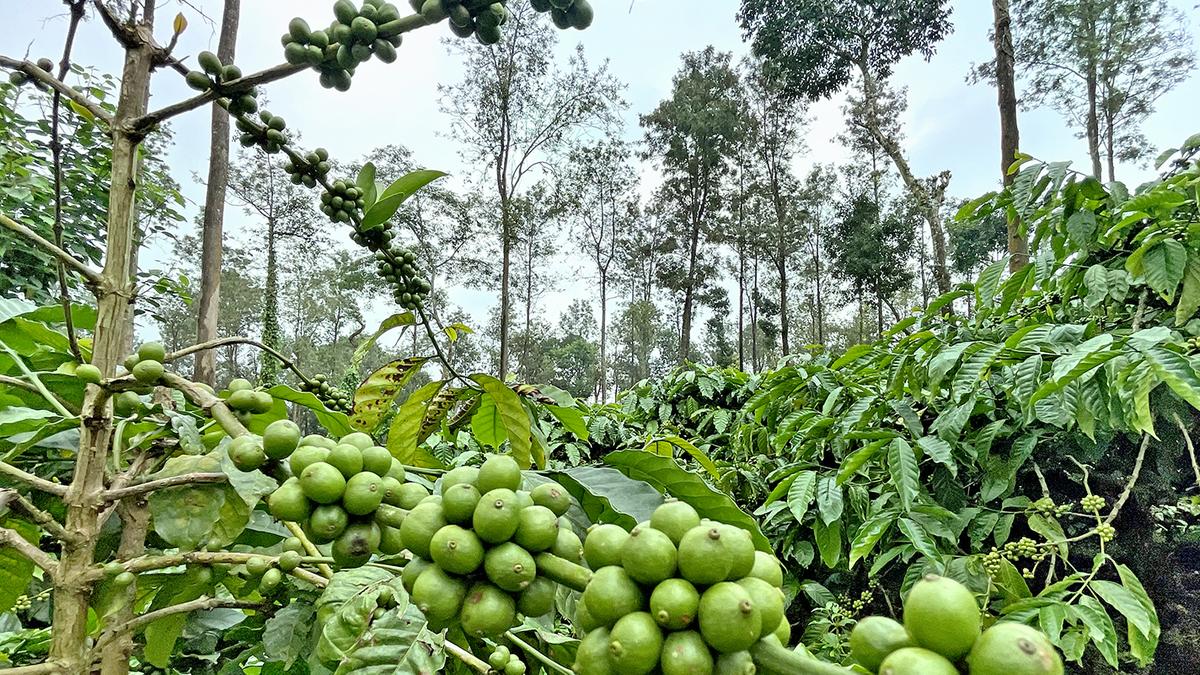
On Friday, the farm gate price of raw Robusta coffee berries in Wayanad market rises to a record ₹251 a kg, a significant increase from ₹171 a kg during the same period last year.
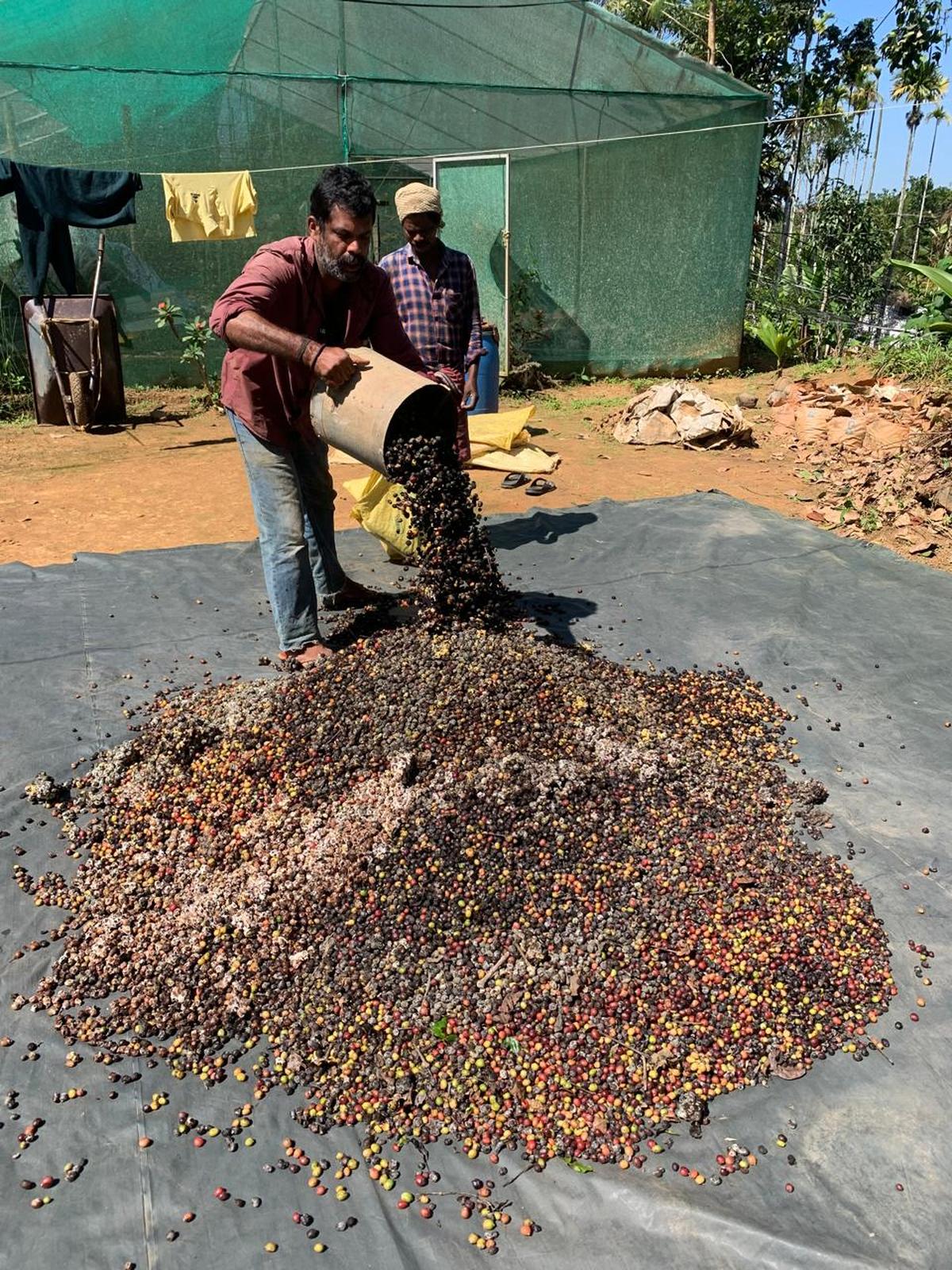
A farmer at Meenangadi in Wayanad district drying coffee berries. | Photo Credit: Special Arrangement
Robusta coffee farmers in south India are celebrating a bountiful harvest season, with prices reaching new heights. On Friday, the farm gate price of raw Robusta coffee berries in Wayanad market soared to a record ₹251 a kg, a significant increase from ₹171 a kg during the same period last year. This time in 2022, the price was even lower at ₹80 a kg.
Though the harvest is almost over, a shortfall in supply has contributed to the surge in prices, according to market sources. Many farmers are opting to hold onto their produce, anticipating even higher prices in the coming days. Concurrently, the spot price for Robusta coffee beans has risen to ₹450 a kg.
Sources say a sharp decline in Robusta coffee production in Brazil, a leading coffee producer, due to drought-like conditions is also driving up the prices. Reports indicate that Brazil’s coffee stock has plummeted to below two million bags (60 kg each) this year, down from nearly 5.5 million bags last year.
Additionally, the coffee market in Vietnam, another key Robusta producer, has been temporarily closed due to lunar holidays, further tightening supply.
The dearth of rainfall is the major concern of farmers now, especially small-scale coffee farmers, as irrigation facilities are out of their reach. Many farmers living on forest fringes are also grappling with increased wildlife crop raids, posing additional challenges.
In a related development, the price of Arabica coffee seeds has also reached an all-time high at an auction held in Bengaluru, fetching ₹605 a kg, up from ₹456 a kg during the same period last year.
According to the Coffee Board of India’s Post Blossom Estimate, the total coffee production in India for the 2023-2024 fiscal is projected at 3,74,200 tonnes, including 2,61,200 tonnes of Robusta coffee, of which Wayanad contributes 61,050 tonnes.
source: http://www.thehindu.com / The Hindu / Home> News> India> Kerala / by E M Manoj, Kalpeta / January 31st, 2025
India 7th Largest Exporter Of Coffee With Shipments Valuing USD 1.29 Bn In FY 2023-24
New Delhi :
India has emerged as the seventh-largest coffee producer globally, with exports nearly doubling to USD 1.29 billion in FY 2023-24 from USD 719.42 million in 2020-21, according to a statement released by the Commerce and Industry Ministry on Monday.
The country’s strong export performance continues in 2025, with over 9,300 tonnes of coffee shipped in the first half of January, primarily to markets including Italy, Belgium, and Russia.
The nation’s coffee production, dominated by Arabica and Robusta varieties comprising roughly three-quarters of total output, is primarily exported as unroasted beans. However, the export boom is increasingly driven by growing demand for value-added products such as roasted and instant coffee.
Simultaneously, domestic consumption has shown steady growth, rising from 84,000 tonnes in 2012 to 91,000 tonnes in 2023, fueled by rising disposable incomes, cafe culture, and increasing coffee preference over tea in both urban and rural areas.
India’s coffee cultivation is concentrated in the biodiversity-rich Western and Eastern Ghats, with Karnataka leading production at 248,020 MT in 2022-23, followed by Kerala and Tamil Nadu.
These regions feature shaded plantations that not only support coffee production but also play a crucial role in maintaining the ecological balance of these biodiversity hotspots.
The Coffee Board of India has implemented several strategic initiatives to boost production and meet growing demand, including the Integrated Coffee Development Project (ICDP).
This comprehensive program focuses on improving yields, expanding cultivation to non-traditional regions, and ensuring sustainable farming practices.
These developments, coupled with export incentives and logistical support, have strengthened India’s position in the global coffee market.
The combination of historical legacy, modern initiatives, and strategic support continues to drive the growth of India’s coffee industry, supporting both domestic production and international competitiveness.
(KNN Bureau)
source: http://www.knnindia.co.in / KNN / Home> Sectors> Exports-Imports / by KNN Bureau / January 22nd, 2025
Chelvies is the latest Indian specialty coffee start-up to attract investment and will use its Endurance Capital-led funding round to scale from six stores to 30 over the next 12 months
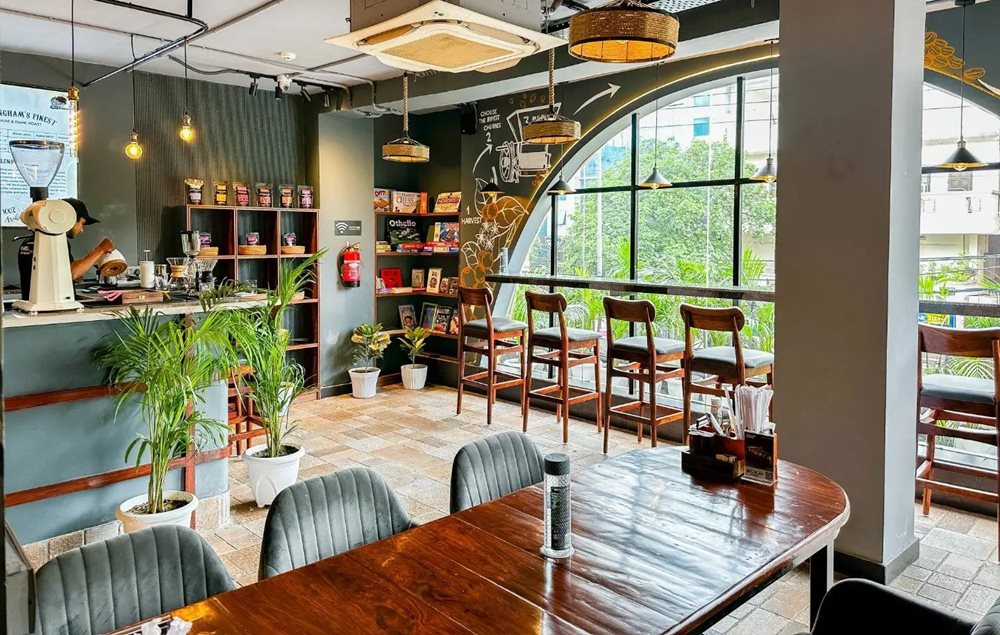
The interior of Chelvies Punjabi Bagh outlet in Delhi NCR | Photo credit: Chelvies/Facebook
Indian specialty coffee and all-day dining chain Chelvies Coffee has raised $1m in a pre-Series A funding round led by Endurance Capital, with an additional $500,000 in debt financing currently under process.
Chelvies, which sources coffee from the Ratnagiri and Mandalkhan estates in Baba Budangiri, Chikmagaluru, opened its first store in 2023 and currently operates six outlets across Ahmedabad and Delhi NCR. The business, which is seeking to create a farm to cup coffee brand which ‘resonates with the cultural fabric of India’, will use the investment to scale its footprint to 30 outlets by 2026, primarily focusing on high street locations across India’s major metro cities.
The Noida-based specialty coffee and all-day dining chain will also use funding to improve its supply chain infrastructure, strengthen its operational teams and develop food production capabilities. Alongside extensive specialty coffee and bakery ranges, Chelvies also offers an all-day dining menu of burgers, artisanal sandwiches, pizza and sharing platters prepared in-store and sells wholebean packaged specialty coffee on its website.
“Since our launch, we have rigorously tested and perfected our concept through our presence in Delhi NCR and Ahmedabad, refining every aspect of the customer experience. This funding comes right at a time when we are all set to scale aggressively and bring our unique offering to key markets across India,” said Dhruv Singh, Founder and CEO, Chelvies Coffee.
Investment in Indian coffee businesses has accelerated over the last 12 months, with fellow start-ups abCoffee, First Coffee and Fast Coffee all raising funds to scale their operations, establish new sales channels and enter new domestic markets.
Additionally, more established brands such as Blue Tokai Coffee Roasters, Third Wave Coffee and Subko Coffee Roasters continue to attract new investment to increase their market share and scale their direct-to-consumer sales channels.
source: http://www.worldcoffeeportal.com / World Coffee Portal / Home> Weekly Coffee News> India / January 13th, 2025
The initiative aims to establish 2,500 coffee kiosks and train women from self-help groups to become successful coffee entrepreneurs.
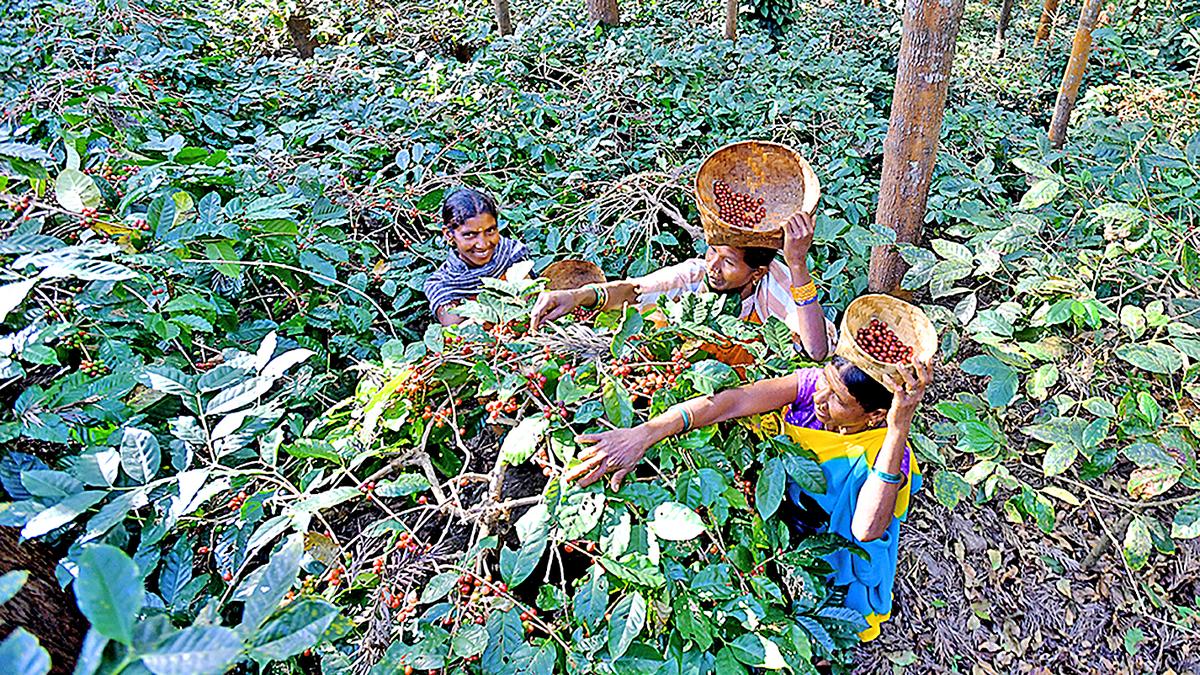
Women harvesting coffee beans. Initially, 400 women will be trained to become master trainers at the coffee board’s head office in Bengaluru. | Photo Credit: K.R. Deepak
The Coffee Board of India, in partnership with the National Livelihood Mission in Karnataka, has initiated a project to empower 1,00,000 women members of National Livelihood Mission Self-Help Groups (SHGs) across the State on coffee brewing techniques and rural cafe management.
To execute the programme, an MoU was signed between K.G. Jagadeesha, CEO and Secretary, Coffee Board, and P.I. Sreevidya, Mission Director of National Livelihood Mission. This was mainly aimed to facilitate the establishment of rural and urban cafes dedicated to offering an authentic filter coffee experience, said the coffee board on Wednesday.
“The coffee board, in collaboration with subject matter experts and in-house specialists, will work along with the Atal Incubation Centre of Coffee Board, the implementing and monitoring partner, to ensure impactful outcomes,’‘ said Mr. Jagadeesha. Ms. Sreevidya added: “This coffee micro entrepreneurial project will provide a new window of opportunities to women empowerment.”
According to the coffee board, the project will be implemented in two phases. Initially, 400 women identified by NLM will be trained to become master trainers at the coffee board’s head office in Bengaluru, who in the second phase will subsequently upskill other women at taluk and hobli levels. The initiative aims to establish 2,500 coffee kiosks and train one lakh women from SHGs to become successful coffee entrepreneurs.
The State government allocated ₹25 crore in its 2024-25 State budget to train one lakh women from NLM SHGs as coffee entrepreneurs. ‘’By supporting potential and existing entrepreneurs, it promotes gender equality, reduces poverty, and fosters opportunities for marginalised women,” Mr. Jagadeesha said.
source: http://www.thehindu.com / The Hindu / Home> News> India> Karnataka / by The Hindu Bureau / January 23rd, 2025
India’s relationship with coffee dates back centuries. The story begins in the 1600s when Baba Budan, a revered holy saint, brought seven Mocha seeds to the hills of Karnataka. This simple act of planting seeds in his hermitage courtyard in Baba Budan Giri marked the beginning of India’s rise as a significant coffee producer. Over the years, coffee cultivation has transformed from a modest practice into a booming industry. Today, India stands as the seventh-largest coffee producer in the world, with exports reaching an impressive $1.29 billion in the fiscal year 2023-24. This figure is nearly double the $719.42 million recorded in 2020-21.
Growing Global Demand for Indian Coffee
The surge in India’s coffee exports can be attributed to the increasing global demand for its rich and unique flavors. In January 2025 alone, India exported over 9,300 tonnes of coffee, with major buyers including Italy, Belgium, and Russia. Approximately 75% of India’s coffee production consists of Arabica and Robusta beans, primarily exported as unroasted beans. However, there is a notable shift towards value-added products, such as roasted and instant coffee, which is further driving the export boom.
The rise of café culture, coupled with higher disposable incomes, has led to a growing preference for coffee over tea among Indian consumers. This trend is evident in both urban and rural areas. Domestic coffee consumption has increased from 84,000 tonnes in 2012 to 91,000 tonnes in 2023. This shift reflects a broader change in drinking habits, as coffee becomes a staple in daily life for many Indians.
Coffee Cultivation in India: A Rich Heritage
India’s coffee is primarily cultivated in the ecologically rich Western and Eastern Ghats, known for their biodiversity. Karnataka leads the nation in coffee production, contributing 248,020 metric tonnes in 2022-23, followed closely by Kerala and Tamil Nadu. These regions are home to shaded plantations that not only support the coffee industry but also play a crucial role in preserving the natural environment. They help maintain the ecological balance of these biodiversity hotspots.
The Coffee Board of India has launched several initiatives to enhance coffee production and meet the growing domestic and international demand. The Integrated Coffee Development Project (ICDP) focuses on improving yields, expanding cultivation in non-traditional regions, and ensuring the sustainability of coffee farming. These measures are part of a comprehensive strategy to strengthen India’s coffee industry, increase productivity, and enhance its global competitiveness.
Empowering Communities Through Coffee Farming
A prime example of successful coffee farming is found in Araku Valley. Here, nearly 150,000 tribal families have collaborated with the Coffee Board and the Integrated Tribal Development Agency (ITDA) to increase coffee production by 20%. This achievement is supported by loans from the Girijan Co-Operative Corporation (GCC). It demonstrates how coffee farming empowers communities and aligns with the vision of Aatmanirbhar Bharat, or self-reliant India.
These initiatives, along with export incentives and logistical support, play a vital role in expanding India’s coffee industry. They not only improve domestic production but also enhance global competitiveness. As India continues to establish itself as a leading player in the global coffee market, the future looks bright for this beloved beverage.
source: http://www.observervoice.in / Observer Voice / Home> News> National / by Shalini Singh / January 21t, 2025
For the past five years, coffee plantations in Kodagu, Chikkamagaluru, and Hassan districts have grappled with a labour crisis during the crucial November-to-March harvest period.
While harvesting requires manual labour, small planters are proposing mechanisation of processes like drying beans and irrigation, which will help reduce dependency on labourers. | Photo Credit: File photo
Karnataka’s big coffee planters, reeling under years of labour shortage, are enjoying a welcome respite this harvest season as migrant workers arrived in sufficient numbers to meet the demand even as coffee prices have hit a record high this year, offering a financial cushion to growers after years of challenges.
For the past five years, coffee plantations in Kodagu, Chikkamagaluru, and Hassan districts have grappled with a labour crisis during the crucial November-to-March harvest period. Planters heavily rely on migrant workers, primarily from Assam and West Bengal, with smaller contingents from Tamil Nadu, Kerala and north Karnataka. However, the COVID-19 pandemic, lockdowns, and state and general elections in those States disrupted the arrival of these workers, exacerbating the shortage.
“We’ve seen a good inflow of labourers from Assam and West Bengal, unlike in recent years,” said Kaibulira Harish Appaiah, former president of the Kodagu Growers’ Association and executive committee member of the Kodagu Planters’ Association.
“All the elections in these States are over. There is no pandemic. This has ensured that workers can travel to Karnataka without disruptions. Coupled with record-high coffee prices, growers are hopeful that this will help recover from the losses incurred over the last 15 years, and help them reinvest in their estates,” he added.
However, workers from Tamil Nadu and north Karnataka have dwindled, opting for construction jobs in urban areas, such as Bengaluru. “These sectors offer regular work and comparable wages, pulling workers away from coffee estates,” said Mr Appaiah.
Kiran Hegde, a planter from Sakleshpur in Hassan, said, “Coffee harvesting is physically demanding and requires precision, which is why we rely on trained workers. The return of migrant workers has brought some relief, but it’s been a tough few years for all of us. If these high prices sustain, it might just give us the breathing room we desperately need.”
Varun Raj, a coffee grower from Mudigere in Chikkamagaluru, said, “We’re finally seeing hope. With global prices rising and labourers returning, it feels like we’re catching a break. However, this is just the beginning — we need sustained efforts to address these challenges for the future. Again next year we don’t know whether the labourers will come and if the price of the coffee will be high.”
Struggle for small growers
While large coffee estates have sufficient labour, small growers are still struggling.
“It usually takes a month to harvest my five-acre plantation with adequate workers. This year, we’ve only managed to cover 30% so far. Despite the high prices, small growers like me cannot afford the increased wages being offered by the larger estates. If we don’t harvest soon, the overripe cherries will drop, causing significant losses,” said Ramesh Uthappa, a planter from Birunani village in Kodagu.
Labour-intensive harvesting requires skilled hands, as the delicate process involves picking ripe cherries without damaging the plant. Workers, often earning double their usual wages, are incentivised to make the long journey to Karnataka.
Planters urge support for coffee mechanisation
Coffee growers rued the lack of support from the State and Central governments as well as the Coffee Board.
M.T. Poovaiah, a coffee planter from South Kodagu, said, “Labour shortages have become a major challenge. Local labourers are no longer available, and we have to rely on workers from Kerala, who come here, work for the day, and return home. We bear their transportation costs and hefty labour charges, which result in significant losses. Around 80% of the profit we earn from coffee goes back into maintaining our estates throughout the year. This includes expenses for harvesting, fertilizers, irrigation, and other essential work.”
Small coffee planters are urging the government to support mechanisation and automation to address labour shortages.
Highlighting this need, Mr Poovaiah added, “To tackle labour shortage problems, mechanisation and automation must be adopted in coffee plantations, and the government, especially the Coffee Board, should assist us. While harvesting still requires manual labour, mechanisation can be applied to processes like drying beans and irrigation, which will help reduce dependency on workers in these areas.”
source: http://www.thehindu.com / The Hindu / Home> Business> Agri-Business / by Darshan Devaiah B.P. / January 17th, 2025
It will be a welcome relief for coffee growers as they are currently bound by international standards.
The certification process involves checking if coffee producers follow guidelines that focus on quality, the environment, and social practices.(Representative image)
Bengaluru :
In a first, the Coffee Board is set to introduce India’s own coffee standards and certification process to recognise the country’s unique coffee varieties.
Coffee standards are rules set to ensure that the produce is grown, processed, and sold in a way that is consistent, of good quality, and enjoyable to drink. These standards cover everything from how coffee is grown and harvested to how it is processed and packed and evaluated for taste and aroma. The certification process involves checking if coffee producers follow guidelines that focus on quality, the environment, and social practices.
Till now, Indian growers were bound by international standards that did not account for the unique conditions in which their coffee thrives, such as cultivation under two-tier thick tree shade.
The board has introduced this plan in response to the high costs of certification, which have hindered many growers from showcasing their coffee internationally. With nearly 85% of Indian coffee remaining uncertified due to lakhs of rupees in costs for international certification, the new Indian standards will come as a welcome relief as certification will now be free, offering a significant opportunity for growers.
Dr KG Jagadeesha, secretary and CEO of the Coffee Board of India, told TNIE that the process is currently in its first stage and aims to position Indian coffee as a unique product with its own distinct identity. “Until now, most coffee varieties have been certified under international standards, which group all types of coffee together under the same conditions. However, Indian coffee is grown in special conditions.
This certification process will recognise and highlight these unique growing conditions, helping Indian coffee stand out and gain its own global recognition,” he said.
Dr Jagadeesha said the cost of certifying, as per international standards even for a small five-acre estate, can range from Rs 3-4 lakh, while board’s certification will be of zero-cost. Growers have to meet strict requirements, filling in various gaps to ensure that their plantations are sustainable.
While experts and a technical core team have finished developing documents, industry professionals are currently drafting the implementation modules, which will be completed in four months, Dr Jagadeesha said.
After this, the technical team will hold consultations with stakeholders and innovative growers to assess whether the procedures are feasible. The process will involve meeting several parameters. Once the estate meets the requirements, an external inspector will visit them for a final assessment.
source: http://www.newindianexpress.com / The New Indian Express / Home> Bengaluru / by Rishita Khanna / January 03rd, 2024
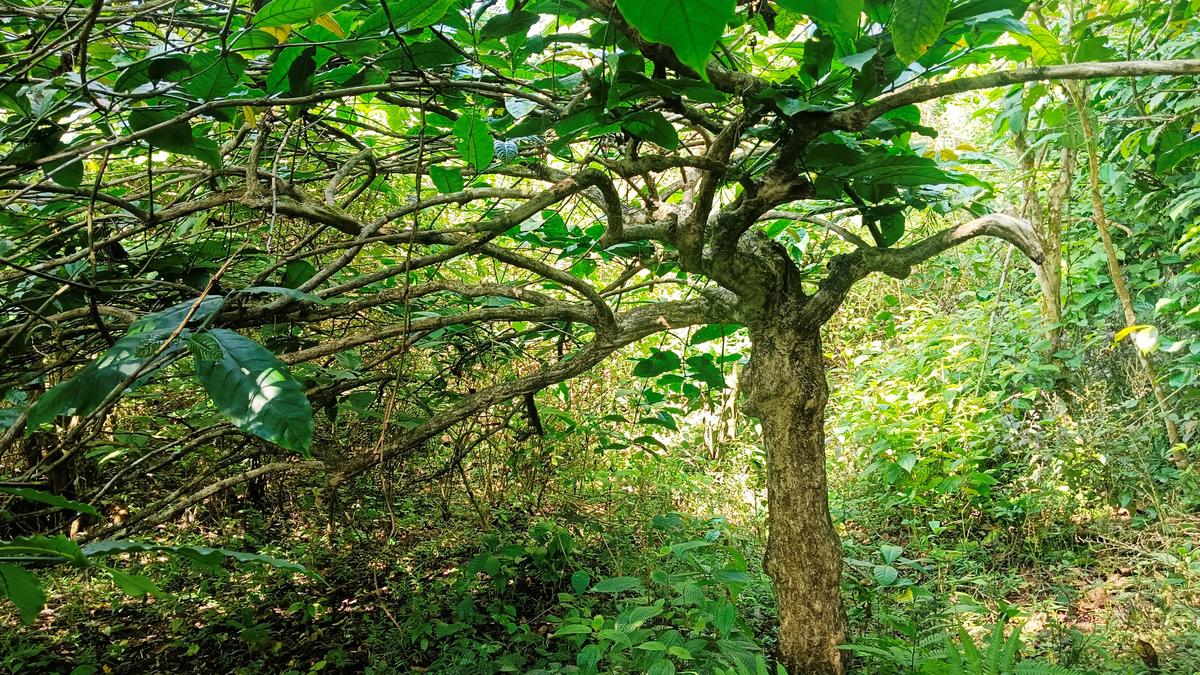
The rare plant can be found in a coffee plantation on the church grounds of the British-built CSI in Pallikunnu near Kuttikkanam.
The 150-year-old coffee plant on the church grounds of Pallikkunnu CSI church in Idukki. | Photo Credit: JOMON PAMPAVALLEY
Those who visit the premises of the British-built Church of South India (CSI), in Pallikunnu near Kuttikkanam in the Idukki district, can see a coffee plantation on the church grounds. It is believed that the British planted coffee on the land owned by the church, which is over 150 years old, during the early period of the plantation industry in Peerumade.
The Church Missionary Society (CMS) constructed the cross-shaped church in 1869 on a 15-acre plot of land gifted by the then ruler of erstwhile Travancore. According to church authorities, the church plans to preserve the historically valued coffee plant in Pallikkunnu.
Pallikkunu St. George CSI Church Vicar Fr. Liju Abraham said that the plant is situated among a group of coffee plants on the church property. “Earlier, the church authorities contacted the Coffee Board officials to ensure the protection of the plant. Two years ago, the Coffee Board officials visited the church, inspected the plant, and assured support for its preservation. But the initiative came to a standstill after we failed to get a certificate from the church. The church aims to secure government support for the initiative,” said Fr. Abraham.
CSI East Kerala Diocese public relations officer Viju P. Chacko said, “The church needs to separate the 150-year-old plant from the group of coffee plants and create a special passage for visitors to view the rare plant. The plant could serve as a window for visitors into the plantation culture of Peerumade,” noted Mr. Chacko.
Kerala State Biodiversity Board (KSBB) district coordinator Ashwathi V.S. said that the KSBB can ensure the preservation of biodiversity-rich trees or plants through the Biodiversity Management Committee (BMC) in any area. “The concerned panchayat biodiversity management committee needs to submit a report to the Kerala State Biodiversity Board (KSBB) in this regard.” Additionally, Ms. Ashwathi recommended that the church authorities submit a letter expressing their willingness to preserve the plant.
Interestingly, during the initial period of the plantation industry in Idukki, coffee plants were the crop of choice. The book Above Heron’s Pool by Heather Lovatt and Peter de Jong, describing the plantation history in Peerumade and Vandiperiyar, sheds light on the change. “In 1875, a leaf disease caused significant damage to the coffee plants, prompting the planters to switch to growing tea instead. The book further states that Thengakal, near Peerumade, once achieved the highest coffee yield in southern India, producing two tonnes of cured coffee per acre,” said the book.
source: http://www.thehindu.com / The Hindu / Home> News> India> Kerala / by Sandeep Vellaram / December 29th, 2024
Many planters are seeing uneven ripening because of multiple rains and multiple blossoms.
A file photo of coffee beans in an estate in Kodagu district (Coorg) of Karnataka. | Photo Credit: MURALI KUMAR K
Coffee planters are a confused lot this year. On the one hand, coffee prices have hit a record high. On the other, vagaries of the weather through 2023 and 2024 have resulted in erratic ripening and a dip in yield this season. The Coffee Board is estimating an average 15% loss this season due to this.
Coffee is harvested between December and February.
Rain pattern
“We are estimating more than 15% loss in yield, mostly in Karnataka, because in other coffee growing regions such as Andhra Pradesh and the North East, they receive the northeast monsoon. This time, the southwest monsoon, which covers Karnataka, was heavier and not uniform,” said K.G. Jagadeesha, CEO and Secretary, Coffee Board, adding that the exact figures will be clearer after the post blossom survey in March-April.
The heavy rain was localised. Some regions received rain well into November. Yield is expected to be hit in the three main coffee districts — Kodagu, Chikkamagaluru and Hassan.
Explaining further, he said, “Last year, there was rain during November-December. Then this year again in January there was rain. Blossom showers during February-March is ideal. If it rains earlier, then uneven berry formation and ripening are observed. We expect a modest production of 3.5 lakh metric tonnes compared to 3.6 lakh metric tonnes last year.”
Naj Chengappa, a planter from Devarapura, south Kodagu, said, “Many planters are seeing uneven ripening because of multiple rains and multiple blossoms. In one coffee tree, we are seeing ripe, green and dried ones. Droppings (of berries) were also observed in high rainfall areas.”
This comes as bad news for planters as coffee prices have hit record highs owing to supply side disruptions in Brazil and Vietnam. “We get no clear information from them on restoration. So, the price may be high till that is restored,” Mr. Jagadeesha said.
Climate resilience
The Coffee Board has urged planters to adhere to best practices to shield themselves from weather variations.
“This year, there was heavy rain. Those who have invested in water conservation will have stored this water and used it for better yield. We have also started the research on climate resilient varieties. We recommend maintaining high carbon content, organic mulching, mixing organic and chemical fertilisers, good shade management and water conservation,” Mr. Jagadeesha said.
source: http://www.thehindu.com / The Hindu / Home> Sci-Tech> Agriculture / by K C Deepika / December 25th, 2024
Specialty coffee brand First Coffee raises $1.2 million funding led by Beenext
First Coffee, a grab-and-go specialty coffee brand, has raised $1.2 million in a funding round led by South Asia and India-focused venture fund Beenext.
The round also saw participation from other investors such as Ashish Gupta (Helion Venture Partners), AngelList India, Ritesh Malik (founder, Innov8), Sahil Malik (founder, Da Milano), Aman Arora (cofounder, board-Keventers), Agastya Dalmia (director, Keventers), among others.
ET on July 10 reported about Beenext leading the new round in the company, as early-stage venture capitalists and angel investors continue to show strong interest in new-age food brands, particularly in segments like coffee.
The funds will be used to support the company’s expansion to more locations across the country, along with investments in hiring and marketing. First Coffee plans to grow its store presence in key urban areas across New Delhi and NCR and tier-I cities in north India.
“We are the first brand to bring true specialty coffee scoring 91% on the Specialty Coffee Association (SCA) scale to the Indian market. At First Coffee, we’re not just serving coffee; we’re crafting a unique, premium experience while still catering to the fast-paced lifestyle of our customers,” said cofounder Shiv Dhawan.
Founded in 2024 by Sohrab Sitaram and Dhawan, First Coffee sources its beans from the Harley Coffee Estate in Chikmagalur.
The brand will primarily focus on small-format QSR outlets in high-footfall areas like malls, corporate parks, high streets and metros. The company plans to launch 35 stores across the country by the second quarter of the next fiscal year.
Commenting on the investment, Anirudh Garg, partner at Beenext said, “First Coffee is uniquely placed where they are not just selling a product but rather a coffee experience, blending tech, sustainability and coffee”.
ET reported on March 9 that specialty coffee chain AbCoffee raised $3.4 million in a series A funding round led by venture capital fund Nexus Venture Partners. Existing investor Tanglin Venture Partners also participated in the round.
On March 26, Subko, a specialty coffee roaster and craft bakehouse, raised $10 million in a funding round led by Zerodha cofounder Nikhil Kamath.
Other companies operating in this space include Slay Coffee, which is backed by Fireside Ventures, Alteria Capital and Faasos-parent Rebel Foods; Sleepy Owl Coffee; Hatti Kaapi; Blue Tokai; and Rage Coffee.
source: http://www.msn.com / ET – Economic Times / September 26th, 2024
WELCOME. If you like what you see "SUBSCRIBE via EMAIL" to receive FREE regular UPDATES.
Read More »