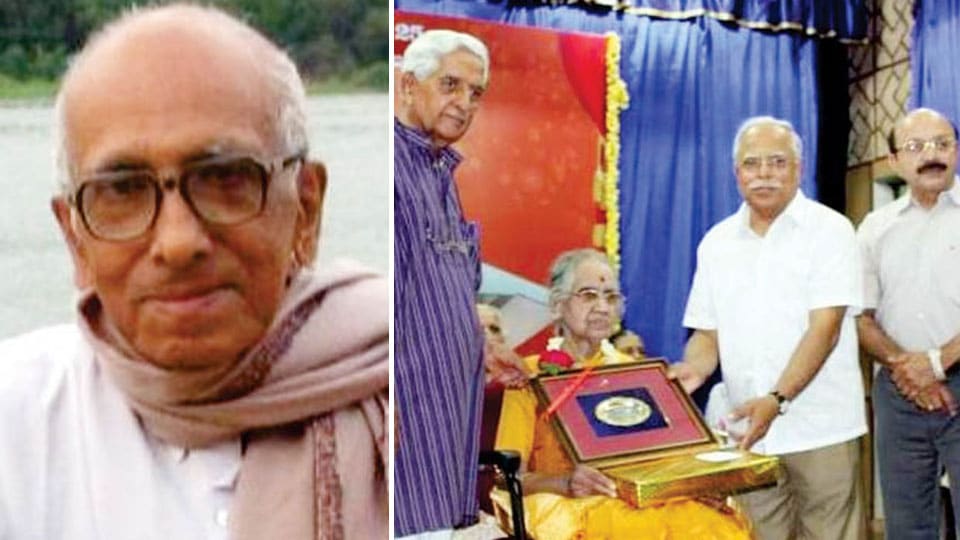
KBG’s ‘Nostalgically Speaking-8’ write-up on Prof. G.T. Narayana Rao in SOM dated Sept.6, 2020, has prompted me to write about my association with him since 1975. He joined our team of Ganabharathi as Committee Member in 1980 when I was the Vice-President.
Guddehittalu Thimmappaiah Narayana Rao, GTN as he was popularly called, after his early education in Madikeri and Mangalore passed MA in Mathematics at Madras (1947). Lecturer in Madikeri College (1953-63) was his first appointment. After a three-year stint in Government College in Bangalore he came to Mysore in 1969 to settle down. He was absolutely simple in his dress, wearing white pant and bush shirt and chappals, going on a cycle or by walk wherever he had to go but equally forthright in speaking his mind out. He was a role model to some of us who were much younger to him.
GTN took the mantle of collecting funds for the construction of Veene Seshanna Bhavana on Adichunchanagiri road. His slogan was ‘Jagannatha’s Rath has to be drawn by all’ and believed in ‘No great work has ever suffered for want of funds.’ He never hesitated to ask any stranger for funds and he even carried a receipt book in his bag to give it readily. His involvement was so much as he did not spare some of the shop owners on Sayyaji Rao and Dhanvanthri Roads.
I fondly remember him barging into my clinic even during busy hours just to tell me a ‘vismaya’ (miracle in his words) that he collected a few hundred rupees. The major donation of Rs. 1 lakh he got was from Dr. Veerendra Heggade of Dharmasthala who was his student in a Bangalore College.
As the estimated cost of construction was Rs.12 lakh he had to make a couple of trips to Bombay. Once he was invited by the Bombay University to deliver a lecture on Science subjects offering him the flight and hotel charges. He politely refused to accept it and travelled in Gandhi class and stayed for a few days in his friend’s house asking the organisers to make that amount as a donation to Ganabharathi!
His love for Karnatak music started while he was in Madras and it continued till his end in 2008. His reviews on music were unbiased and forthright, sometimes quite open and critical too.
Ganabharathi on the occasion of Veene Seshanna Bhavan’s Silver Jubilee in 2016 posthumously honoured GTN with a Silver Plaque which was received by his wife Lakshmi Devi Rao. It is also gratifying to note that a memorial music concert is instituted in his memory in Ganabharathi. His admirers have contributed handsomely to this fund.
Being an avid student of Science he always used to quote Einstein’s popular saying ‘Science without religion is lame and Religion without science is blind’. He has written several books on science including Nobel Laureates Einstein and Chandrashekar. One of his books in Kannada ‘Vijnanada Moolatatvagalu’ has won an award also. After becoming the President of Ganabharathi in 2011, I am proud to say that I am following his footsteps in collecting funds for the development of the institution.
I would like to conclude with GTN’s yet another selfless service for a cause. With his intense commitment to the improvement of art and culture in Mysuru he had provided free of cost a place in his house for the noted Dance Master late Muralidhara Rao to conduct his classes.
– Dr. C.G. Narasimhan, Mysuru, 9.10.2020
source:http://www.starofmysore.com / Star of Mysore / Home> Voice of the Reader / by Dr C G Narasimhan / October 22nd, 2020
The actor said even though it’s a ‘bit too late’, he has began to put his feet in important doors to break casting stereotype and land roles that will, otherwise, not come to him.
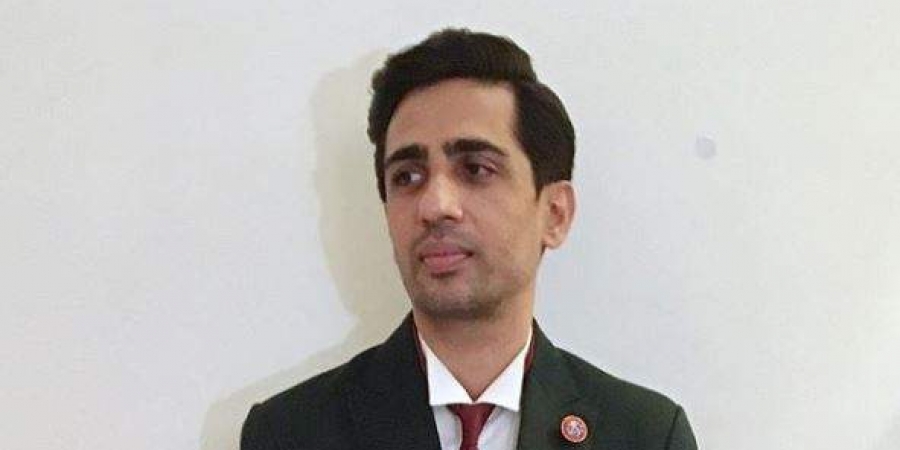
Bollywood actor Gulshan Devaiah (Photo | Gulshan Devaiah Instagram)
Mumbai :
Actor Gulshan Devaiah says after a decade in the industry he has finally started to pitch himself for projects he is interested in.
Devaiah has been a part of several acclaimed films, starting from his 2011 breakthrough “Shaitan”, “Hunterrr” (2015) and Vasan Bala’s 2018 action-comedy “Mard Ko Dard Nahi Hota”.
The actor said even though it’s a “bit too late”, he has began to put his feet in important doors to break casting stereotype and land roles that will, otherwise, not come to him.
Devaiah said he started doing this after realising that meritocracy can’t exist in art as it’s difficult to measure a person’s talent with another.
“You can’t do that with a performance. What is it then? It’s all about perception. We are in the business of perception which is why actors like to control their perception through PR, Instagram, wearing expensive rental clothes, by shaking the right hands.
“Many of them do it subconsciously because we know meritocracy can’t exist in art.
I am conscious about that too, so I can’t keep whining that I’m not getting opportunities.
Because you’re in the place of perception, if you don’t hustle then your career won’t go forward,” the actor told PTI.
Though Devaiah has garnered considerable acclaim for his performances, the actor said he could’ve done better.
“If I had one film that was a smashing box office success, then I would have been empowered. It puts you in the spotlight. But when that’s not the case, you have to try and look for opportunities.”
The pitfalls of merely wishing to do better but not actively pursuing those opportunities has resulted in people from the industry often looking at him and wondering ‘Damn! Why didn’t we think of you’, the actor said.
Devaiah’s attempt is to now gently remind people of his talent at every given opportunity.
“If I feel there are certain directors or projects that I find interesting because I’ve heard about them, I’m going to find out if there’s something in there for me.
“They can say no and so far it has only been no! I’ve come really close many times but nothing, zero so far. But I’m happy that I can hustle.”
The actor is gearing up for his latest crime thriller “Footfairy”, set to release on October 24 on &Pictures.
Billed as a cat and mouse chase between a CBI officer, played by Devaiah, and a mysterious serial killer, the film is written and directed by Kanishk Varma.
Devaiah gravitated towards the film as it offered him a chance to break free from the “villain” characters he felt he was getting trapped into.
“I was getting bored with the negative characters. A lot of the offers were also repetitive, I’d be offered a villain or a grey character. I thought this would be nice and break the mould. Negative characters for me are now retired indefinitely.”
The actor said it’s pointless to “endlessly complain” about getting only certain kinds of roles without even trying to break the chain by saying no.
“I don’t want to do similar roles even if I’m told that people love me in negative roles. I tell them I’ll give you an opportunity to love me in other roles too.
You have to take responsibility for yourself and stop blaming the system. I am happy people want to work with me, it’s unfortunate that they’re offering me villain roles. It’s not their fault,” he added.
“Footfairy” also stars Kunaal Roy Kapur and Sagrika Ghatge.
source: http://www.newindianexpress.com / The New Indian Express / Home> Entertainment> Hindi / by PTI / October 22nd, 2020
IPL 2020: Rajasthan Royals batsman Robin Uthappa on Saturday achieved another feat in his career and the fifth Indian player after Virat Kohli, Rohit Sharma, Suresh Raina, Shikhar Dhawan and Mahendra Singh Dhoni to score over 4,500 runs in IPL.
(pic credits: PTI)
New Delhi | Jagran Sports Desk:
Robin Uthappa, who was going through a lean patch, on Saturday returned to form and smashed a fiery 41 off 22 balls to give Rajasthan Royals a solid opening stand against Royal Challengers Bangalore at the Dubai International Cricket Stadium.
During his innings, Uthappa also achieved another landmark in Indian Premier League (IPL) career and went past 4,500 runs in the cash-rich league. By doing so, the 34-year-old became the ninth batsman overall and the fifth Indian player after Virat Kohli, Rohit Sharma, Suresh Raina, Shikhar Dhawan and Mahendra Singh Dhoni to achieve this huge landmark.
Following his fiery innings against Royal Challengers Bangalore, Uthappa said that he really enjoyed opening the innings again, adding that “wanted to give a good start” to his team. He noted that the “pitch became slower and slower as the innings progressed”, which was making it difficult to play shorts freely.
“If we were told we would get 177 (at the start), we would have happily taken it. Glad that I got the opportunity to open – the wickets are slowing down, and I think it will further slow down as the tournament progresses. We are confident about defending this – have a decent bowling attack, but they have a good batting line-up as well,” Uthappa said, as reported by Hindustan Times.
In his remarkable IPL career, Uthappa has played 184 matches and 4,535 runs at an average of 28.34 and a strike rate of 130.09. Out of the total number of runs, Uthappa has scored 2,439 runs for Kolkata Knight Riders in six IPL seasons. The 34-year-old also has 24 fifties to his name with 87 being his highest total.
However, Uthappa’s innings was not enoug for Rajasthan Royals as Royal Challengers Bangalore defeated them easily with 7 wickets in hand. AB de Villiers smashed an unbeaten 55 off 22 balls after skipper Virat Kohli scored 32-ball 43 as RCB, chasing 179 for three in 19.4 overs.
Posted By: Aalok Sensharma
source: http://www.english.jagran.com / Jagran English / Home> News> Cricket / by Jagran Sports Desk / October 17th, 2020
Dr. S.V. Narasimhan, a family physician based at Virajpet in Kodagu district, is an avid birder, nature lover, adept at computers, Karnatak music and astronomy.
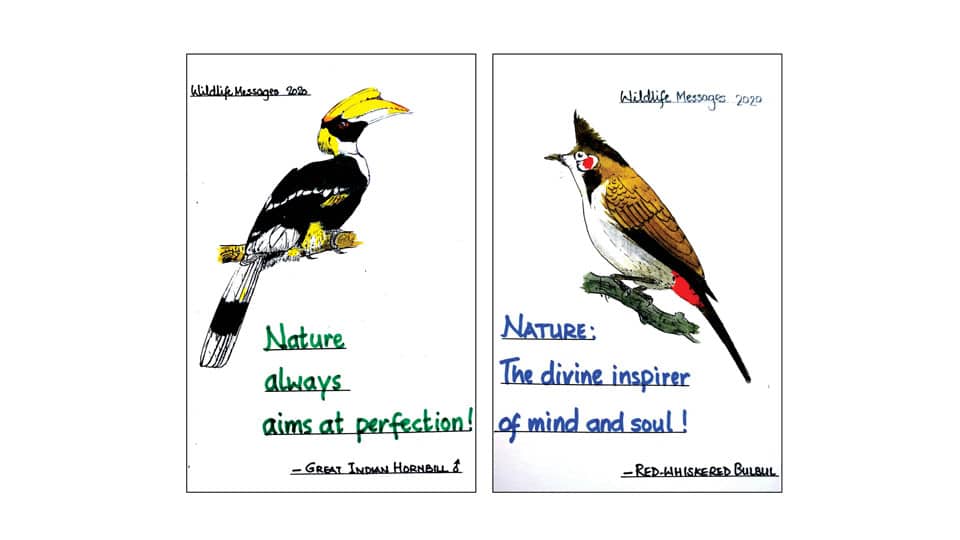
Author of Feathered Jewels of Coorg, a field-guide to 310 species of birds found in Coorg, Dr. Narasimhan is the pioneer in spreading wildlife conservation messages through his unique hand-painted Wildlife Message Cards that are sent free to individuals throughout the world to mark the Wildlife Week.
Total number of hand-painted cards made by him this year is 1,930; in 36 years, 72,655 cards. Total recipients this year including Star of Mysore – 1,010; in 36 years – 13,004 persons.
The Special Wildlife Messenger of this year is Red-whiskered Bulbul (Pycnonotus jocosus) — This is the most common garden bird of India. It has a black chest that is turned forwards and has bright red patches on the cheeks and vent. Melodiously vocal, it feeds on fruits, nectar and small insects.
Bulbuls are mostly monogamous. They build an open cup-shaped nest made of rootlets and leaves lined with soft fibre. They live for about 10-11 years.
source: http://www.starofmysore.com / Star of Mysore / Home> News / October 20th, 2020
‘It took me 45 days of continuous work to complete’
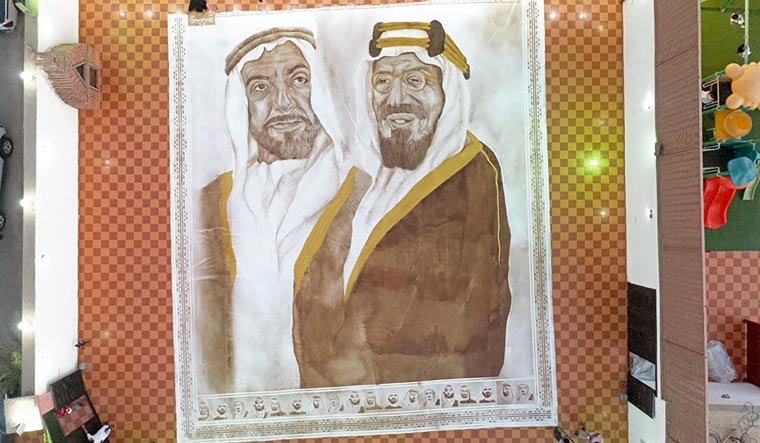
The world’s largest coffee painting by Saudi artist Ohud Abdullah Almalki depicting founding fathers of Saudi Arabia and the UAE, the late King Abdulaziz bin Abdul Rahman (R) and the late Sheikh Zayed bin Sultan Al Nahyan, in Jeddah | AFP /GUINESS WORLD RECORDS
A Saudi artist became the country’s first woman to enter the Guinness Book of World Records by making the world’s “largest coffee painting”. Ohud Abdullah Almalki used expired coffee to illustrate renowned leaders from the country and the neighbouring UAE in a 220 square metre piece.
“It took me 45 days of continuous work to complete, under the watchful eyes of two witnesses, video recording and drone footage,” Almalki said.
The artwork created on a canvas of seven connected cloths is called Naseej and was created in the Saudi city of Jeddah. Approximately 4.5 kg of expired coffee powder mixed with water was used to create the painting. The edge is done in a traditional Bedouin decoration style known as ‘Al-Sadu’.
“My aim is to remind the world of the centuries-old entente between the two nations,” Almalki said. The painting features the founding fathers of Saudi Arabia and the UAE — the late King Abdul Aziz bin Saud and the late Sheikh Zayed bin Sultan Al-Nahyan.
In 2015, 8,264 women joined together in Saudi’s Riyadh to form the largest “human awareness ribbon”, to create awareness for breast cancer.
source: http://www.theweek.in / The Week / Home> News> World / by Web Desk / October 19th, 2020
A file photo of the recording of Yakshagana talamaddale Banada Pala in Arebhashe.
A talamaddale, a variant of Yakshagana theatre, recorded for the first time in Arebhashe, a Kannada dialect spoken in parts of Dakshina Kannada, Kodagu and Kasaragod (Kerala), will be available on a social media platform shortly.
Arebhashe is spoken by a section of the Gowda community.
Recorded under the auspices of Karnataka Arebhashe Samskriti and Sahitya Academy, the Banada Pala Prasanga video recorded in Arebhashe will be uploaded on YouTube within the next 10 days, according to chairman of the academy Lakshminarayana Kajegadde. The performance lasts about two hours.
Banada Pala is the translated version of Yakshagana script “Sharasetubandhana” written by late Hattiyangady Rama Bhatta. Yakshagana bhagavatha (singer-cum-director) Bhavyashree Kulkunda has translated it into Arebhashe in the prosody suitable to it.
Mr. Kajegadde told The Hindu that Ms. Kulkunda has translated another script “Panchavati” written by Parthi Subba, considered as the father of Yakshagana, to Arebhashe on behalf of the academy. It is also for the talamaddale performance.
Ms. Kulkunda said that she is now fine tuning its script in Arebhashe in consultation with Ganesh Kolekkadi, an expert on prosody and Yakshagana script writer, and Subraya Sampaje, a Yakshagana bhagavatha. The two had guided her in translating the first script.
Mr. Kajegadde said that Ms. Kulkunda is now translating one more Yakshagana script Kamsa Vadhe written by Matti Vasudeva Prabhu to Arebhase suitable for Yakshagana performance. It is also for the academy.
In addition, the academy will get two more Yakshagana scripts translated into Arebhashe. Of them, one will be for talamaddale and the other for a Yakshagana performance.
Tentatively, it has identified Krishnarjuna Kalaga or Karnavasana scripts suitable for talamaddale and Indrajitu Kalaga as suitable for the Yakshagana performance. The scripts are yet to be finalised.
Thus, Mr. Kajegdde said that the academy will ensure that it had three scripts translated for talamaddale performance and two scripts suitable for performing Yakshagana. It will preserve those scripts and make them available to performers.
Ms. Kulkunda said that finding an appropriate word while translating Kannada Yakshagana songs into Arebhashe is a challenging task. The translation should also match with the Yakshagana prosody. She translated the first script during the lockdown.
The first video production has Kolthige Narayana Gowda, Jabbar Samo Sampaje and Jayananda Sampaje as “arthadaris”. Ms. Kulkunda, Murari Kadambalithaya and Akshay Rao Vitla are the background artistes.
source: http://www.thehindu.com / The Hindu / Home> News> Cities> Mangaluru / by Raviprasad Kamila / Mangaluru – October 19th, 2020
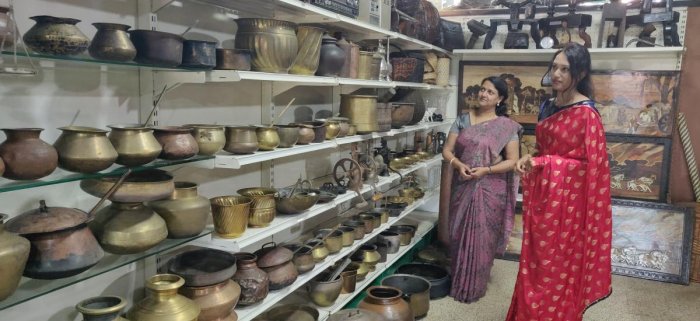
Visitors look at the vast range of antique utensils and other items exhibited from the collection of Ponnacchana Madhu in Madikeri on Friday.
She was speaking after inaugurating the exhibition of antique items from the collection of Ponnacchana Madhu at Coffee Krupa building near Raja Seat in Madikeri on Friday. The exhibition a part of Janapada Dasara, was organised by Taluk Janapada Parishat.
“The items that were used by our ancestors had scientific applications. Some utensils in the older days were designed to improve the health of people. Unfortunately, the young generation is forgetting the significance of the livelihood of their ancestors,” she added.
Zilla Janapada Parishat president B G Anantashayana said that the folklore was close to nature. Folklore is a form of knowledge. But, the modernity has been taking us away from this knowledge, he added.
Taluk Janapada Parishat president Anil H T said that Ponnacchana Madhu, the exhibitor, had collected rare items in the last three years.
These items will be on display till October 26. The work by Madhu and Preethu couple is laudable, he added.
Collector and Exhibitor Ponnacchana Madhu said that he purchased old items in the households, after convincing the elders in the houses. Many tourists have been willing to purchase them from me. However, they are not for sale. The collection began with an old lamp contributed by an old lady called Arifa Munavar, a scrap dealer in Madikeri.
Taluk Janapada Parishat Treasurer Ambekal Navin Kushalappa, Parishat Directors Savita Rakesh and Veenakshi were present.
Exquisite collection
The collection showcases traditional weapons, a 120-year-old mud bowl, an ancient lamp from a temple in Tamilnadu with 84 diyas, puja items, African dolls, bronze items, utensils, coffee grinding machines and so on.
The agricultural equipment are an added attraction.
source: http://www.deccanherald.com / Deccan Herald / Home> State / by DHNS, Madikeri / October 17th, 2020
We ran out of our commercially made coffee powder recently and since I was just back from Coorg with a truckload of pure coffee, I decided to open one of the packets. As I undid the sticky tape of the coffee, a whiff took me back to the time when I was a kid, growing up in the then almost new Indiranagar in Bengaluru.
Just after the double road, on the way to Ulsoor, on the right was housed Cauvery Coffee Works. Run by two sisters, it was a store operating out of a garage. The store faced what is today a huge commercial complex that houses Krishna Sweets among many other stores. Like most homes in Bengaluru, their home too had a lot of trees and plants. The garage was connected to the house through a batwing door, and they would appear mysteriously through this portal when customers would arrive. Clad in the typical Coorg saree, with full-sleeved blouses, or a fitted cardigan in winter, the two sisters were elegant and stylish with their bobbed hair, large bindis and jewellery!
My grandma would always send us to Cauvery Coffee Works, with strict instructions that the coffee powder must be freshly ground and to not buy the already powdered product. This was an errand I loved to run as I was fascinated by the sisters, their bat-wing door, the coffee roaster, grinder and the invigorating smell of the coffee! As a curious kid, I had the special privilege to duck under the counter, enter the store, flap the bat-wing door and call out to the sisters, “Akka, I want coffee.” They would smile and ask how granny was doing and automatically start the process to powder the coffee for packing – they knew my grandma well.
It took a long time for me to get my hands on my 200 gm purchase, the green coffee would be running on the roaster like a large Russian Roulette with a million chips on it. I would watch fascinated as it slowly turned dark brown and as the smell grew stronger. I would help them store the roasted beans in large containers and watch every move with a keenness that was rooted in curiosity.
Once roasted, the powder would be weighed in a butter paper or brown paper packet bearing the logo and the store name, taped with brown tape ready to be taken away. From the coffee grounds to the packing, everything was bio-degradable! A guilt-free way to get-up, get out and smell the coffee!
source: http://www.deccanherald.com / Deccan Herald / Home> Opinion> Right in the Middle / by Devika Ramarathnam / October 17th, 2020
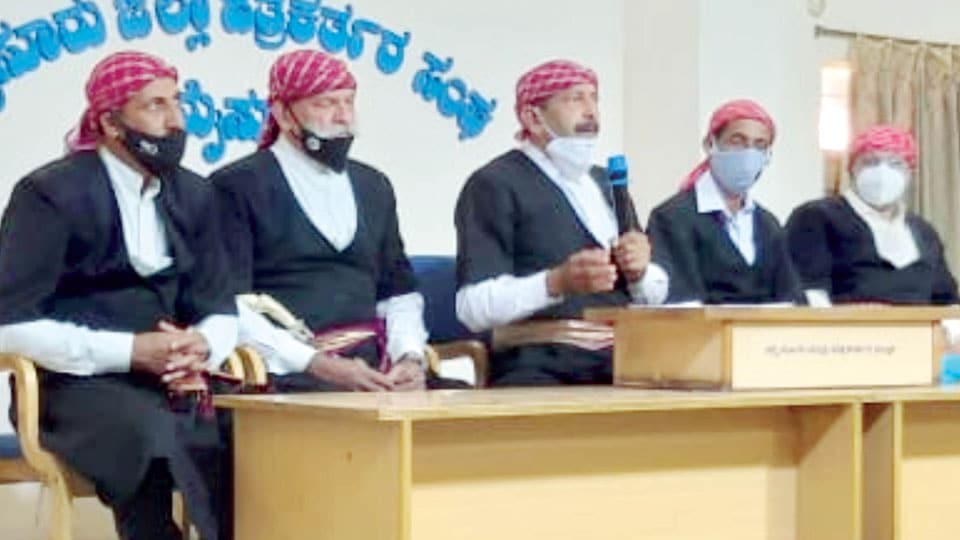
The Codava National Council(CNC) has urged the Government to include Codava tribe in the list of Scheduled Tribes (ST) of the Indian Constitution.
Addressing a press meet at Patrakarthara Bhavan here this morning, CNC President N.U. Nachappa maintained that ST tag for Codava tribe and Geo-political autonomy are synonymous for Codavas. Urging the Government to declare Codava tribe as a primitive tribe, he said that Codava tribalism must be measured through the ‘Emic approach’, an ethnographic study of Codava tribe.
Pointing out that one of the seven fundamental rights enshrined in our Constitution clearly upholds Constitutional remedy for the aspirations of the people, Nachappa argued that the Union and Karnataka Governments should concede Codava aspirations of ST tag as a Constitutional remedy.
Noting that as a result of CNC’s relentless efforts and innumerable petitions to the Union Government, the Central Government directed the State Government to conduct an ethnographic study on Codava tribalism, he said that subsequently, the Karnataka Government entrusted this responsibility to Mysuru based Karnataka State Tribal Research Institute (KSTRI).
Stating that Codava tribe has its own extraordinary tribal characteristics, he maintained that ST tag is a must for their historical continuity and for protection of Codava land, language, cultural heritage, folkloric identity and traditional habitation. Also, the tag was important for their economic and political empowerment, he said.
Accusing KSTRI Director T.T. Basavanagouda of attempting to derail Codavas demand for ST tag through dubious means, Nachappa said that a representation has been given against the actions of Basavanagouda, which are detrimental to the interests of Codavas, to Mysuru DC.
Pointing out that the then MPs B.K. Hariprasad and Kupendra Reddy had raised the issue during the Parliamentary session in Dec. 2019, which attracted the attention of the whole country, Nachappa asserted that the ST tag will also ensure protection of Codava hereditary untitled lands and traditionally defined Codava homeland.
CNC office-bearers Areyada Girish, Kaliyanda Prakash, Chambanda Janath Kumar and Appaneravanda Manoj Mandappa were present at the press meet.
source: http://www.starofmysore.com / Star of Mysore /Home> News / October 13th, 2020
Racially the ethnic groups in India have their own problems related to their personal life and security. Of their landed properties, personal freedom to practice their tradition and religion etc. Kodavas of Kodagu district, Karnataka, belong to one such ethnic groups, racially distinct from all other people.
Kodavas (Coorgs as English called them) are living in the hilly terrains nestled in the Western Ghats, a small identifiable geographical area. It has rain forests, mountain peaks and valleys, heavy rainfall, inhabited by wild animals and in the past the curse of epidemic Malaria. Obviously it is well-isolated and also insulated from the neighbouring places and people. As a result, Kodavas came to have their own unique culture and customs as also a language, dialect. They even had their own Gods in Guru Karana (ancestor worship). Naturally, their population is very small with no outsiders immigrating to Kodagu because of its hostile climate.
The Government of India should invoke the provisions of our Constitution and declare this Kodava community as being on the verge of extinction and provide Constitutional protection and guarantee for the preservation of their habitation known as Kodagu and their landed property considering Kodavas as an ethnic minority. Otherwise, in the next 50 or 100 years, Kodavas in Kodagu would be as rare as hen’s teeth! You may see someone dressed in Kodava traditional attire in museums, like we see native Americans (Red Indians) in US museums.
After independence Kodavas have become a minority population in Kodagu with about 1,50,000 Kodavas as against the immigrants and the other natives who number over 4,00,000. As a result, under our democratic system of Government, now Kodavas are politically, economically and socially relegated to oblivion and have become “vanishing” people.
It is not surprising, therefore, a Kodavathi, Mrs. Kaveri Ponnapa, with a Master’s Degree in Social Anthropology from London, chose to write a book, rather prophetically (let God forbid), titled, ‘The Vanishing Kodavas.’ It is a book that provides a treasure of information about Kodavas and their future as an ethnic race. It is a book no Kodava, nor a Democratic Government can ignore. Kodavas were hunters, agriculturists and warriors for centuries. All the Dewans of Kodagu Rajas were Kodavas and after independence Kodava community produced a Field Marshal (K.M. Cariappa), a General (K.S. Thimayya), over 12 Lieutenant Generals, many Fighter Pilots, Air Marshals and Naval Commodores.In the field of IAS and IPS, Sports and Science too, they have distinguished themselves. Mrs. Rathi Vinay Jha IAS, the visionary behind Kodava Heritage Centre, is one among them. Indeed Kodavas are an asset to our country. They should not be allowed to “vanish” from Kodagu.
I am made to ruminate about Kodavas in a way that does not augur well for them, after reading a report in newspapers on 27.9.2020 about a statement made by our Tourism Minister C.T. Ravi (in reply to a question by Congress MLC Veena Achaiah) about the works on ‘Kodava Heritage Centre’ at Vidyanagar near Madikeri, the District Headquarters of Kodagu District and former capital of Kodagu Kingdom and later C. State.
I first came to know of this proposed Centre in Madikeri sometime in the year 2004 while casually discussing with one of the promoters of the Federation of Kodava Samajas (Federation) located on the Kerala border at Balugodu, about 12 kms from Virajpet. The Federation was established in the year 2000-01 and even to this day is asking for money and more money from donors. But what do we have in return? For spending over Rs. 6 crore!? A shed-like Kalyana Mantap!
I gave the idea for the Federation to make it one Umbrella Organisation of all Kodava Samajas and an apex body for Kodavas to debate and discuss all their problems — political, property, cultural etc. — and speak in one voice, as a spokesperson, for all Kodavas. I gave the idea to an enterprising Kodava with many achievements. But the Kodava Federation located on a fault-line, failed in its objectives and purpose without direction. It has nothing to show except the annual jamboree.
As a result what we hear today on social media and at Kodava meetings is a cacophony of different, divisive voices. One group calls Kodavas as tribals and seeks that status under the Constitution; while the other group says no. One early immigrant group claims right over management of rituals in Bhagamandala and Talacauvery, asking Kodavas not to go to these temples wearing Kodava traditional dress. The controversy about inter-caste marriage is also continuing and it must be resolved.
The Jamma land tenure, which to some extent held at least some Kodavas bound to their land in Kodagu, thereby in a small way keeping Kodagu for Kodavas, was outright abolished leading to large-scale immigration of outsiders buying properties. The issue was never discussed in depth in any Kodava body. As a result now we see Kodavas emigrating from Kodagu after selling landed properties (paddy field and coffee plantation) to non-Kodavas who pay higher price. A clear sign of Mrs. Kaveri Ponnapa’s prognosis coming true!
In this world as we see today, the importance of possessing land by a racial group or the people of a particular religion can never be underestimated. No wonder, in Christian Europe and America, Right-liberals and also White-supremacists are dominating the political space nudging immigrant groups.
I remember in 1960s in the Fiji Island, where there was a majority of Indian immigrants who were businessmen and traders as opposed to the local Fijians (I guess earliest immigrants of African origin) who were landowners, there was a political crisis. An Indian origin man won the democratic election and became the Prime Minister. But, soon he was overthrown by a ‘local’ Fijian Brigadier. The reason was that the island-nation should be ruled by the ‘locals’, the land-owners. I thought there is a lesson in this for Kodavas to learn. The day Kodavas cease to be ‘sons of Kodagu soil’ (ªÀÄtÂÚ£À ªÀÄPÀ̼ÀÄ) they will vanish from Kodagu.
I am reminded of what Desmond Tutu, South African Bishop and Nobel Laureate for Peace had said: When the missionaries came to Africa, they had the Bible and we had the land. They said, “Let us close our eyes and pray.” When we opened our eyes, “We had the Bible and they had the land.”
This is what had happened and is happening to Kodavas today after the Jamma land tenure was outright abolished without a thought about the Kodavas of Kodagu. The Kodavas are having money and the immigrants the land!
I guess, Kodavas could have worked to get a variant of Jamma tenure through Amendments etc. But, majority was for its blanket abolition and naturally they should pay the price. Kodagu will soon cease to be their land of identity. Sad. No Kodava voice was raised in the Assembly against the abolition, I am told.
I attended a couple of meetings of the Federation of Kodava Samajas but found myself at large in a huge hall of zinc sheet-roof with about 25 members who are called Directors. The acoustics was so bad that much of what was said must only be guessed. Then once it rained and the meeting was ruined. I had to request the Chairman to adjourn the meeting till the rains abated. Well, by then, it was time for lunch!
Alas, there are so many Kodava Samajas, but not a single well-furnished venue to conduct a meeting in peace, dignity and proper protocol! When the meeting ambience is bad, good people avoid speaking, why, even good ideas do not cross our minds. But I do not think Kodava Federation could now unscramble the egg. We go to the meeting well-dressed in style like Kodavas usually do, but only to sit on a plastic chair kept in disarray in a huge hall!
While I was thus reflecting on the dismal condition of Kodava Federation, I heard of the Kodava Heritage Centre, with a museum, coming up in Madikeri, the place I had insisted for Kodava Federation. This first information came from my friend in Bengaluru, as I mentioned earlier, when I went to meet him as a courtesy. I jumped with joy. He then told me how it came about over a second cup of tea. He was also heartbroken, that the proposed grant from Government of India was lost to his Kodava Federation.
Be that as it may, let me now turn to our lady with a vision Mrs. Rathi Vinay Jha, an IAS Officer and a Kodavathi of Codanda family, who was the Secretary, Ministry of Tourism, Government of India, New Delhi. She was apparently approached by someone for grant from her Department to the Kodava Federation and she decided to visit the Federation at Balugodu (Virajpet taluk) before releasing the fund. She visited the place, but paid a visit to Lt. Gen. C.G. Somanna (retd.), her uncle, living in Virajpet.
This visit, according to my friend, changed her mind about granting funds to the Federation and instead she came up with the idea of this Kodava Heritage Centre in Madikeri with a Kodava museum. To be built like the traditional Kodava Ainmane (family dwelling with a quadrangle) comprising an auditorium, a library, a museum with artefacts, items of excavation, attire, weapons etc., etc. I hope it will be built that way. Anyway, I said to myself, “Well, God fullfils himself in many ways.” How would the future generation know about the “Vanished Kodavas” otherwise!? For me this is a huge serendipitous happening for “The Vanishing Kodavas.” After all, with the abolition of Jamma land tenure the Kodava Diaspora, like that of Jews, had already begun. I shall now on forget the imaginary usefulness of the Federation for the Kodavas which for all these years of its existence does not have a museum nor a library to show. Yes, an apology of a ‘war memorial’ is built on the border of Kerala that would be seen only by Kodavas who go to the Federation!!
On returning to Delhi, Mrs. Rathi sanctioned about a crore of rupees for the project. Not only this, she ensured that required land is made available for the project in Madikeri itself. It is near the Mahindra Holiday Resorts in Galibeedu. But, it is a paradox that the Federation could not find a place in Madikeri! A reflection on promoters of the Federation and our Kodava politicians. Perish the thought.
Mrs. Rathi, a senior IAS Officer, now retired, is the sister of late Codanda G. Somiah, the legendary IAS Officer during Rajiv Gandhi’s Prime Ministership, who held many high positions including Home Secretary, CVC and Comptroller and Auditor General of India (CAG). I had the privilege of knowing him while he was in Bengaluru after retirement and had even spoken to him and published a couple of articles extracted from his book ‘The Honest Always Stand Alone.’
I was craving to see him personally but it was not to be. However, I made it, rather sadly, when he was admitted to the Manipal Hospital. I drove there from Mysuru one day and met him in the ward, his wife attending. I was an intruder. He was on ventilator but on hearing my name, lifted the ventilator to speak. I touched his extended hand. His wife sprang from her seat and warned him and requested me. I was deeply moved by his gesture.
Post Script: About a year back I had the opportunity to meet Air Marshal Kodandera Nanda Cariappa to whom I broached the subject of the stalled Kodava Heritage Centre in Madikeri. My two newspapers wrote a number of articles about it, but sadly nobody bothered. Not even our Kodagu MLAs. It was he who got me in touch with Mrs. Rathi who happened to be in her bungalow in Virajpet. After some time I met her once in the Metropole Hotel with her husband and discussed the Kodava Heritage Centre. I was surprised to hear that she had followed up on the discussion, met the bureaucrats in the Vidhana Soudha etc. By then, of course, she had retired.
Thus is the predicament in which Kodavas are today placed. This Kodava Heritage Centre seems to be the only Centre that will leave the footprints of Kodavas ‘on the sands of time.’ At least for this reason the enlightened Kodavas must be eternally grateful to Mrs. Rathi Vinay Jha IAS and also to Mrs. Veena Achaiah, MLC (for reviving the project which was almost given up).
I doubt if Mrs. Veena Achaiah had not asked the question in the Legislative Council and pursued it with officials, C.T. Ravi, the Tourism Minister, would have taken any interest and the project would have died a natural death.
Anyway, let us hope, Kodava Heritage Centre will soon be a reality. But, my regret is that despite the dismal future, Kodavas have no united apex body to voice their grievances.
Note: Nostalgically Speaking – 11 on ‘Kempaiah IPS: Officer Who Made A Difference’ was published in three parts on Sept. 27, Oct. 4 and Oct. 11 —Ed
e-mail: voice@starofmysore.com.
source: http://www.starofmysore.com / Star of Mysore / Home> Columns> Abracadabra by K.B. Ganapathy / October 13th, 2020
WELCOME. If you like what you see "SUBSCRIBE via EMAIL" to receive FREE regular UPDATES.
Read More »