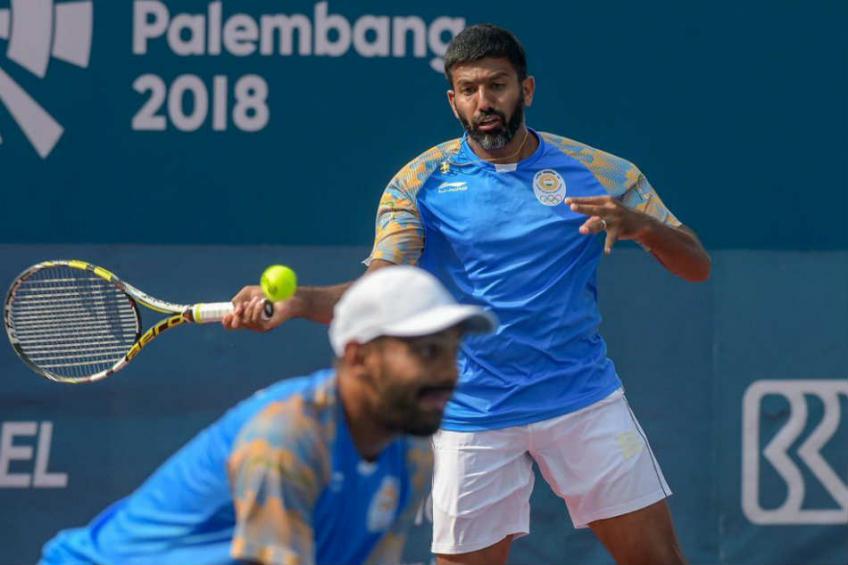
Indian doubles star Rohan Bopanna was recently awarded the Arjuna Award and the Asian Games Gold Medalist could not have been happier. The 38-year old won the French Open Mixed Doubles title last year and the Asian Games this year would have loved to be present for the Award distribution ceremony but had to travel for the China Tournament.
“The Asian Games gold was more special, especially because of the fact that I had a tear on my Latissimus Dorsi (shoulder muscle) and was out for six weeks. To come straight back to competitions like the Asian Games and the US Open, I was extremely happy with my performance,” said Bopanna, who also reached the US Open Doubles Quarter-Finals.
Bopanna was hoping that he was in contention for India’s highest sporting honour – the Rajiv Gandhi Khel Ratna Award. “It has been a long wait for me to get the Arjuna award. It truly means a lot. I was heart-broken last year when I did not get it.
I can surely keep trying in the future for the Khel Ratna,” Bopanna added. With four big events lined up in the season, Bopanna stays focussed to play his best. “Edourad (Roger-Vasselin) and [I] have an outside shot for the London Masters.
With two ATP 500 and two ATP 1000 Masters left, I still believe that we have a great chance to qualify for the year-end championship,” said Bopanna.
source: http://www.tennisworldusa.org / Tennis World / Home / by Philip Anderson / September 23rd, 2018
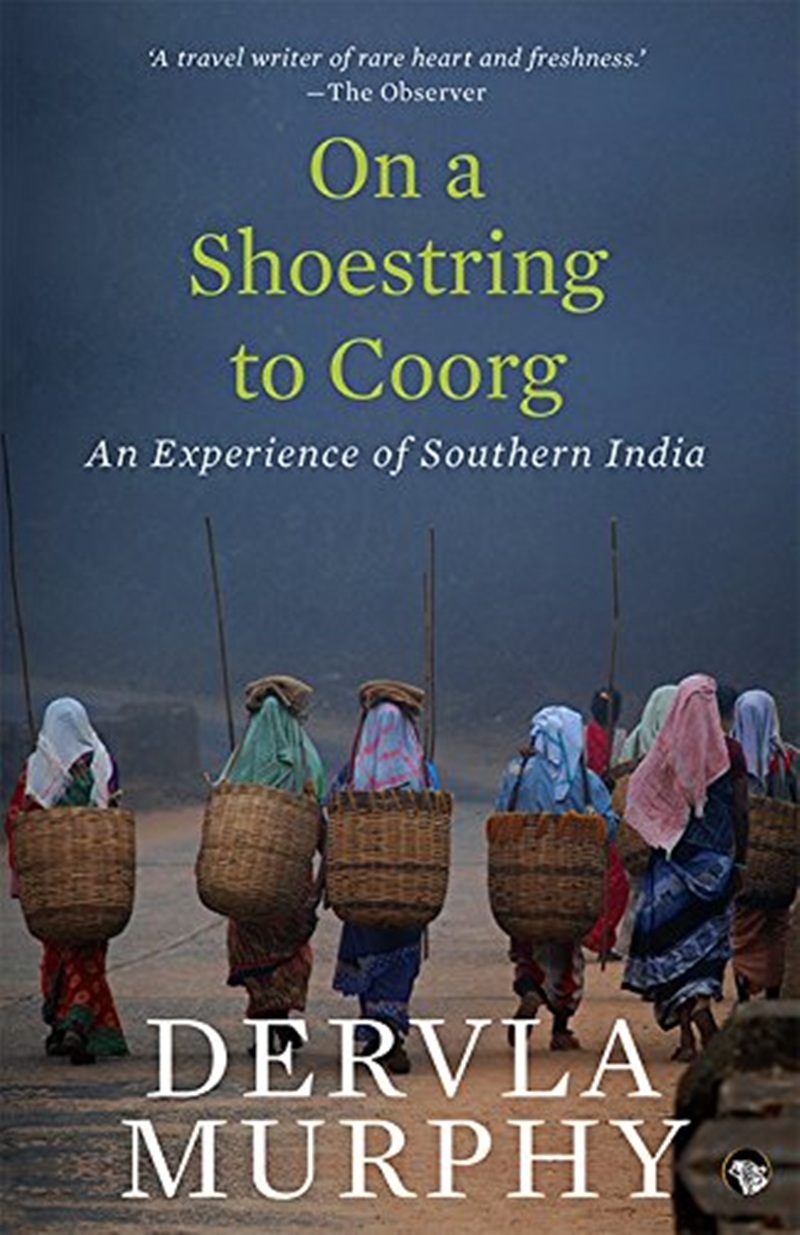
Best known for her 1965 book Full Tilt: Ireland to India with a Bicycle, adventure writer and eternal tourist Dervla Murphy is a legend of travel documentation and Irish cycling. On a Shoestring to Coorg is a thrilling account of her second visit to India, with her 5-year-old daughter Rachael.
The travel is thrilling because Murphy travels to India with little money, no concrete plans on where exactly to go and by which way, and no one to call her own in the alien land. She makes friends on the way — each one unique in his character and habits, made more so by her descriptions born out of keen observation of their idiosyncrasies and incongruities; travels to the most adverse and remote locales in south India, explores uncharted paths walking, moving on carts and buses and boats and notes down everything with piercing clarity and objectivity.
She loves India, which draws her repeatedly to her, but the love is not imbued with dramatic sentimentalism leading to heaps of unstudied praise. She loves India as she would love her own country — being critical where it needs to be, and also praiseful in places where it deserves. This lends the book a balance not always found in writers who are inundated by an overflowing sympathy for a foreign people or an alien culture. Often writers cross the threshold of restraint in their show of generosity for a different culture and exaggerate even the mundane chores of daily life to something quaint and exhilarating when actually they are not so.
Objectivity is the hallmark of a great writing and Murphy is a master of that, even to the extent of being disparaging at times of certain Indian ways which are obnoxious and irksome to one inured to a different standard of civility in the western world. She is wary of the intrusiveness of Indians in the personal space and their definition of cleanliness at times surprises her. But beyond individual stupidities or cultural drawbacks, Murphy sees the larger picture that is India — her glorious history and heritage, the simplicity and naturalness of life against western showbiz, the varied topography and climatic diversity, the capacity of the people to endure the hardships of life with resilience and equanimity, and the spirit with which they accommodate and accept an outsider as their own. These unique attributes of India are what stand out in this book and make it an informative and valuable document for both Indians and outsiders who want to have a view of India from a different perch and perspective.
Behind all her critical takes on India, lies Dervla Murphy’s deep love for the country and a deeper connect she feels with her that gives her the strength to embrace the difficulties of life here voluntarily, with a kind of persistence and gumption not naturally expected of a foreigner in the 1970s India, when travel and staying facilities, especially in the hinterlands, were largely rudimentary and unsavoury.
But if objectivity is her strength, brevity is not. The book is lengthy when gauged against the limited spatial dimension it covers and the detailing too minute and intricate to sustain patience. Many of the insignificant incidents which could have been dropped for the sake of pith make the book unnecessarily weighty and delay the more important turns and twists in the journey which are of greater interest to the reader.
Dervla Murphy has the eye of a cinematographer which forgets that its medium is not the camera but the printed letter, which needs a different idiom of expression.
source: http://www.freepressjournal.in / The Free Press Journal / Home> Book Review / by Diptiman Chakraborty / September 23rd, 2018
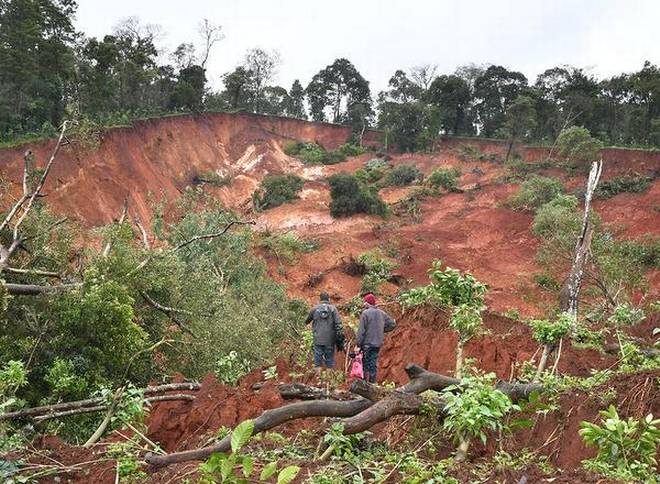
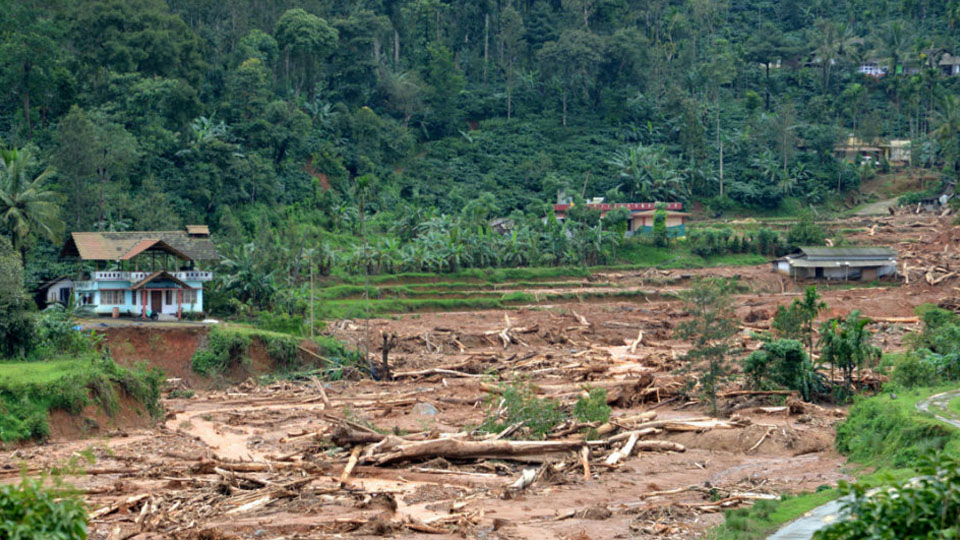
“A forestdepleted Kodagu basin will have reduced capacity to capture and store rainwater.” It is a picture of destruction in Hattihole near Somwarpet, Kodagu, after the floods. | Photo Credit: Sampath Kumar G.P.
Protecting the Kodagu watershed is essential to ensure the water security of three States
We require water for everything: drinking, growing crops, producing electricity and industrial production. With the world population projected to grow to about 10 billion by 2050, according to the United Nations, and with climate change discernible, both the quantity and quality of freshwater will become critical, affecting health, food security, and economic well-being. A 2015 UN report, Water for a Sustainable World, pointed out that the gap between the availability of water and our need for water is only going to increase.
Projects in the river basin
The growing demand on freshwater resources demonstrates the need for sustainable management of water. In this context, projects that are being contemplated, such as the laying of multiple railway tracks in the critical Cauvery river basin in Kodagu district, Karnataka, are not only economically unviable but also ecologically damaging. Mega projects pose a clear threat to the long-term water security of the three States that depend on the Cauvery (Karnataka, Kerala and Tamil Nadu), and exacerbate the threat posed by seasonal droughts and floods.
The Cauvery basin drains an area of about 81,000 sq. km. Originating in Talakaveri, Kodagu, the river irrigates agricultural fields, generates electricity, and provides drinking water to downstream communities across south India. The Cauvery and its tributaries contribute the bulk of water to the Krishna Raja Sagara dam near Mysuru, the primary water source for Bengaluru. However, increasing development pressure from the transportation and construction sectors poses a severe threat to the forests, riverbeds, wildlife and agricultural lands. This March, for the first time in decades, towns such as Virajpet in Kodagu faced a severe shortage of drinking water. The continuing loss of forest cover and illegal sand mining from river beds endanger water and food security for all the downstream communities in the Cauvery basin.
The three proposed railway plans have major implications. One, all the tracks will cut through large swaths of agricultural farms and fields as well as Protected and Reserve Forests that are spread across Kodagu and Mangaluru districts of Karnataka, and Wayanad and Kannur districts of Kerala. Along this sparsely populated area, transportation needs can be met by simply improving existing roads at a fraction of the monetary and ecological cost of the proposed railways. In fact, in its feasibility report of the Mysuru-Thalassery line, the Delhi Metro Rail Corporation stated that the project would not be beneficial to the State. In response to protests by the people of Kodagu in February, the plan to build the Mysuru-Thalassery line was scrapped in March. However, if history is any guide, plans to build the tracks will reemerge in time.
Two, they will affect the Western Ghats, one of the most biodiverse regions on earth. Kodagu has about 45% forest cover and about 30% agroforestry systems (coffee plantations and paddy fields). Between 2013 and 2015, a high-tension power line linking Mysuru and Kozhikode resulted in the loss of about 50,000 trees in Kodagu alone. If the proposed railway lines are constructed, they would conservatively result in tree loss that is 10 times more than this. Forests help capture rainfall, reduce run-off and soil erosion, recharge groundwater aquifers, mitigate flooding, support local communities, and provide refuge for native flora and fauna. Raised railway tracks will also impede wildlife and could result in the deaths of endangered animals such as elephants. Most importantly, a forest-depleted Kodagu basin will have reduced capacity to capture and store rainwater. Even without the railway tracks, a satellite-based report titled India State of Forests 2017 noted that Kodagu lost 102 sq. km. of tree cover in just two years.
Variable monsoon
The Kodagu basin receives heavy rainfall, mainly during the southwest monsoon (June-September), that feeds the Cauvery. However, studies by the Indian Institute of Tropical Meteorology and others, published in the journal Nature, have found evidence for increasingly variable monsoon rainfall. Thus, we can expect to experience more extreme floods as well as droughts in the future. These are scenarios that make preserving forest cover more vital in order to mitigate the collateral effects of these extreme events.
During this year’s southwest monsoon season, Kodagu received twice as much annual rainfall as usual and with greater intensity. This resulted in landslides and floods. A recent study of nearly 5,000 landslides around the world, published in Earth and Space Science News (Eos), has revealed that activities like construction, illegal mining and hill cutting are increasingly responsible for the uptick in fatal landslides, particularly in Asia. It will be hard to claim that the uncontrolled development and forest clearance in the steep slopes of the Western Ghats in recent years has not been a factor in the tragedy that just unfolded in Kodagu, and in the coastal districts of Kerala. With 100-year storms likely to become more frequent as the climate becomes warmer, business as usual is sure to increasingly endanger lives and property.
Erratic monsoon rains can cause flooding, droughts, water and food security. Preserving existing forests in the watershed provides an effective ‘insurance policy’ for reducing the effect of floods and droughts while recharging groundwater across the Cauvery river basin. Nature has reported that diminished access to water resources increases the risk of social unrest, political instability, intensified refugee flows and armed conflicts, even within borders. The variable nature of monsoons makes India one of the most vulnerable regions to water-related disasters associated with climate change and extreme weather events. According to a BBC report, Bengaluru is likely to run out of drinking water in the next decade. Economists should estimate the monetary and human cost of cities like Bengaluru becoming dry, and implement policies focused on achieving and maintaining sustainable water resources.
We are at the start of the UN Decade for Water, which emphasises water security for all. Everyone lives in a watershed, yet water remains a remote concept for those who consume it the most — people, industries and farmers. There are no substitutes for water as the very basis for life. Protecting the Cauvery’s source is essential for the sustained well-being of the entire basin and of the three States that the river nourishes. In fact, good water governance of the nation’s watersheds will be key to its sustainable future. We can begin by saving Cauvery’s cradle.
Bopaiah Biddanda is Professor of Water Resources at the Robert B. Annis Water Resources Institute, U.S.
source: http://www.thehindu.com / The Hindu / Home> Opinion> Comment / by Bopaiah Biddanda / September 24th, 2018
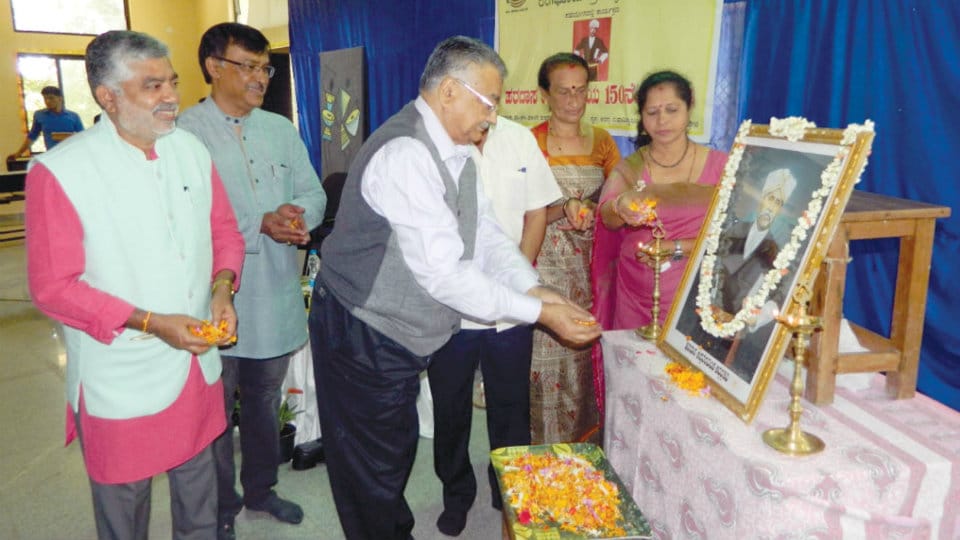
The birth anniversary of ancient poet of Kodagu Haradasa Appaneravanda Appacha (Sept.21) will henceforth be celebrated as ‘Kodava Sahitya Dina’ in recognition of the poet’s immense contribution to Kodava literature.
A decision to that effect was taken at a function organised jointly by Shivamogga Agriculture and Horticulture University, Ponnampet College and Kodagu Rangabhoomi Pratisthana to mark the 150th birth anniversary of Haradasa Appacha Kavi at Forest College auditorium in Ponnampet on Friday.
A declaration to that effect was released by M. Asha Mandanna, Chairperson, Appacha Kavi College Management Council, Ponnampet.
Inaugurating the programme after offering floral tributes to a portrait of poet Appacha, Star of Mysore Editor-in-Chief K.B. Ganapathy recalled that Appacha had come out with many poems on spirituality and wished that the poet could have written a few poems on reformation of the social system for which the poet had enough knowledge and strength. He contended that theatre and poetry were powerful tools to correct society.
Releasing a book of Appacha, Akhila Kodava Samaja Working President I.K. Biddappa expressed happiness that Kodava literature had gained importance and popularity despite a thin population of Kodavas.
Speaking on the occasion, Kendra Sahitya Academy Member A. Cariappa recalled that the then Chief Minister of Kodagu ‘C’ State C.M. Poonacha had conferred the title of ‘Varakavi’ on poet Appacha who popularised Kodava literature using Kannada script.
Kodagu Rangabhoomi Prathistana Chief Convenor Anitha Cariappa welcomed the gathering. Former College Dean Dr. C. Kushalappa and others were present. Cariappa and other artistes presented a programme ‘Amarakavya’ featuring poems of Appacha Kavi.
source: http://www.starofmysore.com / Star of Mysore / Home> News / September 23rd, 2018
With Kodagu devastated by floods and landslides, the Mysuru Kodagu Gowda Samaja will be celebrating ‘Kail Muhurtha’ get-together in a simple manner at the Samaja premises in Vijayanagar II Stage at 9.30 am on Sept.30.
There will be no sports meet and cultural programmes this year.
However, meritorious children of the Samaja members who have scored high marks in SSLC and PUC (2017-18) will be presented pratibha puraskar on the occasion.
Eligible students may applying by Sept.25, according to a press release from Samaja Hon. Secretary Kuntikana S. Ganapathy.
source: http://www.starofmysore.com / Star of Mysore / Home> News / September 24th, 2018
When you’ve successfully built a modelling career, what do you do when you get a call from Mani Ratnam’s production house?
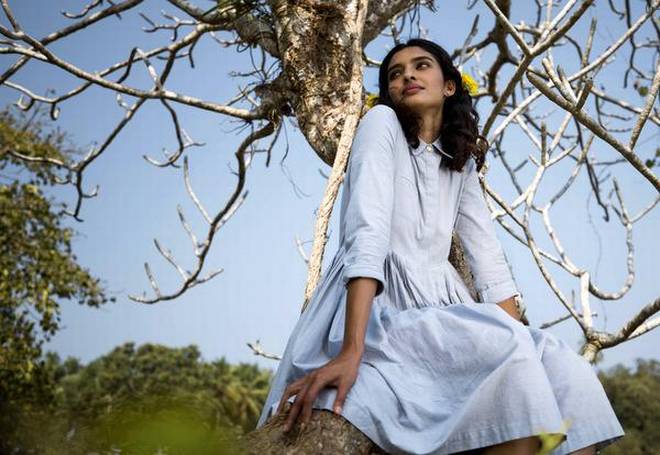
When you’ve successfully built a modelling career, walking for the biggest designers and working with international brands, what do you do when you get a call from Mani Ratnam’s production house? “I thought I was being pranked! I really didn’t think it was real,” says Dayana Erappa, one of the leading ladies in Mani Ratnam’s multi-starrer Chekka Chivantha Vaanam. But it really was Madras Talkies reaching out to her, asking if she knew Tamil and Telugu.
Dayana, who’s from Coorg, said she was fluent in Tamil and Kannada, and sent over her portfolio and forgot all about it. Two months later, she was called for an audition in Mumbai, for a project with Mani Ratnam. When it was time for her to meet the man himself, Dayana had no idea what to expect. Describing the meeting, her voice still has a starstruck quiver, “On the entire flight to Chennai, I was thinking about what I would do when I finally faced him. I grew up watching and falling in love with his movies, how could I be anything but excited?”
The meeting went well. A chat, a script reading with him, and a few weeks later, she got the call confirming her part. “I knew nothing about the role or the character, but I had zero worries. Women have been depicted beautifully in all of Mani sir’s movies, so I knew I was in good hands.” In fact, she says she had no idea she was one of the leading ladies in the movie until the film’s cast poster was released.
With no previous training or experience in acting, Dayana attended a few acting workshops to prepare herself. “When I found out I’d be acting opposite Simbu, I was quite nervous because I’d heard how talented he is. I’d also seen his movies and I wasn’t sure if I could match up to him.” And the first day on set she told Simbu exactly that. But he was supportive, telling her not to worry even if she needed 10 takes to get it right. “Sometimes it did take 10 takes,” she says laughing, but it was the encouragement she received on set that gave her the confidence to pull through. “From the actors to the ADs and stylists, it felt as though the entire crew was rooting for me.”
The transition from a successful model to an actor could not have been easy, but she says, “Even modelling is not something that you learn in a day or two; you work at it every day. So I was prepared to put in the hard work necessary to act from the get-go.” It also helped that she was surrounded by veteran actors. “I got to learn from just being around all that experience. Everyone was easy to talk to. No one treated me like a newcomer.”
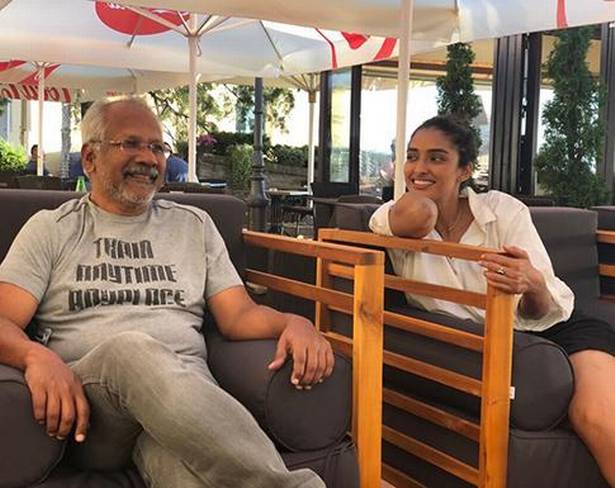
Get her talking about her director and she switches to fangirl mode, “Mani sir is a patient craftsman and definitely a man with a vision. He works with you in a way that puts you at ease; so he gets the best performance out of his actors. His movies like Kannathil Muthamittaal and Thalapathi are my favourites. Now I see where the magic comes from.”
Ask her about Chaaya, the character she’s playing, and she won’t say anything more than that she’s a fun and adventurous girl, quite like herself. With a dream début in her hands, Dayana says she will continue modelling while she works on her acting skills, in case an interesting script comes knocking.
source: http://www.thehindu.com / The Hindu / Home> Entertainment> Movies / by Anugraha Sundaravelu / September 24th, 2018
With donors from across the state contributing to CM’s Relief Fund, exclusively released to Kodagu district, over Rs 62 crore has been collected as on September 20.
Madikeri :
Following the natural disaster in Kodagu district, the numerous families that had lost houses and other properties were handed over Rs 3,800 – Rs 1,800 for clothing and Rs 2,000 for utensils and other household goods (per family)- under SDRF/NDRF guidelines.
Since the damage has been severe and the process of permanent rehabilitation will take some more time, the district administration including Deputy Commissioner Sreevidya P I and Kodagu District Minister Sa Ra Mahesh had proposed a request to the State government to increase the amount from meagre Rs 3,800/- per family to Rs 50,000, in a letter dated 28 August.
While the State and National Disaster Fund guidelines do not allow any changes to be made to the gratuitous funds, the state revenue department had stepped into people’s aid and had forwarded the proposal of releasing Rs 50,000/- each for the distressed families from the Karnataka Chief Minister Relief Fund-Natural Calamity 2018. The proposal, which was forwarded to CM H D Kumaraswamy was later forwarded to the Cabinet Committee for approval, which has now been sanctioned.
With donors from across the state contributing to CM’s Relief Fund, exclusively released to Kodagu district, over Rs 62 crore has been collected as on September 20. As many as 1,156 families have been directly affected by natural disaster and 186 houses have been damaged completely, 530 houses have been damaged severely and 404 houses have undergone partial damage.
While Rs 320 crore has been allotted to Karnataka under SDRF, an additional state fund of Rs 400 crore is provided to the state.
source: http://www.newindianexpress.com / The New Indian Express / Home> States> Karnataka / by Express News Service / September 22nd, 2018
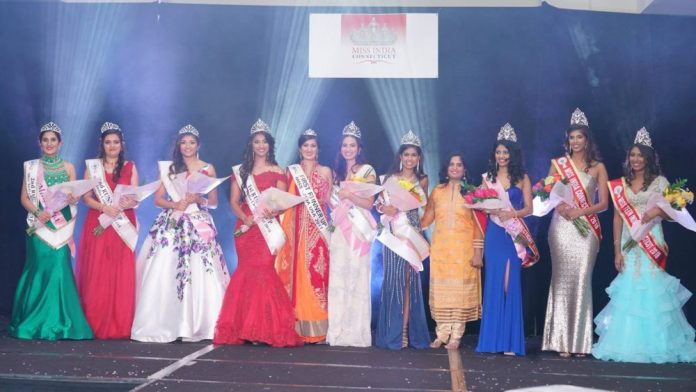
Rekha Gopal – Mrs. India Connecticut 2018 (Left), Alka Marala – Miss India Connecticut 2018 (Middle), Nikitha Kikanamada – Miss Teen India Connecticut 2018 (Right)
Cromwell, Conn.(USA):
Alka Marala has been crowned as Miss India Connecticut 2018. Other winners in the state pageant, which was held last week and directed by Sumathi Narayanan, were: Nikitha Kikanamada, Miss Teen IndiaConnecticut; and Rekha Gopal, Mrs. India Connecticut.
The winners will go on to compete at the national level pageant hosted by Dharmatma Saran, Chairman of IFC, for the title of Miss, Teen, and Mrs. India USA.
Sumathi Narayanan
“We are so proud of the beautiful, talented, and successful women of Connecticut, and we’re excited to see how they further their causes and missions in this upcoming year by using the platform given to them,” said Narayanan, president of Sumathi Narayanan Realty, owner of Swaagat Collections in Shrewsbury, MA, and State Director of Miss India Connecticut Pageant. “We also encourage all women to continue to pursue their dreams and seize these opportunities.”
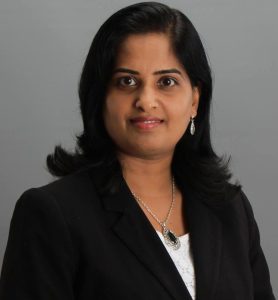
Miss Marala is a student at University at Buffalo and is currently finishing up her second major. She was elected as vice president of Finance for The Women in Management organization at her university. She is a part of UB Zeal, an inter-college competitive dance team. She is also a Kuchipudi dancer, and is fortunate to have her mother as her guru. She loves to travel the world, try different foods and learn about different cultures.
The Connecticut pageant, which was held on Saturday in Cromwell, CT, was directed by Ms. Narayanan, featuring three categories: Miss, Teen, and Mrs. A total of 23 contestants participated in the pageant and confidently portrayed Indian culture, unique talents, and American pride with grace and elegance.
“The pageant was not just about outer beauty, but also valued inner beauty, intelligence, and ambition of the young women of Connecticut,” Ms. Narayanan said in statement.
State Director Sumathi Narayanan along with all 2018 Winners and 2017 Winner Prachi Shah.
Miss India Connecticut is associated and part of IFC, a pioneer in organizing Indian pageants and fashion shows in USA, and aptly called the ‘Mother of all Indian Pageants in USA.’
The Connecticut pageant event started with an opening dance choreographed by P&P Dance Crew of Connecticut, in which all the contestants performed energetic and graceful introductory dances alongside the reigning Miss India CT 2017 and 1stRunner Up of Miss India USA 2017: Prachi Shah.
The opening dance was then followed by the ethnic wear round, where each contestant proudly displayed their Indian culture. Next was the talent round, in which contestants displayed their talent through dance and musical performances, acting, martial arts, crafts, and even magic shows. The contestants then gave their introduction in the evening gown round. Lastly, the finalists amazed everyone with their wits in the question and answer round.
The judges of the pageant were accomplished patrons of the arts from the New England area. The judges’ panel included: Tirthankar Das, a filmmaker and music composer from New Jersey; Sankar Gangaikondan, a singer and musician; Shaila Verma, Artistic Director of Shaila School of Dance in Massachusetts; Dr. Kavita Pattani, Mrs India USA 2017; and Namita Dodwadkar, Mrs India USA 2014 and Mrs India Worldwide 2016.
The crowned winners of each category are:
Miss India Connecticut – Alka Marala
Miss Teen India Connecticut – Nikitha Kikanamada
Mrs. India Connecticut – Rekha Gopal
1stRunner Ups:
Miss India Connecticut 1stRunner Up – Daman Brar
Miss Teen India Connecticut 1stRunner Up – Archita Mundrathi
Mrs. India Connecticut 1stRunner Up – Vidhi Dave
2ndRunner Ups:
Miss India Connecticut 2ndRunner Up – Radhika Rathore
Miss Teen India Connecticut 2ndRunner Up – Athulya Narayanan
Mrs. India Connecticut 2ndRunner Up – Mamatha Puttaswamy.
Here are some other subtitles given in each category, including Miss/Teen/Mrs. Social Media – Radhika Rathore, Athulya Narayanan, Debashree Rupalin. Miss/Teen/Mrs. Congeniality – Radhika Rathore, Nikitha Kikanamada, Mamatha Puttaswamy. Miss/Teen. Talent – Alka Marala, Athulya Narayanan. Miss/Teen/Mrs. Photogenic – Alka Marala, Dhruvi Patel, Nidhi Sinha and Miss/Teen/Mrs. Viewer’s Choice – Alka Marala, Archita Mundrathi, Mamatha Puttaswamy.
source: http://www.indianewengland.com / India New England News / Home> Lifestyle / by The New England News / September 18th, 2018
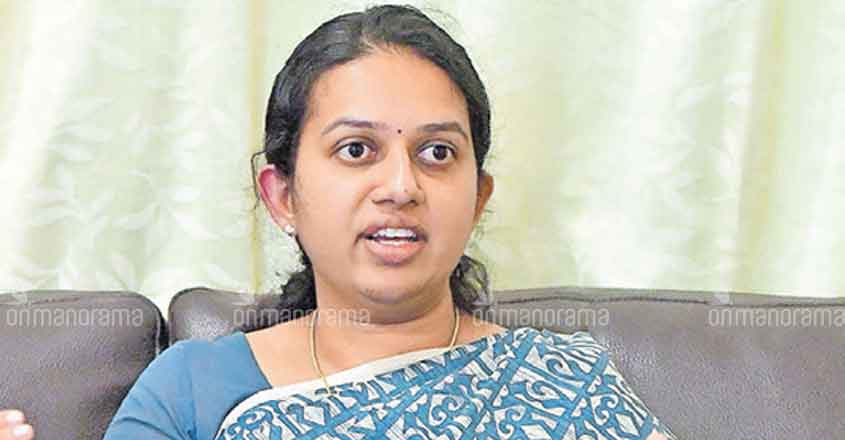
Taking note of the geographical factors typical of hilly Kodagu also known for its origin of the river Cauvery, Sreevidya began vacating people the next day from danger-prone areas.
When the whole of Kerala reeled under floods last month amid rain-triggered landslides along its eastern mountains, just east of upstate Malabar, Kodagu too was hit by the calamity. Yet, if the people of southern Karnataka’s scenic district largely escaped the effects of the monsoon fury, a share of the credit goes to a Malayali bureaucrat’s prompt administrative initiatives.
A native of Kollam district in Kerala, P I Sreevidya was only eight months old with her capacity as the deputy commissioner of Kodagu when her office got information last month that the district along the Western Ghats was set to receive “very heavy and unusual rains.” Far from laughing off the alert received on August 12 through various agencies, the 2009-batch IAS officer swung into action.
Taking note of the geographical factors typical of hilly Kodagu also known for its origin of the river Cauvery, Sreevidya began vacating people the next day from danger-prone areas. Relief camps came up within hours.
As it rained cats and dogs on August 15 and 16, Kodagu lost 2,500 houses while crops perished in acres of farmlands. Roads developed cracks, some simply vanished.
Sreevidya, who had earlier served as Kodagu zilla panchayat chief executive officer for six months from mid-November 2013, opened a control room this time by her office, coordinating rescue and relief operations. She ensured that the district got aid from all the three arms of the service, besides the IAF’s special Garud commando service and the state police, fire force as well as the National Disaster Response Force under the Centre.
Joining her in the efforts were zilla panchayat CEO Prashanth Kumar Mishra, police chief Suman D Pennekar, MLAs Appachu Ranjan (Madikeri) and K G Bopaiah (Virajpet) along with other people’s representatives and social workers. The office of Chief Minister H D Kumaraswamy would enquire about the developments on an hourly basis. There were opportune interventions from state chief secretary T M Vijay Bhaskar.
“All these ensured that we could minimise the loss to property and the impact on public life,” says Sreevidya, who belongs to Chakkuvarakkal near Kottarakara and had secured 14th rank in her civil service exams. “I couldn’t even call home those two days.”
The bureaucrat’s four-year-old son Madhav, sensing the gravity of the situation, threw no tantrums and stayed quietly with his grandparents in the camp house.
As for Sreevidya’s husband, he is also a top officer. T Narayanan, who is Pathanamthitta district police chief, was that time busy in a similar rescue operation in his area. There, in south-central Kerala, the Pamba had swollen dangerously, invading places along both its banks, much to the trauma of their residents. “Believe me, I didn’t know his place was that badly affected. Neither did he know anything about the Kodagu floods,” says Sreevidya. “We were both cut off that time.”
Today, Kodagu people are all praise for their deputy commissioner. Social media posts, especially on Facebook, speak of Sreevidya’s administrative efforts that assuaged their misery.
source: http://www.english.manoramaonline.com / Home> Women / by Malayalam Manorama Correspondent / September 17th, 2018
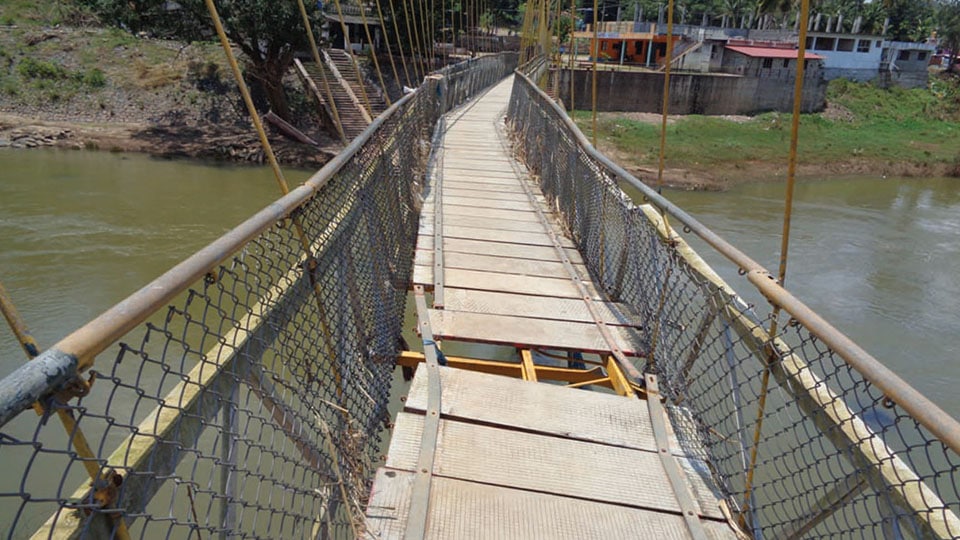
The hanging bride built across Cauvery River near Sri Ramalingeshwara Temple at Kanive close to Kushalnagar in Somwarpet taluk of Kodagu District has been severely damaged by recent floods that devastated Kodagu.
The hanging bridge connects villages along the border between Kodagu and Mysuru Districts. It also acted as a bond between villagers. The bridge with its unique nature, also attracted thousands of tourists. But heavy rains resulting in the flooding of Cauvery and Harangi Rivers, has caused huge damages to the bridge, which is on the verge of collapsing.
The Steel-Suspension Bridge supported by piers on both the banks of the river, has been so devastated by floods, that even pedestrians too are scared to walk on this bridge.
The steel rods that hold the bridge have broken and the wooden planks meant for pedestrian commute, have come apart. Thousands of people who depended on this bridge for their daily commute to work, are now scared about their future, with the bridge no longer safe for commuting.
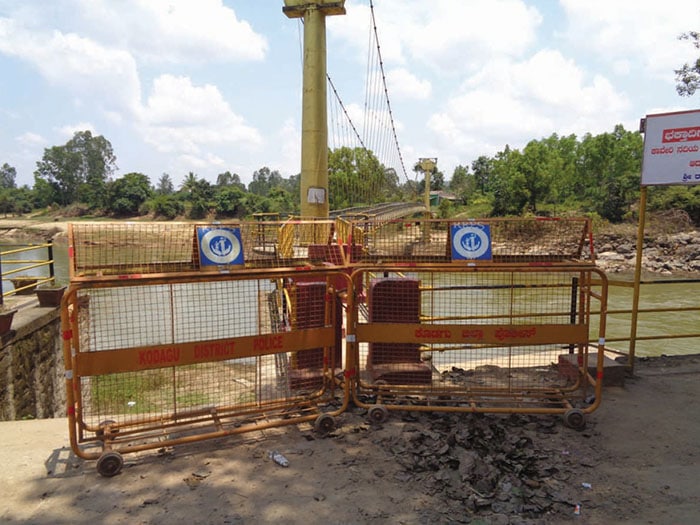
Entry to the bridge has been banned by the Police.
This hanging bridge was built eight years ago at a cost of Rs. 45 lakh, funded by Malnad Area Development Board (MADB), Shivamogga. Sullai’s renowned suspension bridge expert Girish and his team constructed the bridge using the latest technology. The bridge had been the dream of thousands of people living in villages along Kodagu’s border with Mysuru District. The bridge connects many villages of Periyapatna taluk in Mysuru District, including Dodda Kammanahalli, Shanubhoganahalli, Dindigadu, Muttina Mulluroge, Kanagalu, Hanumanthapura and Karadi Lakkanakere with Kodagu villages such as Kanive, Bhuvanagiri, Huluse, Hakke, Kudige, Mararu and Hebbale. Before the construction of this hanging bridges, the villagers had to cross the river on boats and on the dangerous bridge along the aqueduct built at a height of over 50ft. This dangerous and risky bridge was a bane to hundreds of students and labourers who used to commute daily. The authorities taking note of the daily hardship of the people, built this bridge at Kanive.
As flooding waters submerged this bridge and caused considerable damage to it, pedestrian movement on the bridge has been banned. The Police have erected barricades across the bridge. With the closure of his hanging bridge, villagers along the border are forced to take a detour of about 20kms via Avarti to reach Kushalnagar and other places.
With the recent floods weakening the bridge, the villagers have urged the Kodagu District Administration to repair this bridge at the earliest and throw it open once again for the benefit of villagers, who consider this bridge as a very important part of their life.
Unfortunately, for the people who depended on the bridge, the District Administration has not yet announced any funds to repair the bridge.
The bridge is crucial for the devotees to go to the historic Ramalingeshwara Temple and as the bridge is unsafe now, many people are robbed off the opportunity to go to the temple, said Bharadhwaj K. Anandatheertha, a writer from Kanive.
source: http://www.starofmysore.com / Star of Mysore / Home> News /
September 16th, 2018
WELCOME. If you like what you see "SUBSCRIBE via EMAIL" to receive FREE regular UPDATES.
Read More »