With a view to empower and encourage young women achievers, St Agnes College (autonomous) organized a felicitation programme for Poovamma, an Indian spinster who hails from the district.
The programme was held on September 14 at St Agnes College.
Sr Dr M Jeswina AC principal St Agnes College, Sr Dr Venisssa AC, vice principal St Agnes College, Malavika, dean administration and Vasudha, physical education directress were present for the programme.
Vasudha, the physical education directress of the college welcomed the gathering.
Ladleen Monteiro introduced Poovamma to the gathering who was then felicitated by the dignitaries on the dais. Poovamma addressed the gathering and said that with hard work and determination, one can surely achieve great heights.
This was followed by a short message by the principal Sr Dr M Jeswina AC wherein she encouraged the students to take inspiration from Poovamma’s life.
Vijayashree, the sports secretary proposed the vote of thanks.
The programme concluded by singing the college anthem.
source: http://www.daijiworld.com / DaijiWorld.com / Home> CampusBeat / by Media Release / Mangaluru – September 18th, 2018
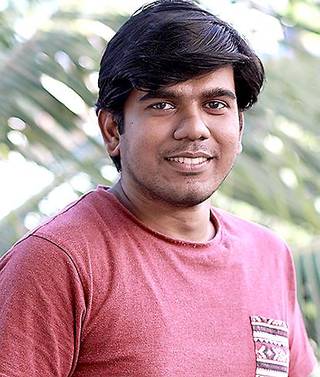
Raj Bhagat Palanichamy of WRI India is preparing open source free online tools and maps to deal with floods.
As Bengaluru and Chennai stare into a future which is likely to be dotted with more floods, Raj Bhagat Palanichamy is busy working on a defence strategy. He is preparing an online tool and maps for Chennai and Bengaluru. Raj works as a GIS and remote sensing analyst with WRI Ross Cities program at WRI (World Resources Institute) India. A not-for-profit global research organisation, WRI works on ideas to create sustainable cities.
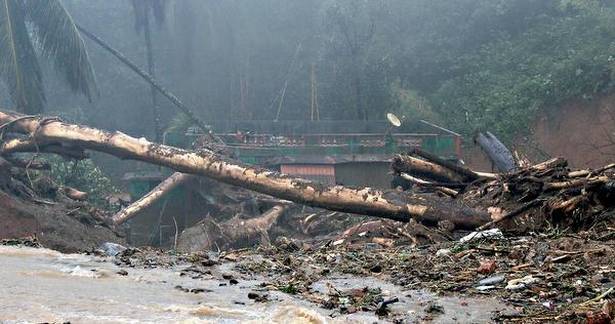
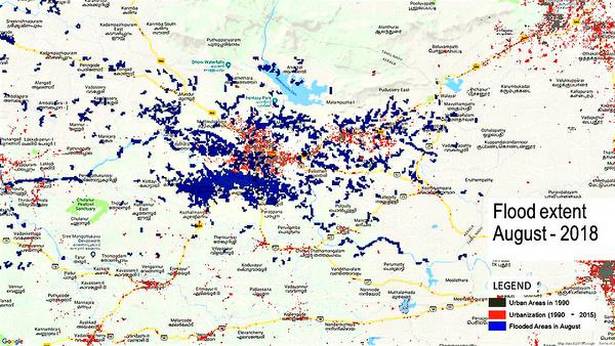
During the recent floods, he had released maps of Kodagu and Kerala that aimed at helping authorities and people involved in rescue work by sharing information. On whether his maps could achieve their objective, the young researcher says, “I got an SOS call from the disaster management wing of the Revenue Department of Karnataka, one morning asking for these maps. I shared with them an interactive website which gave them access to these maps. I think drone surveys were commissioned in Kodagu after consulting our maps. With Kerala, there was no direct channel of communication between us and its government. Also, the authorities in Kerala were right in the thick of action so we couldn’t really interact. The idea was to tell the governments that there are ways to seek information. Social media was interested. My tweets had 40,000 impressions.”
With high possibilities of flooding occurring in Bengaluru and Chennai in the coming months, Raj is now working on maps for both the cities and plans to release it five days before the meteorological department predict heavy downpours. Raj reveals that one can extract more accurate data closer to the date. An hour of observation is needed to generate maps. “Our mandate was never to deal with a crisis on a short-term basis. The 2015 Chennai floods made us realise that there is a need to have a structure for a short-term solution to save lives. We are now working on an open source online tool that will predict the areas to be most affected and also monitor those areas. The online tool will be ready sometime in 2019 as it is stuck right now due to paucity of funds but the maps will be there soon, though.”
Raj feels the conversations should be on handling the climate change. “Like how to diversify our cities so they don’t get overburdened. While the government looks at flooding with an engineering perspective — building and clearing canals, the main thing is rainwater harvesting. We could use parks to hold rainfall and avoid constructions on flood plains.”
He says the flood tool can send out a warning. The findings can be integrated into the planning to identify critical areas and avoid construction there. The tool will help in identifying critical buildings such as hospitals and schools to come up with a proper defence mechanism against floods.
Raj feels too much dependence on dams is not recommended. “Traditional ways of water conservation and improvement of water efficiency and productivity need to be the focus. The government shouldn’t focus on mega projects.” He also feels that the gap between analytics and planning should be bridged. “There are 100 of research projects about the flooding in Mahanadi river but these have not been integrated into planning because researchers probably don’t know how to reach out and publicise their work. The Amaravati floods very often not just because of the infrastructure but also due to lack of planning.”
source: http://www.thehindu.com / The Hindu / Home> Society / by Shailaja Tripathi / September 18th, 2018
The rich and distinct culture of Kodagu, the land of dense hill jungles, is reflected in the clothing and food habits of its inhabitants. Historically, paddy is the major crop in the region. Though paddy fields are gradually disappearing in these fertile valleys owing to many reasons, rice is still the staple food in Kodagu and comes on the platter in various forms.
The traditional staples like kanji (Conjee or ‘rice gruel’) and koolu (boiled rice) are served along with salt and pickle. Other rice dishes like paputt (steamed rice cake, cooked with coconut gratings), noolputt (rice noodles), kadampoott (rice dumplings, also called kadamboott), etc are served along with a curry. Votti (akki roti) with pajji, a mild spicy chutney is a popular breakfast item. Sannakki — fine, small rice grains with a sweet fragrance — is commonly used in these preparations. While some rice dishes have just ceremonial significance now, many find a place among popular recipes.
Curried variations
Curry is a word with Dravidian origins for the Indian spicy sauce preparation of vegetables or meat. A number of South Indian languages, including the Kodava language, use the word karri (curry) while in Kannada it is called sambhar. Grated coconut and seasoning are the inescapable features of a quintessential Kodava curry. While kooth (mixed vegetable curry) is a common vegetarian dish here, any sort of rasam, sambhar or dal curry is called kanni.
Pepper is grown in Kodagu and is one of the common spices used. Parangi malu, a small but fiery chilly, is grown in the kitchen gardens. This ‘chot-mensin-kayi’ spice is used in several preparations.
A majority of Kodagu people consume non-vegetarian food as well. Koli (chicken) curry, meen (fish) curry, kuri yerchi (mutton) curry or pandi (pork) curry are prepared from small cut pieces of meat which are well-seasoned and curried. While the gravy meats are called curry, the fried variants are called barthad. There is one vegetarian variant made of brinjal called the baine barthad.
For dessert, there is thambutt (a sweet dish prepared from bananas and grated coconut), kuvaleputtu (a sweet dish made of jackfruit, steam cooked and served in banana leaves), baale puttu (another sweet dish prepared from bananas), akki payasa (a sweet pudding made from rice) and others. Akki payasa is a traditional dish made for almost all the festivals.
There are a few other sweets that double up as snacks in Kodagu, which are however not native to the region. Some of them are the round chiroti, the crescent-shaped kajjayya and the doughnut-shaped badava kajjayya.
Festival food
Thambutt (also called thambittu) is popularly made during Puttari, the harvest festival which occurs in the month of November or December. During the wedding feasts, and especially during the annual feasts of Kail Polud (a martial festival) and Putthari, meat is permitted. Pandi curry is prepared for both these festivals.
But on Kaveri Changrandi, the feast of the river goddess, meat and alcohol are strictly prohibited. Neer dose (which is of Tulu origin and is a crepe made of unfermented rice batter) and kumbala (pumpkin) curry is made during the festival.
Certain fruits and vegetables are generally cooked in the months when they are readily available. Baimbale (bamboo) curry, kaad mange (wild mango) curry, kemb(colocasia) curry, therme thoppu (fern) curry, kummu (mushroom) curry and pineapple curry are some of the seasonal vegetarian delicacies.
There are seasonal chutneys such as mange (mango) pajji, chekke (jackfruit) pajji and kaipulli (lime) pajji as well. Kuvaleputtu is usually prepared around May, in the season of jackfruit. Some dishes are prepared from chekke kurru (jackfruit seeds) as well.
Chana Kande (elephant yam), tapioca and Puttari Kalnji are also grown in Kodagu. Puttari Kalnji is a kind of yam plant which grows as a creeper. Its fruit is cooked during the Puttari festival, hence the plant gets its name.
Kakkada (Karkataka or ‘of the crab’) is a month in the Kodava calendar which is similar to the Aashada month in the Kannada calendar. On the eighteenth day of this month (called Kakkada Padnett), a certain herb called the kurunji thoppu (Justicia wynaadensis), also referred to as maddu thoppu (medicinal leaf) or aatisoppu (Aashadha leaf), is plucked and an aromatic, purple juice is obtained from it. This juice is believed to have various medicinal benefits and is hence consumed on that day. A dish called madd-putt and a sweet porridge, called madd-payasa, are prepared with this juice. A fattened chicken, labelled as kakkada koli, is cooked on this day and eaten.
A kind of vinegar called puli neer is prepared and used in several dishes. A special native kind of vinegar called kachampuli (Coorg vinegar) is peculiar to Kodava meat dishes. This vinegar is made from a Garcinia gummi-gutta, a wild fruit. Kachampuli gives the pandi curry its unique taste.
Orange, butter fruit, guava, papaya and other fruits are also widely grown and consumed in Kodagu. But they have not gained the culinary popularity of the traditional three: banana, jackfruit and mango. Any visitor to a home in Kodagu gets a welcome coffee drink. Of late, Kodagu has become famous for homemade wine, prepared from different fruits, and chocolates.
Chef Naren Thimmaiah says, “Awareness about regional Kodava cuisine is high since it is distinct. The classic combinations — noolputtu and koli curry, kadambuttu and pandi curry, paputtu and erachi curry never fail to please. Crab and fish curries are usually eaten with akki rottis or rice. We take these pairings for granted, but they owe everything to uncounted generations of gifted women.”
The people of Kodagu have developed their cuisine from what was readily available in Kodagu and in the best way possible. Various curries and other dishes are prepared from the fruits, vegetables, plants and meats found in the region. While some of the food items of the region have evolved locally, some have been inspired by the food culture of the neighbouring regions.
source: http://www.deccanherald.com / Deccan Herald / Home> Spectrum / by Mookonda Kushalappa / September 16th, 2018
The board has launched on pilot basis a number of tech measures to help the 3.66 lakh coffee growers in the country.
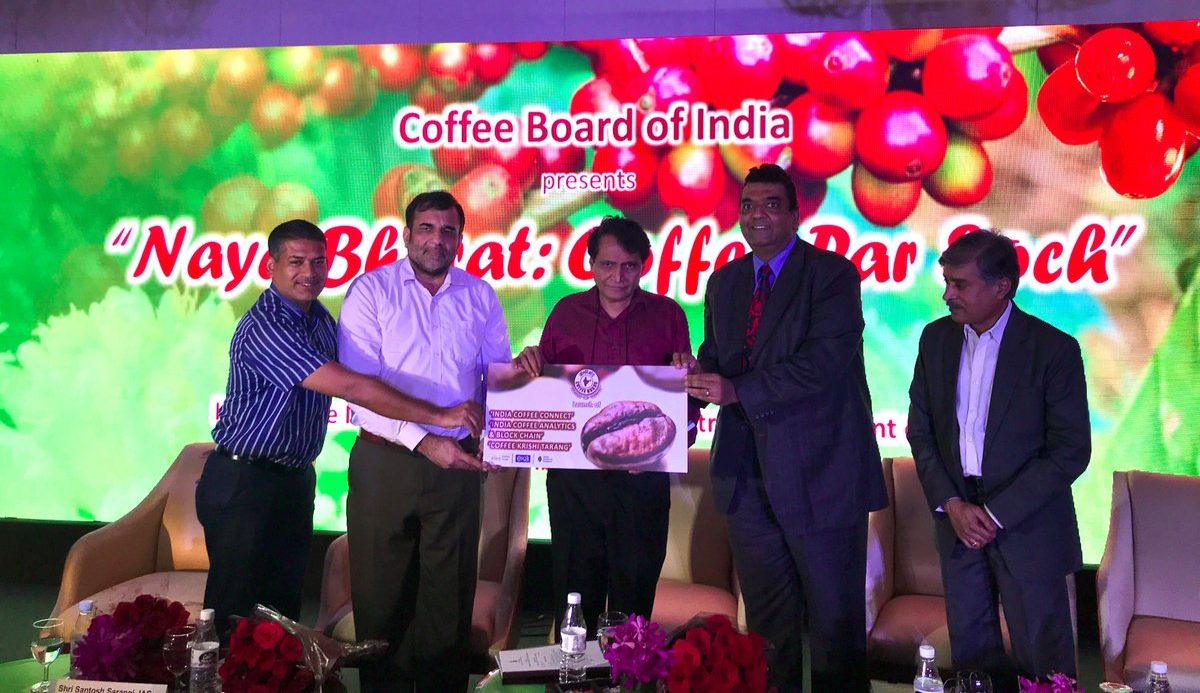
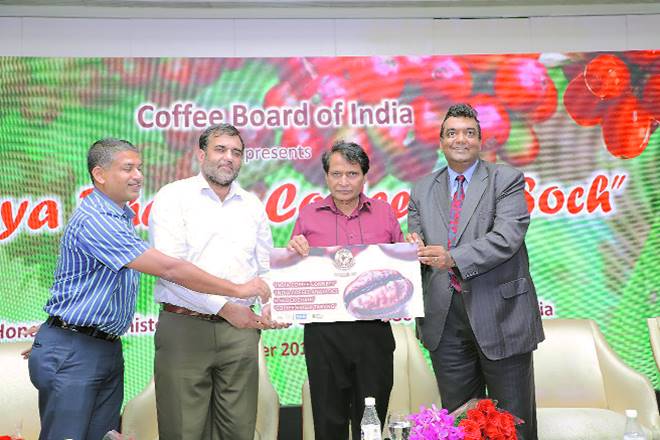
Suresh Prabhu (C) at the Naya Bharat event | @CoffeeboardI/Twitter
New Delhi:
Drones, geo-tagging and a number of mobile apps are among the technological measures the government-run Coffee Board is set to introduce to improve productivity and revenue.
The board, which is under the commerce ministry, set the process in motion last week, when Suresh Prabhu, the Commerce and Industries Minister, formally launched the ‘Coffee Connect’ app.
The app will collect data from coffee plantations in the country through inbuilt geo-tagging which will help generate information about plantation location, plant material and age.
“For the first time in the 75 years of India’s Coffee Act, 1942, we are trying to infuse new technologies that will enhance productivity and yield for farmers,” said Coffee Board Secretary and CEO, Srivasta Krishna.
Krishna emphasised on the need to grow “smart coffee”, using concepts such precision agriculture and smart agriculture to maximise yields from the existing coffee growing regions.
The board hopes that these technological measures will help increase profits of farmers, particularly in the export markets.
‘Way to hike profits’
According to Krishna, a cup of Indian coffee sells for $3 to $4 in the US, of which an Indian farmer gets only 5 cents. With technology, he said, this could rise to 10 cents.
The move comes amid fears that the next season could see the coffee output drop to its lowest in two decades due to the unprecedented rains in the two top crop producing regions in the country – Kodagu in Karnataka and Wayanad in Kerala.
According to a Bloomberg report, output in the year starting October 1 may be about 25 per cent lower than the 3,16,000 metric tons estimated by the Coffee Board for 2017-18.
Coffee is cultivated by 3.66 lakh coffee farmers in the country, 98 per cent of whom are small farmers. Typically, a small farmer is one who owns less than 25 acres.
Apps galore and a call centre
The ‘Coffee Connect’ app is among a number of apps that the board has already launched on a pilot basis.
The app allows users to get in touch with the coffee board’s extension officers, who provide services to coffee farmers.
At present, there are 170 Coffee Board extension personnel — or one extension officer per 2,153 farmers.
The app, officials hope, will enable better information exchange between Coffee Board personnel and those on the ground.
The board has also launched, on a pilot basis, a suite of apps to provide solutions to challenges in rainfall, pests and diseases.
Some of the app features are hyper-local weather forecasting, early detection of coffee crop pests such as the White Stem Borer and predicting the probability of Leaf Rust disease.
This app also has a blockchain-based market-place that allows coffee growers and farmers to directly deal with customers, including multinational firms.
“These are all wonderful efforts. These tech solutions, however, need more effort, and push from all stakeholders to make them really effective,” said Mohan Alwares, a coffee grower from Mudigere in Karnataka.
Alwares lauded the blockchain-based market but urged the board to increase awareness of it.
Rajeev Chaudhary, general manager and the chief risk officer, Agriculture Insurance Company of India, said such measures will hold the board in good stead.
“The Coffee Board’s various tech implementations including the pilot blockchain-based marketplace would make it a frontrunner among the other boards for crops in India. Other boards, however, will most likely follow suit”.
Drones Used
Another proposal that the board is exploring promoting is the use of drones in agriculture.
At the board’s event last Tuesday, several drone start-ups presented proposals, arguing that their use will improve the efficiency of pesticide use and spray.
“A farmer might take 2-3 hours to spray an acre with pesticide; a drone will do this in less than 10 minutes,” said Rahat Kulshreshtha, the CEO of the drone start-up Quidich Innovation Labs. “Using drones we found that 30 per cent less pesticide can be used and since it can be done remotely, farmers are saved from the harmful effects of direct contact with pesticides”.
Alwares, however, isn’t sure that drones will help in coffee plantations in India. “Unlike in Brazil where coffee is grown in open cultivation, in India coffee is largely a crop grown in shade,” he said. “If a coffee plant is 5 feet tall, there are trees as tall as 50 to 100 feet growing over it to provide shade. So I’m not entirely sure how drones can be used.”
Chaudhary of the Agriculture Insurance India foresees drones being increasingly used in other crops. He says drones for aerial surveillance will be especially helpful in monitoring high-value and high-risk crops such as cotton, groundnut, soybean and plantation crops like tea. Agri insurance companies will likely make more drone purchases he said, adding that Maharashtra leads the pack in this sector.
source: http://www.theprint.in / The Print / Home> Governance / by Regina Nihindukulasuriya / September 13th, 2018
Robin Uthappa will continue to represent Saurashtra during the upcoming domestic cricket season.
The 32-year-old had recently expressed an interest in returning to Karnataka, for whom he played for nearly 15 years before moving up north.
His inclusion in the KPL, where he led Bengaluru Blasters to the final, was seen as a step in that direction.
Little choice
But with the State selectors providing him with no assurance, and at the same time looking to build a team for the future, Uthappa had little choice.
“I spoke to them and they said they will get back to me. But there was no communication,” he said.
“I have no issues with the administrators but in the end, it was up to the selectors. I wished to play in front of our crowd but now it’s time to move on.
“I am preparing well for the season and am eager to do well for Saurashtra,” Uthappa said.
I wished to play in front of our crowd but now it’s time to move on
source: http://www.thehindu.com / The Hindu / Home> Sports / by Sports Reporter / Bengaluru – September 12th, 2018
Seva Bharathi and Lions Club had also organised another wedding of a woman who had lost her home in the landslides in Kodagu.
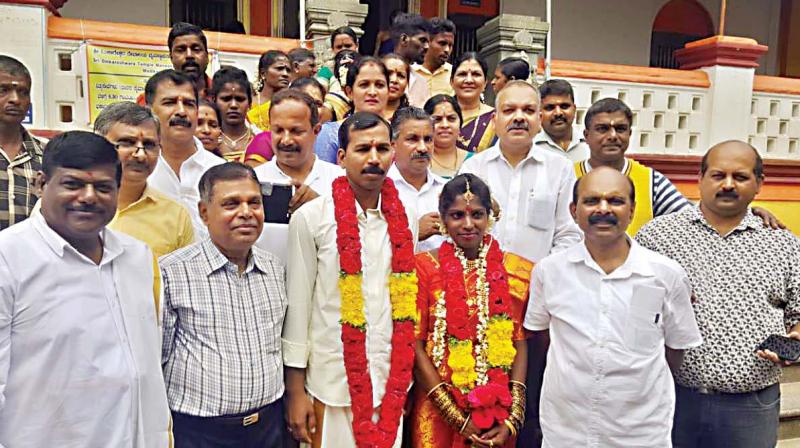
Lions Club of Madikeri and Seva Bharathi organised the wedding of the daughter of a family which lost their home to landslides, at Madikeri on Wednesday.
Mysuru:
Yet another family at a relief centre in disaster-hit Kodagu conducted the marriage of their daughter as scheduled on Wednesday with the support of Seva Bharathi, Lions Club of Madikeri and others.
Ranjitha, daughter of Sanjeev and Sumithra of Makkandur in Kodagu, got wedded with Ranjith, son of Madhusudan and Thangamani of Kannur, Kerala at Sri Omkareswara temple with over 300 people joining their wedding reception at Sri Narasimha Kalyana Mantapa in Madikeri.
Mr K.K. Damodar, president of Lion’s Club, Madikeri told Deccan Chronicle that Ranjitha’s family had lost their home in the landslides during the recent rains. Presently, they are housed at a relief centre in Kushalnagar. “Ranjitha’s wedding was scheduled at Makkandur on Wednesday but following the disaster, her parents had decided to cancel her wedding. But we along with Seva Bharathi decided to organise the wedding. The couple left for Kerala on Wednesday after the wedding.,” he said. Seva Bharathi and Lions Club had also organised another wedding of a woman who had lost her home in the landslides in Kodagu.
source: http://www.deccanchronicle.com / Deccan Chronicle / Home> Nation> Politics / by Shilpa P, Deccan Chronicle / September 17th, 2018
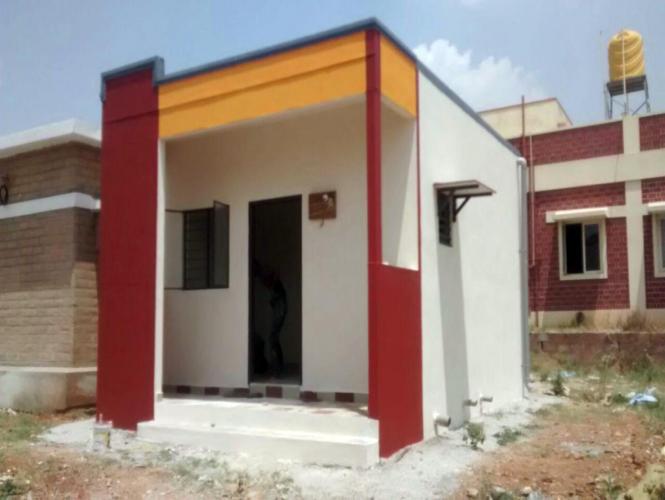
A house constructed using composite material near Chikkapetehalli near Yelahanka in Bengaluru
A former scientist from the National Aerospace Laboratories (NAL), Bengaluru, has come up with a proposal to construct light-weight, flood-resistant houses made of composite material in Kodagu district.
The material used in lightweight combat aircraft will be employed to build the houses, to replace brick and mortar as construction material.
Dr R Gopalan, the retired scientist from NAL, also the executive director and CEO of Society for Development of Composites, says structures constructed using brick and cement increases the load on the soil, which is not good for houses prone to natural disasters.
“Across the world, people are building houses using composite materials, which have high durability compared to traditional brick and cement. The weight of these houses is 1/100th of the traditional structures. Houses built using composite material can be constructed in just a few hours,” Gopalan said.
Referring to Home Minister G Parameshwara, who said pre-fabricated houses like Indira canteens will be promoted by the government, Gopalan said pre-cast cement slabs used in Indira canteens are very heavy and require use of cranes to construct homes. Knowing the soil condition of the flooded areas, it is advisable not to use heavy structures in Kodagu, the scientist said.
Light-weight material gives excellent thermal insulation unlike Indira canteens, which will be like a hot oven.
Gopalan, along with other scientists, travelled across the ravaged areas of Kodagu to assess the situation. The team met the incharge secretary and the incharge minister for Kodagu in this regard. The team has constructed 65 taluk hospitals in North Karnataka in a span of five months and has built houses in flood-affected areas of the region.
source: http://www.deccanherald.com / Deccan Herald / Home> State> Top Karnataka Stories / by Poornima Nataraj, DH News Services,Bengaluru / September 08th, 2018
Your cup of joe just got a digital twist, with the launch of some new apps to help coffee farmers in the country stay on top of the game.
Commerce minister Suresh Prabhu at the launch of the digital initiatives in Delhi
The affair between coffee and India started 400 years ago when the legendary Sufi saint Baba Budan brought seven magical beans from Yemen and sowed them in the Chandragiri hills of Karnataka. But Indians have been known to love tea since the days of British colonisation, with coffee being more of a social lubricant. We are no coffee connoisseurs and most Indians have little idea about French press coffee makers, as they are content with ready-to-make coffees. A majority may be familiar with terms like ‘latte’ and ‘cappuccino’ (thanks to the coffee chains), but ask them about Arabica or Robusta, and their clueless faces will give them away.
These perceptions are what the Coffee Board of India aims to change. “Everyone drinks tea. I have to make them drink coffee… make them taste coffee. People have to understand coffee’s taste. They have to realise the benefits of coffee. There are a lot of myths regarding coffee. We think green tea is good and coffee isn’t. We are trying to break those myths and make you taste it,” says Srivasta Krishna, secretary and CEO, Coffee Board.
For this purpose, the board has undertaken many initiatives, the latest of which was the launch of some apps to help coffee farmers across the country. From helping them know weather patterns to identifying crop diseases, these apps, which will be pilot-tested in 10 panchayats in Karnataka and Kerala, aim to provide timely technological help to farmers. For the initiative, the board has joined forces with EKA Software Solutions, a digital commodity management platform.
The Coffee Board further intends to bridge the gap between the farmer who produces coffee and his consumer. In fact, the statutory organisation, which functions under the administrative control of the ministry of commerce and industry, aims to do away completely with the middleman, doubling or tripling the income of farmers who currently get only 5% of the profits.
The primary reason for launching the apps—Coffee Connect, Coffee Krishi Tharanga, Hyper Local Weather Forecast, Blockchain-Based Marketplace, etc—is to make sure there is ample exchange of information between the Coffee Board and those responsible for growing and selling coffee. Currently, 170 Coffee Board extension personnel offer services to 3.66 lakh coffee farmers in India—or one extension officer per 2,153 farmers.
With the help of these apps, information (such as plantation details, plant material, age, production, infrastructure, machinery available, etc) will also be provided to field functionaries, using a combination of digitisation technologies like geo-tagging.
Shuchi Nijhawan, vice-president, agribusiness, EKA Software Solutions, says, “For the past 14 years, EKA has been working with a lot of coffee trading companies outside India. So when our co-founder said we should do something in India, we thought of the Coffee Board because it is a forward-looking organisation. The Blockchain-Based Marketplace app, for instance, looks at eliminating middlemen and helping farmers connect directly with coffee giants like Starbucks and Tata.”
At the launch of the mobile apps, the utility of drone technology in agriculture was also demonstrated. “Agriculture and horticulture are growing in a big way. But despite the growth, challenges remain. One of these challenges is productivity. India is the highest irrigated land in the world… technology is the only way we can address the issue of productivity,” said commerce minister Suresh Prabhu. “Giving the right quantity of nutrients and ensuring proper control is very important for agricultural productivity,” he added.
source: http://www.financialexpress.com / Financial Express / Hoem> Lifestyle / by Indrani Bose, FE Bureau / New Delhi – September 09th, 2018
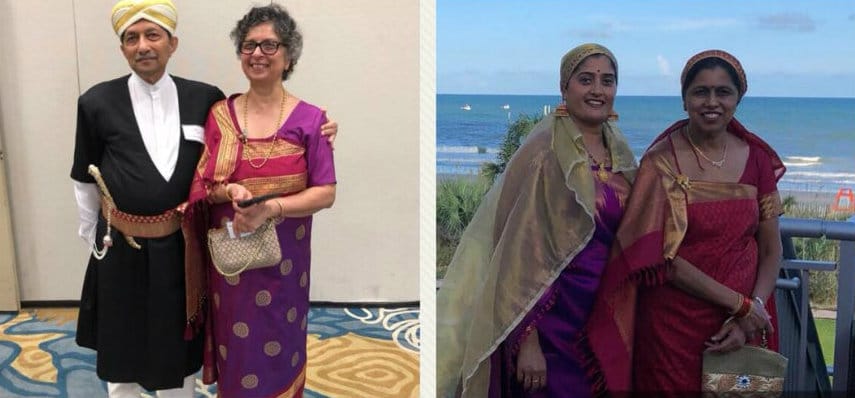
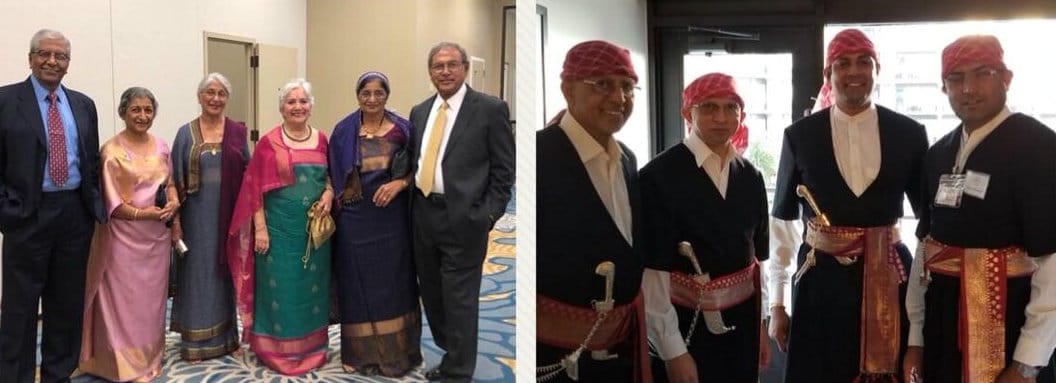
The annual Kodava Convention of North America was recently held in Myrtle Beach, SC, also known as the Golf Capital of the World. Over 370 Kodavas gathered at the Double Tree Resort by Hilton in Myrtle Beach, the venue of the grand two-day event.
The festivities began a day in advance with the making and rolling of ‘Kadumbutt’, a traditional rice dumpling eaten in Kodagu. The event was held at the house of Kambeyanda Dr. Ramesh and Dr. Leela. The hosts were Kodavas of Carolinas with support from community members from Pennsylvania, Maryland, Virginia and Georgia.
On the first day of the convention, a variety of games and entertainment events were organised for all age groups while the performers got together (many of them practicing in person for the first time after months of co-ordination over social media). The informal pre-convention had more than 350 guests who let their hair down and partied late into the night.
While talented children like Tarana Mukkatira (violin) and Kanishk Mukkatira (piano) showcased their talent, seasoned performers like Namitha Achchandira enthralled the audience with her dance moves. Besides, there was an impromptu dance performance by 5-year-old Vianca Kallengada with some moral support from Anwita Monnanda that stole the show.
A morning walk was organised as part of the convention which not only promoted health and wellness but also helped raise funds to help the educational needs of economically challenged children in Kodagu. The second day’s main event started with the traditional lighting of the lamp by Dr. Kambeyanda Ramesh and Dr. Leela. Avinash Chottangada did the invocation in chaste Kodava language. A special mention was made about the victims of the recent floods and landslides in Kodagu.
Thaliyathakkibolcha and Baalopaat added the Kodava traditional elements to the event and helped showcase some of the traditions to our younger generation. Aiyappa Kechamada and Aashiq Paruvangada were the masters of the ceremony.
The ceremony started with prayer song by Kallichanda Kaveri from Denver and was followed by multiple cultural events including songs and dances. A quiz competition on Kodagu, its land, people and culture was organised by Nithan Thimmaiah Monnanda.
Gina Konganda, Founder President of Kodava Koota, spoke about the organisation and listed its achievements that include helping the Sri Ramakrishna old age home at Ponnampet in Kodagu, funding the legal expenses to evict illegal settlers in Devakad at Valnoor and planting about 10,000 saplings in Kodagu.
Besides, the first High School Achievement award ($1,000 and a plaque sponsored by Kodava Koota) was presented to Paruvangada Bopaiah, son of Paruvangada Kuttaiah and Pooja. Kodava Koota which has been running a fund-raising campaign to help redevelopment of Kodagu and the affected people leveraged the opportunity to collect money that will be used to assist those affected. Over 50,000 dollars (INR Rs. 35 lakh) have already been collected and more money will be collected for rehabilitation.
Dr. Kuliakanda Sannu and Dr. Nalini, Alemada Geetha Kiran, Mukkatira Naina Udai, Baduvanda Dr. Changumani and Dr. Shobha, Kandera Deepthi Sharath, Kolera Shriti and Tarun, Mandepanda Uthappa, Chendrimada Deepa and Bopanna, Chottangada Rupica and Avinash were in the core team that organised the convention.
Community members of four countries participated in the convention and 27 States in the United States of America were represented. Over 174 Kodava families were present. The next annual convention will be held at Boston.
source: http://www.starofmysore.com / Star of Mysore / Home> News / September 09th, 2018