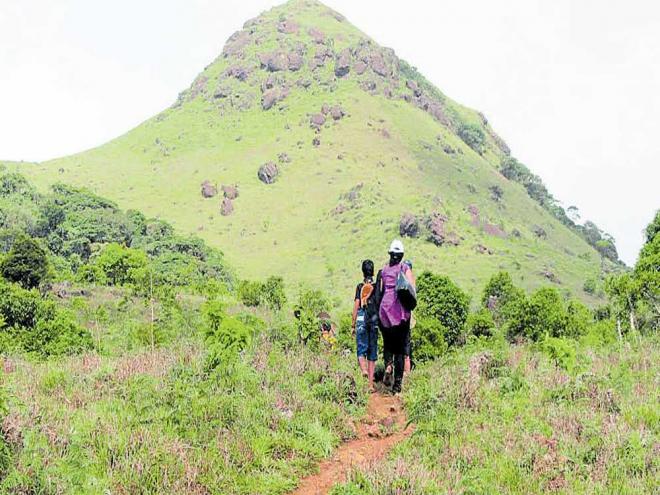
Women will be drawn from local villages and tribal hamlets as they know the terrain better. The women are being identified and shortlisted by local forest officials and panchayat members. dh file photo
The Forest department is planning to set up an all-women trekking guides group. Said to be the first such initiative in India, these women groups will help trekkers on the dedicated trekking trails identified by the Forest department. To start with, women guides will be introduced on three eco-trails of Kodagu district. Women will be drawn from local villages and tribal hamlets as they know the terrain better. Such women will be trained and recruited by Karnataka Eco-Tourism Development Board (KETDB).
Vinay Lutra, Chairman of KETDB told DH that they had received a special request from Kodagu CEO and Chief Conservator of Forests to have all-women trained trek guides.
“The demand for trekking trails is very high and so is the demand for women guides. Based on the response and success rate, more such teams will be formed in the coming days,” he said.
The idea of involving them is to make the women of this section and region employed and independent. The women are being identified and shortlisted by the local forest officials and panchayat members. The KETDB is only training the women.
Vijay Mohan Raj, Chief Conservator of Forests, Chikkamagalur, and member of KETDB, said that earlier 70 women were trained to be a part of the certified women volunteer programme.
These are women from various civil societies. But, this will be for the first time where 30 women will be trained to be trekking guides.
“The difference is that the volunteers are not paid, but these guides will be given permanent employment and a monthly salary. Guides will be trained professionals,” Raj said.
Though dates of the training and their recruitment is not yet decided, board members hinted that it is most likely to start from June. Guides will undergo a week-long training on the trekking routes, the dos and dont’s in the forest, identification of the birds, plants, insects and animals and health safety.
After this, KETDB is also planning to introduce a mixed group of trained guides in Dakshina Kannada and Hassan districts.
source: http://www.deccanherald.com / Deccan Herald / Home> State / by Bosky Khanna / DH News Service / Bengaluru – May 26th, 2017
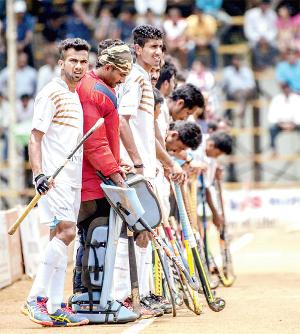
Hotbed for hockey. Nikkin Thimmaiah with his Chendanda team at the Kodava Hockey Festival final.
The Kodava Hockey Festival is testimony that the game is still thriving in Kodagu, feels internationals Nikkin Thimmaiah and SK Uthappa
A crowd of 30,000 people turned out to watch the Kodava Hockey Festival final between Chendanda and Pardanda on May 14, an eye brow-raising statistic to the uninitiated. This wasn’t an international event, not even a national championship. The average spectator turnout for an Indian Premier League game at the M Chinnaswamy Stadium was 25,000 but this hockey contest — played between families in Kodagu district — beat even the IPL. Cricket, they say is religion in the country. In Kodagu district, it’s hockey that gets the adrenaline pumping.
“Every player from Kodagu begins his career in this tournament, including me,” Nikkin Thimmaiah, India forward and a member of the Chendanda winning team, said.
“I watched my father play in this tournament as a six-year-old. That was one of the catalysts that spurred me to take up the sport.”
The tournament is unique in many ways. A team comprises members of a family and there is no distinction between either age or gender. The festival itself has been conducted annually since 1996. The game, though, goes on through the year as youngsters are encouraged to make it a career. “It’s the most talked about sport in Kodagu and even now, kids are still enthusiastic about the game,” Thimmaiah added. “Kids generally place hockey on a priority.”
Over the years though, the number of players from Kodagu making it to the international level has fallen. Currently, there are only three — Thimmaiah, SK Uthappa and SV Sunil — in the Indian squad. There’s no player from Karnataka in the junior team, but Uthappa insists hockey is not dead. The sport is now alive, more than ever, and tournaments like the Kodava Hockey Festival keep it ticking. “I began playing hockey seriously after watching my brother play,” Uthappa said. “I played badminton first, but in Coorg, everything is about hockey. Hockey is in our blood and that’s why we start playing. The next influential factor is your family. It depends on how they support and encourage you to play hockey as a child. Thanks to that tournament, it’s a tradition that everyone participates in it.
“Even now, that culture of developing the sport remains. You often hear that gadgets have taken the fun out of outdoor games. There are kids who use iPads in Coorg but they know how to balance it with the game. I think that love for the sport is influential in getting everyone to play it. Imagine you have to play this sport in every school. You will naturally be inclined to it.”
But it’s not just this tournament which gets Kodavas hooked to the sport. Uthappa says everyone is interested in playing some sport, but what cricket is to the entire country, hockey is to a Kodava. “We Kodavas follow, discuss and dissect hockey just as other people in the country do with cricket,” Uthappa said. “Families here are aware of everything that we do. Over the years, they have become more educated about hockey, thanks to the promotion and media exposure hockey is getting. Now, everyone’s involved in an educated discussion. For example, they tell me I played well in the first quarter, but my dribbling went awry in the third quarter and so on. Earlier, it was only the basic question of whether you won or lost and by what score.”
source: http://www.bangaloremirror.indiatimes.com / Bangalore Mirror / Home> Sports> Others / by Aravind Suchindran / Bangalore Mirror Bureau / May 23rd, 2017
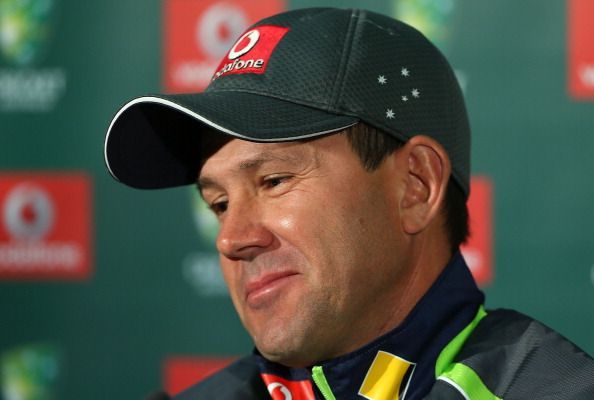
Ricky Ponting has picked Kolkata wicketkeeper Robin Uthappa over MS Dhoni in his team of the year, citing the former’s ability to score from the get-go as the reason for his choice. The former Aussie captain, unsurprisingly, opted to go for two Indian pacers in his best XI for this season’s IPL.
In a position that has been dominated by MS Dhoni for a few years now, Ricky Ponting decided to give Uthappa the nod ahead of his compatriot. While Dhoni finished with just 290 runs in the season compared to Uthappa’s 388, Ponting explained that the approach to the game had changed and it was important for the players to start making an impact from the very first ball their face.
“He’s (Uthappa) a guy whose strike-rate is incredible this year, 165 for the entire tournament. You need those guys in the middle-order to be able to score quickly right from the start. You don’t have that luxury anymore in the T20 game to be able to play yourself in and work the ball around. You have to go in and dominate right from the start and I think that’s what he’s been able to do really well,” Ponting told Cricket Australia.
For the opening slots Ponting decided to use two of his overseas’ players with David Warner and Hashim Amla making the cut. The Aussie opener was the easy choice for his compatriot considering he was the leading run scorer of the tournament with 641 runs at an astonishing average of 58.27 and a strike rate of 141.81. While Amla has not been seen as a traditional T20 player in the past, this season the South African shocked everyone by putting the numbers up on the board at an average of 60 and a strike rate of 145.83.
“He’s (Warner) just been in complete control of his game for a number of years now in the IPL. He thrives on extra responsibility and leadership. Davey’s led the side really well. I’ll actually name him captain as well on the back of what he’s done the last couple of seasons,” Ponting added.
“He (Amla) got a chance as a replacement player at the back-end of last season with the Kings XI, but this year played the best that I think anyone has ever seen him play, whether it be in an international T20 game or in the IPL. He’s the only man in the tournament to score two hundreds (in IPL10) and has got them pretty quickly.”
Following the openers are two Indian stars whose consistency was on show yet again. While Gautam Gambhir led his side to the second qualifier, Suresh Raina was let down by a weak bowling attack as they finished seventh on the table. The duo scored a combined 940 runs this year with Ponting reserving special praise for Gambhir for managing to put up the numbers in spite of changing his batting positions.
“I said before the finals started that I’m a bit surprised that he’s (Gambhir)batting in that number three position considering what he’s done at the top of the order for Kolkata for a long time. He’s ended up with nearly 500 runs … that’s a reasonable tournament. I’ve said for a long time that the number three position in T20 cricket is the hardest spot to bat because you’ll generally go in at the loss of a very early wicket and be expected to hit boundaries straight away,” Punter explained.
“He’s (Raina) just a class T20 player (and) a classy short-form player. He’s got a great one-day record for India as well. (While) he’s got the ability to really dominate spin-bowling. In that role in the middle-order is generally when most of the spinners are bowling, and he’s got the ability to really dominate there.”
The 3-time World Cup winning cricketer had no problem in naming Ben Stokes, who was named the MVP for the entire tournament, as one of his all-rounders due to the Englishman’s 12 wickets in 12 games and 316 runs with the bat which included a century. The second option, however, is a slightly dodgy one with Ponting showing confidence in Hardik Pandya over his brother Krunal Pandya. Pandya Sr. scored 243 runs while claiming 10 wickets while Hardik scored 250 runs and took 6 wickets.
“The MVP for the entire tournament (and) the guy that was most talked about before the tournament started was Ben Stokes. (He’s) on a huge deal with the Supergiants and has probably earned every cent of it to be fair. Twelve wickets in 12 games, made that big hundred as well. The thing about him is he does bring that real X-factor to their line-up and he’s someone you can rely on to bowl four overs. He can also make a hundred in the middle-order. I know they paid a lot of money for him but I’m sure they’re pretty happy that they did. Unfortunately for them he wasn’t around for the finals. When it comes down to what it came down to on that last ball of the game, not having your X-factor player there, they sadly missed him,” Ponting said.
“One guy I’m happy to name in the side is Hardik Pandya, the young allrounder from the Mumbai Indians. I’ve had a chance to work a lot with him the last couple of years. He had a dream-start two seasons ago, (but) found things a bit tougher last year. The thing that I liked was when it was his turn to step up and bowl a couple of overs, either with the new ball or towards the back-end of the innings, he was able to do it and do it well. He closed out a couple of games (with the ball) as well. He’s a pretty complete package now.”
Bhuvneshwar Kumar(26 wickets) and Jaydev Unadkat(24 wickets) make an interesting pair of specialist bowlers. While Bhuvneshwar has had the advantage of bowling in Hyderabad more often, considering it was a slightly bowler-friendly pitch, Unadkat impressed Ponting with his flexibility in varying conditions and particularly his variations.
While one was the leading wicket taker of the season of the season, the other was not far behind, having played a lower number of games.
“If you wind the clock back five or six years, this guy (Unadkat) was touted as the next Indian opening bowler in Test cricket, one-day cricket and T20 cricket. He’s got the ability to swing the ball around as we saw through this tournament and he’s got very good slower ball skills as well. He did a terrific job for his team in varying conditions with new ball and old ball, that’s the sort of flexibility you need in your team as far as your fast bowlers are concerned,” the Aussie said of Unadkat.
His bowling contingent consisted of two leggies, Imran Tahir and Rashid Khan. Ponting pointed out the difference in their economy rate, with Rashid being miserly in his runs while Tahir was slightly expensive, as the difference between the two players. However, both players showed their effectiveness with Rashid ending up with 17 wickets in 14 matches while Tahir claimed 18 in 12 games that he played.
“I’ve actually named two leg-spinners in the side, one that started the tournament really well (was) Rashid Khan. One thing you see with the spinners – and certainly the good spinners in T20 cricket – is even if they don’t take a lot of wickets, their economy-rate is always quite low,” Ponting said while explaining the selection of Rashid Khan.
“(Tahir’s) runs-per-over is slightly higher – 7.85 – which is a little on the high side for a top-class spinner in the IPL but … 12 games, 18 wickets (speaks for itself). You know when you bring these leg-spinners on through those middle-overs that they are going to create some opportunities for you and Imran Tahir has been around for a long, long time.”
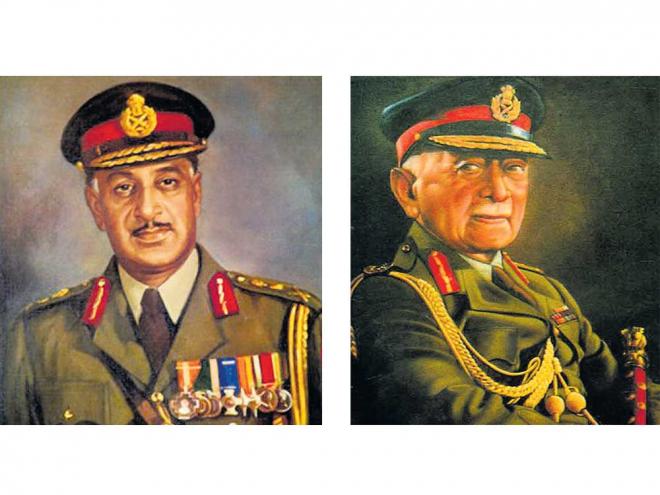
Role Models: Paintings of General K S Thimayya, Field Marshal K M Cariappa.
Kodagu is not just known for its serene landscape and picturesque surroundings, but also for the valour of its people. Rightly, the district boasts of several military heroes. The statues of such brave men can be seen in Madikeri. The Sudarshan Circle in Madikeri is flanked by the statue of Field Marshal K M Cariappa and the equestrian statue of Subedar Guddemane Appayya Gowda.
One of the earliest revolutionaries from Kodagu, Appayya Gowda, was hanged by the British in 1837. His contemporary revolutionaries from Kodagu included Subedar Naalnaad Mandira Uthayya, Chetty Kudiya and Shanthalli Mallayya who were imprisoned for many years by the British. Further along the main road, you can see a circle with the statue of General K S Thimayya. If you take the deviation to the right, you will find Major M C Muthanna Circle near the town hall and Squadron Leader A B Devaiah Circle near the private bus stand.
The first family
In Kunda, near Gonikoppal, lived the Kodandera family, hereditary chieftains of a group of villages. I M Muthanna’s Coorg Memoirs mentions that Naad Parupatyagar (native village official) Kodandera Kuttayya was the grandson of Diwan Mandepanda Thimmaiah. Between 1901 and 1909, he was the assistant commissioner and highest ranked native official in the then Coorg province. When his wife Dechy, or Dechamma, passed away, a locality in Madikeri was named as Dechur in her memory.
Two members of this family, Field Marshal Kodandera Madappa Cariappa and General Kodandera Subayya Thimayya, rose to become the chiefs of the Indian Army. Hence, the Kodandera family came to be considered as the first family of Kodagu’s military heroes. Field Marshal Cariappa was the son of Kuttayya’s younger brother Madappa, who worked in the revenue department. General Thimayya was the grandson of Kuttayya.
Born in 1899, Field Marshal Cariappa, ‘the Grand Old Man of the Indian Army’, studied in the Madikeri Government Central High School and then in the Madras Presidency College. He gained admission at Daly Cadet College, Indore, in 1919 and was commissioned as a second lieutenant in Bombay’s 88th Carnatic Infantry, during World War I. The following year, he served in Mesopotamia (Iraq) and was promoted as a lieutenant.
He became the first Indian army officer to attend the Staff College in Quetta. He married Muthu Machia, a forest officer’s daughter, had a son K C Nanda Cariappa, who later rose to the rank of air marshal, and a daughter, Nalini. During World War II, Cariappa was awarded the Officer of the Most Excellent Order of the British Empire (OBE). He became the first Indian to become a brigadier.
Cariappa also served as India’s first commander-in-chief (C-in-C) between 1949 and 1953. Now this position rests with the President of India. He represented India as its high commissioner in Australia and New Zealand from 1953 to 1956. In 1986, he was made a field marshal. Thus, he became one of the two Indian army officers to hold this rank. He died in 1993.
General Thimayya’s actual name was Subayya, while Thimayya was his father’s name. He was born in Madikeri in 1906. Admitted to the then Prince of Wales Military College in Dehradun, he was one of the six Indian cadets who underwent training in Royal Military College, Sandhurst, England. In 1926, he was commissioned into the Indian army. In 1935, he married Codanda Nina and the couple went to Quetta. During the Quetta earthquake that year the couple rendered outstanding humanitarian service.
During World War II, Thimayya was awarded Distinguished Service Order (DSO). He represented India during the Japanese surrender. Between 1953 and 1955, Thimayya was the chairman of the Neutral Nations Repatriation Commission. He gained international fame for the way he handled the exchange of the prisoners of war (POWs) held during the Korean War. In 1954, he was awarded the Padma Bhushan. Between 1957 and 1961, he was the chief of the Indian army.
In 1964, he was appointed Commander of the United Nations Forces in Cyprus, where he passed away. Cyprus released a stamp in his memory, and later, his wax statue was displayed in Singapore. Both Cariappa and Thimayya are iconic figures in India.
Fond memories
According to Major General Arjun Muthanna, a great grandson of Kuttayya, Cariappa and Thimayya belonged to a generation of Indian officers who stormed the bastion of India’s colonial masters and deftly navigated unchartered situations. Both had huge responsibilities thrust upon them at a relatively young age and rose to the challenge. Cariappa, commissioned as a lieutenant when Indians were just being permitted to become British Indian Army officers, would ‘Outbritish the British’, probably to be accepted and treated as an equal by the British officers.
A strict disciplinarian, he demanded punctuality and proper dress code. He was fiercely nationalistic and moulded the Indian Army into its current apolitical position.
In 1948, the Kashmir situation grew tense and war was imminent. Lieutenant General Cariappa became the head of the Western Command and led Lieutenant General S M Shrinagesh and Major General Thimayya. It was during this war that Thimayya helped India secure Ladakh.
Cariappa’s contemporary and friend, Lieutenant General Nathu Singh, was first offered the post of C-in-C but he declined and stated that his senior Cariappa, who won the 1948 war for India, was more eligible for the post. It was on January 15, 1949 that the three centuries old colonial army became a national army. That was the first time an Indian, General Cariappa, was made chief of the Indian armed forces.
Every morning, Cariappa paid his respects to the portrait of his parents and the statue of a jawan. He was ever thankful to the soldiers for protecting the country. Hence, he was called the soldiers’ general. Cariappa would go to the war front, even after retirement, in order to motivate the troops.
Muthanna narrates a personal anecdote about the Field Marshal, “When I called on him at his residence, in Madikeri, in May 1986, to invite him for my wedding, I was wearing a half sleeve shirt and trousers as appropriate for the hot summer day. After accepting the invitation, he commented on my attire saying ‘You’re an officer in the army aren’t you? In which case, you should be wearing a coat and tie.’ I had no response and thought in my mind I’m calling on my family elder. Pat came his next comment, as if he’d read my mind, ‘In case you’re calling on me as a relative you should be wearing our traditional dress of kupya.’ He walked the talk. He was always dressed formally as a respect to the person who was visiting him.”
Thimayya was charismatic, approachable and had great interpersonal skills. When Thimayya visited his Dehradun alma mater as an alumni, one of the cadets there wanted to know how to address the general. Thimayya simply replied ‘Call me Timmy’, referring to his nickname!
Some of the other military heroes of Kodagu are: Major Mangerira Chinnappa Muthanna, who was awarded the Shaurya Chakra posthumously, and Squadron Leader Ajjamada Bopayya Devaiah, nicknamed ‘Wings of Fire’, the only Air Force personnel to be awarded the Maha Vir Chakra posthumously so far.
The Rural Development and Panchayat Raj (RDPR) Department has bagged e-Puraskar Award for the best performance in empowering panchayats by using Information and Communication Technology (ICT) tools, for 2016-17.
Kerala bagged the second prize, while West Bengal secured third prize in the category of ICT tools. The cash prize for the first position is Rs. 2 crore, Rs. 1 crore for second position and Rs. 50 lakh for third position.
RDPR Minister H.K. Patil and Department Principal Secretary Nagambikadevi received the award from Uttar Pradesh Chief Minister Yogi Adityanath in Lucknow on Monday.
The State bagged the award for its Ganshi Sakshi Kayak GPS-enabled ICT tool. Ministry of Panchayat Raj has been conferring e-Puraskar for bringing in transparency, efficiency and accountability in the functioning of panchayats through ICT tools.
The Kodagu Zilla Panchayat bagged the Deendayal Award for empowering panchayats.
In the taluk panchayat category, Sagar taluk of Shivamogga district and Puttur Taluk Panchayat of Dakshina Kannda district have bagged prizes.
In the gram panchayat category, the Malige Gram Panchayat of Theerthahalli taluk of Shivamogga; Siraguppi GP of Athani taluk in Belagavi district; Palibetta GP of Virajpet taluk in Kodagu; and Sampaje GP of Madikeri taluk, bagged the awards.
source: http://www.thehindu.com / The Hindu / Home> National> Karnataka / by Special Correspondent / April 25th, 2017
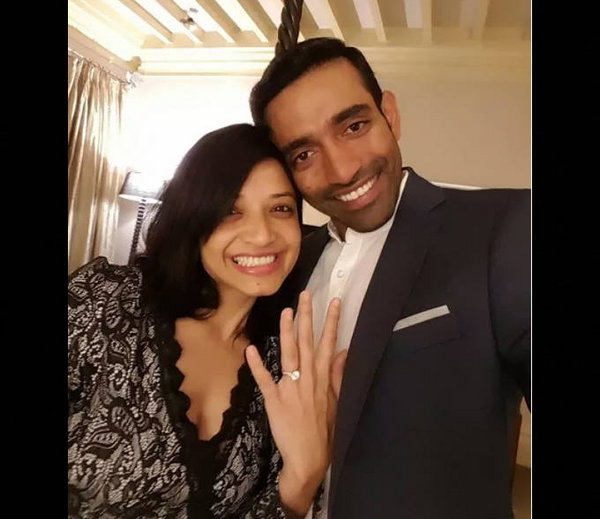
Following the many team’s of the T20 League celebrating their 10-year anniversary, Kolkata soon followed suit and threw a lavish bash for its players. Team’s co-owner Shah Rukh Khan was seen attending the event with his youngest son, AbRam.Robin Uthappa and Sheethal Gautham
While the party was attended by all the players of the Kolkata team, several took to attending the event with their better halves. Indian cricketer Robin Uthappa was seen alongside talented tennis star wife, Sheethal Gautham.
Sporting short hair, unlike her previous look, Sheethal was also spotted wearing the same attire that she wore on the day of the duos engagement in 2015. While Robin and Sheethal had a gala time at the event, cricket Umesh Yadav was also seen alongside his wife Tanya Wadhwa and SRK posing for the cameras.
Having finished in the top 4, Kolkata will be battling against the Hyderabad team on the 17th of May followed by a match with the first qualifier. Considering the team has proven its stand in the 10th season of the T20 league, their 10-year bash seemed well deserved.
source: http://www.daily.bhaskar.com / Daily Bhaskar / Home> News / by Jasmine Philip / May 17th, 2017
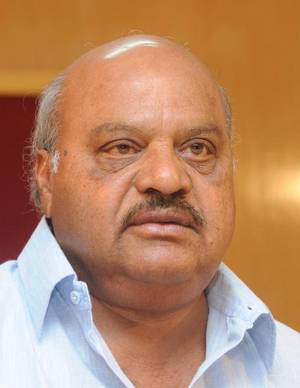
Regulating the indiscriminate use of chicory — used as an additive with coffee powder — is high on the agenda of the new chairman of the Coffee Board of India, M.S. Boje Gowda, a third-generation coffee planter from Chikkamagaluru district, who took charge on Wednesday.
“The farmer grows coffee in its pure form. But by the time it reaches the consumer, there is heavy addition of chicory deforming it. We don’t know how much chicory is added in the branded packaged coffee powder as well,” he said adding that he would discuss the issue with all stakeholders and even explore legal options to ban the addition of chicory to coffee powder.
“If the consumers want chicory let them buy it as chicory and add it. There will be choice for consumers as well,” he said.
When asked whether the Coffee Board of India had the teeth to enforce such a regulation, he said they would work with the Union government towards the end.
Mr. Gowda is the first coffee grower to become the Chairman of the Board after a gap of 70 years. In the past, the post was held by bureaucrats.
Coffee planters from across the State, who came to the city as he took charge on Wednesday, expressed immense hope of their problems being solved with a coffee planter as the chairman.
Apart from monitoring the use of chicory, Mr. Gowda said that his aim is also to increase domestic consumption of coffee while doubling the yield in the country.
“The per capita consumption of coffee is just around 200 grams and is mainly concentrated in Karnataka, Tamil Nadu, Andhra Pradesh and Telangana. We should work towards branding coffee and spread consumption to other parts of the country,” he said, adding that Prime Minister Narendra Modi had set a target to double the annual coffee production in the country from 3 lakh tonnes to 6 lakh tonnes.
source: http://www.thehindu.com / The Hindu / Home> News> States> Karnataka / Staff Reporter / Bengaluru – May 18th, 2017
Chendanda rode on a brace from Olympian Nikkin Thimmaiah to clinch their maiden title in Kodava family hockey tornament on Sunday. In the finals of Biddatanda Cup held at Gen K S Thimayya Stadium at Cheriyaparambu, Chendanda recorded a facile 4-1 win against Paradanda.
Chendanda took an early lead with team India forward Nikkin Thimmaiah sounding the board in the fifth minute. Nikkin doubled the lead with a fine field goal in the 10th minute. Paradanda pulled one back after Dheeraj Muthanna converted a penalty corner. But Chendanda produced a clinical performance and sealed the deal with a goal each from Chirag and Sonu Ponnamma.
Chendanda, who lost in the finals of the 2015 edition of the tournament (Kuppanda Cup) against Palanganda, played a percentage game from the word go and made sure to end the title drought in thye coveted tournament. The winners took home a cash prize of Rs 2.5 lakh and a trophy while Paradanda pocketed a cash prize of Rs 1.5 lkah and Runners-up trophy. As many as 306 teams had enrolled for the 21st edition of the tournament. Of which, 301 teams featured in the hockey festival of Kodavas held for over a month. Six other teams which had made it to last-eight round – Palanganda, Anjaparuvanda, Koothanda, Nellamakkada, Mandepanda and Karineravanda were given Rs 25,000 each.
Biddatanda family Pattedar Prof Biddatanda C Ponnappa presided over the presentation ceremony. Earlier in the day, the title clash was inaugurated by Lt Col B K Subramani. District-In-charge Minister M R Seetharam, Rajya Sabha member B K Hariprasad, MLCs Veena Acchaiah, Sunil Subramani, MLAs K G Bopaiah, Appacchu Ranjan, Deputy Commissioner Dr Vincent D’Souza and others were present.
Pandanda M Kuttappa handed over flag to Kulletira who will host the 2018 edition of Kodava family hockey tournament. English Band team of Mysuru and the students of Ninada enthralled the audience with a fine performance. The bike stunts by the Yuvaka Sangha of Bittangala was another attraction.
source: http://www.deccanherald.com / Deccan Herald / Home> District / Napoklu – DH News Service / May 15th, 2017
Rashmika Mandanna is a Kannada heroine out to conquer the south Indian film industry. This model-turned-actress was roped in for the runaway hit Kirik Party, a college drama, after her photos caught the eye of producer and hero of the movie Rakshit Shetty and director Rishab Shetty. She played the teacher, Anannya.
Following the success of her first film, Rashmika became one of the most sought after actresses in the Kannada movie industry, and started getting offers from other film industries, including Telugu and Tamil. The actress, who is taking her first steps in Tollywood, has been offered movies with some of the top heroes of the Telugu film industry such as Prabhas, Allu Arjun and Nani.
The actress has picked a Naga Shourya-starrer for her Telugu debut, and is shooting for it. This will be followed with another Telugu project with hero Ram under Kishore Tirumala’s direction. Rashmika was also approached for Prabhas’ next film, Saaho, but she refused as it clashed with dates of her other movies. She is now busy shooting for Chamak with Ganesh, and is also working on Anjaniputra, directed by A Harsha, starring Puneeth Rajkumar in the lead.
Rashmika says acting was always on her mind, even when she started her career on the ramp. She learns the language before signing any movie. Her language classes come handy on the sets of her first film, a yet-to-be-titled one, with Naga Shourya.
“I have been offered movies from other industries. Most are from the Telugu industry. I have been going through a few scripts and I thought the best among them was the one with Naga Shourya. It should be great for a debut, and I will follow that up with a project with Ram, for which the shooting will start in September,” she says.
Although the young actress is excited to try other regional languages, she says Kannada movies will remain her priority. “I will never forget the overwhelming response I got for my first film in Sandalwood. Movies don’t have a language barrier, and good ones are remade for other regions. I will try to do good films in all languages,” she gushes.
Rashmika, who always scored a distinction percentage in academics, has to ensure that she completes her graduation and has just written her final year exams for BA in journalism. The Virajpet beauty credits her mother for helping with her career. “She makes sure that I devote all my energy to acting, which helps a lot. I can make a career in another field, besides acting simply by showing my marksheet,” she smiles.
source: http://www.newindianexpress.com / The New Indian Express / Home> Entertainment> Kannada / by A Shardhaa / May 22nd, 2017
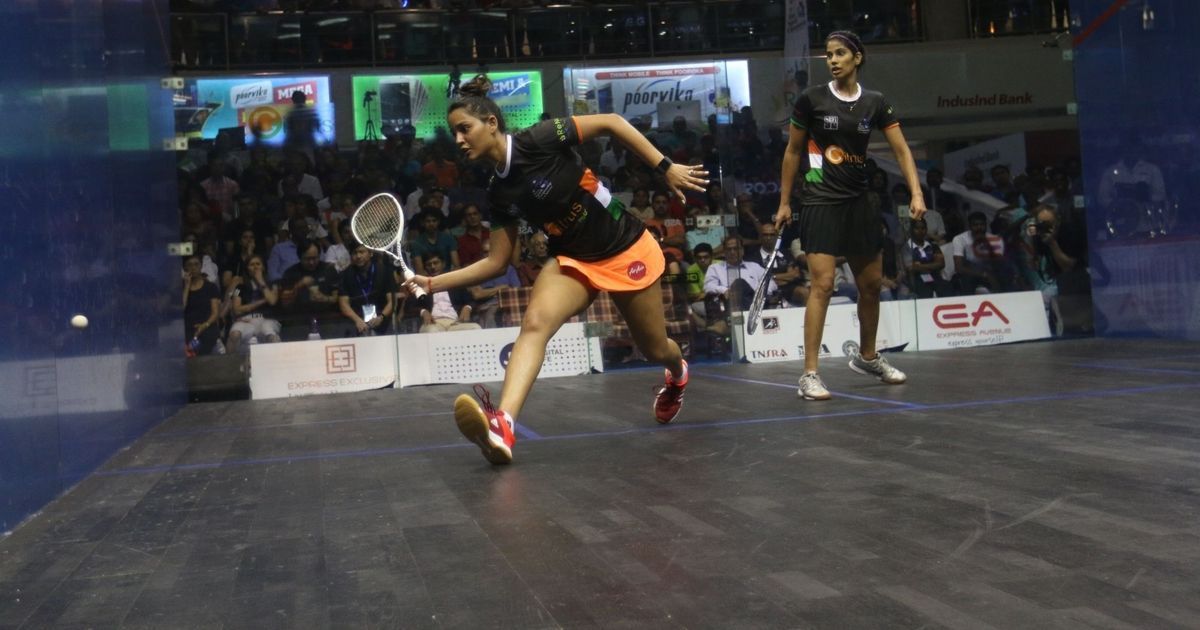
The world No 14 recently beat her compatriot and doubles partner Dipika Pallikal Karthik to become the first Indian to win the Asian Squash Championship.
IANS
“It was special.”
Joshna Chinappa is on a high. Last month, she beat her compatriot and doubles partner Dipika Pallikal 13-15, 12-10, 11-13, 11-4, 11-4 in Chennai to achieve a significant milestone: the first Indian to win the Asian Squash Championship.
It’s an achievement she has eyed for a long time. “It was something I have wanted to win in my career,” Chinappa told Scroll.in. “There is always added pressure playing at home.”
Taking the squash world by storm
It has been an enthralling past 12 months for the 30-year-old. Chinappa broke into the top-10 in July last year and reached the quarter-finals of the World Championship, becoming the second Indian to do so after Pallikal. She lost 6-11, 12-10, 7-11, 11-8, 3-11 to world No 3 Camille Serme of France in the quarter-final. “My run in the World Championship was fairly good and each match was harder than the first,” said Chinappa. “However, I am really grateful to be doing what I do.”
In November 2015, Chinappa beat the world No 2 Raneem el Welily. Currently ranked 14th in the world, her recent win has given her the desire to get better. However, she feels that to beat the top players in the world, a lot of work has to be done. “It is not easy just breaking into the top-five,” she said. “We [Indians] can definitely do it. But for that we need more support from the time we start our careers and continued support till we our done playing. Unfortunately, it hasn’t been that way, though it has improved over the past few months.”
A coach does help
For a major part of her career, Chinappa travelled to tournaments without a coach. However, with Achraf El Karagui now in her corner, Chinappa seems to have taken her a game a notch higher. “I have worked with some of the best coaches at different stages in my career who have all contributed to my game,” she said. “My dad [Anjan Chinappa] and Ritwik Bhattacharya have been the biggest influences. It’s great to have Achraf as part of our team. He is very committed towards helping us and he understands the game really well. He has been able to add more to my game in the past six months.”
But has the move come a little too late? “It has been tough to play without a coach in my corner for the most part of my squash career,” she added. “Though, if my teammates are around we help each other. But it is something I got use too. However, it is always nice to have your team be there for your matches.”
Beating and also playing with Pallikal
Coming into the Asian Championship, Pallikal had a 3-0 win record against Chinappa. So, for Chinappa to beat Pallikal was an extraordinary feat. “Dipika and I are the only ones on tour from India in the women’s circuit, so it is natural to know each other well,” Chinappa said. “We know each other’s game inside out. We also train together most of the time. I enjoy playing doubles with her and we both love playing for India as a team. It works both ways.”
However, the duo will team up once again to defend their doubles gold at the Commonwealth Games next year and are also playing together for the Asian Games. “I look forward to playing with Dipika at the CWG and defending our gold medals,” said Chinappa.
The road ahead
Following her Asian Championship win, Chinappa is back to the grind and slogging it out as she prepares for the World Doubles Championship in Manchester in August. She is back to training and hopes to stay injury-free for the next two years at least. “I train six days a week, twice a day,” she said. “It is usually a combination of squash, weights and on-court fitness. I have an early start and my day usually ends around 7.30 pm after all the training. I have the world doubles in Manchester in the first week of August. I hope to be injury-free and healthy during the next season.” However, she did not reveal her ultimate goal in the sport. “There are certain things I would like to achieve in my career, but for now it is still a secret,” she said.
Growth of squash
Talking about the growth of squash in India, Chinappa, who idolises former athlete PT Usha, said that things are slowly but steadily changing for the better. “Squash has definitely grown a lot more in the past few years,” she said. “The Sports Authority of India, the Sports Development Authority of Tamil Nadu, and the Squash Rackets Federation of India have been a lot more supportive in the past two years. There are so many juniors coming up. Of course we can improve the game further, so we can really reach the grassroot level and kids from smaller towns. We need to give them facilities and support their career financially if we want to see more results.”
We welcome your comments at letters@scroll.in
source: http://www.thefield.scroll.in / Scroll.in / Home> The Field / by Bibhash Chatterjee / May 17th, 2017
WELCOME. If you like what you see "SUBSCRIBE via EMAIL" to receive FREE regular UPDATES.
Read More »