‘Taking coffee to the common man’s cup’

manyepandakf13dec2016

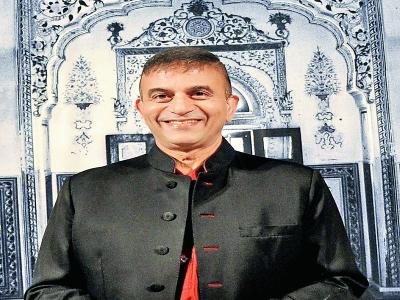
Manyepanda Madaiah Chengappa recently took over as the Chairman of Karnataka Planters Association (KPA). Karnataka accounts for more than 70% of the coffee production in India.

According to United Planters Association of Southern India (Upasi), Karnataka’s post-monsoon estimated coffee production for 2015-16 was 253,340 tonnes, with the all-India number standing at 350,000 tonnes. KPA has about 700 members as of date.

In an interview with Furquan Moharkan of DH, Chengappa says that his aim as the chairman is to make domestic demand for the cup of coffee transform from an elitist drink to a common man’s drink.

What are the challenges that coffee plantation sector faces today?

Climate change has increased, apart from pests and diseases impacting the coffee crop productivity. The Arabica coffee crop yield has reduced from 1,200 kgs, to 600 kgs per hectare, while Robusta coffee has decreased from 2,000 kgs, to 1,400 kgs per hectare, over the last decade. For instance, this year, Kodagu has 300 mm less rainfall over the previous year, and Chikkamagaluru has also suffered a similar fate, which affects the standing coffee crop and development of new shoots in coffee plants for the coming season.

Labour wage constitutes over 60% of the total cost of coffee cultivation. The annual wage increase was below 6% till 2007-08. From 2008-09, the increase was very steep. Against 2007-08’s wage of Rs 79 per day, the current wage is at Rs 263 — an increase of 232% or an annual average increase of 15%. This could be the highest percentage increase for any industry in Karnataka. Also the statutory and welfare costs for the labour, which are over and above the wages and benefits, works out to an additional 50% of the wages. This is an additional financial burden for both corporate and proprietary planters.

However, the sale price for coffee at the farm gate hovers around Rs 2,800 to Rs 3,500 for a 50-kg bag, while the labour and fertiliser costs have spiralled disproportionately. The need to invest more funds for R&D to develop better quality coffee plants that are high-yielding and pest-resistant is another challenge.

What are your priorities after taking over as Chairman of the KPA?

Primarily, my major objective is to make domestic demand for the cup of coffee transform from an elitist drink to a common man’s drink. I would seek the Coffee Board’s assistance to establish coffee kiosks at public places like government offices, bus and railway stations, airports, shopping malls and educational institutions. This would make the demand for coffee explode in the country. Towards this objective, it would be necessary to jointly pursue vegetative clonal and tissue culture propagation of coffee, with United Planters Association of South India (Upasi) and Central Coffee Research Institute, Balehonnur, Karnataka. Also, to push for the import of pest and disease-resistant high-yielding coffee plant material. Identify biological viable and effective methods to treat effluents.

Also, request the state government and its Department of Agriculture to allocate Rs 1.9 crore in the state budget to fund the Upasi-KPA coffee research project. To establish soil and leaf analysis laboratories at Chettalli, Kodagu district and Chikkamagaluru district for the convenience of small and large growers.

A lady planters sub-committee has been constituted to promote community outreach programmes and showcase their achievements in cultivation of coffee, plantation nurseries, local marketing initiatives at national and international levels, home stays and plantation cafes for income augmentation.

What is the impact of the GST regime on the coffee plantation sector?

GST does not affect the coffee grower directly, as being agriculturists, they come under zero tax brackets. GST is applicable only after curing at the roasting and powdering stage, when the value-addition takes place, and the coffee can be consumed as a cup of coffee. According to Rule 7B (1) of Income Tax Act — “Income derived from the sale of coffee grown and cured by the seller in India shall be computed as if it were income derived from business, and 25% of such income shall be deemed to be income liable for tax.” This I-T Rule needs to be amended to tax coffee only at the stage of roasting and powdering that would enable the grower to sell coffee, which is plantation-specific, directly to the local and global markets.
Do you think that the import of pepper from Sri Lanka could affect domestic trade?

Import of poor quality pepper is killing the Indian pepper market. A regulatory price mechanism is necessary, whereby the price of pepper imported should be about 5% lower than the Cochin pepper auction price of equal quality of the day. Also, quality parameters of the imported pepper should be strictly monitored by a suitable government agency.

Your comments on the degradation of forests and environment pollution that have a bearing on the plantations in Karnataka.

The National Forest Policy is under amendment and a high-powered committee has been instituted for the purpose. The KPA and Upasi have jointly made a representation to the Union Ministry of Environment and Forests. Also the elephant menace in Kodagu district has assumed dangerous proportions due lack of proper fodder and vegetation in the game sanctuaries. Plantation crops, fruit trees and human beings are being trampled upon and destroyed. Therefore, the translocation of elephants appears to be the only solution, as all other forms of deterrents and barriers have proved ineffective.

While tourism has phenomenally raised the socio-economic level of people in the plantation districts, it should not lead to environmental pollution. Therefore, it is necessary to promote eco-tourism in the plantation districts of the state. Also, aggressively ban all types of pollutants, plastics, discharge of sewage and chemical effluents into the rivers. People need to be aware of waste segregation, its recycling and proper disposal through the media platforms to promote eco-tourism.

source: http://www.deccanherald.com / Deccan Herald / Home> Supplements> Economy & Business / by Furquan Moharkan / DHNS – December 12th, 2016
Ethnographic survey under way to establish Kodava tribal status

Bengaluru :

As the martial Kodava race gets together to celebrate the annual harvest festival, Puthari, on Tuesday in their homeland Kodagu, they have reason to feel optimistic about their future.

The Karnataka government has initiated an ethnographic and socio-economic survey to see whether the community qualifies for the tribal status. It’s the second time the survey has been taken up, a response to the alarming decline in population.

“Our department has been doing the survey for the past two weeks. Apparently, the culture and traditions of the Kodavas are akin to tribals but the government cannot grant them the status unless the survey establishes it,” said P Manivannan, secretary, social welfare department.

The Centre has also considered a long-pending demand to include Kodava thakk, the Kodava language without a script, in the Eighth Schedule of the Constitution and a notification has been issued to initiate the process.

In 2011, the UPA government directed the then BJP government to take up the survey following petitions by the Codava National Council (CNC), which has been spearheading the community’s cause. It was put on the backburner for political reasons.

AICC general secretary Oscar Fernandes, along with Brijesh Kalappa, legal adviser to the Karnataka state government, recently impressed upon chief minister Siddaramaiah to order the survey to protect the race.

“Our community is dwindling in numbers very fast for many economic and sociological reasons. The population of Kodagu district is around 5 lakhs, of which Kodavas are not more than 65,000. There is an urgent need to sustain the Kodava genus constitutionally under Articles 340 and 342 of the Constitution that provide for recognizing ethno-linguistic tribal minority nationality,” CNC president N U Nachappa said.

Kalappa said: “When the last survey was taken up around two decades ago, many Kodava leaders, including prominent political leaders, had opposed it because they felt it was demeaning for the race, renowned for gallantry and sportsmanship. But now there is a sense of awareness among the community because they’ve realized it’s inevitable.”

The survey report will be given to the government by early next year and the Centre will take a final call based on the recommendations.

Earlier Kodavas were seen in large numbers in civil services, police and other government jobs but their numbers have dwindled owing to lack of reservation. Though they have been granted Other Backward Classes (OBC) status in the reservation schedule of the state government for jobs and higher education, Kalappa said his community has not gained much since they have to compete with the politically powerful Vokkaliga community that they share under 3A category.

Will Kodavas qualify?

Some anthropologists said Kodavas, as a race, are progressive and different from other tribes. “They cannot be compared to tribes like Bedar, Hakki-Pikki and Kadu Kuruba, among others,” said A K Ravesh, a researcher studying socio-cultural anthropology in Kodagu. The Kodava marriage and funeral rituals, among other things, portray a distinctive culture. A former minister also felt that Kodavas will not gain much if they are granted tribal status since the combined reservation for all STs is just 3% compared to 4% under OBC offered by the state government.

Scheduled Tribe tag

The Constitution does not provide a definition of a Scheduled Tribe. Artice 366 (25) mentions “such tribes or tribal communities or parts of or groups within such tribes or tribal communities as are deemed under Article 342 to be Scheduled Tribes…” According to the website of the Union ministry of tribal affairs: “The criterion followed for specification of a community as Scheduled Tribes are indications of primitive traits, distinctive culture, geographical isolation, shyness of contact with the community at large, and backwardness”.

source: http://www.timesofindia.indiatimes.com / The Times of India / Home> City News> Bangalore News / TNN / December 13th, 2016

TheTamara Coorg returns with The Tamara Carnival

After receiving an overwhelming response from guests last year, The Tamara Coorg is back with the second edition of their musical and performing arts fiesta – The Tamara Carnival. The signature fest which takes guests on a journey of India’s great social and cultural heritage through music and dance will be held from December 23, 2016 to January 1, 2017 at The Tamara Coorg.

As the year comes to an end, the resort which is nestled in the mountains of picturesque Coorg, will joyously ring in the Christmas and New-Year festivities with The Tamara Carnival. This beautifully curated festival is a blend of music, dance and performing arts, showcasing the diverse and rich heritage of India. The festival will usher in the celebratory season with exhilarating performances that reflect the true essence of India’s tradition and culture.

The Tamara Carnival will enliven the atmosphere as guests will witness Indian and Western performances including Kathak recital, Kodava dance, a fusion of Marathi Lavani and Bengal flute, Margham Kali, saxophone performance, Kerala art forms, Vyali Bamboo act, Illusionist and many more fascinating and entertaining acts. Apart from the carnival, guests can also take advantage of the treks, coffee plantation tour, yoga and pottery making sessions among others to refresh themselves.

The 10-day carnival aims to gently ease into guests’ consciousness, rejuvenating and uplifting their spirits and leaving them in a blissful state of harmony with their inner being and the universe, amidst the serenity and beauty of nature.

source: http://www.hospitalitybizindia.com / HospitalityBizIndia.com / Home> News Track / by HBI Staff – Mumbai / December 12th, 2016

Madikeri DC tells engineers to expedite water works

Deputy Commissioner Richard Vincent D’souza on Monday has threatened the engineers concerned that they would be held accountable for any complaints/problems pertaining to drinking water supply.

Chairing a meeting on drinking water works and fodder issues, the deputy commissioner expressed his anguish against the engineers over the tardy progress in the drinking water works taken up at a cost of Rs 1 crore last year. The DC was upset over the underutilisation of funds sanctioned for the water works. “If there is failure in utilising the amount, sanctioned last year, to its fullest, how can we seek funds for the current year, the DC questioned.

The deputy commissioner directed the engineers to expedite the water works and address the water woes in the district.

Additional Deputy Commissioner M Satish Kumar said, “A Cabinet sub-committee headed by Revenue Minister Kagodu Thimmappa has been constituted. The sub-committee should be apprised of the measures taken.”

The officials should furnish information related to measures taken to address drinking water complalints, cattle feed among others, he added.

The Addl DC also instructed the officers to speed up drought relief works.
Zilla panchayat deputy secretary, planning director, chief planning officer and executive officers of respective taluk panchayats were told to work in tandem to mitigate drought.

Rural Drinking Water Engineer Shashidhar, along with assistant executive enginers from three taluks in the district, apprised the meeting of the status of the works taken up in the district.

source: http://www.deccanherald.com / Deccan Herald / Home> District / DHNS – Madikeri, December 13th, 2016

Gather your sickles,it’s a harvest

kodavasgatherkf11oct2016

Bengaluru :

As Kodavas retreat to their Kodagu homes from the hurry-burry of the city to rest and celebrate the annual harvest festival, there are some who will be celebrating the Puthari (also known as Puttari and Huttari) festival in the city this time.

“It is hard for me to head back home this time because Puttari falls mid-week,” says Pratvii Ponnappa, who is born and brought up in Bengaluru but usually heads back to Coorg to celebrate the festival. “My father will be going to Coorg, but I will be staying back and celebrate it on the day local Kodavas decide”.

“Celebrating in Coorg means coming together with your family, celebrating in the city means coming together with your community,” Pratvii says.

M T Subbaiah, administrative officer of Kodava Samaja, says, “We have 13,000 Coorgis in the association. This year there will definitely be more celebrating the festival with us since it falls on a week day.” Around 3,000 to 4,000 people are expected to attend this year’s Samaja festival.

Puthari, which means the paddy festival, will be celebrated on December 13 this year. Last year it was in the end of November.
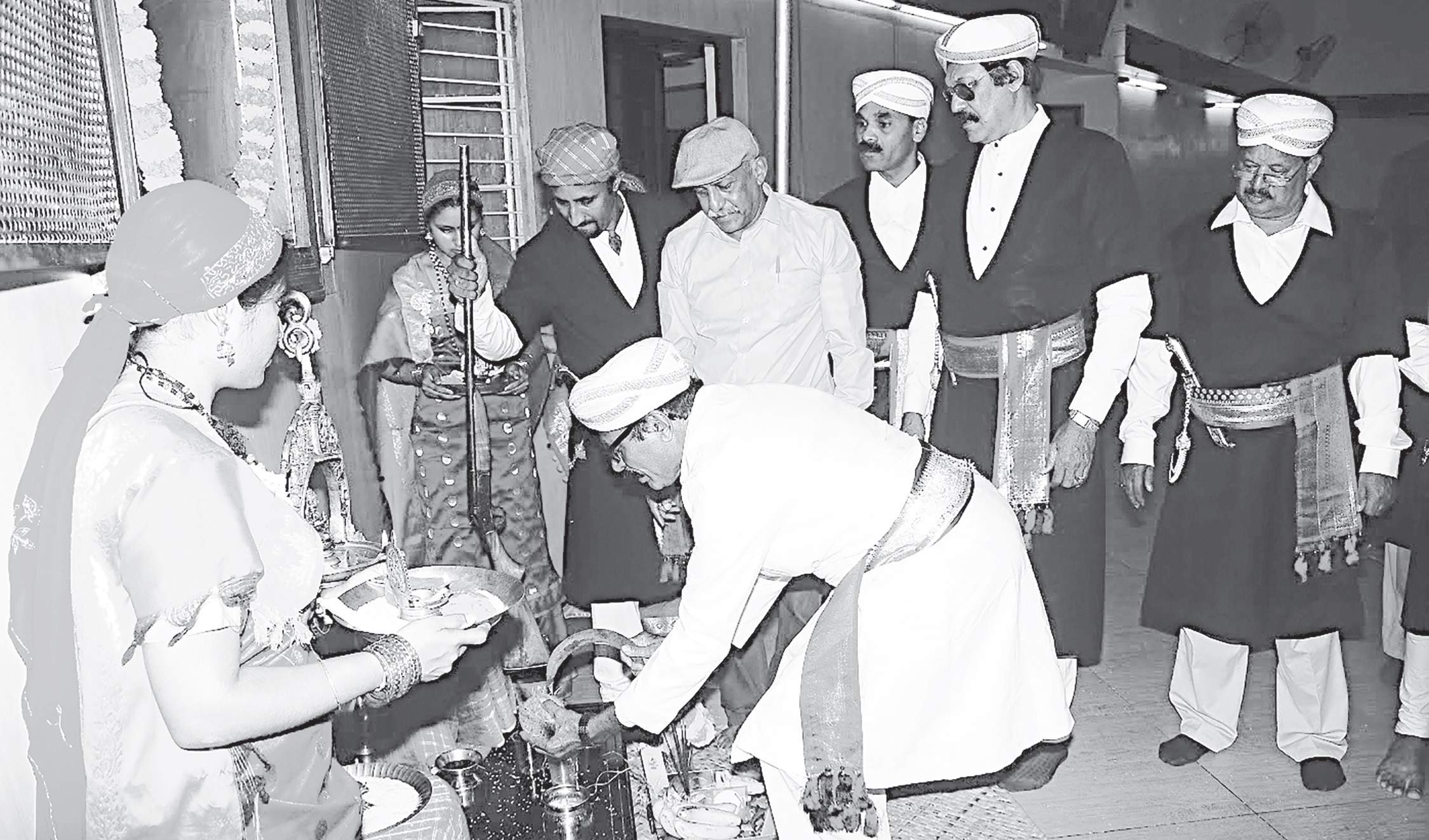
On the day of the festival, family members assemble in their ancestral house or ‘Ain Mane’, which is decorated with flowers, mango and banana leaves.

The children play with fire crackers and in an “auspicious hour” the eldest of the family hands a sickle to the head of the family.

The auspicious time is decided by the Igguthappa temple.
The family together head to the paddy field. A woman leads the procession holding a lit lamp in her hands. A paddy stick is cut and a gunshot is fired to mark the beginning of the harvest. The chanting of “Poli Poli Deva” is recited and the paddy is stacked in odd numbers to be carried home and offered to the gods.

Small bundles of paddy straw are handed to the family members, which are received as a symbol of prosperity.

Since there are no paddy fields in and around the city, the Kodava associations usually get paddy from Coorg and distribute them among the people who come to celebrate. This year, the Kodava Samaja will be celebrating it on Tuesday evening.

The programme will commence at 6:30 pm when all the members will gather for an annual awarding of scholarships and for a speech by community leaders. By 7 pm, everyone will gather in a small 10*8ft piece of paddy land in the office premise to follow the customary ritual. At 9 pm special foods such as thambuttu (made of mashed bananas and roasted rice powder and topped with grated coconut and melted ghee), kadaumbuttu (rice dumplings with coconut milk and ghee), holige (flatbread from flour, jaggery and ghee) and puttari payasa (from rice, coconut milk and jaggery) will be served.

Kishoo Uthappa is heading to Coorg today for the festival since he has grown a small amount of paddy in the field for this festival and he does not want to miss it.

“I am an entrepreneur so I can take off whenever I want,” he says. “Most importantly, I don’t want my children to miss the festival.”

source: http://www.newindianexpress.com / The New Indian Express / Home> Cities> Bengaluru / by Regina Gurung / Express News Service / December 10th, 2016

Asia’s first woman coffee taster is all set to open a Coffee Museum in Bengaluru

Sunalini Menon, a coffee taster and CEO of Coffee Labs is an avid collector of memorabilia concerning coffee.

Bengaluru :

Sunalini Menon remembers the first Cafe Coffee Day (CCD) outlet VG Siddhartha started on Brigade Road in 1996. She had just ended a two decade-long stint at Coffee Board and was making brews for CCD under her independent consultancy Coffeelab.

Siddhartha, Menon reminisces, took advantage of the IT boom to make an offer: buy one cup of coffee and surf the net for one hour.

“We served filter coffee on the ground floor and espresso on the mezzanine floor. People warmed up to only cappucino and lambasted us for charging exorbitant rates for a cup of brew.“

In stark contrast, the three-day Coffee Santhe last weekend saw a footfall of 4,000 people. “We have come a long way since,“ Menon, Asia’s first woman coffee taster, points out.

It is experiences and journeys like these that Menon plans to document in a museum dedi cated to coffee. That’s her dream project and a final ode to her love for coffee.The project, which has been in the pipeline for some time now, is taking shape.

“We are forming a trust since it is a non-profit initiative. It requires two acres of land as we plan to grow coffee around it. We have decided on Devanahalli, though there is an offer for it to come up in Chikmagalur,“ she said, explaining that budgets have to worked on accordingly . Menon favours a location closer to the airport as “travellers with a transit visa can see the museum, have a cup of coffee and fly back with happy memories of India.“

Menon, 64, has the blueprint ready .“We will start with the story of Baba Budan (who brought coffee to South India) and traverse to the cultural aspects of coffee, diversified cultivation patterns and types of seed material.We are planning a layout that is representative of a typical Indian coffee plantation.“

The exhibits will include antique coffee roasters, grinders, brewing equipment, mugs, cups and coffee powders from different corners of the world. The Coffeelabs office in RMV Extension, a mini-museum in itself, houses memorabilia including tribal products from coffee-growing areas, arecanut pickers, ancient milk measurement units and coffee pots.

“Each equipment throws light on the culture of the country it comes from,“ Menon explains. For instance, Italian pots have ornate carvings; the ones in Iran are known for their silver and filigree; Pakistan has a recurring crescent moon pattern while Egypt sports designs of Cleopatra.

Education consultant and coffee addict Shaista Baljee believes that a museum will find takers not only among aficionados like herself but others.“India, especially Karnataka, has such a fantastic coffee culture that has developed phenomenally over the years. An initiative like this in a tea-drinking country will be amazing.“

source: http://www.economictimes.indiatimes.com / The Economic Times / ET Home> Magazines> Panache / by Divya Shekhar, ET Bureau / December 07th, 2016

Samskritika Samarasya in Madikeri from today

Department of Kannada and Culture, various linguistic academies, authorities will organise ‘Sangama, Sambhrama, Samskritika Samarasya’ at Field Marshall Cariappa College premises in Madikeri on December 7 and 8. A huge stage has been built at the college premises and seating arrangements have been done for 2,500 people. Flexes and buntings have been put up. 30 stalls have been set up for the exhibition and sale of books. Guest houses across the district have been booked for the guests and artistes.

The programme is being held to mark the versatility of the culture in Kodagu and to promote the cultural exchange. There is also an intention to introduce the culture of Kodagu to other districts, the organisers said. The department of Culture had organised a similar programme ‘Vasanta Sambhrama’ in Bengaluru, two years ago. Also, following the grand success of the programme, ‘Sangama, Sambhrama-Vartamanada Tallana’ was held in Mangaluru. Now, Kodagu has got the opportunity to host the programme, which will be organised by Kodava Sahitya Academy, Arebhashe Samskriti and Sahitya Academy.

A cultural procession, to be taken out at 9.30 am, will mark the beginning of the convention. Deputy Commissioner Richard Wilson D’Souza will flag off the procession. Around 30 art troupes from Kodagu and other districts will take part. As many as 6,000 people are expected to witness the event, said Kodava Sahitya Academy chairman Biddatanda S Tammaiah.

‘Sangama, Sambhrama, Samskritika Samarasya’ will be inaugurated by Kannada and Culture Minister Umashree at 11.30 am. MLA Appacchu Ranjan will preside over the programme. District In-charge minister M R Seetaram will inaugurate the painting and sculpture exhibition.

Forest Minister B Ramanath Rai will inaugurate the book exhibition. Zilla Panchayat president B A Harish, MP Pratap Simpa, MLA K G Bopaiah, MLC M P Sunil Subramani, Veena Acchaiah and others will take part. Various academies will present cultural programmes on both the days.

Visitors will be served meals and preparations towards the same has started from Tuesday afternoon. The cooks have been preparing ‘shavige uppittu’, ‘kesari baath’, coffee, tea for the breakfast, palav, sweet dishes, ‘palya’ rice and sambar for afternoon, coffee, tea for evening, rice, palya and sambar for night—to be served to 700 people on the first day. For Thursday, poori and sagu will be on the breakfast menu and rice sambar for meals, said Arebhashe Samskriti and Sahitya Academy president Kolyada Girish.

source: http://www.deccanherald.com / Deccan Herald / Home> District / by Aditya K A / DHNS – Madikeri, December 07th, 2016

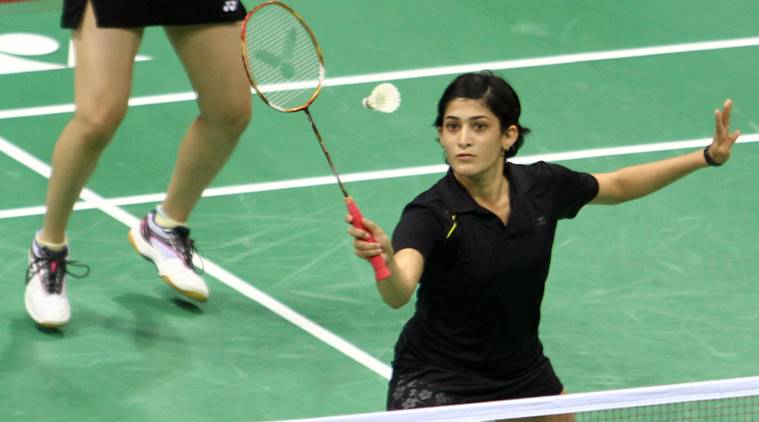
Ashwini Ponnappa-N Sikki Reddy finish runners-up at Welsh International Challenge

Ashwini Ponnappa and N Sikki Reddy went down to top-seeded Russian combination of Olga Morozova and Anastasia Chervyakov 21-16 21-11.

Ashwini Ponnappa and N Sikki Reddy had comfortably beaten England’s Lauren Smith and Sophie Brown 21-16 21-18 in the semis.

India’s women’s doubles pair of Ashwini Ponnappa and N Sikki Reddy finished runners-up at the Welsh International Challenge badminton tournament after losing in straight games in the final.

The unseeded Indian duo went down to top-seeded Russian combination of Olga Morozova and Anastasia Chervyakov 21-16 21-11 in a contest that lasted just 37 minutes.

Earlier, Ashwini and Sikki had comfortably beaten England’s Lauren Smith and Sophie Brown 21-16 21-18 in their semifinal match. The Indians took 39 minutes to get the better of the English team.

Meanwhile, the men’s doubles combo of Jishnu Sanyal and Shivam Sharma lost in the semifinals against Liao Kuan Hao and Lu Chia Pin of Chinese Taipei.

The third-seeded Chinese Taipei pair needed half-an-hour to make it to the finals by beating sixth seeded Indians 21-17 21-15.

Indians bowed out in the semifinals of the mixed doubles event also as second seeded N Sikki Reddy and Pranaav Jerry Chopra lost to Malaysians Goh Soon Huat and Shevon Jemie Lai 16-21 14-21 in 39 minutes.

source: http://www.indianexpress.com / Indian Express / Home> Sports> Badminton / by PTI / Cardiff – December 04th, 2016

Style guru Prasad Bidapa shares his thoughts on BT’s 19th birthday

prasadbidapakf06dec2016

“Nineteen years ago, I was one of the first columnists in Bangalore Times. I cut a wide swathe with that column, and BT was like a fresh breeze blowing through the city.

It chronicled the emergent Page 3 society and made Sandalwood the glamorous entity it is today.

Wherever I am in the country, I get to read The Times of India, but always miss reading Bangalore Times.

Happy anniversary BT, more power to you!” – Prasad Bidapa, style guru

source: http://www.timesofindia.indiatimes.com / The Times of India / News> Chennai News> Bangalore News / TNN / December 05th, 2016

The decoder of Coorg grammar

Coorg, as the British called Kodagu, was annexed by the East India Company in 1834, after dethroning the last Raja of Coorg, Veerarajendra. Coorg was administered as a separate province under a commissioner who was also in charge of Mysore. A British officer designated as superintendent was stationed in Madikeri and reported to the commissioner posted in Bangalore.

In March 1865, William Hobart Kerr, the superintendent of Coorg, fell ill and had to go on sick leave.

CaptRobertKF04dec2016

In his place, a young army officer, Captain Robert Andrews Cole, was appointed as the superintendent. Captain Robert was instantly attracted to the place, the climate, people and the invigorating environment. His duties involved meeting local people in remote villages, checking and updating land records, known as jamabandhi, which certified ownership and simplified revenue collection.

For fluent conversations…

Captain Cole was born in Madras in 1835, to an army doctor, Major General Robert Cole Sr. Having been educated in Madras, he was conversant with Tamil and Telugu. He had familiarised himself with Kannada on being posted in Bangalore. One of the problems Captain Cole encountered in Coorg was communicating with the Coorgis who spoke a dialect, which had many common words with Kannada, Tamil and other South Indian languages.

Surprisingly, according to Captain Cole, the Kodavas who lived in remote villages could not understand Kannada. This prompted him to learn the Kodava language so that he could effectively communicate with the people. Captain Cole soon started learning Kodava language. His knowledge of other South Indian languages helped. He began documenting the words, grammar and pronunciation. In order to help him communicate, he made extensive tables — known as Travel Talk — translating English sentences to Kannada (Canarese), Telugu, Tamil and Kodava language.

However, by October the same year, William Kerr returned, and assumed charge as the superintendent of Coorg. Captain Robert, who had taken a liking for Coorg, went back rather reluctantly to his posting in Bangalore. However, he continued his work on Kodava language. He learnt Kannada script for better conveyance of ‘peculiarities of pronunciation’, and started using this to transliterate Kodava language.

Captain Robert once again took charge from William Kerr, as superintendent of Coorg, in February 1866. He was happy to be back in this mountainous land and had come to enjoy the bracing weather. He particularly enjoyed his outings during the monsoon. This can be evidently seen in his book, Elementary Grammar of the Coorg Language, where he writes, “The thunderstorms during this season are often magnificent. The war of the elements is carried on here in a grander style than in the low country. Banks and mountains of clouds move against each other with the order of armies. The sound of heavy cannon is heard from a distance, solitary discharges of the electric fluid shoot through the gloom.”

Captain Cole served as the superintendent until December 1869. During this period, he compiled a comprehensive book on Kodava language. In 1867, with ample support from Lewin Bentham Bowring, who was the commissioner of Mysore and Coorg, he published his 136-page-book, Elementary Grammar of the Coorg Language. This was printed at the Wesleyan Mission Press. The book also contains a fragment of English-Coorg dictionary.

Captain Cole endeared himself to the people of Coorg. He also wrote another book titled A Manual of Coorg Civil Law. In appreciation of his contributions, an emerging town at the time was named after him as — Colepet. However, over the years, Colepet got merged with present day Ammathi. On promotion as a Major, he was appointed superintendent, Inam Settlement, Mysore. As a Colonel, he was with the Madras Staff Corps. He rose to the rank of Major General by the time he retired and returned to England.

He died in 1907. Major General Robert Andrews Cole ranks amongst other Europeans, who contributed to South Indian languages, such as Rev Hermann Mogling and Rev Ferdinand Kittel.

source: http://www.deccanherald.com / Deccan Herald / Home> Supplements> Spectrum / by C.P.Belliappa / July 26th, 2016