One of a kind comedy show is happening at a popular hangout in Pune at 9 pm today. It is a unique combination of music and comedy where The Yellow Experiment and Nikhil Chinapa will tickle the funny bones of the audience with their music-centric comedy and improvisation. We speak to them and find out how they plan use music and comedy together! The Yellow Experiment that will perform a unique comedy and music show tonight DNA Correspondent DNA
The Yellow Experiment that is – Daniel Fernandes, Kenneth Sebastian and Kanan Gill will be in Pune today and they tell us what makes their show so different!
Daniel has performed all over the country over the last two years and thinks there is nothing better than comedy. Kenneth Sebastian’s trademark is his incredible vocal ability which he uses to combine music and comedy. He performs regularly at comedy clubs like The Comedy Store and Canvas Laugh Factory and has been hailed as one of the top acts to watch out for in the years to come. Kanan Gill is a writer, musician, stand-up comedian, ex-software engineer and fitness enthusiast. He has won the Punch Line Bangalore competition and the open mic at The Comedy Store in Mumbai.
The Yellow Experiment is a comedy collective. “Through this new mix, the show will appeal to the audiences of both music and comedy,” said Fernandes. He has performed at The Irish Village and Olive Bistro before but, “the show at High Spirits will be the biggest one I have done in Pune” he added.
Talking about the unique combination, Sebastian said, “I already have a music background and I incorporate it in my comedy too. In today’s show, we will talk about music trends and song writing”. Most standup comedians joke about politics and other issues but Sebastian says, “We will talk about music and our jokes will be with respect to it”.
“It is not a traditional comedy, but it is based on the suggestions from the audience & Nikhil will join us at the end of the show for an improvisation of music and comedy”, added Kanan Gill.
For Nikhil Chinapa, it’s his first time at intentional comedy. He said, “This is my first attempt at comedy so I am half-excited and half-nervous about the show tonight.” Chinapa and Daniel used to talk and discuss about EDM on Twitter and that’s how they got talking about The Yellow Experiment. He added, “I love to try things out and give new things a shot.” One thing he would like to say to the people who are coming to the show today is, “There will be no intentional nudity”.
This first ever combination of music and comedy will be something to look out for, as two most appealing genres of entertainment come together with The Yellow Experiment and Nikhil Chinapa.
source: http://www.dnaindia.com / DNA / Home> Pune / Place:Pune, Agency:DNA / by Deeksha Sharma / Saturday – May 03rd, 2014
Actress Harshika Poonacha had a busy and fun birthday, which she celebrated on May 1. The highlight of the day, however, seems to be the eight cakes she got on her big day.
The B3 actress took to Twitter to tell her followers how she spent her day. “It was a wonderful birthday indeed… Was at wonderla and rushed to the LIVE in Suvarna news,” she tweeted. She later posted a picture of a cake and said, “My 8th cake for the day… loved evry bit of it and thnq all for ur lovey wishes… Feels lik celebrating my b’day evrydy (sic).”
source: http://www.timesofindia.indiatimes.com / The Times of India / Home> Entertainment> Kannada> Movies / TNN / May 02nd, 2014
We had told you about actor Gulshan Devaiah and his wife Kallirroi’s visit to her family in Greece.
To surprise Devaiah, she invited his dear friend of seven years, Kalki Koechlin, to Greece to holiday with them.
They went to the Acropolis one afternoon and spent an entire day walking around Athens. Their hosts and friends Robin and Katharina took them around. Nothing beats creating great memories with dear buddies.
source: http://www.timesofindia.indiatimes.com / The Times of India / Home> Bangalore Mirror Bureau / May 02nd, 2014
Harshika Poonacha went back to college today — and no, it was not to complete a degree or start a new one. The actress was at Don Bosco college in Bangalore to inaugurate a festival on the campus.
“Good morning twps. I’m sorry as I cudn reply u all,Yes I’m coming and I’m on my way to Don Bosco college. Gonna inaugurate d Fest fr You al (sic),” she tweeted on Tuesday morning. She then followed that up with a selfie, which she captioned, “Fun to be at College Fests. Takes me back to college.”
Harshika has a busy 2014, with as many as five films lined up — Meetru, Beet, Crazy Krishna, Anandha Thollai and Panipuri.
source: http://www.timesofindia.indiatimes.com / The Times of India / Home> Entertainment> Kannada> Movies / TNN / April 29th, 2014
The indomitable duo of Jwala Gutta and Ashwini Ponnappa, ranked 41st in the world now, are back with a bang. They achieved another high when they won the women’s doubles bronze in the recently concluded Asian badminton championship at Ghimcheon in Korea.
Former national coach Syed Mohammad Arif says that the two are one of the best doubles combinations from India ever.
“They have got all the potential to beat anybody on their day. But unfortunately, they lost that momentum after the Commonwealth Games and World Championship because of the unnecessary controversies. They were low on their confidence and they had to make a comeback of sorts. Mind you, it is not easy in the world circuit,” Arif said.
source: http://www.newindianexpress.com / The New Indian Express / Home> Sport / by N Jagannath Das – Hyderabad / April 29th, 2014
Anupama Puchimanda Mundanda, 33, is the first woman referee from India to officiate in 88 international hockey matches and three Commonwealth games. She was awarded the Best Umpire (Women) India by Sardar Gyan Singh Memorial Hockey Society in 2007. She was selected by the Federation International Hockey as one of the youngest umpires among ten men and women in the world. She is in the city to officiate at the fourth National Junior Hockey Championship-2014. She spoke to TOI about her success in a male-dominated field and her goals. Excerpts.
What motivated you to get into hockey?
Hockey is popular in Kodagu and enjoys good support. My father and mother played hockey. When I was nine years old, I started my sports career as an amateur athlete in Kudige. At 13, I joined the Sports Authority of India, Madikeri, where I got into hockey. I represented the state in sub-junior and senior national championships several times.
What made you choose umpiring?
Since my childhood I wanted to do something unique. Umpiring is a field where we have bright opportunities. In 2001 I took the exam. I first officiated as an umpire at Cheppudira Family tournament, Kodagu. Since then I have never looked back.
What are the qualities that umpiring demands?
A referee needs a lot of concentration, has to maintain calmness. We need to study team strategy. It is the complete study of the game. When we manage the game well, everything will fall into place.
How was the journey?
I am blessed to have the support of my husband Mandanna Mundanda and parents and relatives.
Is it difficult for woman to achieve success in the male-dominated umpiring field?
I don’t want to comment on it. Personally, I went step by step with the support of my well-wishers, friends and seniors.
How is the performance of Indian hockey players?
The national hockey team and the state hockey team are performing well. The Hockey India league has been instrumental in promoting the game among the youth.
What is your next goal?
My aim is to be an Olympics umpire. But my immediate goal is to officiate at my 100th international umpiring which will be a landmark in world hockey umpiring. It will be a tribute to my father, who passed away recently.
Your advice to young players, aspiring umpires?
When we start doing anything from our heart, success automatically follows.
How do you feel umpiring at the ongoing National Junior Hockey Championship in Mysore?
I am very happy to be umpiring near my hometown. This is the first tournament I am officiating in Karnataka.
source: http://www.timesofindia.indiatimes.com / The Times of India / Home> City> Mysore / TNN / March 12th, 2014
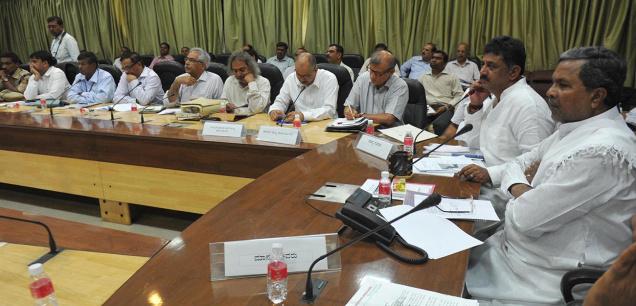
Chief Minister Siddaramaiah and Energy Minister D.K. Shivakumar at a meeting to discuss the power line project, in Bangalore on Tuesday /. Photo: Sampath Kumar G.P. / The Hindu
Expert panel to submit report in 15 days
Chief Minister Siddaramaiah has decided to constitute an experts’ committee to examine alternative possibilities to drawing a high-tension power line from the Kaiga nuclear power plant to Kerala through the catchment area of a tributary of the Cauvery in Kodagu.
The decision comes in the wake of prominent people from Kodagu opposing the project in its present form.
The proposed committee, to be headed by an expert from the Central Power Research Institute, will be given 15 days to look into the concerns of people of Kodagu and submit a report.
An assurance was given by the Chief Minister to legislators and environmental activists from Kodagu who met him at his home office here to seek a change in the route of the proposed power line pass, in public interest.
Coorg Wildlife Society president Col. C.P. Muthanna (retd.), who was part of the delegation that had more than a hour’s discussion with the Chief Minister, told reporters that the proposed committee would comprise wildlife ecologist R. Sukumar, Principal Chief Conservator of Forests, and water expert Rajendra Singh.
He alleged that the project, to be implemented by Power Grid Corporation of India Ltd., would result in devastation of 156 hectares of coffee estate and 104 hectares of paddy cultivation area near Virajpet besides 23 hectares of forests. “The area through which the proposed line is to pass has such a thick green cover that each acre of coffee plantation has 350 fully grown trees,” he said, and expressed concern that nearly 53,000 trees would have to be felled if the power line route was not changed.
He said that leaders from Kodagu had suggested that the power line be drawn underground through the “forest fire line” that runs for 23 km. This would also reduce the length of the power line, he said.
The Chief Minister assured the delegation of taking up the issue again for discussion after the experts’ committee submits its report, he said.
The former Speaker K.G. Bopaiah, MLA Appachu Ranjan and MLC M.C. Nanaiah were part of the delegation.
source: http://www.thehindu.com / The Hindu / Home> News> National> Karnataka / by Special Correspondent / Bangalore – April 30th, 2014
Defending champion Shiva Ram shares fifth position‚ Sanjay finishes ninth THT Minister for Communication and Information Minendra Rijal and Managing Director of Surya Nepal Pvt Ltd Abhimanyu Poddar (right) handing over the Surya Nepal Masters trophy to India’s Chikkarangappa S at the Gokarna Golf Club in Kathmandu on Saturday.
Kathmandu :
Chikkarangappa S defeated fellow Indian pro Shankar Das in the second playoff hole to win the Surya Nepal Masters at the Gokarna Golf Club today.
The match went to extra holes after the duo returned with matching scores of 15-under 273. While overnight leader Chikkarangappa – who began the day with three stroke advantage — played an even-par 72 in the final round, Das carded a four-under 68 to force the playoff.
Both the players saved pars on the first extra hole before Chikkarangappa carded a birdie on the second hole after Das failed to make it from 15 feet. Last year’s runner-up Abhijit Singh Chadha (68) and Abhinav Lohan (70) shared the third position at 14-under.
Defending champion and Nepal No 1 pro Shiva Ram Shrestha fired five-under 67 — his second in the tournament — to share the fifth spot with first-round leader Angad Cheema at 13-under 275. Former winner Shamim Khan was next at 11-under, one stroke ahead of Feroz Ali Mollah.
Out of the total cash purse of Rs 4.8 Million, Chikkarangappa pocketed Rs 775,920, while Das received Rs 535,920. Chadha and Lohan earned Rs 271,920 each, while Shiva Ram and Cheema got Rs 183,120 apiece. Minister for Communication and Information Minendra Rijal and Managing Director of Surya Nepal Pvt Ltd Abhimanyu Poddar handed over the prizes to the winners.
Shiva Ram made a desired start with birdies on the second and third holes before dropping a shot on the next. He then eagled the par-5 seventh to take the turn at three-under 33. Shiva Ram, who won the last year’s title beating Chadha in playoff, carded two straight birdies on the 11th and 12th and faced his second bogey of the day on the next hole. He then carded a birdie on the 16th to finish the back nine at two-under 34.
“The second round score of even-par made all the difference,” said Shiva Ram. “I was concentrating in my own game today but when I saw the scores on the 12th hole, I felt that I can catch them. But I fell behind after I missed birdie chances on the 15th and 18th holes,” said Shiva Ram.
Nepal’s Sanjay Lama (70) was tied on ninth position along with Asbeer Saini, Gulfam and Sanjay Kumar at eight-under 280. Among other Nepali golfers, home club pro Umesh Nagarkoti (70) shared the 15th position at six-under 282, while Surya Prasad Sharma (72) was tied on 31st at one-over. Purna Sharma (71) and Suman Rai (72) shared the 37th position at three-over, while Toran Bikram Shahi (74) and Rabi Khadka (76) were tied on 40th at four-over 292.
Veteran Deepak Thapa Magar (74) — the first Nepali pro to win the Masters in 2007 — finished 43rd at eight-over, while Pashupati Sharma (82) shared the 49th position at 18-over. Bikash Bogati (77) won the amateur section title with the total score of 11-over 299, while Sanjeev CK (77) came second at 16-over in the two-man field after the duo survived the cut.
source: http://www.thehimalayantimes.com / The Himalayan Times / Home> Full News / Himalayan News Service / Kathmandu – April 26th, 2014
The works on a temporary project to supply water from Kundamestri is nearing completion. The water from Kundamestri is likely to be supplied to the citizens of Madikeri by the week end.
Sand bunds have been laid to store water. The collected water will be supplied to Kootuhole through pipes. After filtering the water at a Filter house at Stuart Hill, water will be supplied to the citizens.
Madikeri reels under water crisis every year, during summer. The works on Kundamestri project was initiated to mitigate the water crisis. However, owing to delay in release of funds, the works could not be completed. Now, the estimated cost of the project has escalated.
The Kundamestri project is being implemented by the Karnataka Water Supply and Sewage Board (KWSSB). It will take another year to complete the works.
KWSSB Executive Engineer Balachandra expressed confidence of completing the works soon. “The project has been taken up, keeping in mind the development of Madikeri in the next 50 years. When the water level declines in Kootuhole, water will be supplied from Kundamestri to Kootuhole,” he said.
source: http://www.deccanherald.com / Deccan Herald / Home> District / by Srikanth Kallammanavar / Madikeri – DHNS, April 27th, 2014
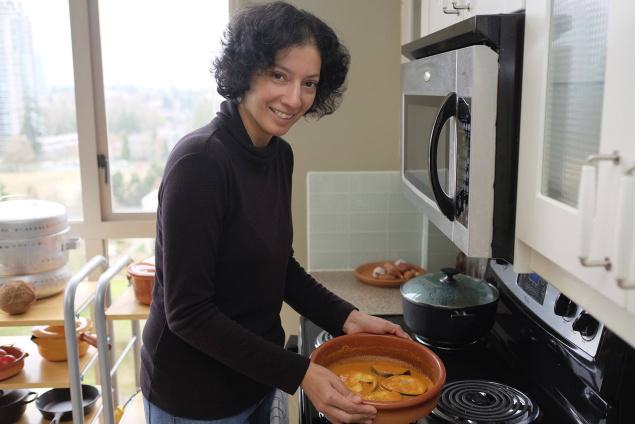
Shalini says oduputtu is a favourite / by Special Arrangement
Coorg food blogger Shalini Nanda shares her recipes and memories of food. And reminds us that with any traditional cuisine, so much depends on the terroir
If you are a recipe seeker on the Internet you couldn’t have missed the site Coorg Recipes that takes you into the world of the Kodava community who love their food and drink and celebrate the produce they grow in their inimitable cuisine.
The newly re-launched avatar of the site features more than 40 traditional recipes from the Coorg region of Karnataka. P.T. Bopanna, a Kodava who’s been running the site says there is a “recipe of the month” section featuring recipes from contributors that’s been made interactive.
The new recipes come from well-known Coorg food blogger Shalini Nanda Nagappa, who now lives in Canada. “Growing up in an Army family, we were stationed in and travelled to various places in India. This provided wonderful opportunities to indulge my natural curiosity about all things related to food. My mother’s interaction with ladies from around the country, and abroad, invariably led to recipe exchanges that fed this fascination,” says Shalini in an e-mail interview.
At every opportunity she travelled home to Coorg to her maternal grandparents’ home. Under the watchful eye of her indulgent grandmother she enjoyed whipping up cakes and desserts for family. She self-published a cookbook in 2010, called A Cookery Year in Coorg (she runs a blog by the same name). Excerpts from an interview:
What is it about Coorg cuisine that sets it apart from others? What’s its distinguishing characteristic?
As with any traditional cuisine, much depends on the terroir, so to speak. Rice, grown in the fertile valleys of Coorg, is the staple, and it was eaten at every meal. I think there is an amazing number of ways in which rice is transformed into flatbreads, crepes, noodles, steamed cakes and more. Some are echoes of preparations found in the cuisines of neighbours in coastal Mangalore, North Kerala and Malanad. Others are quite unique, like paputtu, maddputtu, and oduputtu.
Rice and puttus are accompanied by curries of mutton, poultry, pork, (both fresh and preserved), salt fish, freshwater fish and crab, bamboo shoot, and wild mushrooms. Farmed produce like pumpkin, and fresh and dried beans are popular too. The recurring notes in these preparations tend to be that of fragrant cassia, cloves and cardamom, the brightness of fresh green herbs and green chillies, the sweetness of fresh coconut, the deep warmth of pepper, and dark roasted coriander, cumin and mustard.
Add to this the clarifying effect of sharp citrus, or powerful kachampuli, (a souring agent made from Garcina gummi-gutta). In all these, every cook has a unique take on how, and how much. With changing social norms and the physical environment, some significant elements of Kodava cuisine like wild game, once abundant in the forests of Coorg, are no longer viable. Foraged potherbs, and the use of coconut oil and lard are also not as widespread today. The cuisine continues to evolve, though, with cooks recreating traditional dishes by making use of what is readily available. For example, if one does not have access to wild bamboo shoot one can substitute with farmed bamboo shoot, imported from Thailand. It’s not quite the same, but it works.
Why is it that the “pandi cury” has become almost a synonym for Coorg cuisine, outside the Kodava community?
The short answer to that would be “because it’s so good!” Joking aside, for the uninitiated, a quick glance through the range of recipes on coorgrecipes.com should tell anyone there is much more to discover. Still, the combination of dark roasted spices, pork, and the unique sharpness of kachampuli combine in pandi curry to create something special.
What made you take to cooking? What kind of dishes do you like to cook?
I’ve always loved food, so I suppose it was natural to hang around in the kitchen picking up on the goings on. I’ve also always been curious about the entire process of preparing food, even before I was old enough to handle things on my own. My maternal grandmother indulged that interest and encouraged me. When I was young I was always whipping up cakes and desserts for the family. I enjoy most cuisines and like to cook anything that catches my fancy. I love seafood, and living on the coast of the Pacific NW, I am privileged to have access to some of the best out there. I also have a particular interest in the vast range of regional Indian cuisines.
Among the recipes you have shared, which are your most treasured ones, and why?
I feel every recipe has some special association, whether it evokes memories of meals past, was shared by a friend, or is just some fun innovation. Oduputtu is a particular favourite. I didn’t eat this when growing up, and it isn’t commonly made these days. I would hear my mother recall how she and her siblings were welcomed home from school long before they actually reached the house, by the delicate fragrance of the resin used to scent this unusual rice pancake. Her descriptions spurred me to seek out the clay pan it is traditionally cooked in, season it, and set about practicing getting the batter just right.
With the kaipuli recipes, I enjoyed the process of testing how exactly to substitute one locally found citrus fruit with another that is more widely available where I live and has a similar flavour profile, but different physical characteristics. Palya, which is the simplest style of preparation of vegetables, is applied to a variety of wild greens that once were commonly eaten, each for known health benefits. It’s been wonderful discovering some of these, like thaaté thoppu (Cassia tora), for myself.
For people living outside Coorg, will ingredients/cooking apparatus you have featured in recipes in coorgrecipes.com be easy to come by?
Coming from an army family and having lived outside Coorg for much of my youth, and now living in North America, I am familiar with many of the limitations as well as the possibilities in recreating recipes. Many ingredients are specific to the Coorg region, but on my blog I make it a point to try out, and offer what in my opinion may be the closest substitutes for both ingredients and equipment wherever possible. In India, there are online sources like coorgshoppe.com to help source ingredients like kachampuli and spices.
source: http://www.thehindu.com / The Hindu / Home> Features> MetroPlus> Food / by Bhumika K / Bangalore – April 24th, 2014
WELCOME. If you like what you see "SUBSCRIBE via EMAIL" to receive FREE regular UPDATES.
Read More »