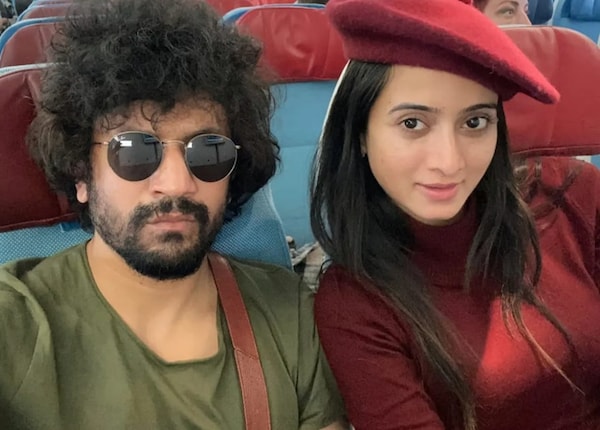
Prepare to be captivated by the upcoming fantasy thriller, ‘Ooru Peru Bhairavakona,’ promising an edge-of-the-seat experience
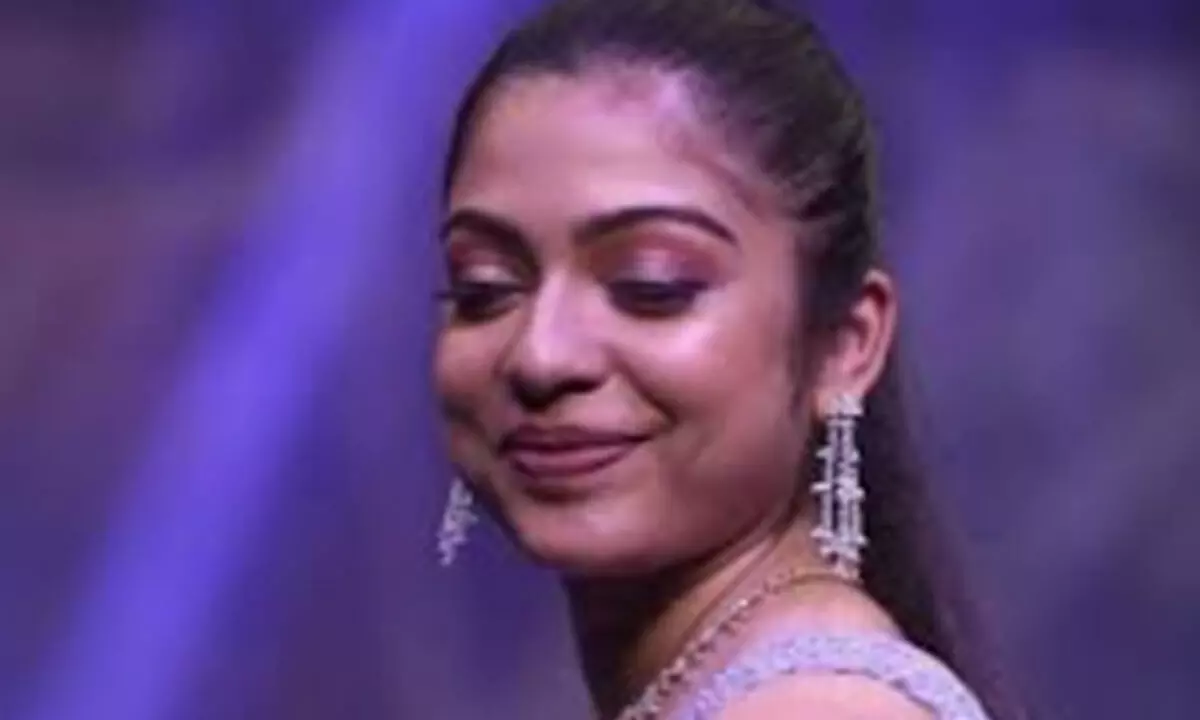
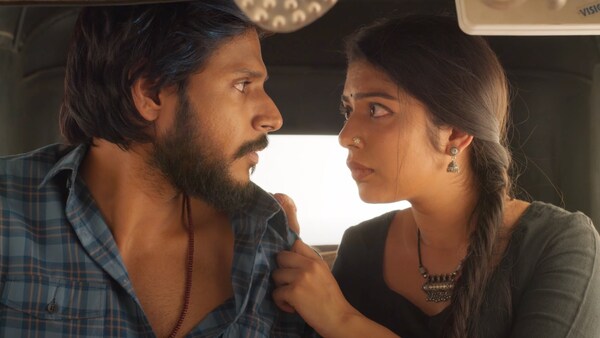
Prepare to be captivated by the upcoming fantasy thriller, ‘Ooru Peru Bhairavakona,’ promising an edge-of-the-seat experience. Renowned actress Varsha Bollamma, who is seen as female lead in the film alongside Sundeep Kishan, recently shared insights into the project, building excitement ahead of its worldwide release on February 16. Directed by VI Anand and produced by Rajesh Danda under the banner of Comedy Movies, ‘Ooru Peru Bhairavakona’ boasts a magical and adventurous narrative. The film stars Sandeep Kishan in a lead role, supported by the talented actresses Kavya Thapar and Varsha Bollamma as heroines. Co-produced by Balaji Gutta, the film is proudly presented by Anil Sunkara on AK Entertainments.
Varsha Bollamma expressed her enthusiasm for joining the project, recalling how the director, VI Anand, narrated a story that felt refreshingly new and unique. She was intrigued by the unconventional storyline and the unexplored character dynamics, leading her to eagerly accept the role of Bhumi, a tribal girl with self-education, courage, and strength.In describing her character, Varsha shared that Bhumi, the tribal girl, exudes innocence while displaying remarkable courage and resilience. Having grown up in a hill station herself, Varsha found a personal connection to the character’s affinity with nature, making the role all the more relatable.
Working alongside Sandeep Kishan, Varsha commended her co-star’s warmth and respect for everyone on set. She praised him as a kind and considerate co-star, contributing to a positive working environment. Varsha’s decision to take on the role was influenced by her admiration for VI Anand’s previous work, particularly the movie ‘Where are you going, little one?’. Excited about the project, she was thrilled to learn that her name was specifically chosen for the role of Bhumi, solidifying her commitment to the film.
‘Ooru Peru Bhairavakona’ promises to be an exhilarating entertainer, offering a thrilling experience with supernatural elements. Varsha assured the audience of an enjoyable ride filled with suspense and a powerful message. As she praised the producers at AK Entertainments for their passion for comedy movies and their commitment to delivering a grand production, Varsha concluded the conference by reaffirming her dedication to prioritizing impactful roles, irrespective of their length. With the film’s release just around the corner, anticipation continues to build for this magical adventure.
source: http://www.thehansindia.com / Hans India / Home> Entertainment> Tollywood / by Hans News Service / February 07th, 2024
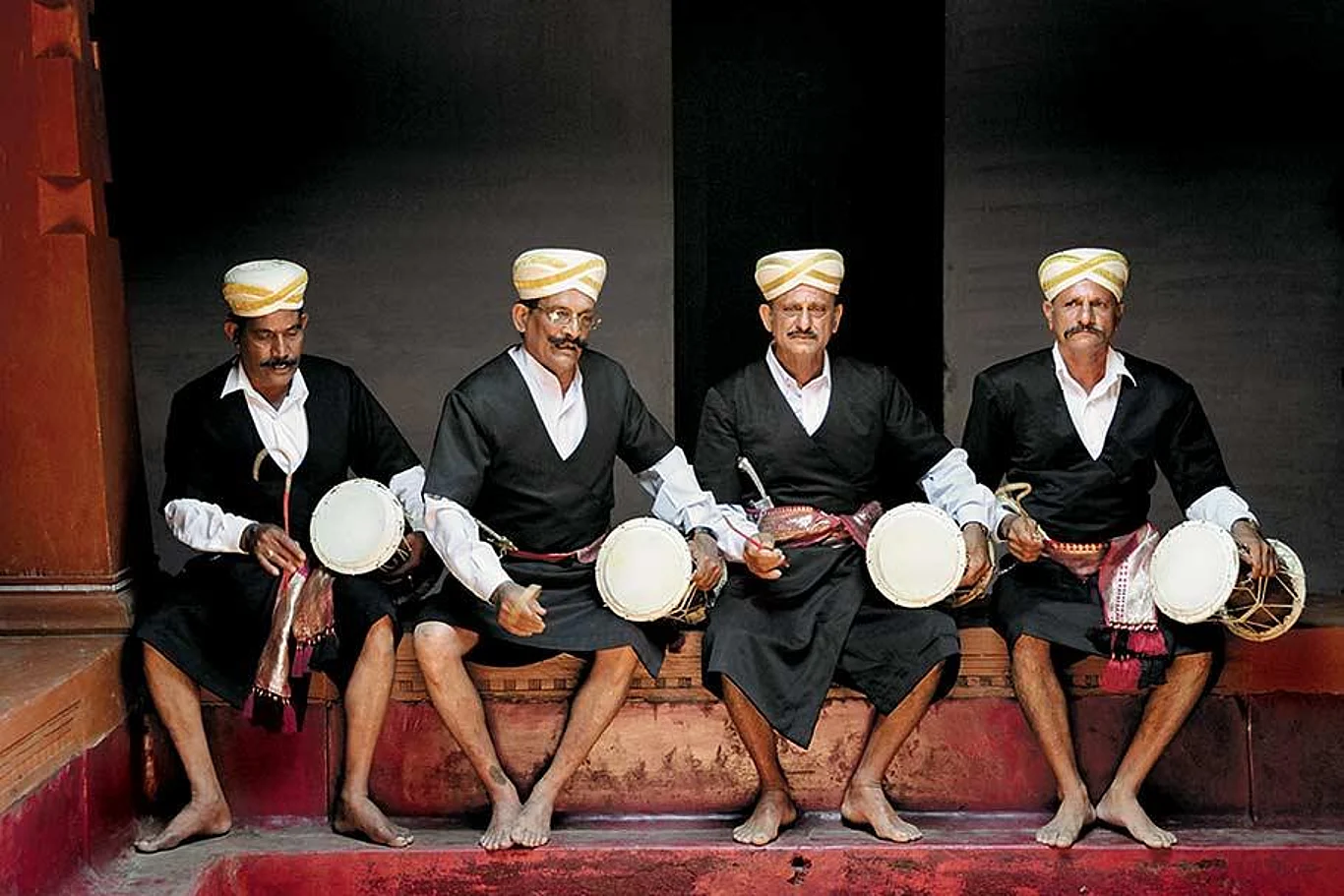
Kodagu’s rich oral tradition was used to hand down the history, culture and social practices of the people. From the book The Vanishing Kodavas (Eminence Designs, Rs 7,500). Text by Kaveri Ponnapa. Four dudipatkaras (bards) sing the history of the clans
A new book chronicles the cultural history of an enigmatic hill people.
The Kodavas, an agricultural and martial hill community known for their oral cultural traditions, are thought to have migrated to and established themselves in the Western Ghats region of Kodagu.
Despite numerous theories about their origins, none have been conclusively proven.
Organised into patrilineal descent groups, they engaged in agriculture and warfare. They were governed by local chieftains who pledged allegiance to various larger kingdoms during their early history.
Later, a dynasty of Lingayat kings, supported by a council of chieftains, assumed control. In her book “The Vanishing Kodavas”, Kaveri Ponnapa chronicles her observations on field excursions throughout Kodagu, meticulously recording village festivals across several cycles, actively engaging in and observing ancestor propitiations, as well as documenting the significant life events within the community.
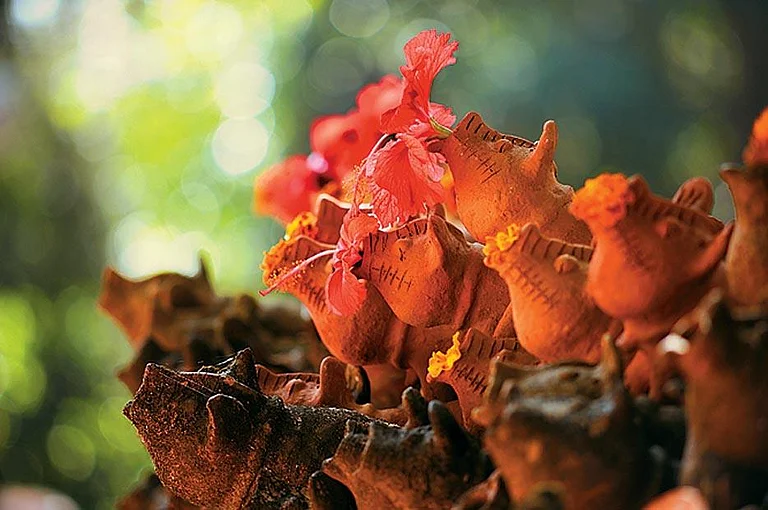
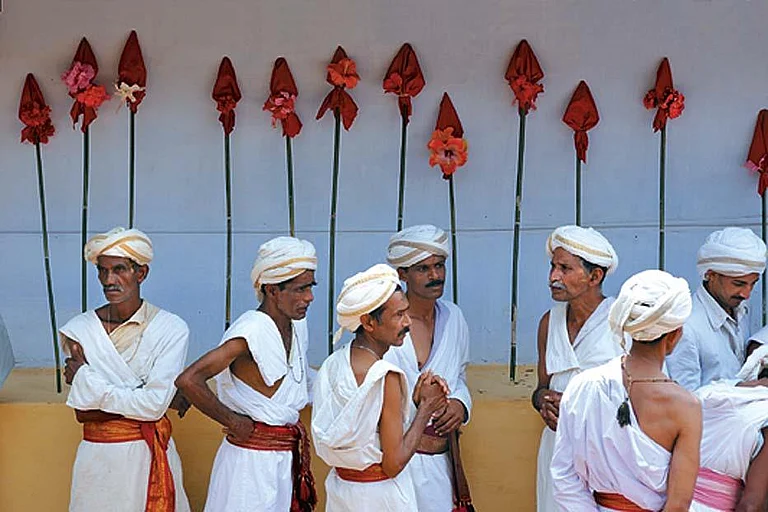
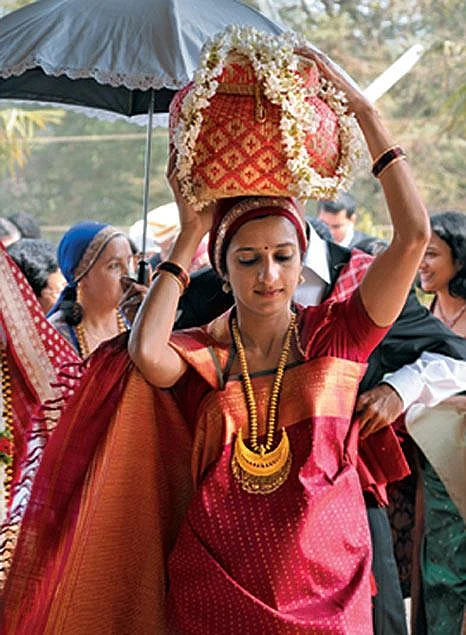
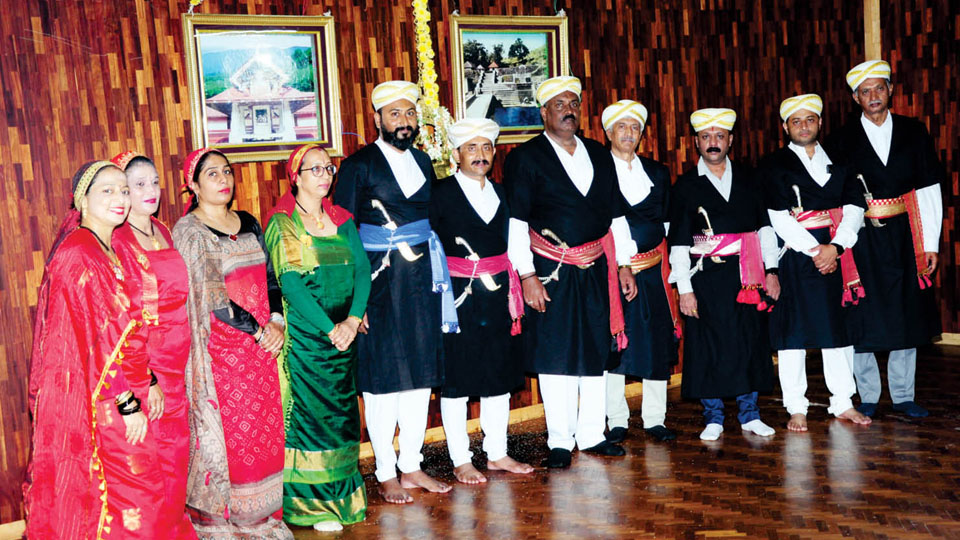
The Coorg valley is also referred to as the Scotland of India for it’s ethereal beautyIn the area of Coorg (Kodagu), terracotta tradition may be traced from the Megalithic period. A few terracotta figurines are known from the dolmen site of Moribetta (Cole 1868 and 1869)The person performing ‘bhuta kola’, a traditional dance wears special makeup, jewellery and costumes. He dances to very unique tunes of musicIn the olden days, a simple white length of cloth, tied around the head was worn as a headdress, or mande tuni as referred to in the Coorg dialect. On ceremonial occasions, this was replaced by a cream and gold mande tuniPariyakali harks back to the days when war was a constant reality in Kodava life and men were expected to display their fitness and prowess on many social occasionsAlong with the Saree, Coorgee women wear a piece of cloth on their head similar to the saree known as ‘the vastra’, and they adorn themselves with gold beaded jewellery to add to the beautiful attireThe ‘Kodava costume’ for men is called ‘Kupya’ which is a collar less half sleeve knee length jacket secured at waist with a maroon sash with gold embroidery called as ‘Chela’ and a knife is tucked into the ‘Chela’ that is referred to as ‘a peechekatti’ which represents their culturePuthari, Kodagu’s annual harvest celebration, is the most important festival across Kodagu, a landmark in the agricultural and social calendar
source: http://www.outlooktraveller.com / Outlook Traveller / Home> India / by OT Staff / January 20th, 2024
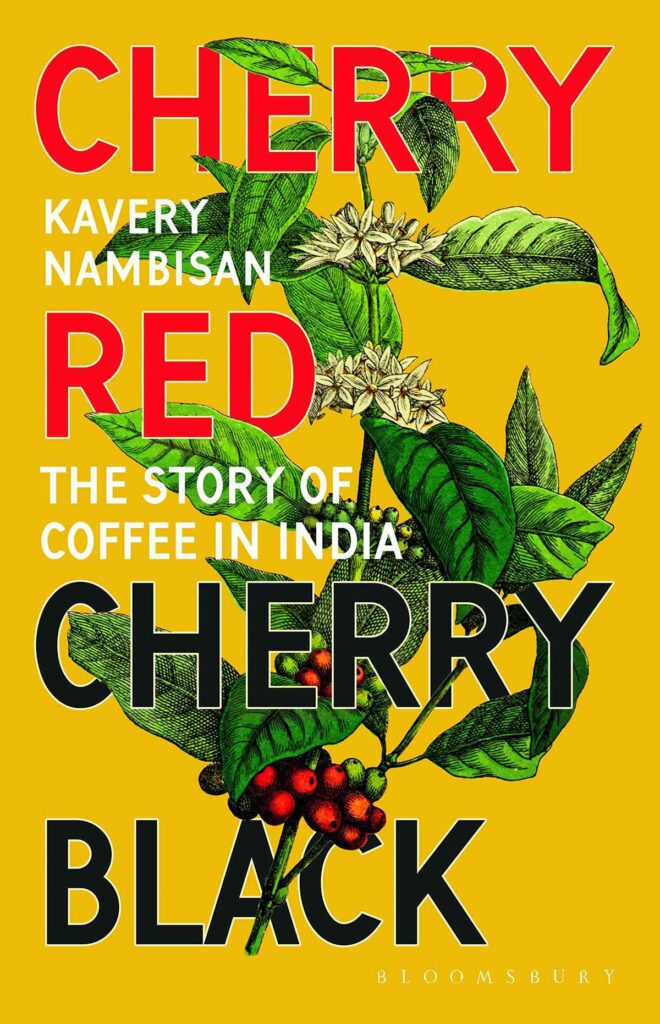
Kavery Nambisan traces the history and geography of the brew in India in her book ‘Cherry Red, Cherry Black: The Story of Coffee in India’.
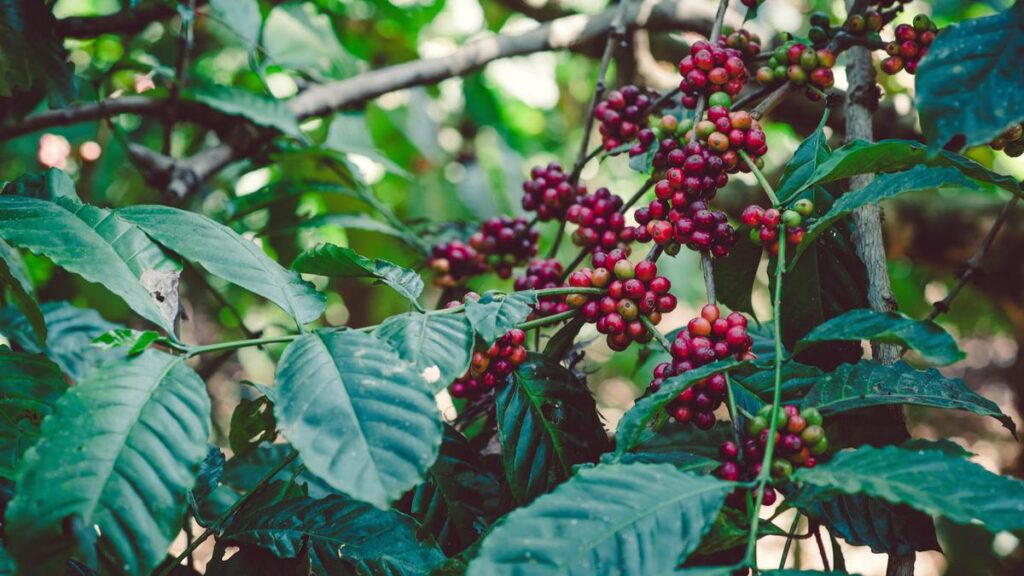
At the Nellikad Coffee Estate in Pollybetta, Coorg | Photo Credit: Special arrangement
When did coffee arrive in India? How did Coorg, a rice-growing area initially, take to growing coffee in large quantities? Where does India stand as a coffee planter and exporter? Kavery Nambisan writes the history of one of the country’s most popular beverages in her new book, Cherry Red, Cherry Black: The Story of Coffee in India. In an interview, she says the history of coffee in India is closely interwoven with global history.
The story goes that an Indian merchant who went on a pilgrimage to Mecca is said to have brought some coffee seeds back with him in the early 17th century, and thus began the backyard cultivation of coffee in parts of then Mysore province, mainly Chikmagalur, Hassan and Coorg. The British saw its potential and expanded the growth of the cash crop. Having worked in the industry — she tried at her hand at berry picking when she was 15 and realised what a tough thing it is — Nambisan also outlines the challenges the industry faces.
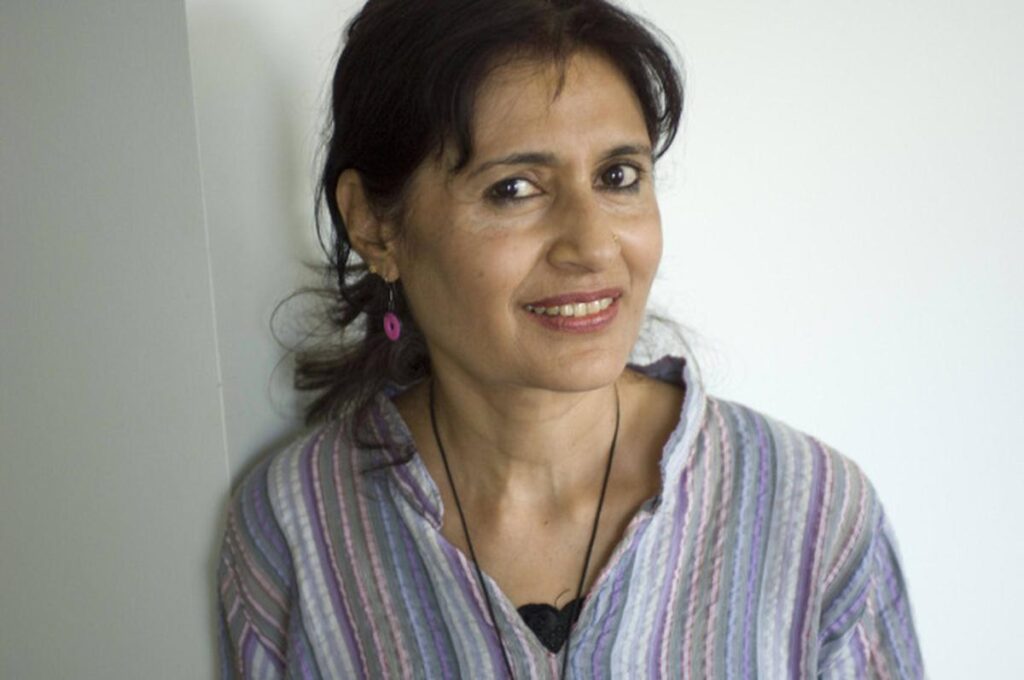
Author Kavery Nambisan | Photo Credit: Special arrangement
You say history has everything to do with the story of coffee in India. Why?
The history of coffee is closely interwoven with global history, particularly from the 18th to the 20th century. It is believed that the stimulant effects were first discovered in Abyssinia when a goatherd noted how his goats frolicked non-stop after eating coffee berries growing in the wild. This led to its cultivation and coffee became something of an energy drink of those days. Its popularity spread to many parts of Arabia and from there to parts of Europe. An Indian merchant who went on a pilgrimage to Mecca is said to have brought some coffee beans back with him and so started the back-yard cultivation of coffee in parts of the Mysore Province, mainly, Chikmagalur, Hassan and Coorg.
By the mid-19th century the British had recognised the potential for growing coffee (and tea) on a large scale. They cut down thousands of acres of forests in these regions for this purpose. The British government which got revenue from its production and export, played a key role in regulating the sale of coffee. The two World Wars challenged the prospects of export and profits while competition from other coffee-growing countries ensured that our own plantations had to work on improving quantity and quality.
Wasn’t Coorg a rice-growing area before the prospect of expanding coffee growth brought the British to the region in large numbers?
The people of Coorg were hunter-peasants right up to the early 19th century when it was annexed by the British. Livelihood was closely tied to paddy cultivation which in turn was dependent on the monsoons. Paddy is a labour-intensive crop and needs workers prepared to work in difficult weather conditions. So the local tribespeople worked in the fields for daily wages. Coffee growing was initially very challenging, and disease often destroyed the crops. But with effective planning, research on the cause of disease, treatment and plant selection, it turned out to be very profitable.
Though the first coffee estate was set up near Mercara, why did coffee growth proliferate in southern Coorg? And what was the variety grown there?
North Coorg where coffee was initially grown receives heavy rainfall which can damage the blossoms and the young berries. Moreover, the area is mostly hilly and so coffee is grown on steep terrain. Within a few decades of cultivation, hundreds of acres of coffee plantations were thus destroyed. Many plantations closed down and some of the British planters went back to England. In Southern Coorg on the other hand, the land is gently sloping, or flat and the rains are not so severe. It is better suited for coffee cultivation. The two varieties of coffee grown are Robusta and Arabica.
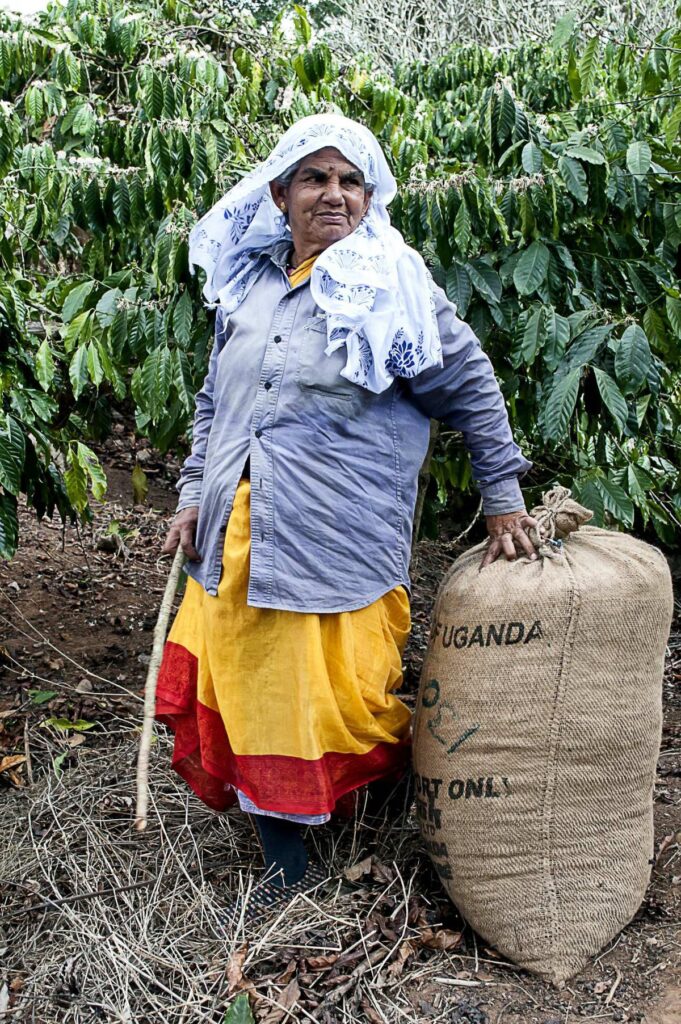
A coffee picker with a sack of harvested beans | Photo Credit: GRJGM
Please share your experience of plucking coffee berries when you were 15. How tough was it?
That was foolish bravado on my part. Perhaps also, the fact that I was of an age when I romanticised manual labour. Coffee plucking itself appears easy when a skilled worker does it. Actually, It is hard work. There are nettled shrubs and creepers that get in the way, abrading palms and scratching the arms and shins. The many insects that creep, crawl and fly will often sting. Dried coffee twigs can poke the eyes for good measure when the picker crouches beneath the bushes to pluck the berries. I was not able to pick as much as I thought I could. But the workers? They talked and laughed all day and plucked enough berries to fill a few sacks each.
Was the rapport between the local Kodavas and the British a happy one? What did they learn from each other?
I guess you could say it was a good rapport. You need to go back in history in order to understand why. Coorg (or Kodagu) was ruled by the Haleri kings for 250 years before the British annexed Coorg in 1834. Coorg was better off under the British. They got schools, dispensaries, apothecaries, etc. Importantly, there was more peace and harmony which came with better administration. Within a few decades, many of the Kodavas became literate. The British found them to be hard-working, honest and trustworthy.
___________________________
Cherry Red, Cherry Black: The Story of Coffee in India
Kavery Nambisan Bloomsbury
₹699
_________________________
What are some of the concerns about the modern coffee industry?
There are several concerns: Coffee plantations are the result of the felling of large areas of forest land, particularly in and around the Western Ghats. It is also a crop that uses pesticides and chemical fertilizers which denude the soil of its health and vigour. Organically grown coffee is a possibility, but economically it is not viable in large plantations. The climate catastrophes experienced in the last few years has led to destruction and loss of lives. We need to look at alternate ways of producing coffee so the end result is not deleterious to the environment. There are many individuals, groups and a few corporates who are experimenting with new methods. Coffee growing is no longer as lucrative as it once was and there is a need for innovation and the use of methods that are not harmful to the ecosystem.
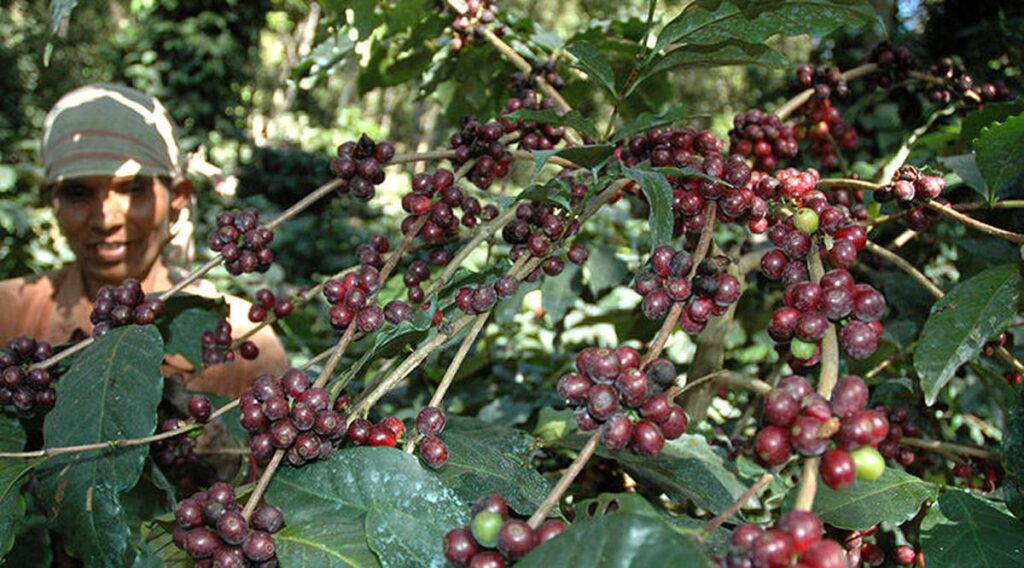
A farmer in Coorg picks riped coffee beans for pulping | Photo Credit: Sampath Kumar G.P.
From Steeping to the French Press there are many ways to make coffee and you describe them in the book, which is your favourite way to make and drink coffee?
I have been a coffee drinker all my life, naturally. I cannot start the day without coffee. I like it strong, hot and full flavoured. I use a mix of Robusta and Arabica beans, roasted at a mill nearby and powdered at home. I have three methods that I use to make coffee, depending on my mood. The Moka pot coffee, filter coffee or the simple brew, in which you heat fresh water and when it comes to boil, add the coffee powder, cover and let it steep for 2 minutes, strain and serve with hot milk and jaggery.
source: http://www.thehindu.com / The Hindu / Home> Books / by Sandipta Datta / December 09th, 2022
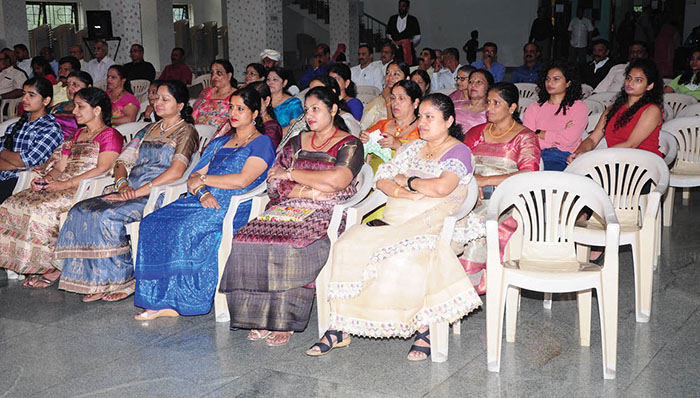
The first Annual General Body Meeting (AGM) and get-together of Pombolak Kodava Koota, Mysuru was held at Kodava Samaja premises in Vijayanagar here recently.
Koota President Mundottira Jaya Chengappa presided.
Theetharamada Dr. Devaki rendered the invocation. Vice-President Thathira Bheemaiah condoled the death of Koota members in the past one year.
Koota’s annual report was read out by Joint Secretary Guddanda Rashmi Uday while the accounts was presented by Treasurer Kullachanda Vinutha Kesari.
The names of new members was read out by Annarkanda Prathima Thimmaiah, who also compered the programme.
Committee Member Boppanda Appaji proposed the vote of thanks.
Various sports and games were conducted for the members present by Sports Committee Member Adikera Sajjan Cariappa.
Cash prizes were presented to meritorious students while the Ph.D awardee Dr. Theetharamada Dr. Devaki was felicitated on the occasion.
Hon. Secretary Chottanda Chengappa, Mallengada Sharanu Somaiah, Theethira Beena, Ammanda Somaiah, Mullanda Vinu Cariappa and others were present.
source: http://www.starofmysore.com / Star of Mysore / Home> News / November 02nd, 2023
Ram Miriyala has crooned Ooru Peru Bhairavakona’s Humma Humma song that is composed by Shekar Chandra
Sundeep Kishan and Varsha Bollamma
Sundeep Kishan, who was earlier seen in the gangster saga Michael this year, is all set to entertain audiences with the mystical thriller Ooru Peru Bhairavakona soon. Kavya Thapar and Varsha Bollamma play the female leads in the thriller produced by Razesh Danda under Hasya Movies, while Anil Sunkara is the presenter. VI Anand, who worked with Sundeep in Tiger, is the director.
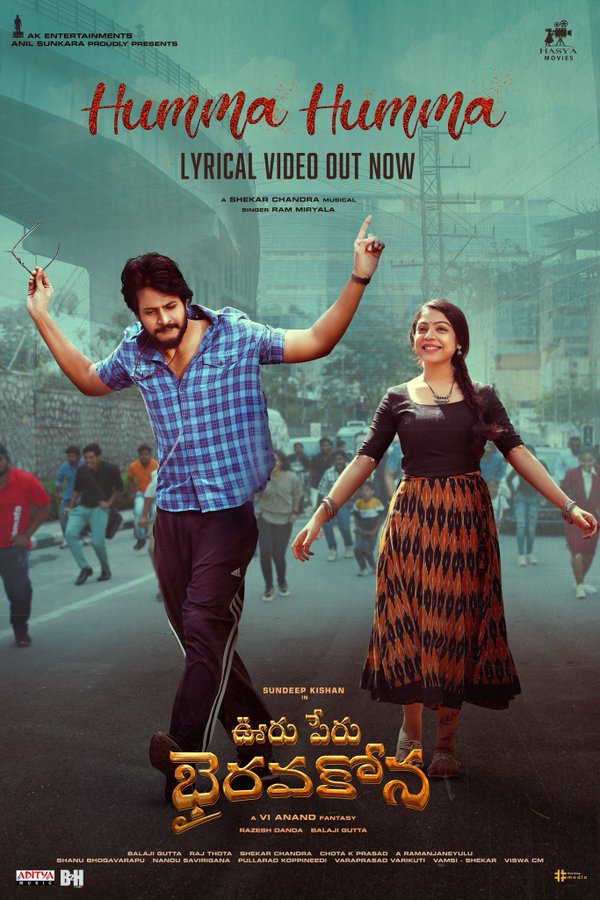
A new single from the film, Humma Humma, was launched today. Shekar Chandra scores the music for the thriller. Ram Miriyala has crooned for the number, jointly lyricized by the composer and Tirupathi Jaavana. The catchy fusion track focuses on how the protagonist is smitten by the woman of his dreams and goes all out to woo her. The quirky lyrics, composition capture his enthusiasm.
‘Naa Valla Kade Bomma..Nee Kallu Chuste Amma..Inta Kalamu Lede..Vinta Lokamu Ente..Jaari Paddade Manase,’ the song’s opening lines read. The simple lyrics showcase the plight of a youngster who’s desperate to express his feelings to a loved one. Ram Miriyala’s laidback rendition, Sundeep Kishan’s expressions and Vijay Binni’s vibrant choreography enhance the appeal of the number.
The song has been shot at popular locations in Hyderabad and cinematographer Raj Thota’s aesthetic sense lets you explore the charm of the city while driving the story forward. The music video introduces viewers to the team behind the song, from the singer to the composer, lyricist and director as well. Humma Humma could be your ideal companion for a car ride to lift your spirits during a lazy evening.
The teaser of Ooru Peru Bhairavakona, released a few months ago, earned encouraging responses from audiences. Besides the mystical thriller, Sundeep Kishan is associating with actor Dhanush for two of his upcoming projects: Captain Miller and D50.While the former hits screens this December, D50 is directed by Dhanush himself.
source: http://www.ottplay.com / OTT Play / Home> News / by Srivathsan Nadadhur / October 28th, 2023
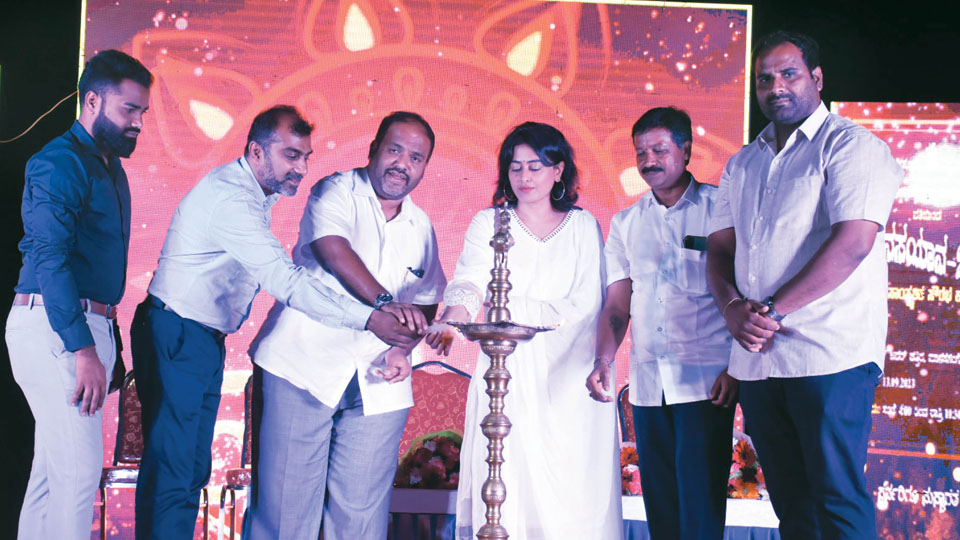
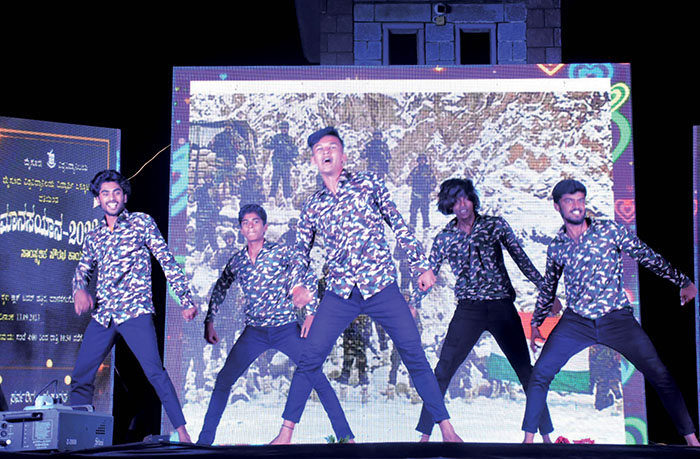
Sandalwood actress Nidhi Subbaiah added glitz and glamour to ‘Manasayana- 2023’, a cultural festival organised by University of Mysore Vidyarthi Okkoota in Manasagangothri campus here recently.
The students of various Departments showcased their talents in cultural programmes, as the fellow students among the audience, went gaga, shaking their legs to the foot tapping music, soaking in joy in the evening filled with music.
Speaking after inaugurating the programme, Nidhi Subbaiah said “I am reminded of my college days, as I studied in Sri Jayachamarajendra College of Engineering (SJCE) near the same campus. I was very lucky to pursue education in Mysuru.”
“Mysuru is the best city. Like you, I was also enjoying the cultural programmes during my student days. I am filled with energy upon seeing your love and affection. Watch my movies and support me,” said Nidhi Subbaiah.
Asking the audience whether they want to be regaled with a film dialogue, Nidhi recalled the famous lines “Nimmannella Uddara Maduvudu Bittu Nangen Bere Kelsa Ilva. Gand Maklu Sahavasa Hagalella Upavasa” from her runaway hit movie Pancharangi, to the applause of the gathering.
Managing Director of Neurozone – Brain and Spine Care Dr. H.V. Shushrutha Gowda said “University of Mysore is one of the prestigious Universities and the alumni have been serving as doctors and scientists, besides decorating many top positions. Even my father Dr. H. C. Vishnumurthy studied in the same Varsity and founded the Gopala Gowda Shanthaveri Memorial Hospital 45 years ago. Our hospital has been catering to patients from rural areas to provide health service on priority.”
Dr. Shushrutha said, “I was in USA for a few years, where I had my higher education and returned to the country. The Super Speciality services were not easily available for rural people then, which pained me. To address the gap, I conducted 40 free health check-up camps to provide health services at the doorsteps of the people and also gave free super speciality services to about 10,000 people.”
Gundlupet MLA H.M. Ganesh Prasad said “One should put efforts at the student level to gain knowledge and education.”
A music album titled ‘Vishwa-guru Anna Basavanna’ of Girish Bendaravadi was also released on the occasion.
Former Syndicate Member of UoM Kumar, leader Harish Moganna, programme organiser Abhishek Palegar and Kaviraj were present.
source: http://www.starofmysore.com / Star of Mysore / Home> News / September 29th, 2023
The film, which begins with a narration, might come across more like a movie than a documentary, and Karumbaiah says it was a deliberate effort.
Bengaluru :
Thashwini Karumbaiah’s documentary film Kodavas – The Highlanders is a deep insight into the rich culture and heritage of Kodavas, renowned as a warrior clan. Hailing from the same community, the filmmaker wanted to document it in some way.
As a passion project, the film took more than two years to be made. “When the British came, they changed the name to Coorg, it is actually Kodagu,” says Karumbaiah adding, “As a Kodavati, I wanted to preserve our culture and attire and thought the best way to document all of it was in the form of a film.”
The film, which begins with a narration, might come across more like a movie than a documentary, and Karumbaiah says it was a deliberate effort. “I wanted to experiment with the documentary. Usually, documentaries are shot in a very different way but I come from a background where we do films and serials, so I wanted to make it cinematic. At one glance, people might feel there is a story behind every chapter. But it is a documentary,” says Karumbaiah about the film that was co-produced by Vaishno Studios.
Hailing from Kodagu, Karumbaiah has heard many stories in the family about the community.
However, the research for the film helped her discover many things that she had not known. “For example, when we started talking about battles that happened in Kodagu, we realised that a lot of them have gone unnoticed. It’s only orally been passed down from the older generations. We came across some of these stories which were interesting,” she adds.
Although the film started as a passion project with no commercial idea in mind, Karumbaiah is hoping to screen it at an international film festival next year.
source: http://www.newindianexpress.com / The New Indian Express / Home> Cities> Bengaluru / by Monika Monalisa, Express News Service / September 20th, 2023
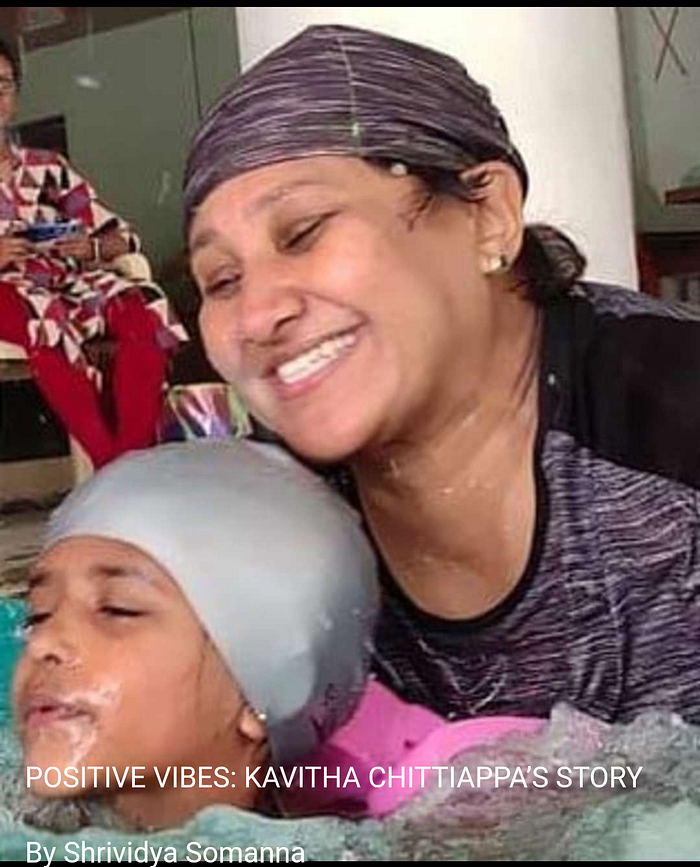
“When you cannot find the sunshine, be the sunshine!” says a cheerful 50-year-old, Guddanda Kavitha Chittiappa (married to Kodira) who hails from Maharashtra. Today, the world is rising of waters, dark and deep or so we think. Living in a perfectly Utopian world is Kavitha who is a former national level Diver and a Swimmer.
As light is to darkness, Guddanda Kavitha Chittiappa has been the light of hope to the young and old. She says, “I worked for a corporate for 29 years, then quit because I thought it was time to give back. I had reached a point in life where there was nothing to look forward to. I wanted to make a difference in my life and the lives of the people around me. That was when I decided to start, “Aqualiners” which is a swimming academy. This academy teaches swimming, Aqua Therapy, Aqua Rehabilitation, and Aqua Fitness to children and adults, differently-abled kids and adults, senior citizens.” Kavitha has been training the intermediate as well as the competitive-level swimmers in Bengaluru.
Always sporting a natural smile, Kavitha has been quick to change her stride post-pandemic. Most parents of the specially-abled children had fewer options on their plate. Thanks to Kavitha, these children could attend online classes for their physical exercises.
She has an international certification on ‘active aging’ and works with senior citizens on age-related ailments on land and water. During this lockdown, she has started an online exercise session for family and friends to ensure that they keep themselves physically fit and active. She has started land-based exercises (movement therapy) as the pools have shut post-Covid-19.
It all started with Kavitha helping her aunt with online physical exercises. What started as a “family workout hour” with her aunt became popular! “Soon, I was not just helping my aunt but her friends too,” she says. The word spread that Kavitha was helping with physical exercises. Many joined because it was not just a workout group that Kavitha had started but a therapeutic group where the participants could vent out their feelings and share their activities during the lockdown phase. “If each of us can make a difference in one person’s life, we could bring positivity to so many people. If I could get 12 ladies every day, on the line and I look at their health… If one of them misses my sessions, I can ask him or her what happened. So, I know everyone is safe for the day,” says Kavitha.
Also, a yoga teacher and a Pranik healer, she works selflessly to enable the specially-abled children with a power of positivity in the mind, in the body. Commenting on how she was coping with classes post Covid-19, she adds, “I couldn’t meet my students and I missed those hugs and smiles, the real connect. But the fact that we could still be there for each other was amazing.”
Her aura of positivity blooms in her own words, “Whatever I do, I always give my 100%. I smile because it brings out the best in me. I believe in my students’ potential, that everyone is unique and different and the best can be brought out of each student. I receive what I give. I give or receive love, hope, and power.” Kavitha has changed so many lives, especially the lives of the young and the old. This world definitely needs more Kavithas!
source: http://www.medium.com / Medium / Home / by Shrividya Somanna / February 07th, 2022
Ashwini Ponnappa, who has achieved many firsts for Indian badminton, is drawing new energy from her 20-year-old partner Tanisha Crasto. But the 33-year-old says her biggest challenge is to stay motivated.
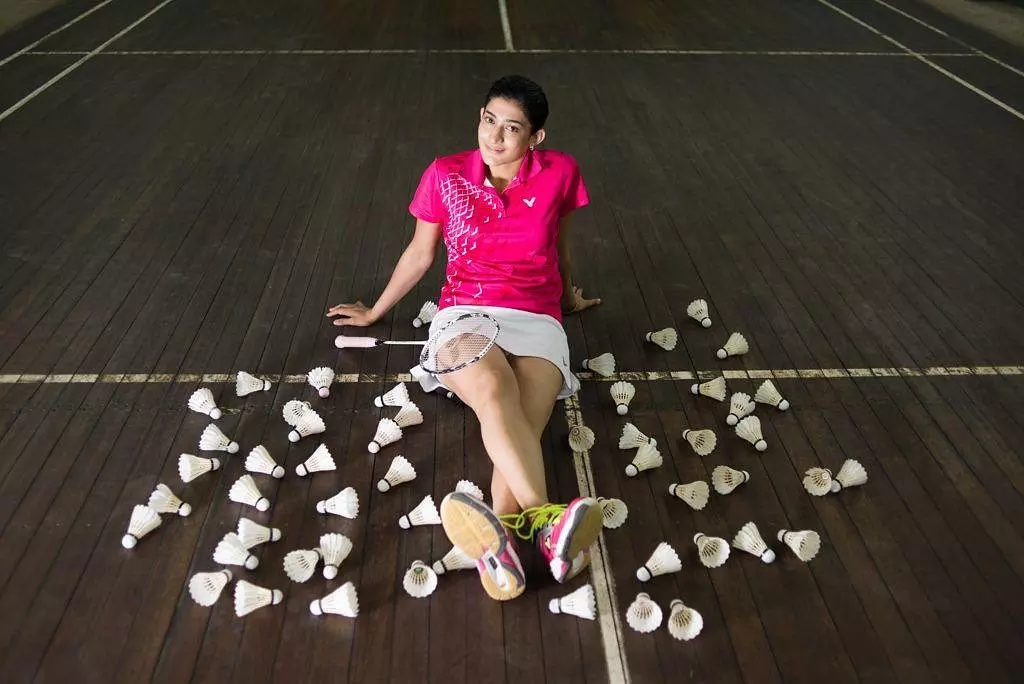
Ashwini Ponnappa poses for a photo among shuttles at a badminton court. (Photo credit: Ashwini Ponnappa/Instagram)
Ashwini Ponnappa is unbothered about her age. An average female shuttler retires at 28, but Ashwini, even at 33, does not see any reason for slowing down. She does not let the thought of retirement sneak into her mind either. Having recently taken up the fresh challenge of playing two intense and physically demanding disciplines – women’s and mixed doubles – instead of one, Ashwini says she ‘finds solace’ in distributing her priorities. “It is not easy to play two events, but it is something that I want to do at this point, I kind of find solace in playing two events rather than one,” Ashwini told The Bridge.
Ashwini broke her long-standing and rather futile partnership with N. Sikki Reddy last year, following her highly successful one with Jwala Gutta which ended in 2016. She tried her hands at pottery and commentary before embarking on a fresh challenge by pairing up with Tanisha Crasto, 13 years younger than her. To put the matter into perspective, when Ashiwni had won her first title – the national sub-junior girls’ doubles gold in 2004 – Tanisha had been in her nappies.
A partner in the mould of a mentor
Ashwin admitted that the trickiest thing for her now is to stay motivated. But Tanisha’s exuberant presence is not allowing her to lag behind. “As you get older, things get tricker. When you are young, you have time on your side, enthusiasm. For me, the challenge right now is to look after my body and keep my mind fresh. And to keep going, keep pushing and keep having that belief and hope that ‘yes, you are going to get that result, again’,” Ashwini said. “It’s tricky, especially when it comes to getting to the stadium and training every single day. The glimmer of hope is that I always believe something good is going to come my way. And starting over with a young partner is a motivating,” she stated.
Being a senior player, Ashwini is more than just a partner in this new partnership. “I love the energy and enthusiasm that she (Tanisha) brings in to the court. Partnering with her is quite fun, because she always wants to do well. And she is very gritty on court. Our age gap does not matter on court. Of course, since I have played for such a long time, I tend to be more like a mentor,” she said. But Ashwini ruled out having any seniority complex. “But having said that, when you are on board, you cannot have a seniority complex. At the end of the day, you are in a partnership irrespective of how big the age gap is,” added the shuttler.
Even though the Ashwini-Tanisha partnership is at a nascent stage now, the combination has started clicking. They claimed their first International Challenge title in Nantes, France, in June. They were also part of India’s mixed team silver medal-winning squad at the 2022 Commonwealth Games. Ranked 56th in the world, Ashwini-Tanisha is the second-choice women’s doubles pair for India after Treesa Jolly-Gayatri Gopichand. The pair will next be seen in action at the Asian Games in Hangzhou in September. However, Ashwini is no longer in the reckoning for the Olympics or BWF World Championships, as she has slipped out of the top 32. “We just started playing in January. Unfortunately, we have not played too many tournaments. But I am very happy with the fact that we won the Nantes International Challenge. We are just getting started, we have a long way to go,” Ashwini asserted.
Juggling between challenges Her women’s doubles career is already legendary, but Ashwini’s transition to mixed doubles has always been challenging. “Switching to mixed doubles has always been a challenge. It is easier to have a woman on your side and also one at the back of the court. I have been a women’s doubles specialist in my career so far. I have always been known as a player who is predominantly at the back of the court rather than front,” explained Ashwini. “The most obvious difference is that in mixed doubles, you always find the girl at the net,” she said.
But, Ashwini, like always, is not willing to give up. “I think I have adapted over the years, which also requires me to move into the net. It’s not natural for me, but I have learnt to make the transition to the back of the court,” she said about the challenge of playing mixed doubles. This challenge is precisely the reason her partnership with B. Sumeeth Reddy has not taken off yet. In the mixed-gender event, they are ranked 64th and are yet to taste success. This is the latest of Ashwini’s many attempts to make her mixed doubles career fly. She had previously paired up with Satwiksairaj Rankireddy, to whom she attributed the speed and power of her smash. But that partnership was severed soon as Satwik specialised in men’s doubles and gave up on mixed doubles.
As she is ranked outside the top rung, Ashwini is no longer a sure shot on the World Tour; she features regularly in the qualifiers. This makes her newest journey more strenuous, as she has had to juggle between smaller tournaments for ranking points, where she often plays too many matches in a day. “If I am playing the bigger tournaments, it is not much of an issue because there is enough time. But if I am playing the smaller tournaments, which we have to since we do not really have a good ranking, there are times when you could end up playing three to four matches in a day,” said Ashwini.
Pride of Indian women’s doubles
Ashwini has been a trailblazer in Indian women’s doubles along with Jwala. The duo achieved many firsts for Indian doubles, by winning Commonwealth Games gold and BWF World Championships bronze. In fact, for 11 years, Ashwini and Jwala were India’s only doubles pair to win a medal at the Worlds before Satwiksairaj Rankireddy and Chirag Shetty – pioneers in men’s doubles – matched their feat in 2022 in Tokyo.
strip
“We were the first to win the bronze medal at the World Championships. And we were the first ones to win a bronze medal overall in 28 years. It was a very special moment for us. The best part for me was that we enjoyed the entire tournament. The icing on the cake was the bronze medal,” Ashwini said.
Ashwini welcomes changes in women’s doubles
Though she finds herself out of favour in the Indian badminton contingent in top-notch events, the seasoned star is delighted with the changes in Indian women’s doubles, which has emerged from an earlier archaic philosophy to become an attractive discipline for youngsters.
“When I started, I did not want to play doubles. I was more interested in women’s singles. I was asked to choose it. But over the years, I have proved myself as a women’s doubles specialist,” said Ashwini.
She welcomes the recent trend where more players are taking up the discipline and sponsors are supporting their bids. India now has two women’s doubles pairings in the top 50. There are five more in the top 100, including Ashwini-Tanisha at 56.
“It has evolved quite a bit in the last decade, especially the last few years. Especially after the Covid-19 pandemic. Youngsters are being pushed towards doubles and sponsors are supporting them. In the past, only one or two pairs were sent and not a lot of pairs went on their own. This has changed drastically,” observed Ashwini.
However, Ashwini finds the latest BWF World Tour hectic, where shuttlers are forced to compete for ranking and Olympic qualification points round the year.
“It gets really overwhelming at times. It is hard to find the right gap for a break. It would be nice if we have a streamlined year, where we would also get an off season. But I would say the sport is growing the way it should grow. There’s always good and bad, it depends on how you look at it,” opined Ashwini.
source: http://www.thebridge.in / The Bridge / Home> Badminton / by Sudipta Biswas / August 27th, 2023
The long-time ‘friends’ will have a traditional Kodava wedding on August 24
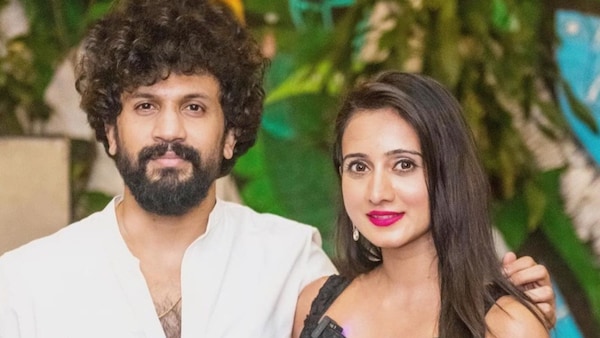
Bhuvann Ponnanna and Harshika Poonacha will get married on August 24
It was an open secret in filmi circles that actors Harshika Poonacha and Bhuvann Ponnanna were more than just friends. In fact, Harshika often introduced Bhuvann as her cousin at public events that they went to together. Since the duo were not willing to openly address their relationship status, it was left unspoken, even though there were tell-tale signs all the way, whether it was their carefully chosen solo pictures from holidays to the same destination at the same time, or their charity work during the pandemic, among others. Bhuvann and Harshika were together pretty much all the time. And now, they’ve finally decided to ‘come clean’ and declare that they are ready to take their relationship to the next level.
Bhuvann Ponnanna and Harshika
Harshika and Bhuvann are set to get married on August 24 back home in Kodagu in a traditional Kodava ceremony. The wedding is expected to be an intimate affair with only close family and friends in attendance, with a reception for their friends from the film industry and Bengaluru’s social circle, where both are quite active, to be held in the city later.
Harshika, who got into showbiz at a young age, way back in 2008, has, over the years, been an integral part of Kannada cinema, and in the last few years, she’d made a mark in the Bhojpuri industry as well. The actress had won a Karnataka State Award for Best Supporting actress in 2010 for her role in the film Thamassu, which had Shivarajkumar in the lead. Bhuvann, who is also an actor, became a household name during his stint on the reality show Bigg Boss Kannada. Bhuvann was a contestant in the fourth season and was later involved in a brawl with eventual winner Pratham, with the latter allegedly biting the former.
source: http://www.ottplay.com/ OTT Play / Home> News / by Team OTT Play / July 01st, 2023
WELCOME. If you like what you see "SUBSCRIBE via EMAIL" to receive FREE regular UPDATES.
Read More »