Tag Archives: Field Marshal K M Cariappa

Field Marshal Cariappa’s Canberra legacy remembered in Indian High Commissioner Nagesh Singh’s Commonwealth Club address

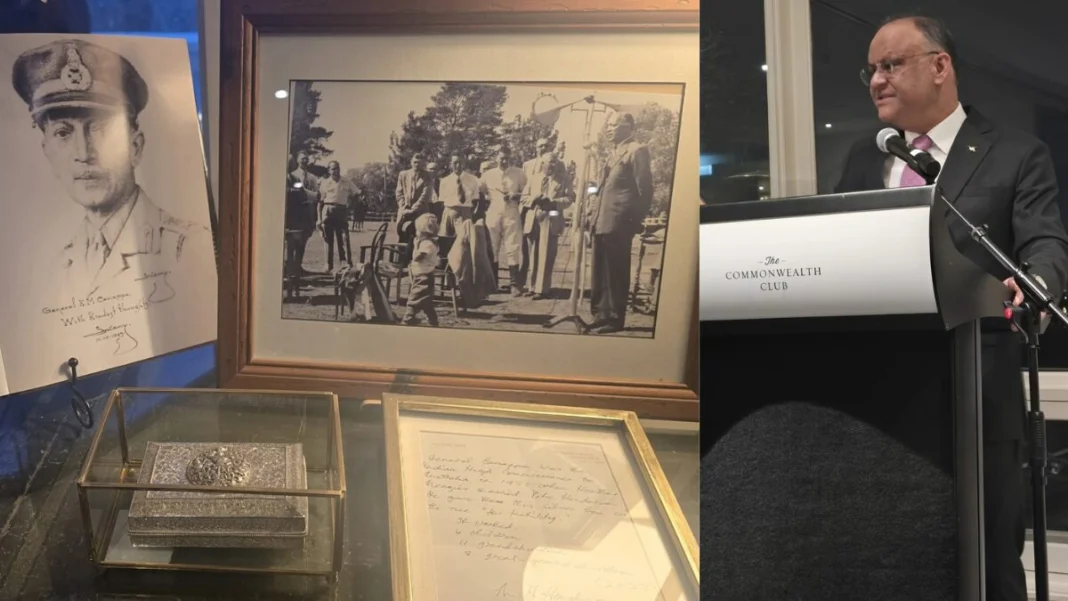
Image: India’s High Commissioner to Australia, Nagesh Singh addressing the Commonwealth Club of Australia’s Capital Lecture Series Dinner in Canberra (Source: X)

India’s High Commissioner to Australia, Nagesh Singh, has highlighted the deepening India–Australia relationship and its historic foundations while addressing the Commonwealth Club of Australia’s Capital Lecture Series Dinner in Canberra.

Singh was the distinguished guest speaker at the event, where he reflected on the longstanding connections between the two countries, their shared Indo-Pacific outlook and the growing breadth of the bilateral partnership.

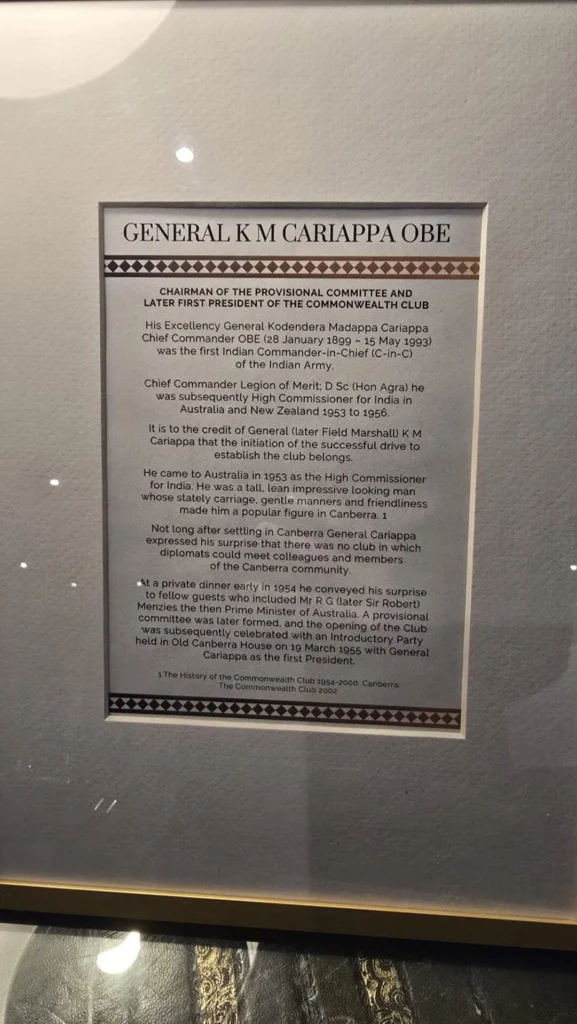
He also highlighted the enduring legacy of Field Marshal K.M. Cariappa, who served as India’s High Commissioner to Australia and played a pivotal role in establishing the Commonwealth Club in Canberra in 1954.

Cariappa arrived in Australia in 1953 and envisioned a neutral and welcoming space where diplomats and members of the local community could meet and interact as equals.

In January 1954, he presented the idea to then Australian Prime Minister Sir Robert Menzies, who encouraged the initiative. Cariappa subsequently brought together community members to establish what became the Commonwealth Club.

The club went on to attract 116 foundation members and welcomed women as members from its beginning. Its first premises were at historic Old Canberra House before it moved to its present Yarralumla location in 1965.

Today, the Commonwealth Club describes itself as a longstanding meeting place for Canberra’s diplomatic, political and community circles, continuing the tradition of connection established by its founders.
Cariappa’s contribution came during an important period in India–Australia relations.

Well-known Australian historian Prof. David Walker has observced that India was among the most persistent international critics of Australia’s White Australia policy during the 1950s, with India’s concerns contributing to wider debate within Australia.

Despite the difficult political environment of the era, Cariappa developed strong personal connections in Canberra and became a well-known figure in Australian social and diplomatic circles.

Cariappa, a distinguished military officer and later India’s first Field Marshal, was also known for his interest in Indian philosophical traditions, including the Upanishads and the Bhagavad Gita.

He arrived in Australia in September 1953 accompanied by his 12-year-old daughter, Nalini, and his niece Sagari Chengappa, who assisted him as hostess at official functions.

The Commonwealth Club’s history reflects Canberra’s evolution from a small early settlement into Australia’s national capital and the development of its diplomatic and community networks.

More than seven decades after its establishment, the club continues to promote the values of connection, diplomacy and community that shaped its foundation.

Singh’s address brought that history into the context of contemporary India–Australia relations, as the two countries continue to expand cooperation across trade, education, defence, technology, critical minerals and the broader Indo-Pacific.

source: http://www.theaustraliatoday.com / The Australia Today / Home> News / by Amit Sarwal / September 26th, 2026

Temple entry row: It is Kodavas vs Arebhashe Gowdas in Kodagu

Kodavas and the Arebhashe Gowdas are two prominent communities in Kodagu, Karnataka.

On February 2,  thousands of Kodava men and women in traditional attire took out ‘Kodavaame Baalo’, an 82km, six-day peace march led by the Akhila Kodava Samaja (AKS) in Kodagu, Karnataka. They did so to reassert their distinct identity and to draw attention to the social, religious and political challenges their community faces.

The trigger for the march was a temple entry row that has pitted two prominent communities in Kodagu―the Kodavas and the Arebhashe Gowdas―against each other.

The newly built Sri Mrutyunjaya (Shiva) temple, in Kattemadu village near Madikeri town, is the epicentre of the dispute. On December 27, when some Kodavas turned up for the annual festival in their traditional attire, some Arebhashe Gowdas stopped them from entering the temple. The “common dress code” as per the bylaw did not allow Kodava attire.

The situation escalated with both sides sticking to their guns. They filed separate complaints and announced massive jaathras (marches) in protest, forcing the district administration to intervene and impose prohibitory orders around the temple. The Arebhashe Gowdas held a massive rally in Madikeri, which the Kodavas followed up with their march from Kutta to Madikeri. The run-up to the two marches was marked by a social media war with both sides uploading provocative videos and posts.

“The Kodava community will not take part in any peace process initiated by the district administration till the police identify and arrest those who attacked Kodavas and attempted to restrict their cultural attire at the temple,” said the memorandum submitted by the AKS to Kodagu Deputy Commissioner Venkat Raja.

Said AKS member J. Ganesh Aiyanna: “A few years before the Mrutyunjaya temple incident, we were prevented from entering Talacauvery during ‘Teerthodbhava’ (annual sacred event at the place where the Cauvery is believed to originate) for wearing our traditional attire. We will not tolerate the assault on our tradition and cultural identity.”

Harsha Kodagana, member of the Arebhashe Samaja, said they were just following the rules. “The temple was built at a cost of around 06 crore, which was collected from devotees belonging to all communities. The 43-member temple committee (which includes nine Kodava members) passed a bylaw with 13 points, including the common dress code. This is meant to build a sense of equality among all communities. Some committee members stopped those wearing the Kodava attire as it violated the bylaw. The temple priest was attacked. We want the police to take suo motu action against people posting derogatory posts on social media and making casteist slurs.”

The Kodavas, however, claim that this is not an isolated case. “Some people from a particular community have belittled our icons Field Marshal K.M. Cariappa and General K.S. Thimayya, who are India’s war heroes,” said Aiyanna. “The Kodava community has a long tradition of serving the Indian armed forces. People have also petitioned the courts to curb our gun rights but the court has restored it till 2029. The gun is revered in a Kodava family as it is an integral part of all our customs. We announce the birth of a baby boy with gunshots, and baby girl by beating brass plates. We have never used these weapons for violent purposes. We are nature and ancestor worshippers and are not involved in any politics. But the assault on our culture is growing.”

The memorandum submitted to the deputy commissioner said that the government must ensure a safe atmosphere for Kodavas to practise their traditions on their own land. It also urged the government to take steps to facilitate Kodava community participation in the Talacauvery rituals, extend constitutional protection for Kodava land, culture, traditions, religious practices and social security, and to curb “political oppression” by dominant communities.

The district administration has sought a report from the temple committee, but notably, the elected representatives―Congress MLAs A.S. Ponnanna (Virajpet) and Mantar Gowda (Madikeri), and BJP MP from Mysore-Kodagu Yaduveer Wadiyar―have kept a safe distance from the controversy.

Interestingly, when it comes to elections, the two communities have supported candidates without caste considerations. Previously, BJP leader Appachu Ranjan, a Kodava, had won the Gowda-dominated Madikeri assembly seat three times, while fellow party member K.G. Bopaiah, a Gowda, had won the Kodava-dominated Virajpet assembly seat thrice.

The temple entry episode is the latest incident that could galvanise the Kodavas, who for long have feared losing their identity. The 1.5 lakh-strong population has been dwindling; there has been fragmentation of families because of migration for education and employment, and inter-caste marriages. The community, under the banner of the Codava National Council, has been resisting the change in demography, loss of land and the alienation of the younger Kodavas from their language and culture. The long list of the council’s demands includes geo-political autonomy, inclusion in the scheduled tribe list, exemption from the Arms Act, inclusion of Kodava language in the Eighth Schedule of the Constitution, recognition of river Cauvery as a living entity, UNESCO’s intangible cultural heritage tag, inner line permit system to prevent demographic changes, and greater representation of Kodavas in Parliament.

The influx of people from outside, commercial exploitation of forests for tourism and massive infrastructure projects have resulted in water scarcity, landslides and floods, say locals. The people of Kodagu include Kodava, Arebhashe Gowda and 21 other Kodava-speaking communities who have lived in harmony despite the many challenges.

“After the backlash by Kodavas over Tipu Jayanti celebrations, the Congress government was forced to stop it,” said a local leader who did not want to be named. “But now, some vested interest groups are playing mischief to divide the Hindu community.”

source: http://www.theweek.in / The Week / Home> The Week / by Prathima Nandakumar / February 16th, 2025