A new climate analysis finds India’s coffee farms absorbed 30 extra days of harmful heat annually because of carbon pollution. Researchers are racing to find alternatives before Arabica and Robusta run out of room.
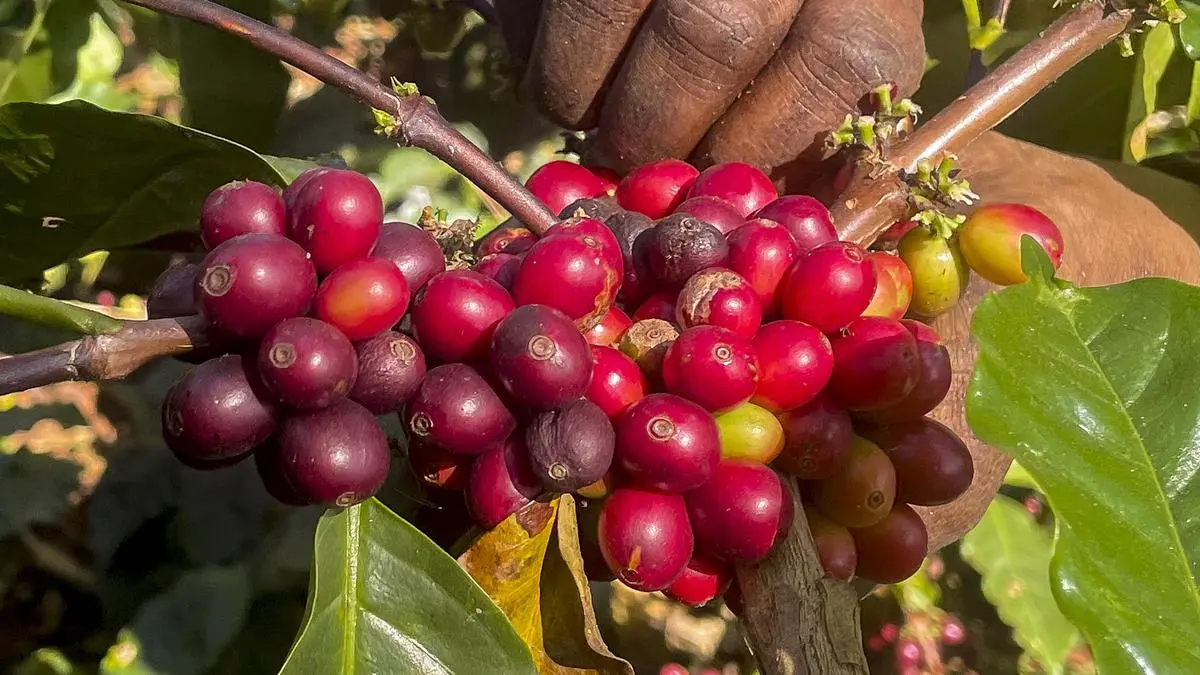
A worker picks ripe coffee cherries at Kelachandra Coffee Estate, in Chikkamagaluru district, Karnataka, on January 10, 2026. | Photo Credit: Laxmi Devi Aere/PTI
More than two billion cups of coffee are consumed every day, and for several years now, surging prices and falling production have marked the global coffee trade. Farmers in the world’s top five coffee-producing countries have faced mounting losses because of a warming planet, and India’s coffee sector is not immune. A new analysis by Climate Central, an independent group of scientists and communicators who research the changing climate, finds that 25 coffee-growing countries together accounting for about 97 per cent of global production all experienced more coffee-harming heat over the past five years.
Kristina Dahl, Climate Central’s Vice President for Science, explained to Frontline in an email interview why coffee was chosen as the subject. “Coffee is one of the most popular beverages in the world and a daily staple for billions of people,” she said. “It also provides a very direct and tangible link between climate change and everyday life. Any climate-driven disruption to coffee production has global ripple effects—from farmers in the ‘bean belt’ to consumers worldwide.”
Coffee plants are highly sensitive to temperature. When maximum temperatures regularly exceed 30°C, the quality and quantity of bean harvests decline. Reduced harvests and lower-quality beans tighten global supplies, contributing to price volatility—as seen in December 2024 and again in February 2025, when global coffee prices reached record highs, Dahl said. For farmers, many of them smallholders, lower yields, crop losses, and the cost of adapting to new conditions strain already thin profit margins.
The analysis, which examined daily temperatures between 2021 and 2025 across 25 major producing countries, is the first to directly attribute the increase in coffee-harming heat days—defined as days when maximum temperatures exceeded 30°C—to climate change using attribution science, she said. Climate Central drew on its Climate Shift Index, which compares observed temperatures to modelled estimates of temperatures in a hypothetical world without carbon pollution. Last year, the organisation conducted a similar attribution analysis on cocoa, another climate-sensitive crop.
Heat is already impacting harvests
The top five coffee-growing countries—Brazil (roughly 37 per cent of global production), Vietnam (17 per cent), Colombia (8 per cent), and Ethiopia and Indonesia (6 per cent each)—together are responsible for 75 per cent of world’s supply, experienced an average of 57 extra coffee-harming heat days per year because of climate change. Brazil averaged 70 additional harmful heat days annually; Indonesia 73; Vietnam 59; Colombia 48; and Ethiopia 34.
The situation is particularly acute in Asia, Dahl pointed out. Thailand recorded an average of about 75 additional harmful heat days a year. India, which contributes approximately 3.5 per cent of global coffee production, experienced an average of 118 coffee-harming heat days per year between 2021 and 2025, of which 30 were attributable to climate change. In a world without carbon pollution, India would have had roughly 88 such days instead of 118. Kerala recorded 65 additional heat days linked to climate change annually; Tamil Nadu 43; and Karnataka, India’s largest coffee-producing State, 32.
These impacts are not theoretical. “In practical terms, rising heat is already affecting harvests in major coffee-producing countries, threatening both quantity and quality,” Dahl said. She pointed out that while earlier studies had linked rising temperatures, drought, and shifting rainfall to reduced yields and shrinking suitable growing areas, the Climate Central analysis adds a new dimension: it quantifies precisely how many additional harmful heat days can be attributed to carbon pollution.
Beyond heat, the analysis notes that climate impacts are worse for Arabica plants, which account for about 60–70 per cent of global supply, since they are more sensitive than Robusta varieties to temperatures above 30°C. Pests and diseases—coffee leaf rust and the coffee berry borer in particular—also intensify with climate change. Without significant reductions in carbon emissions, suitable land for coffee farming could decline by up to 50 per cent by 2050, according to earlier research cited by Dahl. “Adaptation and resilience can only take farmers so far,” she said.
Wild species and the search for alternatives
India is the world’s fifth-largest Robusta producer, and about 80 per cent of its coffee is grown by smallholders, according to World Coffee Research. The country’s coffee exports earned approximately $1.28 billion in fiscal year 2023–24, making it a significant agricultural earner.
Akshay Dashrath, co-founder of the South India Coffee Company (SICC), which he set up in 2017 with his wife Komal Sable as a sourcing and logistics platform, has been researching Excelsa (Coffea dewevrei) since 2019. He found a market initially difficult to reach, but publications by the Royal Botanic Gardens, Kew, on Excelsa and related species accelerated demand. He has been working with Kew for three to four years on climate-resilient coffee species, running trials of Excelsa, Stenophylla, and four coffee species native to India—Coffea bengalensis (found from Chikmagalur to Thailand), Coffea travancorensis, neobridsoniae, and wightiana—on his family’s Mooleh Manay Estate in North Coorg, Karnataka. For the past two years, he has also been breeding Excelsa for better cup quality and commercial viability.
“A hotter environment means coffee is under stress: production per plant reduces, cup quality drops, and the plant weakens. It is happening in specific blocks—those with less shade are more susceptible to disease, and once the plant is weak, it becomes prone to fungal infection,” Dashrath said. He described a severe leaf rust outbreak on his farm: the heavily shaded plants survived, but those under direct sunlight lost their foliage.
Rising heat is not the only problem. He pointed out that for Robusta—and for Arabica—dry air matters as much as temperature. “Heat with dry air is more damaging to certain species,” he said. Excelsa, native to Central Africa, tolerates heat, dry air, and drier soils better than Arabica or Robusta because its root system goes considerably deeper, giving it access to soil moisture that shallower-rooted varieties cannot reach. Dashrath puts Excelsa’s root depth at 4.5 to possibly 7–8 feet, compared with Robusta at 2.5 feet and pure Arabica at around 3 feet.
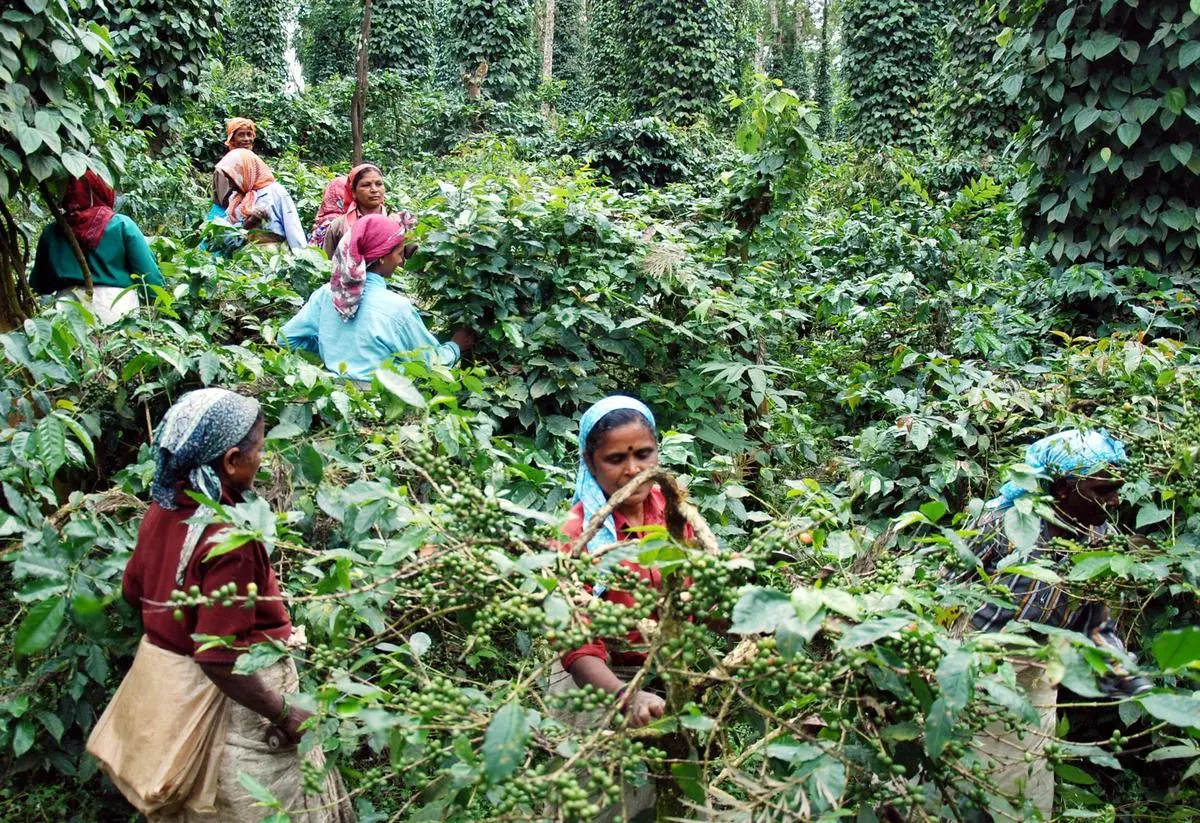
Coffee plants are highly sensitive to temperature. When maximum temperatures regularly exceed 30°C, the quality and quantity of bean harvests decline. | Photo Credit: Prakash Hassan
Indian coffee has been grown under shade since the 1850s, making canopy management central to the crop’s culture. However, Dashrath notes that many growing belts are now thinning their canopy to increase yields by admitting more sunlight, and supplementing Robusta with external irrigation—a trend that could leave farms more exposed to heat and moisture stress.
India also carries a legacy of genetic limitations. “Historically, we had access to diverse germplasm, including hybrids of Arabica, Liberica, and Excelsa,” Dashrath said. “But in the 1940s, the research focus shifted towards developing Arabica–Robusta hybrids for leaf rust tolerance.” The result is that the country’s commercial varieties remain concentrated in two species highly sensitive to warming. The Central Coffee Research Institute, founded in 1925, is conducting research on climate-resilient coffee, though its director did not respond to a request for comment.
The case for Excelsa as a climate buffer became clearer to Dashrath in July 2024, when 33 inches of rain fell on his farm in a single month—far more than the typical annual average of 58 inches. Arabica and Robusta could not withstand the waterlogging, but Excelsa’s deeper root system held. “When we talk of climate-resilient coffee, we need species that can handle not only heat but also climate variability,” he said.
Stenophylla (Coffea stenophylla), a wild species from West Africa, offers another avenue. Rediscovered in Sierra Leone in 2018 after not being seen in the wild since 1954, Stenophylla has been found to tolerate temperatures significantly higher than Arabica while producing a comparable flavour profile, according to research published in Nature Plants in 2021 by scientists from the Royal Botanic Gardens, Kew, the University of Greenwich, CIRAD, and researchers in Sierra Leone. It is currently on the IUCN Red List as “Vulnerable.”
Excelsa currently accounts for about 1 per cent of the global coffee market and is grown commercially in small quantities in Chikmagalur and Coorg. SICC received a grant from Coffee Circle last year to grow Excelsa on trial plots across six different sites; the data from those trials has been shared with Kew, which is mapping climate conditions from Uganda to India and parts of South-East Asia. The trials are informing a broader picture of which plant material performs under changing conditions.
Still, Dashrath is candid about the timeline. Arabica has been bred for around 600 years; Robusta for 150. Excelsa is a wild species with considerable variation from plant to plant, and no consistency in yields. Getting it to a standard where it can compete in commodity markets is a 20–25-year project, he said. “The market is there, but it needs more breeding, standardised seeds, and testing before it can be deployed at scale. Currently it is a niche product, priced rather high.”
There are over 120 recognised coffee species, according to Kew researchers, though most are either inedible or commercially unviable. Coffea racemosa, from Mozambique, has also attracted attention for its claimed heat tolerance, though published data on its upper temperature threshold remain limited. Dashrath is blunt about the bottom line: “If the world gets warmer, coffee-growing areas may shift, or alternatives like Excelsa may need to move to centre stage. To sustain coffee, we need to start looking outside the realm of Arabica and Robusta.”
Concerns about Arabica’s future are felt most acutely in Ethiopia, the crop’s birthplace. Dejene Dadi, General Manager of the Oromia Coffee Farmers Cooperatives Union (OCFCU), one of Ethiopia’s largest smallholder coffee cooperatives and exporters, put the stakes plainly: “Coffee farmers in Ethiopia are already seeing the impact of extreme heat. Ethiopian Arabica is particularly sensitive to direct sunlight. Without sufficient shade, coffee trees produce fewer beans and become more vulnerable to disease.” He called for governments to act on climate change and invest in smallholder organisations capable of scaling up adaptation. “Coffee farming is part of our cultural heritage, and coffee trees are symbols of continuity and pride,” he added. “Ethiopia is the birthplace of coffee, and Ethiopian coffee farmers are key to safeguarding its future.”
Research at the Royal Botanic Gardens, Kew—through a project focused on Excelsa and Liberica coffee and related species, with field and farm trials across Africa and Asia—offers some grounds for cautious optimism. The work is designed to identify which species combinations can sustain coffee cultivation in warming conditions and provide farmers with alternatives to the two varieties that currently dominate.
For India’s approximately 3.6 lakh coffee farmers, most of them dependent on Robusta for their livelihoods, and for the country’s coffee export sector—worth close to $1.3 billion in FY2023–24 and significantly more since—the challenge from climate change is not distant. It is measured, now, in 30 extra days of harmful heat each year, and rising.
Meena Menon is a freelance journalist and visiting postdoctoral fellow at Leeds Arts and Humanities Research Institute, University of Leeds.
____________
Summary
A Climate Central analysis reveals that 25 major coffee-producing countries, including India, are experiencing increased ‘coffee-harming heat’ due to climate change, impacting global production and prices. India faces an average of 118 such days annually, with 30 directly attributable to climate change. This heat stress reduces yields and quality, particularly for sensitive Arabica plants. Researchers are exploring climate-resilient coffee species like Excelsa and Stenophylla, which exhibit better tolerance to heat and variable weather conditions. While these alternatives offer hope, their widespread commercial adoption requires significant research and development, highlighting the urgent need for climate action and adaptation strategies to safeguard the future of coffee.
Key Questions & Insights(AIⓘ)
What is the primary finding of Climate Central’s analysis regarding global coffee production?
Why was coffee chosen as the subject for Climate Central’s analysis?
How does high temperature affect coffee plants and global coffee prices?
What is ‘coffee-harming heat’ as defined by Climate Central?
How many additional coffee-harming heat days did India experience annually due to climate change between 2021 and 2025?
Which Indian states were most affected by climate change-linked heat days for coffee production?
Why are Arabica plants more vulnerable to climate change than Robusta varieties?
What is the potential impact of climate change on suitable land for coffee farming by 2050?
What is the significance of Excelsa coffee in the context of climate change?
What is the current status of Excelsa in the global coffee market?
What is Stenophylla and why is it considered a promising alternative coffee species?
What is the main challenge for India’s coffee sector due to climate change?
_____________
source: http://www.frontline.thehindu.com / Frontline / Home> India> Environment> Digital Exclusive / by Meena Menon / February 25th, 2026

