Coffee to keep tea company in hills

Coffee saplings being distributed among farmers at a village in Kalimpong . File picture

Darjeeling:

Coffee is set to make its debut in the Darjeeling hills which have so far been synonymous with tea.

The Gorkhaland Territorial Administration has decided to give a thrust to coffee plantation in Kalimpong district and picked 407 farmers who have started growing coffee in an area spread over 345.72 acres.

The directorate of cinchona and other medicinal plants has been identified as the nodal agency and is collaborating with the agriculture and horticulture departments of the GTA.

“We plan to brand it as Kalimpong Coffee and the thrust is on organic cultivation,” said Samuel Rai, director, cinchona plantations.

Four village clusters, comprising 34 villages in Kalimpong 1 and Kalimpong 2 blocks, have been formed.

“They are named as Loley, Bhalukhop, Algarah and Gitabling clusters,” said Rai.

To start with, the villagers were selected on the basis of their willingness to grow coffee. “Traditional cash crops like ginger, cardamom, oranges are not doing well and we realised that coffee could be a good alternative. We first spoke to the villagers and identified 407 willing farmers,” said Rai.

The majority of the 87 tea gardens in the hills are concentrated in Darjeeling district. But only six estates can sell their produce as “Darjeeling Tea” and are located in Kalimpong.

“Kalimpong is ideal for coffee plantation as the plant needs a temperature ranging from 20 to 32 degrees Celsius. Coffee is being cultivated by few individuals successfully and we have conducted the trials,” said Madhav Chhetri, a senior scientific officer of the GTA horticulture department.

The GTA has ordered for 7.20 lakh coffee saplings from nurseries in Karnataka which are certified by Coffee Board of India. “About 1 lakh saplings have already arrived. We are planting Chandragiri variety, which is suitable in the area and is both trunk borer and coffee rust-resistant.”

“All the growers will be trained by experts from the coffee board and within the next few months, 40 farmers from the clusters will be taken to Karnataka for further training,” said Chhetri who was also sent to the southern state for a training recently.

The GTA is currently investing Rs 2 crore in the first phase of the project. “At the moment, we are distributing saplings and providing the farmers with 75 percent subsidy,” said Chhetri.

The GTA has decided to set up dry and wet processing units.

Coffee from Kalimpong was also sent to the coffee board for tests. “The results are encouraging and we only need to concentrate on the high moisture level during production,” said Rai.

The GTA officials said initial estimate suggests that a coffee plant bears 6 to 8 kg of green coffee that commands a price of Rs 20 per kilogram in the market.

“If we can hold on to this estimate, then we are looking at selling our produce for around Rs 8 crore. This would be a great start for a project where we are initially investing Rs 2 crore,” said Chhetri.

source: http://www.telegraphindia.com / The Telegraph,Calcutta,India / Home> West Bengal / by Vivek Chhetri / July 05th, 2018
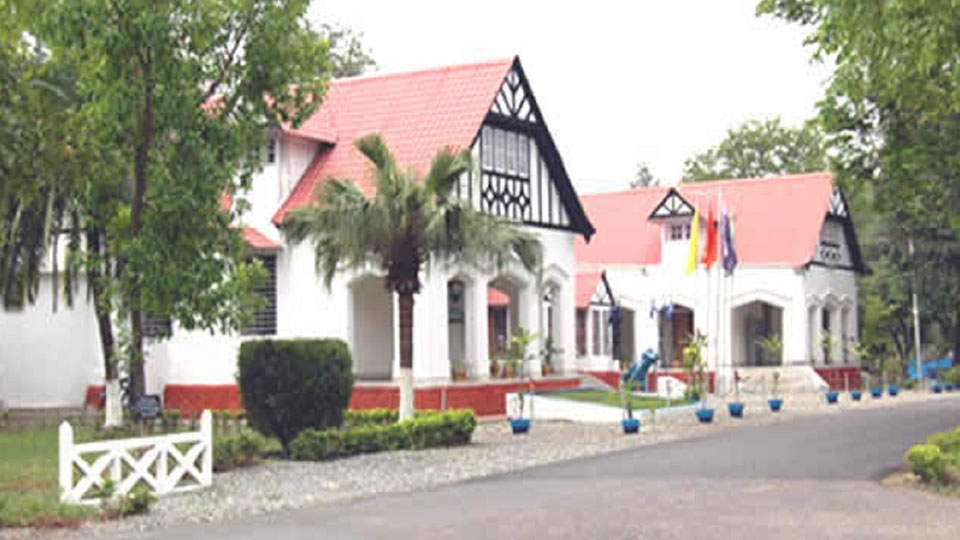
Admission To Military College

RashtriyaMilitaryCollegeKF04jul2018

Mysuru:

The entrance test for admission to eighth standard in Rashtrya Indian Military College (RIMC), Dehradun, will be held in Bengaluru on Dec. 1 and 2.

Boys from Karnataka who are currently studying or have studied seventh standard are eligible to apply. Boys aged between 11 and 13 years as on Jan. 1, 2019 (born between July 2, 2006 and Aug. 1, 2008) are eligible to apply.

The last date for applying is Sep. 30.

The prescribed application form can be obtained from the office of the Department of Sainik Welfare and Resettlement, Field Marshal K.M. Cariappa Bhavan, No. 58, Field Marshal K.M Cariappa Road, Bengaluru-560025 by presenting a Bank draft of Rs. 600 (for General category candidates) or Rs. 535 (for SC/ST candidates), drawn in favour of “The Commandant RIMC Dehradun” payable at SBI, Tel Bhavan, Dehradun (Banl code No. 01576).

The last date for applying is Sept. 30. For details, call Ph: 080-25589459.

source: http://www.starofmysore.com / Star of Mysore / Home> News / July 01st, 2018

Mahabaleshwar Bhat passes away

Neerkaje Mahabaleshwar Bhat

Senior writer and retired principal Neerkaje Mahabaleshwar Bhat passed away on Sunday late night. He was 89.

He had served as the teacher of Madikeri Government High School and later retired as the College Principal in Madikeri.

He was the resident of Biligeri in Madikeri. He had chaired the Madikeri taluk Kannada Sahitya Sammelan held at Moornadu. He had also chaired the District Sahitya Sammelan held at Chembu in 2015.

In fact, Bhat had brought out the stories of Bharathisutha under Kaveri Publications, in the form of books.

Some of his works are “Himalaya Darshana Paryatane,” “Daithya Darshana,” “Avathara Bhat.”

District Kannada Sahitya Parishat President B S Lokesh Sagar has condoled the death of Mahabaleshwar Bhat.

Lekhaka Mathu Kalavidara Balaga has convened a condolence meeting at Patrika Bhavana in Madikeri on July 4 at 3 pm.

source: http://www.deccanherald.com / Deccan Herald / Home> State> District / DHNS News Service, Madikeri / July 02nd, 2018

PHHL: Mebiena Michael is the winner

MebienaKF02jul2018

Mebiena Michael is crowned as the winner of Pyaate Hudugir Halli Lifu season 4. She lifted a glittering trophy with the cash prize of Rs 7 Lakh.

Shahan Ponnama was declared as the runner up.

Mebiena who was tipped to win the show for doing tasks immaculately. She thanked everyone for supporting her through the journey.

Priyanka secured third place. Another contestant Abhijna Bhat who posed strong competition to Mebien did not feature in top three winners list.

The show hosted by Akul Balaji ended with a glitzy finale at Banavani village near Gorur of Hassan.

From next Monday, instead of Pyaate Hudugir Halli Lifu, new soap opera Shree will go on air at 9pm.

source: http://www.timesofindia.indiatimes.com / The Times of India / Home> News> TV> News> Kannada / TNN / June 30th, 2018

It’s Honey Calling

CoorgHoney01KF02july2018

Madikeri:

Any talk of Kodagu often begins with the aromatic coffee, golden-glazed honey and some lip-smacking authentic delicacies. Honey has a special place in the district and Kodagu is known to produce distinct and rich honey that is famous for its originality, purity, taste and longevity even when stored in closed containers for years together.

However, the district hit a low in honey production in the 1990s as Thai Sac Brood disease hit the industry hard. Said to have originated in Thailand, the disease killed bees, including the queen bee and so far there has been no effective remedy for the disease. Also, the red ant menace further crippled the industry and most of the apiculturists were forced to switch to other means of livelihood. So badly affected was the industry that the honey production in Kodagu has dipped to a low of 50 percent in the late 1990s.

Now slowly the industry is regaining foothold and thanks to people who are growing conscious about their health and healthy habits, there is a global market for Coorg Honey. Honey is produced mainly in Bhagamandala, Galibeedu and Cherangala of Madikeri taluk, Birunani, T. Shettigeri and Kedamulloor in Virajpet taluk, Shanthalli, Jakkanalli, Soorlabbi, Hammiyala, Hachchinadu, Kumbaragadige and Mutlu in Somwarpet taluk.

CoorgHoney02KF02july2018

At present, Kodagu has over 7,000 bee-keepers and Bhagamandala region alone accounts for more than 50 percent of production of the district with the total being about 850 tonnes.

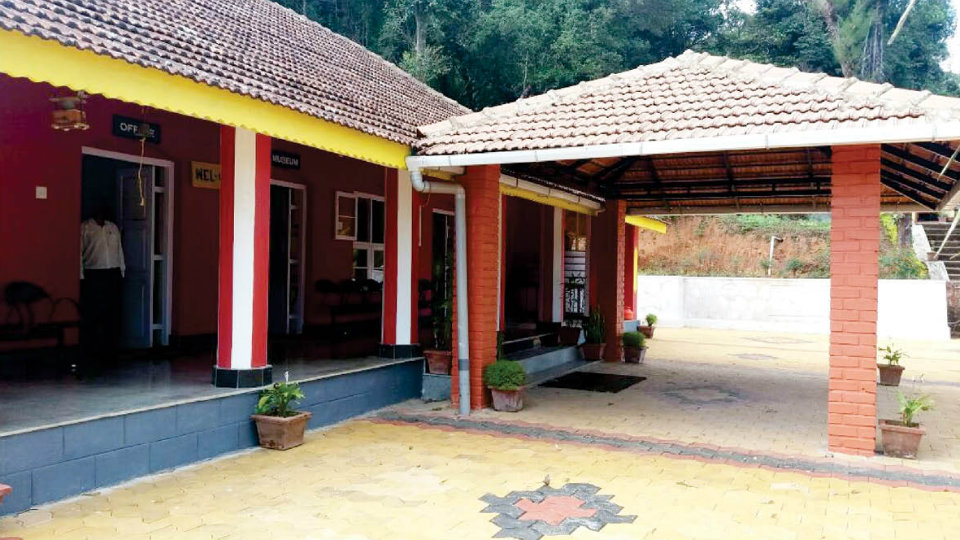
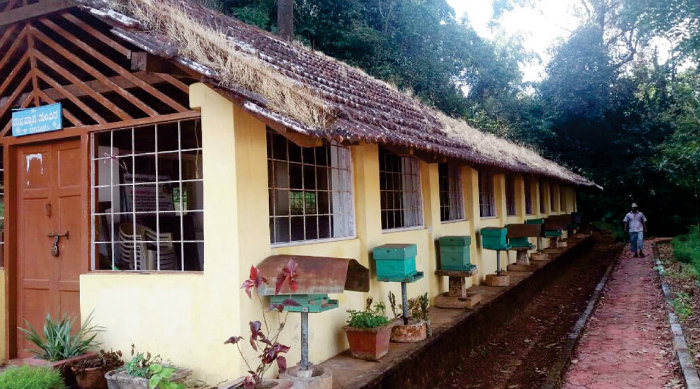
To bring back the glory of honey production in Kodagu, the State government has set up a Honey Park in Bhagamandala where the only Apiculture Technical Training Centre of State is located. The Park also houses a Honey Museum. The Park and the Museum are the first in the State.

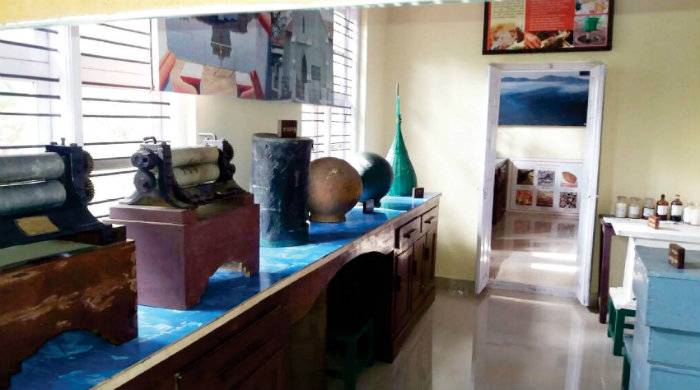
Honey extractors, beehives, honey containers, honey pots on display at the Honey Museum.

Built at a cost of Rs. 1.42 crore, works on the Honey Park began in 2015 and is completed now. The Park is housed at Apiculture Technical Training Centre that was established at Bhagamandala way back in 1948 by the then Coorg State Government. Funds for the Honey Park was released by the State Horticulture Department and initially in 2015-2016, Rs. 50 lakh was released. Later, in 2016-2017, Rs. 82 lakh was released and Rs. 10 lakh was released in 2017-2018.

A honeycomb kept for demonstration at the Honey Park.

The Honey Park acts as a comprehensive centre for honey production and related activities. It would also endeavour to provide marketing facilities for the product in the entire State. The Park is being maintained by food processing division of Agriculture Department. The Park has been set up to promote apiculture, which will supplement the income of the farmers.

According to officials managing the Honey Park, they get regular visitors who want to know about honey production, the costs and apiculture procedure.

CoorgHoney05KF02july2018

Certificate course

“We will provide a three-month certificate course during November-December-January for students and professionals who want to take up apiculture as a part-time business,” they said. Hostel facilities will be provided to the trainees during their three-month stay at Bhagamandala and already many students from Mysuru, Belagaavi, Koppal and Dharwad have enrolled for the training programme.

This apart, the Honey Museum traces the history of honey in Kodagu, its origin, golden period, its gradual decline owing to diseases and the present state. Also, it gives the visitors information about global honey growth and how it has become popular among health freaks. Models have been prepared and ways and means of honey extraction with machines and bare hands without getting bitten or stung by bees are demonstrated here.

A short movie screening is another attraction in the Honey Park. It captures the honey development in Kodagu. The centre will train local tribals and farmers in apiculture. Tribals will be trained in collecting honey in forests. This in turn will help in improving their economic conditions.

source: http://www.starofmysore.com / Star of Mysore / Home> Feature Articles> News / June 30th, 2018

Strongest Coffee In The World Is Headed To International Space Station

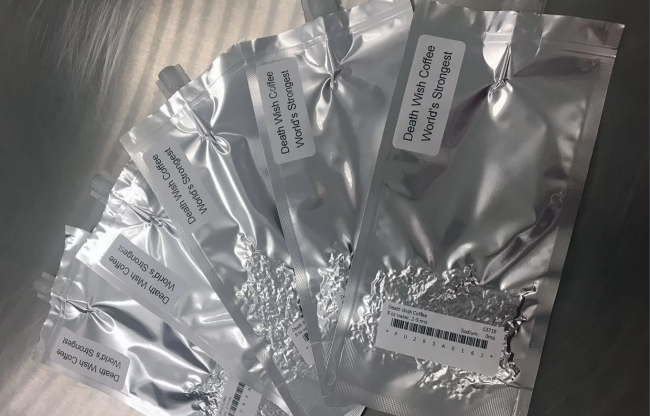
Death Wish Coffee is sending what is hailed as the world's strongest coffee to astronauts at the ISS. The blend contains 200 percent more caffeine than standard coffee. 	( Death Wish Coffee )
Death Wish Coffee is sending what is hailed as the world’s strongest coffee to astronauts at the ISS. The blend contains 200 percent more caffeine than standard coffee. ( Death Wish Coffee )

The world’s strongest coffee is headed to the International Space Station. It will launch into space on June 28 aboard SpaceX CRS-15.

Contains 200 Percent More Caffeine Than Regular Coffee
Death Wish Coffee is billed by its producer as the strongest coffee in the world for its high caffeine content and intense flavor.

The coffee company said that the blend contains 200 percent more caffeine compared with standard coffee, which could give astronauts the added punch that they need while working at the space station.

“Death Wish Coffee is the world’s strongest coffee with the highest-caffeine content available, resulting in a buzz that blows other coffees out of the water,” Death Wish Coffee described the product.

“And because we’ve taken the time to source fair-trade, USDA-certified organic coffee beans and refined our roasting techniques, we’ve created a high-caffeine coffee with low acidity that tastes good, too.”

Specially Packaged Death Wish Coffee For Astronauts Aboard The Space Station
The company is sending crew members of Expedition 56 a special freeze-dried version of the coffee packaged in the same foil packets used by astronauts for other beverages including normal-strength coffee.

Death Wish coffee is normally sold in 1-pound bags of whole and ground beans as well as in K-Cups, but the space-bound coffee is specially packaged by NASA in astronaut drink pouches.

Death Wish said that the coffee is designed to caffeinate astronauts aboard the ISS sans sacrificing the texture, flavor, and potency of the coffee.

Mike Brown, the founder of Death Wish Coffee, revealed about the plan to provide the world’s strongest coffee to astronauts aboard the orbiting laboratory in a statement dated June 6.

“We couldn’t think of a better way to showcase the smoothness and strength of our coffee than by providing the crew aboard the International Space Station with an easy-to-make blend that will keep them on their feet,” Brown said in a statement.

Coffee And Coffee Machine For Astronauts Working In Microgravity
Coffee is a staple aboard the ISS as early as 2000, the year the first batch of crews arrived at the orbiting lab.

Astronauts and cosmonauts can choose from caffeinated or decaf instant coffee. Kona blend with just sugar or powdered cream or both already mixed in are also available.

The space station received its first coffee machine in May 2015 with the arrival of the Lavazza and Argotec ISSpresso.

source: http://www.techtimes.com / Tech Times / Home> Science> Space / by Allan Adamson Tech Times / June 27th, 2018

Cauvery Gallery may soon become a reality

CauveryKF30jun2018

The Cauvery River Gallery, which was proposed to be established in the city, five years back, may finally be a reality with Chairman of the Karnataka Knowledge Commission and former chairman of ISRO K Kasturirangan announcing that he has spoken about the project with Chief Minister H D Kumaraswamy, in Bengaluru, recently.

The formation of the Cauvery Tourism Development Authority was mooted in March 2015 and the idea of the Cauvery River Gallery was discussed in the first meeting of the authority, chaired by then Tourism minister R V Deshpande, in June 2015. Neither of them materialised so far, even though the previous chief minister was a native of Mysuru district, the nucleus of the Cauvery River basin.

According to the annual report (April 2016 – March 2017) of the National Academy of Sciences of India (NASI), River Cauvery is among the most sacred rivers in the southern region of India and is thought to be the Dakshina Ganga, on account of its diverse characteristics and attributes.

“Originating from the Brahmagiri Hill in the Western Ghats and flowing towards the Bay of Bengal, the river travels along Karnataka and Tamil Nadu in the southeastern direction. River Cauvery is well inscribed in Tamil and Kannada literature because of its sacredness. Bathing in waters of Cauvery is a traditional belief. The striking Shivanasamudram falls of Cauvery River is the second biggest waterfalls in the country.

At the request of Minister for Higher Education and Tourism, Government of Karnataka, K Kasturirangan, Chairman of Karnataka Knowledge Commission, requested Manju Sharma, former president of NASI, to establish a Cauvery Gallery on the lines of Ganga Gallery and Brahmaputra Gallery.

Manju Sharma, with the consent of the NASI Council, sent a preliminary intent proposal to establish a high-quality gallery that captures the etymological, ecological, cultural, heritage and social characters of River Cauvery,” the report states.

The Cauvery Gallery can be established with the help of the National Council of Science Museums (NCSM), Kolkata, and the financial support of the department of Tourism, Government of Karnataka. Interactive multimedia with diorama, animation, graphics and the 3-D display will be used to make the gallery interactive and interesting for visitors, the report states. At present, there is a gallery for River Brahmaputra in Guwahati, in Assam, and a gallery for River Ganga at Allahabad, in Uttar Pradesh .

The gallery is expected to showcase the life, culture and biodiversity along the Cauvery River from its birth in Talacauvery of Kodagu district till it reaches the Bay of Bengal at Poompuhar (now Pombuhar) in Nagapattinam district of Tamil Nadu. It splits into two, twice, and forms the islands of Srirangapatna and Sivanasamudra in Karnataka.

Kasturirangan has said that he held talks with Chief Minister Kumaraswamy on setting up of the gallery on the Karnataka Exhibition Authority Grounds (Dasara Exhibition Grounds) in Mysuru and a detailed project report would be prepared soon.

In 2016 itself, Karnataka’s Tourism department and the NASI had signed a memorandum of understanding to set up the gallery at Mysuru. Then, the Tourism department officials and NASI experts had decided to establish the gallery on the premises of the Karnataka Exhibition Authority (KEA) complex. The project was scheduled to be completed in six to nine months and was expected to be a major tourist attraction in the city. The KEA complex is also yet to be constructed.

source: http://www.deccanherald.com / Deccan Herald / Home> State> Mysuru / by T.R. Sathish Kumar, DH News Service, Mysuru / June 28th, 2018

As Much Oltmans Knows Us, Our Team Knows His Coaching As Well Sv Sunil

For Indian hockey team the opening encounter in the Champions Trophy is vital as it will set the tone for …

For Indian hockey team the opening encounter in the Champions Trophy is vital as it will set the tone for the rest of the tournament, believes Indian veteran SV Sunil, speaking to NNIS exclusively in Breda, ahead of the big clash against Pakistan.

Sunil speaks on arch-rival Pakistan and whether it is an advantage for Pakistan Coach Roelant Oltmans, a former India coach of knowing the boys in and out.

source: http://www.deccanchronicle.com / Deccan Chronicle / Home> Sports / June 23rd, 2018

Yamini Muthanna On DD Chandana

YaminiKF29jun2018

Mysuru:

A 26-episode TV programme titled “Do it with me,” written and directed by Bharathanatyam exponent and teacher Yamini Muthanna and picturised at her studio Yogastala in Indiranagar, Bengaluru, is being telecast by Doordarshan (DD) Chandana Channel.

The TV series, which has sequences of Yoga Asana patterns for therapeutic benefits, aims to inculcate a habit of practicing Yoga on a daily basis.

The show is being telecast on DD Chandana every Saturday and Sunday from 7 am to 7.30 am and repeat telecast on Tuesdays and Thursdays from 7 am to 7.30 am.

The show will soon be telecast in the National Network and also in the Regional Channels as the translation work is under progress.

source: http://www.starofmysore.com / Star of Mysore / Home> News / June 24th, 2018

Opinion divided on private sanctuaries next to reserves

Majority of those who attended stakeholders’ meeting sceptical of the concept

The stakeholders’ meeting on the State’s attempt to permit private sanctuaries adjoining national parks and tiger reserves, held in Bengaluru on Monday, elicited conflicting opinions. This only served to underline the division between the conservationists and officials on the initiative.

It also brings to the fore the imperatives of a thorough discussion on the subject given the sensitivity of the issue and the environmental and social ramifications.

Vandita Sharma, Additional Chief Secretary, Forests, Ecology and Environment, who chaired the meeting, said she has been flooded with views on why the private conservancy rules should or should not be introduced. Hence this calls for a comprehensive discussion on wide-ranging aspects before taking the initiative forward.

Some of the speakers cautioned that the concept of private conservancy was non-existent in the Indian laws or the Wildlife Protection Act. Hence the very legality of framing a policy on private conservancies in Karnataka has to be examined because the Wildlife Protection Act, being a Central Act, overrides the State laws if it is at variance or conflict with the former.

There were also views that one had to study the pros and cons that prevail in other countries where such a model is in place and wondered whether such a law should be proposed at all in the first place.

Sanjay Gubbi, wildlife biologist, said one should consider ecological and social aspects, the economic incentives local communities derive etc., and then go ahead with the experimentation.

“I am not sure how many promoters would be willing to invest as the area has to be first notified as a Private Forest under the existing legal provisions. Once it is declared as a Private Forest, then the laws governing the Forest Conservation Act, Supreme Court order of WP 202/1995, etc. will all become applicable,” he said.

Col. C.P. Muthanna ((retd) of Coorg Wildlife Society was sceptical of the concept reducing the conflict situation by merely augmenting the sanctuary boundary with private conservancy.

He feared it would only bring animals closer to human habitation and escalate human-animal conflict, besides increasing local communities’ hostility against the Forest Department and wildlife.

However, Sudheer, of Voice for Wildlife, opined that the proposal provided a legal framework for genuinely interested people keen to promote conservation and forests.

Allaying fears of commercial exploitation, he argued that the draft rules make it clear that only 5% of the private conservancy area can be utilised for tourism and no change of land use would be permitted for the remaining 95%. This itself was a disincentive to keep investors who are not conservation-minded, out of the picture, he added.

D. Rajkumar of Wildlife Conservation Foundation, said there was no rationale to suggest that by merely declaring a portion of land outside forest boundary as “private sanctuary” it would mitigate conflict situations. The general drift of the argument against the concept was that it cannot be pushed merely to promote tourism and one had to look at the ecological and social aspects as well.

P. Sridhar, head of Forest Force; Jayaram, Principal Chief Conservator of Forests (PCCF); former Forest Department officials; wildlife conservationists; NGOs; and representatives of the hospitality sector were among those present.

source: http://www.thehindu.com / The Hindu / Home> News> States> Karnataka / by Special Correspondent / June 26th, 2018