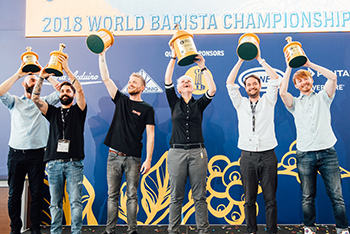
Agnieszka Rojewska wins World Barista Championship

Image credit: World Coffee Events, SCA and Jeff Hann.

Agnieszka Rojewska of Poland has won the 2018 World Barista Championship (WBC). Agnieszka, a veteran of multiple coffee competitions across the globe, triumphed over 55 other baristas to become the first woman ever to win the title.

Lex Wenneker of The Netherlands was runner up, Mathieu Theis of Switzerland was third place, Michalis Katsiavos of Greece was fourth, Cole Torode of Canada was fifth place, John Gordon of New Zealand was sixth place, and Craig Simon of Australia finished in seventh place.

“I never thought I’d be in the final so the fact I [was] is the best experience,” Rojewska said post-performance. “This is like the craziest day of my life.”

Rojewska of Full Pro Coffee has been making coffee for more than 10 years. She started working in a coffee chain before starting her own cafe. Agnieszka now works mostly as a coffee trainer, but has spent the past four years competing in various coffee competitions, tackling almost every category of competition there is to win.

Rojewska is a three-time Polish Barista Champion and four-time Polish Latte Art Champion with a career high ranking of third in the world in 2017. Rojewska will compete in Poland’s Brewers Cup Championship on Sunday 1 July, and will attempt another world title when she competes in the World Latte Art Championship in Brazil from 7 to 9 November.

Last year, Rojewska placed Runner-Up in the Polish Brewers Cup competition and New York Coffee Masters, but this year has been one of first places, winning the London Coffee Masters competition in April, and now the WBC in Amsterdam.

For her 15-minute routine, Rojewska used a coffee sourced from Project Origin Coffee’s CM Selections lot in Mesina, Ethiopia, a new coffee growing area. Because of the fresh soil and young 10-year-old trees planted at 2300 metres above sea level, Agnieszka said the result in the cup would have “more intense yellow fruit characteristics” and “extraordinary sweetness”.

The Heirloom cultivar underwent washed carbonic masceration processing, a concept Ona Coffee Founder Sasa Sestic first presented to the WBC in 2015, the same year he won the event. With this process, the coffee is depulped, put into tanks and pressurised with carbon dioxide to remove all oxygen and encourage lactic bacteria. The coffee was roasted by 2017 Brewers Cup Runner Up Sam Corra of Ona Coffee.

Rojewska says she chose to use Ethiopian coffee because of how expressive it is, with flavours of yellow and red fruit that are easy to recognise. “It was the first coffee I have fallen in love with,” Rojewska told the judges.

To make her milk beverage exude strawberry notes, Rojewska prepared a more intense espresso using 23 grams in the basket and 36 grams out via the Victoria Arduino Black Eagle machine. She added three-and-a-half ounces of milk to help achieve notes of milk chocolate and warm strawberry jam. The full cream milk had a high fat content for a creamy texture and combined with a lower temperature, reminded Rojewska of slow-melted chocolate ice cream.

Despite her accomplished latte art skills, Rojewska poured a simple small heart in the centre of each cup to help stretch the milk, give more aromatics, and more intense strawberry flavours.

For her signature beverage, Rojewska used Ona Coffee’s O.C.D and Stem devices to produce her shots and made a passionfruit infusion. This was made adding 100 grams of passionfruit to 30 grams of coconut sugar, 50 millilitres of water, and cooked for three hours at 60°C for more natural tropical fruit notes. To replicate the same lactic acid bacteria used in washed carbonic masceration, Rojewska used 100 grams of warm milk and seven grams of citric acid in the form of lime juice, which she then let sit and separate for three hours before straining three times. The end result was 20 grams of ‘washed milk’ and a creamy mouthfeel in her signature beverage. She added 4 grams of this liquid to 100 grams of water infused for 20 hours at 120°C, and blended it together with her espresso shots at 20 grams in the basket, 35 grams out.

Lastly, Rojewska prepared her espressos using the same Ethiopian coffee. Despite her coach Sasa Sestic pointing out that she was 20 seconds behind in his Livestream commentary, Rojewska pushed on, using 20 grams in the basket and 45 grams out to achieve medium sweetness, medium bitterness, and flavours of orange, plum, and low intensity of peach. She used visual aids to describe the body and texture of the body and concluded with a simple message.

“It’s my greatest pleasure to bring this world stage coffee to you as my customers, and most importantly, my friends,” Rojewska said with one seconds remaining on the clock.

In the past week, thousands of coffee professionals gathered in Amsterdam for World of Coffee (WOC), one of Europe’s largest coffee trade show, and the host of the 2018 WBC. Just under 11,000 professionals from across Europe and around the globe registered to attend, breaking records for the event.

Next year, WOC heads to the German capital of Berlin from 6 to 8 June, 2019 at the Messe Convention Center.

source: http://www.gcrmag.com / Global Coffee Report / June 25th, 2018

There were times I regretted taking up wrong projects: Harshika Poonacha

In a freewheeling conversation with City Express, Harshika Poonacha, who awaits the release of Chitte, looks back at her decade-long career and gives us the low-down on her choice of films

Harshika Poonacha. (Photo | Instagram/harshikapoonachaofficial)

As the release of Chitte draws close, actor Harshika Poonacha’s anxiety is on the rise. And naturally so. But as she awaits the release and reaction from fans and fraternity to know how the film will fare at the box office, the actor has been hopping from bus stands to metro stations and railway stations, and has even been frequenting malls. During interactions with the public, she is posing like a chitte (butterfly) and even challenging her fans to. Ahead of the release of the film directed by ML Prasanna with Yashas and Harshika in lead roles, the actor, who started her career at the age of 15, tells City Express about how her early days when she played support roles which has given her the confidence that she will one day play lead roles with top stars. Excerpts.

Still from Chitte
Still from Chitte

How different is Chitte from your other films

So far, my roles have mostly been those of school girls or college-goers. Otherwise, it’s been love stories with a happily-ever-after ending. In Chitte I play the role of a married woman, who is bubbly. What we’re trying to say is, ‘Who said a married woman cannot be bubbly?’ And this is the first time that I’m going to be scaring viewers. It’s something to watch out for. (laughs). Playing the kind of role like I do in Chitte was a totally new experience. The challenging bit was bringing out the horror element. Having grown up watching actors like late Soundarya Ma’am in Apthamitra, I thought helped me pull off the role. Of course, that’s not to say that I’m anywhere close. But she has been my inspiration to play a role like this. Horror films in Sandalwood are taking shape, and audience are also showing interest in such films.

You made your debut at a time when many others did. Would you call yourself the dark horse?

I entered the industry at the age of 15, and this is my 10th year in the cinema industry. I remember how many people were making their debut at the same time I was. It was a year when there was a wave created in Sandalwood with fresh faces. Having said that, nobody has stuck on this long. I have seen heroines who have done two-three films and then disappeared. During these 10 years, I have not taken a break. This journey has given me my identity. I’m known by my real name than just that as a film’s heroine. I have come to a stage where people whistle when I enter and cheer for me. At the end of the day, this is what every actor looks for, and I feel content. I wouldn’t have been happy if I was sitting in a cubicle as an engineer. It can’t match the satisfaction when I face the camera, get my make up and hair done, and rehearse dialogues. The feeling is soulful.

Do you regret taking up some films in the early stages of your career?

There was a time when I regretted taking up wrong projects in the early stages of my career. But now I have decided that I live my life without regrets. Tell me any hero or heroine who has not done wrong films in his/her career. Every actor has gone through it or will go through it. Those so-called wrong projects have been a learning for me. Those were the films that had kept me busy, and ultimately helped me pick the right films. I have done close to 23 projects. I am happy to have a solid number.

What is your next course of action?

I started off playing the role of a sister to top stars in Sandalwood, but now I’m confident that I will get to star opposite them. I was young and most filmmakers considered me for the sisterly kind of roles. I’m at an advantage compared to many other heroines who make their debut at 25. I, on the other hand, already have ten years experience on my side.

source: http://www.newindianexpress.com / The New Indian Express / Home> Entertainment> Kannada / June 27th, 2018

Obituary : Thathanda Gowramma Muthamma

TathandaKF28jun2018

Thathanda Gowramma Muthamma (Thamane Balianda), wife of late Thathanda Muthanna, passed away this morning at her residence in Rajivnagar 1st stage in city. She was 94.

She leaves behind three sons, two daughters and a host of relatives and friends.

Cremation was held at the foot of Chamundi Hill at 1.30 pm today, according to family sources.

source: http://www.starofmysore.com / Star of Mysore / Home> Obituary / June 14th, 2018

Coffee sector seeks govt support for re-plantation

City: Chennai

With a large majority of coffee plantations having turned old and unproductive, coffee sector is seeking a Colombian-model re-plantation support from the government.

Abysmally low yield, lower price realisation and high levels of debt have been restraining the sector from taking up re-plantation on its own.

Re-plantation is long overdue for 65-70 per cent of India’s coffee farms. About 65 per cent of plants are more than 40 years old and for those varieties, the maximum yielding age of the plants is 35-40 years. Some of the better-yielding newer varieties have a shorter life of around 25 years and a good number of these newer varieties are also due for re-plantation, said AL RN Nagappan, coffee committee chairman of UPASI.

By retaining the older plants, both production and yield has been coming down. Coffee production, especially arabica production has been falling year-after-year in the past five years. From 120,000 tonnes, it has dropped below 90,000 tonnes.

The yield too is abysmally low. “We cannot even compare our yield with that of Brazil or Colombia. If an acre of coffee plantation provides 1.5 tonnes of coffee in Brazil, it would hardly produce 300 kg in India,’ said Nagappan. Inability to mechanise the plantations due to the hilly and rocky terrain also has been affecting the yield. According to Ramesh Rajah, president of the Coffee Exporters Association, coffee growers in the India are not in a position to take up the task of such large-scale re-plantation as most of the growers are incurring losses due to lesser price realisation and higher input cost.

“If the input cost on an acre is around Rs 70,000, the income would be around Rs 40,000 to Rs 45,000. The grower is incurring a loss of around Rs 30,000 on an acre of coffee plantation,” said Boje Gowda, chairman, Coffee Board of India.

The growers have been relying on the pepper vines to make up for the losses. “But the pepper prices too are down this year,’ added Nagappan.

According Gowda, almost 80 per cent of the growers have defaulted on their loans and the non-performing assets of the coffee plantation have become a burden for the banks.

In such a scenario, the sector is looking forward for support from the part of the central and state governments. “The government should take a leaf out of the re-plantation scheme being provided for growers in Columbia. The government has been providing financial support for the past few years and now the country has been able to enhance its production significantly,” said Rajah.

Since 2009, Colombia has been replanting around 85,000 hectares of coffee plantations every year. The government has been providing subsidy for the every replanted coffee.

“We have been requesting both central and state government to provide subsidies on the inputs like fertilizer electricity and machines,’ said Gowda.

As the grower has to forego the income during re-plantation, he also wants financial support during that critical period. “We are also expecting an interest waiver for the loans so that the growers can pay back at least the principal,” said Nagappan.

source: http://www.mydigitalfc.com / mydigitalfc.com / Home> Miscellany / by Sangeetha G

Move To Include Kodava As Third Language In State, CBSE Syllabus

Karnataka Textbook Society writes to DDPIs to furnish details about number of students available to study Kodava language
KodavaLanguageKF28jun2018

Bengaluru:

The Karnataka Textbook Society that comes under Department of Public Instructions, Government of Karnataka, has written to Deputy Directors of Public Instructions (DDPIs) on the inclusion of Kodava language from First Standard to 10th Standard as a third language in the State Syllabus and Central Board of Secondary Education (CBSE).

The Society is responsible for printing and distribution of textbooks based on the State syllabi for lakhs of children of Classes 1 to 10 in Government, Aided and Unaided Schools of Karnataka.

The letter (copy of which is available with Star of Mysore) was initially sent from the office of Principal Secretary (Primary and Secondary Education) on 13.06.2016 and 10.04.2018 asking the DDPIs and Deputy Director (Administration), Department of Public Instructions, to furnish details about the number of students who will be available to study Kodava language if it is introduced as the third language.

Though the letter was sent in 2016 and another reminder sent in April this year, no action has been taken either by Deputy Director (Administration), Department of Public Instructions, or by DDPIs across the State. Taking objection to this, the Patya Pustaka Sangha has again (04.05.2018) written to the DDPIs and DD Administration to furnish the details. The latest letter has been sent by Narasimaiah, Managing Director.

‘Move beneficial for language’

Though language scholars say that the move to include Kodava language as a third language will ultimately benefit the language and culture of Kodagu, having Kodava language as a medium of instruction is financially unviable.

According to research scholars, who have conducted extensive research in Kodagu, its language and culture, a majority of Kodavas consider Kodava as a language of culture rather than education. They feel that Kodava language is not adequate enough to be a medium of education even at the primary level.

Many Kodavas prefer English as the medium of education and those who can afford it send their children to English medium schools. Even people with a positive attitude towards Kodava language also do not advocate for Kodava medium as they feel that it will not be economically viable. Financial resources, textbooks, availability of the teachers, etc., are the major problems, they say.

However, linguists are of the opinion that learning through a language other than the mother tongue creates interpretative thinking while education through the mother tongue develops creative thinking. Mother tongue also helps preservation of minority language and culture. As such, education through Kodava medium at least in primary education will benefit the language and culture, say linguists.

source: http://www.starofmysore.com / Star of Mysore / Home> News / June 28th, 2018

Ashwini Ponnappa lives the football World Cup dream

The badminton ace had a whale of a time watching the FIFA World Cup in Russia.

Indian badminton ace Ashwini Ponnappa had an exhilarating time in living the football dream by catching the FIFA World Cup from close quarters in Russia.

Soaking in the football frenzy Ashwini said the experience was unforgettable. “I had a fantastic experience. I have never felt the kind of atmosphere and buzz that I felt at the World Cup anywhere else. Of course the Olympics and the multi-sport events have an amazing vibe, but that I can say as being a player and getting to live at the village. In Russia, being a spectator, the vibe at the host cities was just electric,” she said.

The Indian player said fellow fans made the experience more special.

“A sport like football is definitely made up by the fans. Everyone who were there were for football alone. It was amazing to see people from different parts of the world come in numbers to cheer either for their home countries or the countries they support along with also representing there own countries which haven’t qualified.

It was like a gigantic sports carnival. Everywhere we went we’d see fans chanting and singing. I had goosebumps every time we came a cross huge gatherings of fans chanting and singing in unison. It was electric!” she explained.

The fanfare also presented Ashwini an opportunity for a learning.

“There was so much to learn watching these players. It is amazing to see how they deal with pressure. It is not easy when you have an entire nation depending on you to do well for them (fans,country). Star players have more pressure cause they are expected to perform their best in every match from the everyone. To watch a player like Ronaldo stepping up and playing the way he did against Spain was just amazing.”

Simply ‘Inspiring’

The trip was also inspirational to the badminton star. “Thanks to being there and the football craze, I’ve also been reading a lot of stories of different players and it’s just been very very inspiring. How you’ve got to believe in yourself when no one else does.

How determination and belief can work miracles. I loved reading Romelu Lukaku’s story which was sent by a friend. I had tears reading it. Or that of Aron Gunnarsson. I definitely want Iceland to do well after reading his story (laughs). It takes years and years of hard work and sheer determination to get to where they are like any other sport.

I think one of the nicest things about football is that it is easily accessible to everyone from all walks of life. It gives hope to so so many people, it gives people confidence and brings countries up when their players do well,” the 28-year-old player added.

Memorable Moment

Ashwini said the stand out moment was watching Cristiano Ronaldo and Lionel Messi ply their trade and watching the Spain vs Portugal match.

“The best part apart from just being present at the World Cup was getting to watch Ronaldo and Messi play live. The kind of expectations they have from their fans is crazy. It was more like they are expected to win and perform as a one man army. Watching Spain vs Portugal was definitely a highlight for me. Ronaldo played well and led the team like a boss and delivered despite the crazy pressure,” she said.

“Watching Argentina vs Croatia was sad. I did expect to watch incredible Messi work his magic as did the large number of Argentina fans. It isn’t possible if the team on the whole isn’t feeling confident and aren’t into the game. With all that’s going on with their team, I hope it gets better and they get the win and performance they need.

Ashwini said visiting the fan fests were also a highlight.

“They are just amazing. Especially if you do have a ticket for a match and want to still get a feeling of being apart of it. It was well organised with a great vibe. The entire event from the minute you get there to going into the stadium is organised perfectly for the fans to have the best experience possible while they are there. I am lucky to have had the opportunity to experience the World Cup and watch the stars play,” she concluded.

source: http://www.sportstaralive.com / Sportstar Alive / Home> Badminton / by Hari Kishore M / Chennai – June 25th, 2018

Karnataka: Now, permission from Forest Department necessary to enter Mandalpatti

The pleasures of visiting these popular spots were taken away due to the aggressive nature of locals who charged up to Rs. 1500 to ferry tourists to Mandalpatti.

Madikeri :

In order to curb exploitation of tourists by locals who were charging exorbitant charges to ferry them to Mandalpatti, the State Government has now made it mandatory for tourists to obtain permission from the forest department for entry to the Pushpagiri belt of Mandalpatti.

The pleasures of visiting these popular spots were taken away due to the aggressive nature of locals who charged up to Rs. 1500 to ferry tourists to Mandalpatti. While bus routes were drawn to this spot, it was not seen as a convenient option by many tourists who paid over Rs 1,500/- per jeep to reach Mandalpatti from nearly 14 kms away.

Be it one passenger or eight passengers, the charges per jeep remained the same.

This overcharging by locals had been brought to the notice of DC Sreevidya P I, who has laid down strict rules to control the menace.

A meeting was recently held by Sreevidya along with SP Rajendra Prasad who concluded that permissions need to be sought to enter the Pushpagiri belt of Mandalpatti. The DC has also ordered that the jeeps ferrying tourists will be brought under the scanner and Galibeedu village panchayat has been asked to install CCTV cameras at the premises.

No public or private vehicles will be allowed beyond the gates installed by the forest department at Mandalpatti; pedestrians and tourists could trek to the spot (after receiving permission) from the gate instead of travelling in vehicles.

The district administration has also drawn a maximum ferry charge of Rs 300/- per jeep and anyone demanding more money would not be allowed to function in the area.

The forest department is ordered to make sure that no plastic, liquour or other items are carried to the spot by the tourists. Offenders of these rules will be penalized by the Police Department’s Road Transport Authority.

source: http://www.newindianexpress.com / The New Indian Express / Home> States> Karnataka / by Express News Service / June 05th, 2018

Demand for crabs, bamboo shoots rises in Madikeri

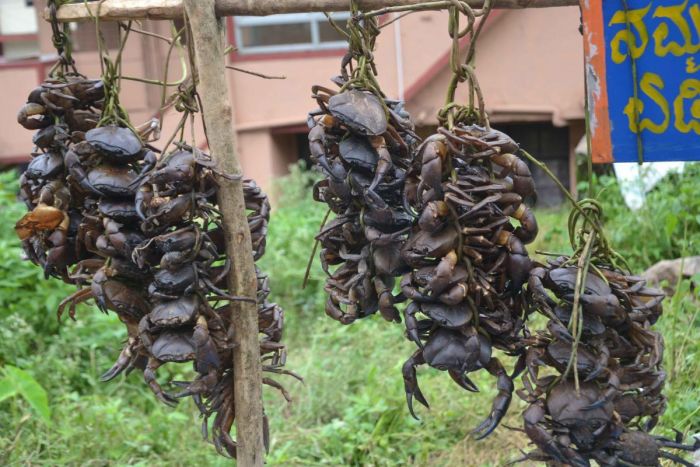
Crabs kept for sale beside a road in Madikeri.

It is the time of the year when people in Madikeri throng to purchase crabs and bamboo shoots.

Crabs, bamboo shoots and “Marakesu” have already entered markets in the district.

People consider crab as good for generating heat in the body which helps in braving the chill during monsoon.

The crab sellers collect 30kg to 40kg of crabs from H D Kote, Bheemanahalli and come to Madikeri to sell them. A bundle of crab (12 crabs) are priced at Rs 300. Crab fetches Rs 250 per kg.

In the past, crabs were available in plenty in paddy fields and water bodies. Now in spite of an increase in demand, there are a few people who sell it.

The availability of crabs has also declined, said crab seller Kumar.

Even the tourists who come here during weekends purchase bamboo shoots while returning home. The bamboo shoot is sold for Rs 40 to Rs 50 for half a kg.

The demand for “Marakesu” leaves also increases during the monsoon. The leaves are used for the preparation of “pathrode” and “bajji.”

The monsoon delicacies are served not only at home but at homestays and resorts as well.

There is a good demand for crab curry, crab fry, bamboo shoot pickle and bamboo shoot dry curry, said homestay owner Suyog.

source: http://www.deccanherald.com / Deccan Herald / Home> State> District / by DH News Service , Madikeri / June 24th, 2018

Sreeraksha Poornesh on running a century-old coffee plantation, the rise of speciality roasters

Sreeraksha Poornesh loves the product of his plantations over all other coffees from around the world. But this is neither boast nor an arrogant statement in the wake of serious success. It is simply his truth, born out of the sheer love for farming and the coffee at Baarbara Estate. “At the end of the day, I’m a farmer and my heart and soul always say that my coffee is the best.”

The 30-year-old is a fourth-generation coffee grower of the illustrious MG Plantations of Chikmagalur, owned and run by the Indavara family for over 120 years. Baarbara Estate gets its name from the Anglo-Indian lady who sold the plantation to Poornesh’s great-grandfather eons ago. And Poornesh attributes his success, first and foremost, to its location. “I’m very lucky to have been handed down an estate on Baba Budan Giri,” he says.

For those who don’t know, the mountain is named after the 17th-century Sufi saint Baba Budan, who is said to have introduced coffee to India when he brought seven beans from Mocha, Yemen, to the country and planted them across the range. In January, the Coffee Board of India submitted an application for the Geographical Indication (GI) tagging of Babu Budan Giri arabica. The GI tag is meant to protect the heritage and quality status of a particular product; according to the World Intellectual Property Organization, it’s a “sign used on products that have a specific geographical origin and possess qualities or a reputation that are due to that origin.”

Sreeraksha01KF25jun2018

However, that isn’t enough to stay relevant, and Poornesh, armed with an MBA from Alliance Business School in Bengaluru, has introduced several new measures to keep up the business. Apart from getting high cup scores every year, he is now inviting roasters to the plantation to process the beans as they like and take them back to their establishments. In light of the changing coffee scene in India and the wave of speciality roasters cropping up across the country, this move is bold and certain to pay off.

“A cup is a team show,” says Poornesh. “As farmers, we do 60 percent of the work to ensure that the coffee you drink is amazing. The process starts with us and ends with roasters.”

Last season, the first roaster Poornesh brought over was Mithilesh Vazalwar, India’s first AeroPress champion and one of the country’s only 25 coffee Q-graders. Their mutual interest in the best-quality beans and obsession with everything coffee lead to a high-grade product that discerning customers can’t wait to get their hands on.

“A certain trend has been set by traditional roasters in India over centuries,” says Poornesh. “I realised that so much of the beans wasn’t processed and handled well. Now, we’ve taken things to a decent level and most third-wave roasters in India get our beans.”

Sreeraksha Poornesh
Sreeraksha Poornesh

Remarkably, having grown up with coffee, Poornesh wasn’t interested in joining the family business. After his MBA, he spent a couple of years working in Bengaluru before returning to Chikmagalur five years ago. He then began to study coffee in-depth, participating in workshops by the likes of Sunalini Menon (Asia’s first female coffee taster and expert) and attending lectures for coffee entrepreneurs at the Indian Institute of Plantation Management. He also did Kaapi Shastra, a coffee training programme by the Coffee Board of India.

“My goal is to dilute everything we grow into speciality coffee,” says Poornesh. Baarbara produces single-origin arabica at present. But he has no plans of expanding internationally, he adds. He has his sights firmly set on the Indian scene. “There’s a lot of potential here, a lot to do. I entered the business at just the right time.”

The brand Baarbara Berry’s status as one of India’s top-ranking coffees is also owed to Poornesh’s driven spirit. In the face of many challenges, including stiff competition, he is focused on getting higher cup scores every year. “You can’t be lax,” he says. “It’s not like you achieve a certain level and then let go. The crop is different every year, and it’s imperative that our cup quality is on the mark. Every year, in the beginning of the season, roasters test the quality, so consistency is very important.”

Now that Baarbara Berry has reached a certain level, Poornesh believes that the farmer-roaster interaction should progress too. Because harvesting and processing are intricate processes and significantly impact brew quality – flavour, texture, acidity, body – roasters can choose their methods for the kind of coffees they want.

Baarbara Berry offers green coffee as well as a range of roasted and ground beans. Owing to high elevation, around 5,000 feet, the ethically sourced and handpicked beans produce rich, full-bodied brews with balanced flavours and finish. MG Plantations is Rainforest Alliance Certified and UTZ Certified, for sustainable farming and better opportunities for farmers.

source: http://www.firstpost.com / FirstPost. / Home> Latest News> Living News> Living / by Tania Bhattacharya / June 25th, 2018

Shwetha Chengappa Romantic Song

ShwethaKF24jun2018

Swetha Changappa is a Kannada television actress who has acted in numerous tele-serials and films.She debuted her acting career through Sumathi, a serial directed via S. Narayan, aired on Udaya TV all through 2003-2005.

Her fame most of the tv audience of Karnataka reached heights thru her role in Kannada soap Kadambari which changed into produced with the aid of Balaji Telefilms and aired on Udaya TV in 2006.

She acted in lead roles for Sukanya and Arundhathi that have been aired on ETV Kannada (now Colors Kannada )which finally have become bigger hits in 2008 and 2010 respectively.

She additionally hosted TV show Yaariguntu Yaarigilla on Zee Kannada which changed into themed on celebration of spirit of womanhood. She additionally hosted Kuniyonu Baara on Zee Kannada, which changed into a dance show for kids.

Shwetha has also acted in Kannada films, Thangigagi with Darshan Thoogudeep and Varsha with Vishnuvardhan.

source: http://www.theprimetimes.in / Prime Time Media / Home> Hit Video / by Ananthu / June 22nd 2018