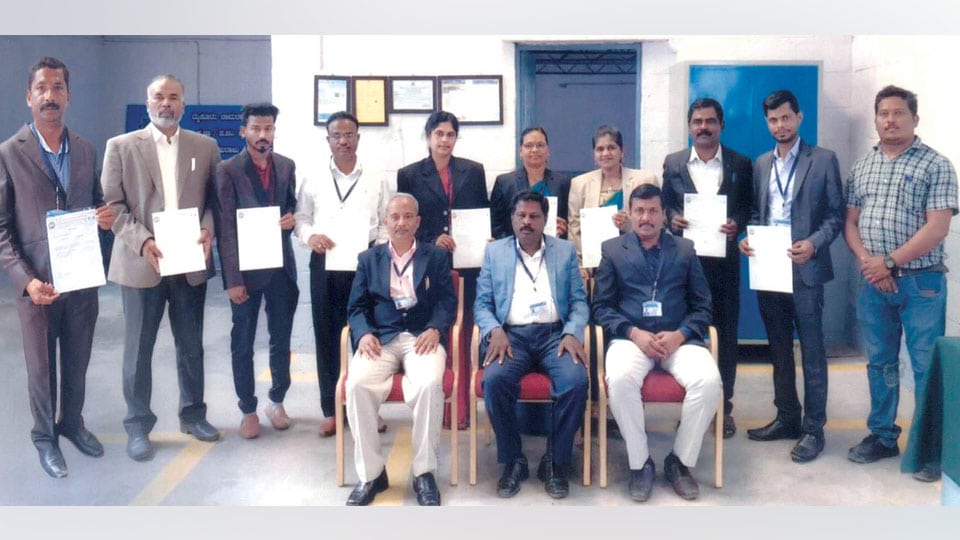
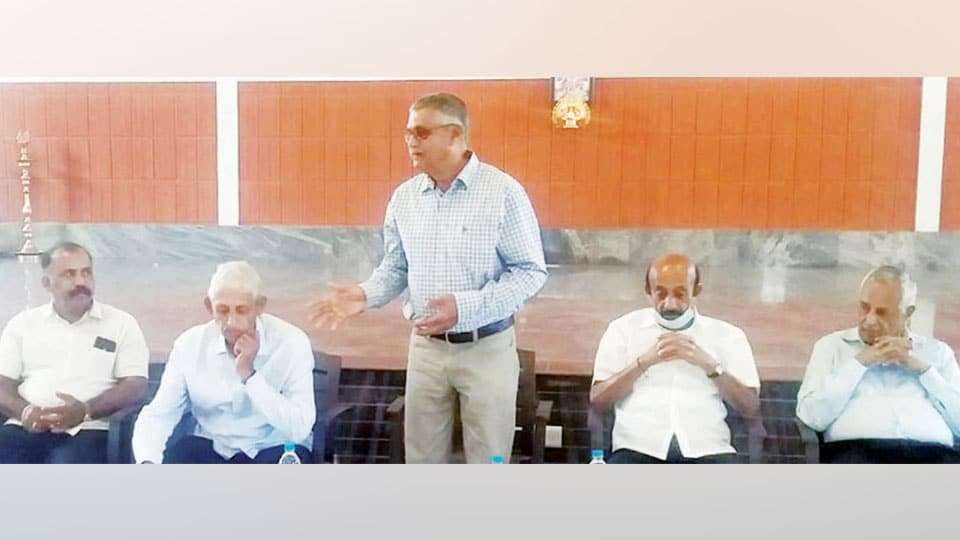
The following newly elected Directors of the Mysuru, Chamarajanagar and Kodagu District SC/ST Industrialists and Goods/ Equipment Supplies and Marketing Co-operative Society Ltd., Mysuru, have been appointed as the Convenors and Co-Convenors of the respective districts, according to a press release from the Society President Vijayashankar:
Chamarajanagar: Convenor – D. Eshwar; Co-Convenors – C.S. Akshay and M.S. Chandrashekar; Kodagu: Convenor – Y.T. Paramesh; Co-Convenors – M. Honnaiah and M. Chandra; Mysuru City: Convenor – P. Nanjundaswamy; Co-Convenors – M. Chandrashekar and Theinmozhi; Mysuru Rural: Convenor – Shivanna; Co-Convenors – Dr. P. Shobharani and B. Kalavathi.
source: http://www.starofmysore.com / Star of Mysore / Home> News / March 21st, 2021
Members of this group have a secondary metabolite used in colon cancer: Expert
Researchers of western Assam’s Bodoland University have recorded a new plant species that may go a long way in fighting cancer.
The species, named Ophiorrhiza recurvipetala, has been found at 675 metres above mean sea level in central Assam’s Dima Hasao district. It has been classified under the Rubiaceae family of flowering plants, to which the plant yielding coffee belongs.
Recurvipetala means petals curved back.
The finding was published in the March 2021 issue of the Nordic Journal of Botany.
“This is a new species to plant science and may be a potential anticancer research candidate. All members of this group have a secondary metabolite called Camptothecin used in colon cancer,” Sanjib Baruah, assistant professor of Bodoland University’s Department of Botany said.
He co-authored the study with research scholars Birina Bhuyan of Bodoland University and Selim Mehmud of Guwahati’s Cotton University.
“It is now our turn to find the Camptothecin content occurring in this novel species. There is a possibility to cultivate this species as a promising medicinal plant for the northeast, but its agrotechnology is not known,” Dr. Baruah told The Hindu.
The researchers had spent a few months in the hilly areas of Jatinga and Haflong in Dima Hasao district to locate a few plants on a wooded mound. “The new species is restricted to this area where it grows in moist shady places,” he said.
Ophiorrhiza is a predominantly herbaceous genus distributed from eastern India to the West Pacific from South China to northern Australia. According to the World Checklist of Selected Plant Families, 2017, it is a notably species-rich and taxonomically complicated genus with about 318 species worldwide.
In India, 47 species and nine varieties have been recorded and among them 21 species and one variety are from the northeast.
The Ophiorrhiza recurvipetala is a perennial herb with a maximum height of 60 cm and is branched. It yields a creamy white flower.
source: http://www.thehindu.com / The Hindu / Home> News> National / by Rahul Kamakar / Guwahati – March 19th, 2021
Using social media as their tool and selfie culture as a weapon, this couple is urging the residents across the state to keep aside a bowl of water for the birds during this summer season.
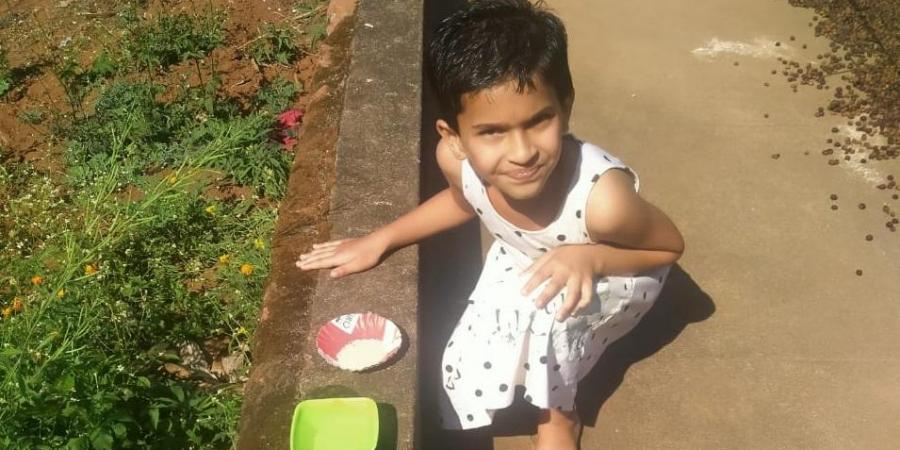
‘Hakkigondu Gutuku’ (a drop to the birds) campaign is receiving an optimistic reaction from many residents across the state including children. (Photo | EPS)
Madikeri (Karnataka):
A couple in Kodagu has started a unique campaign to protect the non-migratory birds during the peak summer season.
Using social media as their tool and selfie culture as a weapon, this couple is urging the residents across the state to keep aside a bowl of water for the birds during this summer season.
‘Hakkigondu Gutuku’ (a drop to the birds) campaign has started from March 10 by Gautham Kiraganduru and his wife Sumana, which is receiving an optimistic reaction from many residents across the state including children. Known for their social works, the couple established ‘Namma Pratishtana’ firm in the district and is promoting various eco-friendly activities.
“Birds are an important part of the ecosystem and they ensure balance in the environment. There is a need to promote and preserve the bird species. Hence, to protect the birds during the summer season, we have started this initiative where we have requested the participants to set up a DIY arrangement to feed birds. The residents have to keep some water and grains for the birds and then click a selfie alongside this setup. We will pick the three best pictures and honour the winners with prizes,” explained Gautham.
The initiative that is making noise across social media has gained attention from not just the residents of Kodagu, but also from the residents across the state including Davanagere, Uttara Kannada, Dharawad, Bellary, Hassan, and Shivamogga among others. “We have received numerous selfie photographs of people setting up the bird feeders. Also, international kickboxer Girish R Gowda has extended support to this initiative,” added Gautham. He explained that numerous trekkers are also participating in this initiative and are setting up feeders across several spots.
Last year, this couple had gained attention after they signed up for body donation during their wedding ceremony. Instead of distributing wedding invitation cards that have low shelf-life, they printed Kannada books with works of unrecognized writers and shared them as wedding invitations. They had also grown over 1,000 different saplings and distributed the same as wedding gifts to the guests.
source: http://www.newindianexpress.com / The New Indian Express / Home> Good News / by Prajna GR / Express News March / March 18th, 2021
Princess Gouramma depicted in Indian dress and rich jewellery, leaning on an Indian table. She is holding a Bible, an allusion to her conversion to Christianity. (Franz Xaver Winterhalter)
______
Snapshot
The short life of princess Gowramma of Coorg serves as a reminder of the potential detachment and loss of identity a fiercely Western education can ensure.
_______
Meghan Markle and Prince Harry’s recent interview with Oprah Winfrey has brought to fore the tumultuous relationship the British monarchy has with all things concerning race. Markle alleged that a member of the royal family had expressed concerns over how dark their baby Archie’s skin would be.
Notably, the Duchess of Sussex is not the first person of colour to be subjected to royal racism.
The institution’s colonial past is filled with instances of the ‘firm’ ( as Markle calls it) taking upon itself the duty of civilising the ‘coloured’ citizens of the colonies it conquered.
In this regard, the remarkable life of Princess Gowramma, the Princess of Coorg and the goddaughter of Queen Victoria, provides interesting insights into the treatment of people of colour by the imperial echelons of the nineteenth century British society.
Princess Gowramma was born in Banaras, to the deposed king of Coorg — Chikka Veerarajendra Wodeyar, who had been exiled by the British in 1834.
She was the Raja’s favourite daughter and was thus his natural choice when it came to accompanying him on his journey to England, where he intended to demand in court the return of his wealth from the East India Company.
Some sources claim that Veerarajendra conveyed his intent of converting Gowramma to Christianity to gain the good graces of the company, so as to receive permission to travel to England.
Governor General Lord Dalhousie and other directors of the company found the idea of voluntary conversion by an Indian royal quite appealing, especially since it would help improve their sagging image in Britain.
Thus, in 1852, after Gowramma had received an education in Christian mannerisms and scripture, she and her father set sail to become the first Indian royals to ever set foot in England.
Princess Gouramma depicted in Indian dress and rich jewellery, leaning on an Indian table. She is holding a Bible, an allusion to her conversion to Christianity. (Franz Xaver Winterhalter)
Upon reaching the island, the 11-year-old Gowramma was presented to Queen Victoria. The Queen, quite taken by the princess declared that she would become the godmother and even endowed Gowramma with her own name — ‘Victoria’.
The Princess of Coorg was then baptised by the Archbishop of Canterbury, at a private chapel in the Buckingham Palace, in the presence of Queen Victoria, her family, senior officials of the government and directors of the company.
Post the baptism, the Queen gifted Victoria Gowramma a bound and autographed Bible with gold embellishments. She then entrusted the princess to the care of Major and Mrs Drummond, who were to groom her with Western thought and education.
Queen Victoria took great initiative in expanding Gowramma’s social circles. She would invite Gowramma to regularly interact with her children and also bestowed upon her a title that made her equivalent to European princesses.
However, Gowramma, who was made to abandon her traditional Indian clothing for Western wear was depressed. She was cut off from all connection with her father and was instead forced to talk, dress and behave like a British aristocrat.
Unable to cope with the pressures of high society, Gowramma tried running away multiple times. She often expressed her desire for privacy and even stated that she rather live like a servant with the handmaidens than suffer the compulsions of regal life. Her troubles were dismissed by the Queen and her consort Prince Albert as ‘innate oriental weakness’ that seeks to escape civilisation.
Meanwhile, back home in India, the British had defeated Maharaja Ranjit Singh to annex Punjab. They then took his minor son, Duleep Singh, under their care.
Exiled to Fatehpur and kept away from Lahore so as to avoid chances of revolt, Duleep Singh was subjected to a Western education that eventually culminated with his acceptance of Christianity out of his own ‘free’will. He then set sail to Britain in order to formalise his conversion under the Church of England.
The Queen, to whom Duleep Singh presented the Kohinoor Diamond, took an instant liking of the Maharaja and became his godmother. She and Prince Albert in cahoots with the company plotted an alliance between Singh and Gowramma.
The hope was to use the influence generated by the marriage between two Christian Indian royals as a tool for proselytising the Indian population. This idea also had the endorsement of Singh’s English guardians — the Logins. They were firm believers in the European responsibility of spreading the word of the Bible amongst the pagan worshippers of India.
However, upon introduction, Singh was lukewarm in his response to Gowramma. He made it known to the Logins that he considered the princess more an honorary sister than a potential wife.
Gowramma, who had earlier been forgiven by the Queen for her torrid affair with a stable boy and her attempted elopement with an under-butler decided instead to marry a close friend of Singh — Lieutenant Colonel John Campbell, who had served in Bellary and was 30 years her senior.
Meanwhile, Chikka Veerajendra, who had lost a seven-year-long legal battle with the company had died.
Gowramma gave birth to a daughter named Edith Campbell on 2 July 1861. By the time Edith was three years old, Gowramma had developed signs of tuberculosis.
She died from the disease on 30 March 1864 just a few months short of her 23rd birthday.
Lieutenant Campbell, who in their short marriage had either neglected his wife or had persistently pestered her for money, disappeared after her death along with the crown jewels of Coorg that had been in her possession.
It is believed that he had only married the princess for her 1,000 pound allowance, the Queen’s favour and of course the jewels of Coorg.
The tragic life of Victoria Gowramma, a princess who had been alienated from her own land and language, was perhaps the paradigm the Britain had for the citizens of her colonies to follow.
Had Duleep Singh and Gowramma not fell short of the royal scheme envisioned by Queen Victoria, they might have had a significant role in shifting India’s religious history.
After all, colonial rulers did find religious conversion a greater instrument for the control of the colonised than plain force.
Gowramma today serves as a reminder of the potential detachment and loss of identity a fiercely Western education can ensure.
Victoria Gowramma was buried in the Brompton Cemetery, her tombstone bears the epithet composed by Queen Victoria, it contains the poignant words — “Other sheep I have, which are not of this fold” (John X,16).
source: http://www.swarajyamag.com / Swarajya / Home> Ideas / by Adithi Gurkar / March 17th, 2021
The project has been launched for the first time in the country on an experimental basis by the Khadi and Village Industries Commission with support from the management of Ponnampet Forestry College.
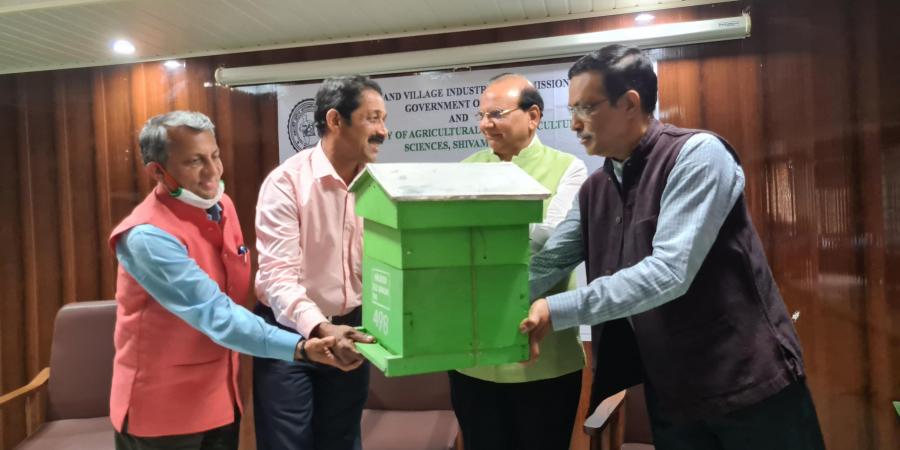
Beekeeping equipment distributed to a farmer during the event (Photo | Special arrangement)
Madikeri :
A research project to reduce human-elephant conflict with the help of honey bees was inaugurated at Ponnampet Forestry College in Kodagu on Monday. The project has been launched for the first time in the country on an experimental basis by the Khadi and Village Industries Commission (KVIC) with support from the college management.
RE-HAB — Reducing Elephant Human Attack by using Bees — aims at controlling wild elephant movement into villages by roping in honey bees. The success of the initiative will be monitored regularly to launch it across the country. A total of three elephant conflict places have been chosen in Kodagu district including two at Nagarahole Sanctuary and one at Thora village in Virajpet where a total of ten beehive boxes have been placed across the forest fringe. The boxes have been placed approximately at eight feet distance and tied using a fence rope. This set-up will act as an elephant conflict mitigation measure.
The project was launched by KVIC Chairman Vinay Kumar Saxena at Ponnampet Forestry College. “In 2017, the Sweet Revolution was launched in the nation to promote apiculture. Beekeeping has many benefits and a farmer can earn from the bee wax, royal jelly and bee venom apart from the honey extraction. Further, beekeeping enables cross pollination and increases the income of a farmer by 30%,” he said.
Saxena explained that states with high elephant populations are spending crores on solving the human-elephant conflict and added, “Many of the mitigation methods to control the conflict are unscientific. The research project of RE-HAB will be monitored regularly and, if successful, will be implemented across the country.”
He said that the RE-HAB project will create a sustainable employment opportunity in beekeeping while also fighting the elephant conflict ecologically. Dr Kushalappa, the dean of the Forestry College, reckoned that the project will enable integrated farming while controlling the elephant menace.
Alongside launching the project, a total of 50 beneficiaries were given bee colonies and beekeeping equipment by KVIC to promote apiculture in the district. Dr Sudarshan of KVIC said, “We are finding a physical solution to an ecological problem. Nature must work with nature and the RE-HAB will work at a low cost.”
source: http://www.newindianexpress.com / The New Indian Express / Home> States> Karnataka / by Prajna GR / Express News Service / March 15th, 2021
Bharat Ratna for Cariappa, Thimayya: Rashtrapati Bhavan sends letter to PMO
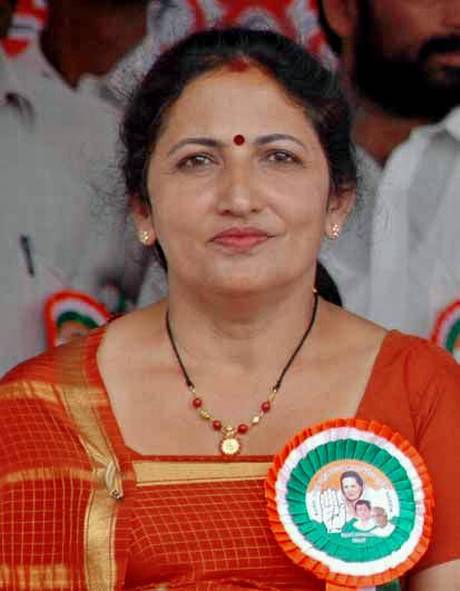
Congress MLC Veena Achaiah’s letter to the President Ram Nath Kovind seeking the country‘s highest civilian award Bharat Ratna for Field Marshal K.M. Cariappa and General K.S. Thimayya has been forwarded to Prime Minister’s Office.
The Rashtrapathi Bhavan has acknowledged the receipt of Ms. Achaiah’s letter dated February 6, 2021, addressed to the President regarding conferment of Bharat Ratna posthumously to both Field Marshal Cariappa and General Thimayya. On March 2, 2021, the Officer on Special Duty, President’s Secretariat, Jagannath Srinivasan wrote to Ms. Achaiah, seeking to bring to her notice that the letter she had sent to the President had been forwarded to the Prime Minister’s Office for appropriate action.
The demand for Bharat Ratna to Field Marshal Cariappa and General Thimayya, both of whom hail from Kodagu district, is pending for a long time before the Centre. Even former Army Chief Bipin Rawat hand endorsed the demand for Bharat Ratna to Field Marshal Cariappa. While Cariappa was the first Indian Commander in Chief of the Indian Army, General Thimayya served as the Chief of Army Staff from 1957 to 1961.
During Mr. Kovind’s visit to Madikeri last month to inaugurate the General Thimayya Memorial Museum, Ms. Achaiah submitted a memorandum recalling that General Thimayya was the only Indian to command an infantry brigade in the battle during the Second World War while Mr. Cariappa belonged to a family of farmers and is one of the only two Indian Army officers to hold the highest and five star rank of Field Marshal.
source: http://www.thehindu.com / The Hindu / Home> News> States> Karnataka / by Special Correspondent / Mysuru – March 13th, 2021
During a picnic, some students who went for a swim in the Cauvery were pulled by the water currents. Lenin Bopanna managed to save the lives of four students but drowned in the process.
Lenin Bopanna
Madikeri :
A student who drowned saving the lives of his schoolmates was posthumously honoured with the Hoysala Shaurya Award by the Women and Child Welfare department. The award was received by the boy’s parents at a ceremony hosted in Bengaluru.
Lenin Bopanna was a student of Lion’s School in Kalathmadu village near Gonikoppal. In March last year, 39 students of the school from the Scouts and Guides team had visited the popular tourist destination of Dubare Camp for a picnic.
However, a tragic event unfurled as some students who went for a swim in the Cauvery river were pulled by the water currents. Lenin Bopanna managed to save the lives of four students during the incident but drowned in the process.
The son of Madeera Harish and Kavitha of Hysodluru village, Lenin was nominated for the award with the help of state Scouts and Guides Commissioner PGR Sindhya. Lenin’s father Harish said that his son received the award for his bravery following the efforts of Sindhya and the principal of Lion’s School.
source: http://www.newindianexpress.com / The New Indian Express / Home> States> Karnataka / by Express News Service / March 10th, 2021
Kodagu does not have appropriate or adequate sports infrastructure though the tiny district has produced innumerable sporting icons over the years. Hence, the Union Government must establish a Sports University in Kodagu to give a platform for thousands of emerging sportspersons from Kodagu and also to encourage sportsmen from other districts of Karnataka.
This demand emerged at a meeting of Federation of Kodava Samajas at Balugodu Samaja premises near Virajpet recently. Explaining the need for a Sports University in Kodagu, the participants of the meeting said that Kodagu district had contributed thousands of sportspersons to the State and to the Nation.
Every village in Kodagu has sports talents in abundance but the budding sportspersons lack encouragement, state-of-the-art facilities and professional training. This way, several sports talents are being ignored, speakers at the meeting said.
Over 50 players from Kodagu have represented Indian hockey team till date. Not only hockey, the district has produced brilliant sportspersons in other disciplines like athletics, tennis and badminton too. Hockey is encouraged in Kodagu with many tournaments including Kodava Hockey Festival taking place around the year. But other sports lack facilities and encouragement.
Kodagu has sports hostels but the facilities available are not adequate. There is a potential for swimming, squash, kabaddi, badminton champions to emerge from the district if proper training and facilities are given, the speakers said.
If at all the Sports University is established in Kodagu, there will be many state-of-the-art stadiums, and training camps can be conducted by Karnataka State Olympics Association.
“The Central Government is enthusiastic about starting a Sports University in Mizoram. As Kodagu has given innumerable sports achievers to the nation, we must ask for a Sports University to our district,” they said.
Establishment of such a University will enable youngsters and emerging sports champions from Kodagu to experience high level competition where national players and international legends and coaches will come to Kodagu and interact with young talents here.
The meeting resolved to urge the Union Government to establish a Sports University in Kodagu. Former Minister Meriyanda C. Nanaiah, Federation President Kallichanda Vishnu Cariappa, Joint Secretary Mederira Naveen, former President Mallengada Dada Belliappa and others were present.
source: http://www.starofmysore.com / Star of Mysore / Home> News / March 13th, 2021
Kodava Samaja, Mysuru and Nethradhama Super Speciality Eye Hospital have jointly organised free eye check-up camp for Kodava Samaja and Kodava Association members and their family on Mar. 16 from 10 am and 2 pm at Samaja premises in Vijayanagar.
For details, contact Mob: 70191-20650 or 94837-54771.
source: http://www.starofmysore.com / Star of Mysore / Home> In Briefs / March 13th, 2021
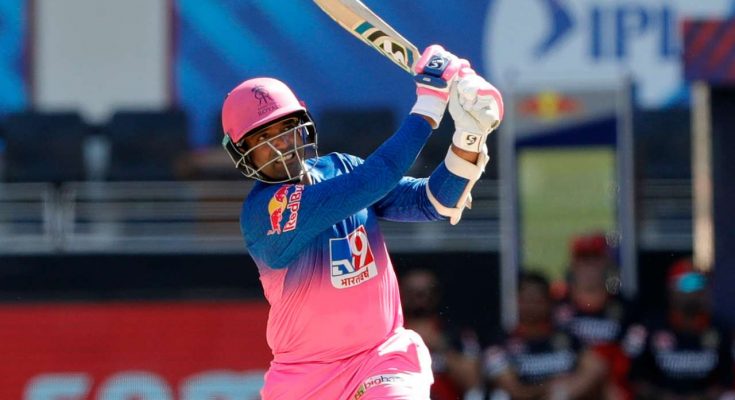
As Rohit Sharma raised his bat while walking back to the pavilion after his record-breaking 264-run knock, he receieved a standing ovation from the crowd as well as the Indian dressing room. But there was another Indian player alongside him at the crease, who perhaps, had an even bigger role to play in helping the Hitman reach that major milestone. That player was none other than the selfless Robin Uthappa.
The 35-year-old has been a seasoned campaigner both in domestic cricket as well as in the Indian Premier League (IPL). However, he never really cemented his place in the Indian team despite making multiple comebacks. Nevertheless, whenever he has received an opportunity, Robin Uthappa has always proven himself as a selfless team man.
In fact, he is one of the most experienced players as far as the IPL is considered. Over the years, he has represented franchises like Royal Challengers Bangalore, Pune Warriors India, Kolkata Knight Riders and Rajasthan Royals.
The veteran right-hander will now embark on a new journey once again as he will play for Chennai Super Kings (CSK) in the upcoming IPL 2021 season. In an exclusive interview with CricXtasy, Robin Uthappa speaks about his fantastic run of form in the recently concluded Syed Mushtaq Ali Trophy and Vijay Hazare Trophy, prospect of reuniting with MS Dhoni at CSK, and much more
Excerpts from Robin Uthappa’s exclusive interview with CricXtasy:
Q: About your IPL days, your best time was probably with KKR. You had a sensational season yourself in 2014, winning the title as well as the Orange Cap. That is what gave you an opportunity to make a comeback for India later that year too. So what would you like to say about your time at KKR? Your general camaraderie with Gautam Gambhir and the others in the team?
Robin Uthappa: Obviously that was one of my fonder memories and experiences in the IPL for sure. So for me, that was something I completely enjoyed, especially when Gauti (Gautam Gambhir) was the captain. And yes, that journey has been something that I hold dear to me.
But I’ve had a good time, in other franchises as well. You know, for instance, I had a good time in Mumbai in the first year. And at Pune Warriors as well, even though we didn’t do well as a team. I was able to perform well and make an India comeback.
Even at RR, it was only one year but the kind of friends that I have made and the relationships that I’ve built in that franchise is something that will be for life. So in every franchise, it’s been a great experience. It’s had its ups and downs. But it’s been a wonderful experience in every franchise that I’ve played with so far.
Q: Talking about ups and downs. that one game against Mumbai Indians in 2019, which was also your last game for KKR. Do you think that they were a bit harsh on you to release you on the basis of that one knock?
Robin Uthappa: Well see, the thing is, obviously, they were looking at different things. For a couple of years, they made me play in the middle order, which is not where I’m normally or, you know, naturally suited to bat, because my entire life I have opened the batting. So for me, even though I tried to make that adjustment to bat in the middle order for the sake of the team, I wasn’t able to adjust.
Then they possibly felt that they had other people who could do the job for them at the top of the order. So, you know, they felt at that point that is best for us to part ways. In fact, my release hadn’t happened till the day before the auction. Initially, they told me that I would still be a part of the team when you know, Brendon McCullum was coming. But the day before the auctions, I got a call from them saying that, you know, they will be releasing.
So, clearly, they had plans to move on and navigate to other avenues they believe would work for them. So, that happens in franchise cricket. It’s a part and parcel of franchise cricket. But I’m grateful for my time with KKR, it was a good one. Yeah.
As a leadership group, RR were more reactive than proactive: Robin Uthappa
Q: One of the most talked-about points about the last season was the kind of opening combinations RR tried in almost every game, there was a different combination. So, do you think that, maybe they could have given you another season at the top of the order? Maybe they were just too quick in writing you off?
Robin Uthappa: See, the thing is, you can talk about ifs and buts. But you have to realize that reality is what it is. They had spoken to me last year when I joined them that they would like me to bat in the middle order. I said that I will try my best and because you know, it is not something naturally I’m comfortable with. Because opening the batting is something that I know what I’m doing. It comes very naturally to me and I have done it my entire life.
And when we got off to the kind of stars that we were getting off within the team, I suggested to them that “you know, I could open the batting”. But it took about seven-eight games before that actually happened and in a tournament like IPL, every game is important. I felt that as a leadership group, they were being more reactive than being proactive at that point in time.
Sanju Samson is a match-winner: Robin Uthappa
Q: This season’s Vijay Hazare Trophy, it was absolutely sensational for you as an individual. How would you say the Kerala team has progressed now, from the time that you joined them? Something about the youngsters in the group, like Azharuddeen, Samson?
Robin Uthappa: I don’t think Sanju is a youngster anymore. Yeah, he’s one of the most important players in that team. He’s the one on whom the team is heavily dependent. The success of the team is really dependent on his performances, and he is doing well because he’s a match-winner. So keeping those things in mind, you know, the youngsters have done really well.
In fact, there are a lot of youngsters who have derived a lot of inspiration from guys like Sanju, and the fact that he’s gone up to the highest level. And having said that, they’ve all worked on their own games. Last year in our season, we felt like our batting was struggling a little bit. I think, this year’s performance is a result of the work that everyone has put in over the last few years into their own individual batting and how they can do well for the team. And we’ve done just that and we worked hard and the results are there to see.
But you know, having said that, I think as a team we also believe that we can go much further in the tournament than where we’ve gone. Like for instance, in the Syed Mushtaq Ali Trophy, we definitely felt that we could have gone further. Unfortunately, we did not, and in fact, we missed qualification by three or four runs in the last game. So all those learning experiences I think will serve us well in the seasons to come and serve all the boys, who not just want to you know play for Kerala but also want to win championships.
So you can only hope and believe that everything that you go through and experience in your career serves you. And everyone’s very hardworking not just Azhar or not just Sanju. There is Sachin who is working really hard, then Sreesanth, who is making a comeback after so many years. You know, it’s just the testimony that age is honestly just a number if you put in the work that’s required.
Q: When CSK picked you up in the IPL 2021 trade window, there was a lot of talk on social media that another aged player has joined the ‘Dad’s Army’. But your current form has silenced the critics in style. What would you like to say about that?
Robin Uthappa: These age things are just left to the trolls, for them to get some attention. So I don’t know how that serves society in any way. But it is what they do. I think for people like us, we realize that age is just a number. It depends on how passionate you are.
Like, for instance, you take an example of the guy who started KFC. Colonel Sanders was 65, when he eventually opened his own KFC. So that just goes to show it doesn’t matter what line of work you’re in. Tom Brady, at 43-44, is continuing to win national championships, which is played at a very high level. So, you know, there’s enough proof that these things are just perceptions that are held by people. But if you work hard enough, if you’re focused enough or channelized enough, then all of these things don’t necessarily matter.
I think the more experienced you are, the better you do. Why do you give youngsters the long run? Because you want them to gain experience. So in the same way, when you have an experienced player, you know they’re hardworking enough, they go out there and do well. People don’t seem to see that and don’t seem to understand it. For lack of depth, or maybe something else. I’m not sure. But I’m someone who believes that honesty gets the numbers. Look at Roger Federer today, at 38, pursuing tennis at the highest level coming back from injuries. So it’s just perception.
Robin Uthappa opens up on his future with CSK
Q: So now that you have been approached by CSK, did they kind of let you know already what your role might be? Or did you let them know about your batting preference?
Robin Uthappa: We haven’t discussed the role yet. I think the role will be clarified. And the clarity of that will be defined once I join the team. But yeah, whatever the role is, whenever I get an opportunity, I’m confident that I will go out there and do my best. I am sure this will add value to the team, that much faith I have in myself.
Q: You were one of the first players to have had the experience of playing under MS Dhoni’s captaincy, and you won that T20 World Cup. So any special memories about that tournament, about Dhoni the captain?
Robin Uthappa: We’ve had some great memories from that tournament. I think just his (Dhoni’s) leadership skills and the way he has executed those skills. As a captain, and I think, as a leader, the most important thing he did was giving the players the freedom to express themselves. I think that is one of the most important things that a leader or a captain can do within a group environment and respect that individuality. And that’s something that he does extremely well.
Q: I would just like to pinpoint at one performance in your last group game of the Vijay Hazare Trophy, and where you scored, I guess, 87 off 32. Now do you think you have got a blueprint to bat and now are you clear in your mind that ‘this is how I’m going to play my cricket, whether I play for CSK or for India again’?
Robin Uthappa: Well, yeah, it is something that I’ve actually been working on for a couple of years. There are always requirements within the team, right, and there are roles that are defined or there are roles within that team that we need to perform. My role is always to make sure that I bat for as long as possible for Kerala. So if I can bat for as long as possible it benefits the team and increases the confidence within the group. So that is essentially what I’m looking to do at all points when I am opening the batting for Kerala.
But having said that, in that game, the requirement was to finish the game as quickly as possible. And they mentioned to us at Lunch break that if you can finish the match in 14 overs it will increase our net run-rate and help us qualify. We were already 4.5 overs, 76-1. So I said okay, maybe I’ll just have a look-in for a couple of balls, and then I’ll just go after it and try and score as many runs as possible. And which is essentially what I did. I gave myself a couple of balls. And then I started going after. And we were able to finish the game in I think 8.5 overs or so.
So I think it again depends on the requirements of the match and the requirements of the team. But, I definitely feel like I’ve had a lot more freedom than I had in the past. And I think the technique that I have right now allows me to play with a lot more freedom than I had in the past.
Robin Uthappa relives his best memories playing for the Men in Blue
Q: You have played 59 International games for India so far, but do you think your best memory is still that chase at The Oval in the sixth ODI in 2007?
Robin Uthappa: I’ve had quite a few I think. But that (game at The Oval) definitely is right up there. But there are different ones that serve the team, serve individuals. I enjoyed, for instance, we won a game in Mumbai against Australia in 2007. It was a really low-scoring one-dayer. They scored 187 or something and we scored the runs back in the 45th over. Zak bhai (Zaheer Khan) and Murali Karthik scored the runs back for us. So I think that was something that I actually enjoyed, because I got a 47 or 48 in that match. So for me, I think, when everyone was getting out, me being able to contribute to that victory was big for me. So, yeah, that is a special game to me.
I think I’ve had a lot of comebacks, four or five or six comebacks in the Indian team. So you know, a lot of those comeback matches have been special. I got a 30-ball 70 against West Indies in Chennai. That was very special for me. And then, you know, Rohit Sharma’s 264. I had scored a run-a-ball 14. That was also my comeback match. So, you know, a lot of these comeback games have been special to me in one way or the other.
But yeah, Oval will stand up there as a fantastic experience. Then to get a 50 on my T20 debut against Pakistan in a World Cup. And to have that bowl out is also a great memory. So I’ve been fortunate you know, incredibly lucky to have had wonderful memories playing cricket, there are a lot of memories that are etched in, you know, part of our culture, which is fantastic. And I consider myself very lucky to have all of them.
source: http://www.cricxtasy.com / CricXtasy.com / Home> Interview / by Anuj Nitin Prabhu / March 13th, 2021
WELCOME. If you like what you see "SUBSCRIBE via EMAIL" to receive FREE regular UPDATES.
Read More »