Distilling coffee’s aromatic history

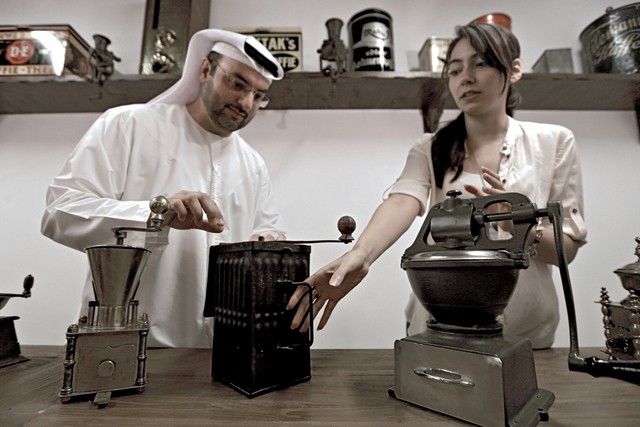
Khalid Al Mulla, the founder of the Coffee Museum. show two German-made coffee grinders from the Second World War to Arezou Schulz, a project manager at the museum. Ravindranath K / The National

During the Second World War, every German soldier carried an essential piece of equipment along with his weapon. Small, sturdy and built to survive almost anything, it was a coffee grinder.

The steel box had a handle on the top and a container at the bottom to catch the coffee grounds. It could be easily disassembled and packed away.

So strong indeed was the European love of coffee that even a scarcity of metal after the war ended did not stop the production of coffee grinders and roasters. Instead, munitions were melted down to manufacture them.

The importance of coffee to different cultures and countries through the centuries is the theme of Dubai’s new Coffee Museum, which will allow visitors to view the rituals of serving the popular beverage and to taste it.

Stepping into villa No 44, a traditional Emirati home in Bur Dubai’s Al Fahidi historical district, the visitor is immediately struck by the familiar aroma of freshly brewed coffee. Even though the museum’s signage has yet to be put up and its official opening is at the end of October, the museum is already swarming with coffee lovers.

“You will love coffee even more after visiting the museum and understanding its history and cultural relevance to us and the other cultures,” says Khalid Al Mulla, the museum’s 43-year-old founder and the director of Easternmen & Co, a coffee company.

His love of coffee begun in childhood, as it did for many Emiratis and Arabs who grew up watching their parents drink coffee and serve it to guests in a show of hospitality and friendship.

Mr Al Mulla later joined the coffee industry, importing to the UAE varieties from more than 16 countries including Indonesia, Brazil, Sri Lanka and Yemen.

He also became the local representative for several coffee brands and coffee-machine makers, including some from Japan.

But he still wanted to add another dimension to his enjoyment of coffee, so he decided to create a historical archive of his passion.

“Coffee drinking should be an entire experience, where all the senses are involved,” Mr Al Mulla says with pride as he takes The National on a tour of the museum, which comes alive with different aromas and sounds.

Seeing how coffee beans are roasted and brewed – from using traditional methods to the latest gadgets – and tasting the essence of different coffee beans are all part of the experience.

The interior of the museum at Bastakiya, Dubai / Ravindranath K / The National

In the two-storey museum, which has six rooms on each floor, each part of the exhibition tells a different story about coffee and how it relates to its fans. Three of the rooms display antiques from the Middle East and around the world.

From Britain, there is a man-sized coffee grinder with an actual carriage-like wheel for a handle that carries the 18th-century crest of a British monarch. From the Ottoman Empire, there are several grinders and hand-held portable roasters that are about 600 years old.

It is said that the first coffee house in Europe was opened in Vienna, using equipment taken from Ottoman troops defeated outside the city’s walls in the 17th century.

Other rooms in the museum display screens, filters, and grinders known as madaq, which are hundreds of years old.

The grinders, which are covered in Quranic verses and weigh more than 12 kilograms, are too heavy to carry. There are also grinders for women, with added support for the leg, allowing the grinder to lean in for support as the beans were being ground up.

In Ethiopia, the coffee pot is known as the jabena. It lacks the distinctive spout of the Emirati dallah. It was Yemenis who introduced the spout, calling the pot a jamena.
The dallah’s spout, which resembles a falcon’s beak, is sharper and narrower to allow the pouring of smaller amounts of coffee. Tradition stipulates the use of two dallahs, one for serving and the other to keep the coffee hot on the stove.

“As one digs, one discovers interesting history,” says Mr Al Mulla, citing as an example the reason for the popularity of Sri Lankan coffee beans in the UAE. “Because Sheikh Zayed used to drink it and liked it, we came to love it as well.”

All the objects on display at the museum – assembled over the years from around the globe – are from his personal collection.

“The museum connects the past of coffee to its present, and so I added live demonstrations of the coffee rituals in the Ethiopian culture, the Egyptian, the Arabic Bedouin, as well as the Levant and Turkish versions, so that every kind of coffee can and will be made here,” says Mr Al Mulla.

Coffee from the Levant is brewed over hot sand to better distribute the heat, he reveals. To be sure, Mr Al Mulla is a walking encyclopaedia on everything related to coffee.

Much of the museum’s top floor is dedicated to the research and study of coffee, with a library filled with rare books and a media room to screen coffee-related documentaries. “The history of coffee is still debated, with many versions,” says Mr Al Mulla. “But the version I like is the one about the man with the same name as me. They call him Kaldi, but his name was actually Khalid, just like mine.”

In the story of Kaldi, the drinking of coffee started in the Ethiopian Highlands hundreds of years ago. Then a goat herder, Kaldi noticed that his flock became hyperactive after eating some unknown berries from a tree. Curious, he tried them, and he remained alert and was unable to sleep afterwards.

There are different versions about how the actual drink was made.

According to some versions, Kaldi’s wife threw the beans on to a fire and roasted them. She then crushed the beans and made the grounds into a drink. In other versions, Kaldi took the coffee berries to a holy man. The latter disapproved of them, saying they were a drug and threw them into a fire. As the berries were roasting, they released the pleasant aroma with which we are all familiar. The roasted beans were then ground up and boiled in hot water, creating the world’s first cup of coffee and its second most traded commodity, after oil.

Coffee had also been drunk in monasteries, where monks were said to have consumed the beverage to keep awake for all-night prayers. From Ethiopia, the coffee trade crossed into Yemen, where Sufi Muslims used it as an aid for worship. It was in Yemen that the drink was first called qahwa.

“The legendary Mokha port in Yemen was once the main coffee exporting site for the region,” says Mr Al Mulla. “The Yemeni port’s name is synonymous with the mocha coffee that we drink today.

“Coffee spread across the world via the Arabs and Turks as the Islamic empire expanded into Europe and the rest of the world.”

Whether Asian or African, Central or South American, the islands of the Caribbean or the Pacific, all coffee varieties can trace their heritage to the trees in the ancient coffee forests of the Ethiopian plateau.

“The story of coffee started with an Ethiopian Khalid, and continues with an Emirati Khalid,” Mr Al Mulla says with a laugh. “I hope I tell it as well as he once did. The legend of coffee continues.”

His museum, unsurprisingly, has a coffee shop and a gift shop. The latter sells all kinds of coffee and coffee machines, as well as coffee-related jewellery, such as a dangling golden coffee bean on necklaces and bracelets.

The opening hours are from 10 am to 7pm, with tickets expected to be about Dh15 for adults and Dh5 for children.

Mr Al Mulla is still deciding whether to include the coffee served in the cost of the visit or to levy an extra charge.

To find out more about Coffee Museum, click here.

rghazal@thenational.ae

source: http://www.thenational.ae / The National / Home> UAE> Arts & Lifestyle / by Rym Ghazal / August 17th, 2014

Ashwini takes up icy challenge

What is the similarity between Bill Gates, Usain Bolt, Justin Timerblake and Ashwini Ponnappa? 

AshwiniKF26aug2014

They have all embraced the ALS Ice-Bucket Challenge willingly.

Ashwini completed the challenge on Tuesday afternoon. She in turn issued a challenge to her doubles partner Jwala Gutta and former swimmer Rehan Poncha.

After players and support staff of Bengaluru FC doused themselves in an icy-cold shower on Monday, they issued a 24-hour challenge to Sania Mirza, Ponnappa and Yuvraj Singh.

After Sania completed the challenge on Tuesday morning, Ponnappa followed suit pretty soon. Both of them have uploaded the video on YouTube.

Sania had already done the ice-bucket once before but since people complained that there was a lack of water, she did it again on Tuesday.

She, in turn, challenged Cara Black, Mahesh Bhupathi, Yuvraj and actor Ritesh Deshmukh.

What is the challenge exactly for? It raises money for charity — especially ALS — a neurodegenerative disorder.

source: http://www.deccanherald.com / Deccan Herald / Home> Sports / DHNS – Bangalore , August 19th, 2014

Rohan Bopanna rises to Ice Bucket Challenge

Bangalore :

After Mark Zuckerberg, Bill Gates, Cristiano Ronaldo and Oprah Winfrey, I-League champions Bengaluru FC and doubles ace Rohan Bopanna have taken up the Ice Bucket Challenge, which has gone viral on social media.

The challenge involves participants dumping a bucket of ice water over their heads to raise awareness about Amyotrophic Lateral Sclerosis (ALS), commonly called Lou Gehrig’s disease.

Once completed, the individual posts the video on social networking sites and nominates three people to take up the challenge within 24 hours or donate $100 to any charity working to fight the neurodegenerative disorder.

Bopanna, who was nominated by Indian-American tennis player Amrit Narsimhan, took to Twitter on Sunday to post his icy video. A shivering Bopanna nominated Bengaluru FC and actor Rahul Bose for the challenge.

Bose chose to opt out, tweeting, “Been chosen by Rohan Bopanna for #IceBucketChallenge to raise money/awareness for ALS. Hv decided not to waste clean water, but will donate!” However, Bengaluru FC were happy to oblige.

“We accept Rohan’s challenge and nominate Ashwini Ponnappa, Sania Mirza and Yuvraj Singh. Good luck guys, let’s end ALS,” Club COO Mustafa Ghouse said.

source: http://www.timesofindia.indiatimes.com / The Times of India / Home> Sports / by Maxin Mathew, TNN / August 19th, 2014

New Chiefs Appointed to Academies

Bangalore :

The Department of Kannada and Culture has appointed heads and members to various academies.

M S Murthy (Bangalore) has been appointed the Chairman of Karnataka Lalithakala Academy, B A Mohammed Hanif (Dakshina Kannada) is the new chairman of Karnataka Beary Sahitya Academy while Kolkada Girish (Madikeri) has been appointed as the Chairman of Arebhashe Samskruthi Sahitya Academy and Biddatanda S Thammaiah has been appointed the Chairman of Kodava Sahitya Academy.

Members Named

For Karnataka Lalithakala Academy, B L Chauhan, Mahalingappa, Prabhu Urs, B K Badigera, Vishweshwari Tiwari, Devarishi, C Chikkanna, Krishna Devadiga, T H Shanmukappa, Khasim I Kansavi, Sharanappa B H, Wajid Sajid, Vedamurthy, Bargur Markandeya and C Rajashekar have been appointed the members.

source: http://www.newindianexpress.com / The New Indian Express / Home> States> Karnatkaka / by Express News Service / August 14th, 2014

Natural pampering

Coorg

The air smelled green. For someone from the city who is used to the smell of petrol fumes, garbage and fried food, inhaling this crisp, clean air was a real treat.

My drive on the winding roads of Coorg transported me to another world. I put my head out of the car to click away at the Kodava houses lining the roads, quaint churches and local shops. My photo sessions attracted some curious glances from local women. I had officially arrived for my weekend in the coffee district of Karnataka, and my stay at one of the most luxurious resorts in the region was about to begin. As the rains pelted the roof of my cottage at Tamara Coorg, a luxury resort situated in the picturesque confines of lush verdant coffee plantations, I opened my eyes to the breathtaking view, wishing I could wake up to this every day.

The mist kissed the foreheads of the silver oaks and the rosewoods, as I walked to the balcony with a hot mug of bella kapi. I sipped the aromatic yet comforting black coffee laced with cardamom and flavoured with jaggery, while listening to the symphony of cicadas and birdcalls. The fresh taste of coffee resurrected my soul and prepared me for the invigorating plantation walk that my hosts at the resort were kind enough to organise.

After being playfully warned about the leeches by the resort’s guide, I remained skeptical about the trek around the 170-acre Kabbinakad Estate, tucked inside the resort. “Don’t worry, madam, leeches will only suck out the bad blood, and you won’t even feel the pain. You know they are now being used for medical treatments in several parts of the world,” he said. Nevertheless, his scientific explanation failed to comfort me as I tied my shoe laces tight, determined not to have my blood sucked out. ‘Just enjoy the walk, and take in the natural beauty,’ I told myself.

Natural fortress

Built strategically around landscaped waterfalls and glistening streams, the resort is home to some rare species of flora and fauna. As we walked around the plantation, we had the electro-pop background score of gushing falls and cicadas follow us wherever we went. “Hey, but why can’t I smell the coffee?” I asked out of ignorance. “Well, you won’t smell coffee here. But you will see the beans in different stages of growth,” my well-informed guide explained. Arabica and Robusta, the two kinds of coffee plants, are grown at the estate, which is dotted with cardamom plants and pepper vines.

Handing me a bright green pod, the guide said, “Just bite into it and tell me what it is.” As I nibbled on the pod, suspiciously, waiting for some allergic reaction to pop out, a fragrant taste exploded my palate. “It’s cardamom, isn’t it?” I shouted excitedly. Finding my daily food ingredient in its freshest form left me hungry for more. By the end of the walk, I had savoured passion fruit right off a tree, watched in awe at the bitter lime tree pregnant with fresh fruits and beautiful wild mushrooms.

Bird-watchers too have something to look forward to at the resort, as one can find some rare avian species, including Malabar trogons, Nilgiri laughing-thrushes, great black woodpeckers, and Malabar whistling-thrushes (that are a part of the night-time orchestra). Apart from these, yellow-browed bulbuls, Pacific swallows, grasshopper warblers, orphean warblers and yellow-billed babblers can also be spotted.

Coffee kicks

After teasing the touch-me-nots, collecting some rudraksha berries and clicking away at the luscious red ginger flowers and pristine white coffee blossoms, it was time to call it a day. But the coffee lover in me was still to be satiated. And the best was yet to come. The resort definitely knows how to woo coffee addicts, and my experience at The Verandah at Tamara Coorg made me fall in love with the drink that half of the world kick-starts the day with. Right from handpicking the fresh beans, drying them, roasting them, sifting through them and grinding them, coffee-making is nothing short of an art form. And the experience of making my very own brew made me feel like an alchemist. And the secret to pure healthy brew is roasting and grinding your own beans.

A visit to Coorg will be incomplete without sampling the authentic Kodava cuisine that includes the famous pandi curry (pork curry) and koli barthad (chicken fried in spices). But for a vegetarian like me, it was best to tip-toe around the meaty dishes and stick to the green zone — lip-smacking mangye pajji (ripe mango curry), kadambuttus (rice dumplings), kumm curry (mushroom curry), akki rotis, banana fritters and sumptuous payasam.

Coorg is blessed with nature’s bounty. Apart from plantation tours, one can trek to the nearby Manje Motte view point, Pathi Pole Falls and Ballyaatre Ridge. For wildlife and history enthusiasts, this quaint hamlet has a lot to offer in the form of Pushpagiri Wildlife Sanctuary, Nagarhole National Park and Madikeri Fort. As the afternoon sun gave way to the golden light of dusk, dark clouds gradually invaded the sky. The rains pounded the earth with all their might, bringing to life every inch of the green surroundings. The perfect weather to cuddle up and read. Another day had come to an end in the land of the brave Kodava warriors, and I slept fitfully to the lullaby of noisy cicadas.

source: http://www.deccanherald.com / Deccan Herald / Home> Supplements> Sunday Herald travel / by Arundhati Pattabhiraman / August 17th, 2014

Verbattle junior- zonal selection kicks off in Mangalore; 22 teams shortlisted

Mangalore :

Around 60 teams participated in the Verbattle Junior Round at the zonal level selection of the Verbattle Junior as a part of Verbattle Debate Competition 2014 here on Friday out of which 22 teams have been shortlisted to go to the next level ‘Verbattle Junior-Skirmish’ which is to be held in Bangalore in the third week of August.

The participants belonged to the age group of 12-16 years studying in Std VIII to Std X. The 22 teams selected in the Mangalore zone included teams from Chikmagalur, Dakshina Kannada, Kodagu, Uttara Kannada, Udupi and Shimoga. The zonal level selection of Verbattle senior will take place on Saturday.

After a basic introduction to the rules and regulations of the Verbattle Junior round, Verbattle foundation Founder Deepak Thimaya announced the topics that were to be debated upon in the course of the event. Out of a list of 10 topic statements, some of the topics included – The current education system is not equipped to deal with intelligence, Politics has solutions to India’s problems and Schools are breeding grounds of negativity. The participant teams were given their final topics around 30 minutes before the debate session following which the teams underwent intense sessions of about an hour.

“Verbattle is a wonderful platform that improves one’s speaking skills. Initially I had problems in speaking fluently but participating in Verbattle Junior and reaching the semi-finals last year has given in me immense confidence in speaking and voicing out my opinions and hence I came back this year to participate and I am excited that our team got through to the next round and I’m also confident that our team will win,” said Suraj Kumar, one of the participants studying in Madhav Kripa High school.

The next round which is the Verbattle Junior -Skirmish will be held on August 19 in Bangalore. The semi-finals and finals for Verbattle Junior and Senior will be held on August 22, 2014. The final debates will be moderated by Deepak Thimaya and judged by some of the eminent personalities from the state.

source: http://www.timesofindia.indiatimes.com / The Times of India / Home> City> Mangalore / Stanley Pinto, TNN / August 01st, 2014

Rollatainers arm to buy coffee chain Barista from Italy’s Lavazza

New Delhi :

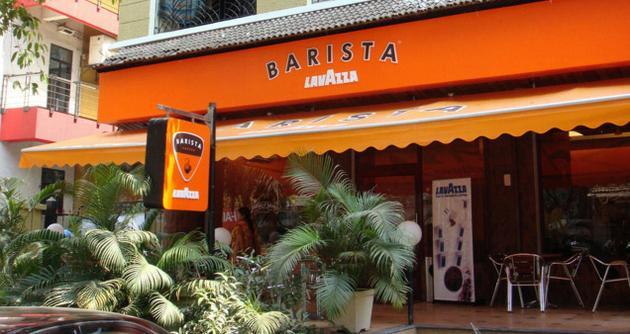
Barista, the chain that pioneered the coffee retail business in a country used to drinking tea, will change hands with Italian coffee brand Lavazza exiting from coffee shop business in India by selling its Barista brand to Rollatainers Ltd’s wholly-owned subsidiary Carnation Hospitality Pvt Ltd, reports PTI.

The company, however, will continue to supply coffee to Barista through a long-term supply agreement.

Lavazza in a statement said it has decided to lay greater focus on its core business, which is coffee.

Commenting on the announcement, Lavazza CEO Antonio Baravalle said: “The decision to move out of Barista has been taken accordingly with the global business guidelines of the group to no longer manage directly the coffee shop business.”

Talking about the Indian market, Baravalle said: “India continues to remain an extremely important market to Lavazza’s international operations and it is strategic to the brand’s overall growth initiatives across the world.” He added that Lavazza will continue to develop its our presence in the country.

The company has a production facility in Sri City in Andhra Pradesh, its only production facility outside Italy. Lavazza bought the café brand Barista in 2007 and has sold the coffee shop chain with over 190 cafés to Carnation Hospitality Pvt Ltd. In the deal, Lavazza has been assisted by Rothschild, as financial advisor, and Desai & Diwanji, as legal advisor.

Barista’s previous owners include US-based Turner Morrison, Tata Coffee Ltd and maverick entrepreneur C. Sivasankaran’s Sterling Group.

source: http://www.freepressjournal.com / The Free Press Journal / Home> Business / by FPJ Bureau / August 13th, 2014

Lavazza sells Barista, exits coffee-shop business in India

Barista Lavazza
Barista Lavazza

Deal size not disclosed; will continue to supply coffee to Barista

Mumbai :

Italian coffee roaster Lavazza has exited the coffee shop business in India. The Turin-based group has sold Barista Coffee Company, which it bought in 2007, to Carnation Hospitality, a subsidiary of containers and packaging firm Rollatainers, for an undisclosed amount. Lavazza , however, will continue to supply coffee to Barista.

In a statement, Lavazza CEO Antonio Baravalle said the decision to move out of Barista was in line with “the global business guidelines of the group to no longer manage directly the coffee shop business.”

Barista has been grappling with management issues. It has also been facing increasing competition from the likes of Starbucks and Cafe Coffee Day and has been shutting down outlets. Currently, it has 190 outlets across formats, including: lounges, cafes as well as kiosks at corporate houses.

The company had tried to tag on to the Lavazza brand to become a premium player, and was also mulling over having a franchise operation in Tier II cities.

“India continues to remain an extremely important market to Lavazza’s international operations, and it is strategic to the brand’s overall growth initiatives across the world,” said Baravelle in his statement.

Changing ownership

Barista was a pioneer in coffee retail in India and had changed ownership several times. It was founded by Amit Judge of Turner Morrison in 2001, and also saw Tata Coffee pick up 34 per cent.

In 2004, it was sold to Chennai-based Sterling Infotech Group, promoted by NRI businessman C Sivasankaran, who also bought out Tata Coffee’s stake.

In 2007, Barista was acquired by Lavazza along with another coffee company, Fresh & Honest, for ₹480 crore from the Sterling Infotech Group.

source: http://www.thehindubusinessline.com / Business Line / Home> Markets / by The Hindu Bureau / Mumbai – August 12th, 2014

Hockey festival thrills fans, marks Indian I-Day

TeamCoorgKF23aug2014

Muscat :

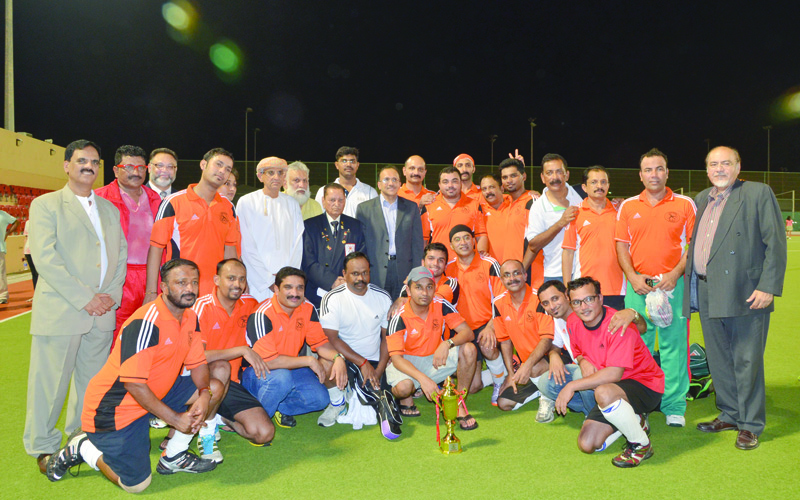
To mark the 68th Independence Day of India, under the patronage of Indian Embassy in Oman and Oman Hockey Association (OHA), the Friends of Naqvi Group and Team Coorg organised an exciting hockey festivity at the Sultan Qaboos Sports Complex on August 8.

Two festival matches, one for the Ambassadors Cup and the other for the seventh edition of Independence Day of India 2014 Cup, were played under the flood light at the lush green hockey astro turf. JS Mukul, Indian Ambassador to the Sultanate, was the chief guest and Shaikh Mahfood Ali Juma al Juma was the guest of honour.

The other sports dignitaries present were the OHA- secretary-general Redha Taqi Lawati, the Secretary-General of Oman Cricket Madhu Jesrani and the former Indian hockey player Sultan Abbas Naqvi.
The Indian Embassy XI lifted the Ambassadors Cup defeating Indian School Al Seeb 2-1 and the Oman Veterans XI lifted the Independence Day Of India 2014 Cup defeating Team Coorg Muscat 6-3 in the presence of hockey lovers of all ages.

“We got ample chance to score but could not capitalise it in the absence of our star forward Zaman,” said Team Coorg manager Belu Kuttappa.

The prizes and other citations were given away by JS Mukul, Madhu Jesrani and Redha Taqi Lawati.
The excitement of evening for the children below 10 years of age was the Indian national anthem recitation competition which was judged by Kanchan Bijlani and Farheen Khan.

This patriotic activity will now be a regular feature in years to come.

“I am quite pleased and charged to see such a massive attendance of the hockey lovers of Oman from all communities at the stadium, who have turned in such a large number to mark the independence celebration of India through this hockey festivity,” said veteran hockey ace SAS Naqvi who has indeed pledged his entire life for the promotion hockey in India and Oman.

The event was supported by Khimji Ramdas, Raha Poly products and Pokari (Muscat Pharmacy) and BG.
The vote of Thanks was given by Mohammad Osama Rawat.

source: http://www.main.omanobserver.om / Oman Daily Observer / Home> Sports / by Oman Observer / Sunday – August 10th, 2014

The glass ceiling in diplomacy

WOMEN OF THE WORLD: THE RISE OF THE FEMALE DIPLOMAT
Helen McCarthy
Bloomsbury, London, 2014
404 plus xii pages; Rs 595

This book’s core message is how the male-dominated world of British diplomacy gradually – and grudgingly – let professional women in. As an academic, the author scores on objectivity, but the reader may miss an intimacy of personal experience that an insider might have provided. The author’s reliance on documentary material, and absence of interviews with working diplomats, produces a disproportionate emphasis on history; the book is weak on the contemporary scene.

This 400-page tome is fluffed up with an extended introduction on the evolution of the world of British diplomats from the late 19th century onwards, in which women were notable for their absence. But useful nuggets are thrown up. Who might imagine that as far back as 1893, most of the candidates recruited into the Foreign Office passed through a “crammer” called Coombes to prepare for entrance tests? It was the shortage of men during World War I that brought women into clerical-level diplomatic work in London, but few rose to executive positions. When in 1933 the Foreign Office asked embassies if women could handle diplomatic and consular work, most ambassadors were aghast. It was the Soviet Union that in 1924 appointed the world’s first female ambassador, Alexandra Kollontai, to Norway. The United States appointed its first female head of mission to Denmark in 1933 (that was a “legation”, headed by a “minister plenipotentiary”; such junior embassies, withered away after World War II, or WWII).

Two chapters (the fifth and the sixth) are devoted to the proceedings of a 1934 committee that examined and recommended against the entry of women in the diplomatic service. It took WWII to bring about real change in British mindsets. At the nine-week conference at San Francisco, five female delegates were among the participants, from Canada, China (KMT), Dominica, Uruguay and the United States; the United Nations Charter bears the signatures of four women.

The main narrative is sketched through the archival material that the historian author has tracked down after rigorous search through official papers, personal diaries, and letters and other sources. This produces fascinating pen portraits of strong characters, such as the Soviet ambassador Kollontai, fluent in 11 languages, who served in Norway, Sweden and Mexico; Dame Edith Lyttelton, the United Kingdom’s delegate to the League of Nations who argued in vain for women’s entry to the diplomatic service; and Freya Stark, a Briton who became an Arab affairs specialist in the 1930s, exploring little-known corners of Syria and the Arab peninsula, and during WWII worked with much verve in Cairo, Baghdad and Tehran. The few women that found diplomatic assignments, such as Nancy Lambton in Tehran, had to appear in academic gowns on formal occasions, since a diplomatic uniform – de rigueur in those days – did not exist for women.

It was as late as 1942 that Mary McGeachy became the first woman to be given diplomatic status, at the United Kingdom Embassy in Washington, D C. While other civil services had become accessible to women 20 years earlier, the ban on women in the service’s executive-level “A Branch” was lifted in 1946. This was preceded by a 1943 white paper that amalgamated the diplomatic and consular services, and a committee appointed in 1945 that recommended removal of the ban. But it came with two caveats: a marriage bar, and a “quota” of 10 per cent. Yet through the 1950s, women did not make up more than two per cent of the executive branch.

Presented through the eyes of female recruits, the final section of the book is fascinating, depicting the recruitment process (including the two-day “house party” where candidates that had passed the written tests were put through problem-solving and goal-achievement skills; how I wish such a process was used for the Indian Foreign Service, or the IFS). The Foreign Office was hugely behind the times in waiting till 1973 to remove the bar on marriage for female diplomats. Indian female diplomats confronted the same prejudice. They were required to resign on marriage; in the 1950s, we lost outstanding persons, such as Rama Mehta and Mira Sinha Bhattacharjea. This irrational rule was lifted in 1962 when Manorama and Hardev Bhalla, both in the IFS, married. In 1973, the United Kingdom appointed its first female high commissioner, but their first married female as ambassador emerged only in 1987. India appointed C B Muthamma (the first woman to join the IFS in 1949) as its professional female ambassador to Hungary in 1970.

The United Kingdom’s glass ceiling remains much worse for professional women than one may imagine. In 1995, the senior-most female diplomat, Pauline Neville-Jones, Foreign and Commonwealth Ofiice (FCO)’s political director, could not win the prize she sought – the Paris ambassadorship; that went to a male colleague six years her junior. She declined substitute assignments and joined a bank. Till date, a woman has not headed any of the United Kingdom’s top six missions, nor served as the FCO permanent under secretary. India has seen three female foreign secretaries since 2002, and ambassadors of both genders at virtually all its top posts.

The book evokes real issues that all foreign services face today: the old formula for wives of diplomats to immerse themselves in “housewifery and hospitality”, treating the embassy as an extended family, with roles assigned by status of their husbands, no longer works. The challenges faced by spouses taking up jobs while accompanying diplomats are all too common in all foreign ministries. One wishes the author had examined this further, looking also at practices in other countries.

The reviewer is a former diplomat, author and teacher
source: http://www.business-standard.com / Business Standard / Home> Beyond Business> Books / by Krishna S. Rana / August 10th, 2014