A walk in the clouds

This summer, abandon the confines of the urban metropolis for the natural beauty of the rugged outdoors. Avantika Bhuyan lists a few challenging trails to get your adrenalin pumping

STOK KANGRI
Stok Kangri is one of the few places in the world where you can actually walk up to 6,000 metres. Stok, the highest peak in the Ladakh range, has been classified by the Indian Mountaineering Federation as a ‘trekking peak’, which means that no technical mountaineering skills are needed for the climb. However, don’t let this lull you into thinking that you can hop, skip and jump your way to the summit. The route offers a worthy challenge to experienced trekkers with great views of the Spartan mountainous desert. On day one, drive past the Leh airstrip, the Spituk Gompa and the Indus river to reach Zingchen where the trek begins. After an overnight halt at Rumbak, one reaches the base of the Stok La to start the steep climb up to the pass at 4,890 metres. Spend the night in the bustling Stok Kangri base camp, swapping adventure stories. On Summit Day, begin the ascent to Stok Kangri in the dead of night, walking for hours across frozen glaciers to reach the peak at sunrise. Nothing can prepare you for the sights that await you on the top of the summit – a 360° view of the Karakoram, a glimpse of the K2 and the Gasherbrums. Legend has it that if you have good karma, then you just might get a peek of Mount Kailash as well.

Info: July is the best time to undertake this six-day long trek. For details, visit www.aquaterra.in or www.geck-co.com

THE GOECHA LA TRAIL
A popular trek is through Lachen, a town in north Sikkim, where you can witness the annual yak race held in the summer. However, one of the most favoured hikes is to Goecha La, located at a height of 4,940 metres. The trek starts at Yuksom, a pretty village in west Sikkim where you can refresh yourself with the tongba, a fresh millet beer served in small eateries there. Most adventure tourism companies organise permits, but if you are on your own, then you need to make an entry at the police station, submit copies of your photo ID and pay permit fees at the forest check post. From about 1,100 metres, this trek takes you up to 5,000 metres through moist jungles, open meadows, dense rhododendron forests and rocky mountains to snow-clad peaks. Stay at the forest guest house at Bakhim or a little further away at Tshoka where tiny restaurants offer you a taste of the local yak cheese. From this moment on, you are trekking in the shadow of Mount Kanchenjunga and can gaze at its southeast face. The trail to Dzongri, at 4,200 meters, offers you a panoramic view of the mighty Singalila range and Kanchenjunga. Time your trek from the Dzongri trekkers’ hut to the top so that you can watch the Kanchenjunga’s golden hue as the first rays of the sun hit the peak.Goecha La is further away along a spare alpine rockscape.

Info: This trek can be completed in eight to ten days, depending on your fitness levels. Visit www.banjaracamps.com or www.geck-co.com

BHABHA PASS TREK
This popular route takes you through the lush Kinnaur valley and the stark landscapes of Spiti region all the way up to the Bhabha Pass, which at 4,640 metres remains snowbound all through the year. Visit Comic, the highest village in Asia and also the famous monasteries of Tabo and Ki. Spend a day with a family in Spiti, which still follows the extended family system, with its roots in the ancient polyandric practices. This six-day long trek starts from the village of Kafnu through thick Pine and Deodar forests all the way up to the tiny hamlet of Mulling at 3,840 metres. The climb is steep in some parts and first-time trekkers are advised to take their time to catch their breath. After spending the night in the camp at Mulling, make your way to Kara, a meadow dotted with alpine flowers. A walk along the Wanger River leads to Phustring, the base of the Bhabha Pass. At 4,200 metres, crisp cold air and icy mountain streams greet you and you are offered a fantastic view of the 5,840-metre high Hansbeshan peak. The trek leads you to Pin valley and the edge of the Great Himalayan National Park which is home to the snow leopard and the Himalayan brown bear. From here, one can drive down to Manali via Kunzum and Rohtang.

Info: The 60 km trek is best undertaken in June and July. For more information, contact Banjara Camps & Retreats at www.banjaracamps.com

HARISHCHANDRAGAD FORT TREK
The scenic trails zigzagging across the lush forests of Western Ghats offer challenges to appeal to the adrenalin junkie within you. One of the most popular jungle trails in this region happens to be the Harishchandragad trek which takes you through waterfalls and rock-cut caves to the mighty fort. Located in the Ahmednagar district, this fort can easily be accessed by bus from Pune or Mumbai. Trekkers believe that there are seven routes to the fort, ranging from easy to challenging. The simplest route is from Pachnai village which allows you to walk through the clouds, soaking in the magnificent views. However, most people start the trek from Khireshwar village, which offers a glimpse of the Nageshwar temple and the Shivling in the Kedareshwar rock-cut cave. However, the hardest route is from the Konkan Kada, a sheer 3,000-ft tall wall. Some use these walls for rappelling while the more daring trekkers climb straight up. The top of the Kada offers magnificent views of the Konkan and the Taramati peak. It is said that on a windy day if you throw an object into the deep chasm below, it flies right back to you.

Info: This two-day long moderate trek is best enjoyed in summer or even in the monsoon when the clouds cling to the mountains. Visit www.geck-co.com

THE KOPATTY TRAIL
The Kopatty trail in Coorg takes you on a whirlwind tour of plantations, dense forests and undulating grasslands – all in one day. The trek starts at Charambane, located 25 km from Madikeri. Start the day with a visit to the Maha Vishnu temple and then stroll through the paddy fields to reach the coffee plantations. The trail, covered in a rich undergrowth of shrubs, gains height to offer a bird’s-eye view of the Talacauvery region. Open meadows give way to dark and dense forests lined with brooks and streams. Clumps of bamboo mark the edge of the forest, giving way to lush grasslands. A walk through the hills offers a wonderful view of the Kopatty summit, which can be reached from the base after a steep ten-minute climb. From the top, you can see the Mandalpatti plateau to the north and the blue hills of Coorg to the south.

Info: Charambane can be reached by bus from Madikeri in an hour. It is also well-connected with Mysore and Bangalore. For more details, visit www.indiahikes.in

source: http://www.business-standard.com / Business Standard / Home> Beyond Business> Features> Features / by Avantika Bhuyan / New Delhi, April 13th, 2013
A green movement like the West

Here comes an innovative idea to bring back greenery to the parched, degraded Silicon City.

Four young professionals, Shailesh Deshpande, Reena Chengappa, Sriram Aravamudan and Athreya Chidambi gave up their five-figure corporate jobs and dedicated themselves to small space urban gardening.

Talking about the project, My SunnyBalcony which aims at giving everyone a dream garden, Sriram said, “All four of us came up with this idea while having a discussion over a cup of coffee one day. We realised that there were a lot of trees been cut for flyovers and other projects. Instead of mourning over it, we thought we should do something.”

With high rise buildings being the order of the day, these youngsters plan to bring in the green room movement like in the West.

“Bangalore is a city where we don’t see excessive heat or cold which can destroy the plants. We have to just sow the seeds in the soil and then watch it grow. Initially we started it as a weekend project and later quit our regular jobs to be here. We decided on taking up the balcony spaces of the house as it is a personally owned space unlike the terrace which is a community space. Too narrow to be of any use and too long to be ignored, this balcony was a perfect candidate for a garden. We started doing it at a friend’s place and then at their bosses’ houses. To take it further, we developed a website and got into this business full time. It has been three years now since we started,” he said.

Getting into a totally uncharted territory, they could only hope for the best.

“Four of us initially did all the digging, planting and gardening. Today, we have come to a stage where we can hire some permanent staff. In the mean time, we realised the city has a major issue with garden products and accessories. So we started selling garden products in terracotta, wrought iron and bamboo which are all sourced from artisans in and around Bangalore. Today, our products are available in a couple of stores and we have started taking shipping orders too,” he said.

Avid gardeners, these youngsters took some basic course in gardening before they plunged into the activity thoroughly.

“The gardening course just gave us the basic understanding. We realised the only way this will pick up is through innovative marketing.

With half of Bangalore population being environment-friendly, it was not difficult for us to sell our products.

“With a very basic budget, we could only do our publicity through social networking sites,” said Sriram who encourages vegetable gardening in the city.

“We are not saying that ornamental gardening is bad. We being passionate about organically grown vegetables, feel that there are some easy ways to tackle the issue. Bangalore weather can be classified as a Mediterranean one even though we are in the tropical region because of the city’s altitude. We can easily grow vegetables like spinach, western oregano, tomatoes, brinjals, beans, grapes, ash gourd, pumpkin, bitter gourd, carrots and more. Vegetable creepers over balconies is also an exotic idea,” he offers.

Gardening needs constant care as the plants have to be watered every day which might become difficult for people who travel often. Well, this problem can be settled. “Farewell, water woes. We do have a solution. We assist them with solutions like irrigation, pest control and how to take care of the plants,” he said.

In terms of gardening project, they have covered at least 300-400 houses. “Our garden products have at least reached 1000 homes,” said Sriram who also hosts a number of workshops at corporate houses to create awareness on gardening.

source: http://www.newindianexpress.com / The New Indian Express / Home> Cities> Bangalore / by A Sharadhaa / ENS – Bangalore / April 16tgh, 2013

Kodava hockey utsav begins

Madanda family is the host of the tournament
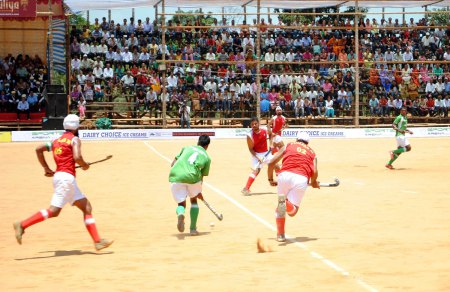
The 17th edition of Kodava families hockey tournament was flagged off in a colourful note at Kodava Samaja Okkuta Cultural and Sports Complex at Balugodu near Virajpet on Sunday.

KodavaHockey20apr2013
Kodava Hockey Academy Founder president Pandanda M Kuttappa inaugurated Madanda hockey utsav by moving the ball using a silver hockey stick.

Speaking on the occasion, Kuttappa said as international hockey players will be taking part in the tournament, it will help the youth to give priority to sports. To encourage sports meet among Kodava families, a full fledged stadium is getting ready with the help of elected representatives.

Balugodu Kodava Samaja Okkuta president M N Belliappa said that the tournaments brings together people under one roof.

Ninada institute students and Kodava Okkuta office- bearers presented Kodava dance on the occasion. The spectators were seen cheering the cultural programmes. After the inaugural session, there was a match between Punjab eleven and Kodagu hockey eleven.

The spectators were seen cheering their favourite players and teams. Though in the first half, none of the team could score a goal, in the second half, Harpreeth from Punjab eleven scored the goal at 31st minute. Muthanna from Kodagu eleven scored the goal at 59th minute. The players were given memento by the hockey utsav committee.

Akhila Kodava Samaja president Mathanda Monnappa, Youth service and sports department joint director J M Appacchu were present.

Karnataka Hockey secretary Dr A B Subbaiah was felicitated on the occasion.

source: http://www.deccanherald.com / Deccan Herald / Home> District / Maddikeri, DHNS – April 15th, 2013

Gulshan Devaiah, Radhika Apte in Vasu

Mumbai :

Gulshan Devaiah, who is known for his grey roles in Shaitan, That Girl In Yellow Boots and Hate Story will now be seen in a comic avatar.

The actor has just wrapped shooting for debutant director Harshvardhan Kulkarni’s Vasu where he plays a Konkani character. Devaiah informs, “I play Mandar Ponkshe, who is a very ordinary man but who has special ways with women. It is a full-blown commercial comedy where I am paired opposite Radhika Apte.”

Interestingly, his character ages from 19 years to 36 years through the course of the film. “It was difficult to pull off the parts where I had to play a 19- year-old teenager because that is much younger than my age. I have played older characters before, so playing someone in his 30s was not very difficult,” he says. Shot entirely in Pune, the film will release sometime this year.

Meanwhile, Devaiah is currently shooting for Sanjay Leela Bhansali’s magnum opus Ram Leela where he plays a character with grey shades, and is also awaiting the release of Vasan Bala’s Peddlers.

source: http://www.expressindia.indianexpress.com / ExpressIndia.com / Home> Story / by Krutika Behrawala / April 18th, 2013

Adventure camp at Kodagu

The National Adventure Foundation (NAF) Karnataka 2 chapter will conduct a three-day adventure camp at Kodagu from April 28 to 30 for children aged 8 to 17.

They will experience parasailing, trekking, and rappelling as well as team-building games. For registration, call 9448354648 or email almanacadventure@yahoo.co.in.

The last date for registration is April 26.

source: http://www.thehindu.com / The Hindu / Home> National> Karnataka / by Special Correspondent / Mysore, April 18th, 2013

In Coorg, ‘jumping japak’ when there’s a goooal!

Photo Caption
E.R. RAMACHANDRAN writes: At a time when Hockey India (HI) and the Indian Hockey Federation (IHF) are at each other’s throats and dragging Indian hockey down the drain by filing cases against each other, in an idyllic part of the world 225 hockey-mad families are participating in the biggest tournament of its kind.

The idyll is Coorg.

In the cradle of Karnataka hockey nay Indian hockey, the 17th edition of the inter-family hockey tournament, which has entered the record book, quietly got underway near Virajpet on Sunday. And, despite IPL being on everybody’s lips, the passion for hockey remains high.

Some of the most popular names of Indian hockey, M.P. Ganesh, B.P. Govinda, M.M. Somaiya, Poonacha and Arjun Halappa have come from the hilly, coffee-country. If hockey has to have resurgence, is it time hockey is moved to Kodagu than be a part of Delhi where they play hooky with hockey and are mostly busy with court cases?

Photograph:
Members of a visiting Punjab team in a duel with a local Kodava team at the inter-family hockey tournament at Balugodu Kodava cultural centre, near Virajpet in Kodagu district on Sunday (Karnataka Photo News)

source: http://www.churmuri.wordpress.com

Coffee and the selfish gene

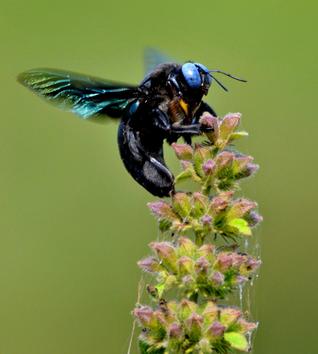
Caffeine in nectar hooks bees. / The Hindu

How did coffee become more popular in south India and tea in the north? History appears to give the reason. Legend has it that in the late 16th century while Haji Baba Budan was returning from Haj through Yemen, he found people boiling coffee beans in water and enjoying the “decoction”. He then smuggled a handful of the (forbidden to export) beans with him and planted them on the Chikamagalur hills in Karnataka and the locals took to it with elan. Soon, coffee plantations appeared in Kodagu and the Nilgiris, and we all were hooked on to the morning coffee. Tea, on the other hand, was introduced later (early 19 century) by the colonial British who copied it from the Chinese and planted it in Assam and Darjeeling. This colonial drink soon became popular among the subjects in the plains as well. Coffee and tea are thus external entrants into the Indian taste buds.

But why are we hooked on to coffee and tea? The answer comes from science, which tells us that they both contain the mood- altering and addictive drug caffeine. While this is a proximal answer, the ultimate question is why at all do these plants go to the trouble of making the molecule in the first place. After all, it takes metabolic energy to do so. The answer appears to be “to deter herbivores”, or as a defence chemical. Note that the raw bean or leaf is bitter to taste, and the animal would shy away, leaving the plant alone to grow and flourish.

Recent findings add another dimension to the tale. It has been found the caffeine is found not only in the bean or the leaves but also in the nectar that the plant produces and packs a drop or two in its flowers. And why it would do so and what this stored caffeine does in the flower nectar has been investigated by a group of researchers from U.K. and published in the March 8, 2013 issue of Science.

They note that while plant-derived drugs like caffeine and nicotine (the drug in the tobacco plant) are lethal in high doses, they do generate pleasant effects when taken in very low doses. But then why in the floral nectar? Is it in order to “hook on” bees and other pollinating insects? To understand this, the researchers first measured the levels of caffeine in the nectar of three plants, Coffee arabica, C. liberica and C. canephora, to which bees make a bee-line for (pardon the pun), and found the amounts to be less than a thousand-fold that of the sugar present in the bean — just a teasing touch.

They hypothesised that the caffeine in the nectar could affect the learning and memory of the foraging pollinators. Could it be that they would come to these flowers, enjoy the nectar and in the process take away and dispense the pollen, thus breeding these plants in preference to those that do not store caffeine in their nectar? In order to test this, the researchers took the trouble of training individual bees to associate a floral scent with sugar reward. In one set the bees would go to the containers with sugar solution, and in another set the sugar solution spiked with a bit of caffeine. And they found that the bees would consistently return to the caffeine sugar scent even three days later. In other words, caffeine acted as a memory enhancer. The bees were hooked onto caffeine.

The researchers went further ahead and investigated the biological mechanisms behind the mode of action of the caffeine. The bee brain contains what are called projection neurons or nerve cells that have a protein surface (a receptor) that normally binds to the molecule adenosine. When these nerve cells are adenosine-bound, the behaviour of the bee is one of quiet and calm. However when caffeine is brought in, it kicks out the adenosine and attaches itself to the receptors at the end of the sensory neurons. The effect is to stimulate the neurons, increase memory, and wake up and excite the insect.

In effect then, caffeine has two roles in the plant. One is defence against the predator goats and cows, while the other is to entice the pollinating insect by drugging it and tweaking its memory so that it pollinates this plant in preference to other pants that do not pack the drug in their nectar. The researchers conclude by stating that “our experiments suggest that by affecting a pollinator’s memory, plants reap the reproductive benefits arising from enhanced pollinator fidelity”.

In plainer English, one can say that the trick the coffee plants play is another example of the ‘selfish gene’ idea, namely, use any ruse to help propagate my genes over other competitors, and do so for generations; and if it takes caffeine to entice and tweak the memory of the pollinator, so be it.

source: http://www.thehindu.com / The Hindu / Home> S&T> Science / by D. Balasubramanian / April 17th, 2013

Karnataka coffee belt gets good blossom showers

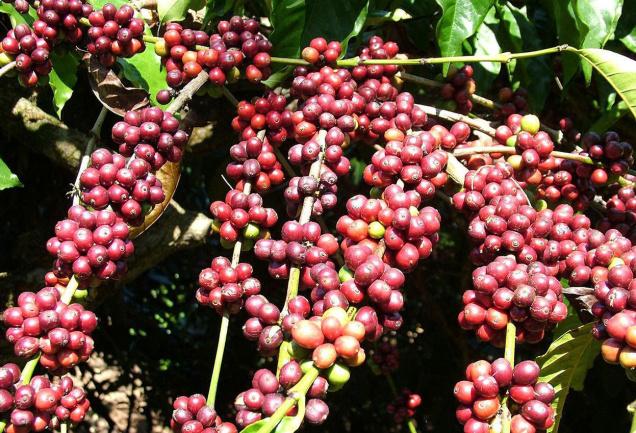
Bright outlook: Ripened coffee berries at a plantation in Karnataka. /.  (a file picture.) / The Hindu
Bright outlook: Ripened coffee berries at a plantation in Karnataka. /. (a file picture.) / The Hindu


Bangalore :

Coffee-growing regions of Kodagu, Chikmagalur and Hassan in Karnataka have received good blossom showers.

“Blossom shower in the coffee belt in Karnataka is very good this year. Very good for Arabica as compared to poor to patchy rains last year,” Bose Mandana, a senior coffee planter from Suntikoppa in Kodagu told Business Line.

MARCH SHOWERS

“Rain in February, especially during mid-harvest, was worrisome, but March shower has been heavy and this has made us comfortable for the next three to four weeks,” he added.

In Kodagu rains have been good in Napoklu zone comprising Murnad, Madikeri and Napoklu whereas Gonikoppal zone, which comprises Virajpet, Gonikoppal, Kutta and Balale, needs additional showers.

For robusta, south Kodagu got early showers in February and now has received moderate March showers.

In Chikmagalur and Hassan districts, March rains have been well distributed. “Due to timely showers and moisture status being good, many planters have begun applying manure in their estates. This year, they have been able to save on irrigation,” said Mandana.

According to Nishant Gurjer, Chairman, Karnataka Planters’ Association and a grower from Chikmagalur said “Early rains in February and subsequent rains in March have been good for overall crop production.”

“Rains in the last two months have been good for robusta. Stressed period for Arabica was cut short and there was initial apprehension among the growers over early rains. But March rains, however, have been beneficial,” he added.

Last crop year (2012-13), the Coffee Board had estimated the post-blossom estimate at 3,25,300 tonnes (arabica 1.04 tonnes and robusta at 2.21 tonnes).

As for the final crop forecast, the Board has estimated 3,15,500 tonnes, of which Arabica is 1,00,225 tonnes and robusta at 2,15,275 tonnes.

source: http://www.thehindu.com / The Hindu / Home> Industry> Agri-Biz / by Anil Urs anil.u@thehindu.co.in / Bangalore, March 15th, 2013

A fine performance by Pooavamma

The qualification marks for the World Athletics Championships continued to be elusive, but M.R. Poovamma lit up the evening with a fine performance in the women’s 400 metres in the second Asian Grand Prix at the NIS Complex in Patiala on Saturday.

With a battery of technical officials in operation, and manual timings as a back-up, the meet was a smooth affair, even as triple jumper Renjith Maheswary and Om Prakash in shot put improved their performances, in promising a better fare in the Federation Cup to be staged at the same venue after a fortnight.

Returning to competition after a bout of typhoid, the 22-year-old Poovamma clocked 53.59 seconds in outclassing a weak field. Pleased with her strong start for the season despite having trained for a few days only, she expressed confidence about improving her time in the meets ahead.

Having won two titles in the Asian Grand Prix last year, Poovamma felt that better competition would help her improve on her best time of 52.94.

Coach N. Ramesh was also confident that Poovamma would improve quickly and go under the qualification mark of 52.35. Of course, the athletes have the chance to win the Asian championship and become automatic ‘A’ standard qualifiers for the World Championship, but the question mark about the event coming off continued to dangle despite attempts to host it in Jharkhand.

Renjith had only two good jumps but managed to reach 16.78 metres, better than his mark of 16.67 last week. He said that the delayed start, by about an hour on the jumping pit, had spoilt his preparation, and he could not strike any rhythm.

However, that did not stop him from competing in long jump as well, and bagging a bonus bronze.

In shot put, the other Olympian in the fray, Om Prakash won with a throw of 18.65 metres. He had two other throws of 18.19, and 18.54 — better than his last week’s effort of 18.12. However, the qualification mark was a bit away at 20.10.

Arokia Rajiv continued to shine as he won the 400 metres ahead of Kunhu Mohammed and S.K. Mortaja, with an improved time of 47.22 seconds. He also won the silver in the 200 metres, and felt that it had taken a bit of sting away from him for the 400 metres.

Coach Mohd. Kunhu who trains all the three at the Army base in Pune assured that Rajiv would go under 46.5 soon.

With the third Grand Prix having been postponed owing to the Annual General Meeting of the Athletics Federation of India (AFI), the athletes will next assemble at the same venue on April 23 for the Federation Cup.

The results: Men: 200m: 1. Bhartinder Singh 21.66; 2. Arokia Rajiv 21.72; 3. Bala Murugan 22.19.

400m: 1. Arokia Rajiv 47.22; 2. Kunhi Mohammed 47.44; 3. S.K. Mortaja 47.69.

800m: 1. Manjit Singh 1:52.55; 2. Pranjal Gogol 1:52.97; 3. Vikash Latyeya 1:53.59.

3000m: 1. Kheta Ram 8:06.33; 2. P. Suresh Kumar 8:06.43; 3. V. L. Dangi 8:18.27.

400m hurdles: 1. Jithin Paul 51.72; 2. Binu Aquito 53.14; 3. Gurinder Singh 59.21.

Long jump: 1. Arshad 7.56; 2. Bhartinder Singh 7.54; 3. Renjith Maheswary 7.27.

Triple jump: 1. Renjith Maheswary 16.78; 2. Arpinder Singh 16.46; 3. Rakesh Babu 15.89.

Shot put: 1. Om Prakash 18.65; 2. Jasdeep Singh 17.95; 3. Satyender Singh 17.50.

Javelin throw: 1. Devender Singh 76.77; 2. Dinesh Kumar 73.44; 3. Samarjit Singh 72.71.

Women: 200m: 1. Asha Roy 24.23; 2. Merlin K. Joseph 24.83; 3. Sini S. 25.13.

400m: 1. M.R. Poovamma 53.59; 2. Anju Thomas 55.27; 3. Saraswati Chan 55.70.

800m: 1. M. Gomathi 2:11.99; 2. Jhuma Khatun 2:12.66; 3. Fulan Khatun 2:16.62.

3000m: 1. O.P. Jaisha 9:37.49; 2. Swati Gadke 10:13.87; 3. Kiran Rani 10:23.36.

Long jump: 1. V. Neena 5.95; 2. Amitha Baby 5.57; 3. Niksy Joseph 5.50.

source: http://www.thehindu.com / The Hindu / Home> Sports> Athletics / by Kamesh Srinivasan / Patiala, April 07th, 2013

Ale team apologizes to Harshika Poonacha

(Harshika )
(Harshika )

The female cast of the upcoming Kannada film found themselves in the midst of a controversy recently, when lead actress Harshika Poonacha took offence to promotional material that prominently featured Aviva Bidapa, who is only doing a cameo in the film. Harshika, in fact, voiced her disappointment when she saw Aviva’s pictures showcased in such fashion. Sources say that Harshika refused to associate herself with the film since then.

However, a clarification note recently issued by the film’s team seems to have put things in the right perspective, as far as Harshika is concerned. “Harshika Poonacha is the only female lead in our film. All the other characters appear either in guest or supporting roles,” states the notice issued by the production house. “Some of the initial posters did feature Aviva, but that led to unnecessary misunderstandings which we have rectified now,” confirms filmmaker Kiran Kumar Reddy.

The actress herself, seems a lot more relaxed after the team issued a public clarification. “A film’s poster should have the heroine, not someone who appears in a cameo. I don’t think it is fair if a film unit does otherwise. I just insisted they do the right thing. The team has apologized and we have now put behind all our differences,” says Harshika. Kiran also tells us, “We will not be using any of Aviva’s photographs or stills from the film anymore. She will only be seen as part of the movie, playing her cameo.”

source: http://www.articles.timesofindia.indiatimes.com / The Times of India / Home> Entertainment> Regional / by Kavya Christopher, TNN / April 14th, 2013