Rashmika Mandanna to wear Kodava style saree for her evening wedding- Exclusive
From Karnataka’s Coffee Hills to Nordic Royalty in Gulmarg: Bhavani Nanjunda Reigns at KIWG 2026
Amid coffee estates, Pollibetta’s colonial legacy lingers
Priyan R Naik explores the history and architecture of British-era bungalows, clubs and churches in a small town in Kodagu.
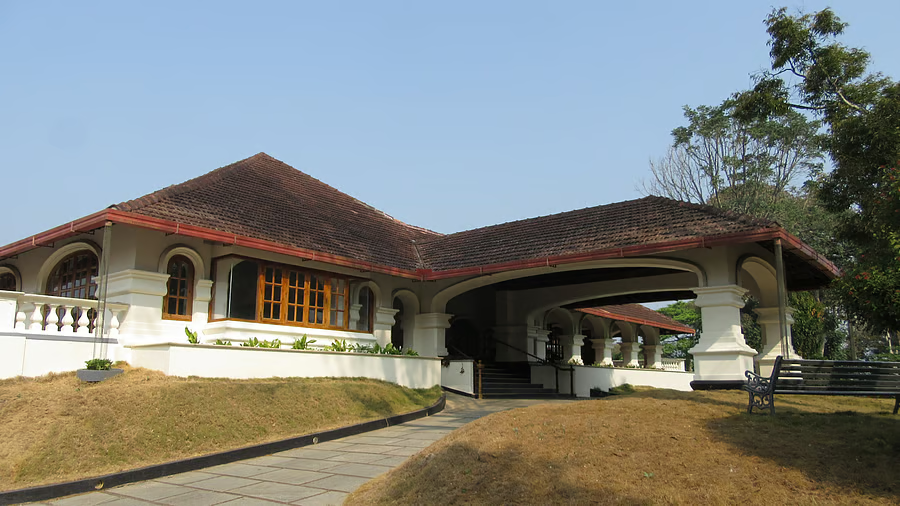
A view of the Bamboo Club at Pollibetta in Kodagu; the Pollibetta Bungalow. / Credit: Priyan R Naik
Pollibetta, a town in the heart of Kodagu district, still echoes the region’s plantation past. Its bungalows, British-era clubs and churches tell stories of a bygone era, blending colonial architecture with restored heritage elements. Amid tiered coffee terraces and pepper vines, the town stands as a living record of history, architecture and cultural adaptation.
Scattered across coffee estates, the region’s colonial bungalows remain the most visible markers of Pollibetta’s architectural heritage. Designed for both climate and lifestyle, these buildings blend practical planning with aesthetic restraint. Continuous verandahs encircle many houses, keeping the interiors dry while allowing cool breeze, especially during the monsoon. Tall, shuttered windows and high ceilings enable cross ventilation. Traditional Mangaluru-tiled roofs, steeply pitched to withstand heavy rain, harmonise with the surrounding greenery.
Most bungalows here were built on elevations so that British planters could oversee their estates, amid a life supported by butlers, cooks and gardeners.
If one patriarch shaped Pollibetta’s modern coffee culture, it was Ivor Bull, a British officer who moved to India and purchased Consolidated Coffee Estates Ltd, an early integrated coffee companies in Coorg. The ripening Robusta coffee cherries on century-old estates trace their lineage to pioneers like him. He encouraged a pooling system that brought planters together to market their coffee.
As the president of the Bamboo Club (a European social club) for several years, Ivor made coffee the engine that brought architecture, infrastructure and social institutions to this once forested land.
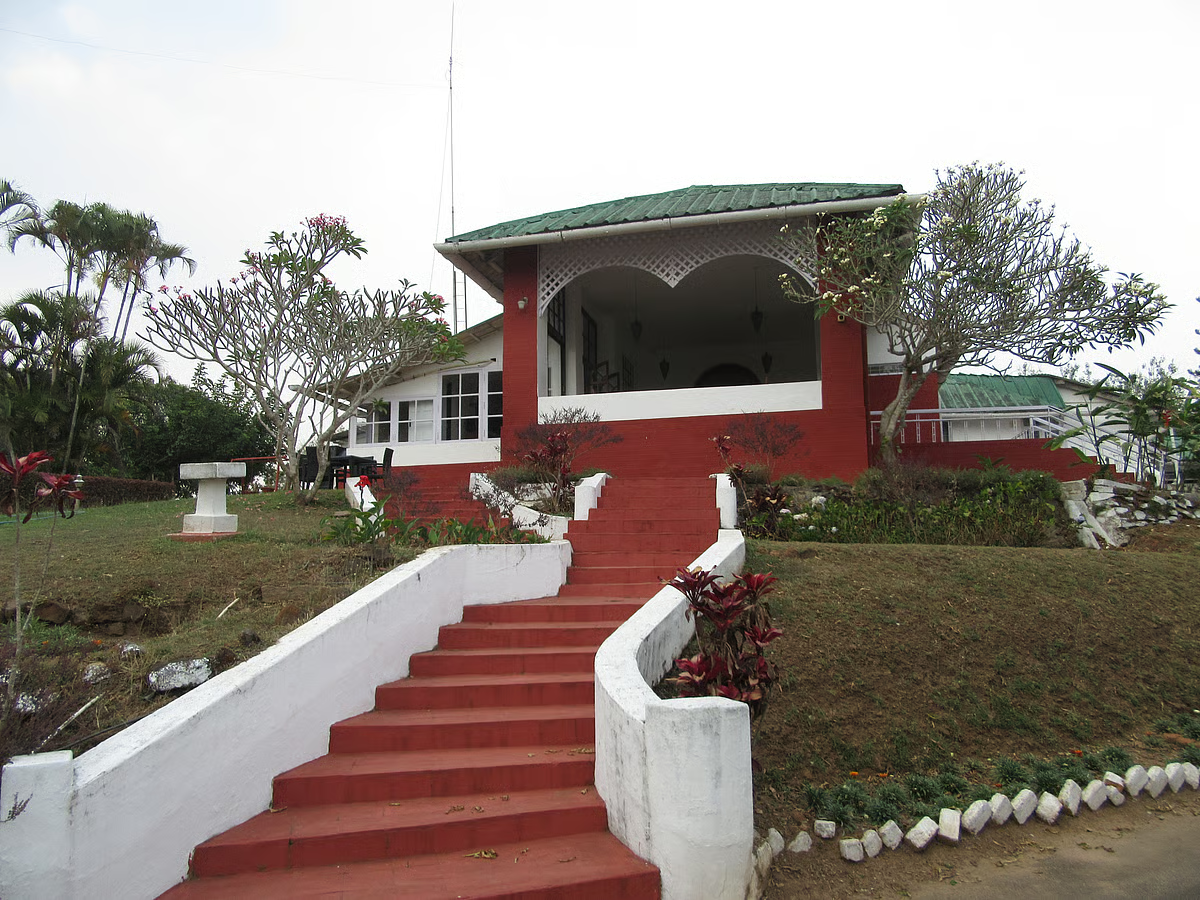
The Pollibetta Bungalow. Photo by author
The historic Pollibetta Bungalow, dating to the 1880s, was once Ivor Bull’s residence. With its wrap-around verandah and sloping Mangaluru-tiled roof, it stands above coffee terraces. Hardwood floors, latticed windows and rosewood panels define the interiors. Large rooms furnished with Victorian furniture and wooden shutters are a marvel to behold.
Little England
Pollibetta’s social infrastructure during the colonial era evolved alongside its architecture. Established in 1886, the Bamboo Club’s timber halls once hosted billiards, ballroom evenings and plantation politics. The club became a ‘Little England’ where coffee planters could meet, play games, dance and party to overcome their nostalgia for home. It was established in keeping with the British tradition of establishing a club wherever they resided. Its classic colonial club architecture — wood-framed lounges, high ceilings and expansive halls — was designed to accommodate large gatherings. Today, the clubhouse serves the planter community’s recreational and social needs. Across the club is the CSI Christ Church. Modest compared to a cathedral, its pointed arches, lancet windows and modest steeple reflect a restrained Gothic style adapted to a plantation setting.

The Woshully bungalow at Pollibetta. Photo by author
The Bamboo Club was first established at the Woshully bungalow where the European planters met. Built in the 1880s, it functioned as the clubhouse before a dedicated building was constructed. Perhaps one of Kodagu’s oldest heritage bungalows, it stands amid orderly rows of coffee and silver oak trees, built of stone and timber and crowned with tiled roofs. Even today, it remains a vantage point to observe the surrounding hills while sipping a cup of coffee.
The Thaneerhulla bungalow, around 130 years old, derives its name from a nearby pond. With antique wooden floors and a cosy fireplace, the bungalow exudes an old-world charm. It has an expansive patio which once saw bullock and horse carts dropping guests for parties.
The Cottabetta Bungalow, built in 1888, is another residence from the colonial era, with simple colonnades, manicured lawns and views opening from its verandah — Kerala to the south, and Kushalnagar with Madikeri Hills overlooking it, to the north.
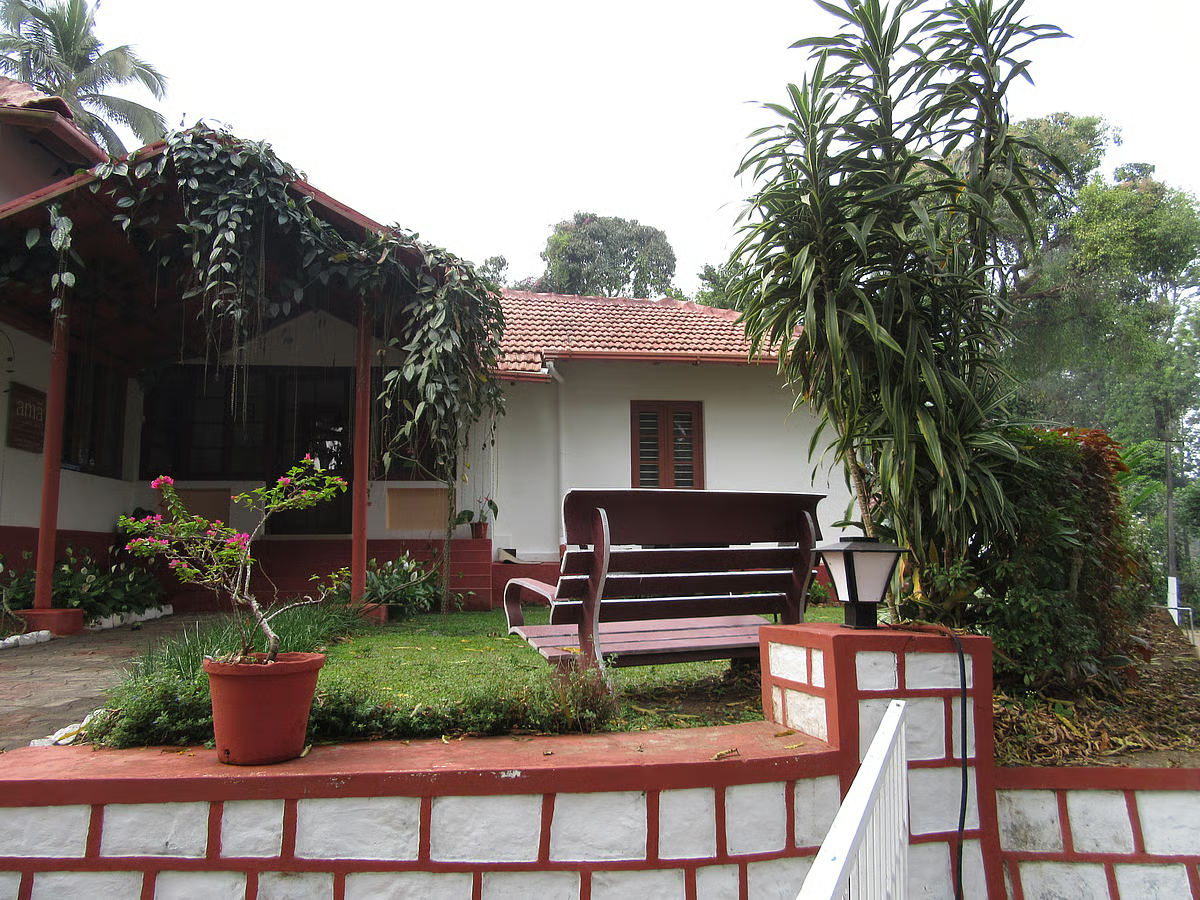
The Surgi Bungalow at Pollibetta. Photo by author
The Surgi bungalow is yet another charming property with rosewood beams, panelled doors and a colonial-style fireplace. Today, its original floor plans, outdoor fireplaces, timber elements and courtyards that once hosted planter gatherings, have been restored.
Today, Pollibetta represents an architectural continuum. Verandahs remain, though fireplaces are now largely ornamental. Restored plantation homes welcome travellers with modern comforts while preserving the heritage timber and tile with memories. Sustaining this legacy depends as much on sensitive restoration as on responsible visitors who value its past.
source: http://www.deccanherald.com / Deccan Herald / Home> India> Karnataka / by Priyan R Naik / February 26th, 2026
Traditional Coorgi rituals at Rashmika Mandanna, Vijay Deverakonda’s second ceremony explained: All about Kodava wedding
Inside Vijay Deverakonda and Rashmika Mandanna’s Kodava wedding: traditional Coorgi outfits to groom’s ritual shave and bath and bride’s ‘bale iduva’ ceremony.

Rashmika Mandanna and Vijay Deverakonda’s second wedding ceremony was all about traditional Coorgi rituals. (Couple in a still from Dear Comrade)
Following a morning ceremony steeped in Telugu traditions, actors Rashmika Mandanna and Vijay Deverakonda chose to celebrate the second leg of their wedding on February 26 by honouring Rashmika’s heritage with a traditional Kodava wedding.
While the morning belonged to the groom’s culture, the afternoon and evening shifted to the lush wedding traditions of Coorg (Kodagu). Distinct from typical Hindu ceremonies, a Kodava wedding is a unique cultural experience centred around ancestors, nature, and community rather than Vedic rituals or a priest.
The preparation: Oorkuduvo
As per Kodavaclan.com’s blog, the festivities begin with the Oorkuduvo, where both families gather to prepare the wedding venue. This involves the ritualistic cutting of vegetables and pork — a staple of Kodava feasts — and the construction of the five-legged pandhaal (pendal). Interestingly, one pillar of this structure must come from a ‘milk-producing tree’, topped with jackfruit leaves and adorned with mango leaf swags. This structure remains standing for several days following the nuptials as a symbol of the new union.
Wedding attire of Coorgi ceremony
The couple look striking in traditional Coorgi garb: the groom dons a white kupya (a long tunic-style coat), cinched with a red-and-gold silk chele (waistband). He carries the peeche kathi (traditional dagger) and wears a peta (turban). The bride wears a vibrant silk saree, draped in the famous Kodava style — pleats tucked at the back and the vastra (headscarf) elegantly tied at the nape of her neck.
Key rituals: From bales to baale kethuvadh
The ceremony features several deeply symbolic rituals that define the warrior-tribe heritage of the Kodava
1. Before the main event, the groom undergoes a ritual shave where milk is applied to his face using blades of grass. Following this, he is given a ritual bath by his mother and two married women, symbolising purification.
2. The bride participates in the bale iduva, where a traditional bangle seller places coloured glass bangles on her wrists. Per custom, at least one pair of black bangles is included to ward off the evil eye.
3. In one of the most spirited displays of the day, the maternal uncles of the couple perform the baale kethuvadh. This involves cutting through nine banana stems with a single stroke of the odikathi (warrior knife), followed by a joyful dance to the beats of the valaga (traditional music).
The main wedding ceremony
The core of the wedding, the dampathi muhurtha, takes place on a decorated dais. Unlike most Indian weddings, there is no agni (fire) or pheras. Instead the couple sit on mukkalis (three-legged stools). Elders and family members shower them with rice and blessings. The groom offers his bride a sip of milk and presents her with cheela pana (a bag of coins). The ceremony concludes with the exchange of garlands and the groom helping his bride to her feet.
The final rituals
The celebration isn’t without a bit of drama and humour. During the batte thadpo, the bride’s cousin playfully blocks the couple’s path, jokingly claiming the groom should have married her. They can pass only after the groom’s side offers a gold coin as a guarantee of her well-being.
The day concludes with the Ganga pooje (Neer Edpo). The bride carries pots of water from a well while balancing on a thombuda (head-rest), taking small, rhythmic steps as the groom’s family dance around her. This symbolises her integration into her new household and her strength in managing her future responsibilities.The double-ceremony day ends with the kombarek kootuvo, where the groom officially welcomes the bride to their private quarters, gifts her a gold wedding band, and the two seek final blessings as a wedded couple.
Note to readers: This report is based on user-generated content. HT.com has not independently verified the claims and does not endorse them.
This article is for informational purposes only.
source: http://www.hindustantimes.com / Hindustan Times / Home / by Sanya Panwar / February 26th, 2026
Coorg Hawks clinch CHAIROS Bheemaiah Hockey Cup 2026 title
Coorg Hawks emerged champions of the 7th edition of the CHAIROS Bheemaiah Hockey Cup after defeating Pale Taluk 7–5 in a thrilling final at the Field Marshal K M Cariappa Hockey Arena in Bengaluru on Sunday, February 22.

Coorg Hawks pose with their winners trophy. Photo courtesy: Collected
The event was organised by the Coorg Challengers Chickpet Association under the aegis of Hockey India and Hockey Karnataka. QNET, an MLM company, returned as the title sponsor, continuing its support for sports development and community initiatives.
The high-scoring contest capped three days of fast-paced hockey action and reaffirmed the tournament’s growing stature in Karnataka’s grassroots hockey scene.
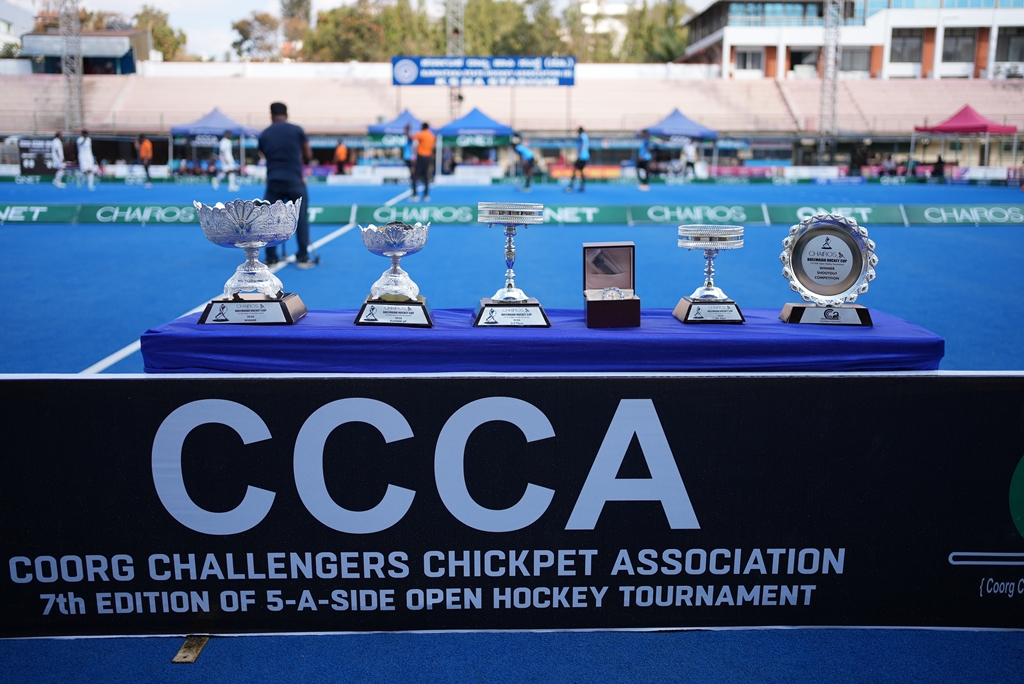
The trophies and prizes awarded to players. Photo courtesy: Collected
Southern Command secured third place, while DYES Karnataka finished fourth in the competition. In the special Shootout Competition, SAI STC lifted the Shootout Competition Trophy, adding to the excitement of the closing day. Md. Raheel from Coorg Hawks was named the player of the tournament.
The tournament, held from February 20 to 22, featured the popular 5A-side format known for its speed, quick passing and high-intensity gameplay. A total of 18 teams from across the country participated, including several national-level player.
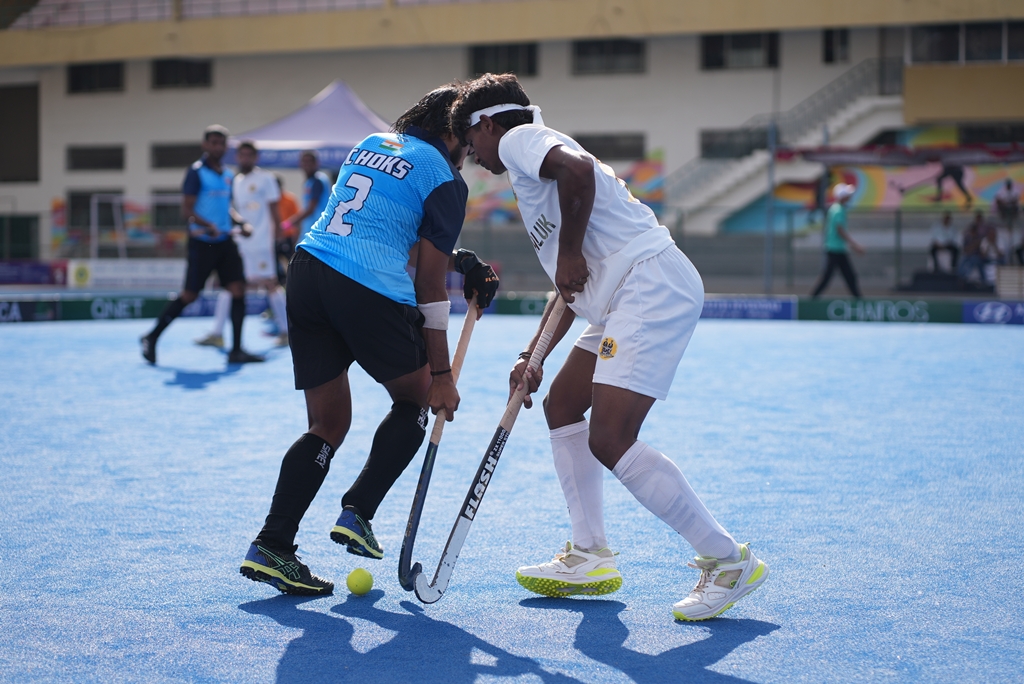
The finale displayed a thrilling match between Coorg Hawks (blue) and Pale Taluk. Photo courtesy: Collected
“At QNET, we remain committed to supporting initiatives that empower communities and create meaningful sporting opportunities at the grassroots level. Platforms like the CHAIROS Bheemaiah Hockey Cup play a vital role in nurturing young talent and strengthening the sporting ecosystem,” said Nishchal Churamani, Head of Corporate Communications, QNET, India region.
The closing ceremony was attended by Arjuna Awardee and former Indian Olympian and goalkeeper A B Subbaiah, who presented the trophies and appreciated the organisers for providing a strong platform for emerging talent.
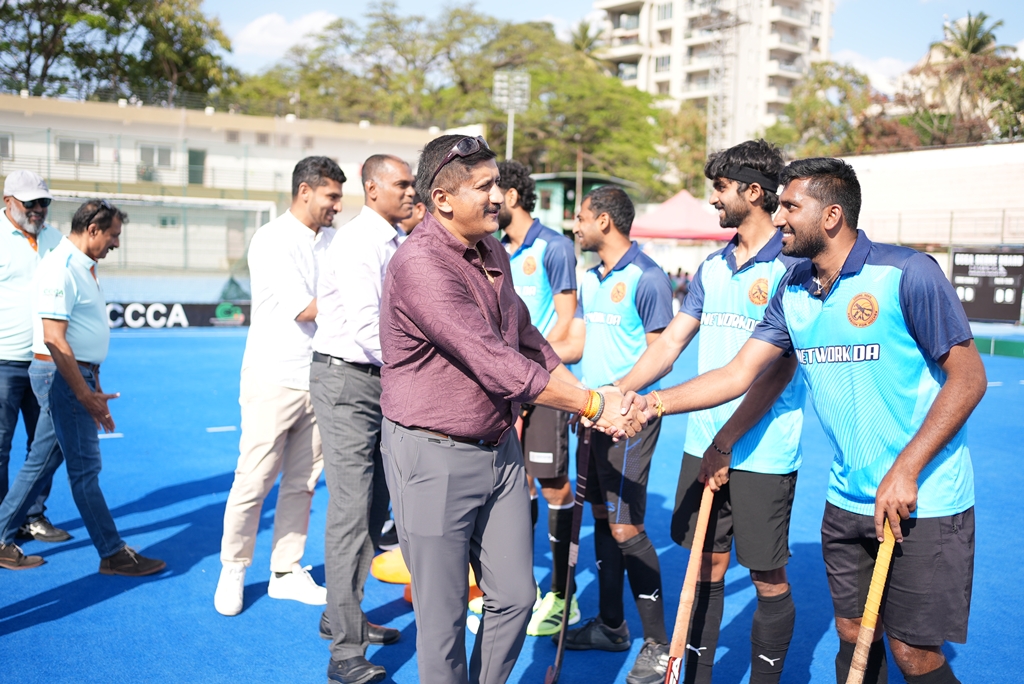
A B Subbaiah shaking hands with the players. Photo courtesy: Collected
Other dignitaries who attended the event were Anil Alexander Aldrin – Asian Games Gold Medallist and Former Captain of the Indian hockey team, V.S. Vinaya – Former Indian hockey player, Karnataka State Representative and Coach at Hockey Karnataka, Abharan Sudev – Indian hockey player, Karnataka State Representative and emerging defender, Mohammed Raheel Mouseen – International hockey player and a part of the Indian’s men team, Kaliyanda Bharath – International hockey player, Karnataka Representative and defender and Chelsea Medappa – Karnataka hockey player, National Championship competitor and Defender.
source :http://www.connectedtoindia.com / Connected to India / Home / by C to I News Desk / February 23rd, 2026
CNC demands inclusion of Kodava language in 8th Schedule
Inclusion of Kodava language in the Eighth Schedule will provide legal, cultural, and educational benefits to the Kodava community.

CNC members stage a protest in front of the deputy commissioner’s office in Madikeri on Saturday. / Credit: DH Photo
Madikeri:
Marking International Mother Language Day, leaders of the Codava National Council (CNC) staged a protest in front of the Deputy Commissioner’s office here on Saturday, demanding that Kodava language be included in the Eighth Schedule of the Constitution.
CNC President N U Nachappa placed several demands, including the inclusion of Kodava Thakk in the Eighth Schedule as recommended in the report of the Commission headed by noted linguist Pandit Dr Sitakant Mahapatra.
He urged that on the lines of Konkani language model and similar to the proposal for Tulu, Kodava be declared an official language of the state under Articles 345 and 347 of the Constitution, and implemented in administration and education under Article 350.
Inclusion of Kodava language in the Eighth Schedule will provide legal, cultural, and educational benefits to the Kodava community. Official recognition by the Central government will enhance the language’s prestige and prevent it from being treated merely as a dialect. It would also facilitate the introduction of Kodava as a medium of instruction in school curricula.
He also alleged that the names of local Kodava folk villages, hamlets, and even festivals have been altered into Kannada, distorting them. This, he said, reflects disregard for Kodava heritage and uniqueness and amounts to a violation of human rights.
A memorandum was submitted to the government through DC S J Somashekar on the occasion.
source: http://www.deccanherald.com / Deccan Herald / Home> India> Karnataka / by DHNS / February 22nd, 2026
Selected for State Masters Badminton team
Mysuru:
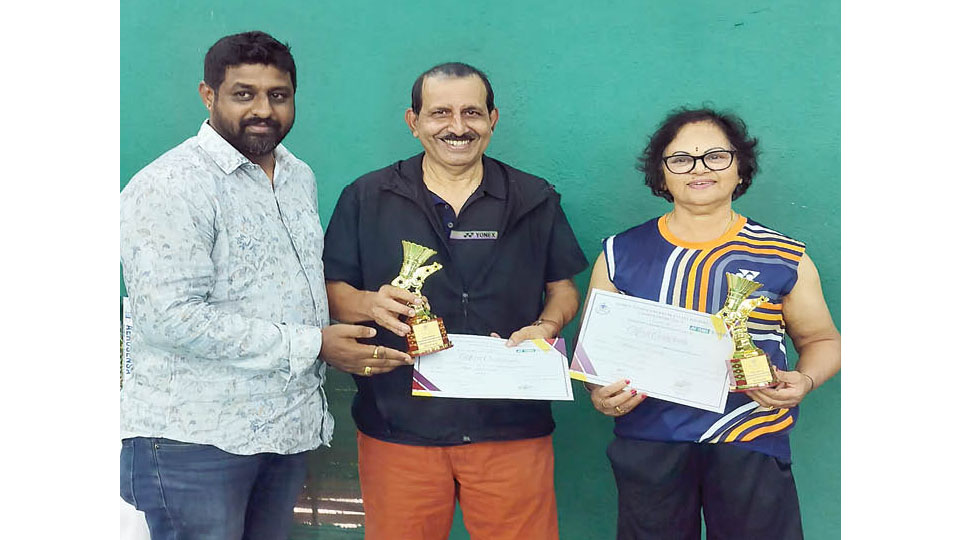
Maleyanda Arun Poovaiah, former international badminton player, has been selected to represent the Karnataka State Masters Badminton team at the Yonex- Sunrise 48th Indian Masters Badminton Championships to be held at Goa from Mar. 18 to 25.
Arun recently emerged victorious in the men’s singles and mixed doubles during the selection tournament.
Arun Poovaiah will also participate in the doubles category directly on the basis of national ranking.
source: http://www.starofmysore.com / Star of Mysore / Home> Sports / February 19th, 2026
Olympic Medallist Boxer Vijender, Tennis Ace Rohan Bopanna To Flag Off New Delhi Marathon On Sunday
Olympic medallist Vijender Singh and tennis star Rohan Bopanna will flag off the 11th Cognizant New Delhi Marathon at Jawaharlal Nehru Stadium on Sunday. Over 30,000 runners from 31 countries are expected to participate across full, half, 10K and 5K categories. The event, recognised by AFI and World Athletics, also serves as an Asian Games qualifier.

Olympic medallist boxer Vijender Singh (L) &tennis player Rohan Bopanna (R) | File Pic
New Delhi:
Olympic medallist boxer Vijender Singh and the country’s ace tennis player Rohan Bopanna will flag off the 11th edition of the Cognizant New Delhi Marathon from the Jawaharlal Nehru Stadium here on Sunday.
With over 30,000 participants expected to take part, the marathon is set to be one of the largest sporting events in the country.
Certified as a National Marathon by the Athletics Federation of India (AFI), recognised by the Association of International Marathons and Distance Races (AIMS), and acknowledged by World Athletics, the event continues to strengthen its position on the global athletic calendar.
This edition of the event has attracted participants from 31 countries, 490 cities, and 32 states and Union Territories of India.
The event will be held in four categories — full marathon, half marathon, 10K and 5K.
India will be represented by an elite contingent, which includes Anish Thapa, A.B. Belliappa, Man Singh, Akshay Saini, T. Gopi, Bhagirathi Bisht, Nirmaben Thakor Bharatjee, Ashwini Madan Jadhav, Disket Dolma, and Stanzin Dolkar.
The marathon also serves as a qualifying race for the upcoming Asian Games.
Inclusivity and Social Impact
In a step towards greater inclusivity, the marathon will host approximately 20 visually-impaired athletes, reaffirming its commitment to creating an accessible and empowering sporting platform.
The event has also raised Rs 10 lakh, which has been contributed to the AFI as support for its junior development programs to help in strengthening grassroots athletics in the country.
“The New Delhi Marathon is not just a race; it’s a celebration of human spirit, perseverance, and unity. We are proud to witness such incredible global participation and to continue fostering an inclusive and inspiring event. Our goal is to create a platform where every runner — from elite athletes to first-timers — can push their limits and be part of something much larger than themselves,” said Nagaraj Adiga, Race Director & CMD, NEB Sports.
Rajesh Varrier, President – Global Operations and Chairman and Managing Director of Cognizant India added: “The participation of elite runners at the New Delhi Marathon reinforces its stature as one of the leading long-distance events in Asia and inspires every runner to push their limits.
AFI treasurer, Stanley Jones said the event is a perfect platform for country’s long-distance runners to make a mark.
“The National Marathon serves as a premier platform for India’s elite long-distance runners. With only the highest-performing athletes qualifying to represent the nation at events such as the Asian Games, competitions of this stature play a crucial role in identifying and preparing top talent,” he said.
Sustainability Initiatives
The marathon continues its strong focus on environmental responsibility by implementing comprehensive waste segregation, promoting recycling across the venue, partnering with environmental organisations and local authorities and encouraging greener practices among participants.
(Except for the headline, this article has not been edited by FPJ’s editorial team and auto-generated from an agency feed.)
source: http://www.freepressjournal.in / The Free Press Journal / Home> Sports / by PTI / February 20th, 2026
India’s GI Coffees At AI Summit 2026: Monsooned Malabar To Coorg Arabica
India’s rich coffee heritage took center stage at the AI Impact Summit 2026 in New Delhi, where global leaders and tech CEOs sampled the country’s GI-tagged coffees.

At the India AI Impact Summit 2026 in New Delhi, alongside discussions on artificial intelligence and global collaboration, another distinctly Indian story brewed quietly but powerfully. The Commerce Ministry unveiled the Bharat GI Coffee Lounge, showcasing India’s exclusive Geographical Indication (GI)-tagged coffees.
Leaders including Google’s Sundar Pichai and OpenAI’s Sam Altman sampled these varieties, with Pichai himself praising the Malabar Arabica.
The showcase highlighted how India’s coffee heritage, rooted in specific regions and traditions, is now being positioned as a global brand.
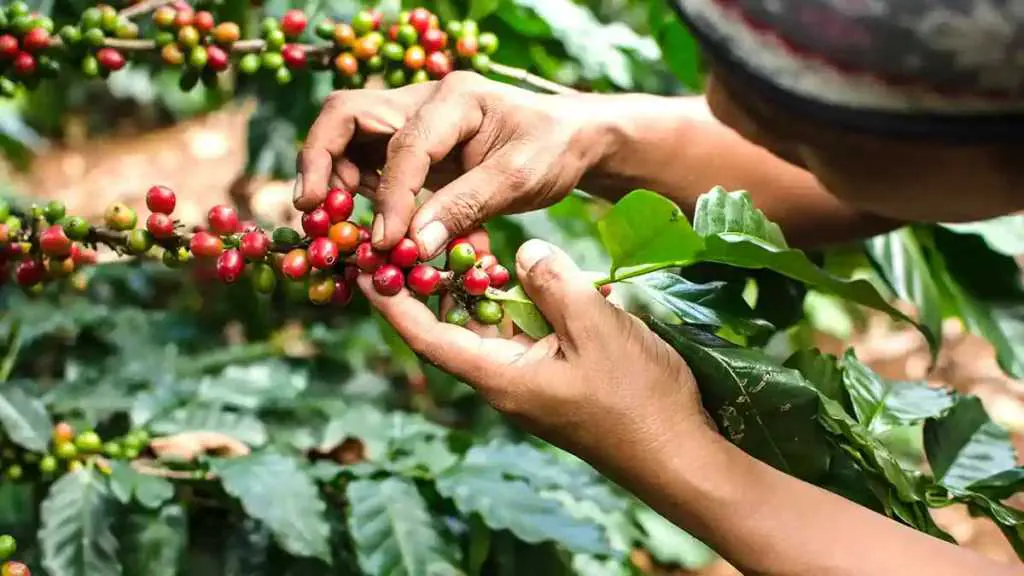
Chikmagalur Coffee: Often called the birthplace of coffee in India, Chikmagalur in Karnataka is where the first coffee beans were planted centuries ago. The GI tag recognizes its unique flavour profile – smooth, mildly acidic, and aromatic. Chikmagalur coffee is prized for its balanced taste, making it a favorite among connoisseurs who prefer a class

Bababudangiris Coffee: Named after the revered Sufi saint Baba Budan, who is said to have introduced coffee to India, this variety comes from the Baba Budangiri hills in Karnataka. It is known for its full-bodied flavour, with notes of chocolate and spice. The GI tag ensures that this historic and culturally significant coffee is protected and celebrated worldwide.
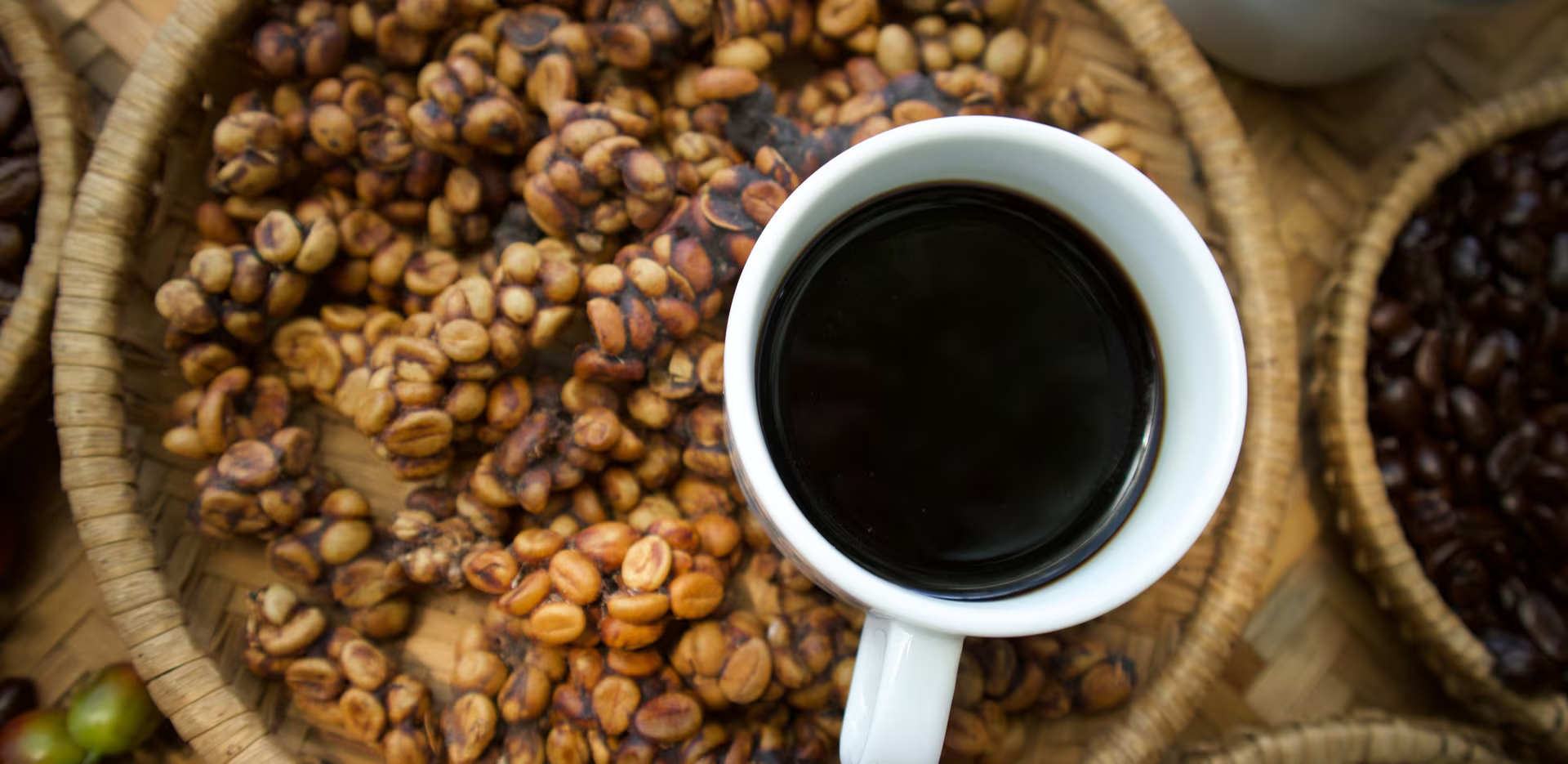
Coorg Coffee: Coorg, also in Karnataka, is famous for its lush plantations and distinctive coffee. Coorg coffee is rich, bold, and slightly bitter, often described as earthy with a lingering finish. The GI tag highlights its regional authenticity, and it remains one of the most exported Indian coffees.

Wayanad Coffee: From Kerala’s Wayanad district comes a coffee that thrives in the Western Ghats’ biodiversity. Wayanad coffee is smooth, with fruity undertones and a gentle acidity. The GI tag emphasizes its eco-friendly cultivation practices, often grown alongside spices, which add subtle complexity to its flavour.

Araku Valley Coffee: Produced by tribal farmers in Andhra Pradesh’s Araku Valley, this coffee is celebrated for its organic cultivation and social impact. Araku coffee is mild, with floral notes and a clean finish. The GI tag not only protects its identity but also supports the livelihoods of indigenous communities, making it a symbol of sustainable agriculture.

Monsooned Malabar Coffee: Though not always listed among the original five, Monsooned Malabar from Kerala and Karnataka has become iconic. Beans are exposed to monsoon winds, swelling and mellowing to produce a unique, low-acid, heavy-bodied coffee with a distinctive flavor. Sundar Pichai’s approving sip at the AI Summit brought this variety into the global spotlight.
source: http://www.news18.com / News18 / Home> Showsha> English edition / curated by Sujata Singh / eidted by Priyanka Das / February 20th, 2026


