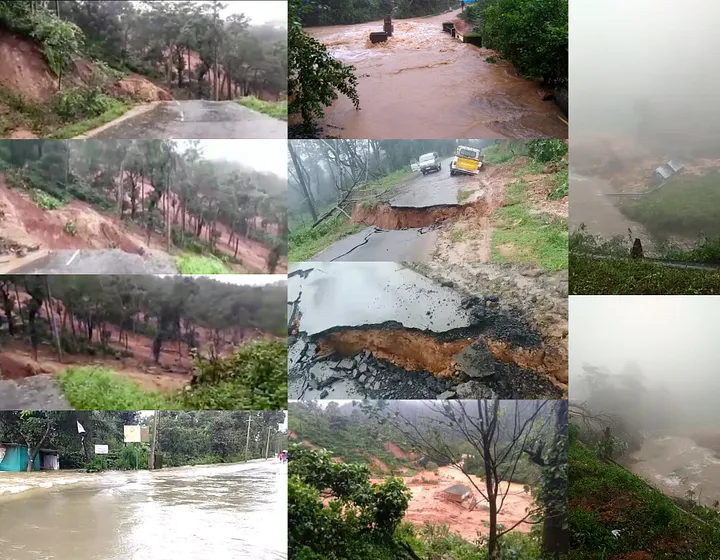
The Western Ghats in India have been experiencing one of the worst natural calamities in recent history. Kerala is facing its worst floodin 100 years. Over 350 lives lost and more than 223150 people in over 1500 relief camps.
Kodagu is a district in Karnataka adjacent to Kerala. Though Kodagu was facing the same fury of the monsoon rains that decimated Kerala, little or nothing was being reported. Mainly because the population of this district is limited and also because politically it not a significant vote bank. Culturally and religiously Kodagu is very different from mainstream Karnataka and mainstream India. So, all things considered, no political leader took a step forward to help out immediately.
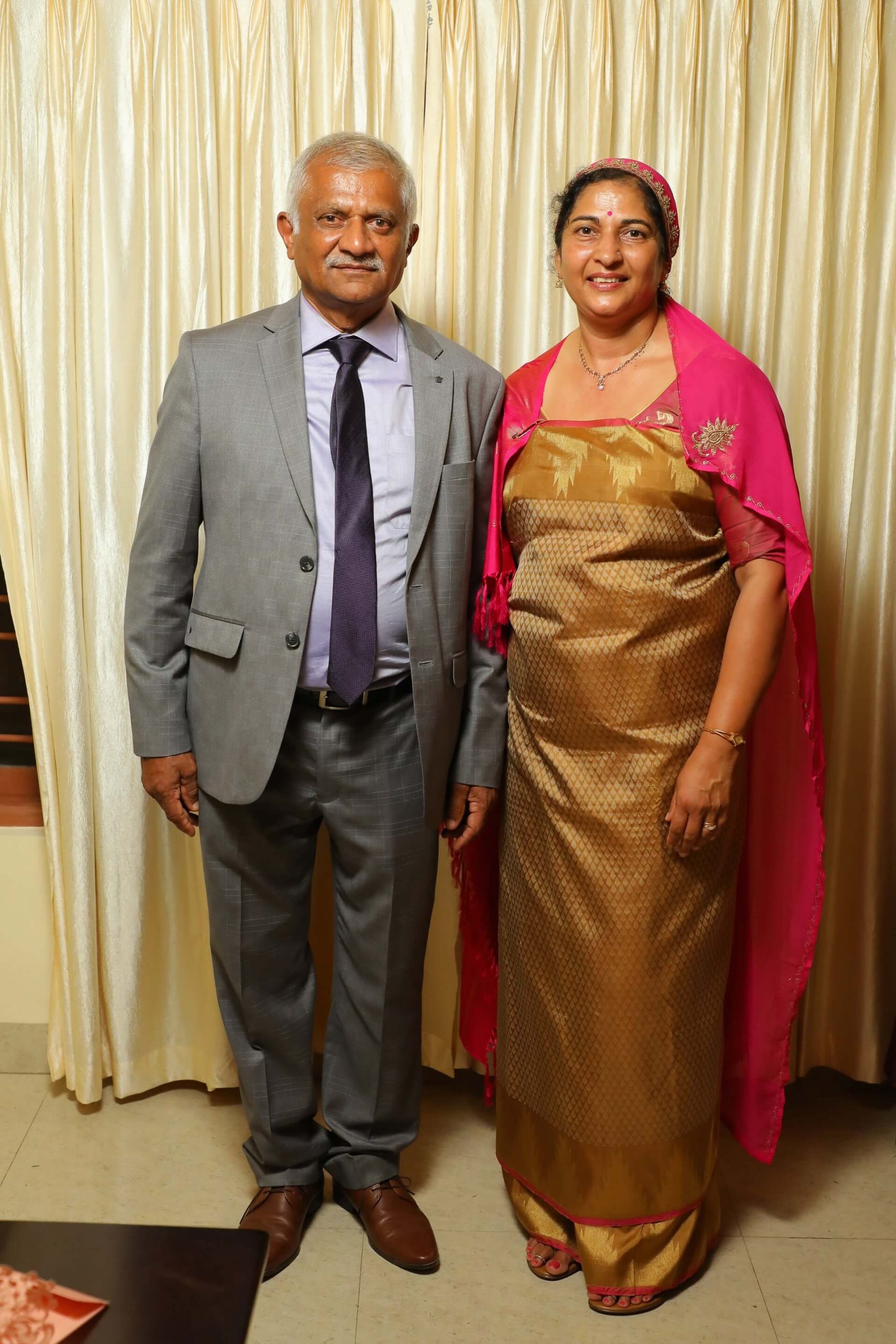
Here is a little story of how my Aunt survived the night the mountains fell.
My 66-year-old Aunt Mrs. Vani Belliappa Muddura lost her husband 3 months ago. She lives alone is a village called Hattihole, Makkandur near Madikeri. Her companion – a rescue puppy that she took home from Bangalore.
In the area that she was living in little springs started to erupt from the earth. One erupted in her bathroom, she managed to divert it but did not pay attention to the warning signs. On the night of August 16th, she went to bed as usual. It was raining outside and she had her pup with her warm in the house.
At around 12:30 am that night she heard a thunderous roar. Like the earth crashing. Like the earth splitting. Like thunder under her feet. A sound she will never be able to describe. Within minutes of this sound, her neighbour who lives a few 100 meters away came knocking, urging her to leave with them. He told her that the mountain was shaking and they could not tell in the dark about the movement of the earth. Something bigger than they could imagine of was happening. And that they better go to a flatter, safer terrain.
She doesn’t remember the moment she left the house. She didn’t take anything with her.
The neighbour’s family and my Aunt ran in the rain in the middle of the dark night in the direction that their guts guided them. Within minutes of leaving her house, her slippers got stuck in the mud and her night clothes that she left her home with were soaked. They ran towards Kandanakolli junction. It took them over 2 hours to reach the junction and then they made their way to a relatives house. There are no roads that connect to that house. Just mud paths over uneven terrain. They reached there at around 2:30 at night.
They collectively decided to rest till the morning.
In less than 2 hours the house that they were resting in cracked open as a huge spring burst through the floors. Their resting place was not safe anymore. All of them had to leave the house before it crumbled under the pressure of the spring. They ran blindly in the dark once again. They began another long and arduous journey towards Suntikoppa town. The roads were filled with rouble and there were landslides everywhere.
She doesn’t recall much about this part of her journey as yet. She had been running, walking barefoot in the cold wet rain for over 8 hours.
At around 9 am they reached a slightly wider road, near an open area where they spotted a rescue mission in the process. They were individually lifted with ropes and over 100 rescued people were packed in a truck and dropped off in a little church in Suntikoppa. At 10:30 am she found a working phone and called her son. Her son could not reach her because the roads and highways have all disappeared. Lucky for them they had a friend in that area who went and picked her up. Her nephew reached their friend’s house and got her to his house in Gonikoppal at 4:30 in the evening.
Mrs. Vani Belliappa Muddura doesn’t know if the house that they have know as home for over half a century still exists. All she can think about right now is the little puppy she left behind. There is no road, way or path to go home.
My Aunt’s story is not an isolated one. Kodagu has been decimated. A lot of people are not reachable by phone or road. Electricity has been cut off. Roads have vanished. Mountains have fallen. The extent of damage cannot be assessed. They are many in desperate need of food, warm clothes, clean drinking water, and medical assistance.
The People of Coorg are resilient and helping each other is all ways that they can. They are the Gods that are there in the need of the hour.
Kodagu or Coorg as it is popularly known always gets a step-motherly treatment from the government. But the apathy of the govt. in this hour of crisis is criminal. The rescue mission that was deployed many days too late is now in motion. Much has been lost and hundreds have been reported missing.
Crying out loud to all those who can to Rescue Coorg, Save Coorg, and Re-build Coorg.
This is the story of the mysterious warrior race of Coorg—the Kodava people. The nature-worshipping people are as famous for their presence in the Indian armed forces and sports as they’re known for their pandhi curry.
The first thing that comes to mind when you say Coorg are lush coffee plantations, mist-laden mountains, and spicy pork curry. Coorg is home to all this and more, but what makes Coorg or Kodagu special is its warm and welcoming people. Of the many communities that are part of Coorg, the one with the most fascinating history is the Kodava community.
Demographics And Distribution Of Coorg’s Communities
Besides the Kodavas, Coorg is home to several other communities. The 18 other communities are ethnic groups that are smaller in number but speak the same language and follow similar traditions as the Kodavas. Here is a list of the other communities in Coorg.
Amma Kodavas:
The Amma Kodavas are believed to be the original priests at the temples in Coorg. Most of the Amma Kodava families live in the southern part of Coorg now. Like the Kodavas, the Amma Kodava families are also recognised by their family names or okka. The community also follows a few Brahminical customs such as Gothra names or wearing the sacred thread. However, there are many among the community who don’t wear the thread or have gothras assigned to them. They are endogamous and vegetarians. However, all other social activities like marriage, attire, and celebration of festivals are similar to the Kodavas.
Kodagu Brahmins:
Said to have originally migrated from South Canara districts, the Kodagu Brahmins have been residing in Coorg since the Haleri dynasty. They celebrate the Kodava festivals such as Puthari and Kaveri Sankramana, but not Kailpodh. Kodagu Brahmins are pure vegetarians and wear the sacred thread. They also speak both Kannada and Kodava Takk. The Kodagu Brahmins follow Kodava customs to an extent. They have a clan system and also have gothras assigned just like the Amma Kodavas.
Peggade Or Kodagu Heggade:
Originally believed to have come from North Malabar, the Peggade or Kodagu Heggade is another of the indigenous communities in Coorg. They have around 100 family names and follow the Kodava habits and customs. They also dress like other Kodavas and speak Kodava Takk.
Kodava Maaples:
The Kodava Maaple sect is a Muslim community residing in Kodagu district of Karnataka. During the rule of Tipu Sultan in Coorg, many Kodavas were converted to Islam and they are called the ‘Kodava Maaple’ or ‘Jamma Maaples’. The Kodava Maaples are followers of Sunni Islam. They refrain from alcohol and eat only Halal. They have maintained their original Kodava clan names and dress habits and speak the endangered Kodavu language.
Airi (Iri):
Iri or Airi is another sub-community in Coorg. This particular ethnic community was carpenters or village smiths in Kodagu. The people of the Airi community also have family names. They speak Kodava Takk and follow Kodava culture.
Other Sub Communities
Other than the communities mentioned here, Kodagu is also home to the Koyavas, the Bannas, the Kodagu Madivala, the Kodagu Hajama, Kembatti poleya, Medas, Malekudiyas, the Kollas, and Kavadis among others. The Are Bhashe Gowda or Kodagu Gowda is another community that lives in Coorg. The people of this community speak a distinct language called Are Bhashe.
As mentioned, of the many communities in Coorg, the one with the most fascinating history is the Kodava community. So, explore them in detail.
Where Did The Kodava Tribe Come From?
The history of Coorg and the Coorg people or the Kodava people is one that is shrouded in a lot of mystery. If you ask a Kodava about their origin, they’ll immediately tell you they are of foreign descent. And though there is no concrete evidence to back up this claim, they’ll insist that their ancestors were actually part of Alexander’s invading army who decided to stay back and practice agriculture, thus giving birth to the Kodava tribe. But however outlandish the claim might be, one can agree that this ethnic group is a very fascinating one. Their culture, language, and customs, so strikingly different from the other ethnic communities of Coorg, are what makes them so unique.
The origin of the Kodava community is still a bit of a mystery, but there are several theories and speculations as to where they really come from. Some of these theories claim the Kodavas are the indigenous inhabitants of the area. Other theories claim they have foreign roots, but these are mere speculations as there is no evidence to back up this claim.
source: Wikimedia Commons
The Origin
Indigenous origin: According to this theory, the Kodava people were an ancient warlike tribe, who were indigenous inhabitants of Kodagu. This tribe learned and practised agriculture in the area and over the centuries they got civilized and gained prosperity.
Foreign origin: The more popular theory among the Kodavas is that they are of foreign descent. One theory is that they might be descendants of the broad-headed (Brachycephalic) stock who entered the Indus Valley during the Mohenjodaro period and later migrated down to Coorg. According to Wikipedia, another theory is that the Kodavas are descendants of the Scythians, or they belong to the Indo-Scythian race like the Sakas.
The most popular theory among the Kodavas is that they are descendants of the Indo-Greek soldiers, who came into India with Alexander the Great. It is believed that these soldiers then moved down south and settled in the hilly region now known as Kodagu or Coorg. These Indo-Greeks are then believed to have married the native women and produced the race called the Kodavas.
Puranic Theory: Another theory about the origin of Kodavas is from the Hindu Puranas. According to the Skanda Purana or Kaveri Purana, the fierce race of Kodavas is descended from a Chandravanshi Kshatriya called Chandra Varma. He was on a pilgrimage to several holy places in India when he came upon Coorg or Kodagu district, the source of the river Kaveri. He settled here and became the first King of the Coorg principality. His children and their descendants cultivated and populated the land and these people apparently came to be called the Kodava race.
However, the consensus among historians is that the Kodava people have been in Kodagu for centuries and are probably the oldest settled inhabitants of the area. In fact, a Kannada poet from 1398 CE called Mangaraja mentions the Kodavas in his lexicon. He described them as warrior people with a fondness for hunting games for sport.
Kodava Culture
The mystery behind their origin aside, the Kodava people and their very different cultures are equally fascinating. The people of Kodagu have kept their very intriguing culture intact over the years. Their festivals and all manners of celebrations are celebrated in pretty much the same way as it was for centuries, save for a few modern trappings.
Kodava Society
The Kodava community of Coorg is a patrilineal society. The people of the Kodava community identify themselves by their family names or okka (family groups). Each okka has an ainmane (ayyangada mane meaning ‘house of elders’) or ballayamane. This is a large ancestral home, where all the family members lived originally. These ainmanes are scattered across agricultural and forested holdings in Coorg. Now, these ancestral homes of Kodavas are mainly used for meetings and gatherings. Currently, there are over 1,000 Kodava family names or okka in Coorg.
Kodava Attire
Photo courtesy: Chaitanya Thammaya
Their attire is one among the many things that the Kodava community has kept unchanged over the centuries. Though they might now be considered ceremonial Kodagu attire, it’s worn with pride.
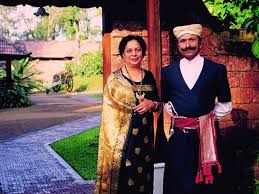
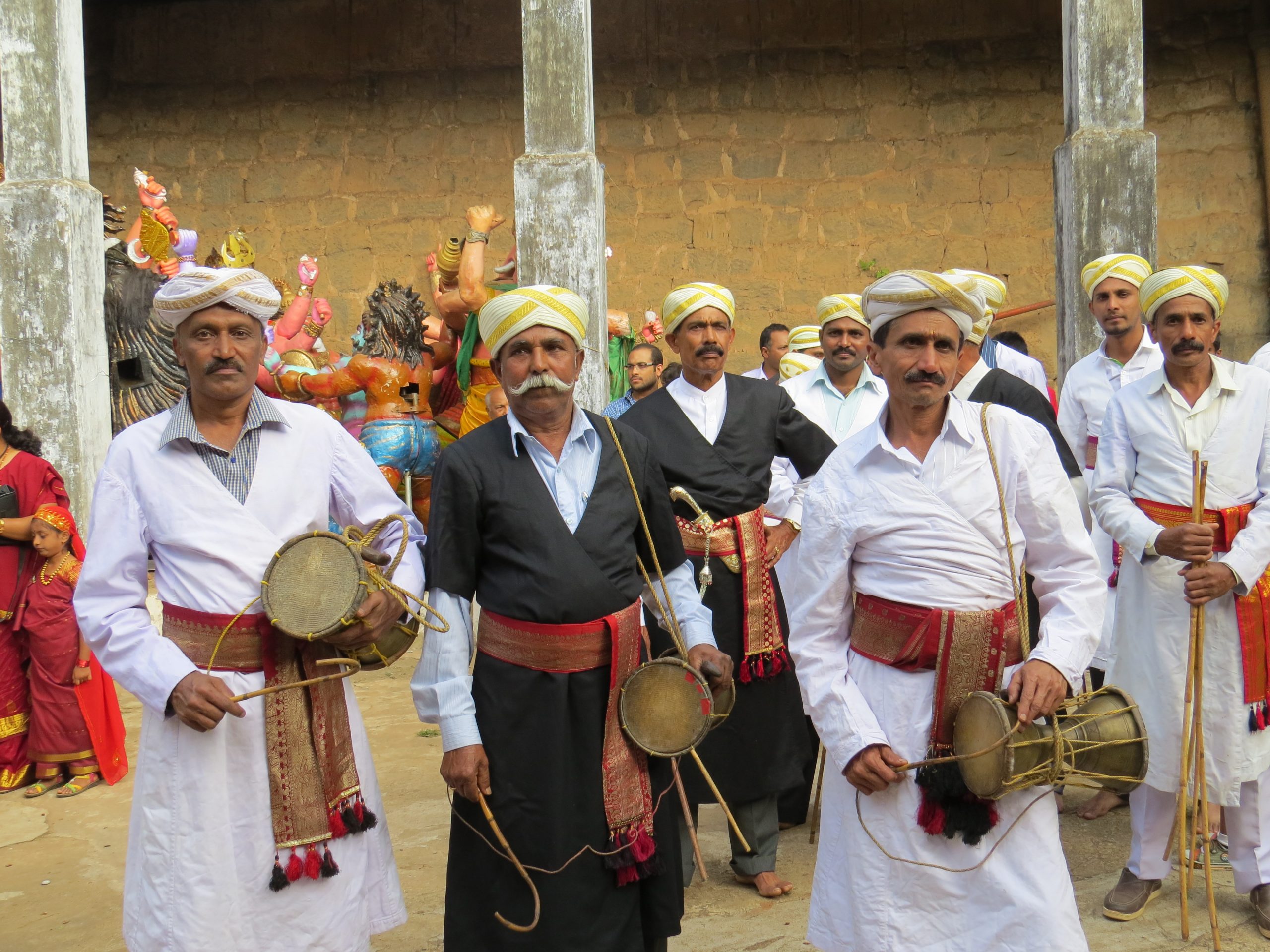
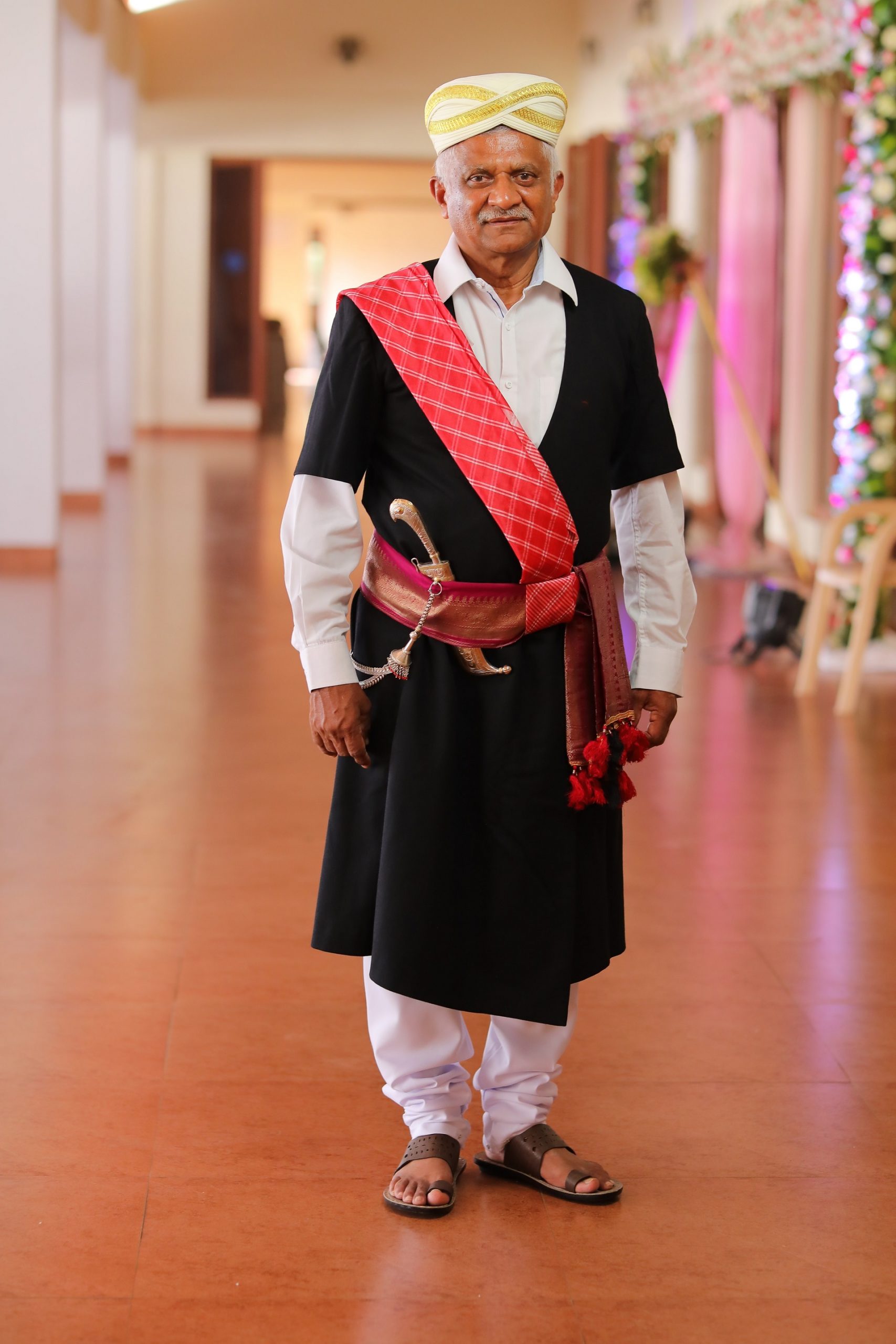
The typical attire of a Kodava man is called a kuppya chale and peeche kathi. The kuppya is a black wraparound robe that falls just below the knee, and the chale is a red/magenta silk sash embroidered with gold thread. This sash is wrapped around the waist and secured on the left. The peeche kathi is an ornamental silver dagger, which is tucked partially into the chale on the right side, with ornamental chains tucked at the back. The men also wear a white turban on their heads called the mande thuni. These days the kuppya chale and peeche kathi are considered ceremonial attire and are worn only at festivals or weddings.
The women wear saris called kodava podeya (meaning Kodava sari) and an embroidered veil on their head, cinched at the back, called the vastra. What’s unique is that the pleats of the sari are tucked at the back, while the pallu is draped over the right shoulder and secured with a brooch. Again, the kodava podeya and vastra are also considered ceremonial attire, though many an elderly Kodava grandmother can still be found cooking up a storm and ruling the roost in her kodava podeya.
Photo courtesy: Chaitanya Thammaya
Kodava Language
The people of the Kodava community speak a completely different language known as kodava takk. This Kodava language, which is considered to be the original language of the Kodagu district is considered to be an endangered Dravidian language. Linguistically, kodava takk is a mix of most South Indian languages and is influenced by Tamil, Tulu, Kannada, and Malayalam. Since the language didn’t have a script of its own, it was traditionally written in the Kannada script. However, the linguist Gregg M. Cox developed a new script called the Coorgi–Cox alphabet to write the endangered language.
While kodava takk is still spoken by many in Coorg, the younger generation, especially the ones who live abroad or in metropolitan cities have lost touch with the language. In a bid to ensure that the language lives, Talk Pariyana was created. Talk Pariyana is a platform, which encourages the younger generation to listen to stories or anecdotes in kodava takk and interact in the language.
Kodava Festivals
While most modern-day Kodavas consider themselves Hindus, they don’t celebrate any of the major Hindu festivals. They were originally worshippers of natural elements and their ancestors, called the Guru Karana. The Kodavas worship several deities, chief of them being Kaveramme, or the goddess of the river Kaveri who is considered their patron goddess, the Kuladevi. Being nature worshippers, the festivals of the Kodavas centre around agricultural activities, their weapons, and agricultural implements.
1. Kailpodh (Kailpoldh) [The Festival Of Weapons]
The festival of Kailpodh is celebrated on the 3 September, every year by the Kodavas. On this day, all the weapons in the house, the agricultural implements, and vehicles are cleaned and decorated with flowers and worshipped. The family prepares a feast of kadambuttu (steamed rice balls), pandhi Curry (pork curry), and akki payasa (rice pudding), which is also offered to the gods and ancestors with alcohol.
2. Tula Sankramana Or Kaveri Sankramana [Festival Celebrating The Birth Of River Kaveri]
This festival, which falls on 17 or 18 October is celebrated by the Kodavas to mark the birth of the river Kaveri. The sacred river, which is the lifeblood of Coorg, originates in the Brahmagiri hills. At home, the Kodava people perform a ritual called Kani Puje, where they perform puja in front of a decorated cucumber or coconut. This decorated cucumber or coconut symbolises the goddess Kaveri. Kaveri Theertha (holy water from the birthplace of river Kaveri) is served to everyone present.
3. Puthari [The Harvest Festival]
Puthari is the harvest festival of the Kodavas, which marks the beginning of rice harvesting and is celebrated in late November or December. It is a festival that is celebrated by most of the communities in Coorg and not just the Kodavas. On this day, the people of Coorg bring in the first harvest to their homes and offer it to the gods and ancestors, and pray for prosperity.
Kodava cuisine has much more to offer than the very famous pandhi curry and kadambuttu. Of course, the people being paddy cultivators, rice forms the main part of their diet. Rice is eaten in several different ways—otti (rice tortillas), paputtu (steamed rice and coconut cakes), noolputtu (rice string hoppers), thaliya Puttu (fermented and steamed rice cakes) and kadambuttu (steamed rice dumplings) are some of the most popular ones.
As mentioned before, the Kodava tribe loved hunting games for sport. The game meat was cooked and eaten. Now since hunting is banned, they eat pork, chicken, fish, and mutton. Sweet dishes like akki payasa (rice pudding) are a treat reserved for festivals or days of celebration. The Kodavas also consume a wide variety of locally grown vegetables and fruits like coconuts, jackfruit, plantain, and mango. The seasonal and rare wild mushrooms and bamboo shoots are a delicacy that the community enjoys during the monsoon.
The Kodava community has several folk dances, most of which are performed in the ‘mandh’ during celebrations or festivals. Bolakaat, Kombaat, Kolaat, Kathiaat, Peeliaat, and Chowriaat are all folk dances performed by men. Most of the dances performed by the men resemble martial arts practices. The Kodagu dancers wear traditional Kodava clothes and dance in a large circle. Most of the dances require the dancers to carry weapons like sticks for the Kolaat, Peeche Kathi, and Odi Kathi (the ceremonial dagger and sword) for the Kathiaat.
The ummathaat is performed by Kodava women. The women wear red saris, traditional Kodava jewellery like kokkethaathi (a gold necklace with an ornate half-moon shaped pendant), jomaale (a double-stranded black thread chain with alternating gold beads), and tie a red vastra on their heads. They dance in a circular motion with a swinging rhythm, with cymbals in their hands. The women dance around a white sari-clad, a pot-bearing woman in the centre, who is supposed to represent the goddess Kaveramma.
But the most popular dance form is called the kodava-aat (Kodava dance) seen at Kodava weddings. There is no synchronisation to the kodava aat like the other dance forms. It’s just Kodava men and women busting out some graceful moves to the tuneful music of the Kodava Valaga at weddings.
Contribution Of Kodava People To National And International Sports:
Ashwini Nachappa (track and field athlete)
Born in 1967, Ashwini Nachappa is an accomplished former track and field athlete. She represented India in three South Asian Federation Games. In 1984, Ashwini won two silver medals, in 1986 two silver medals and in 1988 she bagged three gold medals. She received the Arjuna Award in 1988.
Chenanda C. Machaiah (Boxing)
Known as one of the earliest International Indian boxers, Chenanda C. Machaiah represented India in 1976 at Montreal, in the Asian Boxing Championships at Jakarta (1977), in the Indo-USSR Tournament in USSR (1977), in the XIth Commonwealth Games at Edmonton (1978) and in the 8th Asian Games at Bangkok. He has won a total of 6 international medals including one gold and has received the Arjuna Award in 1978-79.
Machanda Rohan Bopanna (Tennis)
Born in 1980, Machanda Rohan Bopanna is an Indian professional tennis player from Kodagu. He has 19 career titles in his name and was also awarded the Ekalavya Award by the Government of Karnataka in 2005 for his achievements on the court.
Aiyuda Robin Uthappa (Cricket)
Born in 1985, Aiyuda Robin Uthappa is an international cricketer from Kodagu in Karnataka. He was also part of the India U-19 team during the 2004 ICC U19 cricket world Cup and in Ranji’s trophy season in 2006-07, he scored a massive 857 runs in just seven games.
Kuttanda Joshna Chinappa (Squash)
Joshna Chinappa is a famous professional squash player from India. She was the first Indian to win the British Junior Squash Championship title in 2005 in the under-19 category and is the current record-holder of most national championship wins, with 18 titles.
Machettira Raju Poovamma (Athletics)
Indian sprinter Machettira Raju Poovamma was born in 1990 in Gonikoppal, Karnataka. She won a silver medal in the 400 m and a gold medal in the 4 × 400 m relay at the 2008 Commonwealth Youth Games. Povamma bagged two gold and a silver medal in the 2012 Asian Grands Prix. She also won a gold medal at the 2013 Asian Grand Prix in Bangkok and won the gold medal in women’s 4×400 metres relay at the 2014 Asian Games along with Tintu Luka, Mandeep Kaur, and Priyanka Pawar.
Maneyapanda Muthanna Somaya (Hockey)
Born in 1959, Maneyapanda Muthanna Somaya is a former Indian field hockey player from Coorg, Karnataka. He won the Gold medal at the 1980 Moscow Summer Olympic Games and was bestowed the Life Time Achievement award by the Petroleum Sports Promotion Board in 2007.
Mollera P. Ganesh (Hockey)
He is a former Indian professional field hockey player who is also captain and coach of the Indian team. Mollera has participated in India in World Cup, Olympic Games, and Asian Games where he has received two bronze and 3 silver in total. He is also a recipient of the Arjuna Award.
Ashwini Ponnappa (Badminton)
A well-known Badminton Player, Ashwini Ponnappa has represented India internationally in both the women’s and mixed doubles disciplines. She has participated in World Championship, Uber Cup, Commonwealth Games, Asian Games, Asian Championship, and South Asian Games. She has bagged 6 Gold, 4 Silver, and 4 Bronze Medals in total.
Ajjikuttira Trishul Chinnappa (Golf)
Born in 1993 in Coorg Karnataka, Ajjikuttira Trishul Chinnappa is a professional Indian Golfer. His career highlight has been the All-India Amateur Championship triumph.
A Perfect Mix Of Old And New
Throughout Kodagu’s history, you can find mentions of the Kodava people for their bravery. The people of this ancient warlike race have stood guard for several different empires including at the Mysore, Mangalore, and Malabar boundary posts. In today’s world, Kodava people show their bravery in the Indian Armed Forces. And in all the years, they’ve never lost touch with their roots, customs, and culture. They have embraced the new ways of the world without forgetting the old, and both past and present are woven well into the Kodava community’s ways making theirs a very intriguing culture.
If you ask me, a Kodavathi, the best description for my people would be party people, who work very hard and party even harder! They toil all year round in their coffee plantations and paddy fields. But come festival or celebration time in Kodagu, you’ll see a completely different side of the Kodava community. There’s plenty of joy and merriment, food and drink and dancing to be had, and no one is left behind. The story of where we came from originally or where our guests are from doesn’t bother us then.
What is believed to be the lineage of the people of Coorg?
The Kodava people are the native inhabitants of Coorg. They are considered a patrilineal Ethno-lingual tribe from the region of Kodagu.
What is the culture of the people of Coorg?
The Kodavas have a unique and strikingly different culture as compared to that of the neighbouring cultures.
What is the story about the origin of the people of Coorg?
There are several theories about the origin of the Kodava people. According to one theory, it is believed that Kodava people or people of Coorg are of Arabic/ Greek origin. However, there is no proof to corroborate this theory. Another theory and a more believable one suggests that the Kodavas are indigenous inhabitants of the land.
What are the people of Coorg famous for?
The Coorg people are famous for their unique culture, hospitality, and their valour. The Kodavas are a martial race and the tribe has numerous tales of valour throughout history. A significant number of Kodavas have served in the Indian defence services.
source: http://www.travel.earth / Travel.Earth / Home> Topics of Interest> Heritage & Culture> India / by Chaitanya Thammaya / August 08th, 2020
To mark International Women’s Day celebrations, Daksha College, Mysuru, recently felicitated Padma Shri Awardee Rani Machaiah, who is an exponent of the Ummathat (traditional dance of Kodagu) and T.K. Smitha, a climate journalist and TEDX speaker, for their valuable contribution to the society.
Speaking on the occasion, Jayachandra Raju, Chairman of Daksha College, said women are the life and embodiment of mother earth and humanity that sustains life.
He assured of all possible support to women teachers and students who can volunteer and come up with practically possible activities and processes that can save water, prevent wastage of food, create livelihoods for women in distress and maintain our surroundings clean and green.
Rani Machaiah called upon the students to give out their best, respect elders and take care of the parents who have selflessly strived to give the best the education to their children thus enabling their growth and development.
Smitha and Sonia Umapathy, Secretary of Global Education Trust, motivated women to become independent and pursue their dreams without any inhibitions.
Prizes were distributed to lady teachers by the team of Dr. Mahesh, Principal of Daksha Degree College.
source: http://www.starofmysore.com / Star of Mysore / Home> News / March 23rd, 2024
Poonacha Machaiah has over 20 years of global experience as a successful serial entrepreneur and business leader in Fortune 100 companies.
Poonacha is among the new breed of emerging social entrepreneurs who are using approaches from the commercial world and employing technology to tackle social and environmental problems. Today he is levering his vast global experience and technology domain expertise to bring to communities transformative educational solutions and ubiquitous access to the masses via mobility.
Poonacha has co-founded “Jiyo” a wellbeing platform along with internationally renowned physician and author Deepak Chopra M.D. He is founder the founder and CEO of ‘ABOVE – A Bunch of Versatile Entrepreneurs’, a company he had founded in 2008. ABOVE is a company that has delivered industry-leading solutions in the Education, Mobility, Media and Entertainment segments. ABOVE has launched one of the pioneering Social TV/collaboration platforms TangoFX and recently launched ABOVE Learning Platform.
Poonacha is also the co-founder of the social enterprise ‘WeightLess Project’, a global movement to address the challenges that plague our communities i.e. lifestyle disorders related to obesity/overweight and hunger/malnutrition.
He was instrumental in the founding of India’s leading social media startup along with internationally acclaimed film director Shekhar Kapur and Oscar award winning music composer AR Rahman.
During his tenure as CEO, Qyuki was been voted as one of India’s coolest startups (Business Today) and also featured in Fortune (India) and Fast Company.
Through the majority of his career, he has held senior leadership positions in Global Sales & Business Development with leading MNC’s like Sasken, Motorola, Visionael, Iridium, and Dimension Enterprises – a leading Internet Data Center services startup in the Washington DC area, which was then acquired by Nortel Networks in 2000.
He is on the advisory board of Chopra Foundation and International mentor at XMedia Lab, an internationally acclaimed digital media think tank.
Prior to his return to India in 2007, he has been an active member of the Vienna Volunteer Fire Department and Joy of Sports in the Washington DC area.
Poonacha holds an MBA from the College of William and Mary in Virginia and a Bachelor of Science in Computer Science and Engineering from the B.M.S. College of Engineering in Bangalore, India.
Vidul Thimmanna, a former student of Army Public School, Bolarum in Hyderabad, has topped the All India Merit List of Technical Entry Scheme (TES) to join the Indian Armed Forces. He hails from Kodagu and is the son of Colonel C.M. Thimanna and Veena Thimmanna.
Col. Thimanna is a Shourya Chakra awardee and is currently posted at the Military College of Electronics and Mechanical Engineering, Secunderabad.
The Technical Entry Scheme is a technical intake of the Indian Army with the aim of transforming young boys into techno-warriors during the course of training of four years. The Merit List was released on Nov. 29. Vidul, who is presently an engineering student at the prestigious Army Institute of Technology, Pune, will discontinue the course and join the Indian Army.
“It has been my passion to serve the country by joining the Indian Army. To me, the challenging and the adventurous life the army offers is any day better than delivering from a cubicle of a MNC,” Vidul said.
“We are proud of our son for taking such a decision. I am confident that he will definitely keep the name of the country above self,” said his mother Veena Thimanna.
source: http://www.starofmysore.com / Star of Mysore / Home> News / December 03rd, 2017
45 stalls celebrate Kodagu’s coffee culture as top growers honoured
Madikeri:
The Coffee Dasara celebration held on Wednesday at Gandhi Maidan, Madikeri, captivated visitors with a vibrant display of coffee culture, featuring 45 thematic stalls and a strong message of solidarity with coffee growers grappling with persistent challenges.
The event was jointly organised by the Madikeri Dasara Committee, Madikeri Dasara Cultural Committee and the Coorg Planters Association inside the Sakamma Auditorium, named after Karnataka’s first woman coffee entrepreneur. The coffee mega event was executed and coordinated by H.T. Anil.
Inaugurating the celebration, Madikeri MLA Dr. Mantar Gowda highlighted that despite favourable market prices, coffee growers continue to face serious hardships.
“Labour shortages, climate fluctuations, and market instability are major hurdles, especially for small-scale producers. We must unite to tackle these challenges,” Dr. Mantar Gowda urged.
Dr. Mantar Gowda noted that Kodagu district accounts for nearly 75 percent of Karnataka’s coffee production and stressed that Coffee Dasara, which began last year, should become an annual platform to foster dialogue and development.
Madikeri MLA Dr. Mantar Gowda with Coffee Dasara Convener H.T. Anil during the event.
Crop insurance coverage
Coffee Board Chairman Dinesh Devavrinda underscored the need for insurance coverage for coffee crops, similar to schemes available for arecanut and pepper. He pointed out that coffee is cultivated not only in Karnataka’s Kodagu, Hassan and Chikkamagalur districts but also across the north-eastern States and encouraged farmers to take pride in their profession.
Kodagu Deputy Commissioner Venkat Raja reaffirmed the administration’s commitment to supporting farmers, promising to act as a bridge between growers and policy-makers. He announced plans to launch video-based training programmes on coffee cultivation and marketing, emphasising the urgent need for modernisation in the 21st century.
Technical insights
Several experts shared technical insights during the event. Dr. Ichettira Mandappa, Coffee Board Director, spoke about maintaining quality in coffee cultivation, coffee grower Karan discussed emerging varietals in coffee farming, Jermie D’Souza presented research on dwarf robusta strains while Dr. Chendrimada Captain Thimmaiah, Assistant Director, Veterinary Services, explained the role of soil fertility in improving yields.
The event also featured a felicitation ceremony honouring outstanding coffee farmers, recognising their contributions to the industry.
Growers felicitated
Distinguished coffee growers were felicitated by International Booker Prize-2025 winner Deepa Bhasthi, who hails from Madikeri. They included Vinod Shivappa, former President of UPASI (United Planters’ Association of Southern India), S.M. Chengappa, progressive farmer from Kiragandur, Lava Edadante from Edadante village, D.P. Ravishankar from Ponnampet, D.Y. Abdul Razak from Kodlipet, Vikram from Masagodu, Robert from Ponnathmotte in Chettalli and Nizamuddin Siddiqui, senior coffee entrepreneur from Madikeri.
Prominent dignitaries present included the Coorg Planters Association Chairman A. Nanda Belliappa, Madikeri Town Municipality President and Madikeri Dasara Committee Chairperson P. Kalavathi, Madikeri Dasara Committee office-bearers, Jyothika of Women’s Coffee Awareness Forum, former MLCs Veena Achaiah and S.G. Medappa.
source: http://www.starofmysore.com / Star of Mysore / Home> News / September 28th, 2025
The tournament marks India’s first Pickleball World Ranking (PWR) 1000 event and featured prominent names, including former Asian Games tennis player Prajnesh Gunneswaran, who took to the court in both singles and doubles events, partnering with Venkatesh Nagarajan.
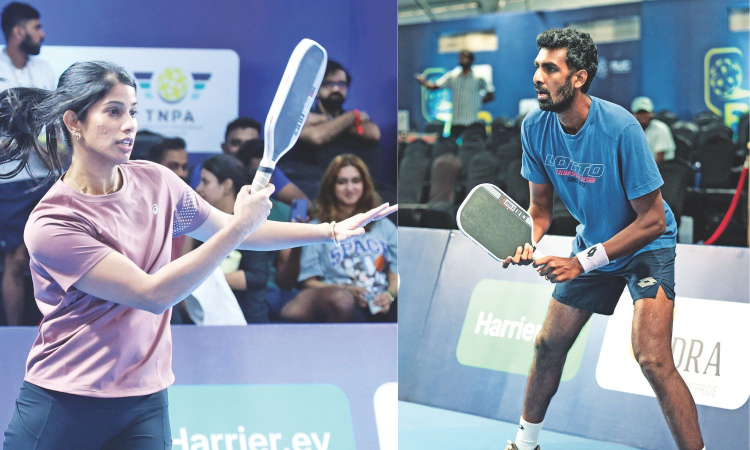
Joshna Chinappa returns a shot during her doubles contest; Prajnesh Gunneswaran at the event
Chennai :
A handful of tennis players traded racquets for paddles on Friday, as the inaugural day of the Rise Up Championship – Pickleball by the Bay tournament got underway in Chennai.
The tournament marks India’s first Pickleball World Ranking (PWR) 1000 event and featured prominent names, including former Asian Games tennis player Prajnesh Gunneswaran, who took to the court in both singles and doubles events, partnering with Venkatesh Nagarajan.
Having announced his retirement from professional tennis last year, Prajnesh has taken to playing pickleball casually on weekends with friends. His participation in a few ranking tournaments in the past helped him secure a spot in the qualifier draw of the PWR 1000 event.
I enjoy the sport. Most of the pickleball tournaments happen during weekends, and if it’s convenient, I make sure to take part,” Prajnesh told DT Next.
The Pickleball by the Bay event saw participation from a wide age group — including players over 50 — something Prajnesh believes highlights the sport’s inclusive nature.
“Pickleball courts in the city are mostly full, which shows people are willing to play — across all ages. In other sports, it’s a lot harder: one, you need to be athletic; and two, if you haven’t played from a young age, it becomes difficult,” he added.
Former world No 10 squash player and Commonwealth Games gold medallist Joshna Chinappa also featured at the event, pairing with Niranthara Muthiah to win the doubles qualifier and advance to the main draw. Discussing the similarities between racquet sports and pickleball, Prajnesh said that although he doesn’t play full-time, his background in tennis helps him adapt quickly.
The basics are quite similar. Pickleball came a bit easier to me because of my tennis background,” he said. Former Olympian sailor Varun Thakkar was also present at the event to show his support for the emerging sport.
“I think many players are picking up pickleball because it feels familiar. A lot of common people are taking it up because it’s not too harsh on the body,” said Selvakumar Baalu, Founder of the Rise Up Championship Foundation.
“Sports is a small community where people support each other. At Pickleball by the Bay, we’re happy to provide a platform for that.”
source: http://www.dtnext.in / DT NEXT / Home> News> Sports / by Jayantha Sengupta / September 27th, 2025