The winners of JB Fresh Face Season 8 held at a private hotel in city on Saturday — Anoushka Uthaiah and Shashank — are seen with fashion designer Jayanthi Ballal (JB).
source: http://www.starofmysore.com / Star of Mysore / Home> Photo News / September 24th, 2025
A unique Coffee Dasara blending festive spirit with agricultural pride will be held on Sept. 24 (Wednesday) at Gandhi Maidan in Madikeri, celebrating Kodagu’s deep-rooted coffee culture.
The event will honour coffee growers and provide valuable insights into cultivation techniques, announced H.T. Anil, Convener of Coffee Dasara.
Launched last year under the vision of Madikeri MLA Dr. Mantar Gowda, Coffee Dasara returns this year following an overwhelming response. The second edition is being organised in collaboration with the Coorg Planters’ Association.
The programme will begin at 10 am at the Sakamma Memorial Hall, named after Kodagu’s trailblazing coffee entrepreneur, the late Sakamma — Karnataka’s first woman coffee entrepreneur. Coffee stalls will be opened in her memory, celebrating her legacy.
A lecture series from 10.30 am to 1 pm will offer practical knowledge and expert guidance to coffee cultivators. At 1 pm, ten distinguished coffee growers from Kodagu will be felicitated for their exceptional contributions to the coffee industry.
Coffee on the menu
Adding a delicious twist to the festivities, culinary competitions will showcase coffee’s versatility in cooking and baking. Categories include coffee-flavoured cakes, cupcakes, brownies, biscuits, puddings, beverages, and chocolates — all celebrating coffee as both a drink and a delicacy.
This year’s Coffee Dasara will feature 35 stalls highlighting coffee-related products, information and innovations. Speciality brews will be served by local cafés, while major exhibits will be set up by the Indian Coffee Board, Horticulture Department, Industries Department, HOPCOMS, Nandini Dairy and the Kodagu Coffee Growers’ Cooperative Society, among others.
Coffee Dasara continues to honour Kodagu’s rich coffee heritage by blending tradition, innovation and community pride. This vibrant event not only celebrates the region’s global reputation for coffee cultivation but also strengthens the bond between growers, producers and coffee lovers.
source: http://www.starofmysore.com / Star of Mysore / Home / September 22nd, 2025
Although tribes and indigenous people of India have been studied by scholars (especially in the field of anthropology and sociology) for more than a century now, the origins of individual tribal communities still beg for scholarly attention, in the mainstream narratives of Indian history. As part of our series on ‘Tribal history’, we bring to you the history of one such community: the Kodavas from the region of Kodagu in Karnataka, as studied by scholar B.D. Ganapathy.
Tribes and indigenous people of India have been studied by scholars (especially in the field of anthropology and sociology) for more than a century now. A lot of which has been written since the establishment of the Asiatic Society of Bengal in 1784. Some of the most notable among them, writes Aashish Xaxa, from the colonial period are Edward Tuite Dalton’s ‘Descriptive Ethnology of Bengal’ (1872), Herbert Hope Risley’s ‘Tribes and Castes of Bengal’ (1891), Edgar Thurston and K Rangachari’s ‘Castes and Tribes of Southern India’ (1909), Robert V Russell and R B Lal’s ‘The Tribes and Castes of the Central Provinces of India’ (1916) and G S Ghurye’s ‘The Aborigines—“So Called”—and Their Future’ (1943).
And yet the origins of individual tribal communities still beg for scholarly attention, in the mainstream narratives of Indian history. In an attempt to shed a light on these histories, we bring to you our series on ‘Tribal history’. In the first episode, we present the history of one such community: the Kodavas from the region of Kodagu (Coorg) in Karnataka, as studied by scholar B.D. Ganapathy.
What is unique about Kodagu, a word derived from ‘Kodimandal’ or ‘Kudu’ meaning ‘steep’ or ‘hill’? According to ancient poets, “This land of our birth is the loveliest chain of gold in Jambera, India”, as mentioned by Nadikerianda Chinnappa in his book ‘Pattole Palame: Kodava Culture- Folksongs & Traditions’. Elaborating the beauty of Kodagu, Veena Poonacha tells us that it is a “land of a thousand hills, primeval forests, and lush green valleys … scientists have described Kodagu as a ‘micro hotspot of biodiversity,’ for it supports a rich diversity of plants, insects, reptiles and animals.”
And who are the Kodavas? Like many other ethnolinguistic minorities, the sources on Kodavas are oral in culture, and so written records are hardly if not never available. Their history remains shrouded in mystery. What is available is in the form of songs, narratives, tales, and practices of day-to-day life.
“Since the dawn of history, the Kodavas are said to be the dominant community in Kodagu. The name of the land itself denotes that only after the advent of the Kodavas, the land took its name as Kodagu. Historians and other research scholars opine that the Kudiyas, Yerawas, and Kembatti Holeyas were perhaps living in Kodagu as the original inhabitants when the Kodavas came on the scene.” — Ganapathy
Among the many theories that exist to trace their origin (as explored by Muzaffar Assadi in his article ‘Separatist Movement in Coorg’ and by Ganapathy in the excerpt below), one particular theory locates them as the original inhabitants of the land belonging to the martial Kshatriya clan. According to some other theories, they are people belonging to the Mohanjedaro civilisation. Even others speculate their Indo Scythian origin and Dravidian in the race. A recent theory tries to link them to the foot-soldiers of Alexander the Great.
A common line of argument in these theories, as observed by Hema M.A. and Jitendra Kumar Singh, is the “orientation of the community to warfare. This is further supported by the observations of Rice, that, the men of Coorg enjoyed hunting and warlike sports.” Even Ganapathy notes that “Kodagu has often been in the forefront, nay the pioneer in its contribution to the Indian Army of independent India, the first Commander-in-Chief of the combined forces of Army, Navy and Air Force in the person of General K.M. Caraiappa.”
It is estimated that there are in India about three thousand different communities. Among them perhaps the Kodavas are one of the smallest numbering not even a lakh. “This microscopic community”, writes Ganapathy, “with its great cultural tradition, with its high water mark of independence, integrity and valour has etched an indelible mark in the annals of Indian history.”
Read the chapter titled ‘Origin of the Kodavas’ as reproduced from Ganapathy’s book, below.
Our knowledge of the pre-history of Kodagu and the Kodavas is very scanty. There are no written documents or inscriptions from which we could deduce a credible story regarding the origin of the Kodavas. Even the history of Kodagu till the 17th century is very scanty and we find no mention of the Kodavas in the pages of the history of this period.
But many attempts have been made by various historians, anthropologists and others to unravel the mystery regarding the origin of the Kodavas. Especially after the advent of British rule in Kodagu many westerners and others have bestowed their attention on this subject. Having no written evidences or historic documents or stone inscriptions to probe their origin, efforts were made to unfathom the secret with the help of other material evidences that were available.
Pre-historic dolmens or burial cairns were found in Kodagu as in other parts of South India. Though these cairns throw some light on the life of those pre-historic-people, we cannot form an opinion as to who they were. Whether the remains that are found were of the Kodavas or that of the original inhabitants of this tract of land viz., Yeravas, Holeyas, Kudiyas, etc., is not clear.
The first discovery of the dolmens in large numbers was made by Lt. Mackenzie in 1868 on a bane near Virajpet. Capt. Rob Cole the then police superintendent of Kodagu followed it up and his excavations yielded interesting results. All the cairns found are either level with the ground or their tops crop up just a little out of it. When laid bare they present a stone chamber? of 7x4x5 feet composed of four upright granite slabs 7 or 8 inches thick and a cup stone with projects over the upright. The flooring is likewise of stone. The narrow front slab has an aperture of an irregular curve nearly two feet in diameter broken out from the top and generally facing east. Sometimes a compartment may be two-chambered. These cairns are either solitary or in groups, in some cases forming regular rows.
The relics found in them are peculiarly shaped pottery buried in the earth that nearly filled the chambers. These vessels contain earth, sand, bones, iron spearheads and beads. The pottery consists of chatties, and urns of burnt clay and is of a lead or black colour. They are smooth and shining and can hardly be said to be glazed. Bones, ashes and bits of charcoal are usually found at the bottom of the urns grains like paddy. ragi have also been found inside the chambers. Beads of red cornelian of cylindrical shape are occasionally met within the smaller pottery. The iron implements, spears and arrowheads are hardly distinguishable. These cairns apparently were resting places of the earthly remains, of a generation that existed anterior to the historical records of the present local races. The Kodavas call the dolmens as “pandukulis” or dwellings of the pandus. However, these pre-historic relics do not shed any light on the origin of the Kodavas.
Since the dawn of history the Kodavas are said to be the dominant community in Kodagu. The name of the land itself denotes that only after the advent of the Kodavas, the land took its name as Kodagu. Historians and other research scholars opine that the Kudiyas, Yerawas, and Kembatti Holeyas were perhaps living in Kodagu as the original inhabitants when the Kodavas came on the scene.
Since the dawn of history the Kodavas are said to be the dominant community in Kodagu. The name of the land itself denotes that only after the advent of the Kodavas, the land took its name as Kodagu. Historians and other research scholars opine that the Kudiyas, Yerawas, and Kembatti Holeyas were perhaps living in Kodagu as the original inhabitants when the Kodavas came on the scene.
The migration of Kodavas to Kodagu was set down by some of the European historians to the third century A.D. At that time according to them the servile or plebian class in Kodagu must have been composed of the Yeravas, Kurubas, Male-kudi yas and Holeyas. The Kodavas having conquered them formed themselves into an aristocracy.
The Kodagu inscriptions, copper plates and writings on palm leaves unearthed so far hardly throw any light on the Kodavas. However the first mention about the Kodavas was found in the Palpare inscription found in Nallur village in South Kodagu which is published in the Imperial Gazetteer of India 1908, vol XI. page 20, in which it is said.
“In 1174 Ballala II of Mysore sent his general Bettarasa to fight against the Chengalva king in Kodagu and in the fight that ensued at Palpare, Bettarasa was victorious and built a township at Palpare as his capital. But after some time Pemma Veerappa joined by Badigondeya Nandideva, Udayaditya of Kurchi and the Kodavas of all the nads marched against Palpare and attacked Bettarasa, who seems to have got the worst of it at first but was victorious.”
This inscription though does not shed any light on the Kodavas, gives an idea that the Kodavas were the dominant race in Kodagu during the 12th century. Though we are nowhere near the solution regarding the origin of the Kodavas we shall have a quick glimpse of the various efforts made by several books, people and researchers in quest of the object.
The first mention about the Kodavas was found in the Palpare inscription found in Nallur village in South Kodagu which is published in the Imperial Gazetteer of India 1908
The Cauvery Purana the oldest literature pertaining to the family deity of the Kodavas viz., Cauvery and the origin of river Cauvery after her, narrates that the Kodavas are the descendents of king Chandraverma of the Kadamba dynasty who ruled over Kodagu from the fourth century to the middle of the sixth century. Kadamba rule over Kodagu is recent and comprises subsequent history whereas Cauvery Purana dates back to a much earlier time. The Cauvery Purana mentions that when their family deity Cauvery transformed herself into the holy river, the Kodavas, of the land were present in good number and she blessed and assured them of her protective grace. This shows that the Kodavas were there before the birth of river Cauvery. This being purely a Puranic story we cannot base our findings on that and as Capt. Rob Cole rightly avers, the mythical nature of Cauvery Purana lacks credibility and it does not help us in any way in finding the origin of the Kodavas.
Col. Wilks in his book “History” expostulates the theory of the Kadambas and says that the Kodavas “descended from the conquering army of the Kadamba kings.” He further says that the first colonist were made out to have migrated from the Kadamba kingdom-Banavasi. Lewis Rice supports this view and says that it is consistent with what is known as the Kadamba history as corroborated by the modern annals of Kodagu: He expresses that the tales of Chandrashekhara, and Chitrashekhara as expounded by professor Wilson lend support to the same view.
Kadambas ruled over Karnataka from the third century A.D. to the middle of the sixth century. But we hear about Kodavas and Kodagu from a much earlier date even from the time of the Ramayana and Mahabharata that is, from the fourth or fifth century before Christ.
But we must note one important factor. The kings and chieftains who ruled over Kodagu were always aliens. A powerful chieftain or a king from outside comes with his army and invades a country, over-comes the opposition if any and establishes his suzerainty. With the invader some people of his ilk and a contingent of his soldiers may settle in the conquered land. But the majority of the people of the subdued land remains as they are. Thus the saga of conquests and establishment of kingdoms does not much change the ethnic and social structure of society.
The kings and chieftains who ruled over Kodagu were always aliens. A powerful chieftain or a king from outside comes with his army and invades a country, over-comes the opposition if any and establishes his suzerainty. With the invader some people of his ilk and a contingent of his soldiers may settle in the conquered land. But the majority of the people of the subdued land remains as they are. Thus the saga of conquests and establishment of kingdoms does not much change the ethnic and social structure of society.
The Kodava community had nothing to do with the Kadamba rulers or the subsequent ones. Whoever ruled Kodagu, the Kodava community maintained their separate identity, culture and customs as could be vouched from the recent happenings during Lingayat and British rule over Kodagu. Let alone the ethnic polarisation, the Kodavas were not influenced by the customs, mode of life, religious beliefs, dress etc.. of the rulers though there may be minor adaptations in the style of dress etc. Hence the Kadamba theory does not stand any charice of acceptance.
Some research scholars take back the advent of the Kodavas to the Mohenjodaro period. Attempts were made in the past to establish the existence of the Kodavas during the Vedic period. There is an assumption By Rev. Heras that there occurs the name of the Kodavas and some of the seals and references belonging to the pre-vedic (?) Mohenjodaro and Harappa culture refer to the Kodavas. But these are theories that are still in the realm of speculation.
Lt. P. Connor in his book “Memoirs of Kodagu survey (1817) says that the Kodavas themselves do not know anything about their origin. There is no trace of any helpful material to find out their origin of anything even to deduce a reasonable and convincing assumption. Though there are no historical data or evidences to establish their origin, there is no doubt that the Ködavas are one of the oldest races. Their land being a forest-ridden area with no outside contact and moreover, there being nothing attractive to arrest the covetous eyes of conquerors and even if anyone attempted the forbidding hilly terrain inclement weather and the heavy monsoon completely thwarted and made outside conquest well nigh impossible. As such it remained for years cut off from the external world and the face preserved its purity, its customs, traditions and culture unsullied.
Sri Erskine Perry who also failed to establish the origin of the Ködavas points out that “the Kodavas have no resemblance to any of the races of south India and that it clearly indicates that they must have come from outside“. He also describes that the kodavas are by far the finest race he had seen in India in point of independent bearing good looks and all the outward signs of well-being”.
Sri Erskine Perry who also failed to establish the origin of the Ködavas points out that “the Kodavas have no resemblance to any of the races of south India and that it clearly indicates that they must have come from outside”. He also describes that the kodavas are by far the finest race he had seen in India in point of independent bearing good looks and all the outward signs of well-being”.
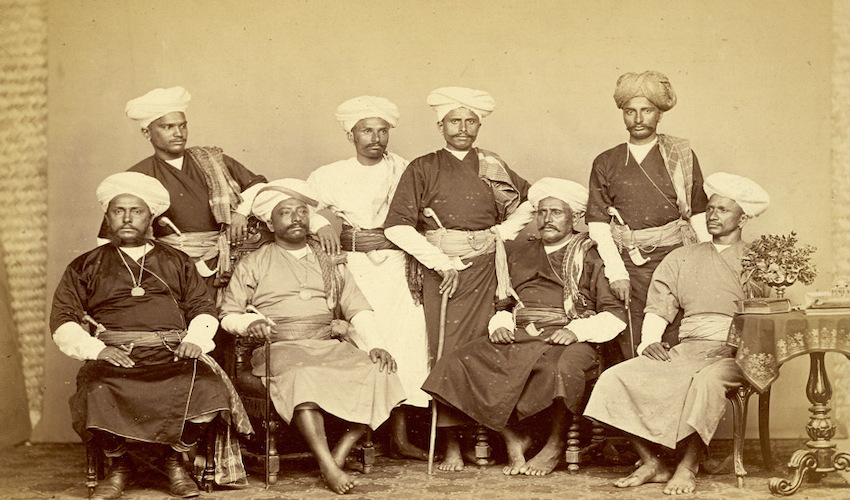
Mr. L. A. Krishna Iyer in his book, “The Coorg Tribes and Castes writes that “their (Kodavas) mode of life, pride of race, impart in their whole being an air of manly independence and dignified self-assertion, well sustained by their peculiar and picturesque costumes”. Giving the maximum and minimum and the average státure and cephalic and nasal indices he concludes that “they bear no comparison with the other races of South India”. He says that “the Kodavas have a finer nose, a larger head with a distinct tendency towards brachyce phalism. Their average cephalic index is 80.6 and the nasal Index 65.2”. Giving all these details Mr. Krishna Iyer also fails to unravel the origin of the Kodavas.
Mr. Abdul Gaffar Khan who wrote a book entitled “Kodavaru Arabiyaru” (Kodavas are Arabs) assumes that the Kodavast must have migrated from Arabia. Though he does not substantiate his assumption with any reliable data he simply bases his findings on the similarity of the mode of dresses between them, This does not justify as sufficient evidence to establish the origin of a race. As a matter of fact dress patterns change from time to time and place to place according to weather and other conditions. Hence the mode of dresses can hardly be the basis to ascertain the origin of any community. We know that the Kashmiris and some tribes who live in the Himalayan region do wear dresses closely resembling the dress pattern of the Kodavas and by no stretch of imagination could one conclude that they belong to the ethnic group of the Kodavas.
Some of the educated Kodavas claim that they are the descendants of the Pandavas of Mahabharata and cite in support some of the social customs like the younger brother marrying the widow of the elder brother etc. One need not say that these are decidedly very flimsy and unreliable grounds to determine the identity of a community.
Some of the educated Kodavas claim that they are the descendants of the Pandavas of Mahabharata and cite in support some of the social customs like the younger brother marrying the widow of the elder brother etc.
Some modern research workers have classified the Kodavas with the Todas of Nilgiris, the Caucasians of the country around mount Caucasus in Russia. Some others have classified them with the Kapalas, one of the original inhabitants of Kodagu. Mr. Herbutt Rishely opines that “the Scythians (an Asian nomadic people of Asia) who were residing in the Balkans region during the fifth or the sixth century were forced by their neighbors, the Yuvachi community to migrate to the East and settle in Punjab. They built a new kingdom in Punjab. The people with bigger heads, taller physique and longer limbs who are found in the region comprising Western Punjab to South Deccan were said to be the descendants of these Scythians. At that time cattle-raring being the principal occupation, they migrated with their herds of cattle in search of grazing plains and that is how, we find their progeny viz.. the people with larger heads, longer limbs and taller physique scattered along the western ghats and especially in Kodagu.”
Some recent research workers are definite about the Kodavas coming from the Dravidian stock. Though almost all the recognised anthropologists are unanimous in denouncing this assumption yet the protagonists of Dravidian theory argue that the Kodavas and the Todas of Nilgiris belong to the same ethnic group of the Dravidian family. They say that their traits are biologically useful and related to mental capacity and intellectual endowment. They further say that the mountainous habitat, climate, food, contact with Western races are responsible for what the Kodavas are today and these factors have differentiated them from the people of the plains. They argue that the jungles of Kodagu satisfied their highly developed propensities of hunting and outward life and they were noted for their predatory excursions into the country of their wealthier and less war-like neighbours. It is their conclusion that these traits are still with them and even at the present time they revel in their fighting and sporting qualities, which have ample scope in their socio and religious ceremonies and customs.
There are others who are of definite opinion that the Kodava language is nothing but a mixture of the Southern languages of the Dravidian group and on that basis they are definite that the Kodavas belong to the Dravidian heritage. They further say that if the Kodavas had come from the North or elsewhere they should atleast have had their own language, but in reality Kodava language is only a dialect a mixture of Dravidian languages. They quote Richtor to substantiate that the “Kodava language has a close relationship with the other Dravidian languages, but being neither cultivated beyond its colloquial use, nor possessing any original literature, it hardly deserves the distinction of being elevated into a special Dravidian language”.
These arguments of the Dravidian enthusiasts come in the realm of speculation and hardly can be reckoned as reliable data. The martial tradition of the Kodavas, the rugged nature of their home-land and the inevitable battles they had to wage against the wild animals and out-ward enemies, the inhospitable conditions of the forest area account for their highly developed martial traits but in no way or at any time they were the predators who invaded their docile neighbouring countries for loot or lucre. Their history is replete with events of high propriety, orderly behaviour and ideal neighborliness.
Regarding the issue concerning their language it is pertinent to ask the Dravidian enthusiasts as to why the Kodavas-a microscopic little community-instead of speaking one of the languages of the Southern group should speak a different language? The fact that Kodava language consists of many words and traits of the neighbouring languages does not disprove that it is an original language. Some of the recent linguists, who have done sufficient research on this language and published the grammar and compiled a vocabulary for the language say that it has many traits which we don’t find in the other Dravidian languages. They also are definite that Kodava language is of great antiquity and even older than Malayalam. As this issue is discussed at length, elsewhere in the book, it is sufficient to say here that languages which are always changing and which absorb words freely from contemporary other languages are not reliable data to determine the origin of any race or community. Once upon a time our ancestors were speaking Samskritha and it was the original language of our country but today it has yeilded place to other languages. But it does not mean that Samskritha was not the dominant and mother-tongue in our land.
The so-called authorities who easily tag the Kodava community to this or that ethnological group in South India must explain as to how a small community numbering within a lakh of people could develop and maintain a special mode of dress, a unique culture, a special way of life, a different language in spite of the heterogeneous influx and pressure of other major forces that dominated the South during the millennium. They must explain how this microscopic community could build up a tradition, which is markedly different from those of their neighbours.
The so-called authorities who easily tag the Kodava community to this or that ethnological group in South India must explain as to how a small community numbering within a lakh of people could develop and maintain a special mode of dress, a unique culture, a special way of life, a different language in spite of the heterogeneous influx and pressure of other major forces that dominated the South during the millennium.
The time of the settlement of the Kodavas in Kodagu is also a point of uncertainty. There are people who argue that the Kodavas lived during the Mohenjodaro and Harappa culture and must have migrated to the South at that time, The Indus Valley Civilization is said to have thrived for thousand years from 2500.B.C According to modern dating this is prior to the happenings of the epics Mahabharata and Ramayana. They say that there is the mention of “Kroda Desha” in Mahabharata and it refers to Kodagu only. This can only be an assumption and does not stand any scientific scrutiny. However there are certain credible assumptions to show that the Kodavas must have migrated to Kodagu much before the Christian era.
We know from history about the Greek invasion of India during the rule of Chandragupta Maurya. Alexander of Greece with an army of 40, 000 men, with the intension of conquering the world marched towards India. He crossed the Hindu-Kush and wanted to conquer Maghada (Southern part of Bihor). He had heard about this powerful kingdom and its wealth and grandeur. But the soldiers of Alexander refused to go further and he had to abandon his march appointing Selukus his general to rule over the conquered kingdoms. Selukus and his fellow soldiers settled down in a country called Bactria. After sometime when they saw that there were no powerful rulers they came down and conquered Punjab and ruled that part of the country for over a hundred years. One of their kings was Menander. Hel was a wise and good king. He was completely taken by the life and philosophy of the Indians and adopted Indian ways of life and called himself an Indian. His followers also adopted Indian ways of life and became Indians, and in the course of time they mingled with the local people giving rise to a new community with broader heads taller stature and sturdier limbs.
We know from history that when Alexander withdrew from India leaving Selukus, Chandragupta Maurya, the young and powerful king who wanted to be an empire builder like Alexander, himself, fought against Selukus, defeated him and married his daughter. Thus we see a fusion of races. How this new race came down to the South is corroborated by various historians.
“What is the earliest date in the historical period when the South came into contact with the North? The answer to this question is not very precise. Of course we have Ashoka’s inscriptions located in the various parts of Karnataka, but what about the pre-Ashokan period? Certain epigraphs of the 12th and 13th centuries in the Kannada language found in the Shimoga district refer to the rule of Nandas over Karnataka. We know that Ashoka conquered Kalinga but who among the Mauryan kings conquered the South is not known. Prof. Nilakanta Sastri suggests that the Mauryans came by their southern possessions as a matter of course by over-whelming the Nandas. The coming of Chandragupta Maurya to Sravanabelagola with his teacher Bhadrabhahu is well-known. The smaller hill at Sravanabelagola where the teacher and the pupil lived is referred to as Katavapura and Chandragupta lived here for twelve years after his guru’s death and the place is named after him as Chandragiri” (Karnataka through the Ages, page 99).
“Bindusara son of Chandragupta ruled in the South (298 272 B.C.) including certain portions of Mysore then known as Mahismamandala. This fact has been conceded by historians on the basis of Taranath the tibetan historian and Mamoolnar the Tamil poet. We have ample proof of the sway of Ashokan rule in the shape of pillars and rock edicts at Brahmagiri and other places of Chitradurga and other districts. The Brahmagiri excavations by the Archaeological Survey of Mysore in 1939 and the Archaeological Survey of India in 1947 respectively have amply unearthed objects belonging to the Mauryan period. Sir Mortimer Wheeler excavated some of the megalithic burials at Brahmagiri and dated them to the period of Ashoka. It is significant to note that the megalithic monuments are locally known as Mauryana” or “Morera mane” by the people thus associating them with the Mauryas”.
This conclusively proves that there was migration of the people of the North to the South as far back as the Mauryan period i.e,. round about 200 years before the Christian era. As explained above the inter-mixing of the Greeks, Indians, and the Pahalavas of Persia gave rise to a new community known as the Aryans. The word Arya in Samskritha means noble. This mingling gave rise to a new ethnic group of Aryans with bigger heads, taller stature, longer and sturdier limbs, grecian nose and special cephalic indices other than the local population,
The people being nomadic were moving from place to place with their cattle in search of grazing grounds gradually moved South. With the extension of the Mauryan Empire till Mysore (Mahishamandala) these sturdy people settled along the Western coast as far as Kodagu.
The people being nomadic were moving from place to place with their cattle in search of grazing grounds gradually moved South. With the extension of the Mauryan Empire till Mysore (Mahishamandala) these sturdy people settled along the Western coast as far as Kodagu.
Dr. J. H. Hutton states that, “it appears to be a much simpler and more satisfactory view to regard this stock of people as Aryans. We may suppose them to have migrated to the South and to have extended down to the West Coast as far as Kodagu forming the physical basis of several of the brachycephalic or mesatocephalic groups of Western India,”
From the above it can be safely inferred that the progenitors of the Kodava community have come from Aryan stock (Greek Indian mixture) and they migrated and settled along the Western Ghats and Kodagu at about 200 B.C. that is during the rule of the Mauryan dynasty. This brachycephalic stock which settled along the many parts of Western India could not maintain its identity as it was gradually absorbed by the local groups though we find people of longer heads, taller stature with Grecian noses here and there. But those groups who settled in Kodagu have maintained their specialities and separate entity to some extent as to be distinguished from the others. This was possible because of the mountainous and forest nature of Kodagu and the lack of communcation and outside contact with the nighbouring groups of the South. As outer contact increased this process of assimilation is being accelerated and it is but natural that in the present mode of life, and inter-mingling, the Kodava way of life, language, etc have been much influenced by the neighbours. Though this process is going on, the small community of the Kodavas have maintained their separate identity, culture, customs and other social traits with zealous care.
From the above it can be safely inferred that the progenitors of the Kodava community have come from Aryan stock (Greek Indian mixture) and they migrated and settled along the Western Ghats and Kodagu at about 200 B.C. that is during the rule of the Mauryan dynasty.
It is estimated that there are in India about three thousand different communities. Among them perhaps the Kodavas are one of the smallest numbering not even a lakh. This microscopic community with its great cultural tradition, with its high water mark of independence, integrity and valour has etched an indelible mark in the annals of Indian history.
This excerpt has been carried from B.D. Ganapathy’s Kodavas.
B. D. Ganapathy was a prolific writer, scholar and journalist writing in English, Kannada and Kodava Takk, covering religion, anthropology and philosophy. He is particularly noted for his coverage of the Kodagu (Coorg) region and the Kodava ethno-linguistic group, his own birthplace and community.
During the Indian Independence Movement, he was the sub-editor of the Kodagu, a pro-Independence weekly Kannada newspaper founded by his father-in-law, editor and freedom fighter Pandyanda I.
Among Ganapathy’s most noted works is his 1967 Kodavas (Coorgs), their customs and culture. Other works include: The Eternal Quest (1970), Naṅga Koḍava (1973 in Kodava takk), Kodavas (1980) and Kanni Kāvēri (1990 in Kodava Takk). Among his works two books are in the Kodava Language: Nanga Kodava and Kuttambolicha. His Kannada book on Kodava culture Kodagu mattu Kodavaru has won him the State Academy Award. He wrote 11 works in 16 publications and in three languages.
___________________________
source: http://www.indianhistorycollective.com / Indian History Collective / Home / by B.D. Ganapathy
In a curious case, a 10-cm-long worm was surgically removed from a man’s eye. The 66-year-old man, a former soldier from Cherambane in Madikeri taluk, had been experiencing persistent itching in his left eye for a month.
He visited the Iksha Super Specialty Eye Hospital in Madikeri on the September 12, where Dr A G Chinnappa examined him.
Upon examination, Dr Chinnappa found a swelling on the conjunctiva (the white part of the eye) that was moving. A scan revealed a long worm inside the swelling.
An emergency surgery was performed, and the worm was removed. The worm measured 10 cm in length. Further microscopic examination confirmed that the worm was a Loa loa, a type of parasitic worm commonly found in Africa. If left untreated, the man could have suffered from blindness. The successful surgery has saved the man’s vision, and he is receiving further treatment.
“We could see some movement on the eye ball and subjected him to a scan which revealed the presence of a worm. We immediately performed surgery under local anasthaesia. We were surprised that the worm was still alive and was 10 cm long”, said Dr Chinnappa.
source: http://www.english.public.tv / Public TV / Home / by Public TV English / September 20th, 2025
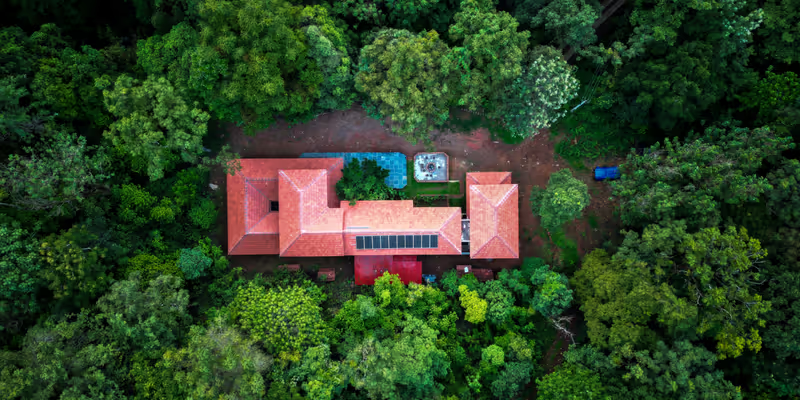
A weekend getaway at the Blyton Bungalow in the Poomaale Estate in Coorg is all you need to recharge yourself from the urban noise.
The six-hour journey from Bengaluru to the Poomaale Estate feels like a slow untwining of the city’s grip. By the time the car climbs the hills of Kodagu district—better known as Coorg—the traffic thins, the air cools, and the dense green folds of the Western Ghats begin to swallow the winding road.
The final stretch feels enchanted: rain-slicked roads winding past tangled forests, a lone elephant crossing the road, and finally, the quiet approach into a 128-acre coffee estate that seems to have been built for retreat.
Nestled in the dense forests of the estate is the Blyton Bungalow. One can’t call Blyton a resort in the conventional sense; it encompasses the essence of Coorg’s diverse ecology and raw beauty.
The large, but homely, guesthouse is decorated with modest Mangaluru tiles, wide verandas, and wooden chairs, which build a perfect ambience for long hours of coffee and conversation, interspersed by the chirps of birds and a gushing waterfall.
We were welcomed with steaming cups of the estate’s brew, as Aranya Bagchi, the hospitality manager and resident naturalist, laid down some ground rules for our safe stay at Blyton, which is right in the middle of a dense rainforest.
No wandering outside alone after dark, as it may get dangerous.
Once the night falls, until early morning, the estate and its adjacent jungle become roaming grounds for wildlife movement, especially elephants.
And then, there’s the coffee.
Coffee at the source
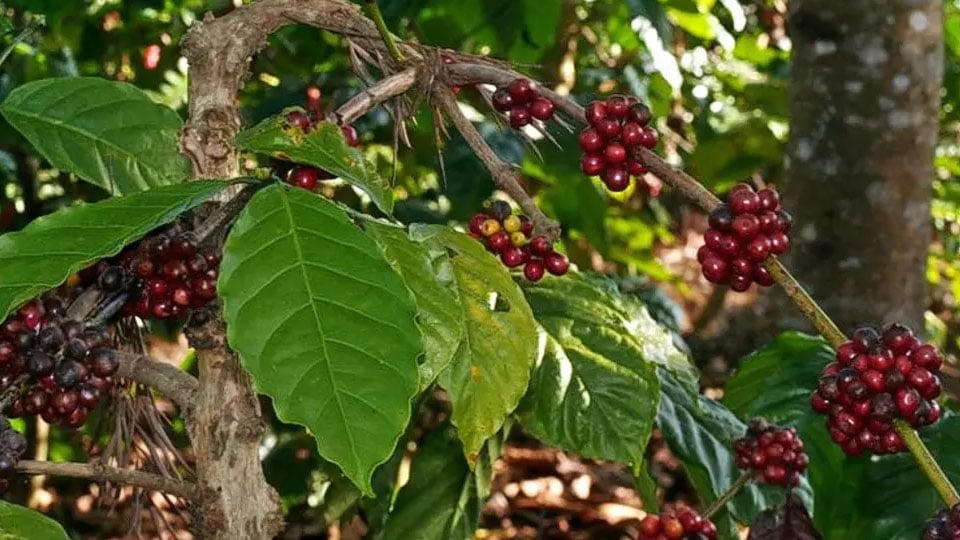
Coffee is always better at its origin, and at Poomaale, it was earthy and robust, harvested, dried, and roasted just a few hundred meters away from Blyton. By the end of the stay, we lost count of the many cups we had consumed!
We just didn’t sip coffee, as part of the experience, we indulged in an hour-long session on various brewing methods. It wasn’t just a tutorial, but almost a ritual—one kindred to the Japanese tea ritual.
The nuances of grind size, the temperature of the water, and the patience of the pour. Coffee, in Bagchi’s telling, became more than a drink. It was a dialogue between soil, climate, and craftsmanship.
Walking the land
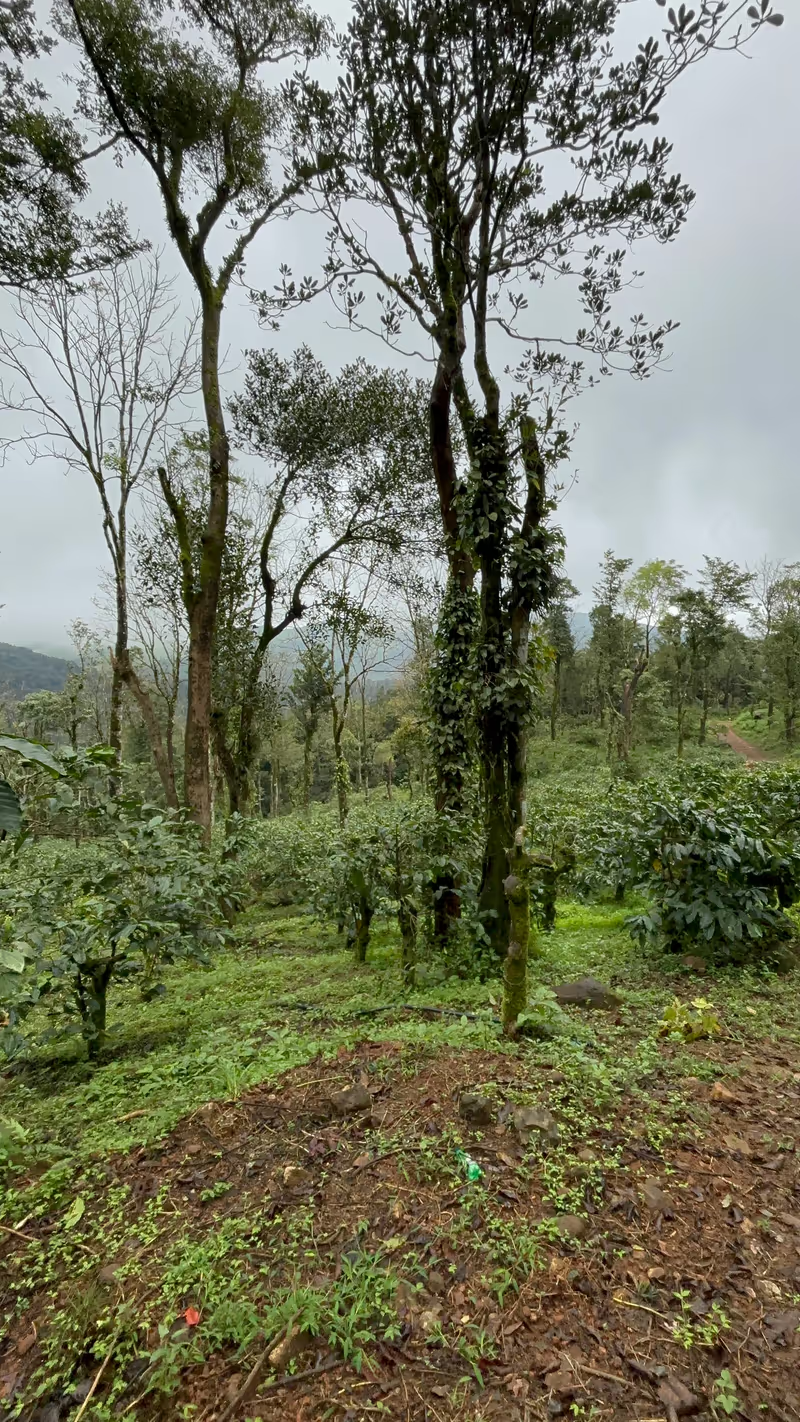
Poomaale Estate’s beauty best unfolds on foot. Sharan V, a budding researcher and a naturalist, guided us on a trek to a nearby hillside. On this hour-long trek, we crossed many coffee shrubs—most of them loaded with gestating green berries, while a few others were decorated with white flowers, rendering a sweet, almost jasmine-like scent.
Did you know? The gestation period of coffee is similar to that of humans; it takes nine months for coffee to mature from flower to bean.
Here, the trail was alive with fungi following the monsoon rains, as well as many fruit trees, specifically litchi, rambutan, and mandarins.
A small stream kept us company for much of the trail, and so did the patter of rain on leaves. By the time we emerged onto a grassland clearing, the hills of Coorg stretched before us, wrapped in mist. It wasn’t an arduous trek, but for sedentary city dwellers, the incline was steep enough to bring back to life muscles long forgotten.
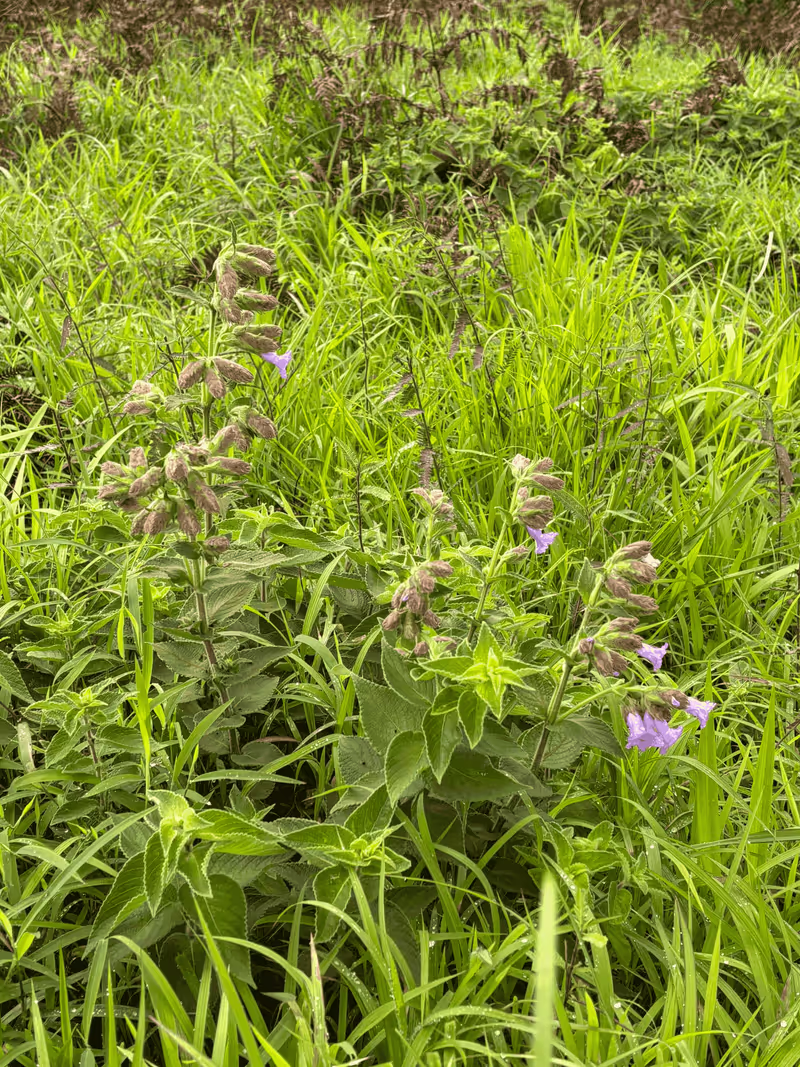
As we reached our destination, we stopped to check out a purple-hued, bell-shaped bloom called the Kurunji—not to be confused with the famed Neelakurinji of the Nilgiris, but equally rare, flowering once every four years.
To stumble upon it in bloom—surrounded by the dense green hills, partially covered in clouds—felt like being let in on a secret.
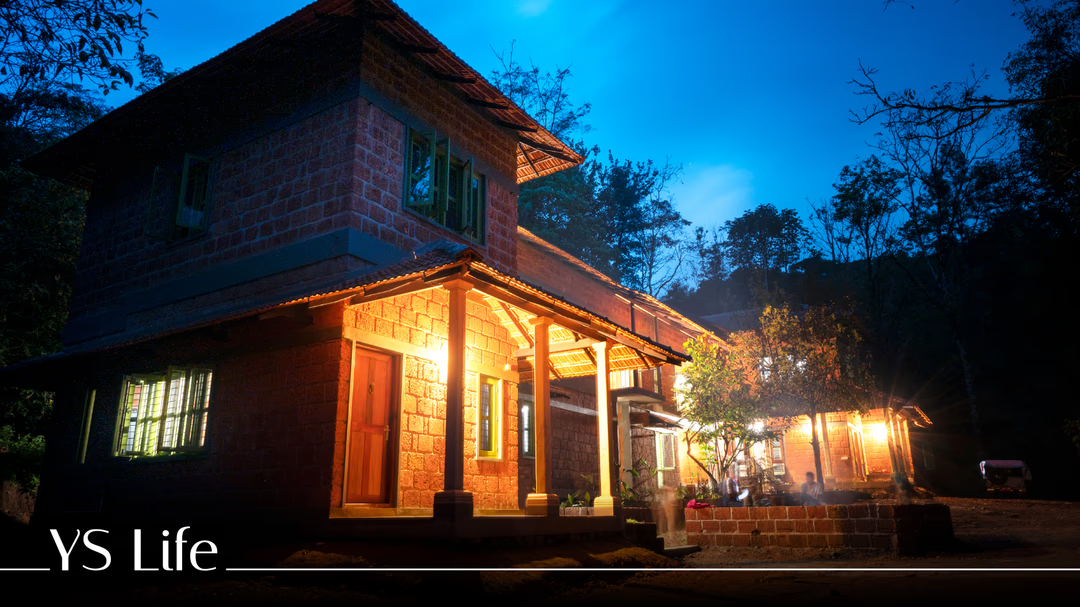
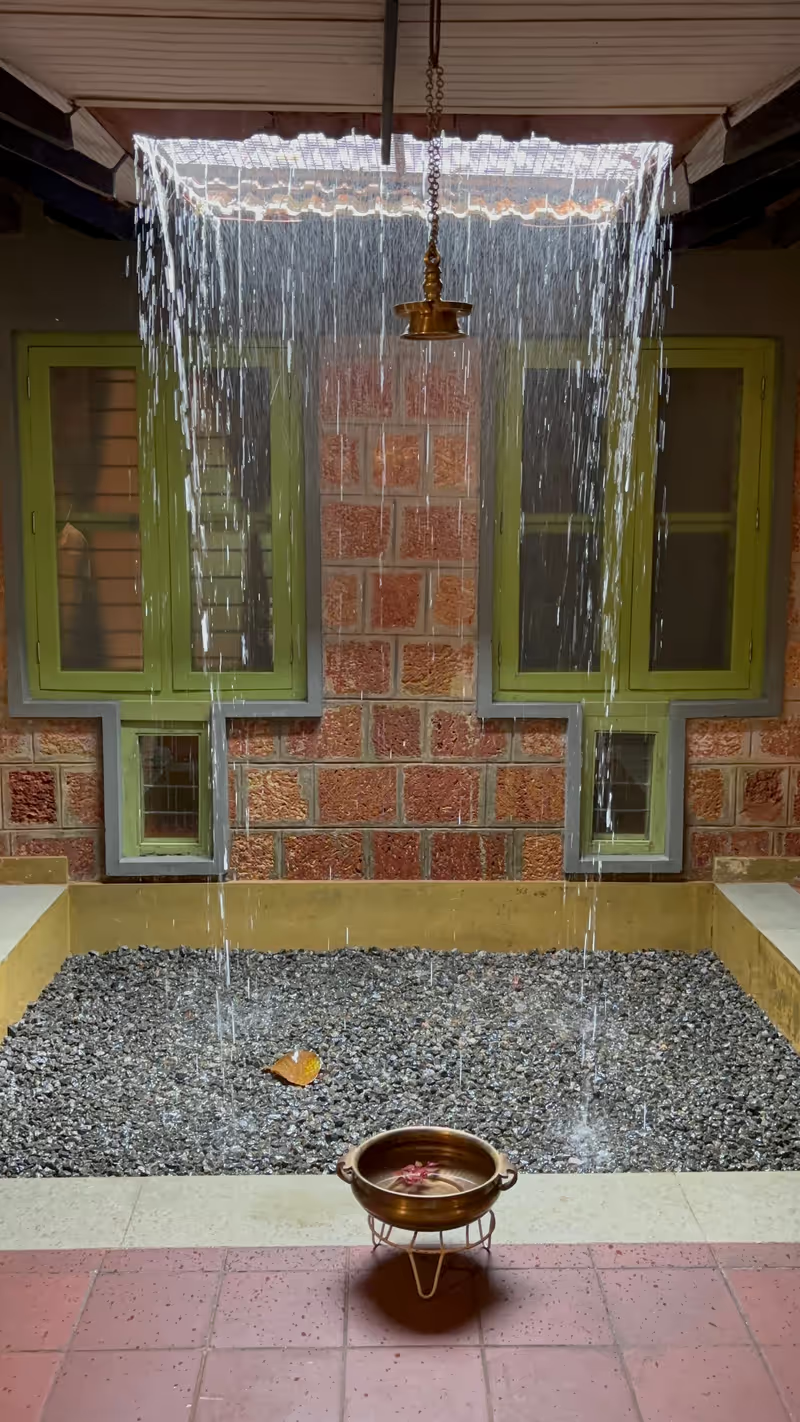
That night, rain lashed the windows, but our hosts were well prepared with hot water bottles, which were tucked into our bed for cosy comfort. The rooms were big, simple, but intimate. The laterite stone walls, iron-clad windows, rustic wooden doors, and high-rise ceilings reminded one of a village homestay, metamorphosed for a premium experience and comfort.
Encounters with the wild
Blyton offers a much-needed escape from the city’s ambient noise. The next morning, we were woken up from our deep slumber by an alarm bell, but not in the way one expects. The sound was the courtesy of the Malabar Whistling Thrush, also known as the Whistling Schoolboy; the bird is a daily visitor at Blyton Bungalow.
A morning walk, following a scrumptious breakfast, led us to several birdwatching points, where binoculars revealed flashes of scarlet and cobalt in the canopy. Sharan was quite excited to show us a tiger beetle, named after its distinct tiger-like patterns, indigenous to Coorg.
And then there was the waterfall. Swollen with the season’s rain, it roared with an energy that pulled you in. Standing beneath it, drenched and exhilarated, felt less like sightseeing and more like baptism—a cleansing of city fatigue.
PS: If you are in a rainforest, be prepared to encounter leeches and snails, among many other critters.
Food from the land
Meals at Blyton Bungalow were as much a reflection of the land as the treks. Every dish was sourced either from the Poomaale Estate itself or from one of its sister properties or “collectives” in Andhra Pradesh and Maharashtra, operated by their parent entity, Beforest.
Founded in 2018, Beforest is one of the first firms in India to carry out permaculture activities on a scale of 100+ acres in each of its collectives to reimagine a forest-friendly lifestyle.
Food at Blyton was homely, prepared by a local resident cook, Ishtak, who spun the forest produce into delicious meals. One evening, we were served a delicate dish made of young ferns, sautéed simply with local spices, their freshness speaking louder than seasoning. Try the wild mango curry—a sweet and tangy curry made with small mangoes from the estate’s orchards. We were also served the local rice, which had a distinct purple colour and was sweet to taste.
In fact, the estate has a cow shed that provides milk products for Blyton’s guests as well as manure for the plants. Behind the cow shed grows cardamom and pepper in the wild—the two spices that are cultivated at Poomaale besides coffee.
There was something grounding in knowing that every bite had a direct lineage to the soil underfoot. Nothing felt imported, nothing staged. It was food in conversation with the place.
A pause from the world
Blyton Bungalow is not about curated experiences or glossy perfection. Its magic lies in the authenticity of being away. The air carries petrichor and coffee blossom, the walls echo with bird calls, and the evenings settle into long stretches of rain and firefly glow.
Time slows here—not in the sense of boredom, but in the way that every moment feels fuller, layered with the textures of land, weather, and companionship.
When it was time to leave, the six-hour drive back to Bengaluru felt heavier, the city waiting with its demands and deadlines. But somewhere in the mind, the sound of the stream lingered, and so did the warmth of a hot water bottle pressed tucked in the sheets, and the image of a lone elephant, chalk-painted and solemn.
Blyton Bungalow isn’t just a getaway. It’s a reminder that retreating into nature is less about escape and more about return—a return to the quiet, the simplicity, a way of being that listens as much as it speaks.
Prices for two nights (inclusive of taxes):
Regular room: Rs 20,000
Suites: Rs 32,000
source: http://www.yourstory.com / Your Story / Home> YS Life> Travel & Leisure / by Suman Singh / edited by Kanishk Singh / September 20th, 2025
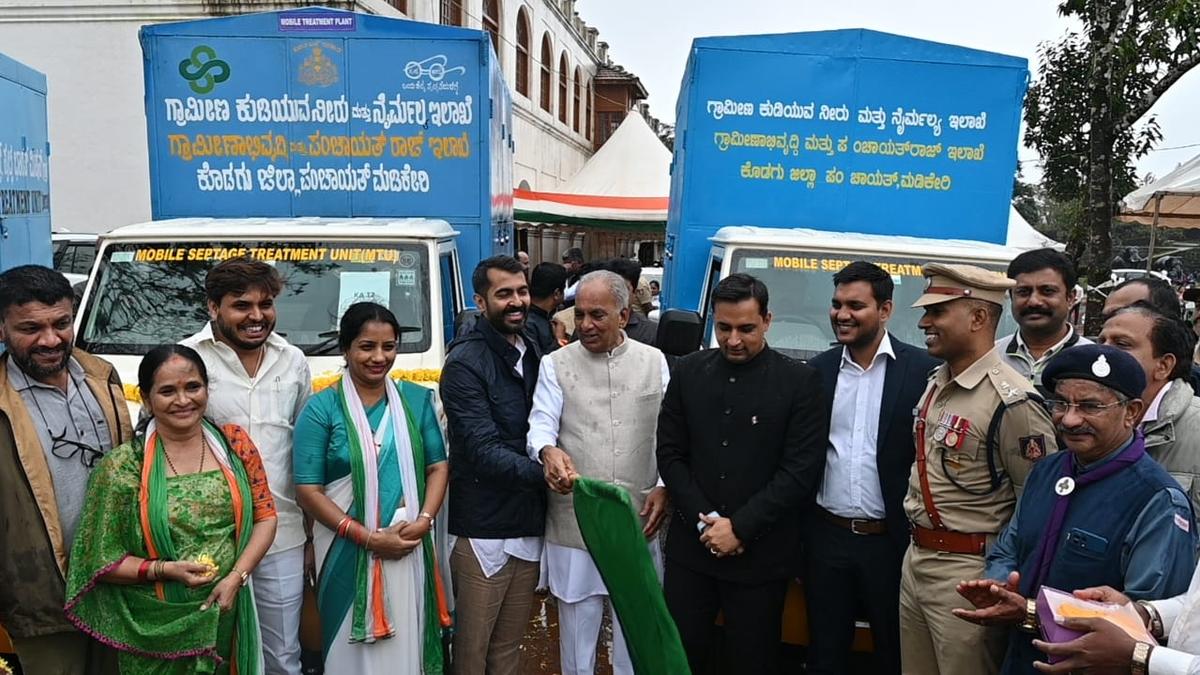
Minister in charge of Kodagu district N.S. Boseraju flagging off the mobile septage treatment vehicles in Madikeri on Friday. | Photo Credit: SPECIAL ARRANGEMEN
Three mobile septage treatment units will soon begin functioning in Karnataka’s Kodagu district.
The mobile septage treatment vehicles flagged off by Minister in charge of Kodagu N.S. Boseraju on Friday are reckoned to be the first in the State.
The mobile septage treatment units were launched jointly by the Department of Rural Drinking Water and Sanitation, the Department of Rural Development and Panchayat Raj, and the Kodagu district administration.
While the septage treatment plants already operational at Bhagamandala in Madikeri and Suntikoppa in Kushalnagar takes at least three months to complete the process of treating the septage by separating it into solid and liquid waste, the mobile septage treatment units can complete the process of treatment within hours, said a statement issued by the district administration.
The mobile units can purify 60 to 70% of the water separated from the septage, but the water would not be potable. However, the same can be used for gardening or can let let out directly into the drains. The sludge or septage that remains after the treatment is about 80% decomposed, which can be transported to the septage treatment plants and used in the production of fertilizers, the statement said.
The vehicles have a capacity to process about 6 kilolitres of septage per day. “There is no need to transport the septage to a Feacal Sludge Treatment Plant for treatment, management, or disposal. The entire process is carried out within the mobile septage treatment vehicle itself, as it is equipped with all necessary machinery and can operate anywhere as required,” the statement said.
Each mobile septage treatment vehicle launched in Kodagu district costs around ₹30 lakh, the statement said, while pointing out that the total cost, which amounts to ₹90 lakh, had been funded by the Swachh Bharat Kosh Trust.
The mobile septage treatment vehicles will initially operate within the limits of Kutta, Napoklu, and Shanivarasanthe gram panchayats in the district. In future, the services of these mobile septage treatment vehicles will be extended across the taluks.
source: http://www.thehindu.com / The Hindu / Home> News> India> Karnataka / by The Hindu Bureau / August 16th, 2025
According to Coffee Statistics, Coffee Board, Government of India, India’s coffee production is projected to touch 4.03 lakh metric tonnes in 2025-26, a strong 10.9 per cent rise from the 3.63 lakh tonnes harvested in 2024-25. The surge is anchored by Karnataka, which alone contributes nearly 70 per cent of India’s coffee, with its output climbing to 2.80 lakh tonnes, up from 2.56 lakh tonnes last year.
Within Karnataka, Chikkamagaluru’s production leapt to 1.04 lakh tonnes, Kodagu delivered 1.30 lakh tonnes, and Hassan clocked 45,175 tonnes, collectively powering the state’s robust growth. Kerala followed with 85,150 tonnes, a sharp rebound over last year’s 72,950 tonnes as robusta yields strengthened, while Tamil Nadu posted 20,315 tonnes, consolidating its steady trajectory.
Production from non-traditional areas also recorded healthy gains, with Andhra Pradesh breaching the 16,500-tonne mark and Odisha improving to 500 tonnes, signaling diversification beyond the Western Ghats. The North-Eastern Region added 210 tonnes, underscoring the Coffee Board’s efforts to promote cultivation in new geographies.
Arabica production is forecast at 1.18 lakh tonnes, while robusta — India’s export mainstay — is projected at 2.85 lakh tonnes, reinforcing the country’s positioning as a leading supplier of premium washed robusta to global markets.
India’s coffee economy now spans 3.79 lakh holdings, with over 1.75 lakh farms concentrated in traditional belts and nearly 1.97 lakh holdings emerging in non-traditional regions, reflecting the crop’s widening footprint.
With domestic consumption consistently crossing 1 lakh tonnes and global demand for traceable, sustainably grown coffee surging, the Coffee Board emphasized the need for continued investment in quality upgradation, post-harvest infrastructure, and climate-resilient agronomy. This record output could help India strengthen its share in specialty and value-added coffee exports, provided supply chain modernization and price discovery keep pace with production growth.
Rajya Sabha member Ajay Maken and MLA for Virajpet A.S. Ponnanna, who is also Legal Advisor to the Chief Minister, looking at a map during an inspection of a site reserved for a sports facility in Kodagu on Monday. | Photo Credit: SPECIAL ARRANGEMENT
Rajya Sabha member Ajay Maken has assured to provide funds from his grants for the construction of a Sports Training Residential Hostel in Kodagu.
Mr. Maken, along with the Chief Minister’s Legal Advisor and MLA for Virajpet A.S. Ponnanna, inspected a site reserved for a high-level sports facility at V. Badaga village in Virajpet in Kodagu district on Monday.
During the inspection, Mr. Ponnanna explained to the Rajya Sabha member that the residential hostel in Kodagu will attract athletes, especially those from Kodagu.
Mr. Maken, during the inspection of the 11.2 acres of land reserved for the sports facility, assured that maximum possible funds from his grants will be allocated to the hostel.
Speaking to reporters, Mr. Ponnanna recalled that he had submitted a request to the MP earlier and the latter had fondly remembered Kodagu’s proud contributions to sports and armed forces, while assuring full support by providing grants to the best of his ability.
A statement said that preparatory work for the construction of the Sports Training Residential Hostel has already been under way. An official programme in the presence of Chief Minister Siddaramaiah, Sports Minister and Mr. Maken will be held likely in November this year and the date for the same will be finalised later.
source: http://www.thehindu.com / The Hindu / Home> News> India> Karnataka / by The Hindu Bureau / September 15th, 2025
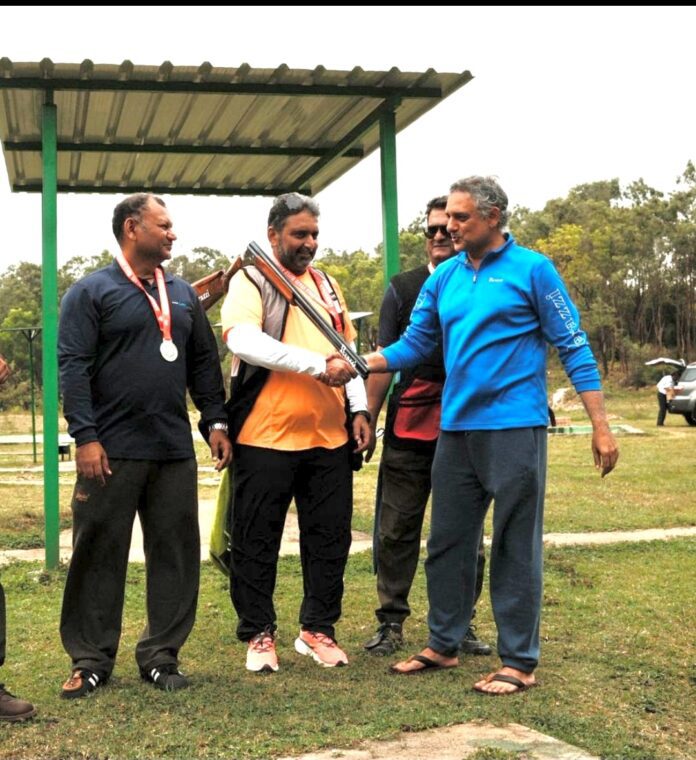
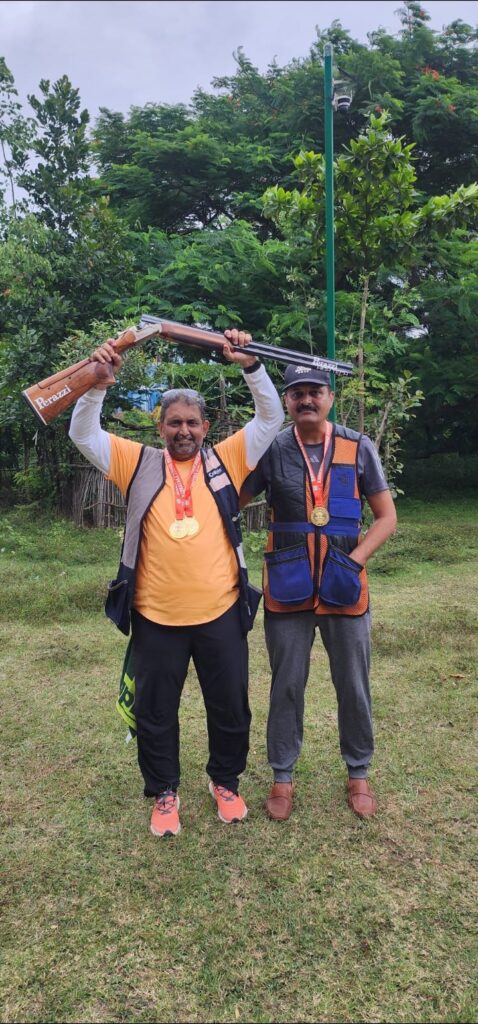
Karthamada Navin Bopaiah retains his No. 1 State ranking, winning the individual Gold in the Trap event (NR Masters) at the recently concluded 13th Karnataka State Skeet & Trap Shooting Competition, held at SAI, Bangalore. He also secured the team Gold (Masters NR) along with Kalliyanda Sajan Sajan Aiyappa. Both are shooters representing the Coorg Rifle Association, Madikeri.
The Coorg Rifle Association (CRA) has been thriving with a rich history and is home to talented shooters such as Baduvamanda Dhanu Devaiah and his family. Dhanu and Sajan Aiyappa are both ‘Renowned Shots’, and Kodagu has also produced international-level shooters in the past.
The Coorg Rifle Association continues to flourish with its legacy of skilled shooters and has been instrumental in promoting shooting sports both in the past and in the present. While recent local competitions within the district have boosted interest in conducting shooting events, it also serves as a reminder for organizers to emphasize gun safety regulations, which have seen a decline, in order to prevent any major accidents.
The Coorg Rifle Association is actively working with regulatory bodies to improve its facilities and is hopeful that upgrades will be completed in a couple of years. CRA’s goal is to produce quality shooters who can compete at the national and international levels.
Presently, KALS School has been instrumental in promoting shooting sports and has been actively involved in grooming youngsters in this discipline.
source: http://www.clnews.in / CLN News / Home> Sports / by CLN Newsdesk / July 08th, 2025
In this legend, the three elder brothers living in Kannur send their remaining siblings into Kodagu and Wayanad.
An idol of Pannangalatamme. Credit: Roshan Bopanna and Chenanda Rohan Ponnaiah
Kodagu folklore speaks of seven divine siblings — six gods and one goddess — who were from Kerala and settled in various parts of Kodagu and the adjacent districts in northern Kerala (Kannur and Wayanad).
In this legend, the three elder brothers living in Kannur send their remaining siblings into Kodagu and Wayanad. The three younger brothers (the eldest among them being Igguthappa) and the only sister enter Kodagu on foot. The sister is the best archer among them; she shoots arrows the farthest. She cooks food for them without using fire, instead relying on the hot sand on the banks of a river.
Igguthappa flings an arrow that lodges itself in the trunk of a mango tree. The sister takes the form of an egret and flies to that tree, near which she takes up residence. There, she fulfils her destiny. This is Pannangalatamme, the goddess of the Kodava-speaking Dalit community, the Kembattis.
The worship of Pannangalatamme and the celebration of her temple festival are central to the Kembatti identity today.
Festivities
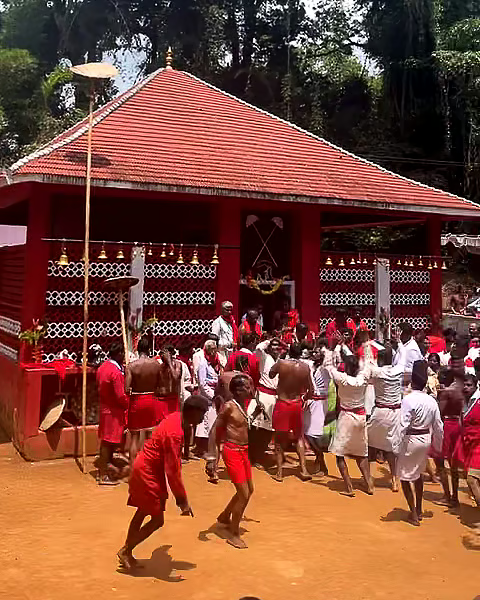
Every year, during a two-day festival, members of the Kembatti community gather at the main temple of Pannangalatamme, which is near Kakkabe, a large village in Kodagu. The men dress in traditional wraparound tunics called kuppyas, often coloured red or white. There are also temples dedicated to Pannangalatamme in Beppunaad Armeri and a few other locations.
Devotees at the main shrine in Kakkabe Kodagu district.
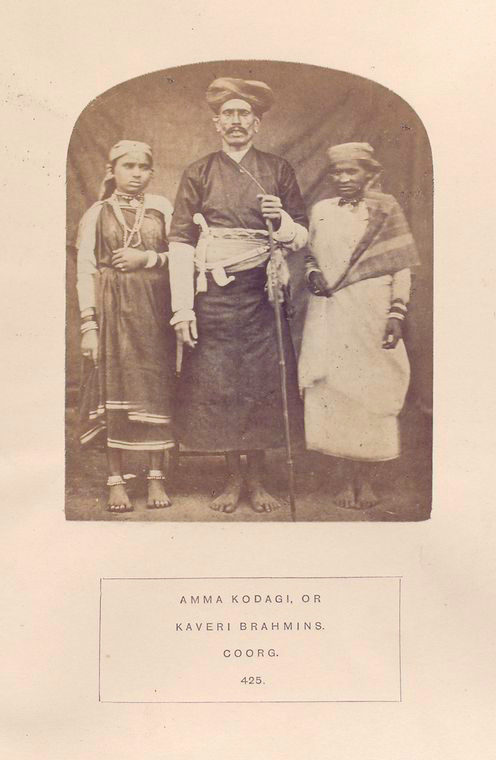
The kuppya is a long coat worn by the Kodavas and other natives of Kodagu. It is secured at the waist by a sash called a chele. In the past, the kuppya and chele came in various colours. These days, the kuppya is often black or white, and the chele is gold-embroidered and usually has a silver-covered dagger called the pichekaththi tucked into it.
The Kembattis were also village musicians, playing the vaalaga, a double-reed wind instrument similar to the oboe, the shehnai, and the nadaswara, which lent its name to the popular folk music of the region.
The Kembattis also blew long brass horns called kombu and played with thaala cymbals. They were often accompanied by drummers called Medas, who otherwise worked with cane, making baskets and mats. Their large drums were of two types: pare and dhol. This motley band of musicians performed at Kodagu weddings, funerals, and temple festivals.
It is difficult to trace the historical timeline of these traditions and temples, which are rooted more in folklore than classical literature. The Kembatti community and the Igguthappa temple are referenced in nineteenth-century texts of the Haleri Rajas, who ruled Kodagu.
The legend of Igguthappa, Pannangalatamme, and their brothers is old and appears probably for the first time in print in the 1870 Gazetteer of Coorg.
In some villages such as Chembebelloor and Bilugunda, the Kodavas, the Kembattis, and others celebrate their annual village festival through various performances in groups, either in disguise or as musicians.
Author Dr Bodukuttada Radhika Kuttappa, who belongs to the community, notes that there are currently 51 Kembatti clan names. On the other hand, Dr M G Nagaraj claims in his 2017 book Kodagina Kembatti Samskriti that there are 97 Kembatti clans in existence. While Dr Radhika listed unique names, Dr Nagaraj counted unrelated clans, sharing the same name as separate entries for different villages.
source: http://www.deccanherald.com / Deccan Herald / Home> India> Karnataka / by Mookonda Kushalappa / August 07th, 2025
WELCOME. If you like what you see "SUBSCRIBE via EMAIL" to receive FREE regular UPDATES.
Read More »