Rs 1 crore to be provided for Beary community hall in Kodagu: Speaker U T Khader
Madikeri:
Karnataka Legislative Assembly Speaker U T Khader said that Rs 1 crore will be allocated for the construction of a Beary community hall in Kodagu district, and directed officials to identify suitable land for the project.
He was speaking after inaugurating the first Kodagu District Beary Literary Conference organised by the Karnataka Beary Sahitya Academy in association with the Kodagu Bearys Welfare Trust.
The event was presided over by B A Shamshuddin. Khader said the grant of Rs 1 crore would be facilitated with the support of local MLA Mantar Gowda and Virajpet MLA as well as Chief Minister’s legal advisor A S Ponnanna.
Highlighting the cultural importance of the community, he said Beary culture, literature and traditions have a distinct history and called for efforts to preserve and promote them.
He said the literary conference would help encourage discussions, strengthen the Beary language, and guide the community towards development. It would also help educate youth about Beary literature, culture and history, and provide a platform for exchange of ideas.
Khader also stressed the importance of learning and respecting all languages, stating that in a globally connected world, multilingualism promotes harmony.
Speaking on the occasion, MLA Mantar Gowda assured that funds would be released once land is identified for the construction of the community hall.
source: http://www.msn.com / MSN / Home / by Newspoint / April 2026
Despite sufficient time being given to homestay owners, it has been observed that many establishments remain unregistered. | Photo Credit: File Photo
All homestays operating in Kodagu district have been instructed by the Tourism Department authorities to be mandatorily registered.
As per government orders, it is mandatory for all homestays operating in the district to register with the Tourism Department. Despite sufficient time being given to homestay owners, it has been observed that many establishments remain unregistered, said a press statement issued by the office of the Deputy Director of the Tourism Department in Madikeri on Friday.
The instructions by the Tourism Department have come in the wake of an alleged sexual assault on a woman from the U.S. in a homestay in Kodagu district.
Pointing out that the district administration has taken serious note of many homestays remaining unregistered and had earlier directed that all unregistered homestays complete their registration immediately, the Tourism Department said, “Homestays operating without registration must cease all unauthorised activities forthwith.”
Licenses of homestays operating illegally in the district have already been cancelled, the Tourism Department said, before warning that legal action will be initiated against those continuing to operate in violation of the rules, without registration with the Tourism Department.
The homestays that have already obtained licenses from the Tourism Department and whose validity of five years is nearing expiry have also been instructed to renew their licenses.
source: http://www.thehindu.com / The Hindu / Home> News> India> Karnataka / by The Hindu Bureau / May 01st, 2026
Ganesh BM, an electrical contractor and philanthropist, is helping the poor lead more comfortable lives by building houses and providing free electricity connections.
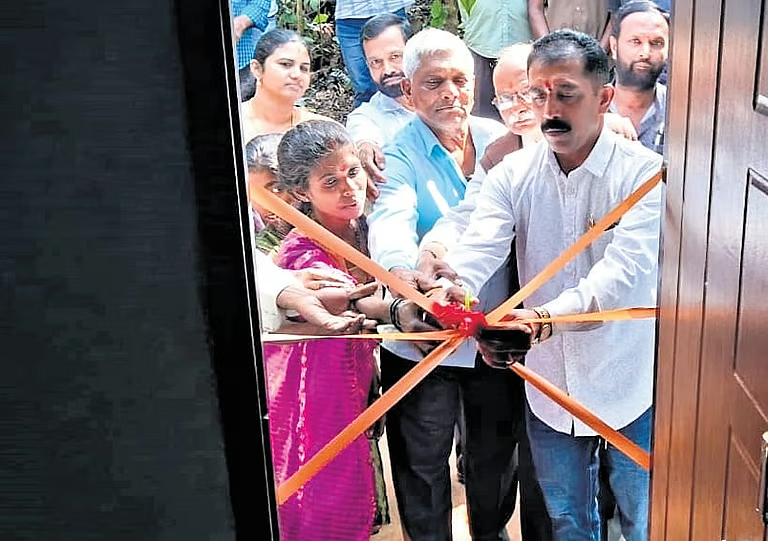
Ganesh BM inaugurates Shankru and Vasanthi’s new house
Madikeri :
When we exit this world, we don’t take with us the assets we earned in this lifetime. So instead of concentrating on gaining more and more assets, keep what is required to lead a decent life and donate the rest to the needy,” is the mantra Ganesh BM lives by. A resident of Arji panchayat in Kodagu, Ganesh is an electrical contractor and a philanthropist who has donated houses to the poor.
Recently, Ganesh celebrated his 50th birthday and instead of a lavish celebration, he cut a cake with a poor family to whom he gifted a two-bedroom house. “Hard work and determination helped me earn a decent living. I was born in a poor family and lived in a straw hut for the longest time. However, I am now in a well-to-do position and have the urge to help the needy,” he shared.
Lighting up homes
In 2000, Ganesh won the Betoli Gram Panchayat (now known as Arji panchayat) election by five votes. “During this time, I travelled across the panchayat limits and learnt about the living conditions of the people. I was re-elected to the panchayat in 2005 and served as vice-president. I then became a Taluk Panchayat member,” recalled Ganesh.
It was then that he came across a girl from a financially weak background who had scored 95 per cent in the SSLC examination. Her story went viral as she studied under an oil lamp, as the hut she lived in did not have electricity connection. “Her story inspired me and I enabled free electricity connection to her house,” he recalled.
Meanwhile, in 2023, during a routine panchayat survey, Ganesh was introduced to a tribe called Kala. “No one in the panchayat limits lived in such a pitiable condition as Kala and his family. I wanted to make a difference in his life and promised to build him a house,” he shared.
He constructed a four-bedroom house for Kala and the keys were handed over to the family on January 22, 2024, to coincide with the inauguration of the Ayodhya Ram Mandir. “I wanted to the day to have a special memory, so I handed over the keys on the day the Ram Mandir was inaugurated,” he added.
After
In April 2024, Ganesh was alerted about a family which had lost their house. “I am the taluk president for the Billava Community Association, and I was told that the house of a poor woman from the community had collapsed. I decided to build her a house,” he shared. He built a four-bedroom house for Kamala and her family, who had lost their shelter. He spent up to Rs 2.5 lakh each on the two houses.
After these donations, Ganesh was approached by many from financially weak families who sought his help. A total of five families from the panchayat limits reached out to him, seeking help for electricity connections to their houses. “I helped them get electricity connection free of cost,” he explained.
A birthday gift
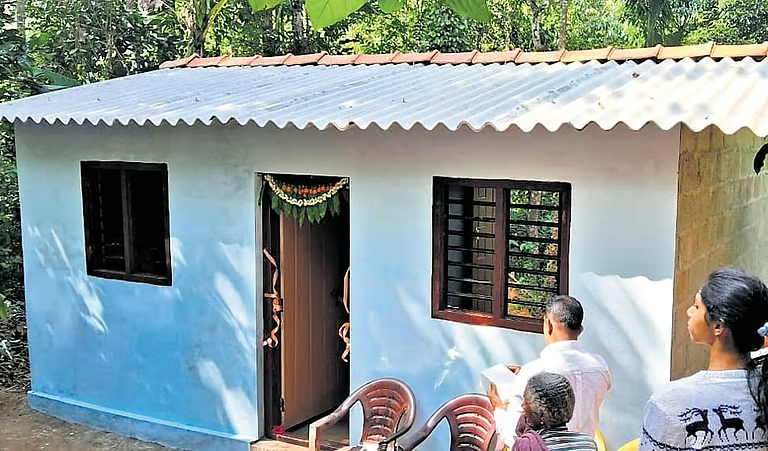
To mark his 50th birthday celebration, Ganesh built a two-bedroom house for Shankru and Vasanthi’s family. “I was visiting the Theremekadu paisari area for some work when I met Shankru and his family. They were living in a straw hut that was nearing collapse. I assured them I would build them a house,” he said.
While the couple was living on paisari land, they received the rights for the land a few years ago. Spending Rs 1.60 lakh, Ganesh built a house on the land and handed over the keys to the house on his birthday. “A rich person looks forward to earning more assets, but we all have to leave this world behind one day. When you are alive, keep what is necessary and help those in need,” concluded Ganesh.
source: http://www.newindianexpress.com / The New Indian Express / Home> Bengaluru / by Pragna GR / January 12th, 2025
Rashmika Mandanna and The Weeknd are set to share the stage at the Anime Awards 2026. Read more here.
Actress Rashmika Mandanna will be returning to the 10th Global Anime Awards as a presenter, set to be held in Tokyo, Japan, on May 23, 2026. She made history as the first Indian to present an award at the 2024 Anime Awards in Tokyo. The global ceremony, which honours excellence in anime across categories, will see the actress join an esteemed lineup of international presenters, including global music sensation The Weeknd.
It will be especially exciting to see Rashmika Mandanna and The Weeknd share the stage as presenters, bringing together two massive global fan bases. Their combined presence is expected to add a unique energy to the ceremony, blending the worlds of cinema and music on a global platform.
Rashmika has often expressed her fondness for anime and its imaginative storytelling. From admiring iconic characters to appreciating the depth and emotion that anime narratives bring to life, her interest in the genre aligns seamlessly with the spirit of the Anime Awards. Her association with the event not only reflects her personal passion but also highlights the increasing crossover between global entertainment industries.
On the film front, she has a career spanning multiple industries, including Telugu, Kannada, Tamil, and Hindi cinema.
The actress was last seen in the film The Girlfriend with Dheekshith Shetty and Anu Emmanuel, among others. Up next, she has interesting projects in the pipeline. Rasmika Mandanna will be seen in the Hindi film Cocktail 2 with Kriti Sanon and Shahid Kapoor. It will be released theatrically on June 19. She then has the Telugu films Mysaa and Ranabaali. For the latter, she will share the screen with her actor-husband Vijay Deverakonda. Both these films are slated for release this year.
source: http://www.filmfare.com / FilmFare / Home> News> Bollywood / by Filmfare / April 28th, 2026
‘Sapientia-26,’ the Annual Inter-College Fest was held on Apr. 13 at Sapient College on KRS Road in Metagalli here.
The valedictory and prize distribution ceremony was held at North Avenue.
The chief guests for the event were the well-known film celebrity couple Bhuvann Ponnannaa and Harshika Poonacha, who herself is a gold medallist in Engineering.
They, along with Sapient College Chairman P. Daljeet Ram, presented trophies and cash prizes worth over Rs. 1.50 lakh to the winning teams.
The couple motivated the gathered students with their own life experiences and appreciated the growth and reputation of Sapient College in such a short period of time.
As part of the programme, students of the college presented various cultural activities and entertained the gathering.
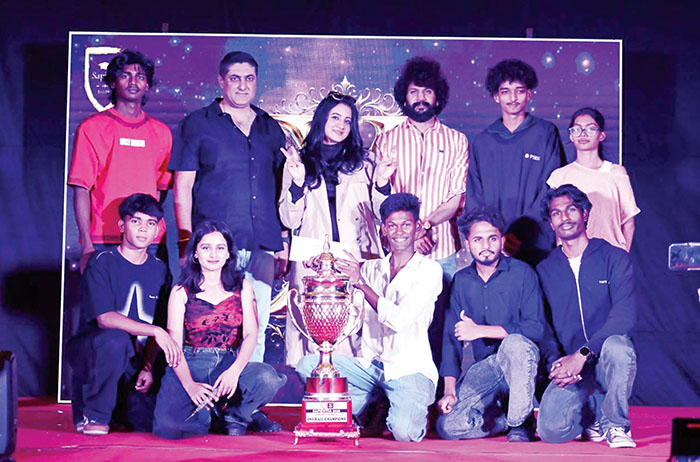
SBRR Mahajana First Grade College team which won the overall winners’ trophy at ‘Sapientia-26’ with the guests.
The two State toppers of Sapient PU College were honoured on stage by the dignitaries, along with other UG toppers in the presence of their families and gathering of students, for their outstanding academic achievements.
SBRR Mahajana First Grade College Team emerged as the overall winners of Inter-College Fest securing the trophy along with a cash prize of Rs. 25,000.
The event was attended by Sapient College Director Yeshmik Daljeet Ram, Dean Dr. Sujatha Bopanna, Principal Dr. K. Ganesh, Administrative Officer Sujit Padival, teaching and non-teaching staff.
source: http://www.starofmysore.com / Star of Mysore / Home> News / April 29th, 2026
The Minister said the mandate for production, development, research and domestic marketing of spices other than cardamom is vested with Ministry of Agriculture & Farmer’s Welfare.
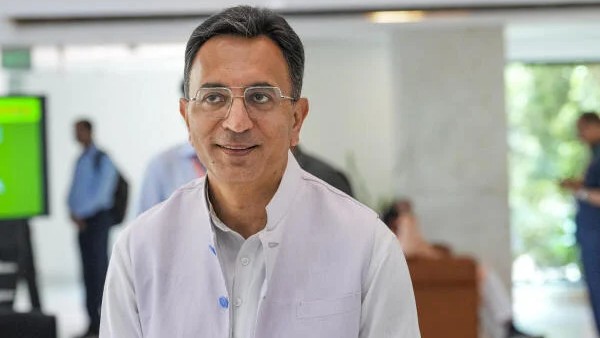
Union Minister for Commerce and Industry Jitin Prasada /Credit: X/@JitinPrasada
New Delhi:
Union Minister of State for Commerce and Industry Jitin Prasada on Tuesday said that black pepper production in Kodagu may increase by about 16 per cent in 2025-26 compared to 2024-25.
Replying Yaduveer Wadiyar question, the Minister said the mandate for production, development, research and domestic marketing of spices other than cardamom is vested with Ministry of Agriculture & Farmer’s Welfare. The Ministry informed that it has conducted a quick pre-harvest survey in Kodagu district which indicates that black pepper production in Kodagu may increase by about 16 per cent in 2025-26 compared to 2024-25, he said.
Spices Board under the “Sustainability in Spice Sector through Progressive, Innovative and Collaborative Interventions for Export Development (SPICED)” scheme provides assistance to the growers of spices, including pepper growers of Kodagu district for post-harvest improvement by providing pepper thresher, graders /cleaners etc, conducting capacity building programmes and undertaking market linkage initiatives organizes buyer seller meets, he said.
He further said at present the import policy for pepper is ‘Prohibited, with a provision permitting import only if the Cost Insurance & Freight (CIF) value is Rs. 500. per kg or above. The said MIP of Rs. 500/kg continues to remain in force and is not applicable to imports under Advance Authorization Scheme for export production, imports by 100% Export Oriented Units (EOU) and units in Special Economic Zones (SEZ) and imports for extraction of oleoresin for re-export by manufacturer-exporters, subject to applicable policy conditions, he said.
source: http://www.deccanherald.com / Deccan Herald / Home> India> Karnataka / by Ajith Athrady / March 11th, 2026
MP for Mysuru Yaduveer Krishnadatta Chamaraja Wadiyar releasing a set of booklets on natural farming, in Mysuru on Tuesday. | Photo Credit: SPECIAL ARRANGEMENT
MP for Mysuru Yaduveer Krishnadatta Chamaraja Wadiyar released a set of booklets under the National Mission on Natural Farming (NMNF) aimed at benefiting farmers in Kodagu district.
The booklets, which include a farmers’ study handbook, natural farming diary, Frequently Asked Questions (FAQs) booklet on natural farming, and information material on schemes available through the Agriculture Department, were released at the MP’s Mysuru office. The books will be distributed to 3,125 farmers in Kodagu district.
The department said that the NMNF scheme was being implemented in Kodagu district with 60% financial assistance from the Centre and 40% contribution from the State government.
Under the programme, 50 Cluster Resource Persons (one for every two gram panchayats) and 17 Block Resource Persons will guide and train farmers practising natural farming across the district.
Joint Director of Agriculture, Kodagu district, B.S. Chandrashekhar, and Deputy Director of Agriculture D.S. Somashekhar were present.
source: thehindu.com / The Hindu / Home> News> India> Karnataka / by The Hindu Bureau / March 03rd, 2026
Karma Kargyue Monastery is home to 700 indigenous tree species; under Guru Karma Samtenlingpa Rinpoche, plans are afoot to plant 1,500 more saplings
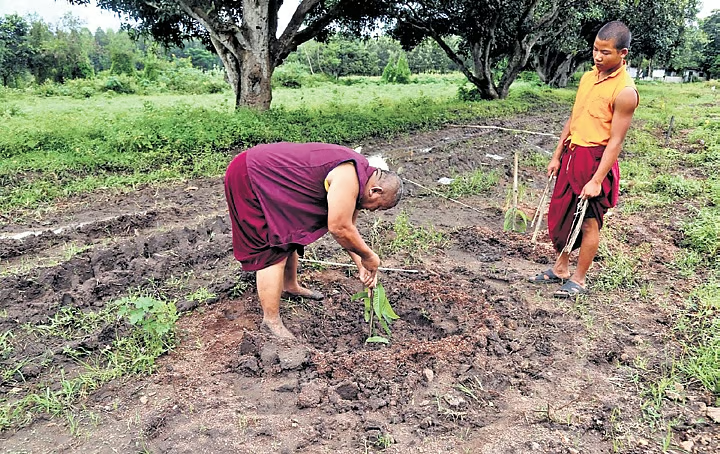
Monks of Eco Nalanda work in the fields every week to gain practical knowledge about the environment Photo | Express
Madikeri :
Buddhism has a profound connection with the natural world — a bond rooted in the very moment Siddhartha Gautama attained enlightenment beneath the canopy of a Bodhi tree.
This reverence for nature is reflected in Buddhist monasteries, which serve as tranquil, spiritually-charged sanctuaries. And deep within Southern India lies the Karma Kargyue Monastery, a premier example of spirituality intertwined with environmental stewardship.
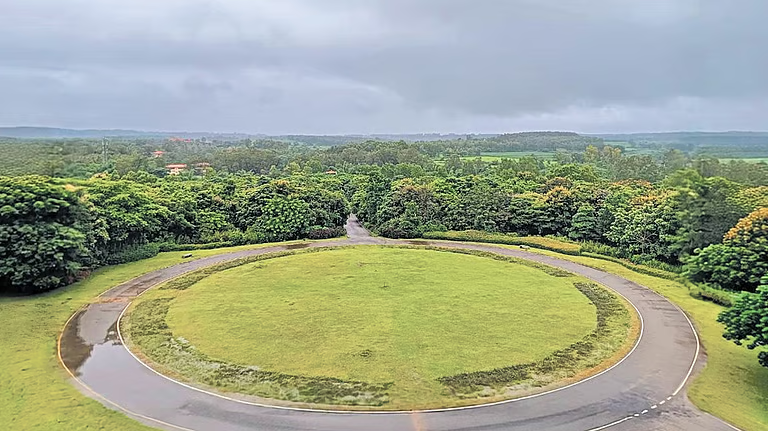
Nestled in the heart of a 100-acre forest zone, the monastery has evolved beyond a place of worship to become a vital hub for conservation and ecological harmony.
Established under the aegis of Bodhi Sattva Trust, the monastery is in the Tibetan Refugee Camp at Bylakuppe in Mysuru district. The trust also runs a Gurukul institution named Eco Nalanda School, where monks are taught to lead sustainable practices along with the routine academics.
What is special about this monastery is that it is home to over 700 indigenous tree species. The trust was established in 1995 with an ambition to initiate a conservation programme. Established by Guru Karma Samtenlingpa Rinpoche, the trust is leading a conservation and nature rejuvenation mission even as it has grand plans to promote its conservation initiative for a sustainable living.
“Buddha is the ambassador of peace and we at Bodhi Sattva want to share spiritual science,” explains Guru Karma Samtenlingpa Rinpoche, the founder of the trust.
He goes back in time and retells the story of his inspiration to start such a massive conservation project. Son of Maha Yogi Kazung, Karma Rinpoche was born in Bylakuppe and he calls this place his Karma Bhoomi. As a child, he grew up amidst nature even as his grandfather was his first inspiration.
Karma Kargyue Monastery Photo | Express
“My grandfather, a great yogi who meditated in Mt Kailash, was a nature lover. After the communist invasion of Tibet in 1959, my grandparents and father moved to Bylakuppe. And whenever my grandfather was here, he always spent time meditating and creating spiritual art atop a mango tree. He spent most of his time atop the tree and only came down to eat,” he says.
According to Karma Rinpoche, his house had a large orchard and all kitchen items were grown in the backyard. He said it was where he found his calling towards conservation.
After he graduated from the Gurukul in 1995, he established the trust to start the conservation project. However, the path was not easy. A youngster then, Karma Rinpoche did not have a proper plan for the project and he started off by planting saplings that he received for free from government departments. A silver oak sapling planted in 1995 still stands as a testimony to his conservation journey that began in a small manner at the monastery.
“The only ‘sathya’ I knew was surrendering to Mother Nature and Mother Nature is the only true Dharma. My conservation story started beside the then small temple of Karma Kargyue Monastery built using Mangalore tiles,” he says.
After meditating in this temple, he used to head out to plant saplings. He travelled across the globe seeking support to promote his vision and his journey introduced him to D Kupendra Reddy, former MP, who has led many conservation initiatives, including lake conservation projects in Bengaluru. Karma Rinpoche’s conservation journey led him to Dr Yellappa Reddy, a well-known conservationist, who helped shape the Bodhi Sattva Conservation project.
“We both shared the same vision for conservation and a month after our meeting, he visited the monastery,” he recalls, explaining that till his visit, the conservation project was lagging due to unscientific management. Dr Yellappa Reddy scrutinised the entire area, surveyed the land, conducted soil tests and even identified the indigenous species of flora that existed in the region. While several saplings had been planted in the region randomly, over 400 indigenous saplings were planted after Dr Yellappa Reddy’s visit.
Sharing that this happened in 2006, Karma Rinpoche explains that monks in the monastery were part of the project and walked miles carrying buckets of water to nurture these plants. While the trust now has a rainwater harvesting unit and a drip irrigation unit, the challenges they faced initially were a test turned into a testimony.
“Rainwater harvesting was planned by Prof Ravi Kumar from Mysuru and Dr Chandrashekar from Kerala Forest Science Institute became a horticulture advisor. All these scientists, including Dr Yellappa Reddy, did not take a single rupee for their efforts towards conservation,” says Karma Rinpoche.
The trust has planted 700 species of indigenous tree saplings and aims to plant 1,500 more. Karma Rinpoche has a vision to make Bodhi Sattva and Eco Nalanda, a small ecology arboretum learning centre, so that conservationists can easily replicate the concept. The trust is now involved in constructing a model house near the monastery to promote the concept of sustainable living. “Around this house, we will develop an orchard, a garden for kitchen needs and plant ayurveda saplings for daily needs. We will also build a ‘Happy Cow Temple’ where we will introduce ‘Malnad Gidda’, the indigenous cattle breed, and promote a sustainable lifestyle,” he says.
At Eco Nalanda, several tree species, including those connecting with the concept of ‘Sathyam Shivam Sundarm’, and several ayurvedic saplings are being nurtured. The trust has developed a Nakshatra Vana, Raashi Vana and Navagraha Vana plantation.
The 100-acre conservation project is in the centre of the 5,000-acre Tibetan Camp in Bylakuppe and it has become a resting place for wild elephants. “The region is known for elephant menace. Elephant herds are often chased from one estate to another. However, Eco Nalanda is like a guesthouse for elephants. With fodder and water aplenty, the elephants often enter this place and return to their home forest,” he says.
source: http://www.newindianexpress.com / The New Indian Express / Home> Karnataka / by Prajna GR / April 12th, 2026
A new climate analysis finds India’s coffee farms absorbed 30 extra days of harmful heat annually because of carbon pollution. Researchers are racing to find alternatives before Arabica and Robusta run out of room.
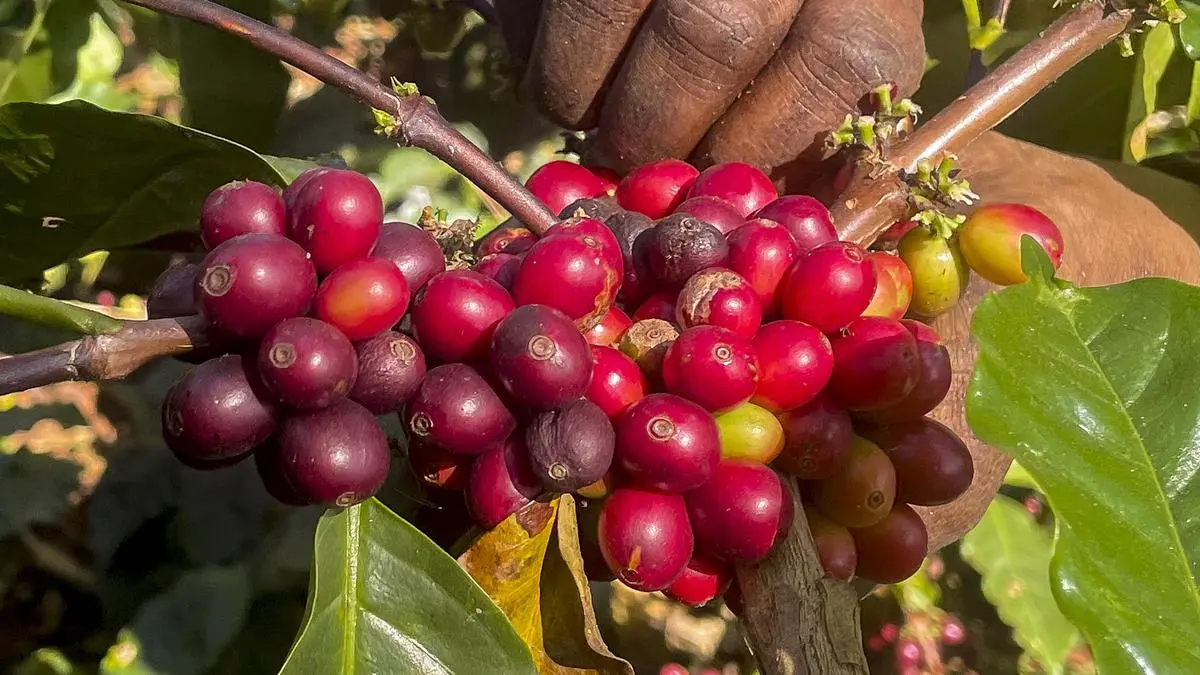
A worker picks ripe coffee cherries at Kelachandra Coffee Estate, in Chikkamagaluru district, Karnataka, on January 10, 2026. | Photo Credit: Laxmi Devi Aere/PTI
More than two billion cups of coffee are consumed every day, and for several years now, surging prices and falling production have marked the global coffee trade. Farmers in the world’s top five coffee-producing countries have faced mounting losses because of a warming planet, and India’s coffee sector is not immune. A new analysis by Climate Central, an independent group of scientists and communicators who research the changing climate, finds that 25 coffee-growing countries together accounting for about 97 per cent of global production all experienced more coffee-harming heat over the past five years.
Kristina Dahl, Climate Central’s Vice President for Science, explained to Frontline in an email interview why coffee was chosen as the subject. “Coffee is one of the most popular beverages in the world and a daily staple for billions of people,” she said. “It also provides a very direct and tangible link between climate change and everyday life. Any climate-driven disruption to coffee production has global ripple effects—from farmers in the ‘bean belt’ to consumers worldwide.”
Coffee plants are highly sensitive to temperature. When maximum temperatures regularly exceed 30°C, the quality and quantity of bean harvests decline. Reduced harvests and lower-quality beans tighten global supplies, contributing to price volatility—as seen in December 2024 and again in February 2025, when global coffee prices reached record highs, Dahl said. For farmers, many of them smallholders, lower yields, crop losses, and the cost of adapting to new conditions strain already thin profit margins.
The analysis, which examined daily temperatures between 2021 and 2025 across 25 major producing countries, is the first to directly attribute the increase in coffee-harming heat days—defined as days when maximum temperatures exceeded 30°C—to climate change using attribution science, she said. Climate Central drew on its Climate Shift Index, which compares observed temperatures to modelled estimates of temperatures in a hypothetical world without carbon pollution. Last year, the organisation conducted a similar attribution analysis on cocoa, another climate-sensitive crop.
Heat is already impacting harvests
The top five coffee-growing countries—Brazil (roughly 37 per cent of global production), Vietnam (17 per cent), Colombia (8 per cent), and Ethiopia and Indonesia (6 per cent each)—together are responsible for 75 per cent of world’s supply, experienced an average of 57 extra coffee-harming heat days per year because of climate change. Brazil averaged 70 additional harmful heat days annually; Indonesia 73; Vietnam 59; Colombia 48; and Ethiopia 34.
The situation is particularly acute in Asia, Dahl pointed out. Thailand recorded an average of about 75 additional harmful heat days a year. India, which contributes approximately 3.5 per cent of global coffee production, experienced an average of 118 coffee-harming heat days per year between 2021 and 2025, of which 30 were attributable to climate change. In a world without carbon pollution, India would have had roughly 88 such days instead of 118. Kerala recorded 65 additional heat days linked to climate change annually; Tamil Nadu 43; and Karnataka, India’s largest coffee-producing State, 32.
These impacts are not theoretical. “In practical terms, rising heat is already affecting harvests in major coffee-producing countries, threatening both quantity and quality,” Dahl said. She pointed out that while earlier studies had linked rising temperatures, drought, and shifting rainfall to reduced yields and shrinking suitable growing areas, the Climate Central analysis adds a new dimension: it quantifies precisely how many additional harmful heat days can be attributed to carbon pollution.
Beyond heat, the analysis notes that climate impacts are worse for Arabica plants, which account for about 60–70 per cent of global supply, since they are more sensitive than Robusta varieties to temperatures above 30°C. Pests and diseases—coffee leaf rust and the coffee berry borer in particular—also intensify with climate change. Without significant reductions in carbon emissions, suitable land for coffee farming could decline by up to 50 per cent by 2050, according to earlier research cited by Dahl. “Adaptation and resilience can only take farmers so far,” she said.
Wild species and the search for alternatives
India is the world’s fifth-largest Robusta producer, and about 80 per cent of its coffee is grown by smallholders, according to World Coffee Research. The country’s coffee exports earned approximately $1.28 billion in fiscal year 2023–24, making it a significant agricultural earner.
Akshay Dashrath, co-founder of the South India Coffee Company (SICC), which he set up in 2017 with his wife Komal Sable as a sourcing and logistics platform, has been researching Excelsa (Coffea dewevrei) since 2019. He found a market initially difficult to reach, but publications by the Royal Botanic Gardens, Kew, on Excelsa and related species accelerated demand. He has been working with Kew for three to four years on climate-resilient coffee species, running trials of Excelsa, Stenophylla, and four coffee species native to India—Coffea bengalensis (found from Chikmagalur to Thailand), Coffea travancorensis, neobridsoniae, and wightiana—on his family’s Mooleh Manay Estate in North Coorg, Karnataka. For the past two years, he has also been breeding Excelsa for better cup quality and commercial viability.
“A hotter environment means coffee is under stress: production per plant reduces, cup quality drops, and the plant weakens. It is happening in specific blocks—those with less shade are more susceptible to disease, and once the plant is weak, it becomes prone to fungal infection,” Dashrath said. He described a severe leaf rust outbreak on his farm: the heavily shaded plants survived, but those under direct sunlight lost their foliage.
Rising heat is not the only problem. He pointed out that for Robusta—and for Arabica—dry air matters as much as temperature. “Heat with dry air is more damaging to certain species,” he said. Excelsa, native to Central Africa, tolerates heat, dry air, and drier soils better than Arabica or Robusta because its root system goes considerably deeper, giving it access to soil moisture that shallower-rooted varieties cannot reach. Dashrath puts Excelsa’s root depth at 4.5 to possibly 7–8 feet, compared with Robusta at 2.5 feet and pure Arabica at around 3 feet.
Coffee plants are highly sensitive to temperature. When maximum temperatures regularly exceed 30°C, the quality and quantity of bean harvests decline. | Photo Credit: Prakash Hassan
Indian coffee has been grown under shade since the 1850s, making canopy management central to the crop’s culture. However, Dashrath notes that many growing belts are now thinning their canopy to increase yields by admitting more sunlight, and supplementing Robusta with external irrigation—a trend that could leave farms more exposed to heat and moisture stress.
India also carries a legacy of genetic limitations. “Historically, we had access to diverse germplasm, including hybrids of Arabica, Liberica, and Excelsa,” Dashrath said. “But in the 1940s, the research focus shifted towards developing Arabica–Robusta hybrids for leaf rust tolerance.” The result is that the country’s commercial varieties remain concentrated in two species highly sensitive to warming. The Central Coffee Research Institute, founded in 1925, is conducting research on climate-resilient coffee, though its director did not respond to a request for comment.
The case for Excelsa as a climate buffer became clearer to Dashrath in July 2024, when 33 inches of rain fell on his farm in a single month—far more than the typical annual average of 58 inches. Arabica and Robusta could not withstand the waterlogging, but Excelsa’s deeper root system held. “When we talk of climate-resilient coffee, we need species that can handle not only heat but also climate variability,” he said.
Stenophylla (Coffea stenophylla), a wild species from West Africa, offers another avenue. Rediscovered in Sierra Leone in 2018 after not being seen in the wild since 1954, Stenophylla has been found to tolerate temperatures significantly higher than Arabica while producing a comparable flavour profile, according to research published in Nature Plants in 2021 by scientists from the Royal Botanic Gardens, Kew, the University of Greenwich, CIRAD, and researchers in Sierra Leone. It is currently on the IUCN Red List as “Vulnerable.”
Excelsa currently accounts for about 1 per cent of the global coffee market and is grown commercially in small quantities in Chikmagalur and Coorg. SICC received a grant from Coffee Circle last year to grow Excelsa on trial plots across six different sites; the data from those trials has been shared with Kew, which is mapping climate conditions from Uganda to India and parts of South-East Asia. The trials are informing a broader picture of which plant material performs under changing conditions.
Still, Dashrath is candid about the timeline. Arabica has been bred for around 600 years; Robusta for 150. Excelsa is a wild species with considerable variation from plant to plant, and no consistency in yields. Getting it to a standard where it can compete in commodity markets is a 20–25-year project, he said. “The market is there, but it needs more breeding, standardised seeds, and testing before it can be deployed at scale. Currently it is a niche product, priced rather high.”
There are over 120 recognised coffee species, according to Kew researchers, though most are either inedible or commercially unviable. Coffea racemosa, from Mozambique, has also attracted attention for its claimed heat tolerance, though published data on its upper temperature threshold remain limited. Dashrath is blunt about the bottom line: “If the world gets warmer, coffee-growing areas may shift, or alternatives like Excelsa may need to move to centre stage. To sustain coffee, we need to start looking outside the realm of Arabica and Robusta.”
Concerns about Arabica’s future are felt most acutely in Ethiopia, the crop’s birthplace. Dejene Dadi, General Manager of the Oromia Coffee Farmers Cooperatives Union (OCFCU), one of Ethiopia’s largest smallholder coffee cooperatives and exporters, put the stakes plainly: “Coffee farmers in Ethiopia are already seeing the impact of extreme heat. Ethiopian Arabica is particularly sensitive to direct sunlight. Without sufficient shade, coffee trees produce fewer beans and become more vulnerable to disease.” He called for governments to act on climate change and invest in smallholder organisations capable of scaling up adaptation. “Coffee farming is part of our cultural heritage, and coffee trees are symbols of continuity and pride,” he added. “Ethiopia is the birthplace of coffee, and Ethiopian coffee farmers are key to safeguarding its future.”
Research at the Royal Botanic Gardens, Kew—through a project focused on Excelsa and Liberica coffee and related species, with field and farm trials across Africa and Asia—offers some grounds for cautious optimism. The work is designed to identify which species combinations can sustain coffee cultivation in warming conditions and provide farmers with alternatives to the two varieties that currently dominate.
For India’s approximately 3.6 lakh coffee farmers, most of them dependent on Robusta for their livelihoods, and for the country’s coffee export sector—worth close to $1.3 billion in FY2023–24 and significantly more since—the challenge from climate change is not distant. It is measured, now, in 30 extra days of harmful heat each year, and rising.
Meena Menon is a freelance journalist and visiting postdoctoral fellow at Leeds Arts and Humanities Research Institute, University of Leeds.
____________
Summary
A Climate Central analysis reveals that 25 major coffee-producing countries, including India, are experiencing increased ‘coffee-harming heat’ due to climate change, impacting global production and prices. India faces an average of 118 such days annually, with 30 directly attributable to climate change. This heat stress reduces yields and quality, particularly for sensitive Arabica plants. Researchers are exploring climate-resilient coffee species like Excelsa and Stenophylla, which exhibit better tolerance to heat and variable weather conditions. While these alternatives offer hope, their widespread commercial adoption requires significant research and development, highlighting the urgent need for climate action and adaptation strategies to safeguard the future of coffee.
Key Questions & Insights(AIⓘ)
What is the primary finding of Climate Central’s analysis regarding global coffee production?
Why was coffee chosen as the subject for Climate Central’s analysis?
How does high temperature affect coffee plants and global coffee prices?
What is ‘coffee-harming heat’ as defined by Climate Central?
How many additional coffee-harming heat days did India experience annually due to climate change between 2021 and 2025?
Which Indian states were most affected by climate change-linked heat days for coffee production?
Why are Arabica plants more vulnerable to climate change than Robusta varieties?
What is the potential impact of climate change on suitable land for coffee farming by 2050?
What is the significance of Excelsa coffee in the context of climate change?
What is the current status of Excelsa in the global coffee market?
What is Stenophylla and why is it considered a promising alternative coffee species?
What is the main challenge for India’s coffee sector due to climate change?
_____________
source: http://www.frontline.thehindu.com / Frontline / Home> India> Environment> Digital Exclusive / by Meena Menon / February 25th, 2026
I learnt to appreciate coffee at the age of thirty-seven and since then I have been tasting coffee at speciality coffee shops in and out of Singapore. The more types of coffee I tried, the more I want to try. From just drinking coffee made by others, I ventured into brewing coffee on my own and soon I became the owner of many coffee gadgets and accessories.
When I was in Papua New Guinea for ten days, I was drinking one of the best coffees from the Eastern Highlands. I did not stop at that. I visited coffee plantations in countries like Indonesia, Sri Lanka, Vietnam, Mexico, Thailand, and India. Within India, I have visited coffee plantations in the states of Odisha, Kerala and most recently Karnataka.
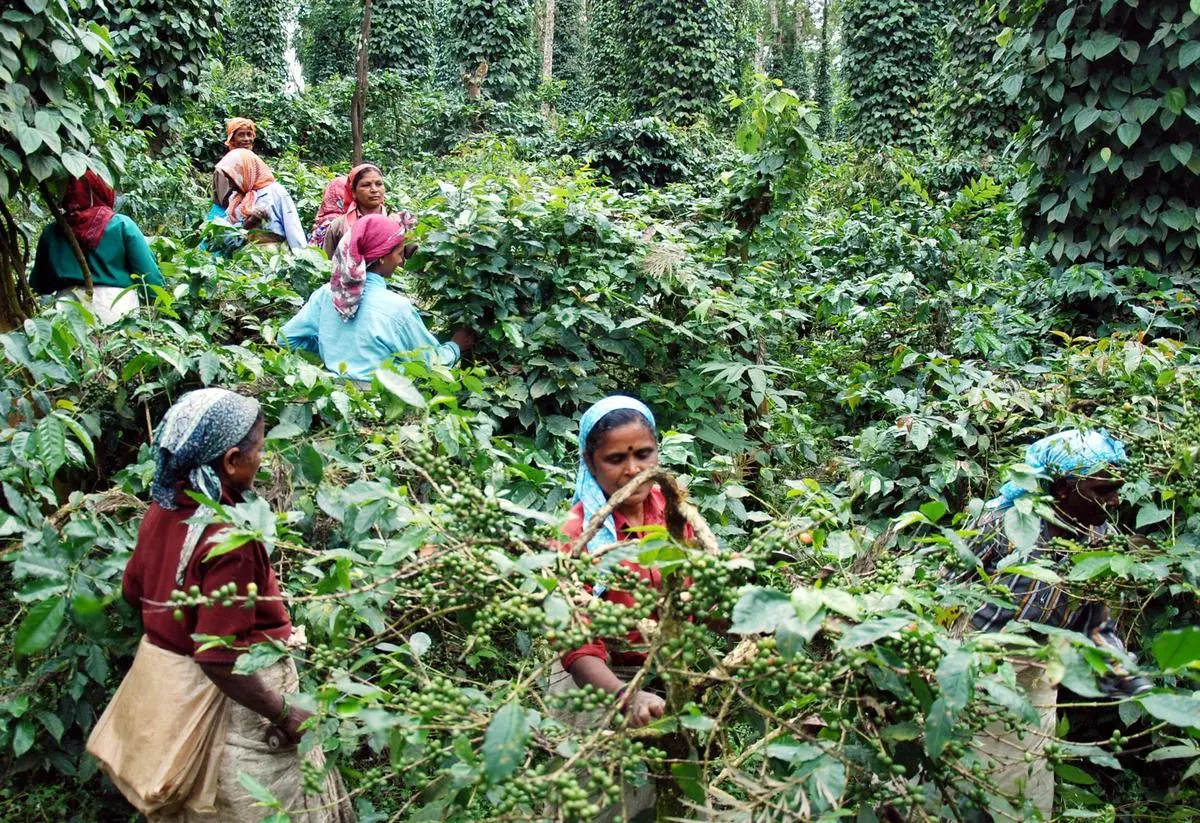
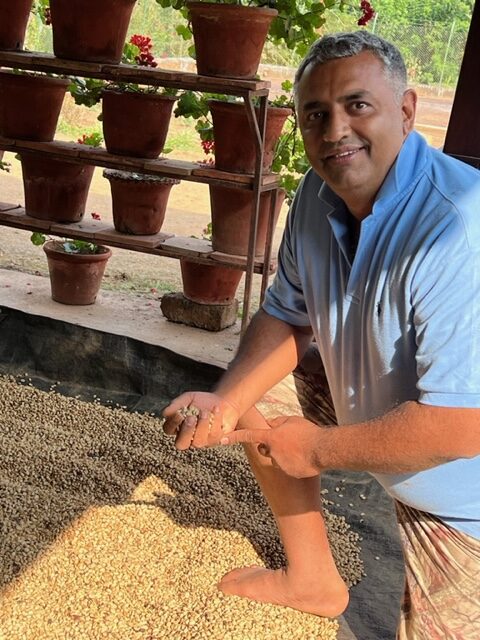
Karnataka produces about 71% of India’s coffee and Coorg in Karnataka produces 33% of India’s coffee! Coorg, a beautiful hill town is covered with acres of green, lush coffee plantations. I had to the pleasure of not just touring but also roasting and grinding my own coffee blend when I visited @fivefarms.in coffee plantation in Coorg.
I have not been exposed to Indian coffee much except when I am travelling in India. I became much more enlightened after my visit to @fivefarms.in and my meeting with Subbaiah and Ashith, partner and founders of @fivefarms.in.
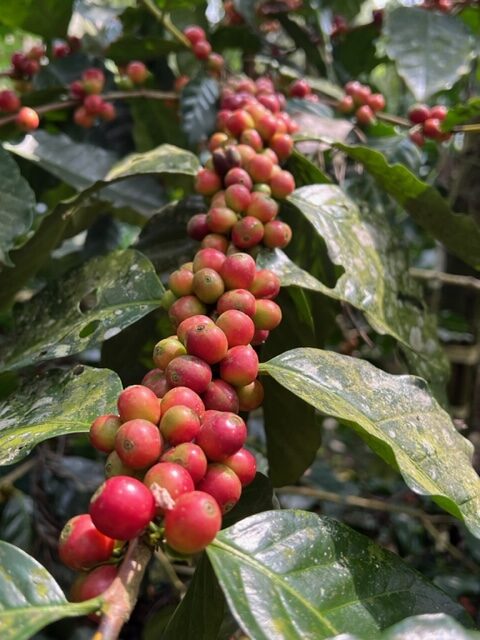
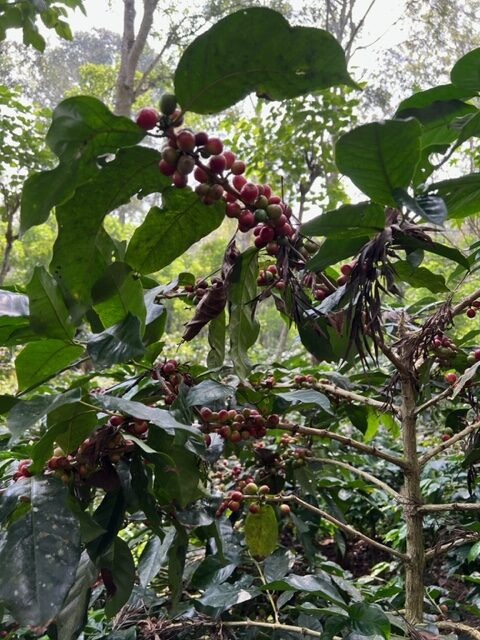
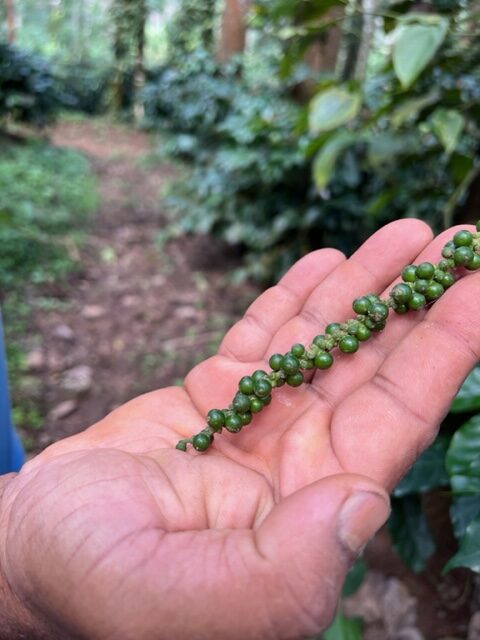
Subbaiah and Ashith stay in a 75-year-old bungalow surrounded by the Malcode coffee estate in Chetthalli Village, Coorg, Karnataka. This coffee estate produces Arabica and Robusta coffee beans and the popular #Indianblackpepper — Paniyoor black Pepper.
The husband-wife team are third generation coffee farmers and founders of fivefarms.in – one of India’s premium single estate coffee stores. Subbaiah told me that they believe in very traditional plantation skills but ensure that they apply only modern roasting and grinding techniques to their coffee beans.
They conduct Seed to Cup tours of the coffee estate. I learnt the history of how coffee was discovered and brought to India, its culture, farming techniques including harvesting, inspection of the coffee plants, and production process from its raw state.
After the tour, I had the pleasure of sampling a sumptuous lunch prepared by Ashith and her mother-in-law, ending with a cup of freshly brewed coffee!
I left the farm with about a kilogram of freshly roasted and ground coffee!! Thank you @fivefarms.in
__________________
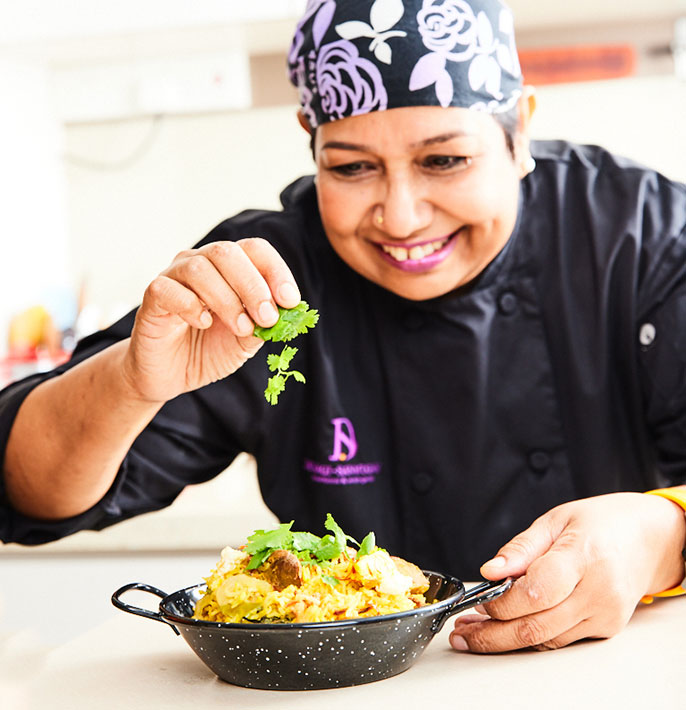
Devagi Sanmugam
As a chef, spice curator, and author of over 20 cookbooks, my life revolves around the exquisite world of food. I am deeply passionate about experiencing food in all its forms—I love to see, touch, smell, hear, and feel the ingredients that create culinary magic. Each spice tells a story, every herb evokes a memory, and the textures of food bring joy to my senses. Traveling is not just a pastime for me; it is an essential part of my journey as a culinary educator. Exploring diverse cuisines around the world allows me to expand my knowledge and understanding of food, enriching both my cooking and teaching. I revel in discovering new flavors and techniques that I can share with others, igniting their own passion for cooking. This blog is a heartfelt expression of my love for food—a platform where I can share my culinary adventures, insights, and recipes. Join me as we explore global cuisine, celebrating the beautiful and delicious experiences that food offers.