“Society can develop only with clean thinking and fair-mindedness. Do not mix politics in Dasara celebrations. When I came during last Dasara celebrations, I was the president of Handicraft Corporation. I have come now as the president of the Parishat. The Almighty has bestowed high positions on me,” said member of vidhana parishat, Shantheyanda Veena Achaiah. She was speaking after inaugurating the third year’s women’s Dasara held in Mangala Vihara auditorium, Gonikoppal on Monday, October 10.
Meanwhile, member of the legislative council, Veena Achaiah, who is identified as the best women’s Dasara performer, felicitated the former grama panchayat president and president of the third year’s women’s Dasara , Kulletira Pravimonnappa.
Rekha Sridar and Sharina Sukumar sang the prayer song. Grama panchayat member, women’s Dasara treasurer Prabhavathi welcomed the gathering. Sheela Bopanna compered the programme and chief secretary M Manjula proposed the vote of thanks.
Gonikoppa, traditional attire, flower designing, mehendi competition, cooking without fire competition, group dances, janapada songs and pick and act competitions were held at the occasion.
Pravimonnappa, president of the programme, gave a keynote address.
Meals were served at the occasion.
source: http://www.daijiworld.com / DaijiWorld.com / Home> Karnataka / From our Special Correspondent / Daijiworld Media Network – Madikeri (EP) / Tuesday – October 11th, 2016
Demand for coffee is booming in an increasingly caffeinated world, and although Myanmar is capable of producing international-quality product it has neglected the crop for years. But agricultural ministry officials are hoping to develop a coordinated strategy to ramp up production and connect cultivators with world markets.
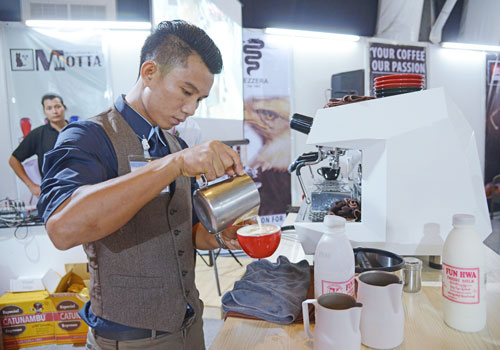
A barista competes in the Myanmar Latte Art Competition in Yangon in June. Photo: Aung Htay Hlaing / The Myanmar Times
Myanmar has been growing coffee for years but in relatively small amounts. An itinerant Scotsman brought a strain of arabica to the Mandalay hill town Pyin Oo Lwin in the 1930s, and it is still grown today, U Myint Swe, director of the coffee crop branch under the ministry’s agriculture department, told The Myanmar Times.
But the agricultural sector’s overwhelming focus has been on an industrial approach to growing crops like rice and beans for domestic consumption and export, said U Tin Htut from the Ministry of Agriculture, Livestock and Irrigation.
“Coffee was previously a neglected crop,” he said during a ministry research workshop on coffee growing in Myanmar on September 28. But U Tin Htut is hoping that ministry workshops can help produce a strategy to boost coffee production and tap into a strong global market.
The annual growth rate in global coffee consumption has averaged 2 percent since 2011, and the world consumed the equivalent of 152.2 million 60kg bags in 2015, according to the intergovernmental International Coffee Organisation.
US demand is higher than ever, and two shipments of coffee beans to the US in August represented Myanmar’s first commercial-scale exports to that country in over 15 years, according to Reuters. The US recently announced it was lifting almost all remaining sanctions against Myanmar, and would reinstate generalised system of preferences (GSP) benefits on November 13.
Myanmar is well placed to take advantage of the global thirst and improving economic relations with the US. At a US coffee expo in June 2015, Myanmar-produced strains of arabica and catimor coffees were deemed world-standard in a quality test – receiving higher marks than most other coffees shown at the event, U Myint Swe said.
“The strains have also been tested in Germany, and they also sent a report saying the quality was world- standard,” he added.
Local firms have taken advantage of Myanmar’s climate and regional demand. Yangon-based firm Coffee Genius, owned by Ko Ngwe Tun, has exported its Shan highlands coffee to Singapore and also enjoyed high marks from the Specialty Coffee Association of America.
But although Myanmar’s local industry can produce exceptional quality, it also faces production and marketing problems that have made it hard to reach international markets, U Myint Swe said.
Strains like the arabica have been grown for over 80 years, but a lack of finance has seen little in the way of progress.
“Crop yields have decreased steadily, although the quality has not,” U Myint Swe said. The useful life of a coffee plant, depending on growing conditions, is 20 to 30 years. “In other countries, once a coffee plant reaches 30 years old it is cut down and new ones planted,” he said. “But in our country we don’t cut them down, we make existing plants produce new shoots and branches.”
Although the international market is booming – driven mainly by rising consumption in developed economies – Myanmar’s local market for coffee is poor and cultivators are producing less in response, U Zaw Tun Myint, director general of the Agriculture Department, told The Myanmar Times.
The ministry wants to see coffee planted and grown according to international-standard practice, but in order to get cultivators onside the ministry has to improve the market, he added.
“We need to cooperate with the department and expand the market for growers,” he said. “Right now profits [in the local market] are low, so growers lower inputs, which lowers quality, which lowers prices and pushes profits down further. We need to reverse this vicious cycle.”
The acreage given to coffee plantations in Myanmar is shrinking and is now less than 50,000 acres – down from over 60,000 acres at the peak of production many years ago, he said.
U Tin Htut from the agriculture department’s coffee branch said collaboration between agricultural experts, exporters and planters is crucial to remedy the slump in production. He is helping work on a strategy paper for coffee development in Myanmar.
“Now is the time to really perform,” he said. Myanmar has the human resources and skills, but needs to improve the agricultural system in order to catch up with regional competitors, he added.
The coffee strategy should include targets for the next 10 years, and cover market research, finance, technical assistance, farmer training and which strains should be planted more widely, he said. The plan will be sent to a parliamentary economic committee, which includes the vice president and officials from the finance and commerce ministries, he said.
U Myint Swe said the plan will take around six months to draw up, and should involve assistance from experts from the agriculture department, USAID, the Myanmar Coffee Planting Association and other coffee experts.
But industry interest bodes well. At the ministry workshop on coffee growing last month over 40 members of the Coffee Planting Association and the private sector attended the meeting, joined by over 100 experts and officials from government departments, U Zaw Myint Tun said.
“It was the first big meeting on coffee in the last five years,” he said. “It’s a very encouraging situation. We held meetings in the past, but there wasn’t as much freedom as there is now.”
Translation by Win Thaw Tar and Khine Thazin Han
source: http://www.mmtimes.com / Myanmar Times / Home> Business / by Htoo Thant / Wednesday – October 05th, 2016
Janapada Parishat district president B G Anantashayana said that the Parishat museum and the office will soon be set up in the district.
He said this addressing the gathering at Grameena Janapadotsava folk festival in
Devanagiri in Virajpet taluk recently.
Rural art and games like Balopatt, Ummattatt, Kolata, Naropooda, Ajjappa, Tayavva, Kola, Dolpatt, Valagathatt, Ajjappa Kola, Buguri ata and Chilki were organised as part of the Janapadotsava, under the aegis of Kodagu Janapada Parishat Virajpet taluk unit, at Bairanadu Chembebeliyuru High School grounds atDevanagiri in Virajpet on Thursday.
B C High School chairman Sunil Nanaiah inaugurated the festival. Karnataka Janapada Parishat honorary secretary H R Rajegowda said that more such festivals should be held to preserve local folk art and culture.
Patron of folk art Puggera Poovamma Karumbaiah was felicitated on the occasion.
Kodava Sahitya Academy president Biddatanda S Thammaiah, Parishat district convener Meriyanda Sanket Poovaiah, Akhila Kodava Samaja president Matanda C Monnappa, Zilla Panchayat Health and Education standing committee president Mookonda Shashi Subramani were present.
source: http://www.deccanherald.com / Deccan Herald / Home> District / Virajpet – DHNS, October 10th, 2016
CRICKET / The dashing batsman confident of playing for India again
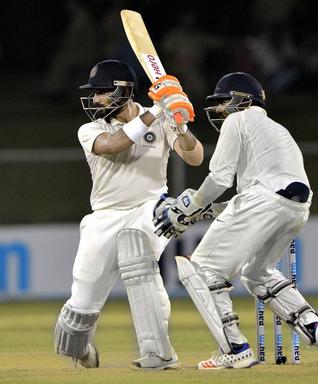
OPTIMISTIC:The prolific Robin Uthappa says he has become more consistent and feels people will take note again.— FILE PHOTO
Robin Uthappa will not seek to keep wicket for Karnataka this Ranji Trophy season, believing it is best for “team chemistry.”
The 30-year-old shared the gloves with C.M. Gautam last time around, in an effort to bolster his credentials as a keeper-batsman, but the situation was recognised as not perhaps being ideal.
“Last season was a learning for me; I understood a little more about team chemistry,” Uthappa told The Hindu here on Thursday. “The chemistry works with CM keeping. And I respect that.
“Last year, we shared the duties but this year I’m going to allow CM to keep. And I think he should keep because it works well for the team. I don’t want to disturb that. For me it was a learning and I’ve accepted that learning and grown with that.”
After two glorious years, last season ended in disappointment for Karnataka, and Uthappa felt there was an element of things being taken for granted.
“Our batting didn’t fall into place. We couldn’t get 20 wickets. The rub of the green wasn’t going our way either. Eventually we missed the knockouts by a point. We were a little lacklustre in a few games.
“When the team’s good then sometimes you take things for granted. But we want to make amends for that this season. We’ve got the hunger, the drive, and motivation,” he said.
Not a fan of neutral venues
Uthappa admitted he was not a fan of playing at neutral venues. “I’ve been playing domestic cricket for 13 years and in the last three-four years crowds are actually turning up to watch Ranji Trophy games. It is very heartening. It is healthy for domestic cricket.
“To not see that happen this year would be a bit of a lull. I don’t know if this will last. I don’t know if this is the right way to go. But some teams were playing on such bad pitches that they were forced to take this option. Hopefully, it’s not something that will last too long,” he said.
Uthappa was last called up to the Indian team in 2015 following a good IPL season but was overlooked for the ODI and T20 tour of Zimbabwe this June. He was in fine form with the bat in the Ranji Trophy last season, scoring 759 runs at an average close to sixty.
“I have been staking a claim [for an India spot] every season. But it’s up to the selectors to make that call,” he said. “Sometimes, it’s disheartening. Especially when you watch other teams, other nations playing. You feel you’re missing out. But I do believe strongly that I will play again.
“People have seen me as flamboyant but not consistent. It’s taking time for people to relate to how I play. But consistency is something I’ve worked on. Hopefully people will take note again.”
source: http://www.thehindu.com / The Hindu / Home> Sport / by Shreedutta Chidananda / Bengaluru – October 07th, 2016
If you think that the ongoing Dasara Ahaara Mela is just for foodies, you are wrong. As the venue also is a place to cure your skin diseases and other common ailments.
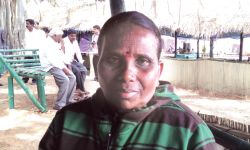
Nagamma, a nature therapist or Naati Vaidya, has come all the way from Kodagu to provide medicines to visitors. And the medicines given by her are in great demand.
She offers a variety of natural plant medicines, consultation and treats minor illnesses. She has set up her shop inside the Bharath Scouts and Guides Grounds where the Ahaara Mela is being held. So much so that she has gone back to Kodagu to bring more medicines as the stocks what she had got exhausted due to great demand.
68-year-old Nagamma is the recipient of 2014 State Janapada Award and apart from being an expert folk singer, she has innate and immense knowledge about herbal medicines that have been handed over to her by her ancestors.
At Doddabettageri in Kodagu, where Nagamma lives in a tribal hamlet, people with common ailments like stomach and tooth aches, joint pains, fever, ear-related problems and diarrhoea get treatment from her. Her fame is spread far and wide and this time, she has come to Mysuru to offer her expertise.
People who have pain in their ears, fever, hand and leg sprains and allergies flock to her stall and get cured within a day. Jademada, one of her patients, swears by her treatment and says that the illness once treated by Nagamma will never recur.
Talking about her medicines, Nagamma said that the juice extracted from Gandhari leaves cure ear pains and wax discharges in just five minutes. If a person is totally affected by allergies or acne, a juice extracted from Gali leaves mixed with garlic can be applied on the infection.
“The patient will feel a sense of relief and within a couple of days, the skin problems will be completely cured. Also, Black Tualsi available abundantly even in cities is a very good medicine,” she says.
Nagamma is an expert in folk songs as well. Any special occasion within her tribe, she does not fail to sing, soothing the listening ears with her voice. Ganga puja, a prominent ritual in her tribe’s weddings is incomplete without Nagamma singing “Ondele ondadike, ondu gandhada bottu namma sastra…” She sings various folk songs throughout the rituals and continues even after that to entertain guests. Nagamma has also sung Sobane Padha for Akashavani and has gained a lot of praises.
“In my tribal hamlet, I treat hundreds of patients without even charging a single rupee. I have learnt about natural medicines, leaves, barks and roots from my forefathers. Now I am teaching the same to my daughter,” she says with a smile.
source: http://www.starofmysore.com / Star of Mysore / Home> Feature Articles / October 05th, 2016
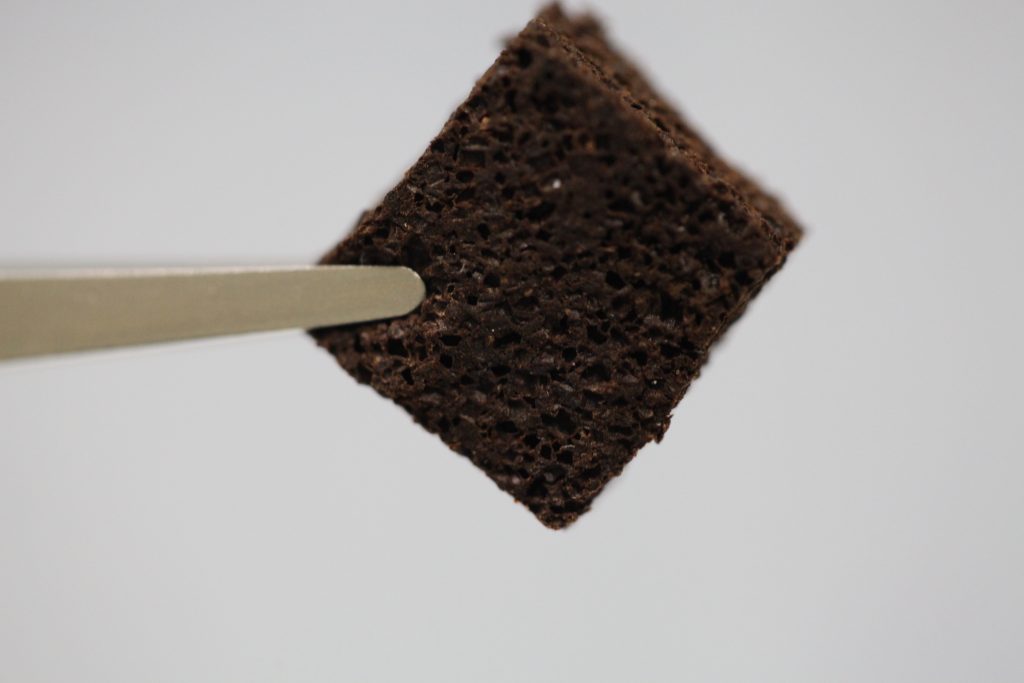
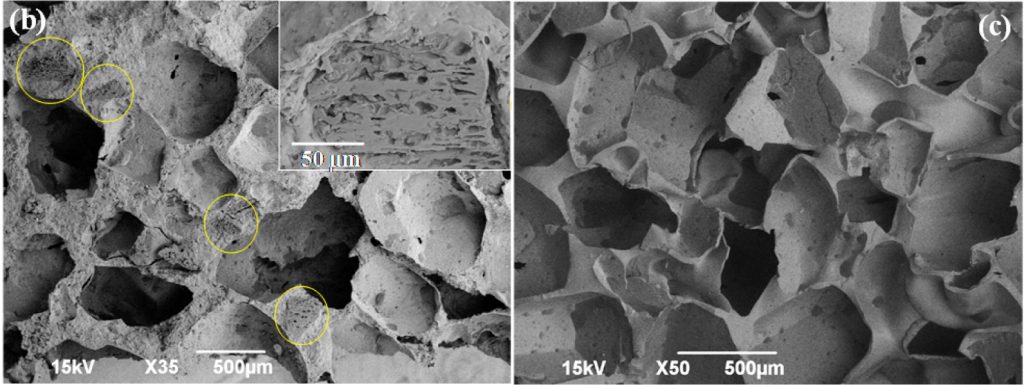
This coffee-infused bioelastic foam can filter lead from water. Photo by Chavan et al., ACS Sustainable Chem. Eng., 2016
Tune in tonight on PBS NewsHour where Miles O’Brien will look at the hazards and history of lead as part of his Leading Edge series.
Needless to say, humans have a coffee obsession.
Last year, global coffee consumption weighed in at 10 million tons — or one and half Great Pyramids worth of beans ground into caffeinated oblivion. Now, a lab at the Italian Institute of Technology wants to put those discarded grounds to good use.
The team has engineered a coffee grounds-infused foam that removes hazardous metals, like lead, from water. Though still in its prototype phase, this foam might be able to clear the worst levels of lead contamination found in places like Flint, Michigan, within a few hours.
“The proposed method is cheaper [than current large-scale filtration systems], since it uses principally costless waste,” said IIT physicist Despina Fragouli who led the project. “and more sustainable compared to other systems, where synthetic materials are used.”
The idea isn’t entirely new. Scientists have known for years that coffee contains chemical groups — called carboxylates — that stick to metals. Early attempts at this water remediation concept tried smashing the coffee grounds into a fine powder, which was then mixed into lead-tainted water. The toxic metals bind the powder, and together, they are filtered out of the water. But this procedure is a bit redundant — you need a filter for a filter.
Fragouli and her colleagues simplified this process by chemically infusing the coffee powder onto a elastic foam. The final spongy foam is 60 to 70 percent coffee by weight.
Left panel: Bioelastic foam with the spent coffee powder indicated by the yellow circles and the inset. Right panel: Pure elastic foam without coffee powder. Photo by Chavan et al., ACS Sustainable Chem. Eng., 2016
“Both the coffee and the heavy metal ions are entrapped in the foam,” Fragouli said of her findings published in ACS Sustainable Chemistry and Engineering. “Therefore, no additional procedures are required for the removal of the [coffee] adsorbents and the pollutants from the water.”
So, a water official would simply pull the foam from the water to take out the metal toxins. The rate of removal depends on how much lead is in the water. If Fragouli’s team started with water containing nine parts per million of lead — 360 times higher than most common amount found during the Flint water crisis — the foam could remove a third of the contamination in 30 minutes.
Though promising, Fragouli said more research is needed to determine if the foam can obtain lead and mercury levels appropriate for drinking, especially with gunky water flowing through real-world pipes. So far, the sole field test occurred with wastewater from the IIT’s chemistry department, which contained a mixture of metal ions.
“The results show that the metal ions of interest can be effectively removed,” Fragouli said.
source: http://www.pbs.org / PBS Newshour / Home> The Run Down> Science / by Nsikan Akpan / September 28th, 2016
The aptly named Folksy Food in Madikeri proves that often canteens serve genuine local fare
Although I’ve written about Indian food for 20 years, I’ve never been on a jury to crown the best restaurant in India. Perhaps that is a good thing. For if I were to put together a top list, it’d be full of no-frills joints that other food critics would look down their noses at.
Café Military would be in my top 10 — down the road from the Bombay Stock Exchange, a place where one spots brokers hogging comfort food such as dhansak or brain at the end of a bad market day. Also Yaseen Hotel on the corner just south of the Jama Masjid in old Delhi: their sign ‘good taste, cheap and best, all Mughlai dishes are served by hygienic environment’ says all that needs to be said.
My list of 10 would include homely places that consciously promote local food such as Kewpie’s, started by a Bengali cookbook author in Kolkata, Dalema in Bhubaneswar that dishes up Odisha for you, Gateway Paradise’s Assamese thali in Guwahati, the fish biryani at old Paris Hotel in Thalassery, and the seafood thali at Anantashram in Margao which is far from the touristy beaches of Goa.
As for best veg, any khanavali in Dharwad would qualify for its robust and hearty jolada roti with delicious badanekaayi yennegai — eggplant curry. The top list cannot ignore drinking dens like the surprisingly unknown Mangalorean bar Royal Garden on the Outer Ring Road in Bengaluru (near Hebbal Flyover), which never fails to amaze with its spicy fresh crabs and creative snacks like tandoori mushrooms stuffed with Amul cheese.
But at the top of my list, I’d put the aptly named Folksy Food in Kodagu, because having visited time and again for my regular fix of Kodava cooking, I’ve never once felt disappointed at the end of a meal.
It’s a tiny place in a nondescript shopping complex in Madikeri town — and with four tables it serves at the most 16 people at a time, typically office-goers in need of affordable lunches. Unlike restaurants patronised by tourists that showcase ‘foods of Coorg’ where chilli and oil are ladled on to satisfy undiscerning palates, here the fare feels 100 per cent wholesome and satisfyingly ‘tasty’.
Also, the menu isn’t pretentious or long-winded — in fact there is no printed menu at all. Apart from the basic veg meal, there are just four non-veg items subject to availability: mutton, chicken, fish and, of course, pork (the Kodava national dish).
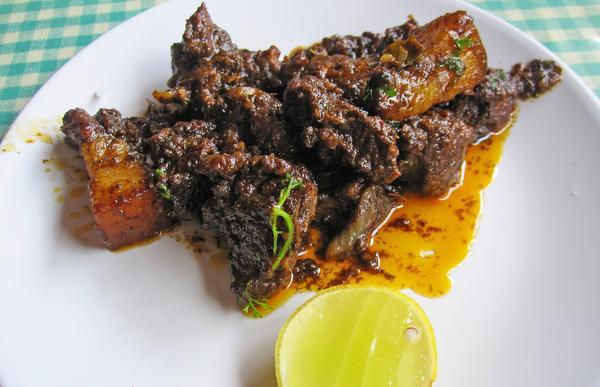
Meaty role: Pork curry at Folksy Food comes in a peppery semi-gravy, with the local black vinegar kachampuli giving it a distinctive tang. Photo: Zac O’Yeah
Yesterday, I shared a meal with my wife and we polished off two bowls of rice; a house speciality called koot curry which is a local dish similar to sambar, but milder and loaded with succulent veggies of the season such as Mangalore cucumber; the loveliest of rasams with the right amount of jaggery in it to offset the pungency; a dry dish of curried bhindi; fried fish; pork (half plate); and chicken (half plate), which altogether totalled ₹300.
The rice at Folksy Food is always light and fragrant, freshly steamed, and the veggies are delicately prepared — nothing like the greasy mushes and dry rice that are all too frequently passed off as vegetarian cookery in budget restaurants — while the tender pork morsels, with a few chunks of the fatty stuff mixed in, are fried in a peppery semi-gravy, the local black vinegar kachampuli giving it a distinctive tang. The chicken is another speciality; richly coated in a pungent masala, the meat simply falls off the bone. The plump mackerel, the most favoured fish locally, has a crispy outside with a hint of coconut oil, and each bite melts in the mouth. Any day at lunchtime (closed on Sundays and public holidays) there are a large number of eager eaters, so it isn’t much of a place to linger on at. Also, there are no desserts, coffee or brandy that might make you want to loiter after you’ve licked off the last specks of gravy from your plate. But the family who owns it are chatty and cheerful folks, so it isn’t one of those brusque eat-and-go affairs either. More likely it is the envious face of some guest-in-waiting — hoping to score a table — that eventually makes you stop licking plates.
It must be added for the protocol that I’ve nothing against five-stars and never say no to a lavish repast (especially if somebody else is footing the bill). But thanks to my peripatetic lifestyle, I’ve found that the best canteens showcase genuine local cuisine, as close to home-cooking as it gets — and the simpler the eatery, the more dependable the eating experience, and vice versa.
So if Folksy Food was in, say, France and did exactly the same thing and as consistently as it does but in French, it would be written about in guidebooks and perhaps have a Michelin star. But despite being located in a popular tourist area, Folksy has stayed off the foodie radar.
It is perhaps for the better as such a tiny eatery couldn’t handle an onslaught of gourmets flying in from across the globe. Maybe I am making a mistake by writing about it, but I trust you to keep the secret. Further, if you know of a fantastic but largely unknown canteen devoted to homely food anywhere in India, please share all details with me.
Zac O’Yeah is a part-time travel writer and part-time detective novelist; zacnet@email.com
source: http://www.thehindubusinessline.com / Business Line / Home> BLINK> Tummy Travels / by Zac O’Yeah / October 07th, 2016
The cultural programmes on account of Madikeri Dasara Janotsava was inaugurated by Deputy Commissioner Richard Vincent D’Souza on Monday evening.
The cultural programmes will be held for 9 days. The DC said Madikeri Dasara is also known across the country. “The speciality of Navarathri Utsav is that development should be carried forward overcoming all evil forces. In spite of having all the facilities, people lack peace of mind. There is lack of unity. All of us should strive for peace and harmony in society through unity,” he added.
“In the era of internet, we have forgotten our own rich cultural legacy. The festivals help in preserving the culture and tradition of the land,” he felt.
CMC Vice President T S Prakash said there is a need to create awareness on Karaga of Shakthi Devathas which are taken out a procession in the city on all the nine days of Dasara.
A team of Natya Mayuri Nritya School presented a variety of cultural programmes. Green Mountain College team presented a variety of dance and Karagata. Dance by Bhairavi troupe from Bengaluru enthralled the audience.
Empty chairs
Though cultural programmes unraveled a ‘cultural world,’ the lack of audience dampened the spirit of the artistes.
Expecting a huge gathering, the cultural programmes were inaugurated late. However, empty chairs welcomed the artistes.
Sports meet in Madikeri
The district-level Dasara sports meet, to be organised as part of Dasara Janotsava, would be inaugurated on October 5.
Briefing mediapersons, Dasara Sports Committee President M D Sada Muddappa said Additional Deputy Commissioner M Sathish Kumar would flag off a marathon at General Thimmaiah Stadium. The district-level men’s Kabaddi will be held on October 8. National Hockey player Nudumanda Nisha Nanjappa would be inaugurated on October 6, he added.
The marathon competitions would be held in six categories — first standard to third standard students (1-km), fourth and fifth standard students (1.5-km), sixth and seventh standard students(2-km), eighth to 10th standard students(5-km), men (10-km) and for women (5-km).
On October 6, competitions like throwball for women, football (five players in each team), for men, 100 metre race for senior citizens would be held in addition to slow motor cycle race, race and shotput for journalists and CMC members. For details, contact 9448325904.
source: http://www.deccanherald.com / Deccan Herald / Home> District / DHNS – Madikeri, October 04th, 2016
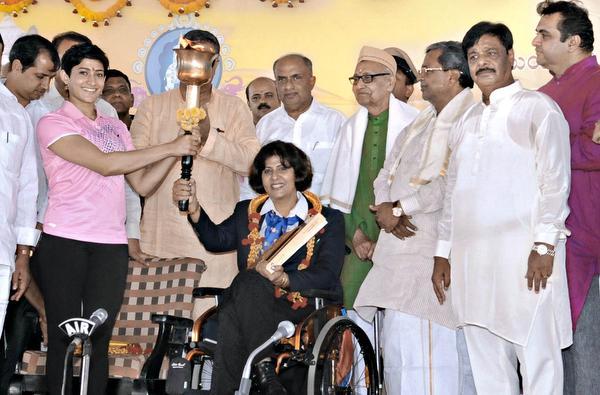
Olympian Ashwini Ponnappa and Paralympian Deepa Malik holding the Kreeda Jyoti during the inauguration of Dasara in Mysuru on Saturday.— PHOTO: M.A. SRIRAM
The Kreeda Jyoti was lit and handed over to Olympian Ashwini Ponnappa at the Chamundeshwari temple atop Chamundi Hills on Saturday.
Ms. Ponnappa, along with other athletes, ran for a distance before handing it over to veteran athletes. The athletes then installed the torch at the Chamundi Vihas stadium where the Dasara sports events were being held.
As many as 22 games have been organised for this year’s Dasara. Over 8,000 sportspersons will be taking part. Paralympic Deepa Malik and Ms. Ponnappa jointly inaugurated the sports event later at the stadium.
The half-marathon will be held on October 2 and October 9 and over 500 people have already registered for the event.
Earlier, Ms. Ponnappa and Ms. Malik were felicitated by Chief Minister Siddaramaiah.
source: http://www.thehindu.com / The Hindu / Home> National> Karnataka / by Staff Correspondent / Mysuru – October 02nd, 2016
International Coffee Day was celebrated in Kodagu by giving piping hot coffee to tourists at Dubare elephant camp.
Representatives of 77 nations are members of the International Coffee Association and the Coffee Day is celebrated worldwide to promote coffee sales on par with prouction.
Woman folk took the lead in coffee awareness programme. Kodagu deputy commissioner R V D’souza inaugurated the coffee show. He said Kodagu produces the best quality coffee while stressing the need for better marketing.
Madikeri DFO Edukondalu opined that such awareness campaigns will help increase coffee consumption.
Senior scientist from Appangala Research Station Dr. Ankegowda said coffee is a healthy drink and many researches have proved it.
Convener of the women team of coffee awareness campaign Chitra Subbaiah announced that more and more awareness campaigns will be conducted in coming days. She appealed to the tourism department to provide Kodagu coffee to tourists who visit the district.
Several coffee products were exhibited during the coffee festival. In Madikeri also several organizations served coffee to tourists at Raja Seat.
source: http://www.timesofindia.indiatimes.com / The Times of India / News Home> City News> Mysore / TNN / October 03rd, 2016
WELCOME. If you like what you see "SUBSCRIBE via EMAIL" to receive FREE regular UPDATES.
Read More »