45 lakh released for Kodava Sahitya Academy: Appachu Ranjan
MLA dancing to the tune of music of Kodagu, Kodava Sahithya Academy President and ZP members engaged in retransplatation of seedlings, Taluk Panchayat members ploughing the field, running race with a dog, tug of war and marshy field race… These were the scenes at ‘Male habba’ organised by the Karnataka Kodava Sahithya Academy in the field of Mukkodlu Hotteyanda S Thimmaiah in Madikeri Taluk on Sunday.
The habba was inaugurated by MLA M P Appacchu Ranjan. Amidst the greenary of the nature, the villagers actively took part in ‘Male habba.’
Irrespective of caste, creed and age, all took part in the competitions. On a whole, it was reflecting the Kodava culture, tradition and agriculture activities.
MLA M P Appacchu Ranjan, Kodava Sahithya Academy President Rani Machaiah, ZP Member B C Neelamma, TP Member Napanda Ravi Kalappa and others were taken out in a traditional procession.
Speaking on the occasion, the MLA said that it was good to see that Male Habba is being organised by uniting all the villagers. “The tradition and culture of Kodavas should be passed on to the future generation and Male Habba will help in showcasing the rich culture of Kodavas.”
Race, dancing and having meals together was the speciality of the ‘Male habba.’
The MLA said a sum of Rs 45 lakh was released to Kodava Sahithya Academy. Public should join hands with the Academy in preserving the Kodava language, culture, tradition of the land.
Academy President Rani Machaiah said additional grants are being released to the Academy, which helps the Academy in organising several programmes. The Academy will bring out a CD to showcase the rich Kodava culture to the future generation.
source: http://www.deccanherald.com / Deccan Herald / Home> District / Madikeri – DHNS / August 08th, 2010
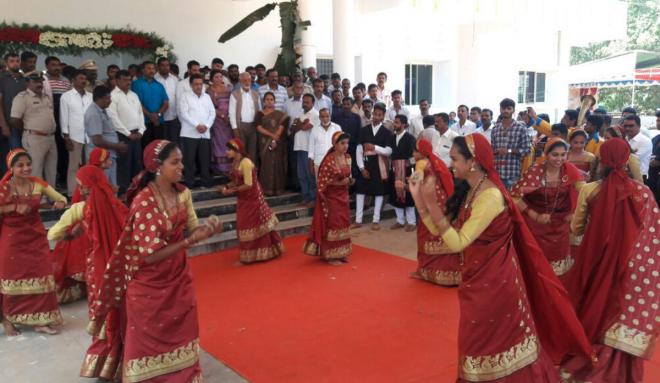
Kaveri College students present cultural programme, during the inauguration of mini Vidhana Soudha, at Virajpet on Sunday.
District in-charge minister M R Seetharam called upon the students to develop a scientific temper.
Speaking after inaugurating the mini Vidhana Soudha at Virajpet on Sunday, he said, “Public should exert pressure to accelerate public works, which are moving at a snail’s pace. A lot of development works have been initiated after the Siddaramaiah-led government came to power in the state.
Title deeds
The taluk authorities had received 3,900 applications seeking title deeds. Already, 2,459 title deeds have been distributed. The remaining will be distributed within 15 days.
The minister distributed title deeds to 121 beneficiaries on the occasion.
The students of Kaveri college presented cultural programmes as well.
BJP boycotts
The inauguration of mini Vidhana Soudha was scheduled at 11 am. As the minister arrived late, the programme started at 12.45 pm. BJP elected representatives, who had arrived on time, boycotted the programme citing they had other engagements.
Reacting to this, Seetharam said, “Politically-motivated behaviour does not speak well for anyone. Two programmes were fixed at 11 am. After taking part in a programme at Madikeri, I arrived at Virajpet.”
source: http://www.deccanherald.com / Deccan Herald / Home> District / DH News Service, Virajpet / February 18th, 2018
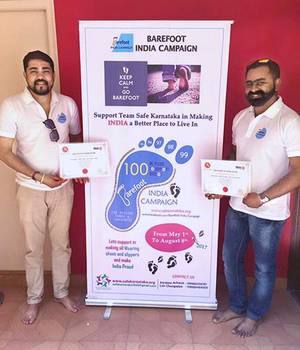
Joyappa Achaiah and Lim Changappa have started a campaign to ensure that the poor are able to walk safely.
Bengaluru duo roughs it out to convince people to donate footwear
It was not a barefoot beach holiday. When Joyappa Achaiah and Lim Changappa, both 36, doffed their footwear and walked to work for 100 days from May to August, they were keen to make a point.
A large segment of the population, they say, cannot afford footwear. This, despite India being the second large producer in the world. The Bengaluru-based entrepreneurs came up with the Barefoot India Campaign to drive home the message, that the poor should be able to walk safely. A month-long footwear collection drive has begun in Bengaluru as part of the effort, from September 3.
‘Essential gear’
On what motivates them, Mr. Achaiah said, “We’ve been doing multiple drives to educate the girl child, and on women’s safety and environment protection. But these are initiatives that a lot of other NGOs have also taken up. We thought about the one thing that everyone needs, which is footwear. It’s not just part of attire, but essential protective gear.”
Before launching the campaign, they visited villages and slums and spoke to people about what they needed the most. “More than money, they highlighted the difficulty of walking without cover for feet. More than 10% of the poor in the State cannot afford footwear. We want to help them,” said Mr. Changappa.
The activists decided to convince by example, and took up the 100-day no-footwear challenge.
For the collection drive, cardboard boxes are being kept in public locations like ITPL, Manyata Tech Park, Embassy Golf Links, Forum Mall and Phoenix Mall, and in colleges. “People can drop their used pairs,” he said.
Those in good condition will be distributed directly, and the rest, refurbished.
The entrepreneurs have petitioned the Karnataka government to initiate a ‘Padharaksha Bhagya’ programme to supply footwear to 10 lakh needy people. A marathon in November and a shot at a Guinness record with a 100 ft rangoli of a bare foot are on the cards.
source: http://www.thehindu.com / The Hindu / Home> News> Cities> Bengaluru / by Sarumathi K / Bengaluru – September 03rd, 2017
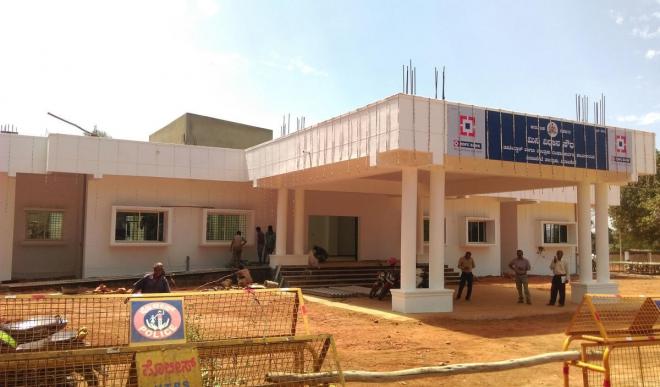
The first phase of the Mini Vidhana Soudha in Virajpet has been completed and will be inaugurated on Sunday.
With this, the long-pending demand of the people in the taluk will be realised. The first phase of the work was taken up at a cost of Rs 2 crore. It has seven rooms including the tahsildar’s court and toilets.
In the second phase, two-storeys will be built. A proposal for Rs 6 crore has been submitted to the state government. With the completion of the first phase of the work, the taluk office, sub-treasury, Department of Survey will be shifted. Once the second phase of the work is complete, entire Revenue Department of the taluk will function under one roof, according to officials.
The mini Vidhana Soudha for Virajpet was sanctioned way back in 1997. A committee was constituted to decide on the place for the Vidhana Soudha. Though there was a demand to build the Soudha at Ponnampete or Gonikoppa, it was decided to construct it at Virajpet keeping in mind the convenience of the citizens.
It was said that three years were spent on identifying the land. As suitable land was not available it was decided to construct it in a place where the old taluk office existed. The old building was demolished to facilitate the work on the Vidhana Soudha.
Accordingly, PWD invited e-tender for the work. Two contractors who had taken up the work left the work halfway. Later, once again tender was invited in 2013. Owing to a shortage of sand, and change in contractor, the work was further delayed.
District-in-charge minister M R Sitharam will inaugurate the Mini Vidhana Soudha, while MLA K G Bopaiah will preside.
With the completion of the first phase work, the offices will start functioning from mini Vidhana Soudha from March itself, said tahsildar R Govindaraj.
source: http://www.deccanherald.com / Deccan Herald / Home> District / DH News Service, Virajpet / February 17th, 2018
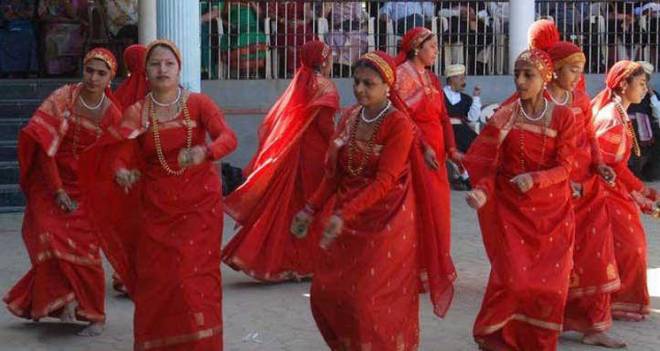
GRACEFUL: Kodava women perform Ummathat dance at the Kodava Samskrutika Mela at Napoklu in Kodagu on Monday.
Karnataka Kodava Sahitya Academy president Rani Machaiah on Monday called upon the Kodava-speaking groups to foster the unique Kodava culture to perpetuate it for posterity.
She was addressing a gathering at the Madikeri taluk Kodava Samskritika Mela (Kodava cultural convention) held at the Napoklu Kodava Samaja premises in Madikeri taluk, an official release said here.
The academy had been doing its best to preserve the unique Kodava culture by organising various cultural programmes across the district, she said. The Virajpet taluk convention would be held in Birunani on February 7 and in Somwarpet taluk in March, Ms. Machaiah said.
The traditional Bolakkat dance was inaugurated by Neriyandammanda Prabhu, Ummathat by Ikolanda Dotty Aiyappa, Kolatt by Mechira Ravishankar Nanaiah and Kodava song competitions by Boppanda Bollamma Nanaiah.
The former president of the Academy Bacharaniyanda P. Appanna presented a paper on the history of Nalnad area, comprising Napoklu and surrounding areas, at a seminar later.
There were five taluks in Kodagu in 1834 and several ‘nads’ (nad is a group of villages), he said. However, they had undergone geographic changes, Mr. Appanna said.
There were 26 villages in the Napoklu nad. The credit of preserving the Kodava culture should go to Napoklu nad, he added.
Mr. Appanna remembered the contributions of Kodavas of the past to nurture Kodava culture such as Appachira Mandanna, Kaliyatanda Ponnappa, writers such as Appaneravanda Appacha and Nadikeriyanda Chinnappa, all of whom hailed from the Nalnad area (Napoklu and surrounding areas).
Biddatanda Ramesh Chengappa, vice-president of the Napoklu Kodava Samaja, presided over the function.
Writer Moovera Rekha Prakash spoke on the history of Cauvery on the occasion.
source: http://www.thehindu.com / The Hindu / Home> National> Karnataka / by Staff Correspondent / Madikeri – February 01st, 2011
Arabica coffee helps both farmers and wild birds in the Ghats.
Coffee lovers may be discerning about their sweet arabica brews and the bolder robusta ones, but both types help maintain the diversity of wild birds in the Western Ghats. One, a little more than the other.
Arabica grows under the deep shade of native trees, with benefits for both farmers and birds. The surprise is that Robusta, also grown under native shade, is not far behind in the Ghats, unlike in other parts of the world.
These insights from a group of researchers were published in the journal Scientific Reports.
Native trees are cut down to grow robusta, in order to give it more sunlight, earning this coffee the tag of being inhospitable to wildlife. In Vietnam, for instance, full-sun coffee growth occurred at the expense of native trees. India too has leaned towards robusta: between 1950 and 2015, planted area under robusta grew by 840% while arabica grew by 327%.
Scientists from the Wildlife Conservation Society (WCS-India) and USA’s Princeton University compared bird diversity in 61 arabica and robusta estates across Chikkamagaluru, Hassan and Kodagu districts in Karnataka.
Some surprises
What they found is that the plantations supported 79 species of forest-dependent birds in all, but arabica estates hosted twice the number of endemic birds than robusta. They also supported more birds that depend on forests, and eat fruits, insects and other food. Interviews with 344 coffee-growers showed that arabica was more profitable, with returns of around ₹1 lakh per hectare.
Yet, surprisingly, robusta plantations also hosted high bird diversity. “To our surprise, robusta agroforests had much higher diversity of birds that are specifically adapted to the habitat than we expected,” says scientist Krithi Karanth of WCS-India, who led the study.
Since robusta farmers in the Western Ghats retain native trees, they have been able to preserve the complex canopy structure, setting them apart from others worldwide, says Ms. Karanth.
“Though the current selling rate for robusta is only around ₹3,000 for a 50-kg-bag, it is easier to grow,” explains Suresh M. D., who owns a one-acre coffee plantation of both coffee types.
source: http://www.thehindu.com / The Hindu / Home> Sci-Tech> Environment / by Aathira Perinchery / Kochi – February 16th, 2018
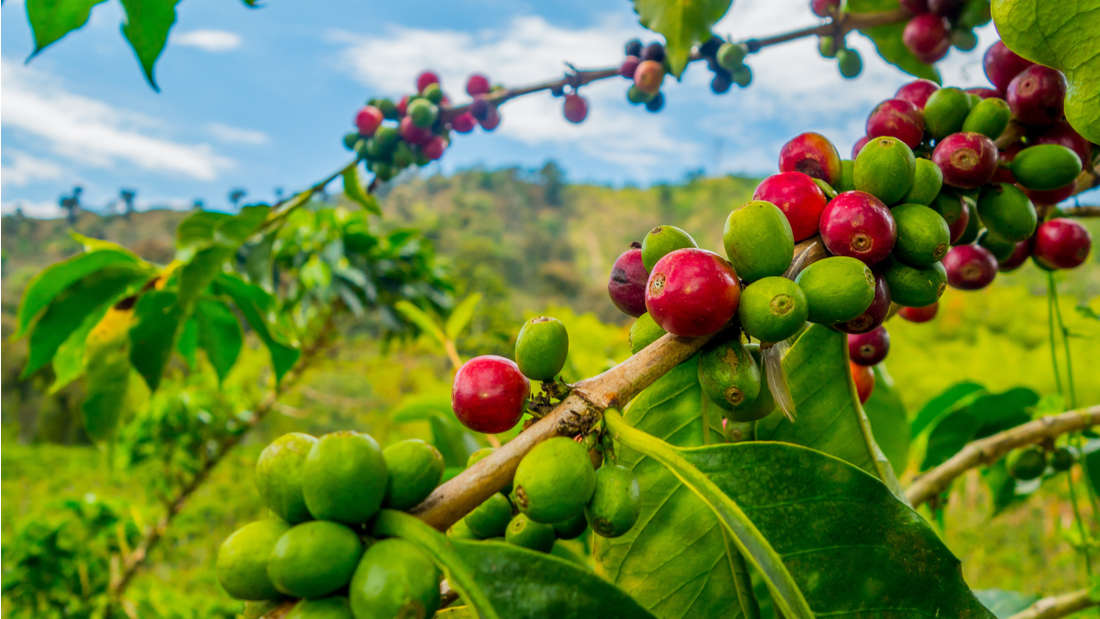
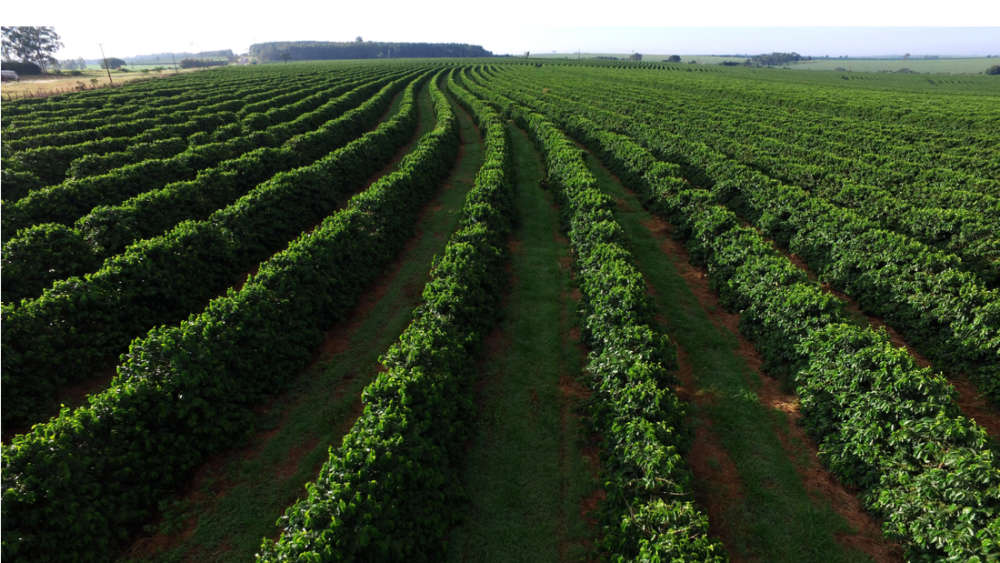
Coffee berries that contain the life-giving bean (seed) inside / Foto 5533 – Shutterstock
Any truly environmentally conscious coffee drinker has fretted over the massive commercial agriculture systems required for each lovely cup to appear in their waiting hands. The land-use impacts are especially hard to swallow because the bean-producing shrub grows best in tropical ecosystems – beautiful regions home to some of nature’s most fascinating creatures.
Most well-meaning connoisseurs thus exclusively consume coffee produced by the arabica variety, a shade-tolerant species that happily grow within an existing forest environment, over the other main variety, robusta, the cultivation of which usually involves clearing native trees and understory plants in order to give the coffee bushes the bright Sun and open space they desire. Given that arabica beans can be farmed using sustainable methods and they taste better than robusta, one would think that the case is closed. Unfortunately for wildlife, however, robusta dominates the worldwide coffee market because it is both cheaper and easier to grow.
According to research led by the Wildlife Conservation Society, the rising demand for coffee since 1990 has led to a 150 percent increase in coffee farmlands in India. The majority of these new farms are located within the Western Ghats (one of the Earth’s top eight biodiversity hotspots), and the growers are overwhelmingly choosing robusta.
The team’s paper, published in Scientific Reports, set out to determine how the area’s tropical forests are responding by surveying the bird species present at 344 family-owned coffee plantations. Because birds are known to be a reliable indicator of overall ecosystem vitality, the researchers expected to find that arabica farms host far more birds and a richer variety of species.
Surprisingly, they found instead that robusta plantations are actually home to a higher density of forest-specialist flocking birds, including many fruit-eating species that plants and trees rely on to disperse their seeds. The distribution of threatened species also appeared equal between the two farm types.
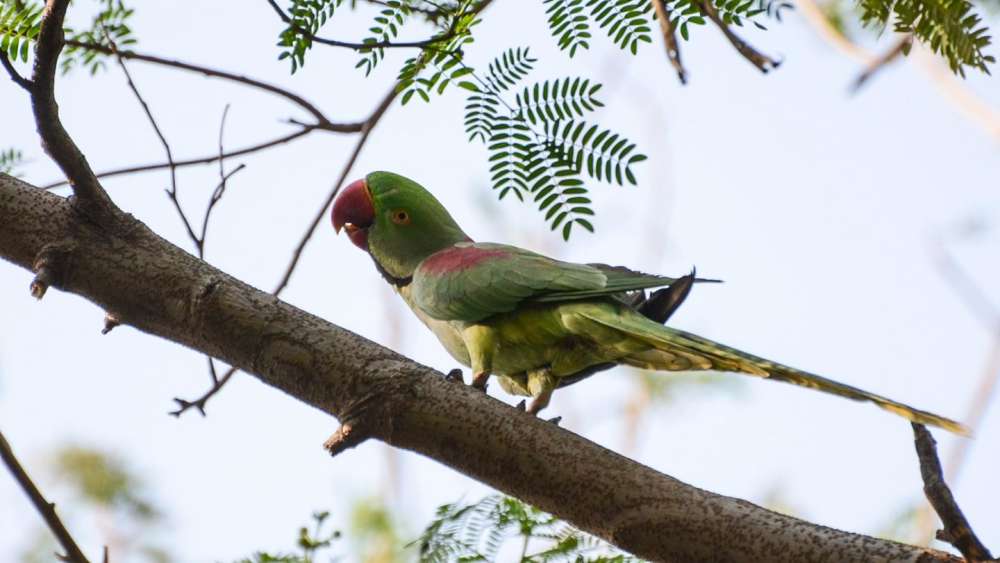
The threatened Alexandrine parakeet was found on both types of coffee farm. Photo credit Manish Kumar
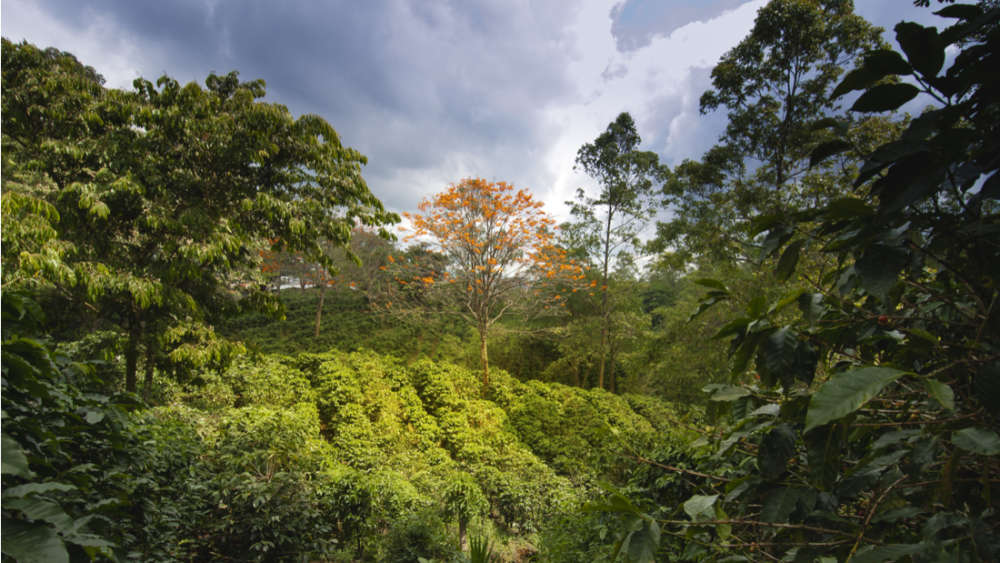
On the other hand, arabica farms did have greater numbers and varieties of forest-dwelling individual birds that are only found in the Western Ghats area. Several of these species are known to be the first to disappear when a habitat is modified, suggesting that although robusta farms are not necessarily as bad as we thought, arabica growing conditions remain more favorable. A shaded arabica farm in Costa Rica. Erkki & Hanna/Shutterstock
Few previous studies have directly compared the ecosystem impacts of arabica vs robusta, but just glancing at photographs of each type of farm leads one to believe that there’s no way that the average robusta growing operation has anything to do with the word “sustainable”.
A robusta farm in Brazil. Paulo Vilela/Shutterstock
So, what are the Indian farmers doing differently than the rest of the world?
The authors observed that though most farmers in Western Ghats used conventional (non-organic) fertilizer, only 19 percent of robusta growers also used pesticides compared with 75 percent of arabica farmers – likely due to the fact that the robusta variety is naturally hardier against attack from insects and mold.
In addition, these robusta growers kept way more native trees than growers in other areas.
“In fact, the surveyed robusta agroforests possessed canopy and forest cover three times higher than shade-grown coffee farms in Indonesia,” the authors wrote.
They conclude that the results are not just good news for the birds. Several types of once-lowbrow robusta now fetch market prices that are close to those of arabica, and the farms studied suggest that competitive crop yields are possible without relying on intensive farming methods. Adding this together means that the Western Ghats farming model could provide a sweet spot for the coffee industry: Efficient, profitable, and sustainable.
source: http://www.iflscience.com / IFL Science / by Aliyeh Kovner / February 19th, 2018
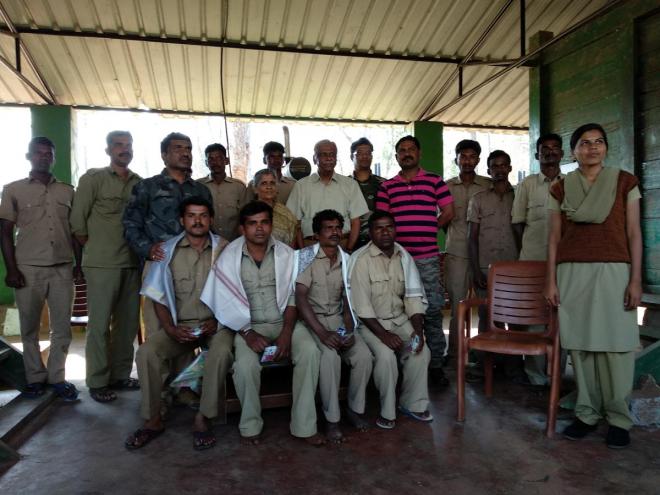
Mahout Vasantha and Gundu and kavadis Jaibal and Ravi being felicitated by retired secretary for forests A C Lakshmana and his wife Savithri at Mathigodu Elephant Camp, in Virajpet taluk, Kodagu district, on Wednesday. ACF S R Prasanna Kumar, RFO Y K Kiran Kumar and veterinarian Dr Mujeeb ur Rehman are seen.
In recognition of their services, mahouts Vasantha and Gundu and kavadis Jaibal and Ravi were felicitated by retired secretary for forests A C Lakshmana at Mathigodu Elephant Camp in Virajpet taluk, under Nagarhole National Park, on Wednesday.
It has to be recalled that Jaibal and Ravi, caretakers of elephant Drona, successfully took part in the operation to rescue a rogue elephant at Nagavara in Alur taluk, Hassan district, recently. Another elephant, Gopalaswamy, from Veeranahosahalli camp had taken part in the operation.
Jaibal and Ravi could complete the operation even though Drona was attacked by the rogue elephant, which was in ‘mast’. “Drona was injured but he recovered in a few minutes and joined Gopalaswamy to complete the operation,” Jaibal said.
Vasantha is the mahout of Abhimanyu, the star trouble shooter. Vasantha said, “Abhimanyu has taken part in 30 operations to rescue rogue elephants in Hassan district alone. He has taken part in various elephant rescue operations across India whenever there was a man-animal conflict. Besides, he was instrumental in rescuing seven tigers. When my father Sanappa was his mahout, Drona had rescued 12 elephants in Madhya Pradesh,” he said.
Assistant Conservator of Forests S R Prasanna Kumar said Vasantha was also on a 10-day tour to Indonesia, along with Nayaz from Dubare camp, to train the elephant caretakers in that country.
A C Lakshmana said that elephants are the most intelligent animals on earth and their caretakers understand them well and train them accordingly. “The services of the elephant caretakers to the Forest department in tackling man-animal conflict and in conserving the nature is commendable. They work under adverse conditions. So, it is our responsibility to recognise their services,” he said.
He said that even though there is a general feeling among the people that ‘kheda’ (operation of rescuing elephants) has been stopped, only ‘kheda’ as a sport has been stopped. “The last kheda as sport was held at Kakanakote forest in 1972, and in 1962, even then President Rajendra Prasad was witness to ‘kheda’. However, all rescue operations of elephants, during man-animal conflict, are similar to ‘kheda’. Now, the officials have the option to use tranquilisers in case the operation becomes difficult,” he said.
Range Forest Officer Y K Kiran Kumar said, till recently, there were 38 elephants in Mathigodu camp, but four of them have been given to Chhattisgarh while another four have been shifted to nearby camps, where availability of fodder is adequate.
source: http://www.deccanherald.com / Deccan Herald / Home> District / DH News Service, Mysuru / February 14th, 2018
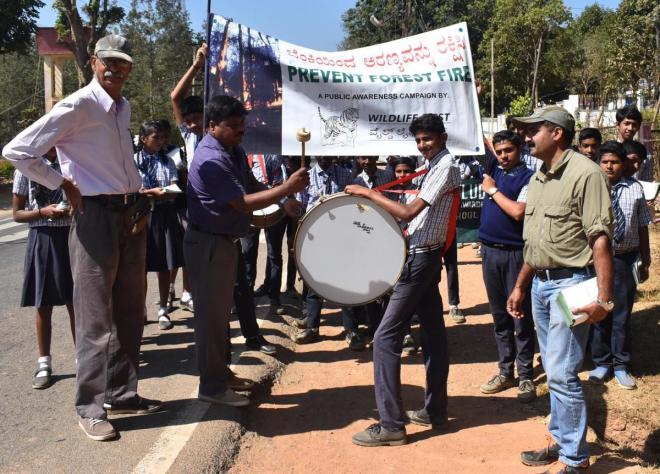
An awareness rally on forest fire was held in Gonikoppa.
A forest fire is not a natural incident. There are always human hands behind the accident, said Wildlife First president K M Chinnappa.
He was speaking during the flagging-off of an awareness rally conducted by Wildlife First and the Aided High School at Gonikoppa to create awareness against forest fires.
Negative impact
“A forest fire not only results in the loss of valuable flora and fauna but also increases the temperature levels. This will further result in less rainfall and depletion of groundwater level. The amount of rainfall is diminishing year by year as the forest cover is depleting. If this continues, drought will be the most common phenomena,” Chinnappa said.
Dependence on forests
Inaugurating the rally, Titimati Assistant Conservator of Forests Sripati said that the existence of all organisms depends on the existence of forests. “Everyone should, therefore, extend their help towards preserving forests and wildlife,” he added.
Around 3,000 handbills on forest conservation were distributed among citizens on the occasion. Up to 50 students took out a procession and raised slogans on conservation of forests.
Science teacher and Tiger Pug Nature association coordinator D Krishna Chaitanya was present on the occasion.
source: http://www.deccanherald.com / Deccan Herald / Home> District / DH News Service, Gonikoppa / February 05th, 2018
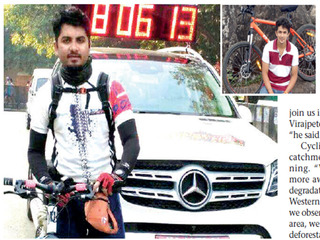
The skies are not opening up as expected and the state is likely to witness drinking water crisis next summer. In an attempt to protect the environment and raise awareness, especially about the Cauvery catchment area, two cyclists Ashish Muthappa, a second-year interior design student at Jain University in Bengaluru, and his friend Chengappa Chekkara, an HR consultant, also based in Bengaluru, will cycle from Bengaluru to Virajpete on August 12.
Muthappa told BM, “Cauvery is the lifeline of South India. It provides water to over 80 million people and 600 major industries across the region. The food, water and economic security of southern India depend largely on Cauvery. Trees were axed for a high-tension power line from Mysuru to Kozhikode in Kerala. There is a proposal to expand the railway network and four-laning of national highways through Kodagu. The weather is already changing and it is becoming humid. The projects will indeed cause large scale destruction of several thousands of precious trees that guard the Cauvery catchment area. Do we really need this development at the cost of water?”
In the past, the duo participated in several cycle expeditions in Bengaluru city for a cause. Ashish said,”“We hope to leave Bengaluru at about 1am so that we reach Mandya early in the morning. We are looking forward to interacting with farmer groups there. We hope to video-record our interactions with famers. We are approaching cyclists in Mysuru. Cyclists from Coorg are expected to join us in Mysuru, Gonikoppa and Virajpete were the expedition ends, “he said.
Cycling 270 km to protect the catchment area is just the beginning. “We would like to spread more awareness on environment degradation by cycling through the Western Ghats stretch soon. When we observe the Cauvery catchment area, we have noticed that massive deforestation is taking place and no afforestation,” they said.
source: http://www.bangaloremirror.indiatimes.com / Bangalore Mirror / Home> News> State / by Deepthi Sanjiv, Bangalore Mirror Bureau / August 02nd, 2017
WELCOME. If you like what you see "SUBSCRIBE via EMAIL" to receive FREE regular UPDATES.
Read More »