The debut film of actor Mukesh’s son Shravan had a unique audio launch, held underwater!
The launch was held at Kovalam beach in Thiruvananthapuram on February 6 and marked the first-of-its-kind event in the film industry. Putting across the message on ocean conservation, the team, including actress Varsha Bollamma, director Rajesh Nair, music director Prakash Alex and actor-turned-producer Vijay Babu dived into the sea in their scuba outfits to launch the music of the film.
Varsha Bollamma
“By diving into the depths of the ocean, we could use the event for an environmental cause,” said director Rajesh Nair. “The scuba divers alerted us about the plastic debris settled on the sea bed. But I didn’t believe them. Then I saw it with my eyes and was shocked to see the amount of plastic deposited on the shallow beds of the ocean.
It was very hard for us to walk under water due to the plastic deposits. I wish to spread awareness about this among people,” says Rajesh.
Later the party peeps, socialites and stars from the film industry switched to their party avatars and headed to the launch venue.
Though the lead actor and hero of the film Shravan was missing at the do, his father, Mukesh, dancer Methil Devika, Asha Aravind, Unni Mukundan, Prasanth, Rajagopal and Usha Rajesh were spotted at the do.
source: http://www.timesofindia.indiatimes.com / The Times of India / News> Entertainment> Hindi> Events> Kochi / February 07th, 2018
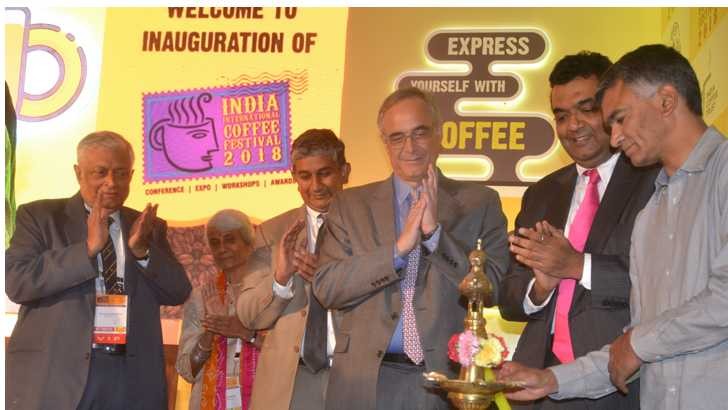
The theme for the event was ‘Express Yourself with Coffee’.
It highlighted the merits of coffee tourism for the coffee industry and the small farmers associated with it.
The India Coffee Trust and Coffee Board of India jointly hosted the 7th edition of India International Coffee Festival 2018 in Bengaluru for the first time. Hosted from 16- 19 January at The Lalit Ashok, the four day event included workshops, fireside chats, keynote address by various speakers representing different industry sectors and a coffee exhibition.
The event was attended by trade visitors like roasters, retailer’s distributors, café owners, policy makers, industry captains, exporters,manufacturers and host of other luminaries associated with the coffee industry.
It was inaugurated by Krishna Byre Gowda, Minister for Agriculture, Government of Karnataka, along with Sudhir Sitapati, Executive Director – Refreshments, Hindustan Unilever Limited, Anil Kumar Bhandari, President, India Coffee Trust. Jose Dauster Sette, Executive Director, International Coffee Organisation, Srivatsa Krishna, IAS, Chief Executive Officer and Secretary, Coffee Board of India, Sunalini Menon, CEO, Coffee Lab Limited Trustee, India Coffee Trust.
The theme for the event focused on the lines of ‘Express Yourself with Coffee’. It highlighted coffee tourism as not just benefiting the coffee industry and the small farmers associated with it, but also to bring in the much needed growth to the tourism in the state.
Anil Kumar Bhandari said, “With this 7th edition of IICF, we are optimistic about the great ideas shared by industry experts and eminent speakers. Some exciting initiatives were also discussed during the event and we will take them up to make World Coffee Congress in 2020, a grand success.”
Srivatsa Krishna said, “Bangalore being the coffee capital of India, we are seeing this as a preparatory event leading us to the World Coffee Congress in 2020. For coffee tourism, we are also in talks with few startups for creating coffee trails which will soon be in process.”
source: http://www.voyagersworld.in / Voyager’s World / Home / by Irene Susan Eapen / February 12th, 2018
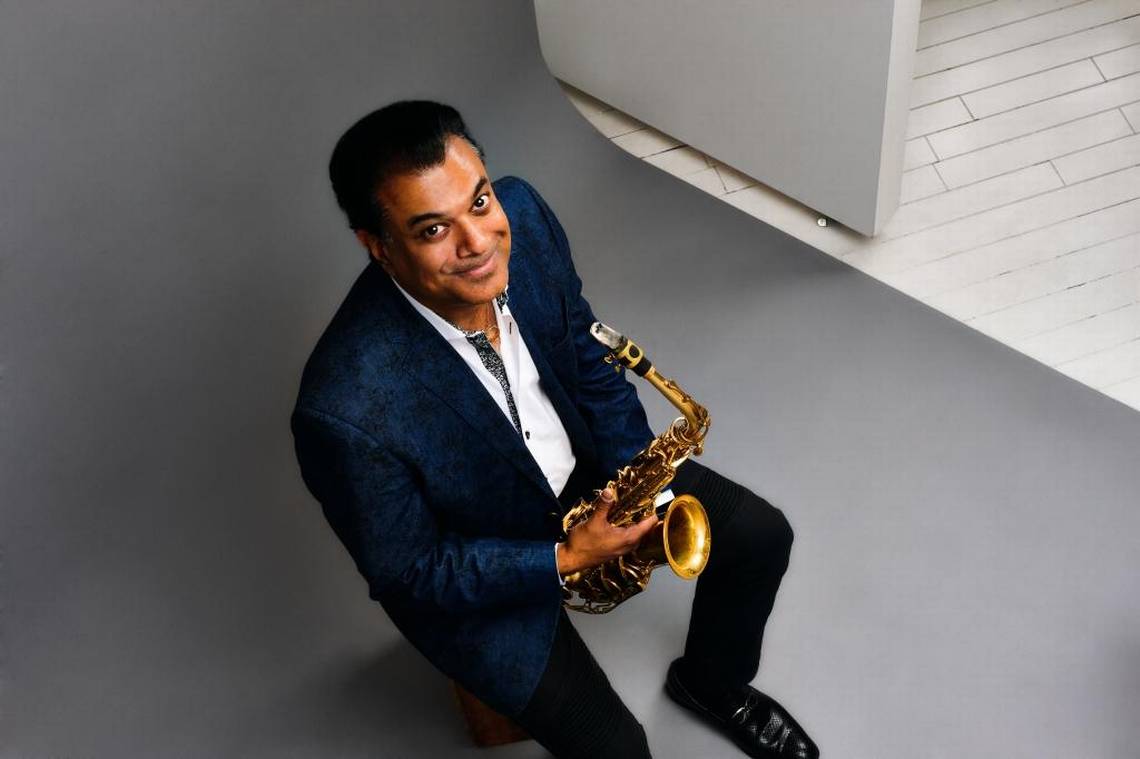
Rudresh Mahanthappa has been named alto saxophonist of the year six out of the last seven years by Downbeat magazine. Ethan Levitas
Rudresh Mahanthappa
Opening: Osland/Dailey Jazztet. 7:30 p.m. Feb. 10. Singletary Center for the Arts Recital Hall, 405 Rose St. $13 public, free in advance to University of Kentucky students. 859-257-4929. Singletarycenter.com, Rudreshm.com.
With each recording he cuts and each band he takes the stage with, Rudresh Mahanthappa reveals different views of a musical persona that can best be described as globally expansive.
In 2015, the composer, educator and bandleader — as well as Alto Saxophonist of the Year, as voted on by Downbeat Magazine’s International Critic’s Poll six out of the last seven years — channeled, dissected and re-assimilated the music of Charlie Parker into an audacious album called “Bird Calls.” Last fall, Mahanthappa followed with “Agrima,” a stylistic turnaround that meshed jazz, Indian classical music and electronics. As he prepares for his Kentucky debut on Saturday, Mahanthappa discussed plans for a future project that involves a straight ahead jazz trio of sax, bass and drums fashioned after Sonny Rollins’s classic 1958 album, “A Night at the Village Vanguard.”
“Look at my discography, and you will see every album is different,” Mahanthappa said. “Almost every album has a completely different band, so I’m always trying to shake things up for myself and change the vehicle as much as I can. My musical personality stays the same, I guess, but different scenarios bring different things out of me.”
I KNEW EVERY TRACK WITH A SAXOPHONE SOLO THAT WAS BEING PLAYED ON TOP 40 RADIO, WHETHER IT WAS MEN AT WORK OR SUPERTRAMP OR THE SAX SOLOS ON SPRINGSTEEN RECORDS.
Mahanthappa’s personal history is as culturally rich and varied as his music. Born in Italy to Indian parents, he grew up in Boulder, Colorado, initially absorbing the pop sounds of Grover Washington Jr. and David Sanborn on the radio before cutting his teeth in area jazz and even Dixieland bands.
“I knew every track with a saxophone solo that was being played on Top 40 radio, whether it was Men at Work or Supertramp or the sax solos on (Bruce) Springsteen records. I learned them all. That was my first kind of ear training, trying to learn by holding my mono tape recorder up to the radio so I could learn the saxophone solos.
“The players in the Boulder bands were all twice my age, but they took me in. I was butchering Charlie Parker solos, but people gave me a chance. Those experiences were really important. It was the welcoming aspect that really mattered. I felt like I belonged someplace. Not that I didn’t belong in my family. It was just a way to really be a musician with other musicians.”
Curiously, Mahanthappa’s exploration of his Indian heritage came much later in his decidedly American upbringing.
“The elements of Indian music came from a place of trying to engage my ancestry in a way that was really meaningful. I don’t speak my parents’ language. I didn’t grow up around any other Indian families. Beyond the limits of my immediate household, I was figuring out how to create an Indian-American culture on my own and with my brothers. For me, in particular, music was the most effective way of describing that, defining that and communicating that. I feel a lot of the music I play is a by-product of me getting to know myself.”
IT’S NICE TO GO TO THESE PLACES I’VE NEVER BEEN BEFORE AND PLAY WITH THE LOCALS WHO HAVE DEVELOPED A REAL SCENE IN THEIR PART OF THE COUNTRY.
Today, Mahanthappa’s heralded career is balanced with duties as the head of jazz studies at Princeton University. That ties in to his performance on Saturday at the Singletary Center, where he will team with University of Kentucky jazz pros Miles Osland and Raleigh Dailey in their Jazztet.
“It’s nice to go to these places I’ve never been before and play with the locals who have developed a real scene in their part of the country. I think it’s very important to the relevance of this music to engage as many of the communities as possible and not just show up to do the gig and take off. There’s a lot more to it than that.”
source: http://www.kentucky.com / Lexgo – Kentucky.com – Lexington Herald Leader / Home> Music News & Reviews / by Walter Tunis, Contributing Music Critic / February 07th, 2018
Following some power-packed performances, the actor was laid low after a skiing accident and is re-starting his career from scratch.
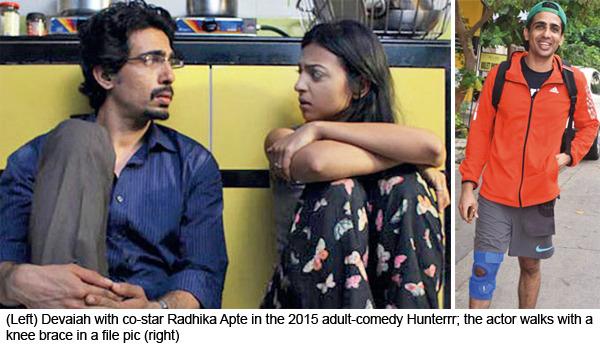
Gulshan Deviah grabbed eyeballs with Bejoy Nambiar’s 2011 thriller, Shaitan, and went on to headline the coming-of-age adult comedy Hunterrr four years later as the bumbling Mandar Ponkse. Life was on a roll for the 39-year-old actor when he went to Kashmir to bring in his wedding anniversary on February 12, 2017. The following day, Gulshan was skiing on the snow-capped slopes of Gulmarg when he took a tumble that resulted in a broken knee, and he was to be confined to the bed for the next eight months.
Reminiscing about the unfortunate accident, the actor says, “I was just a beginner, on a 4.5 km run at 10,000 feet. The previous day I had done seven runs from 10 am to 4 pm, and even though I fell a few times I didn’t hurt myself. On February 13, I continued from where I had left off. After three runs I was exhausted but since I was feeling good, I decided to do one more before taking a break. After a kilometre I swerved to the left and my ski got stuck in the snow. The next thing I remember, I’m flying through the air.”
Usually the ski opens out when something like this happens, but in Gulshan’s case, his right knee twisted and snapped. “I knew something bad had happened as a shooting pain felled me,” he narrates, recalling his trainer and wife Kallirroi Tziafeta panicking as they watched him try to stand and topple over because of his knee.
Even as he was hoping it would turn out to be just a sprain; the actor was rushed to the local dispensary in a sledge and, with the help of pain killers, survived the night. “The swelling was so bad that even going to the bathroom was difficult. The doctors told me that the medial and lateral ligaments had been severely damaged and my anterior ligament was blown. I would have to undergo surgery but they needed to rehabilitate my leg first for three weeks by putting it in a straight brace which I could only take off while having a bath. I could barely walk,” he recalls.
After three weeks, Gulshan went into surgery and post-op couldn’t bend his knee even at 15 degree but the pain was gone. “The doctor said I was one in a thousand cases when it came to pain tolerance. I guess I had prepped myself well,” he slants a wry smile, going on to inform that the doctors had used a tendon to replace the ligament which, being much harder, usually needs a year to become more flexible. “After two months, the doctor assured me that my leg was healing well but I was out of work for eight months. I had to drop a couple of films and turn down two I might have done, along with several other offers. In the meantime I only focused on my physiotherapy. At times I would even over-train and then the doctor would tell me off,” he smiles.
Finally, Gulashan is back on his feet with Vasan Bala’s romcom Mard Ko Dard Nahin Hota, which introduces Abhimanyu Dassani and Radhika Madan. “The physical training I had to undergo was a challenge as my leg was broken then. This is the only film I am doing and we should wrap it up by early March. It’s almost like re-starting my career from scratch after eight months of being out of action,” he signs off with a smile.
source: http://www.mumbaimirror.indiatimes.com / Mumbai Mirror / Home> Entertainment> Bollywood / by Shravan Shah,Mumbai Mirror / February 13th, 2018
The Kerala government’s decision to brand and market Wayanad coffee in the recent state budget, close on the heels of Coffee Board’s decision to apply for its geographical indication (GI), could make it the singular robusta variety from India to attract attention.
Wayanad in north Kerala grows around 50,000 to 60,000 tonnes of robusta coffee annually, making it the prominent region in the country cultivating the variety.
Most of the locations in Karnataka, the largest producer of the beverage in the country, grow both arabica and robusta beans. Just over a month ago, the Coffee Board had applied for GI status for Baba Budan Giri, Araku Valley, Coorg and Chikmagalur coffee along with with Wayanad coffee. While the first two are exclusively arabica, the latter two have both arabica and robusta.
“We are sure of receiving the GI tag for Wayanad coffee as we can easily authenticate the scientific and historic evidence for the coffee as required under GI documentation,’’ said K Basavaraj, head, quality division, Coffee Board.
Brahmagiri Development Society, a cooperative of 13,000 farmers, in Wayanad, which came into limelight with the production of various meat under the brand Malabar Meat, is gearing up to play a stellar role in the branding of Wayanad coffee too. With the Kerala government’s encouragement, it has drawn up a plan to construct IRs 60-crore instant coffee factory.
Instant coffee can be sold for Rs.3000 – 7000 per kg bringing more revenue to the growers
Instant coffee can be sold for Rs 3,000-7,000 per kg bringing more revenue to the growers. Besides the special aroma of Wayanad coffee, its growth in semi-forest area helps in environment protection. So, we can also factor in carbon neutrality of the region for branding,’’ said P Krishnaprasad, chairman of the society.
source: http://www.economictimes.indiatimes.com / The Economic Times / Home> ET Home> Markets> Commodities> News / by ET Bureau / February 08th, 2018
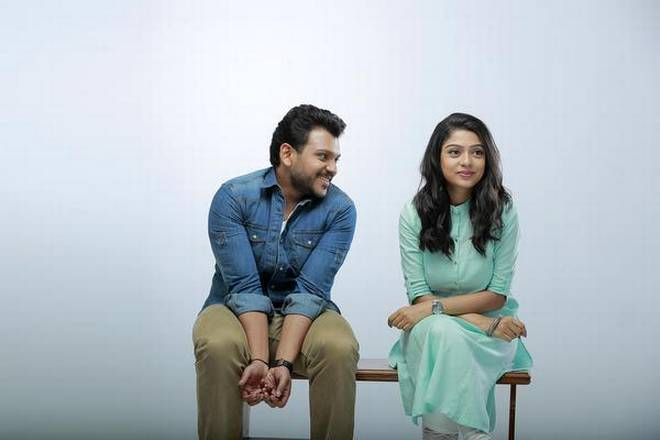
Shravan and Varsha in a still from Kalyanam | Photo Credit: special arrangement
Rajesh Nair says his film ‘Kalyanam’ narrates a love story that is married to comedy. It reaches cinemas today
It is again ‘son rise’ in Malayalam cinema! If Pranav Mohanalal made his debut last month, this month, it is the turn of Shravan, son of Mukesh and Saritha, to make his debut in cinema with Rajesh Nair’s Kalyanam.
“Kalyanam is a marriage of comedy and romance,” says the director about his film after his previous one, Salt Mango Tree, dished out a tangy treat to viewers.
“This is about a romance that began at the age of five for Sharat, enacted by Shravan. A laidback guy, his only aim in life is to woo his girl, Shari, and win her for keeps. Varsha Bollamma plays Shari. In this day of communication glut, there is no dearth of means to convey his feelings to his girl. Yet, he is hesitant and that is how the story unfolds. By the way, the tale is set in the nineties,” explains Rajesh. On the lookout for new faces for this story of young love, Rajesh happened to hear that Mukesh’s son was all set to follow in his parents’ footsteps. So Shravan became Sharat while Rajesh found his heroine from dubsmash videos of which Varsha is quite a star. The girl from Coorg had no issues about the language as her mother is a Malayali. “I call it a clichéd love story, which is also our tag line,” chips in Rajesh.
Till a few decades ago, a couple would struggle to meet each other, talk to one another or even express their feelings. It was an age of stolen glances, hidden messages, wayside meetings and so on. “I wonder how many love stories died an early death because the concerned people could not talk about it to each other,” muses Rajesh who quips that he chose his partner himself. However, today every youngster has hundreds of methods to reach across to his/her love. “But that does not mean every one is finding it easy to communicate with their partners. That nervousness and apprehension have still not changed,” laughs Rajesh.
Shravan, says Rajesh, was Sharat and he points out that there was nothing surprising in that considering that “acting is in his genes”. When acting with his father, Mukesh, Sharat was able to hold his own despite his initial nervousness, says Rajesh.
He says while Salt Mango Tree was a sugar-coated pill for viewers, this is a “full-length comedy” about two families and their children. He hastens to add that though the film is not preachy and makes no claims to have a message or anything of that sort for viewers, there is an underlying thread that makes it clear why parents should support and guide their children as they assume new responsibilities and begin new chapters in their lives.
Mukesh acts as Shari’s father and Sreenivasan and Parvathy act as the parents of Sharat. Rajesh insists that even the parents are not the usual screen parents. “Parvathy chechi and her husband are so in love with each other that he leaves his job in West Asia to be with her. He indulges her so much that he happily does all the work in the house while she bosses him around,” he narrates.
Standout role
According to the filmmaker, Parvathy’s character is a standout role for the actor who has been evolving with every role of hers. He can’t stop gushing about her act as Sharat’s mother and how she stepped into the character so well.
Salt Mango Tree had some memorable lines that still make the rounds of comedy clips aired on television. Will Kalyanam also have such sparklers to liven up the proceedings? “Of course. Dialogues have been written by Govind Vijayan, Summesh Madhu and Rajesh Radhakrishnan. So you can expect plenty of funny one-liners and dialogues,” says Rajesh.
Binendran Menon is the cinematographer and debutant Prakash Alex is the composer of all the five songs and background score of Kalyanam.
source: http://www.thehindu.com / The Hindu / Home> Entertainment> Movies / by Saraswathy Nagarajan / Thiruvananthapuram – February 22nd, 2018
Romance blooms along with coffee in Manu Warrier’s debut feature film.
A love story set in the lush coffee plantations of Coorg, where love blooms along with the coffee flowers. And you have a Kodava protagonist in a Hindi movie! Co-written by Mumbaikar from Kerala Manu Warrier and Bengaluru man Sharath Parvathavani, Coffee Bloom is an indie inspired by the scenic plantations of Coorg.
Manu, whose directorial debut is Coffee Bloom , wanted the location to be an important part of the narrative. “My co-writer Sharath, with whom I have worked on a short film earlier in the U.S., is from Bengaluru and it dawned on us when we were working on the script that Coorg is just one night away from Bengaluru. Our story required a contained setting. We visited Elephant Corridor (a homestay in Siddapura) owned by Viju and Nimmi Chengappa and they gave us a detailed account of life there and the phenomenon of coffee blooms. We realised this could be a key factor in our story and we reworked the script around it, and adapted the story to Coorg, so that it didn’t feel gimmicky.”
Manu admits that till he visited the Chengappas, his knowledge of Coorg was limited to photographs. “The first thing that occurred to me was that it was a visual delight.”
Manu, a scriptwriter, says he’s averse to showing violence and frustration on screen. “I’m driven to working on plot-oriented subjects.” So, the story traces the life of Dev Anand, a self-proclaimed wise man who finds comfort in being a loser, having given up on life as a result of a romance gone wrong. A life-changing event takes him on a journey to a coffee plantation in Coorg, where he meets Anika, his long-lost love, currently his boss. Love blooms in an idyllic setting; and much is at stake as the yearly bloom is round the corner.
Manu admits that he was lucky when he started out wanting to make this indie. He was introduced to Bollywood producer Harish Amin by filmmaker Leena Yadav, who loved the story. He also brought on board Bollywood actor Arjun Mathur, who has earlier starred in Luck by Chance, My Name is Khan, and Fireflies, and Sugandha Ram who was part of Jaane Tu Ya Jaane Na and My Name is Khan . The film also stars Mohan Kapoor and Ishwari Bose-Bhattacharya. Manu started writing the film in 2011 and shot it in February 2013. “The climax was dependent on nature. We had to chase the seasons to ensure continuity did not suffer.” Thus the film cost Rs. 1.5 crore to make, he admits. In 2014, it premiered at the MAMI Mumbai Film Festival. At the NFDC Film Bazaar, it was marked for ‘Market Recommendation’.
It was while he was studying for his MBA in U.S.A. that Manu seriously started getting engrossed in cinema. “I wanted to make films, but my middle-class upbringing frowned on filmmaking as a career. But, in the U.S., I had access to film libraries. I started reading, and started DIY filmmaking.” He worked in HR recruitment for a while, and then decided to come home. When he moved to Mumbai, he says he was naïve enough to believe that he would write scripts and films would be made out of them. “But reality doesn’t work like that. So I started pitching myself as a scriptwriter, and as someone who would develop people’s content for them.” Things started opening up, but projects were also frustratingly shelved midway.
Manu says he had been going back and forth with filmmaker Anurag Kashyap to collaborate on a script when another great opening came his way — “Anurag Kashyap suddenly called me late one night and said there is a writing project. He didn’t tell me any more details or who it involved. I think it was about being in the right place at the right time.” Manu landed a writing job, having been given the task to write the screenplay for four episodes of Yudh , the TV series starring Amitabh Bachchan, that Kashyap had created.
Talking of opportunities available now, and the possibilities of the indie film in Hindi cinema, Manu says there are people who make films on controversial subjects to get attention, and there are others putting up their films online.
“But whatever you do, struggle is a part of the picture. I was a rank outsider. And it’s never easy. But after a point, you just want to be part of the picture, whether it’s rosy or not. But the indie scene is surely changing for the better,” says the 36-year-old filmmaker.
Coffee Bloom releases in India, U.S. and Toronto simultaneously on March 6.
source: http://www.thehindu.com / The Hindu / Home> Features> MetroPlus / by Bhumika K / March 03rd, 2015
Says it has not approved the Thalassery-Mysuru rail link
A burgeoning environment movement across Kodagu was put to halt — albeit breifly — by the state government on Wednesday.
Putting an end to the rising levels of anxiety among thousands of Kodavas and green activists, the state government clarified that it has not approved the controversial rail link connecting Thalassery (Kerala) with Mysuru (Karnataka) via Kodagu. Further, the state government clarified that it would not even allow preparation of detailed project report (DPAR) for the proposed rail link as the project would jeopardise the fragile ecosystem of the pristine Western Ghats.
Allaying the fears of thousands of people, RV Deshpande, Minister for Large and Medium Scale Industries and Infrastructure, told the state legislature that the government expressed its opposition for the project. Drawing the attention of the state government, BJP MLA from Virajpet KG Bopaiah alleged that both Karnataka and Kerala already met once and agreed to carry out survey for the proposed rail link amidst stiff opposition from the local population.
Deshpande acknowledged that a meeting between secretaries of Karnataka and Kerala did take place recently, however, the Karnataka government had not consented for the project. “Holding a meeting does not ensure our approval for the project. We have not consented for the rail link project. Further, the project is yet to be approved by the Railway Board and thereafter a formal request has to be made by the Kerala government. Only then, we will be able to take a decision,” Deshpande revealed.
Going further, Deshpande stated, “We already had discussion about the project at government level. Our forest department has not only expressed reservations but also opposed the project as it would jeopardise the green cover and affect elephant corridor through which the rail link passes. Hence, the state government in principle has not consented for the project.” According to Bopaiah, as per the Railway minister’s reply in the Lok Sabha in December 2017, a joint meeting between Kerala and Karnataka secretaries had resolved to take up survey along the route only if the Kerala government submits a proposal to Karnataka provided it does not cause disturbance to wildlife areas. Interestingly, the rail link spanning more than 200 km would pass through Wyanad of Kerala and enter Kodagu at Kutta to pass through thick forest regions like Balele-Nittor-Canoor and Thithimati to reach Mysuru.
Perturbed that the new railway line with a project cost of Rs 6,685 cr would result in clearing of about 40 per cent of Kodagu’s forest, Kodavas, including retired defence officials, planters, environmentalists and public had staged massive protest rallies recently at Kutta and Madikeri. Fighting against the projects that would spell doom over the fragile eco-system of Kodagu where the River Cauvery originates, people from Kodagu, Mysuru and Bengaluru had launched Save Kodagu and Cauvery campaign led by Coorg Wildlife Society. Col (Rtd) Muthanna had even accused Kerala political leaders, including Congress parliamentarian KC Venugopal, of misusing his office as the Congress in-charge in Karnataka by leading Kerala delegations to push for destructive projects cutting through Kodagu benefiting Kerala.
source: http://www.bangaloremirror.indiatimes.com / Bangalore Mirror / Home> News> States / by Niranjan Kaggere, Bangalore Mirror Bureau / February 08th, 2018
Several rituals are associated with the Kodavas from time immemorial. One such ritual is ‘Kakkada Padinet.’
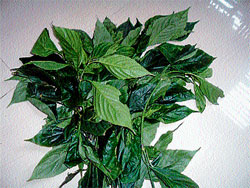
‘Kakkada Padinet’ is 18th day of the month of Kakkada in Kodava calender and is a significant day in the lives of Kodavas. It will be observed across Kodagu on August 2. It is said that the 18th day of Kakkada month of the calender is associated with medicinal values. As the per the traditions, the paddy seedlings are transplanted in paddy fields on the day. Later, they prepare a sweet dish made of ‘Madhubana’ leaves or ‘maddu soppu.’
On the 18th day of Kakkada, the leaves are said to contain 18 medicinal values. The leaves grown in the wild are plucked and boiled in water to get the aromatic juice, which has thick and unique flavour and has dark violet colour. The leaves are used either for preparing sweet or rice. It is said that consuming the leaves on the 18th day of Kakkada will be useful for the health of an individual.
The Gowda community members prepare payasa, kesaribhath or ghee rice made of this leaves on the day of newmoon in the month of Aashada.
‘Marakesu’ soppu which is widely grown during monsoon are used only in the month of Aashada. It is believed that the use of the leaves are good for health. People prepare ‘Pathrode’ from Marakesu leaves.
source: http://www.deccanherald.com / Deccan Herald / Home> District / Shanivarasanthe, DHNS / August 01st, 2012
The Kodavas were always a martial race with a pronounced colonial hangover (Agency Photo)
It’s an impressive roll call. Field Marshal K M Cariappa, Gen Thimmaiah, B C Nanda, M P Ganesh, Prasad Bidapa, Len Aiyappa….The Kodava community, from southwestern Karnataka, has always punched above its weight in Indian public life. Kodavas rose high in the Indian Army; they excelled at sport, particularly hockey and flourished in the coffee trade. But that was then. Today, the Kodavas are buffeted by the winds of change. Modernity and migration are taking their bewildering toll on a people that set great store by tradition.
This is the context of renewed demands for a separate Kodava autonomous region, which would give them a separate place of their own, in keeping with their claims of being vastly different from everyone else. For this would also accrue all the benefits that go with a distinct identity. The men are strikingly handsome and their women appealing winsome. Their customs and traditions too are quite different from those in the rest of the region,one being that an uncle usually marries his niece. For nearly two decades, the Codava National Council (CNC) has been fighting for autonomy and the issue is back on the agenda with regular dharnas and sporadic protests at the state legislature.
The Kodavas were always a martial race with a pronounced colonial hangover. Their loyalty to the British meant they found secure footing in the armed forces. Even though they had few officers and mainly made up the rank and file, the Army had a significant Kodava presence. No longer. Kodava recruitment at the Bangalore Army headquarters, which caters to Karnataka, Kerala, Mahe and Lakshadweep, fell steadily from 85 in 2001-02 to 28 in 2007-08. Today, the highest-ranking Kodava officer is a lieutenant-general and they have just a few major-generals.
The once-famous Coorg Regiment has suffered too. Twenty-five years ago, every Kodava family could proudly list several of its men in uniform. That’s history. Sons prefer to head for engineering colleges now or professions more lucrative than the Army, say recruitment officers.
It is the same with sport and the Kodava’s once-legendary skill on the hockey field. M P Ganesh, the first Kodava to captain the national team, heads a list that also features ace players such as M M Somaiah, B P Govinda, Len Aiyappa and Mandepanda Monappa. The community always enjoyed and excelled at traditional war games such as pareya-kali and shakti-kolu. This is why Ganesh, who started playing hockey late, was deemed a natural.
Army hockey teams, particularly those that played for the Madras Engineering Group, had several Kodavas. They were robust, used to walking to school several miles a day. And they had the right temperament for the game. But now, hardly any Kodavas play hockey, says Ganesh. “High coffee prices, other employment opportunities and a more sedentary lifestyle have led to a lack of interest in the game,” he says.
Today, the Kodava’s passion for hockey surfaces only during the annual tournament in Madikeri, the town in the Kodagu district that Kodavas regard as home. The tournament is hosted by one Kodava family or clan. Other families and clans play for pride and honour. Women are allowed to compete. National and state players are welcome but Ganesh says they are nothing like yesterday’s Kodava hockey stars. “Players should be picked up from here and coached,” he suggests. Eight Kodavas play in the Karnataka team today, but none in the national team. Len Aiyappa was the last to distinguish himself at the national level.
It is hardly different in the former Kodava mainstay, the coffee plantation. Once upon a time, almost every Kodava family owned a coffee estate, or part of it, ranging from a few acres to vast swathes of land. Coffee is cultivated on roughly 2.5 lakh acres in Kodagu, says M C Nanaiah, a member of the state legislative council, but the Kodavas no longer rule the roost.
Many Kodava families are selling off their ancestral homesteads and estates and migrating to Bangalore or Mysore. The trickle grew to a flood after coffee prices slumped a few years ago. Kodavas are also converting their palatial bungalows into home-hotels, burgeoning business ventures for sure but emblematic of their decision to swap a timeworn culture for modern commerce.
The winds of change are sweeping the little district, bearing the scent of the white coffee flowers. The Kodavas are hanging up their hockey sticks and Army boots. Many argue that it is all to the good for a community to change with the times, embracing newer professions such as IT and science. For the Kodavas, the change may be eagerly sought but bewildering.
deepa.bhasthi@timesgroup.com
source: http://www.timesofindia.indiatimes.com / The Times of India / News> India News / by Deepa Bhasthi / TNN / November 02nd, 2008
WELCOME. If you like what you see "SUBSCRIBE via EMAIL" to receive FREE regular UPDATES.
Read More »