Kodavas: One of the few tribes in India allowed to possess a gun without a licence

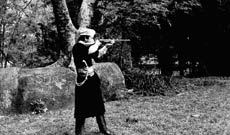
A Kodavn takes aim: a shortage of bullets threatens his way of life

An acute shortage of cartridges is threatening the way of life of the Kodavas, a martial race living in Kodagu (Coorg) district in south-west Karnataka. The Kodavas are one of the few tribes in India allowed to possess a gun without a licence. Cartridges are sold like any other commodity in Janata bazaars, cooperative stores and by private traders throughout the district.

But every time a fresh consignment of cartridges is received by the 36 licenced ammunition dealers, long queues are formed in front of these shops. The cartridges are rationed and usually-one box is allotted per person. At least four private dealers have closed shop because of the shortage.

C.U. Kalappa, president of one of the Janata bazaars, told India today in Mercara: “We had indented for 20,000 cartridges but the Government supplied us only 5,000. Now there is such a big rush for them that quarrels are frequent.” Of course, there are no shoot-outs as bullets have become a scarce commodity. Of the district’s demand of two-and-a-half lakh cartridges, the Government was able to supply only 1.3 lakh last year.

Shortage of bullets had been reported in the past few years after the Government banned manufacture of ammunition by private dealers and made the Government ammunition factory at Kirki the sole supplier. But it is only now that the shortage is being felt acutely and has restricted certain rituals of the Kodavas for whom guns are as common as ploughs.

Exception: The Kodavas have been exempted from the Indian Arms Act right from the time it was introduced by the British in 1834. The British made an exception for this tribe in appreciation of their valiant support to them in their fight against Tipu Sultan. Of the 3.8 lakh people living in Kodagu, almost every family possesses a gun, some even ten. The only regulation is that the Kodavas should obtain an exemption certificate from the Government, which gives them the right to possess any gun without a licence. Borkar, the district superintendent of police said: “In the past five years 12,189 exemption certificates have been issued. We can roughly estimate that about 40,000 weapons are in the district.”

Kodagu is perched on the summit of the Western Ghats and its numerous hills are covered with thick forests. Panthers, tigers, wild boars, bisons and elephants abound in large numbers and the Kodavas are adept hunters. The 1973 Wild Life Preservation Act put an end to one of the important traditions of this tribe. But even now, clandestine hunting goes on.

Legend has it that in the good old days no Kodava was allowed to cultivate a handlebar moustache unless he had shot a tiger. Even as late as 1970 there were nine forests reserved specially for hunting and licences were issued to people who wanted to shoot tigers. Today most of the ancestral houses are decorated with stuffed bisons or boar heads and tiger skins.

The Kodavas are one of the few races in India who worship a god for sports and hunting called Sarthau. Every year a special festival called Kiel Poldu (worship of arms) is held in which Kodavas perform poojas for their guns and swords. Every festival is usually accompanied by a shooting competition in which three coconuts are placed and the men are expected to knock them down. The Kodava festive dress, a black robe with a white turban, is embellished with jewelled guns and swords.

The men usually carry an ornamental dagger and a sharp sword. According to tradition, whenever a male child is born two rounds of ammunition are fired in the air. When a male member dies, two rounds are fired simultaneously and if it is a female, only one round. During the death ceremony, every time a group of mourners pay homage to their dear departed, a round is fired.

Complaint: Because of the acute shortage of cartridges, these customs have to be curtailed drastically. The more affluent families still observe these customs with the full paraphernalia and usually buy the bullets in ‘black’ at double the controlled price. Said B.D. Ganapathy, a noted Kodava writer: “We don’t use the guns as indiscriminately as before because of the cartridge shortage. But it has not drastically affected our culture because we are still willing to buy cartridges from other sources. But I don’t know how long we can continue.”

Said K.N. Ponappa, vice-president of the Mercara Kodava Samaj: “Our major complaint is that our crops are systematically being destroyed by wild animals and we are helpless because of the Government Act banning shooting. The Government must modify these laws.”

The present law stipulates that if a wild animal is troubling a village then the forest officer should be called to shoot it. But one planter said: “Who can afford to wait till a government officer comes to shoot the animal?” Many planters kill the animal themselves and have a feast at dusk.

source: http://www.indiatoday.in / India Today / Home> News> Magazine> Coorg / by Raj Chengappa / November 20th, 2013

How single-origin coffees in India disappeared

With tax, growers have lost the incentive to sell cured coffee

Slip between the cup and lip: Production of fine coffee needs a lot of effort, but rewards are uncertain.   | Photo Credit: pixelliebe
Slip between the cup and lip: Production of fine coffee needs a lot of effort, but rewards are uncertain. | Photo Credit: pixelliebe

Under the Constitution, agricultural income can be taxed by the State and not by the Centre. However, in the case of tea, the Centre contended that there was a substantial manufacturing process involved in the production of tea; hence, income from tea could not be classified as fully agricultural income and that a part of the income had to be taxed as central income.

This was done under Sec 8 of the I-T Act, which stated that due to the manufacturing activity involved, 40% of the income would be taxed by the Centre.

In 2002, the Centre then followed the same logic and introduced Sec 7 & 7B for rubber and coffee respectively. It decided to partially tax the agricultural income from both commodities, claiming there was manufacturing activity involved.

Where coffee is cured or hulled before being sold, manufacturing activity was involved and hence 25% of the income was to be taxed by the Centre.

Curing is a process by which raw coffee is converted to green beans ready for roasting. Substantial machinery and effort is involved but the actual cost of curing works out to about ₹2 per kg for a product worth about ₹200 per kg, or 1%. The Centre thus claimed the right to tax 25% of the agricultural income from coffee.

How did this lead to the end of single-origin coffees from India?

Rise of raw coffee

Once this legislation was enacted planters, started selling uncured coffee instead of cured coffee. The coffees were sold in raw coffee form which is a ‘bulk’ coffee. Soon, a vibrant, active, regular and credible market for raw coffee developed. Today, the farm gate prices are quoted mostly for raw coffee. When raw coffee is traded, the criteria looked at is moisture content, appearance and outturns, not so much the cup taste. Overnight, the charm of producing a fine cup disappeared.

Good bulks at the least cost of production became the norm. The coffee was then bought by curers, exporters and domestic roasters, who cured, graded and bulked the coffee according to customer requirements. In the process, the origin of the coffee got lost.

The production of fine coffees takes a lot of effort; while the extra input and efforts are certain, the rewards are uncertain. There is a considerable marketing effort involved and the price realisations are uncertain.

In such a scenario, most growers will be reluctant to pursue fine coffees when they know that they fall within the jurisdiction of an income tax officer.

Though today there is no agricultural income tax, central income tax can also be avoided. As a result, one finds that most of the fine coffee awards are won by corporates, who have the administrative capacity to deal with the extra headaches.

Just before the enactment of the rule 7B, pooling of coffee was abolished and free open market sales began. The first coffee auctions were opened for growers. This was an opportunity to sell their coffees after curing in the name of the estate and an opportunity for buyers to buy single-origin coffees.

It was the ideal platform for promoting single-origin coffees. Then came Rule 7B and the sellers disappeared. The auctions never recovered from this setback.

Low-hanging fruit

The Finance Minister often talks of reducing complexity in income tax rules; deleting this rule is one of the easiest steps he can take.

Using an appropriate cliché, it is “one of the lowest hanging fruits” he is ever likely to find. This is a rule that brings little revenue, may be even no revenue, but destroys a beautiful business. We hope he picks this ripe coffee cherry at the earliest.

And, if he is a coffee drinker himself, he will find he has many fine single-origin coffees from India to choose from.

(The writer is a coffee planter with an interest in financial markets and agricultural development)

source: http://www.thehindu.com / The Hindu / Home> Business> Agri-Business / Guest Columns / by M.Meyyappan Jr / January 17th, 2018

Tracing the roots of Kodava tribe

There is opposition to releasing the findings of research

Blood samples of 100 couples to be drawn for DNA tests Kodava tribe is said to be 2,000 years old Research team asked to be cautious while dealing with sensitive issues There is apprehension that research findings may divide the community

Virajpet (Kodagu Dt.) :

Kodagu Natural Sciences Society has launched a unique initiative to trace the origin of Kodavas by ascertaining the ancestry, customs, culture, language and a study of genealogy by the Kodagu Natural Sciences Research Society.

A research professor from Delhi University has drawn 150 blood samples of selected Kodava families for conducting the DNA test. This was revealed at a seminar organised by the Akhila Kodava Samaja here on Friday, attended by representatives of various Kodava Samaj units, prominent Kodavas and office-bearers of society. The significance of the research will be to carry out DNA tests on Kodavas to trace their origin and roots.

Society president Lt. Gen. B.C. Nanda said Kodavas inhabited Kodagu 2,000 years ago. The first recorded instance of Kodavas was found in 1174 AD during Hoysala dynasty in the State. Kodava was the only community that accepted the “gotra” system other than non-Muslim and non-Christian communities, he said.

Speaking in favour of tracing the origins of Kodavas, Gen. Nanda said modern scientific inputs gave ample opportunities to take up research work. Along with the DNA test, socio-cultural aspects, somatometry (physical measurements on various attributes) and demography should go hand-in-hand to corroborate the theory. The final report will be submitted to Akhila Kodava Samaja president Matanda.C. Monnappa.

Gen. Nanda said the pilot project started involving nine couples aged between 20 and 40. As many as 100 DNA samples will be drawn from Kodavas living in all parts of Kodagu. The outcome of the study will be kept confidential.

The former president of the Karnataka Kodava Sahitya Academy B.P. Appanna, who did not approve of the idea, said a report on the scientific study on Kodavas can turn out to be sensitive. The principal investigator of the study team is M.A. Abdul Kalam, Department of Anthropology, University of Madras, Chennai, and the project coordinator is Xavier Raj from the Social and Environmental Research Centre, Chennai. The cost estimated for carrying out the study is Rs. 11.80 lakhs.

source: http://www.thehindu.com / The Hindu / Home> National> Karnataka / by Jeevan Chinnappa / February 18th, 2006

Nidhi Subbaiah bereaved: loses her father to cancer

NidhiSubbaiahKF16jan2018

Actress Nidhi Subbaiah lost her father Bollachanda Subhash Subbaiah on late Sunday night.

The actress, who is currently shooting for the film 5G that is being directed by Yogaraj Bhat protege ‘ Guru Raghavendra, has been shuttling between her shoots in the city and her home in Mysuru to be with her father, who she was very attached too.

Her father was battling cancer lately, we hear.

source: http://www.timesofindia.indiatimes.com / The Times of India / News> Entertainment> Kannada> Movies> News / TNN / January 24th, 2017

Angakali: Traditional tribal folk dance inching towards burial

Funeral01KF16jan2018

Madikeri:

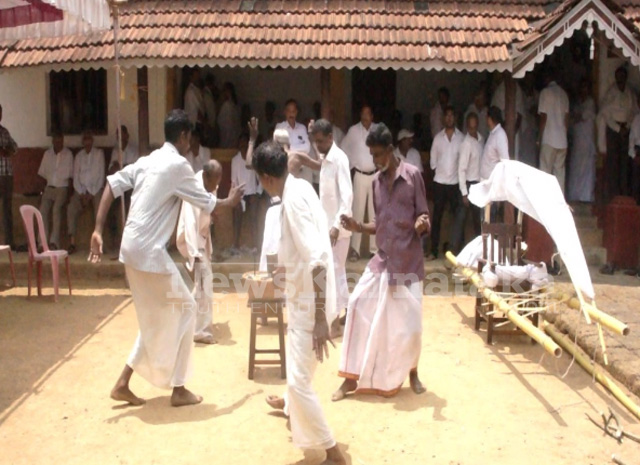
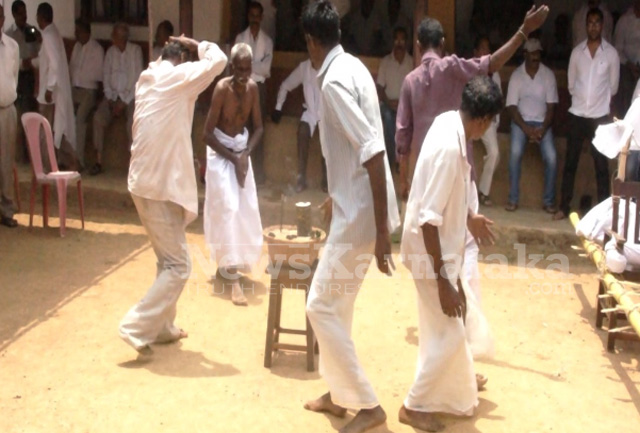
Angakali is the traditional tribal folk dance performed at the Kodava funerals before performing the last rites after the demise of the head of the family or elderly member by a special tribe called “Kembatti.” With changing times and attitudes most Kodavas of the present times are not even aware of this dance form called Angakali.

When Okkada (family head) dies in the Kodava family, Kembatti tribals in the village are summoned to perform Angakali.

A lamp lit using castor oil is placed at the centre of a cane basket filled with rice. Another tubular container and coconut is placed in the middle and a wooden rod is inserted in the rice. A white “Mundu” (Long piece of cloth tied around the waist extending till the ground) is given to the main performer by the family of the deceased.

The performer enacts a scene where he touches the dead body thrice by chanting, “Kattiri adanne bolla, kattiru abbayo” and circles around the lit lamp placed in the centre to the beats of “Malepoyithodeyutha” band.

The main Angakali performer has to strictly adhere to certain norms till the end of the funeral (Mengathe). If the deceased member is elder to him, he will be sent back home with a basket full of rice, coconuts, salt, meat, oil and cloth sufficient enough to stitch a shirt.

If the performer is woman, the cloth given will be of sari length.

The folk dance ritual is rarely seen off late at Kodava funerals with only a handful of artistes remaining, including Biddanda Kutada Sannu and Bollu to perform Angakali.

There is story woven around this folk funeral ritual by the Kembatti tribes. According to them, Lord Shiva had granted a boon to Basmasura using which the latter could turn anyone to ashes by placing his hand on the target. In an attempt to test his powers, Basmasura attempted to place his hand on Lord Shiva himself. Lord Krishna sensing the danger to Shiva, came to his aid in woman’s attire ultimately averting the danger.

Most Kembatti tribes believe this story led to the folk dance ritual at the funerals and continued it for generations.

Angakali is performed when deaths occur in Kodavas, Medaru and Kembatti communities.

The Kembatti tribals have performed the folk rituals at the cultural events/folk shows held in the cities of Bengaluru and Mysuru to keep the tradition alive and to draw the attention of the government for support.

Funeral02KF16jan2018

Bavali residents near Parane, inhabited by Kembatti tribes rue over total neglect by all the concerned.

Angakali (word found in Malayalam language too) means “part dance” with “part” referring to the parts of the body and “kali” means play/dance. It is considered the last attempt by the Kembatti tribes to please the deity to rescue the dead (In this case Okkada-head of the family/eldest member).

source: http://www.newskarnataka.com / News Karnataka / Home> Special / by Coovercolly Indresh / January 03rd, 2017

In naxal-hit Darbha, coffee aroma to bring winds of change for farmers

Raipur :

The Chhattisgarh government has undertaken an innovative coffee plantation project in Darbha region of insurgency-hit Bastar district in a bid to boost the income of farmers.

The cash crop is raised on 20 acres of the government land under the Darbha development block, located around 35 kms away from Jagdalpur district headquarter on an experimental basis by the Jagdalpur horticulture college in collaboration with the Bastar district administration.

Jagdalpur district headquarter is located around 350 kms away from here.

“During research, the geo-climatic conditions of Darbha, located at a height of around 654 meters above the sea level and where around 100 mm rainfall occurs in summer, found suitable for growing coffee,” Dr Krishna Pal Singh, Horticulture Scientist at the College of Horticulture and Research Station, Jagdalpur, told PTI.

He said the regions like Bijapur and Kirandul (Dnatewada) in south Chhattisgarh, and Jashpur (north Chhattisgarh) also have possibilities for coffee farming.

The ultimate plan was to bring about a change in the cropping pattern of farmers who traditionally depended upon cultivation of rice, Singh said, adding that farmers could not fetch a good return from paddy farming but a coffee plantation would yield more revenue.

In the first phase of the project, 20 acres of land was finalised on terrains of Darbha-Koleng road, he asid, adding that the fund was granted by the district administration under District Mineral Foundation (DMF).

The plantation was started in September last year on two acres of the land while the remaining 18 acres will be covered by May this year, he said.

Initially ‘selection 8’ variety of coffee Arabica species was planted in two acres.

The Coffee Board of India, Bengaluru, has agreed to provide seedlings of two improved varieties of coffee Arabica- Chandrgiri dwarf and selection 9, and one Coffee Robusta variety- CxR for further plantation, he said.

The Coffee Board took this decision after its team recently visited the plantation orchard, Singh said.

As many as 12 local farmers, including six women, have been involved in the cultivation after they were imparted necessary training.

“Besides, some of the farmers will be sent to the Coffee Research Station in Koraput (Odisha) for further training so that they can take up coffee farming in their field and disseminate it to other farmers,” Dr Singh said.

For the first three years of the project, the district administration has sanctioned a fund of Rs 60 lakh, he said.

The horticulture scientist said the coffee cultivation had a span of 45 years once sown.

“Coffee beans (cherries) for commercial production will be ready from second year onwards. A small processing unit will be set up in future for processing beans into coffee powder,” he added.

The project has started attracting response of local farmers who have approached the horticulture college to take up the same plantation in their field.

A group of farmers from Mawlipadar village of Darbha block has contacted us seeking assistance and guidance for growing coffee in around 40 acres of land in their village, Singh said.

Meanwhile, the college has also planned to plant bush pepper in the coffee orchard as an inter crop.

Bush pepper will be sown in gaps between two rows of coffee plants, Singh said, adding that the mixed cultivation of both crops would yield a handsome income for the farmers.

Farmers involved in the cultivation believe that the project would give a new identity to Darbha–where a number of state Congress leaders were killed in a deadly Maoist attack on May 25, 2013 in its Jhiram valley area.

The district administration has plans to expand coffee plantation in other places of the region if it would turn successful.

“The coffee cultivation has been started on the experimental basis and once we will get good results, it would be later replicated in other suitable parts,” Bastar Collector Dhananjay Dewangan said.

The collector further added that based on the results of the project, an action plan will be drafted that would benefit the farming community.

source: http://www.outlookindia.com / Outlook / Home> The News Scroll / by Tikeshwar Patel / Raipur – January 14th, 2018

Getting a memorial: War tank reaches ‘Sunny Side’

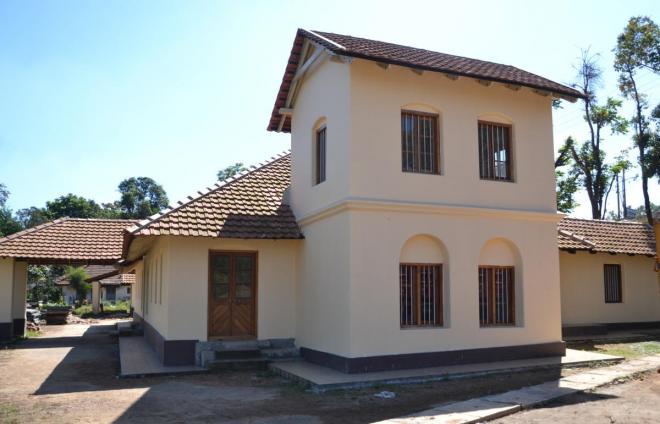
A view of the General Thimayya Memorial Bhavana in Madikeri.

The work on converting Sunny Side, the abode of late General K S Thimayya in Madikeri into a memorial has been re-started.

The state government, through the Department of Kannada and Culture, released Rs 2.30 crore for the purpose last week. The memorial is expected to be ready within a few months.

At the same time, a war tank, a long-pending demand, has finally arrived at the ‘Sunny Side’.

Demand for tank

Owing to shortage of fund, the work on converting ‘Sunny Side’ into a memorial could not be taken up. Ex-servicemen have been demanding that a war tank be kept in the museum of ‘Sunny Side’. When the Indian Army Chief General Bipin Rawat visited Kodagu to unveil the statues of Field Marshal K M Cariappa and General K S Thimayya on Kaveri College premises in Gonikoppa recently, the ex-servicemen’s association had appealed for the same. The war tank has arrived at Madikeri from Army Training Centre in Pune.

The battle tank “Himath” was used during the India-Pakistan war in 1971. After the completion of the memorial, the war tank will be open for public viewing.

The Nirmiti Kendra has taken up the work on the memorial but will retain the old structure of the house. It is proposed to keep a model of a fighter plane too, and items used by Gen Thimayya while serving the Army, along with war tank, in the memorial.

Funds for memorial

The state government had announced the conversion of the house into a memorial in its budget. Accordingly, the district administration had prepared an estimate for Rs 5.5 crore.

In 2013-14, the government had released Rs 45 lakh. When the state government claimed that it cannot release such a huge amount, the district administration had revised the estimate to Rs 3.70 crore. The state government has so far released Rs 1.45 crore. With the recent release of Rs 2.30 crore, the work is likely to be completed at the earliest, said the Nirmiti Kendra officials.

source: http://www.deccanherald.com / Deccan Herald / Home> District / by DH News Service, Madikeri / January 14th, 2018

Army Day 2018: Important Things Students Should Know About Field Marshal KM Cariappa

January 15 is observed every year as Army Day in India.

CariappaKF16jan2018

New Delhi:

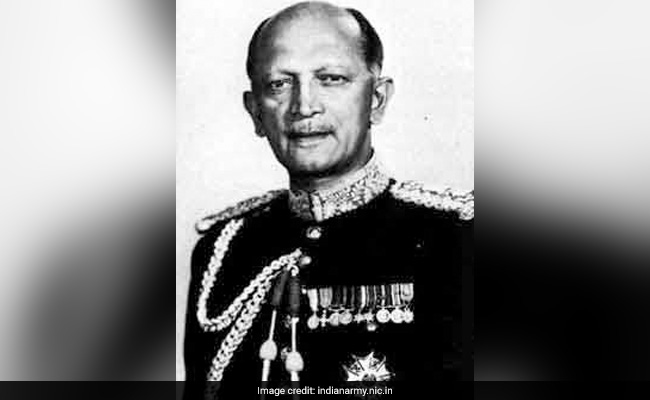
January 15 is observed every year as Army Day in India. Field Marshal Kodandera M Cariappa took over as the first Commander-in-Chief of the Indian Army from General Sir Francis Butcher, the last British Commander-in-Chief on this day in 1949. Army day is dedicated to the soldiers who fought to safeguard the country’s honour. Prime Minister Narendra Modi has extended his greetings on Army Day. PM said, “On Army Day, I convey greetings to the soldiers, veterans and their families”.

“Our Army always puts the nation first. I salute all those great individuals who sacrificed their lives while serving the nation. India will never forget our valiant heroes,” he added.

Army Day 2018: Important Things Students Should Know About Field Marshal KM Cariappa
ArmyKF16jan2018

January 15 is observed every year as Army Day in India

Born on 28th January 1900 in Mercara state, now part of Karnataka, Field Marshal KM Cariappa was amongst the first officers to receive the King’s Commission in 1919.

After an outstanding career, he became the first Commander-in-Chief of the Indian Army on January 15, 1949.

A hardcore Infantryman, Field Marshal KM Cariappa was a thorough gentleman who exhibited the highest standards of self discipline and compassion.

He had been a legend in his life time and left an indelible impression that would inspire the people for a long time.

Field Marshal KM Cariappa was the first Indian Commander-in-Chief of the Indian Army and was conferred the rank of Field Marshal on 28 April 1986.

He breathed his last in May 1993.

In memory of Field Marshal KM Cariappa, the Infantry Directorate at the Army HQ has been organizing the ‘Field Marshal KM Cariappa Memorial Lecture’ every year, since 1995, as part of Infantry Day celebrations.

Gen Dalbir Singh, then Chief of the Army Staff, dedicated a statue of Field Marshal K M Cariappa at the Army Parade Ground, Delhi Cantonment and rechristened the parade ground as “Cariappa Parade Ground” on December 29, 2016.

Three Service Chiefs paying homage at Amar Jawan Jyoti on the occasion of 70th #ArmyDay 2018 #ArmyDay2018@DefenceMinIndia@SpokespersonMoDpic.twitter.com/FbAUAAwFY

– ADG PI – INDIAN ARMY (@adgpi) January 15, 2018

source: http://www.ndtv.com / NDTV / Home> Section> Education / by NDTV Education Team / January 15th, 2018

Team Coorg shine at Republic Day of India Hockey Festival

Muscat:

Team Coorg overcame Oman Veterans XI to win the top honours in the Republic Day of India Hockey Festival at the Sultan Qaboos Sports Complex on Friday.

The annual Festival was organised by Friends of Naqvi Group and Team Coorg under the patronage of Indian Embassy.

In a closely-contested final of the Republic Day of India Trophy, Team Coorg outlasted Oman Veterans XI for a 5-4 victory and to lift the title for the second successive time. Belu Kutappa winning the best player award came as an icing on the cake for the triumphant Team Coorg.

Meanwhile, there was a double delight for Indian School Al Seeb with their boys team winning the Ambassador’s Cup for men after defeating Indian School Maabella and the girls squad lifting the Ambassador’s Cup for women by beating Indian School Maabella.

Chief guest Indian Ambassador Indramani Pandey presided over the Festival, which was also graced by Oman Hockey Association chairman Talib Al Wahaibi and former Oman Olympic Committee vice-chairman and chairman of football and athletic associations Sheikh Soud Al Rawahi as guests of honour and Syed Anwar Ahsan, an Oman Cricket official and General Manager of Raha Poly Products, as the special guest.

During the presentation ceremony, the organisers also honoured distinguished personalities from the Indian community, including Dr. Benny Panakkal, eminent cardiologist and Medical Director of Badr Al Saama Hospital, Dr. Satish Nambiar, Chairman of Indian Social Club (ISC), Leena Francis, Principal of Indian School Al Seeb. Indian School Muscat’s musical talent Santrupth Vedanthi and MK Iqbal, famous cricket coach and Ranji Trophy player from Tamil Nadu, and Inayat Naqvi, former national hockey level player from India, were also feted during the ceremony.

Mohammed Noordeen, General Manager of the Future Group of Companies was awarded the trophy and memento for being the main sponsors. The event is co-sponsored Bank Muscat, Raha Poly Products, ROCA (Khimji Ramdas Group), Monalisa Grand Mall, Mohammed Rafiq & Partners, UTSC, Team Coorg Muscat, Pocari Sweat (Muscat Pharmacy), Oasis Water Company, Al Omaniya Financial Services, Oman Hockey Association, Al Ansari Group of Companies and Oman United Insurance.

source: http://www.timesofoman.com / Times of Oman / Home> Sports> Hockey / by Times News Service / January 14th, 2018

Book on freedom fighter to be released on Jan 15

A work on freedom fighter and veteran politician Pandyanda Belliappa, titled ‘Kodagina Gandhi, Pandyanda Belliappa’, will be released at the Kodava Samaja in Ammathi on January 15.

The book has been written by Aithichanda Ramesh Uthappa.

Karnataka Sahitya Academy president Aravinda Malagathi will release the book while Ammathi Kodava Samaja president Mookonda Bose Devaiah will preside over the programme.

source: http://www.deccanherald.com / Deccan Herald / Home> District / DH News Service / Madikeri – January 13th, 2018