Karnataka coffee growers in a fix over wage hike

The new structure suggests 10% hike in the basic daily wage

Bengaluru :

Amidst the prevailing volatile price trend, an imminent wage hike of over 10 per cent is seen inflating the cultivation costs for the coffee growers of Karnataka, which accounts for more than two-thirds of India’s output.

Negotiations of wage hike have been completed recently between the growers and labour unions and the Karnataka government is expected to notify the new wages soon.

As part of the new wage structure, the basic daily wage is fixed at ₹305 — up 10.10 per cent over the current ₹277.41, said N Bose Mandanna, a member of the committee that negotiated the new wage structure. Including the other social costs, the total outgo for a worker would be in the range of ₹450-470 per day, he said.

Total outgo up
Labour wages account for around 60 per cent of the cultivation costs in the coffee sector, followed by fertiliser and fuel which constitute 35 per cent, Mandanna said.

“The wage hike is going to affect the growers badly,” said HT Pramod, Chairman, Karnataka Planters Association, the apex body of the growers in the State.

To offset the wage hike impact, the government should help the growers by reducing the interest costs. “We have urged the government to reduce the interest on loans up to 25 lakh at 3 per cent and above 25 lakh at 6 per cent,” he said. Pramod further said the impact of the wage hike could be more on growers of arabica, where the cost of production and pest incidence is higher and the productivity is low compared to robustas.

Global production
The revision in wages, after a gap of around four years, is happening at a time when the prices globally have been volatile and at multi-year lows.

The prevailing bearish trend in prices is largely attributed to a surge in global output, which is seen heading for a record in 2017-18 (October-September) at 158.8 million bags (of 60 kg each), about 0.7 per cent higher than last year’s 157.7 million bags, according to the latest estimates of the International Coffee Organisation released on Tuesday.

Production of arabicas is projected to reach 97.3 million bags — down 1.1 per cent from the 2016-17 season.

Robusta production in 2017-18 is seen at 61.5 million bags, up 3.7 per cent over last year, mainly on account of rebound in output of Vietnam, the largest producer of the variety. The prospect of a hike in global output is seen resulting in a bleak outlook for rebound in prices.

“We don’t have any hopes of getting a better price this year,” said DM Purnesh, a large grower in Chikmagalur.

Back home, the harvest of arabicas is almost over, while that of robustas has commenced in the key growing regions of Kodagu and Chikmagalur.

For 2017-18, the State-run Coffee Board sees a 12 per cent increase in total output at 3.5 lakh tonnes with output of arabicas estimated at 1.03 lakh tonnes and robustas accounting for the rest. Growers and the trade, based on the harvest and marekt arrivals, estimate arabica production to be around 90,000 tonnes, while that of the robusta could be much lower than the Board’s estimates.

source: http://www.thehindubusinessline.com / Business Line / Home> Economy> Agri-Business / by Vishwanath Kulkarni / January 11th, 2018
Raitha Santhe yard to open on Jan 12

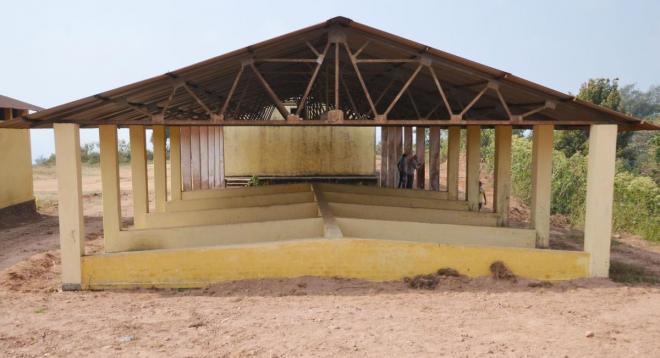
A view of the APMC yard in Madikeri where Raitha Santhe will be held every Friday.

To provide an opportunity for growers and consumers to make a direct transaction, a Raitha Santhe will come into force at the APMC yard near the KSRTC depot in Madikeri from January 12.

The Raitha Santhe has come up on a two-acre land belonging to the APMC. Toilet and drinking water facilities have also been provided. The APMC yard has enough parking space as well.

Also, the Raitha Santhe will be held on every Friday. The farmers will be allowed to sell not only farm produce, but also cattle, fowls, pigs, goats and fish. They will be permitted to carry out their business without any fee.

So far, a shandy market was held every Friday at Mahadevapete, where farmers were forced to sell their products in a congested area, said APMC members.

source: http://www.deccanherald.com / Deccan Herald / Home> District / DH News Service / January 07th, 2018

Virajpet TP chief and member take part in ‘Grama Vastavya’

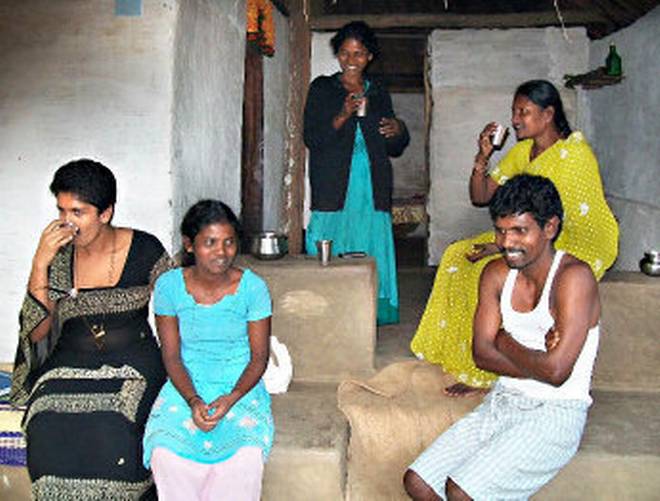
REACHING OUT: The president of the Virajpet taluk panchayat, Sarita Poonacha (left), sipping coffee at Kolli hadi, a tribal settlement in the Nagarahole National Park in Kodagu.

They stay in the house of a tribal couple overnight at Nagarahole

Madikeri:

The president of the Virajpet Taluk Panchayat, Sarita Poonacha, stayed in Kolli hadi, a tribal settlement, in the Nagarahole National Park on Tuesday as part of the “Grama Vastavya” programme to listen to the grievances of the hapless tribal people, according to information reaching here on Thursday.

This was the first step being initiated by the panchayat to redress the problems being faced by the tribal people, Ms. Poonacha said. J.K. Muthamma, a tribal member in the panchayat, also stayed with Ms. Poonacha. They were offered tuberous roots and honey for supper.

The Chief Executive Officer of the zilla panchayat, Mirza Akbarulla, who along with Ms. Poonacha, heard the grievances of the tribal people, said steps would be taken to redress them in a phased manner.

Replying to a man from the tribal community who alleged that officials only gave promises to them and nothing else, Mr. Akbarulla said his efforts were sincere and that he and other officials would not have visited them during the night if it were otherwise.

J.K. Thimma of the tribal community requested Ms. Poonacha to introduce regular buses to help tribal children reach schools in Kutta, Srimangala, Gonicoppa and other places.

Members of the tribal community also demanded more kerosene and ration under the public distribution system as the existing ration was not sufficient.

Tribal people sang revolutionary songs (Kranti Geete) and performed “Kolata” in the night to showcase their culture.

The deputy secretary of the zilla panchayat, Basavarajappa, executive officers of the Virajpet amd Madikeri taluk panchayats, Nagaraj and Motappa, respectively, and Assistant Director of Kannada and Culture Department K. Damodar were present.

The officials left while Ms. Poonacha and Ms. Muthama stayed in the house of J.K. Thimma and Bojamma.

source: http://www.thehindu.com / The Hindu / Home> National> Karnataka / October 30th, 2009

Salem, Madikeri get Fly bus from KIA

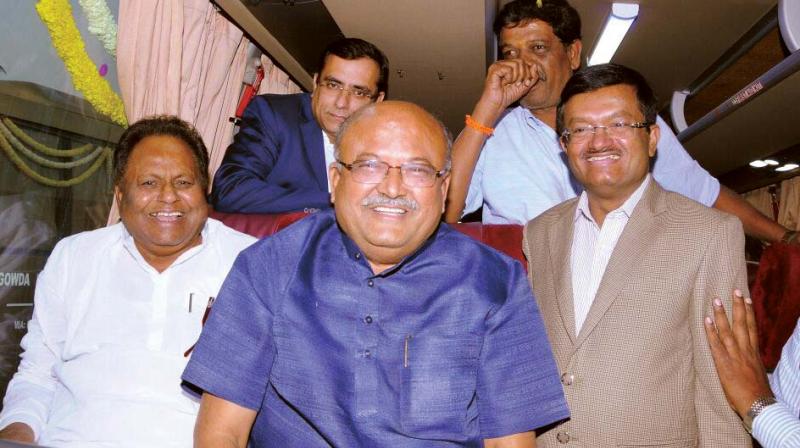
Transport Minister Revanna inaugurated three more services, two to Salem and one to Madikeri from the Airport.

Transport Minister Revanna launches the new KSRTC Fly bus services

Bengaluru:

After the success of KSRTC fly bus service from BIAL to Mysuru, Transport Minister Revanna inaugurated three more services, two to Salem and one to Madikeri from the Airport. The first of its kind in country, the service provides interstate connectivity to the Airport. The luxury Volvo buses have in-built toilets, saving passengers the inconvenience during long-distance travel.

“Now, we have six fly buses to Mysuru and two to Kundapura. Apart from the three inaugurated today (Monday), we plan to extend services to Tirupati and Kozhikode. Fly buses have live flight details, 12 gears to support the back wheel as opposed to other Volvos that have 6+1 gears, backdoor emergency exit and minimal consumption of diesel,” said Mr Revanna.

Assistant vice-president of BIAL, Mr Venkatram, said, “Our survey showed that passengers prefer coming to Bengaluru Airport instead of Chennai Airport to go to nearby places like Mangaluru, Udupi, Manipal, Madikeri, Mysuru, Kundapura and Salem. With the 2nd Terminal coming up, we will ensure the buses stop near it.” The tickets are priced at Rs 800 to Salem and Rs 1,000 to Madikeri, plus 5 % GST. Mr Revanna said that commuters prefer taking the bus from the airport, rather than travel all the way to the Satellite terminal.

KSRTC General Manager (Traffic) K.S. Vishwanath said that earnings from Fly Bus Mysuru are good. “We spend Rs 40 per km and earn Rs 70 in return. There is definitely a profit. Pantry services within the bus were not much of a hit with passengers, and we withdrew it this time,” he said.

Mr Revanna said, “We are collaborating with other state transport corporations in Telangana, Maharashtra and Tamil Nadu. We are yet to get Kerala Transport Department to coordinate with us. This will help us extend more services.”

source: http://www.deccanchronicle.com / Deccan Chronicle / Home> Nation> Current Affairs / Deccan Chronicle / January 09th, 2018

Hanging out with Huang at Bengaluru

ChefAnthonyKF09jan2018

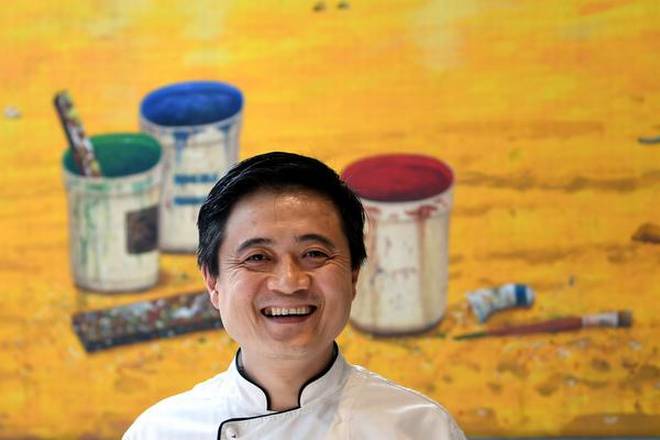
Chef Anthony Huang admits that Bengaluru played a big role in his culinary story

There are not a lot of things this small-made man with a big heart can’t whip up in his kitchen. Bengaluru-bred Anthony En Yuan Huang, is an alumnus of St. Joseph’s High School and Christ College and currently Executive Chef at JW Marriott Bengaluru.

After the recent success of creating and curating a coffee-infused menu, drawing inspiration from the Kodava cuisine, and hosting it in an exclusive Coorg food festival, the chef talks about his love for coffee, his culinary journey and where his cooking is taking him.

The idea was to keep working with the hotel’s concept of going local, explains Huang. “It only seemed fitting that we visit Coorg, which has some of the best coffee plantations in Karnataka, and try to capitalise and use the fabulous produce the State has. We did some research and found coffee actually goes well with food and doesn’t have to necessarily be looked at as a beverage. That’s where we started thinking about exploring the opportunity.”

After experimentation, Huang found that coffee, with its robust flavour, lends itself extremely well to grills, roasts and meats. “We chose to use coffee with our barbecues since its finest flavour comes when you’re roasting it. However, we did not tamper with the cuisine itself – pandi curry remains a pandi curry. We used coffee in various forms, including expresso, roast and coffee extract after decoction with higher antioxidants.”

So where did his interest in cooking begin? Huang fails to recollect the exact moment because he is a third generation chef, albeit the only one with formal training in the family. “It was always in the blood. As a child I’ve always watched mom and grandmom cooking. They come from a line of wedding caterers in China. I have tons of memories with food and I guess it came very naturally to me.”

He adds that at one point in his life, “Like all kids, I also wanted to be a pilot, a vet or a farmer. Eventually, fate won. I was a typical Bengalurean guy hanging around everywhere except college. But I did want to be a chef. I missed my deadline to apply for hotel management. I went to Christ College anyway to put in a word with the principal. I did not expect in my wildest dreams that he would call me in a few days and allow me to join.”

He pauses to pop a yummy hot rasgulla in his mouth and continues: “The Bengalurean in me remained and I continued to bunk college. But I was the first graduate to get though Oberoi School in their campus interview. I got through OCLD which is like the IIT of hotels. I scraped through attendance and the rest is history.”

Huang went on to work in Oberoi Hotels in Delhi, Mumbai and Bengaluru before moving on to propping up free-standing restaurants that were not doing so well. “I wanted something challenging. I went on to Hyatt and then came to Marriott. This is my fourth year here and I’m loving it.”

He admits that Bengaluru played a big role in his culinary story. “Given the fact that I studied in St Josephs and Christ, I grew up as a hard core Bengalurean. He’s the most easy-going guy in the country. He accepts anything in his stride. A third person can come join our table and he will be welcomed. We, as a city, accept people the way they are. That has been drilled into my DNA since school and it has thought me in my professional line to take every input and add it to my development.”

A lot of that reflects in Huang’s food.

“Nothing is wrong – as long as I’m comfortable with it. As long as I’m happy with every plate that has my name on it, I’m cool with it. I don’t have to go by the rule book. Had I not looked at food that way, this coffee trail would have never happened. However, I’m also quite a purist. I like to keep things authentic.”

Ask him what his signature dish is and he says, “That depends on my mood and the ingredients I have around me. I’d like to take a walk and see what’s available. I believe in freshness. I like to also keep it simple. You will never find my food hiding behind a lot of fluff or garnish. If there’s something on my plate, it means it’s meant to be eaten and adds value to the dish’s taste and enhances the way it looks.”

While a large part of his life was spent as an Asian chef with Vietnamese and Chinese cuisines and he dabbled a bit with French food, “Deep down in my heart I’m an Indian chef. I love South Indian and North Indian food. I love my biryanis. When I’m at home I’m mostly cooking that for the family.”

Describing the psyche of a chef, Huang says, “They are driven by passion and work with their heart. When you choose to work in this artistic field, it is equivalent to falling in love with someone. Cooking has a lot to do with emotions.

“Never ask a chef who’s in a bad mood to cook for you.”

source: http://www.thehindu.com / The Hindu / Home> Life & Style> Food / by Allan Moses Rodricks / January 08th, 2018

Mumbai: Coorg Association celebrates ‘Puthari’ festival

PuthariKF08jan2018

Mumbai :

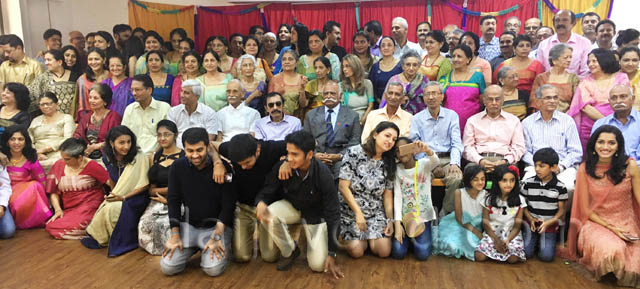
Coorg Association which had remained behind the curtains for some time met again and celebrated its 97th annual ‘Puthari festival 2018’ (Harvest festival) here on January 6.

Senior community leader and president of the association, Boppanda Appaji offered prayers to deity Iggutappa and Kaveri and set the celebrations in motion. Games, music, dances and entertainment programmes were held.

Community men and women wore traditional attire. Trustees Pandanda Ramesh, Biddanda Jagdeep Nanjappa, Kuppanda Muddaiah, Napanda Ramesh, Biddanda Lekha Nanjappa, Kallichanda Aiyanna, Manepanda Somaiah and Managing Committee members Boppanda Appaji- president, Pandanda Pushpa – vice president, Kuppanda Kavita – vice president, Bollachettira Mandanna – secretary, Mukkatira Somaiah – joint secretary and Areda Raja – treasurer were present.

Priya M Poovayyag and Kavya M Poovayyag sang a prayer song. Boppanda Appaji welcomed everyone. Pandanda Ramesh and Napanda Ramesh presented the details of the programme. Jaggi Manjayya, Akshay Chengayya, Mukuthira Somayya, Lekha Nanjappa and Nithin Chengayya introduced the guests. Balya Mediririra sang Kodava songs. Others conducted dances and cultural programmes. Honorary secretary Bollachettira Mandanna proposed the vote of thanks.

source: http://www.daijiworld.com / Daijiworld.com / Home> Mumbai / by Ron Bantwal, Daijiworld Media Network, Mumbai (EP) / January 08th, 2018

Rohan Bopanna serves home-grown brew at Tata Open

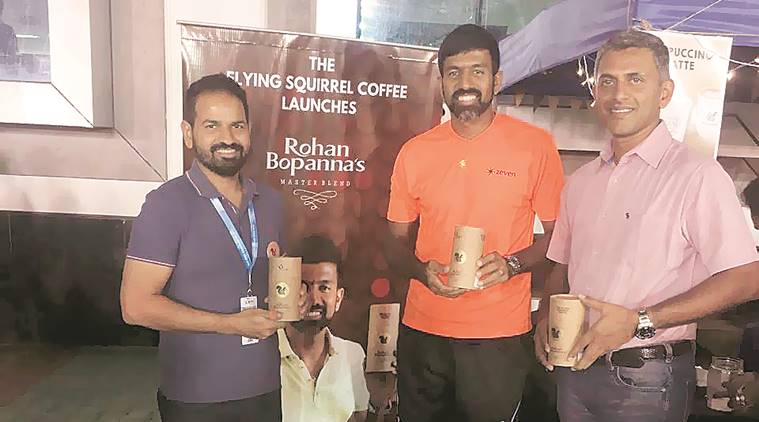
Rohan Bopanna with Ashish D’Abreo (right) and Tej Thammaiah (Express Photo)

At the ATP-250 Tata Open Maharashtra underway at Balewadi, Rohan Bopanna makes it a point to be there at the coffee counter where his own coffee brew is being sold.

Rohan Bopanna, coffee connoisseur. Such an introduction may not ring too many bells, but the tennis star not only grows coffee at his farm in Coorg, he also gifts tennis legends the home-grown brew. At the ATP-250 Tata Open Maharashtra underway at Balewadi, Bopanna makes it a point to be there at the coffee counter where his own coffee brew is being sold. “I am truly well-versed in the nuances of cultivation, processing and blending coffee beans,” writes the champion of the 2017 French Open Mixed Doubles on a flyer at the coffee counter.

Earlier, he had announced the launch of the brew — the Rohan Bopanna Master Blend — on Twitter, posting, “I bring to you a very special part of me from my very own coffee estate in Coorg.” Bopanna has joined hands with the Flying Squirrel – a brand involved in micro-lot cultivation and processing coffee using artisan methods — to set up the counter at the Tata Open.

Ashish D’Abreo, who launched Flying Squirrel with his college friend Tej Thammaiah, says the response to Rohan Bopanna Master Blend has been quite positive. D’Abreo and Thammaiah have been blending, roasting and brewing coffee beans for over five years. “We roast the coffee for 15 minutes before sealing each pack,” says D’Abreo. He then shares some important information for those who enjoy filter coffee: it has to be consumed within a month of roasting.

“Tej owns a coffee estate at Pollibetta in Coorg. So, we experimented with the beans at Tej’s estate… we developed and processed them to arrive at different variants of the coffee,” says D’Abreo. Today, they supply coffee powder online and have also set up a cafe at Bengaluru. It was during a meeting with Rohan Bopanna, which took place over a month ago, that they realised their common goals and decided to experiment with the coffee beans grown at Bopanna’s farm at Madapur in Coorg.

The first variant, Rohan Bopanna’s Master Blend, was launched on January 1. “It is an all Arabica variant, comprising a few differently processed beans, all of them from Bopanna’s farm,” says D’Abreo. He shared that when world no. 6 Croatian Marin Cilic visited the counter with Bopanna, he tasted the coffee while posing for fans. For Nilufer Solai, who came from Mumbai to watch her favourite tennis players in action, the coffee counter was a hit. “…I could buy the beans and have some refreshing coffee,” she says.

source: http://www.indianexpress.com / The Indian Express / Home> Sports> Tennis / by Anuradha Mascarenhas / Pune / January 05th, 2018

India’s ‘first coffee’ brews GI tag

Representational Image / TOI

Kochi :

Baba Budangiri, 250 km from Bengaluru, where coffee was first grown in India, is going for Geographical Indication (GI) of its variety of the Arabica brew.

On January 1, the Coffee Board filed an application for the GI tagging of Baba Budangiri Arabica and four other varieties — Coorg Arabica, Wayanad Robusta, Chikmagalur Arabic and Araku Valley Arabica — with the Geographical Indication Registry at Chennai.

Coffee Board head (coffee quality) K Basavaraj said: “We have applied for the GI marker and we are also profiling the majority variety grown in Baba Budangiri, a variety called Selection-795,” Basavaraj said. Selection-795 (S-795) is considered to be the natural descendant of two of the oldest African cultivars of coffee — Coffea Arabica and Coffea Liberica — and a third variety is called Kent. Currently, S-795 is the most prominent coffee grown at Baba Budangiri.

Edmund Hull in his book ‘Coffee Planting in Southern India and Ceylon’ says that Coffea Arabica originated in Caffa in southern Abyssina and then found its way to Yemen. According to John Shortt’s ‘A Handbook on Coffee Planting in Southern India’, Baba Budan (Baba Booden), a Muslim pilgrim, brought the brew from Mocha, a port city in Yemen, in the 17th century and introduced the variety in the uninhabited hills that came to be known as Baba Budangiri.

Today, Baba Budangiri Arabica is grown acorss 15,000 hectares around the original hills, where it was first planted. Over the last few centuries, coffee plantations grew beyond Baba Budangiri and the adjoining Chickmagalur and spread to Kodagu and Hassan in Karnataka, and Wayanad, Travancore and Nelliampathy regions of Kerala. It is also grown in the hilly regions of Palani, Shevroy, Nilgiris and Anamalais in Tamil Nadu. The non-traditional areas of coffee-growing in India includes certain pockets in Andhra Pradesh, Orissa, Assam, Arunachal Pradesh, Manipur, Meghalaya, Mizoram and Nagaland.

source: http://www.timesofindia.indiatimes.com / The Times of India / News> Business News> India Business News / by Shenoy Karun / TNN / January 06th, 2018

CM’s upcoming visit creates sensation in Kodagu DCC

Backstage activities are in full swing for the district Congress members, as the day of the visit of Chief Minister Siddaramaiah and other ministers, is nearing.

The chief minister’s visit to the district ahead of Assembly elections is considered significant.

The chief minister and other ministers will take part in the ‘Sadhana Sambhrama’ programme to be held at General Thimmaiah Stadium in Madikeri on January 9. The upcoming visit of the chief minister has sprouted many expectations in the minds of the Congress workers. Even as the programme in which the chief minister will attend is a government programme, the discussions on the elections preparations are likely to take place in party cadres.

Siddaramaiah will arrive in Madikeri at 11.30 even though the programme is scheduled at 3.30- pm.

Tough contest for tickets

The names of candidates for Madikeri and Virajpet seats are still not finalised and many ticket aspirants are waiting in the wings. The related issues are most likely to come up in the internal meeting of the party, during the chief minister’s visit.

As MLC Veena Acchaiah has expressed her unwillingness to contest in the elections, the competition for the ticket from Virajpet constituency has turned tougher. B T Pradeep, who contested from the constituency during the last elections, had lost by 3,414 votes. Rumour has it that a search for an able candidate is on, after Pradeep’s demise.

Forest Development Corporation vice president Padmini Ponnappa, minister M R Seetharam’s personal secretary Harihs Bopanna, Karnataka Kodava Sahitya Academy former chairperson B S Thammaiah, Zilla Panchayat member Saritha Poonaccha and District Congress Committee president Shivu Madappa are the main aspirants from Virajpet.

Many more are eyeing the Madikeri constituency. The names of the Somwarpet Block Congress president K M Lokesh, entrepreneur Napanda Muttappa and advocate Chandramouli are surfacing in this context. KPCC general secretary and Zilla Panchayat member K P Chandrakala too, is willing to contest. Kumuda Dharmappa has already approached the High Command for the ticket, according to party sources.

Siddaramaiah is likely to talk to the Congress workers, before finalising the names of candidates.

Agitations for separate taluks

Agitations for the formation of Cauvery and Ponnampet taluks, which are going on from the last 125 days, are likely to have an impact on the chief minister’s visit.

The protesters have been demanding the announcement of the two hoblis as new taluks. Three bandhs have already been conducted in Kushalnagar. The agitators have been looking forward to their demands being fulfilled with the chief minister’s visit.

The newly announced 50 taluks will function officially in the next 15 days.

source: http://www.deccanherald.com / Deccan Herald / Home> District / by DH News Service / Aditya K A / January 04th, 2018

The lure of Nishani Motte

Devaragundi Falls
Devaragundi Falls

Travelling to Nishani Motte and hiking there was on our bucket list for a long time. We had heard that the place is also called the ‘Leech Kingdom’ as it is surrounded by a large number of leeches during the Monsoon.

On a Saturday early morning, I left Bengaluru with four of my friends for this interesting journey. We took the Hassan Road which is good to drive during the Monsoon months.

The first stop we planned was the Devarakolli Falls, which is a few km after Madikeri on Madikeri-Mangalore Road.

The Falls lie parallel to the main road and there are some shops for the travellers to have snacks. You can’t take bath in the Falls but it is a great place to shoot some good pictures.

After the short break, we hit the road for beautiful Devaragundi Falls, which is exactly 13 km from Sampaje, and located in a village called Thodikana. You need to park the vehicle two km before the Falls and do a small trek of two km on a flat jeep track to reach the Falls, which is so majestically placed inside the forest and is easily accessible.

To say the least, it was beautiful and gushing at the peak of Monsoon. Until January end, there is water for taking bath in the Falls but it gets dry during the peak of summer.

However, one should keep an eye on the kids as the water gushing area is steep. We were informed about this by the local villagers.

After a refreshing bath, we reached Mayura Cauvery in Bhagamandala to stay the night over.

The rooms were decent enough. We had our dinner in the small village of Bhagamandala.

Next day morning, we visited the forest office in Bhagamandala and got permission from the department to trek to Nishani Motte after paying a nominal entry fee and guide charges.

There was also another group who joined us in the trek. The Nishani Motte trek is around five km in total. One has to hire a jeep or travel in their own vehicle to the base from the forest office. The base is around five to six km from the forest office. We started our trek around 9 am.

The initial trek was a mild climb through estates and huge trees. In 20 minutes, we could see the grasslands and the leeches too. No wonder this place is called the ‘Leech Kingdom’ as thousands of leeches jumped over us.

Two hours through the trek, we reached the peak which was misty and foggy. We enjoyed every minute of the trek exploring the greenery and escaping from the leeches.

It started to rain during the last leg of our trek but it was an amazing experience to completely get drenched and enjoy the walk with friends.

Finally, we reached the other side of the base. We had our jeep waiting for us to drop us back to the Forest Department office. We reached the forest office around 2.30 pm, had a great lunch and finally visited the Thalacauvery Temple which is just a 15-minute-drive from Bhagamandala.

After visiting the Thalacauvery Temple, which is interestingly the birthplace of river Cauvery, we started our drive back to Bengaluru with lovely memories to cherish forever.

(The author can be contacted at kavinkishore85@gmail.com)

source: http://www.deccanherald.com / Deccan Herald / Home> Supplements> MetroLife / by Kavin Kishore/ January 03rd, 2018