Coffee Board of India showcases varieties at World of Coffee Dubai
KSRTC launches Bengaluru–Dharmasthala–Kukke non-AC sleeper bus via scenic Bisle Ghat
Grieving wife’s decision gives new life to many, ‘walk of honour’ for donor
Madikeri:
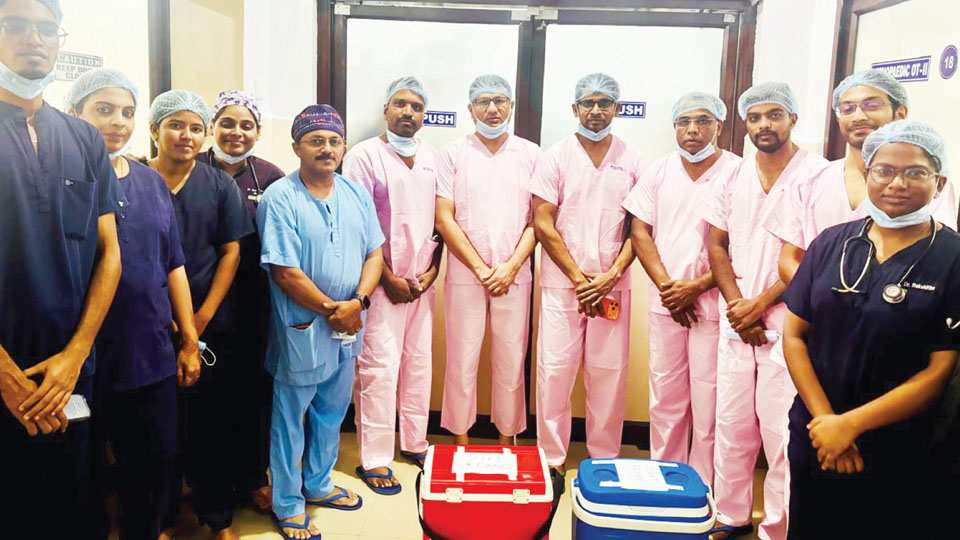
In a touching act of humanity, a grieving wife chose to give life to others by consenting to donate her husband’s organs after he was declared brain dead at Kodagu District Hospital, Madikeri, managed by Kodagu Institute of Medical Sciences (KIMS).
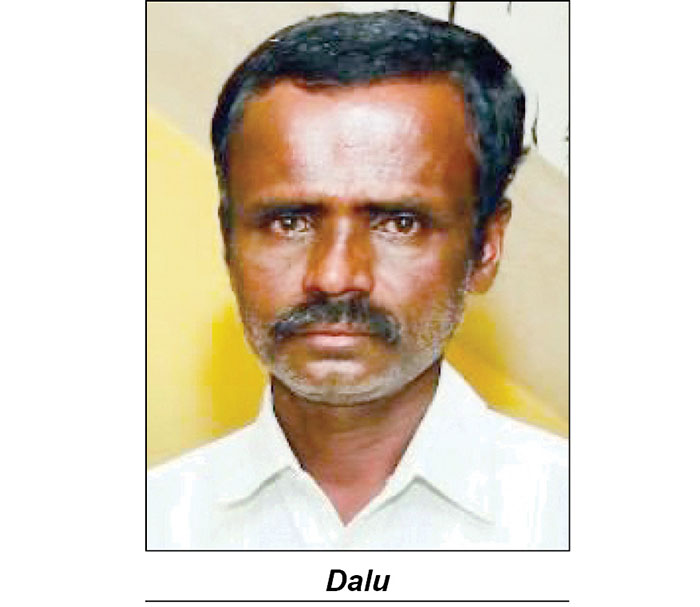
Dalu, 46, a resident of Aravathokkalu village in Ponnampet taluk, had suffered severe head injuries after falling at his house on May 17. Despite treatment, he succumbed to his injuries, following which his wife Rajeshwari agreed to donate his organs.
The donation marked the first organ retrieval procedure in the history of Kodagu District Hospital. Doctors retrieved his heart, kidneys and corneas, which were later transported under ‘zero traffic’ arrangements to hospitals in Mysuru and Bengaluru for transplantation.
Dalu was initially treated at Gonikoppal Government Hospital before being shifted to Madikeri District Hospital on May 19 after his condition deteriorated. A CT scan revealed critical internal head injuries.
Family consent, procedure
On May 22, doctors confirmed brainstem death after two rounds of examinations by a medical board and mandatory observation procedures under Indian law. The family was subsequently counselled on organ donation and Dalu’s wife, Rajeshwari, gave her consent.
The organ retrieval surgery was carried out in the early hours of May 23 under the guidance of Kodagu Medical College Dean Dr. A.J. Lokesh and Senior Surgeons Dr. Somashekar and Dr. Nanjundaiah.
ICU Specialist Dr. Nishid Joseph and Nursing Officer Pavan continuously monitored and stabilised the donor’s condition ahead of the procedure.
Nursing staff Jayashree, Anil and Manjunath, along with Senior Nursing Officers Vasanth and Mahesh, assisted through the night.
To Mysuru and Bengaluru hospitals
By 2 am, Surgeons had successfully retrieved the two kidneys, heart and corneas. Medical teams from Mysuru and Bengaluru, including specialists from JSS Hospital and Narayana Hrudayalaya, participated in the procedure. The organs were dispatched to recipient hospitals by 6 am. The hospital later held a solemn ‘walk of honour’ for Dalu. Rajeshwari was also presented with an official organ donation certificate in recognition of the family’s decision.
Speaking emotionally, Rajeshwari said, “We wanted his death to give life to others, so we agreed to donate his kidneys, eyes and heart,” she said.
source: http://www.starofmysore.com / Star of Mysore / Home> News / May24th, 2026
Brain-dead man saves four lives as first organ donation performed at Karnataka’s Madikeri district hospital
Following the consent by the victim’s family, the management at the hospital contacted several other hospitals and made a list of the recipients.
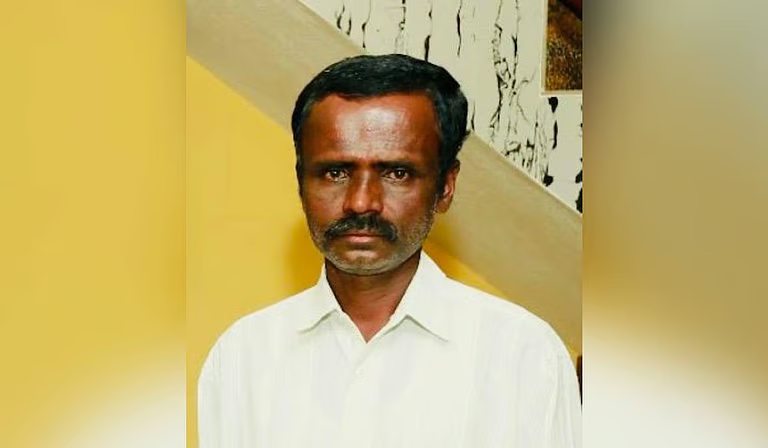
Dalu (46), a resident of Arvathoklu near Gonikoppal, was admitted to the District Hospital aka Kodagu Institute of Medical Sciences (KoIMS) after he suffered severe head injuries in an accident. Photo | Special Arrangement
Madikeri :
A 46-year-old man, declared brain dead, gave a new lease of life to over four people after his family donated his organs. In a landmark achievement, the organ donation procedure was conducted for the first time at the District Hospital in Madikeri.
Dalu (46), a resident of Arvathoklu near Gonikoppal, was admitted to the District Hospital aka Kodagu Institute of Medical Sciences (KoIMS) after he suffered severe head injuries in an accident. However, Dalu was not responding to the treatment, and after 48 hours of observation, a two-stage medical committee conducted the examination and confirmed loss of brain stem functions. The hospital declared him brain dead.
While tragedy struck the family of Dalu after he was declared brain dead on May 19, Dalu’s wife Rajeshwari, took a bold step. Following counseling by the medical experts at the District Hospital, Rajeshwari agreed to donate the organs of her husband.
“My husband suffered continuous epilepsy attacks on May 17 and he was shifted to the District Hospital. After several tests, the doctors at the hospital confirmed that my husband was brain dead on May 19,” recalled Rajeshwari. An estate worker who also works as domestic help to run her family, Rajeshwari decided to donate her husband’s organs after she learnt that it would help many patients.
Following the consent by the victim’s family, the management at the hospital contacted several other hospitals and made a list of the recipients. As Dr Nanjundaiah, District Surgeon, explained, “We are intimidated about the organ donation to Jeevasarthakathe (state government body that coordinates organ transplantation) and hospitals that were in need of organs were recognized.”
The kidneys of Dalu were donated to recipients registered with JSS Hospital in Mysuru even as expert doctors Dr Vijay and Dr Manjunath Shetty, who visited the District Hospital to retrieve the kidney conducted the transplantation in Mysuru. Further, corneas were transplanted to registered recipients at Mysuru Medical College.
Since the functioning of the heart of Dalu was slow, the heart valves were retrieved and the transplant was done at a private hospital in Bengaluru. “However, we could not find a recipient for lungs and hence we did not remove Dalu’s lungs,” Dr Nanjundaiah confirmed. He added that since Kodagu Institute of Medical Sciences has already been accredited by SOTTO and NOTTO, the case was reported to the State Organ and SOTTO. The organ procurement process was carried out under the guidance of SOTTO.
The operation was carried out under the leadership of KoIMS Dean Dr Lokesh AJ., Hospital Superintendent Dr. Somashekar and District Surgeon Dr. Nanjundaiah. ICU team Dr. Nishid Joseph and Nursing Officer Pawan worked tirelessly to keep the patient’s condition stable.
In the surgery that began at 2 am on Saturday, two kidneys, heart valves and eye corneas were successfully harvested. Neurosurgeons Dr. Sachin Dharwadkar and Dr. Vijayakumar, who arrived from Mysore, carried out the kidney harvest. Dr. Abhinandan and Dr. Chandrashekar collected the heart valves, and Dr. Shruti and the team collected the corneas. Nursing staff Jayashree, Anil and Manjunath and senior nursing officers Vasanth and Mahesh performed the task efficiently.
Meanwhile, Dalu’s remains were handed over to the family through a ‘walk of honour’ after the medical experts honored the donor’s service.
source: http://www.newindianexpress.com / The New Indian Express / Home> Karnataka / by Express News Service / May 23rd, 2026
After Dubare tourist death, Karnataka to replace open camper vehicles used for wildlife safaris
The order comes after a 33-year-old woman tourist died during a clash between two elephants at the Dubare Elephant Camp in Kodagu.
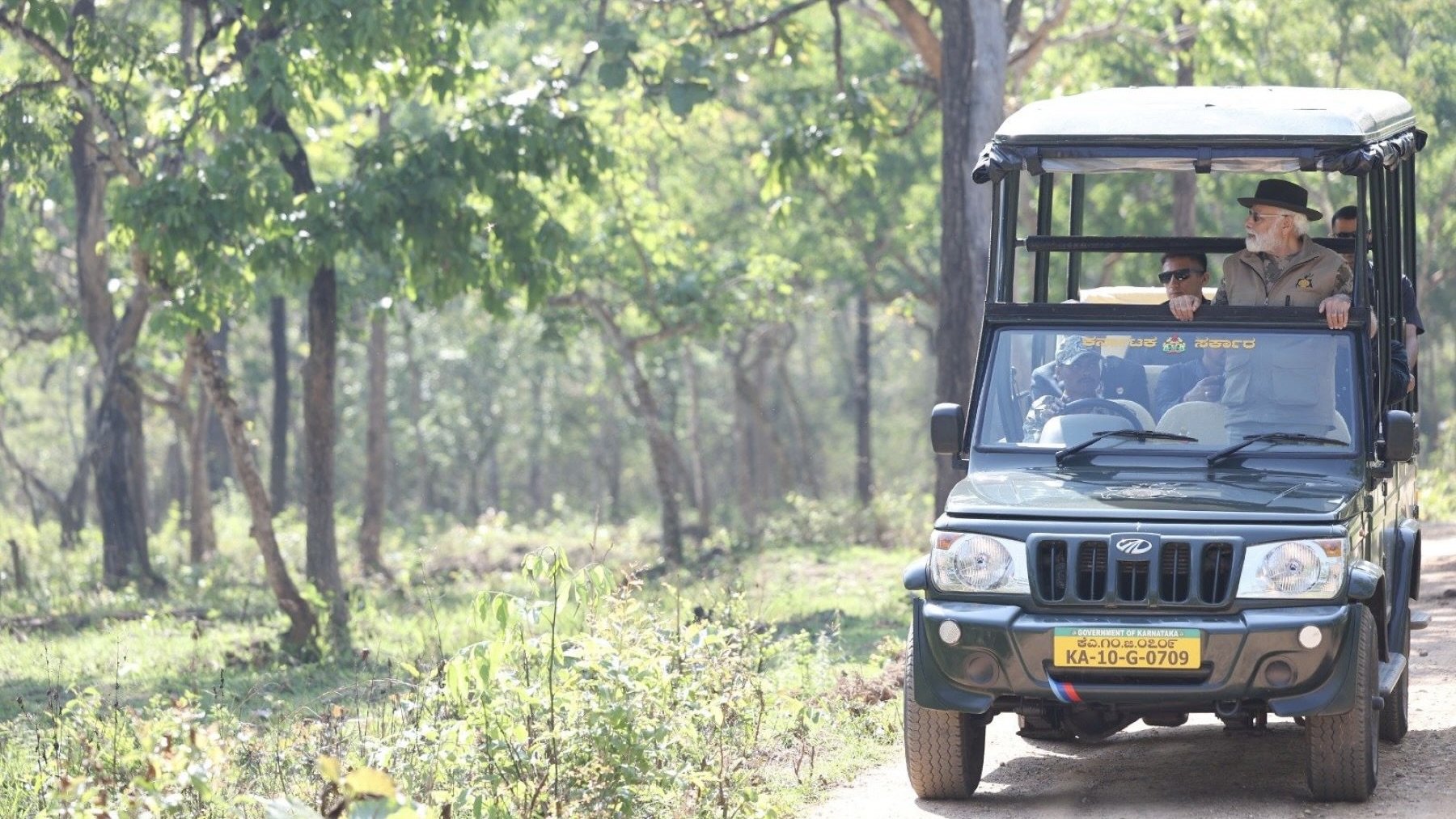
Prime Minister Narendra Modi takes a safari in an open camper vehicle at the Bandipur Tiger Reserve on Sunday. (File photo)
Synopsis:
Karnataka Forest Minister Eshwar Khandre has directed officials to replace open camper vehicles with secured buses for safari operations across the State’s tiger reserves and wildlife sanctuaries after a tourist died at the Dubare Elephant Camp in Kodagu. He also ordered officials to fit existing safari vehicles with iron-bar grills or shatterproof glass, equip them with first-aid kits, and ensure ambulance services.
Karnataka Minister for Forest, Ecology and Environment Eshwar Khandre has directed officials to replace open camper vehicles with buses for safari operations across the State’s five tiger reserves and wildlife sanctuaries.
The order comes after a 33-year-old woman tourist died during a clash between two elephants at the Dubare Elephant Camp in Kodagu.
Khandre said the State would replace open camper vehicles with fully secured buses to improve tourists’ safety during safaris. As an interim measure, existing vehicles will be fitted with iron-bar grills or shatterproof glass, he said.
He further directed officials to equip every safari vehicle with a first-aid kit and ensure ambulance services near safari centres and elephant camps.
Dubare incident
On Monday, May 18, 33-year-old Juneshe was crushed to death at the Dubare Elephant Camp in Kodagu after she was caught in a fight between two Dasara elephants, Kanjan and Jai Marthanda.
Jai Marthanda was being bathed by tourists as part of an activity offered at the camp when Kanjan was brought nearby to drink water.
Kanjan then reportedly attacked Jai Marthanda, triggering a clash between the two elephants.
During the fight, one of the elephants reportedly lost balance and fell on the tourist, who was taking part in the bathing activity. Jai Marthanda sustained injuries to its head, ears and back during the fight. The elephant succumbed to its injuries the next day.
(Edited by Dese Gowda with inputs from Anisha Reddy)
source: http://www.thesouthfirst.com / South First / Home / South First Desk / by Dese Gowda and inputs Anisha Reddy / May 21st, 2026
Kodagu boy is International Brainobrain Champion
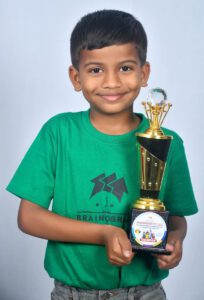
Anvith S. of Madikeri has won the Champion Trophy in the junior category at the 15th International Brainobrain Abacus Competition held at Dubai.
8 year old Anvith S. is being trained by Mapangada Kavitha Karumbaiah at the Brainobrain Madikeri Centre. Anvith was one of the 6 contestants from Karnataka State.
The Abacus competition was held at Sheikh Rashid Hall, Dubai. Over 1,800 children, from 16 countries participated, and it was a very proud moment for Kodagu, when 8 year old Anvith S. representing India won the Champion Trophy.
Anvith S. is the son of Srinivas V., who is a Lecturer in Made Maheshwara P.U. College and Pavithra M.N., who is working in National Highway Department. Anvith S. is studying in 3rd std in BGS. Public School, Made.
Anvith received the Champion Trophy from from Mr. Arul Subramanian, Director Technical of Brainobrain and Mr. Anand Subramanian, MD Brainobrain.
Faculty Kavitha Karumbaiah attributed the entire credit to Anvith S. for his determination to participate and to his parents and family, for their unwavering support, that made this huge accomplishment possible.
Anvith has won the Gold Topper Medal in the State Level Competition and also the Champion Trophy, in the National Level Competition in Chennai.
source: http://www.clnews.in / CoffeeLand News / Home> General / by CLN Newsdesk / December 13th, 2025
How Indian coffees shape Aberdeen’s MacBeans blends
Get the inside story as MacBeans Aberdeen launches its Indian coffee trilogy.
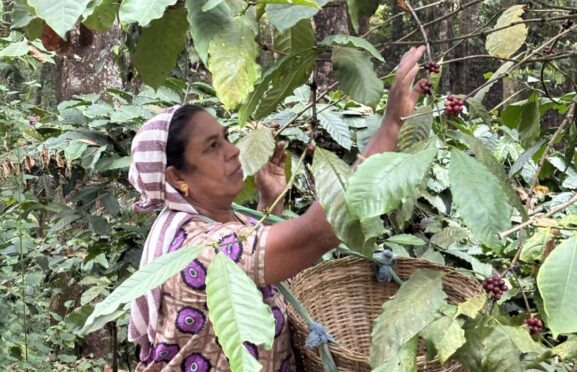
All Indian coffee from MacBeans is farmed organically.
MacBeans in Aberdeen explores the world of Indian coffee, offering fresh blends, single origins and new flavour experiences.
MacBeans Coffee Roasters in the corner of Little Belmont Street in Aberdeen has been open for 37 years. It’s now one of the oldest surviving High Street coffee roasters in Scotland. And unlike most other retailers, it roasts its coffee right on its premises.
For the past several weeks, MacBeans has been roasting coffee freshly delivered from India, which the proprietor, Brian Milne visited early this year.
About 20% of the coffee sold at MacBeans is sourced from India. The shop carries single origin coffees from the South Asian country. But it also uses Indian coffee in many of its own MacBeans blends.
As a former oilfield chemist with a passion for coffee, Brian Milne does not source his coffee blindly. With direct connections to producers all around the world, Brian is able to work closely with them to deliver the highest quality beans to use in every customer’s cup of coffee.
A Passage to India
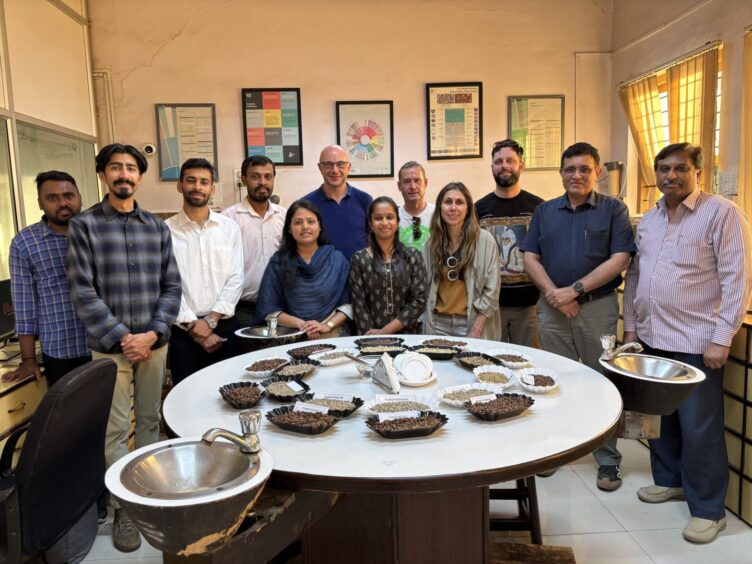
MacBeans’ proprietor, Brian Milne (center) meets with coffee producers in India
Last January, Brian went on a ten-day trip to South India, facilitated by MacBeans’ coffee importer, to visit different coffee plantations and meet with local producers.
Brian says: “A big part of my drive with our coffee is to make sure I understand where the coffee comes from. Going on these trips is a good opportunity to learn more about what’s happening in each country and finding things that we can support.”
In Bangalore, he met with agricultural communities and local cooperatives, even India’s coffee minister.
Brian shares: “We got to tour The Coffee Board of India’s facility and that really appealed to my background in analytical chemistry. I got very excited over some of the lab equipment because they were doing a lot of work to develop and standardise the quality of the coffee that comes out of India.
“They had an artificial nose and an artificial tongue – analytical instruments designed to analyse the coffee for the compounds that contribute to its aromas and its flavour profile.
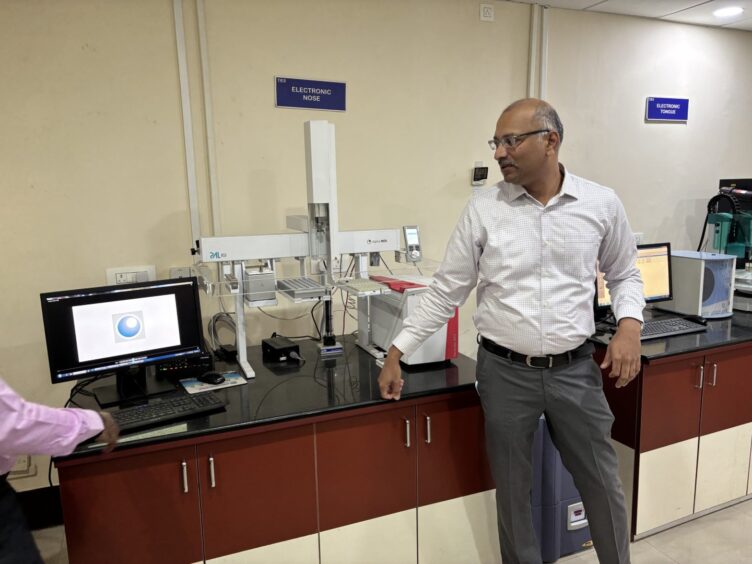
An electronic nose analyses coffee for compounds that contribute to its aroma.
“They are building a library of their coffees to keep track of the quality, which was very interesting.
“They also do a lot of agricultural training. A lot of the agronomists who support the farmers have all been trained by or worked with the Coffee Board of India. So there’s a lot of governmental support at that level to help the local coffee producers.”
Caring for the environment
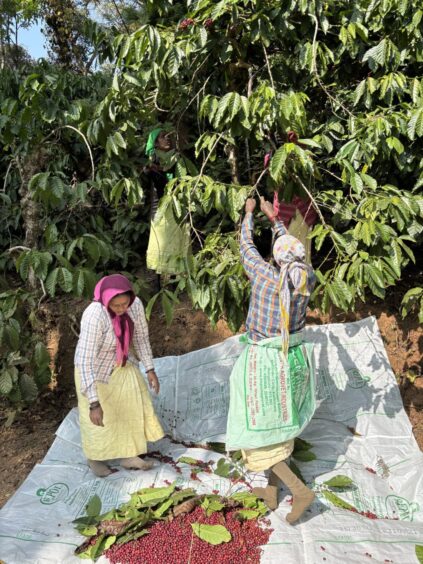
Coffee beans are handpicked by workers in India.
Brian observed that Indian producers followed strict environmental practices. This aligns with the principles of MacBeans, where all the coffee is free of pesticides and farmed organically.
Brian notes: “They reuse a lot of the biomaterials like leaves that have dropped. When they pulp the coffee cherries, all the fruit flesh is composted. That’s what they put back onto the land to help fertilise the crop.
“Because water can be scarce, the processors also collect and recycle the water used from washing the coffee. That’s purified through reed bed processes and reused. So they’re very considerate of the environment.”
People at the heart of the business
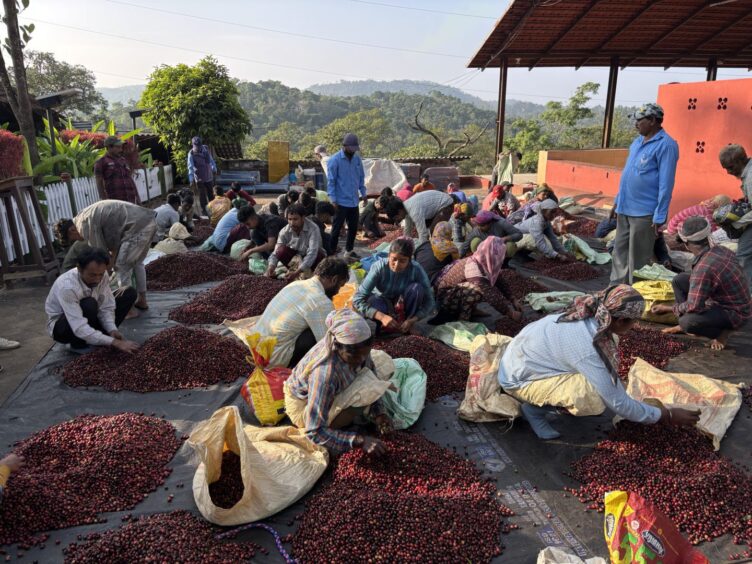
Hundreds of people are employed in Indian estates to produce coffee.
Before his visit, Brian knew that India was among the top 10 coffee producers in the world. But he didn’t understand the scale of the production until he saw it for himself.
“During harvest time, the estates we visited would employ about 1,000 people – pickers, processors. But even outside the harvest, there would be 600 or 700 people employed to tend to the land and maintain the plants.
“People are at the heart of the whole process. There are estates owned by families or cooperatives working with small landowners. They all work together to produce their coffee to manage it and support it. It’s a people business.”
The story behind the Monsoon Malabar
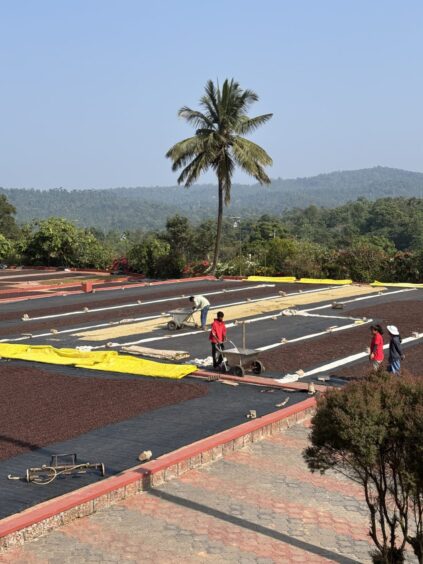
Indian workers dry coffee beans in the sun.
On his trip, Brian discovered more about one of MacBeans’ more popular coffees – the Monsoon Malabar.
“What I knew about it was that it was just an aged coffee. Apparently, that came about a hundred years ago when they were shipping coffee from India on long journeys on sailing ships.
“Researchers found that when the coffee got to Europe, it tasted a lot more mellow than it did when it was at origin. They worked out that it was attributed to the damp environment in ships and the extended time the coffee spent in that environment.
“Today, coffee makers in India are replicating that aging process now called monsooning. They harvest the coffee then wash and dry it as normal. But afterwards, it is aged in the monsoon rains then dried in warehouses on the Malabar coast, resulting in a very smooth and mellow coffee.”
This ageing method as well as the production zones are strictly defined by regulations to protect the production and authenticity of the Monsoon Malabar. It’s a system that’s similar to the DOC system for Italian wines.
Busting the Robusta myth
Brian also travelled to Chikmagalur, the heartland of coffee production in South India, right at the tail end of the Robusta crop harvest and the beginning of the Arabica harvest.
MacBeans does not sell Robusta as a single origin coffee. It’s so intensely flavoured that it can be bitter and even unpalatable.
“In India, producers are investing a lot of time and effort into how they treat Robusta coffee when it’s harvested to improve its flavour and develop it into a specialty coffee.
“There’s a method sometimes called the honey process where you pulp the cherries. But you don’t wash off the little bits that stick. So then you still get all kind of fruitiness to the coffee, but it’s a much milder effect.
“They’re also co-fermenting coffees with other fruits in barrels from a few days to a few weeks. The amount of time makes a huge difference to the flavour.
“The trip was an eye-opener for me. I always thought of Robusta as a low-grade coffee that we added to some of our blends to make them stronger in caffeine and in flavour. But we had to be careful about how much we put in because it can affect the taste detrimentally.
“Now I have a much bigger appreciation for the quality of Indian Robusta and its potential to broaden people’s profiles and expectations of coffee. So I’ve committed to use only Indian Robusta. The coffee that I saw being harvested is now in the shop, ready to sell.”
A reminder, though, to those who favour the milder Arabica coffee but would like to explore speciality Robusta. Brian says: “It’s like tasting wine and comparing it to beer; they’re very different – different in the mouth, different flavour profiles.”
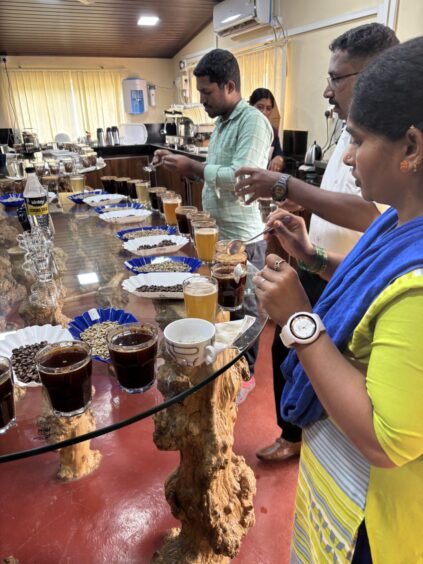
The taste of coffee depends on the beans and roasting methods used.
Try MacBeans’ new India coffee trilogy
Of course, Brian was also able to sample Arabica coffee produced at many of the estates.
“There was a huge variety in the flavours that we tried. Some were very fruity, sharp, distinctive flavours that would be great to try.
“We’ve now got Indian Mysore, an Arabica coffee that forms part of our blends. We also roast it as a single origin Indian coffee. The coffee we have now is from the harvest period that started from the end of 2025 and finished up in February this year.”
The Mysore will be combined with Monsoon Malabar and India Tiger Stripes to form MacBeans’ newest coffee trilogy. Inspired by Brian’s recent trip to India, each bag is bursting with flavours just waiting to be explored by eager coffee aficionados.
To order, pop into MacBeans’ Aberdeen shop or visit the store’s website.
source: http://www.pressandjournal.co.uk / T P&J / Home> In Partnership with MacBean’s Coffee Roasters / May 21st, 2026
Kodagu shadowdamsel, discovered last year, spotted in Kasaragod
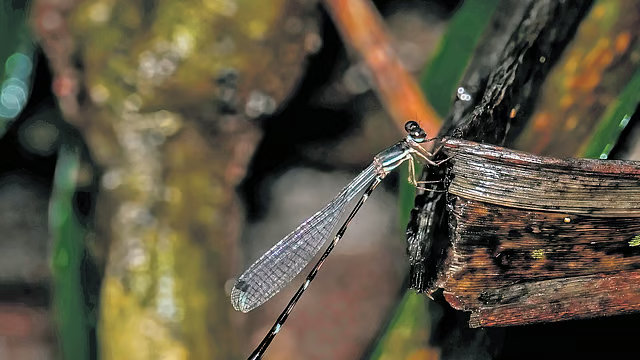
Sooryaprakasha (female) Photo| Express
The species was named after late botanist Dr Sooryaprakash Shenoy. According to the team, Shenoy was an eminent botanist and head scientist at the Dr Shivaram Karanth Biological Park in Mangaluru.
Kasaragod :
A species of damselfly that was discovered in Kodagu last year was recently spotted in Kasaragod.
“Damselflies like dragonflies indicate a healthier ecosystem,” said Muhammed Haneef K A, assistant professor of botany at Thalassery Government Brennen College.
He along with fellow researchers discovered the Protosticta sooryaprakashi, which they named the Kodagu shadowdamsel. The team published its findings in the peer reviewed journal Zootaxa.
The species was named after late botanist Dr Sooryaprakash Shenoy. According to the team, Shenoy was an eminent botanist and head scientist at the Dr Shivaram Karanth Biological Park in Mangaluru. He was widely regarded for his efforts towards biodiversity conservation in the Western Ghats.
“The damselfly stands apart with a bluish-white prothoracic marking, duck-head-shaped genital tips, and distinct caudal appendage structure. It is also the smallest of its species,” said Haneef.
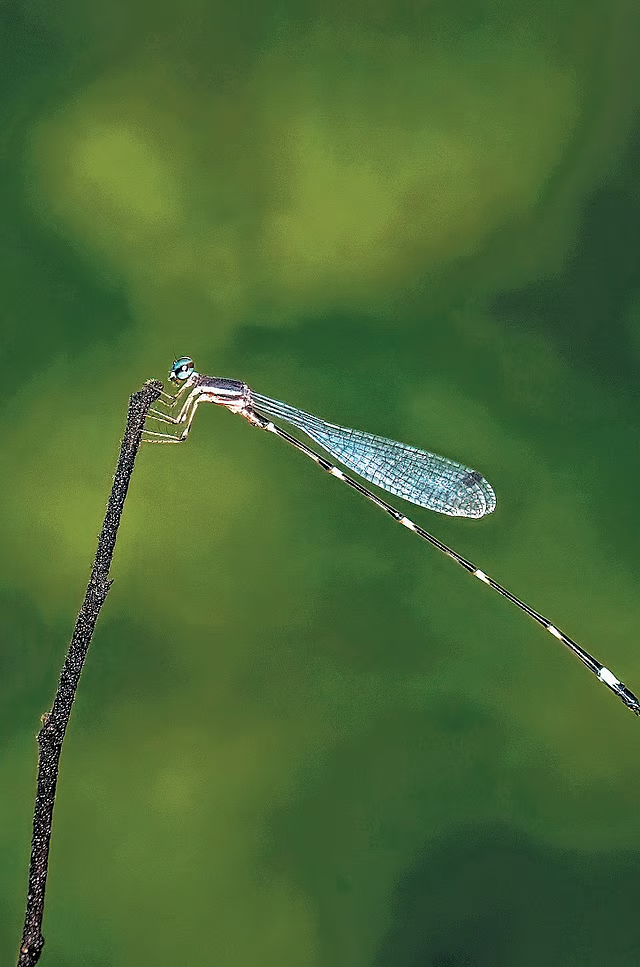
Sooryaprakasha (male)
Haneef was on a field trip in Panathur region in Kasaragod when he spotted the damselfly. “We later spotted it in the Aralam Wildlife Sanctuary. We believe its presence in Wayanad is also due to the region’s micro-climate, which is similar to that of Kodagu,” he said.
Nearly 80% of the protosticta genus flies in the country are endemic to the Western Ghats.
Dragon and damselflies are carnivores which feed on small insects, especially mosquitoes. The Protosticta sooryaprakashi is found in micro-climates with running forest streams, clean water and lots of shade. “The presence of this delicate fly indicates the health of the micro-climate,” Haneef said.
source: http://www.newindianexpress.com / The New Indian Express / Home> Kerala / by Arockiaraj J / May 20th, 2026
Velavan Senthilkumar, Joshna Chinappa Clinch Double Titles at National Doubles Squash Championships in Chennai
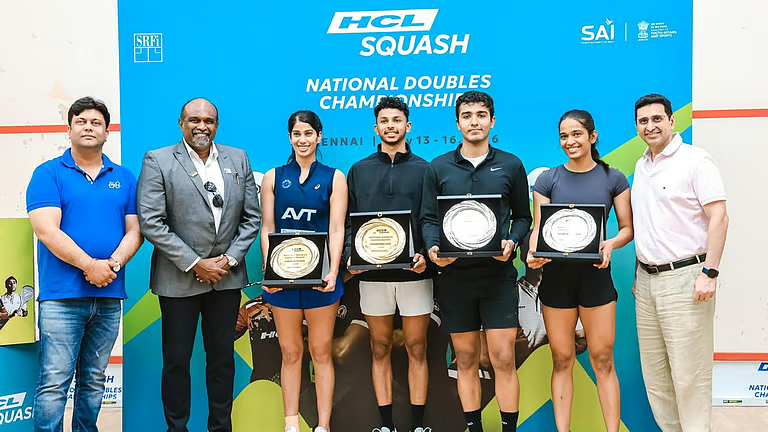
Velavan Senthilkumar and Joshna Chinappa recorded a ‘double’ each in the 3rd National Doubles Squash Championships in Chennai on Saturday
Chennai:
Velavan Senthilkumar and Joshna Chinappa recorded a ‘double’ each in the 3rd National Doubles Squash Championships in Chennai on Saturday, clinching the mixed title together after bagging the men’s and women’s doubles crowns with their respective partners. Senthilkumar-Joshna, the top seed, defeated second-seeded Abhay Singh-Rathika Seelan 11-7, 11-9 in a keenly-contested final at the Indian Squash Academy.
Earlier, Abhay and Senthilkumar, the top seed, won the men’s doubles crown for a third straight year, by beating second-seeded Rahul Baitha-Suraj Kumar Chand 11-8, 11-5 in the title-round.
In the day’s first match, top seed Joshna-Rathika beat Janet Vidhi-Pooja Arthi 11-8, 11-4 in the women’s doubles final. IANS
source: http://www.sentinelassam.com / The Sentinel / Home / by Sentinel Digital Desk / May 17th, 2026

