BioNEST at CFTRI, in collaboration with the Coffee Quality Division, Coffee Board of India, has organised a five-day specialised Barista Training Program aimed at promoting excellence in coffee brewing and service. The program, titled “A Bean to Brew Journey – Master the Basics of Brewing”, will be held from September 1 to 5 at CSIR-CFTRI, Mysuru.
This hands-on, non-residential program is open to individuals who have completed their 12th standard and wish to gain professional coffee-making expertise. The training will be conducted in English, with lunch and coffee provided daily.
Participants will learn and practice essential skills for the coffee industry, including Espresso Basics – Mastering grind size, extraction, and tamping; Milk Frothing & Latte Art – Creating perfect microfoam and its designs; Customer Service Excellence – Building rapport and delivering quality; Coffee Knowledge – From bean origins to tasting notes; Equipment Maintenance – Caring for espresso machines and grinders; Hygiene and Safety – Ensuring quality and cleanliness and Certification – From the Coffee Board to be distributed, a press release said.
The training costs ₹10,000 plus 18% GST. There will be 50 per cent discount for SC, ST, and student participants.
For registration and contact, email: managerbionest@cftri.res.in and the registration link: https://forms.gle/mK226XFExht1Jsyi7
As per the data, exports stood at $1.28 billion in 2023–24, compared to $1.14 billion in 2022–23. Europe continues to be the top destination for Indian coffee, with key markets including Italy, Germany, Belgium, Middle East nations, South Korea.
India’s coffee exports have surged by 125 per cent over the past 11 years, touching $1.8 billion in 2023–24, up from $800 million in 2014–15, according to central government data. The rise in exports has been attributed to a series of policy measures implemented by the Coffee Board of India, including digitalisation of permits, export incentives, and support for value addition in processing.
As per the data, exports stood at $1.28 billion in 2023–24, compared to $1.14 billion in 2022–23. Europe continues to be the top destination for Indian coffee, with key markets including Italy, Germany, Belgium, Middle East nations, South Korea and Japan.
To bolster exports, the Coffee Board has taken steps such as digital issuance of RCMC, export permits and certificates of origin, regular engagement with exporters to address bottlenecks, and providing global market intelligence. Additionally, the government has introduced transit and freight assistance, offering Rs 3 per kg for value-added exports and Rs 2 per kg for high-value green coffee shipments to far-off markets such as the US, Canada, Japan, and Nordic countries. To further aid domestic processors and entrepreneurs, the Board offers 40% subsidy on machinery costs, capped at Rs 15 lakh, for roasting, grinding and packaging units.
India, the seventh-largest coffee producer globally with a 3.5% share, ranks fifth in exports with a 5% global share. The country produces about 3.6 lakh tonnes of coffee annually, with Karnataka, Kerala and Tamil Nadu being top growers. The sector directly and indirectly supports around 2 million people.
The award categories saw participation from different planters from all over the country. Badra Coffee also secured a second place in the ‘Robusta Washed’ category.
pix
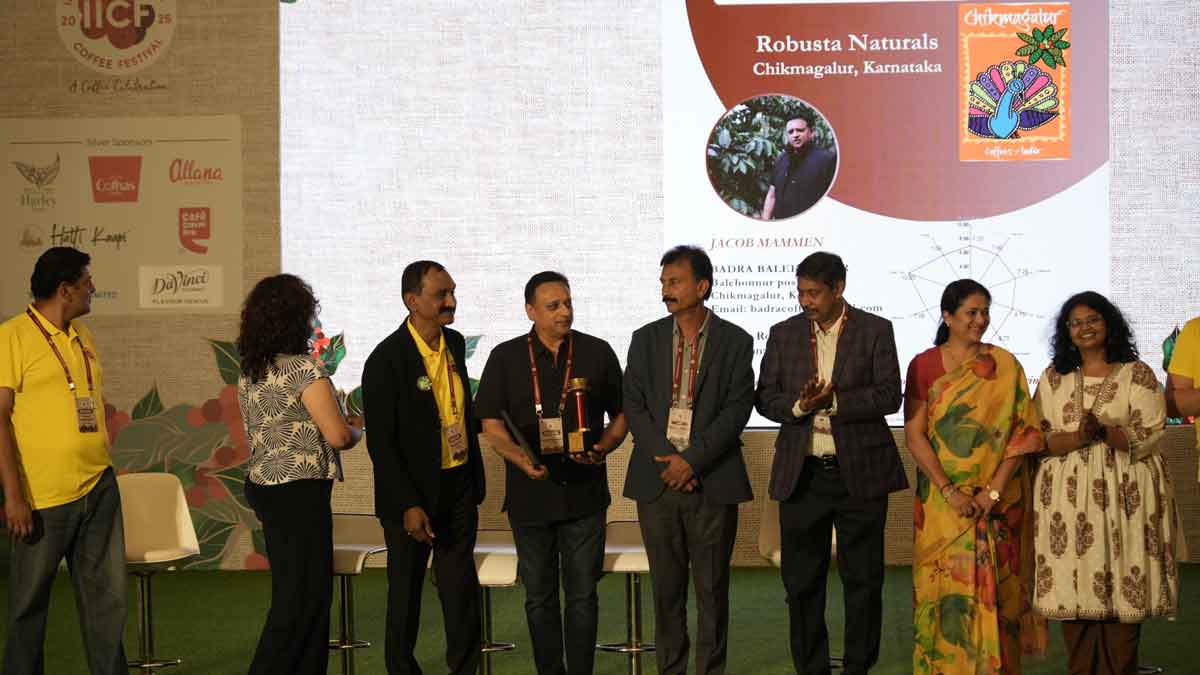
Bengaluru-headquartered Badra Coffee has won the Flavour of India Fine Cup Award for Best Robusta Naturals from the Coffee Board of India. There were seven categories in Flavour of India and the company won the award in the Robusta Naturals category. The company also secured second place in the Robusta Washed category.
The award categories saw participation from different planters from all over the country who had submitted their coffee samples. These samples were tasted by Q graders and coffee professionals. The award was received by Jacob Mammen, managing director of Badra Estates.
Badra Coffee mainly sells to niche coffee roasters in Japan, South Korea, Thailand, Malaysia, Germany, Italy, the UK, Norway, Greece and the US and has launched four blends for the retail market. Three of them, Temple Mountain (Arabica), Misty Heights (single estate) and Kaapi Nirvana (filter), are pure coffees, while Dakshin Fusion is a filter coffee with chicory.
Badra Coffee has estates in Chikkamagaluru Karnataka. Mammen’s great-grandfather bought the estate from Brooke Bond Ltd. Three generations of the family have run Badra Estates and Industries Ltd, which was formed in 1943.
Mammen, a true believer in developing speciality coffee, has worked with reputable international buyers to improve the quality of Badra Coffee. “We call it relationship coffees,” he had told THE WEEK. “We interact with our buyers to understand their requirements of different flavour profiles, and then work on developing coffees that specifically suit them,” Mammen added.
Special attention is also given to manufacturing, which involves washed, semi-washed, and unwashed processes. The company has done different trials in fermentation and has been working with a German buyer who collaborates with the German government.
During the harvest, scientists from Germany visit the farm. They collect samples after many trials. The samples are then taken to their labs in Berlin where they isolate the beneficial microbes prevalent on different estates. These microbes are then used to tweak fermentation and produce a basket of flavours.
source: http://www.theweek.in / The Week / Home> Magazine> News> Business / by Abhinav Singh / April 28th, 2025
The festival celebrated India’s growing coffee culture and featured a vibrant mix of food stalls, lifestyle brands, and live music, creating a lively atmosphere for attendees.
The India International Coffee Festival (IICF) 2025 was held from April 25- 27 at Marakata, Chamara Vajra, on Jayamahal Main Road, Bengaluru. Organised by the Specialty Coffee Association of India (SCAI) with support from the Coffee Board of India, the event brought together some of the country’s finest brewers, baristas, and coffee enthusiasts.
Following its successful 2024 editions in Delhi, Mumbai, and Bengaluru, the festival offered three days of competitions, discussions, entertainment, and interactive experiences. Highlights included the semi-finals and finals of the National Barista Championship (NBC), National Latte Art Championship, National Brewers Cup (NBrC), and the grand finale of the National Filter Coffee Championship.
DM Purnesh, President, Specialty Coffee Association of India (SCAI) said, “IICF has always been an inspiration for coffee lovers, industry experts, and brands. As we return with the much-anticipated semi-finals and finals, we’re proud to once again spotlight and celebrate the country’s finest coffee talent. With seasoned baristas, industry pioneers, and even discerning coffee critics in attendance, IICF 2025 promises to be an unmissable event for anyone passionate about the art of coffee.”
The festival celebrated India’s growing coffee culture and featured a vibrant mix of food stalls, lifestyle brands, and live music, creating a lively atmosphere for attendees. Experts, top growers, roasters, and equipment makers participated, sharing insights into brewing trends and innovations.
Sreeram G, Director, Marketing, Specialty Coffee Association of India (SCAI) said, “The India International Coffee Festival is not just about competition; it’s about connection. This festival serves as a dynamic platform for networking, innovation, and celebrating coffee as a lifestyle. It brings together coffee professionals, aficionados, and industry leaders to exchange ideas, explore emerging trends, and experience the rich intersection of coffee, cuisine, and craftsmanship.”
source: http://www.bwhotelier.com / BW Hotelier / Home> F&B / by BW Online Bureau / April 08th, 2025
We are planning to sell coffee online to popularise and promote GI-tagged coffee and make them accessible to consumers across the country, says Coffee Board Secretary and CEO K.G. Jagadeesha.
The GI-tagged coffee drip bags are designed for simplicity and effortless brewing, says the Coffee Board. | Photo Credit: special arrangement
The Coffee Board on Friday (March 29, 2025) introduced premium GI-tagged single-serve coffee drip bags to strengthen the domestic consumption of pure coffee in the country.
These GI-tagged coffee drip bags are designed for simplicity and effortless brewing and require just hot water and no equipment, said Coffee Board Secretary and CEO K.G. Jagadeesha at a media conference. “Only boiled water and a mug are required to brew a quality cup of pure black coffee,” he said.
Each drip coffee pouch contains five GI-tagged Arabica coffee varieties: Coorg Arabica, Chikmagalur Arabica, Bababudangiri Arabica, Araku Valley Arabica and the Monsooned Malabar Arabica coffee.
According to Mr. Jagadeesha, the drip bags being marketed under the India Coffee brand will be made available across all e-commerce platforms. “We are planning to sell coffee online to popularise and promote GI-tagged coffee and make them accessible to consumers across the country,’‘ he added.
Coffee Board also simultaneously launched Indian speciality coffee like GI-tagged Monsooned Malabar Arabica Coffee and Mysore Nuggets Extra Bold Arabica Coffee. Monsoon Malabar, he said, is the only monsoon coffee (where harvested coffee seeds are exposed to the monsoon rain and winds) in the world, Mr. Jagasheesha added.
Coffee culture
Coffee Board chairman M.J. Dinesh said the Board has been taking initiatives such as Kaapi Shastra, Barista Skills training, and participation in domestic exhibitions to promote coffee culture and thereby drive pure coffee consumption.
“Coffee farmers and entrepreneurs are getting training from the conception stage to the product stage. Even private coffee players can benefit from this training and start focusing on promoting GI-tagged pure coffees of India,’‘ said Coffee Board officials.
Under Atal Innovation Vision, the Coffee Board has been offering training to various coffee farmers and coffee entrepreneurs. Some 68 coffee startups, including over 20 start-ups in Karnataka, have come up under this scheme.
As per CRISIL estimates, India’s current coffee consumption is estimated at 95,000 tonnes.
source: http://www.thehindu.com / The Hindu / Home> News> Cities > Bengaluru / by The Hindu Bureau / March 29th, 2025
Bengaluru’s coffee production outlook, global prices, and the importance of value addition in the industry discussed by Coffee Board officials.
Coffee Board Secretary and CEO KG Jagadeesha said nature played a critical role in coffee farming and if plantations get 6-7 months without a dry spell, next year’s yield would be substantially higher than the last two years. | Photo Credit: Special Arrangement
Bengaluru India’s coffee production for the crop year ending in March 2025 is likely to be 3.52 lakh metric tonnes, while the yield for next year is expected to be much higher than last two years’ yield as most plantations have already received adequate blossom showers helping a healthy berry setting, said Coffee Board CEO and Secretary, K.G Jagadeesha.
However, he said, nature played a critical role in coffee farming and if plantations get 6-7 months without a dry spell, next year’s yield would be substantially higher than the last two years.
He further said the board was currently in the process of wrapping up harvest (which just concluded) volumes data for the current year and preparing a production outlook for next year based on post blossom-shower assessment conducted on plantations across the country.
Global coffee prices to remain high for a year: ICO
Quoting International Coffee Organisation (ICO), Mr. Jagadeesha said, global coffee prices were likely to remain high for one more year as most major producing countries were facing drastic climatic changes.
“The current coffee prices may hold for one more year with marginal growth, however may not double or treble as they did a couple of years ago for arabica and robusta, respectively. I just attended the ICO meeting and this is the sense I am getting regarding prices,” he said.
Globally, coffee prices remained too low for 10 years, before they started climbing last two years ago.
India should focus on premiumisation in coffee
Highlighting the importance of value addition in coffee, Mr. Jagadeesha said, some 70% of Indian coffee were exported as green beans which meant the country has been losing out on premiums.
“We are producing the best quality coffee in the world and selling it as green beans in the global markets and someone else is blending, value adding and forking out premiums. This situation has to change by increasing our focus on value addition to fetch premium prices in the global markets. Some of our growers have already started focusing on value add and premiumisation, but the trend has to become industry-wide,’‘ he insisted.
According to Mr. Jagdeesha, post covid, there is a spurt in coffee consumption globally and this trend has been quite evident in India as well.
Coffee Board Chairman M.J. Dinesh said additional strengthening of the domestic market was required to protect coffee growers in the wake of any international price fluctuations.
“A robust domestic market will provide a shield to the coffee growers against the volatile international coffee prices. It will also encourage entrepreneurship and boost employment opportunities and bring in overall improvement in the coffee value chain. Such a scenario will act as a buffer for Indian coffee,” he added.
source: http://www.thehindu.com / The Hindu / Home> Business / by MIni Tejaswi / March 29th, 2025
The sharp rise on February 11 was attributed to severe crop losses in Brazil and Vietnam — world’s leading coffee producers — due to adverse weather conditions.
The sharp rise on February 11 was attributed to severe crop losses in Brazil and Vietnam — world’s leading coffee producers — due to adverse weather conditions. (Shutterstock)
Bengaluru:
Coffee prices in Karnataka’s Kodagu and Chikkamagaluru markets that recently surged to historic levels was driven by a global supply crunch, according to officials familiar with the matter. Arabica Parchment, a premium coffee variety, soared to ₹29,600 per 50 kg bag in Chikkamagaluru, while Kodagu recorded an even higher price of ₹29,800, marking an unprecedented peak.
The sharp rise on February 11 was attributed to severe crop losses in Brazil and Vietnam — world’s leading coffee producers — due to adverse weather conditions. Experts predicted that recovery will take at least five to eight years, as new coffee plants require time to mature and yield produce.
“Coffee prices are heavily influenced by weather conditions, and it’s impossible to assume that current prices will remain steady,” Coffee Board president Dinesh Devavrinda told HT. He advised growers, particularly those with outstanding bank loans, to capitalise on the price surge by opting for the One-Time Settlement (OTS) scheme, which covers the principal amount up to ₹5 lakh.
India produces approximately 365,000 tonnes of coffee annually, with 70% of the yield exported to European markets. Karnataka is the country’s largest coffee producer, accounting for 70% of national output, with Kodagu alone contributing 32%. The state has 246,000 hectares of coffee estates, yielding 220,000 tonnes annually, while Kodagu, spanning 4,102 square kilometers, produces around 120,000 tonnes from 110,000 hectares of estates.
At the beginning of the year, coffee prices were volatile, but a steep upward trend emerged over the past 10 days, with daily price hikes ranging between ₹500 and ₹1,000 per bag. On January 1, Arabica Parchment was priced at ₹17,000 per 50 kg bag but by the end of the month, it rose to ₹23,500. Other coffee varieties also saw significant increases: Robusta Parchment reached ₹24,500, Arabica Cherry was sold at ₹17,000, and Robusta Cherry hit ₹13,500 in Kodagu markets.
According to market analysts, the absence of buffer stock this year has further aggravated the supply shortage, pushing prices to record highs.
Rajiv Kushalappa, managing director of Leonflix Fintech Ventures Pvt Ltd, a Bengaluru-based coffee export firm, pointed to the impact of global shortages. “Thousands of coffee estates have been destroyed in Brazil and Vietnam, leading to a severe supply crunch in the international market. With no buffer stock available this year, prices have skyrocketed and are likely to remain high for some time,” he said.
For coffee growers, the soaring prices offer much-needed financial relief. “This is the first time I am getting such record prices. Growers have long struggled with high production costs, disease outbreaks, and labour shortages. Arabica coffee estates require significant manpower, and labor costs have risen due to shortages. These higher prices will help growers maintain their estates,” Sannuvanda Kaverappa, a grower from Napoklu in Madikeri, said.
Kodagu, nestled in the Western Ghats of Karnataka, is India’s largest coffee-producing region, contributing nearly 32% of the country’s total output. The district, spanning 4,102 square kilometers, is home to vast coffee estates spread across 1.1 lakh hectares. Known for its rich biodiversity and hilly terrain, Kodagu primarily cultivates Arabica and Robusta coffee varieties. Coffee farming, introduced by British planters in the 19th century, remains the backbone of the local economy, with thousands of small and large growers dependent on it. The region’s coffee is highly sought after in international markets, with 70% of India’s coffee production being exported.
source: http://www.hindustantimes.com / Hindustan Times / Home / by Coovercolly Indresh / February 18th, 2025
On Friday, the farm gate price of raw Robusta coffee berries in Wayanad market rises to a record ₹251 a kg, a significant increase from ₹171 a kg during the same period last year.
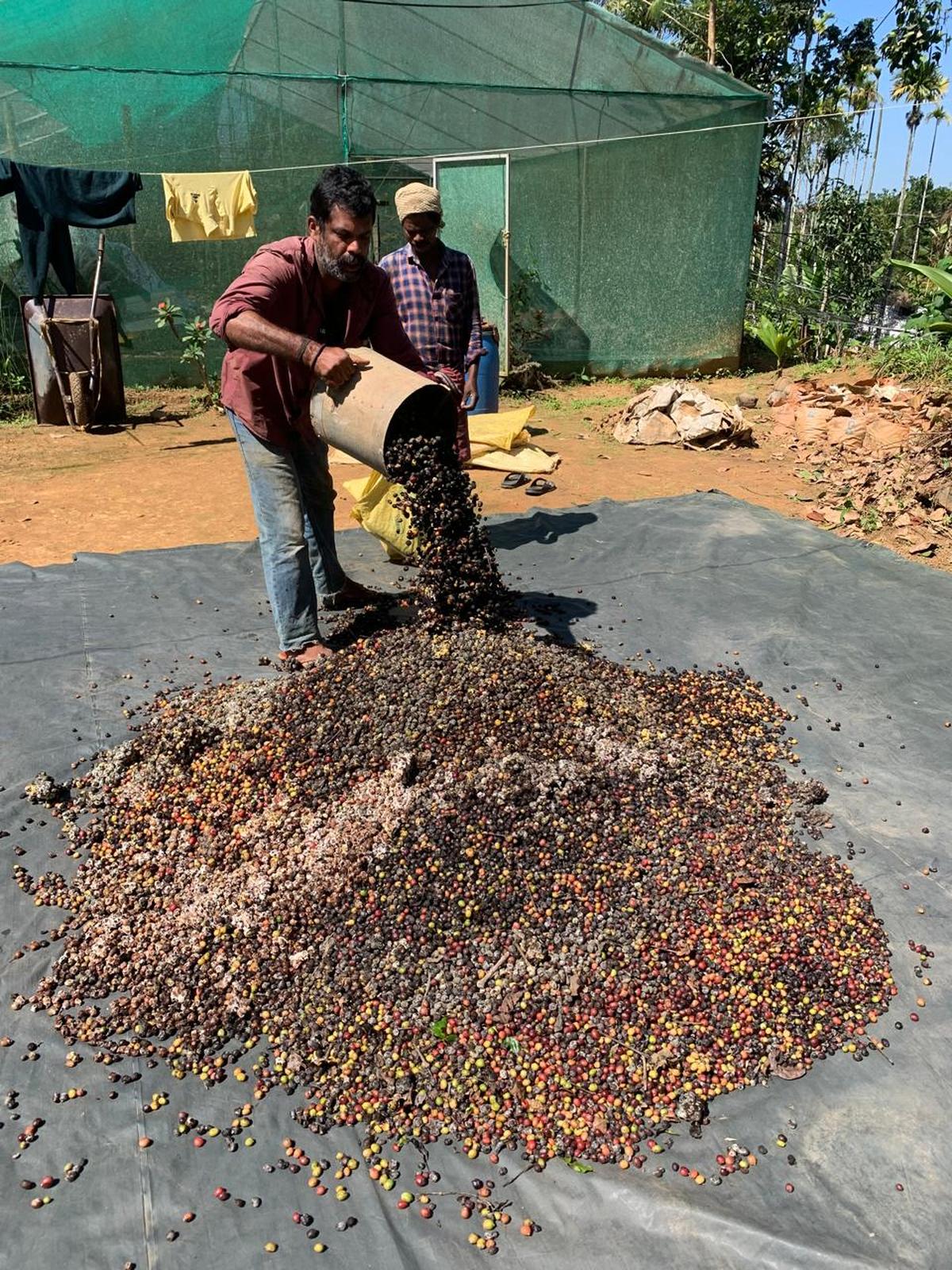
A farmer at Meenangadi in Wayanad district drying coffee berries. | Photo Credit: Special Arrangement
Robusta coffee farmers in south India are celebrating a bountiful harvest season, with prices reaching new heights. On Friday, the farm gate price of raw Robusta coffee berries in Wayanad market soared to a record ₹251 a kg, a significant increase from ₹171 a kg during the same period last year. This time in 2022, the price was even lower at ₹80 a kg.
Though the harvest is almost over, a shortfall in supply has contributed to the surge in prices, according to market sources. Many farmers are opting to hold onto their produce, anticipating even higher prices in the coming days. Concurrently, the spot price for Robusta coffee beans has risen to ₹450 a kg.
Sources say a sharp decline in Robusta coffee production in Brazil, a leading coffee producer, due to drought-like conditions is also driving up the prices. Reports indicate that Brazil’s coffee stock has plummeted to below two million bags (60 kg each) this year, down from nearly 5.5 million bags last year.
Additionally, the coffee market in Vietnam, another key Robusta producer, has been temporarily closed due to lunar holidays, further tightening supply.
The dearth of rainfall is the major concern of farmers now, especially small-scale coffee farmers, as irrigation facilities are out of their reach. Many farmers living on forest fringes are also grappling with increased wildlife crop raids, posing additional challenges.
In a related development, the price of Arabica coffee seeds has also reached an all-time high at an auction held in Bengaluru, fetching ₹605 a kg, up from ₹456 a kg during the same period last year.
According to the Coffee Board of India’s Post Blossom Estimate, the total coffee production in India for the 2023-2024 fiscal is projected at 3,74,200 tonnes, including 2,61,200 tonnes of Robusta coffee, of which Wayanad contributes 61,050 tonnes.
source: http://www.thehindu.com / The Hindu / Home> News> India> Kerala / by E M Manoj, Kalpeta / January 31st, 2025
It will be a welcome relief for coffee growers as they are currently bound by international standards.
The certification process involves checking if coffee producers follow guidelines that focus on quality, the environment, and social practices.(Representative image)
Bengaluru :
In a first, the Coffee Board is set to introduce India’s own coffee standards and certification process to recognise the country’s unique coffee varieties.
Coffee standards are rules set to ensure that the produce is grown, processed, and sold in a way that is consistent, of good quality, and enjoyable to drink. These standards cover everything from how coffee is grown and harvested to how it is processed and packed and evaluated for taste and aroma. The certification process involves checking if coffee producers follow guidelines that focus on quality, the environment, and social practices.
Till now, Indian growers were bound by international standards that did not account for the unique conditions in which their coffee thrives, such as cultivation under two-tier thick tree shade.
The board has introduced this plan in response to the high costs of certification, which have hindered many growers from showcasing their coffee internationally. With nearly 85% of Indian coffee remaining uncertified due to lakhs of rupees in costs for international certification, the new Indian standards will come as a welcome relief as certification will now be free, offering a significant opportunity for growers.
Dr KG Jagadeesha, secretary and CEO of the Coffee Board of India, told TNIE that the process is currently in its first stage and aims to position Indian coffee as a unique product with its own distinct identity. “Until now, most coffee varieties have been certified under international standards, which group all types of coffee together under the same conditions. However, Indian coffee is grown in special conditions.
This certification process will recognise and highlight these unique growing conditions, helping Indian coffee stand out and gain its own global recognition,” he said.
Dr Jagadeesha said the cost of certifying, as per international standards even for a small five-acre estate, can range from Rs 3-4 lakh, while board’s certification will be of zero-cost. Growers have to meet strict requirements, filling in various gaps to ensure that their plantations are sustainable.
While experts and a technical core team have finished developing documents, industry professionals are currently drafting the implementation modules, which will be completed in four months, Dr Jagadeesha said.
After this, the technical team will hold consultations with stakeholders and innovative growers to assess whether the procedures are feasible. The process will involve meeting several parameters. Once the estate meets the requirements, an external inspector will visit them for a final assessment.
source: http://www.newindianexpress.com / The New Indian Express / Home> Bengaluru / by Rishita Khanna / January 03rd, 2024
Coffee Board of India has embarked on a 10-year road map with a target to double the country’s coffee production and coffee exports by 2034, said board chairman M.J. Dinesh on Tuesday (November 19).
“It’s a 10-year mandate starting from 2024 to double our production and also double our exports by 2034. We will also increase the area under production during this period. However, the focus will be on creating best yielding varieties and increasing the production from existing plants through best practices and technology upgradation,” he said.
Addressing coffee growers at the Karnataka Planters’ Association annual conference held here on Tuesday, Mr Dinesh said these activities would include forming 100 FPOs (farmer producer organisations) across the country, of which 60 will be in Karnataka. These FPOs, expected to come up within a year, would create additional momentum for the commodity within the country and in global markets, he anticipated.
What is the offing
He further said that under the 10-year growth plan, the board would also identify 10,000 small coffee farmers who would grow speciality coffee varieties mostly targeted at export markets. “We expect these small farmers to come up with a wide range of speciality varieties that can fetch a premium in the global markets,” he added.
Under the 10-year market expansion plan, the board would also facilitate 10,000 coffee kiosks, mostly managed by women entrepreneurs, to increase the country’s per capita coffee consumption from 107 grams currently to 250 grams in 10 years, he further said.
He also said the board has an ambitious target of nearly trebling the coffee production from 3.7 lakh tonnes in 2024-25 to 9 lakh tonnes by 2047.
Commenting on the possibilities of mechanisation, Mr Dinesh said currently, the growers’ community has been pending a whopping ₹ 1200 crore to ₹ 1300 crore to get the coffee harvested annually through manual labour. This expenditure could be significantly reduced through the use of harvesting machines, and IIT Kharagpur, in collaboration with the Coffee Board, has been working on the prototypes of some such machines.
“Overall, the 10-year plan will certainly give Indian coffees a sizable standing in the global markets. In addition, it will also redefine the coffee landscape of the country,“ he hoped.
KPA chairman K G Rajeev said the grower’s body has made a presentation to the Ministry of Commerce and Industries seeking the inclusion of coffee under PM Fasal Bima Yojana. Presently, coffee farmers are not covered under insurance, while all other plantation crops are covered under insurance. The KPA has also sought assistance from the Govt to promote brand identity for coffee and tea emphasising their quality and unique characteristics. It has also sought exemption or reduction of customs duty on import of agriculture equipment.
source: http://www.thehindu.com / The Hindu / Home> News> India> Karnataka / by Mini Tejaswi / November 20th, 2024
WELCOME. If you like what you see "SUBSCRIBE via EMAIL" to receive FREE regular UPDATES.
Read More »