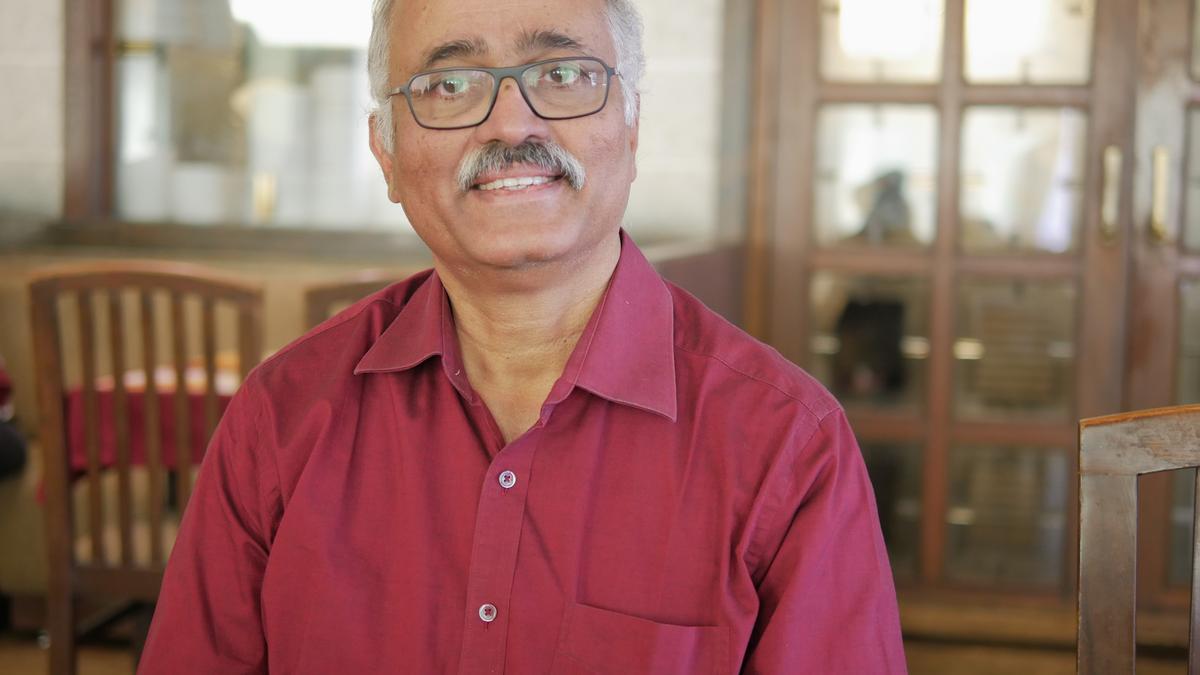
A philanthropist from Kodagu has set an inspiring example by celebrating his 50th birthday in a truly noble way — by gifting homes to the homeless.
Ganesh, a resident of Arji panchayat in Kodagu, marked his milestone birthday by cutting a cake with homeless individuals and gifting them houses.
“No one is permanent in this world. We cannot take anything with us when we leave. Instead of accumulating property and wealth, we should keep only what is necessary and donate the rest,” said Ganesh.
An electrical contractor by profession, Ganesh was born into a poor family and, through hard work, made a living for himself. He understands the struggles of the homeless and has always wanted to help those in need.
“I won the Betoli grama panchayat elections in 2000 by a margin of just five votes, and during my tenure, I became acquainted with the lives of the people. I was re-elected in 2005 and served as vice-president before later becoming a taluk panchayat member. During this time, I met a girl who scored 95% in SSLC but came from a financially poor background. Her hut had no electricity. The video of her studying under an oil lamp went viral on social media, and her story inspired me. I provided a free electricity connection to her family’s hut,” recalled Ganesh.
In 2023, during a panchayat survey, Ganesh came across a woman named Kala from the tribal community, living in poor conditions. He noticed that none of the families in the area were living in decent homes. Moved by their situation, he vowed to help them and assured them of new houses.
He built a four-room house for Kala’s family and handed over the keys to them on January 22, 2024, during the inauguration of the Rama Mandir in Ayodhya, hoping it would be a day they would always remember.
In April 2024, while serving as the taluk president of the Billava community association, Ganesh learned of a woman whose house had collapsed. He immediately arranged for a new house to be built for her as well.
Now, many more families have approached Ganesh seeking housing. As part of his 50th birthday celebrations, Ganesh donated two houses to Shankar and Vasanti. Additionally, he has provided electricity connections to five families through the panchayat.
“I visited the Theremekadu Paisari area for some work and met Shankar’s family, who were living in a hut about to collapse. I promised them a new house and built one at a cost of Rs 1.6 lac, handing over the keys to them,” said Ganesh.
source: http://www.daijiworld.com / Daijiworld / Home> Top Stories / by Daijiworld Media Network – Madikeri (MS) / January 12th, 2025
In a recent cleanliness survey conducted across 50 cities in Karnataka by a private organization, Madikeri has emerged as the cleanest city in India.
Leading in Clean Air and Sanitation Already renowned for having the cleanest air in the country, Kodagu district’s Madikeri has now added another feather to its cap with this prestigious recognition. The achievement is largely credited to the tireless efforts of the city’s sanitation and civic workers, whose dedication has made this milestone possible.
A Call for Citizen Responsibility Social activists have emphasized that maintaining Madikeri’s status as a clean city and preserving its pristine air is a collective responsibility. Citizens are urged to actively participate in cleanliness initiatives to ensure the city continues to shine as an example for others to follow.
source: http://www.thehindustangazette.com / The Hindustan Gazette / Home> News> Latest News / by The Hindustan Gazette / January 10th, 2025
P.T. Bopanna’s book Nanjamma Chinnappa – Chronicler of Coorg Culture looks at how the writer who passed away last year and her husband closely observed and recorded many aspects of the Kodava culture.
P.T. Bopanna | Photo Credit: SPECIAL ARRANGEMENT
The Pattole Palame (Silken Lore), originally compiled by the folklorist Nadikerianda Chinnappa in 1924, is considered a treasure trove of Kodava oral traditions, including songs, rituals, and stories that have been passed down through generations. Originally written in Kodava, it was the late Nanjamma Chinnappa and her late husband Boverianda Chinnappa who translated the work to English in 2003, making this treasured piece of literature accessible for Kodavas as well as others interested in oral literature around the globe.
As the celebrated author passed away in March 2024, writer and journalist P.T. Boppanna is set to release a book honouring her, titled Nanjamma Chinnappa – Chronicler of Coorg Culture. The book is a collage of works of Nanjamma that talks about her setting the image of a quintessential Kodavathi, her work on the architectural heritage of Kodagu, ancestral homes and Coorg cuisine. It is also a personal tribute looking at how the Chinnappa couple guided Bopanna’s journey as an author.
Speaking to The Hindu, Bopanna said that Nanjamma and her late husband worked as a team for various projects and were associated with some of his work too. “The Chinnappas were closely associated with my book and website projects for over 15 years,” he said.
Book on Nanjamma Chinnappa by P.T. Bopanna. | Photo Credit: SPECIAL ARRANGEMENT
The couple’s journey
“Nanjamma, a statistician of international repute, and her husband Chinnappa, an engineer, left for Cambridge, England, in 1974 where Nanjamma was a visiting fellow of Cambridge University. In 1975, they went to Canada to continue their careers and returned to India in 1995. Their first project after returning from Canada was to translate into English Pattole Palame, a book on Kodava culture, folk songs and traditions, written by their common grandfather Nadikerianda Chinnappa,” he explained.
Boppanna said that it took Nanjamma and her husband nearly eight years to complete the translation of the book which runs into 700-plus pages and was published in 2003. “The couple will be remembered mainly for their monumental book Ainmanes of Kodagu, on the traditional dwelling places of the original inhabitants of Kodagu. The Chinnappas believed that Ainmanes (house of elders/ancestral home) and their surroundings were sacred heritage sites that need to be preserved for future generations,” he said.
The Chinnappas are said to have visited close to 700 traditional and functional Ainmanes belonging to all communities in Kodagu and clicked 1,500 photographs during their field-work which took them five years. The book was published in 2014. “The couple also put together a website www.ainmanes.com that contains detailed information and photographs of each Ainmane visited, including oral narratives related to the Okka (clan) to whom the Ainmane belongs,” explained Boppanna.
A personal connect
The couple took a lot of interest in Boppanna’s own work on Kodava heritage and guided him in many ways, he said. “The Chinnappas were associated with my book and website projects since around 2007. They had gone through the manuscript of all my nine books, including my last book Round and About with P.T. Bopanna, published in 2022. They checked my books for grammatical and factual errors and offered suggestions for improving the content. Initially, I used to visit their home in Bengaluru. After they shifted to Mysuru a few years ago we exchanged emails and messages. They wrote the foreword for my book Are Kodavas (Coorgs) Hindus? They also wrote the afterword for my book My Coorg Chronicle,” he explained.
Boppanna said that one of the highlights of this book is the interview of Nanjamma by Dr. Nervanda Veena Poonacha, an eminent sociologist and women’s studies scholar. Veena had spoken to Nanjamma on the latter’s life journey. The foreword for the book has been penned by Dr. Sowmya Dechamma C.C., Professor, Centre for Comparative Literature, University of Hyderabad.
In the foreword of the book, Dechamma says that those who are even slightly familiar with the Kodavas of Kodagu and their increased awareness of Kodava language, culture and identity politics in the last three decades or so, would have definitely come across Nanjamma Chinnappa, her work and her ideas.
Context of their work
“On 31st March 2024, Nanjamma left us, leaving a void in the Kodava world. If an earlier generation of Kodava writers and intellectuals like Pandyanda Belliappa, I.M. Muthanna, B.D. Ganapathy, set a foundation for a discourse about the different identities of the Kodava, it was around a time when limitations of literacy and media restricted access to their work and discussions around them. The times in which Nanjamma and her husband and collaborator in her work, Chinnappa, began researching, writing and translating on the Kodavas, their work began appearing during a period of immense growth in media, combined with changes in the larger socio-economic scenario that had bearings on identity politics of the 1990s and thereafter. The opening up of the economy and large-scale migration of the Kodavas into urban centres along with an awareness of a distinct Kodava identity was the context in which Nanjamma and Chinnappa’s works were received,” she says in the foreword.
What Dechamma finds of immense significance in this volume is the interview of Nanjamma by Veena Poonacha that charts Nanjamma’s life and work. “Her review of works by Nanjamma and Chinnappa are equally valuable. Bringing together in one place the reflections and works by Nanjamma and Chinnappa is one of the best tributes possible to the life and work they were part of. Their effort in spreading indigenous knowledge associated with Kodavas and Kodagu needs us to take their work further,” she says.
Priced at ₹195, the book Nanjamma Chinnappa – Chronicler of Coorg Culture is published by Prism Books Pvt. Ltd,. and is available for purchase on online stores such as Amazon and Flipkart.
source: http://www.thehindu.com / The Hindu / Home> News> Cities> Bengaluru / by Yemen S / January 03rd, 2024
Justice Suraj Govindaraj ruled that the state cannot exploit a mistake made by a citizen in categorising the land as ‘sagu bane land’ when it was, in fact, alienated ‘sagu bane land’, and retain the deposited amount.
Representative image showing a forest./ Credit: DH Photo
Bengaluru:
The Karnataka High Court has directed the Forest Department to refund Rs 4.33 lakh, along with 6 per cent interest, to the legal heirs of a Kodagu landowner, Mahabaleshwar Bhat, who had deposited the amount in 1982.
Justice Suraj Govindaraj ruled that the state cannot exploit a mistake made by a citizen in categorising the land as ‘sagu bane land’ when it was, in fact, alienated ‘sagu bane land’, and retain the deposited amount.
Bhat, who owned 38.5 acres in Biligeri Village, Madikeri taluk, Kodagu district, had received permission on February 1, 1983, to cut 349 trees on the property. He subsequently paid Rs 4,33,082, the assessed value of the trees. However, he later realised that the land had been classified as alienated ‘sagu bane land’ since 1897, making the payment unnecessary.
Bhat requested a refund from the authorities, but his plea was rejected by the Forest Department on April 25, 2012, citing the Karnataka Land Revenue Act, 1964, as grounds for denial. After the department’s appellate authority also dismissed his appeal, Bhat moved the high court.
During the pendency of the case, Bhat passed away and his legal representatives were substituted as petitioners in 2023. The court found that the Forest Department failed in its duty to verify the land’s classification.
“In fact, it was for the assistant and chief conservator of forest to verify these from the records concerned and not go by the statement made by the petitioner himself. Whenever any application is filed by any person claiming permission to cut trees, there is a duty imposed on the authority granting such permission to verify the details. If at all the details had been verified, it would have been clear that the land in question is alienated ‘sagu bane land’ and not un-alienated ‘sagu bane land’.
This aspect has been made clear by the deputy commissioner in his order dated March 29, 2010,” Justice Suraj Govindaraj said.
source: http://www.deccanherald.com / Deccan Herald / Home> India> Karnataka / by Subarna Mukherjee , DH Web Desk / January 03rd, 2025
It will be a welcome relief for coffee growers as they are currently bound by international standards.
The certification process involves checking if coffee producers follow guidelines that focus on quality, the environment, and social practices.(Representative image)
Bengaluru :
In a first, the Coffee Board is set to introduce India’s own coffee standards and certification process to recognise the country’s unique coffee varieties.
Coffee standards are rules set to ensure that the produce is grown, processed, and sold in a way that is consistent, of good quality, and enjoyable to drink. These standards cover everything from how coffee is grown and harvested to how it is processed and packed and evaluated for taste and aroma. The certification process involves checking if coffee producers follow guidelines that focus on quality, the environment, and social practices.
Till now, Indian growers were bound by international standards that did not account for the unique conditions in which their coffee thrives, such as cultivation under two-tier thick tree shade.
The board has introduced this plan in response to the high costs of certification, which have hindered many growers from showcasing their coffee internationally. With nearly 85% of Indian coffee remaining uncertified due to lakhs of rupees in costs for international certification, the new Indian standards will come as a welcome relief as certification will now be free, offering a significant opportunity for growers.
Dr KG Jagadeesha, secretary and CEO of the Coffee Board of India, told TNIE that the process is currently in its first stage and aims to position Indian coffee as a unique product with its own distinct identity. “Until now, most coffee varieties have been certified under international standards, which group all types of coffee together under the same conditions. However, Indian coffee is grown in special conditions.
This certification process will recognise and highlight these unique growing conditions, helping Indian coffee stand out and gain its own global recognition,” he said.
Dr Jagadeesha said the cost of certifying, as per international standards even for a small five-acre estate, can range from Rs 3-4 lakh, while board’s certification will be of zero-cost. Growers have to meet strict requirements, filling in various gaps to ensure that their plantations are sustainable.
While experts and a technical core team have finished developing documents, industry professionals are currently drafting the implementation modules, which will be completed in four months, Dr Jagadeesha said.
After this, the technical team will hold consultations with stakeholders and innovative growers to assess whether the procedures are feasible. The process will involve meeting several parameters. Once the estate meets the requirements, an external inspector will visit them for a final assessment.
source: http://www.newindianexpress.com / The New Indian Express / Home> Bengaluru / by Rishita Khanna / January 03rd, 2024
It is the duty of the forest authorities to verify official records before allowing applications seeking permission to cut trees, the High Court of Karnataka has said, while finding fault with the authorities for refusing to refund the amount deposited by a land owner by mistake, though he was not required to deposit it while seeking permission to cut trees on his land.
Justice Suraj Govindaraj passed the order while allowing a petition filed by N. Mahabaleshwara Bhat, a resident of Biligeri village in Madikeri taluk of Kodagu district.
The petitioner, who died during the pendency of petition filed in 2016, deposited ₹4.33 lakh with the forest authorities to seek permission to cut several trees on his Sagu Bane land.
However, he realised later that his was alienated Sagu Bane land for which there was no need to deposit money, and hence he requested the authorities to refund the deposited amount. But the forest authorities rejected his request, stating that he himself had described his land as Sagu Bane land in his application.
Negating the contention of the authorities, the court said that it was for the Assistant Conservator of Forest and the Chief Conservator of Forest to verify nature of the land from the records and not to go by the statement made in the application.
If at all the details of the land had been verified by the forest authorities, it would have been clear that the land in question was alienated Sagu Bane land as this aspect was made clear by the Deputy Commissioner in his order passed in 2010, the court said, while stating that there was a duty imposed on the authority to very the records before granting such permissions.
source: http://www.thehindu.com / The Hindu / Home> News> India> Karnataka / by The Hindu Bureau / January 03rd, 2024
Retired IAS officer, Rathi Vinay Jha, has been selected as Coorg Person of the Year 2024 in a poll conducted by a news and tourism portal, www.coorgtourisminfo.com.
With her roots in Kodagu district in Karnataka, Ms. Rathi Vinay Jha, a former Union Tourism Secretary, had initiated several projects to “conserve Kodava culture and the martial traditions of the comunity, known for its contributions to the nation in the areas of defence and sports,” author P.T. Bopanna, who runs the portal pointed out.
He said Ms. Rathi was instrumental in setting up the virtual museum of Kodava heritage and culture, the project known as Sandooka — a treasure trove of information.
“The virtual museum is an interactive online space, brought together through material contributed by the Kodava community. Sandooka will be a living museum of Kodava culture and will be useful for future generations of Kodavas.”
“It was at the instance of Ms. Rathi, a model of Kodava ainmane (ancestral house) was inaugurated this October in Dakshinachitra Museum near Chennai,” Mr. Bopanna said.
Dakshinachitra is home to 18 traditional houses that depict the unique culture of South India. The ainmane project involved dismantling a structure built in 1852 in Kodagu and was transported to Dakshinachitra Museum, said Mr. Bopanna.
source: http://www.thehindu.com / The Hindu / Home> News> India> Karnataka / by The Hindu Bureau / January 01st, 2025
Kanthur Friends team from Murnad (Maragodu) in Kodagu from Karnataka emerged victorious in the women’s throwball championship by defeating P G Pudur team from Coimbatore in straight sets.
Meanwhile, Alif Star team from Chikkamagaluru (seen in picture below) defeated Palli Friends team from Udupi in the men’s volleyball match in a thrilling contest.
The grand finale was held in the presence of the 112-foot-tall Adiyogi at the Isha Yoga Center in Coimbatore. The winning teams won a cash prize of ₹5 lakh, bringing the event to a grand close.
Along with Sadhguru, cricket legends Virender Sehwag and Venkatesh Prasad graced the historic occasion. Thousands of spectators from India and abroad came to watch the event.
Isha Gramotsava is a two-month sports festival held across the South Indian states of Karnataka, Andhra Pradesh, Telangana, Kerala, Tamil Nadu and the Union Territory of Puducherry.
Held in over 162 rural areas, the festival saw the participation of over 43,000 players.
More than 10,000 of them were rural women, most of whom were housewives – volleyball and throwball Participated in matches.
Started by Sadhguru in 2004, Isha Gramotsava aims to bring sports and the spirit of play into the lives of rural communities.
Apart from professional players, the festival provides a platform for ordinary rural people, including daily wage workers, fishermen and housewives, to step away from their daily activities and experience the celebration and unifying power of sports.
source: http://www.mysoorunews.com / Mysooru News / Home> General / by Mysooru News Desk / January 01st, 2025
The soldier, identified as Deevin Palangoti, hails from Alur Siddapura in Kodagu.
Deevin Palangoti / Credit: Special Arrangement
A 28-year-old soldier from Kodagu district in Karnataka succumbed to his injuries on Monday that he sustained after an Army vehicle, in which he along with others were travelling, fell into a gorge in Poonch district of Jammu and Kashmir on December 24.
The soldier, identified as Deevin Palangoti, hails from Alur Siddapura in Kodagu.
His lungs were critically damaged when the army vehicle fell into a gorge. He was admitted to a hospital in Srinagar for treatment. Divin’s mother, Jaya had reached the hospital.
Deevin was the only child of his parents and had joined the Army ten years ago. He was engaged to be married in February. In fact, he had built a new house for the family a year ago.
It may be recalled that three jawans from Karnataka – Subedar Dayanand Thirakannavar (44) from Belagavi, Lance Havaldar Anoop Poojary (33) from Kundapur and Mahesh Marigond (25) of Mahalingpur in Bagalkot district were earlier killed in the Poonch accident.
source: http://www.deccanherald.com / Deccan Herald / Home> India> Karnataka / by Naina J A, DHNS / December 30th, 2024
The rare plant can be found in a coffee plantation on the church grounds of the British-built CSI in Pallikunnu near Kuttikkanam.
The 150-year-old coffee plant on the church grounds of Pallikkunnu CSI church in Idukki. | Photo Credit: JOMON PAMPAVALLEY
Those who visit the premises of the British-built Church of South India (CSI), in Pallikunnu near Kuttikkanam in the Idukki district, can see a coffee plantation on the church grounds. It is believed that the British planted coffee on the land owned by the church, which is over 150 years old, during the early period of the plantation industry in Peerumade.
The Church Missionary Society (CMS) constructed the cross-shaped church in 1869 on a 15-acre plot of land gifted by the then ruler of erstwhile Travancore. According to church authorities, the church plans to preserve the historically valued coffee plant in Pallikkunnu.
Pallikkunu St. George CSI Church Vicar Fr. Liju Abraham said that the plant is situated among a group of coffee plants on the church property. “Earlier, the church authorities contacted the Coffee Board officials to ensure the protection of the plant. Two years ago, the Coffee Board officials visited the church, inspected the plant, and assured support for its preservation. But the initiative came to a standstill after we failed to get a certificate from the church. The church aims to secure government support for the initiative,” said Fr. Abraham.
CSI East Kerala Diocese public relations officer Viju P. Chacko said, “The church needs to separate the 150-year-old plant from the group of coffee plants and create a special passage for visitors to view the rare plant. The plant could serve as a window for visitors into the plantation culture of Peerumade,” noted Mr. Chacko.
Kerala State Biodiversity Board (KSBB) district coordinator Ashwathi V.S. said that the KSBB can ensure the preservation of biodiversity-rich trees or plants through the Biodiversity Management Committee (BMC) in any area. “The concerned panchayat biodiversity management committee needs to submit a report to the Kerala State Biodiversity Board (KSBB) in this regard.” Additionally, Ms. Ashwathi recommended that the church authorities submit a letter expressing their willingness to preserve the plant.
Interestingly, during the initial period of the plantation industry in Idukki, coffee plants were the crop of choice. The book Above Heron’s Pool by Heather Lovatt and Peter de Jong, describing the plantation history in Peerumade and Vandiperiyar, sheds light on the change. “In 1875, a leaf disease caused significant damage to the coffee plants, prompting the planters to switch to growing tea instead. The book further states that Thengakal, near Peerumade, once achieved the highest coffee yield in southern India, producing two tonnes of cured coffee per acre,” said the book.
source: http://www.thehindu.com / The Hindu / Home> News> India> Kerala / by Sandeep Vellaram / December 29th, 2024
WELCOME. If you like what you see "SUBSCRIBE via EMAIL" to receive FREE regular UPDATES.
Read More »