Star Indian doubles player hopes to get facility with four clay courts running by April
Dubai:
Indian doubles ace Rohan Bopanna will launch his tennis academy in Bengaluru next month.
35-year-old, who has struck a successful partnership with Romanian Florin Mergea on the ATP World Tour said that the focus of his academy will be on tapping talent in the 4 to 14 years age-group.
The academy that will be located on the outskirts of the country’s IT capital, is a personal initiative from the Indian Davis Cup player.
“I want to do this my way. I want the primary focus to be on fitness because that’s the most important factor in our sport today, also if the child then doesn’t want to play tennis, he or she can play another sport because they will already have the necessary early training,” Bopanna told Gulf News after he and Mergea had lost in the doubles to the veteran pairing of Daniel Nestor and Radek Stepanek.
Bopanna disclosed that he is teaming up with former South African professional Piet Norval and fitness trainer Yash Pandey in his new venture.
“Piet has done a fantastic job with kids back home in South Africa,” Bopanna said.
“He will visit the facility once every month for a week. I want to focus on juniors to begin with and then see if I want to expand in the future. Right now it’s all about a wholesome exposure to children who want to play the sport. I’m only having clay courts now because it’s easier on the body, more so when kids are learning the sport,” the 35-year-old added.
Bopanna will launch the academy with just four courts late next month before going into business probably a month later. “I’ve spoken to a lot of schools and the response so far has been very good. The idea is to get as many kids as possible playing the sport. The more the numbers, the greater our chances for success,” he said.
Bopanna and Mergea, ranked 8 and 12 individually, and placed 14 as a team, haven’t had a great start to the new season. Last year, the pair surprised a few when they sailed into the doubles final at the season-ending Barclays ATP World Tour Finals held at the O2 Arena. After Dubai they are scheduled to play Indian Wells and Miami before they hit the European trail for the clay court stretch.
source: http://www.gulfnews.com / Gulf News / Home> Sport> Tennis / by Alaric Gomes, Senior Reporter / February 27th, 2016
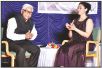
Niranjan Nikam in conversation with Yamini Muthanna.
Mysuru is the Ashtanga Yoga capital of the world, a sobriquet which is music to the ears of Mysureans, after the cleanest city tag for the second time. The city has also produced two of the finest yoga exponents in the world, B.K.S. Iyengar and Pattabhi Jois. However, there is one more Guru, who is quietly doing his bit on whom many discerning yoga practitioners swear — it is B.N.S. Iyengar.
Bengaluru-based Yamini Muthanna, dancer and yoga exponent, is one such. She was in city recently to participate in the launch function of her book “The Power of Yoga” at Dhvanyaloka Open Air Theatre.
After the book launch, organised by the Mysore Book Club, a first-of-its-kind experiment in Mysuru, Yamini, who gave a breath-taking yoga demonstration, shared her views on how the book shaped, the power of yoga, the undue importance for competitions and why everybody should practice yoga, with Senior Journalist N. Niranjan Nikam. Excerpts. — Ed
by N. Niranjan Nikam
SOM: We just saw your demonstration of yoga. I was thinking all the time, aren’t children the best yogis because their body is so flexible. How is it that we lose all that and only when we see people like you, we say to ourselves, “I wish I was like her — flexible, elastic and graceful.”
Yamini Muthanna: Children are natural Yogis. They are so free in their mind and body so the Asanas are easy for them. They do not have points of resistance either in their body and mind due to stress or tension that an adult might have. Therefore, I personally feel that flexibility in a Yoga Asana practice is a product of freeing the body and mind rather than putting in a lot of imposed effort. Anybody can train to be flexible with proper training of the body and freedom in mind. Yoga Asanas are patterned so beautifully that the body can be slowly animated into an Asana with proper judgement and care.
SOM: Yamini, you started yoga at a young age and you have come a long way. What made you write “The Power of Yoga?”
Yamini: My practice of Yoga has been extremely beneficial for me in all circumstances of my life. It helped me cope during my teenage through motherhood. I have been in constant touch with my body and mind and Yoga has helped me to be always aware. Once I started teaching from 2001 onwards, I noticed it was helping my students also to deal with situations better than how they used to handle things before they started practice. I started documenting their progress and started prescribing need-based specific practice sessions. It was helping my students and, therefore, I decided to share it for a larger group of yoga enthusiasts. My message in the book is you can choose your daily practice according to your day’s needs and have tried to explain how it works.
SOM: I learnt a little bit of yoga about 25 years ago from a Guru here. Later, I practiced for quite some time with the book, “Light on Yoga,” by B.K.S. Iyengar. Your book is equally interesting as you make it look very simple, how far have you come?
Yamini: Guru B.K.S Iyengar’s book is my Bible for my personal Asana study. He has set the benchmark of perfection in the Asanas and I am yet to come across another book equal to that of “Light on Yoga.” The book has been my Guru ever since I started personal practice. I did personal practice from 1996 to 2001 before I started to teach. I did a thorough study of the book, summarised by Guru B.N.S. Iyengar’s teachings and built up my practice, experimented my understanding and documented them in a way which would be easy for a Yoga Practitioner to comprehend. My book is not about loads of information but it is a guide to delve deeper in the practice by triggering a curiosity.
SOM: Yamini, you were talking to me about angles and Trikonasana which is the cover page that has caught you in action is such a perfect pose. Share a little about angles and sequences with our audience.
Yamini: I have a strong understanding that Yoga Asanas are geometric patterns from the Sri Chakra Yantra. I do not want to go to the details of it as I do not have proof and specific information about it. Just as Guru B.N.S.Iyengar mentioned in his speech earlier that the body will get chiselled into a fine cut diamond with perfect glitter in the body with the practice of Asanas and Pranayama. I would like to add that perfect geometry exists in pyramids and prisms also creating certain beneficial energy source forming specific benefits in the universe. It is in the same lines I personally feel that Asanas are also patterned to generate specific benefit to the body. Therefore, it is very important to maintain perfect lines in an Asana construction.
SOM: You have talked at length about asanas, chakras, mudras, pranayama and their benefits, all with photographs and you yourself doing each one of them. However, you have not mentioned time needed for each asana, or have I missed it?
Yamini: No I have not gone too much into the details of these deeper practices of Hatha Yoga as I do not want practitioners to try them on their own with the help of a book as they could be dangerous. It is very important that their first instruction comes from a Guru. I have just mentioned them as an information guide into the future practice.
SOM: You said that you do not believe in giving certificates. I would like to share my experience — I had written a story about yoga talking to a teacher about four years ago titled “Posturing ‘Olympics’ (op)position.” I had read an article in Deccan Herald about a move to include yoga performance in Olympics. The yoga teacher had opposed this idea and I had even quoted that B.K.S. Iyengar was also not in its favour. You yourself and a few noted yoga exponents including Sharath Jois, grandson of Pattabhi Jois, whom I met the other day does not favour it. When I sourced this article of mine which I had promptly forgotten, after four years, I was pleasantly surprised to see that there were 39 comments on it but all blasting me away to glory.
Yamini: I do not agree that Yoga Asana be treated as sports. Yoga is all about a personal well-being routine rather than challenge or competition. Your practice is your personal journey and you don’t need to get a medal or stand on a victory stand to announce your success. You silently practice yoga and reap the glory of the practice by using it in life and your routine mundane activities. It’s not sports.
SOM: But you yourself had participated in competitions earlier. In fact that is how you started your tryst with yoga.
Yamini: I did go for two competitions in 1986 and 1987, won the championships and understood it was a mistake. Master was also not too pleased by it. I did not inform him before entering the contest, because I knew he would not let me. I was sorry for a long time for that mistake.
SOM: What is the difference between a Nadia Comãneci’s perfect ten and yoga postures is the question many ask? Can you highlight the difference?
Yamini: Well, I am going to answer this in brief. Gymnasts use a lot of kinetic energy in their postures and expel a lot of force and energy to get into their perfect positions. Yoga uses potential energy with holds and binds in the asanas conserving energy. So some of the postures look the same but the benefits and the source of construction are different in both Yoga and Gymnastics.
SOM: Yamini you are a Kodava — and Kodavas are slim, tall, elegant, beautiful, handsome, rugged and with wiry bodies. The trouble sometimes is, we stereotype people. Did you turn a vegetarian when you started practicing yoga?
Yamini: I am a proud Kodavathi rooted in my Kodava culture and tradition. I have not given up anything at all. But my personal development has adopted various principles from my study of the two classical disciplines. They are my personal principles that do not interfere with my home culture, which is Kodava. [Daughter of Chendrimada Raja (late) and Sundari, Yamini is married to Kotera C. Muthanna].
No I did not turn vegetarian when I started practicing Yoga, though I changed a lot of principles to suit my practice. However, I am not a great fan of non-vegetarian food. You can call me a “No-fussytarian.” I eat whatever is healthy.
SOM: How much of your yoga has influenced your dance?
Yamini: A lot, in terms of energy and health. Breathing especially gets regulated when we do rigorous dancing. It has helped me keep my body agile and supple and less injury-prone.
SOM: What are your future plans and why the word ‘Power’ in the title of the book?
Yamini: Future plans — I shall keep doing what I am doing with more passion and conviction. I shall keep replenishing my knowledge in these two subjects. With the blessings of my Gurus, I have no doubt in accomplishing this; I will need their support and guidance always. I have already started my next book on Yoga, which would be exclusively for women from 18 to 80. The contents are just shaping up. I feel it will give an interesting perspective on woman’s body and how Yoga could benefit maintenance.
“Power,” I can’t think of a better term for Yoga. Yoga is a source of Power to better your life. As one adapts Yoga into his/her lifestyle, it becomes more and more obvious. I am using the term to emphasise this fact… It’s been my personal Power.
source: http://www.starofmysore.com / Star of Mysore / Home> Feature Articles / by Niranjan Nikam / February 24th, 2016
“Look at me… don’t you notice any change,” said Jwala Gutta, displaying her toned down body.
“This is what our doubles coach has done. I am much fitter now. He brought a number of changes to our game, more particularly to my fitness,” said Jwala, who lost at least 11 kgs in the last five months. Earlier, it was difficult to push Jwala in many aspects. But new doubles coach Kim Tan has found a way on how to deal with talented senior players.
Ever since he took over five months back, Kim is working hard with the doubles teams. After acrimonious exchanges with national coach P Gopichand, which made headlines, Jwala and her partner Ashwini Ponnappa came back to train at the Gopichand Academy and started working with Kim. Kim took time to understand the doubles scenario in India and succeeded in creating a working atmosphere.
“My contract with Badminton Association of India is up to 2020. I have to make some good contributions before that. When I came here I was happy with the things around. I realised that I had to deal with two aspects, the senior doubles team like Jwala-Ashwini, who have achieved success, and a few junior doubles pairs. So I have a plan for them,” Kim said.
Kim is also planning to use Ashwini in mixed doubles. Known for effective smashes which are packed with a lot of power, Ashwini hardly played in mixed doubles events. “Manu Attri and Ashwini will be playing the mixed doubles event. We have finalised on that. They will make an exciting pair,” said Kim, adding that he has plans for others as well.
source: http://www.timesofindia.indiatimes.com / The Times of India / News Home> Sports> Badminton / M Ratnakumar / TNN / February 18th, 2016
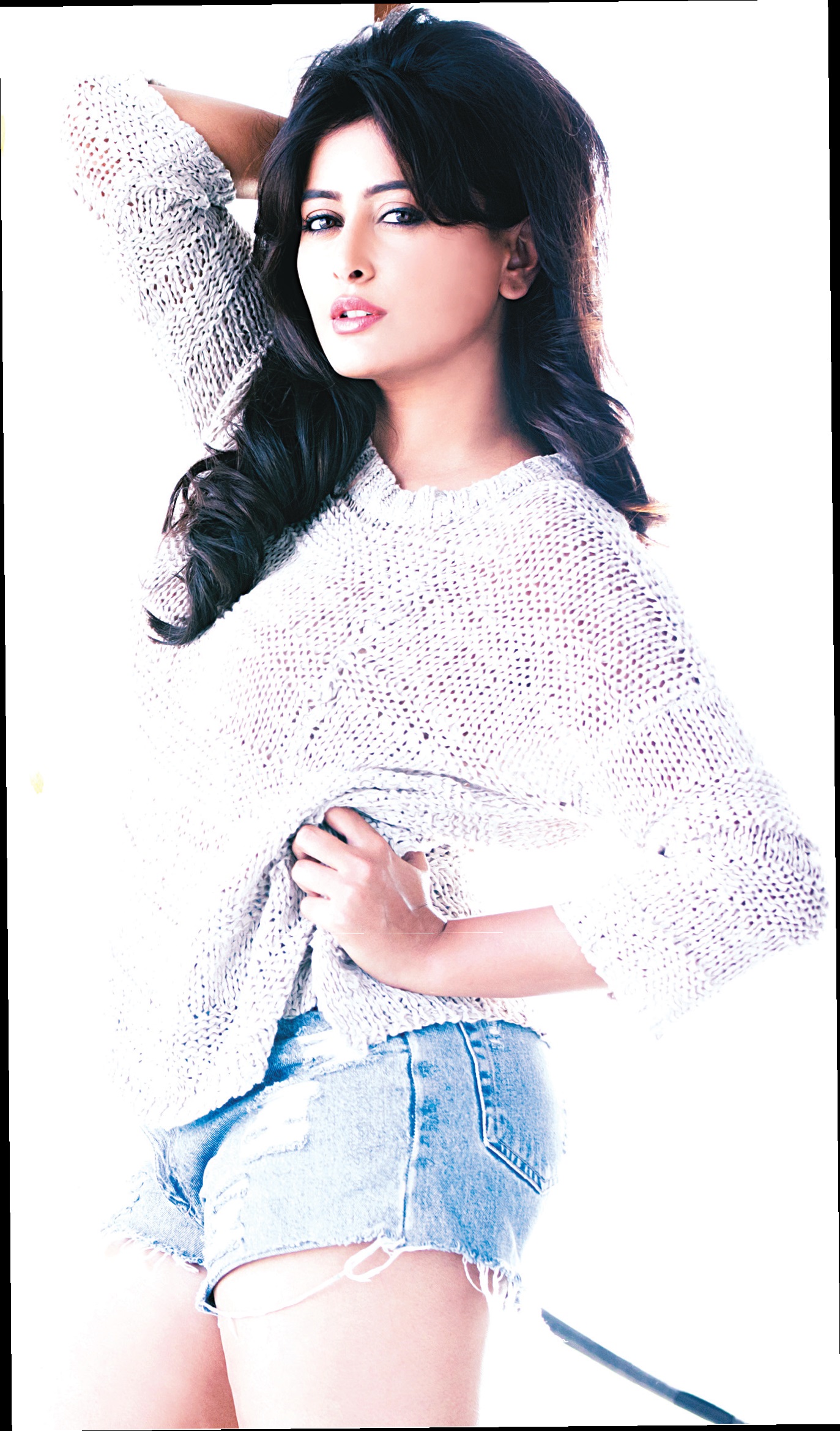
Having featured in seven Sandalwood films, most notably Pancharangi,Krishnan Marriage Story and Anna Bond, Nidhi Subbaiah knew that her destiny was not to crawl about in a fenced comfort zone, but to soar through clouds of limitless ambition, even if it meant enduring the storms.
Nidhi Subbaiah
Having opted to make her debut in Bollywood with a cameo in the blockbuster Oh My God! and progressing to the grab the lead role in the tanked Ajab Gazab Love, Nidhi has battled odds. She now awaits two back-to-back B-town releases this month — Direct Ishq, releasing next Friday, and Love Shagun, which releases on February 26. Speaking to City Express about her journey in Bollywood, the actress who has made Mumbai her home since 2012 says she is four films old now with another film releasing in May. “I didn’t have a godfather in Sandalwood but still made a mark and it is the same belief that I carry in B-town too. Of course, it is tough, but talent does not go unrecognised. After seeing so many people who are still trying to make it to B-town, I feel lucky to have made it,” she says and adds, that she is gifting herself two films for her birthday on February 16.
According to her, it is her belief of utilising one’s potential to the maximum that has taken her so far. “Bollywood is big and if you have been accepted as a fish, why limit yourself to a pond when there is an ocean. Everyone wants to be part of Bollywood, and if they say otherwise, they are lying. I have seen a lot of Kannada actresses coming to Mumbai and trying their best to make it. I am glad to know the cremede la creme of Bollywood, who also recognise me,” Nidhi says.
Talking about her role in Direct Ishq and Love Shagun, she says, “I play a character named Dolly Pande in Direct Ishq, where I am paired opposite Rajniesh Duggall, who is born and brought up in Banaras. It was fun for me, a South Indian, playing this UP girl. I had to attend workshops before I got into the character and perfected the slang. I also play a rockstar, which is another shade of mine in the film.”In Love Shaguan, she plays a party going girl running a boutique in Goa, who knows the importance of moral principles. “Thankfully, I play the solo lead in both films, which demands a lot of effort towards acting. And, at times, the directors were surprised I could pull off a role on my own. I am open to challenges and don’t hesitate to experiment,” she says.
As of now, Nidhi is open for films in Sandalwood and and Bollywood. “Right now, I am doing a Kannada film, Nanna Ninna Prema Kathe, and it is a brilliant story. I like to be at a place, where directors feel that I can perform and fit into a role, irrespective of whether it is Hindi or Kannada,” she says.
source: http://www.newindianexpress.com / The New Indian Express / Home> Entertainment> Kannada / by A Sharadhaa / February 13th, 2016
Shanvi Srivastava returns to the big screen with the Sumanth Shailendra-starrer Bhale Jodi.
Adding to the glam quotient are actresses Hariprriya and Harshika Poonacha.
While Hariprriya plays the second female lead, as she has a couple of scenes as well as a song, Harshika appears in a guest role. Watch the chemistry unfold on screen shortly.
source: http://www.timesofindia.indiatimes.com / The Times of India / News Home> Entertainment> Kannada> Movies / TNN / February 09th, 2016
It was in December 1946 that a Constituent Assembly was constituted and it took 3 years for the august body to draft the historic document which enshrines the guiding principles of this country. Members who were active in the freedom movement were inducted through indirect elections from the Central and Provincial Assemblies to represent a broad cross-section of the country.
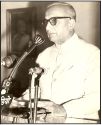
C.M. Poonacha
The Assembly was further strengthened by inducting legal luminaries such as Dr. B.R. Ambedkar, Dr. K.M. Munshi, N. Gopalaswami Ayyangar, K.T. Shah et al, even though they did not participate in the freedom movement. My father C.M. Poonacha, a leading freedom fighter from Coorg, who was the District Board President at the time, represented Coorg. At 36 years of age, he was one of the youngest members in the Constituent Assembly.
One of the earliest decisions taken was to avoid the Constitution being written only by technical experts or the elite-bureaucracy (Pakistan took this route, and their Constitution has been re-written three times!). The Indian Constitution was drafted through a combination of ‘democratic-consensual’ and ‘elite-bureaucratic’ approach. This has resulted in a resilient and all-inclusive document which has stood the test of time for 66 years.
Another unique feature in drafting the Constitution was to pass every resolution unanimously after extensive consultations and debate. Thus, every clause in the Constitution was discussed until all the members of Committees and Sub-Committees agreed without dissent. None of the resolutions were put to vote to avoid ‘tyranny of the majority.’
Final draft
The final draft of the Constitution of India was signed and adopted on 26th November 1949. C.M. Poonacha was one of the 299 signatories to this revered document (see the last signature in the image). The Constitution of India was brought into force on 26th January 1950 when India was declared a sovereign Republic.
One more distinctive narrative in the Constitution of India is that the nation expects excellence from every citizen. Unfortunately, that is least practiced in recent years, especially by the elected representatives!
Now, the tricycle!
During the course of his duties in the Constituent Assembly, my father took us to Delhi a couple of times. My age was in single digit and my sister was an infant. However, I have vivid memories of Delhi at the time.
Most of the Constituent Assembly members, who came from other parts of the country, were housed in the ‘Constitution House’ on Janpath Road (It does not exist any longer). The accommodation was modest — a studio apartment in a double-storied building complex.
One evening we were window shopping in Connaught Place when a toy-shop attracted my attention. I peeled off and stood watching in awe the colourful toys. I then spotted a tricycle which had a wooden horse head and a horn with a rubber bulb, mounted on its handle. I gingerly asked my father if he could buy it for me. “No, No, it’s expensive and I don’t have the money for it,” he said. My eyes welled-up and I beseeched him again.
Just then, the shop-keeper sidled up to us. ‘Your little boy likes the tricycle sir,’ he said to my father and subtly encouraged me. My parents wanted to distract me and exit the shop as soon as possible. Emboldened by the shop-keeper, I started howling and held on to the tricycle. No amount of cajoling would make me relent. Finally, my father tried to pacify me by saying that we would return the following day with the cash.
But I stuck to my guns and yelled, ‘Nakkikkabondu’ (I want it now!) My sister too joined me in crying. Soon we attracted the attention of others in the shop and my parents were thoroughly embarrassed. I kept hollering ‘Nakkikkabondu…’
The clever shop-keeper suggested that the tricycle could be taken and the payment made the following day. My father had no other option! I proudly pedalled my new possession right from the shop to the tonga we took back to the Constitution House!
Back in the Constitution House, I happily rode all along the corridors. Many luminaries framing the Indian Constitution would tousle my hair, chat me up and admire my tricycle!
About the author: C.P. Belliappa writes humour, history and human interest stories, and is a regular contributor to newspapers, websites and magazines. He holds a Master’s degree in Chemical Engineering from Stevens Institute of Technology, USA. Belliappa currently lives in Coorg.
source: http://www.starofmysore.com / Star of Mysore / Home> Feature Articles / February 19th, 2016
In Bollywood, Nidhi Subbaiah was last seen in the romcom outing Ajab Ghazab Love. From playing a cool chic, it was time for her to move into a rustic zone with Direct Ishq, a film which has been set in Banaras. In an author backed role where she plays the part of a wannabe rock-star from the holy city, Nidhi knew that she had to look and act the part.
However, she wasn’t prepared for the hardships that were on the way to glory.
“You make it sound really scary, though trust me, I enjoyed every bit of it,” say Nidhi, who is said to have delivered her most ‘bindaas’ performance ever in the romantic musical entertainer, “Yes, Direct Ishq is by all means the toughest role of my life. The weather conditions were really tough.”
Considering the fact that she also had to be seen in rockstar attire for a major part of the film, leather pants and boots were everyday outfits.
Laughs Nidhi, “Yeah, and I got a dose of that pretty early in the day once I was called to shoot for my introduction song – Ganga Maiyya. Swati (Sharrma) has sung it really well and I had to make sure that I get that energy on screen as well. I had to be the kind of rockstar that Dolly Pandey (name of my character) is supposed to be in the film.”
The first step in this direction was to prepare for the role, which means developing the kind of body language that goes with a rockstar.
“I went to YouTube and checked out many videos of live performances. I kept referring to notes for almost 25 days of the shooting. I designed a particular look for myself too. However, if this required good work, there were excruciating weather conditions to deal with as well. With the temperature touching 53 degrees, you can well imagine how it must have felt to shoot outdoors,” sighs Nidhi.
It was all in good time though for Nidhi.
“Not just ‘Ganga Maiyya’, I had to stress myself for Mera Kissa as well. I must have given my body so much pain while shooting these rock tracks that my neck was sprained in a matter few days. However, when I look back at the results, it was all worth it,” she says.
One looks forward to the results on screen once Direct Ishq, with Rajniesh Duggall and Arjun Bijlani as the leading men, releases all over this Friday.
source: http://www.movietalkies.com / MovieTalkies.com / Home> Bollywood News / by Shalini Burman, MovieTalkies.com / February 15th, 2016
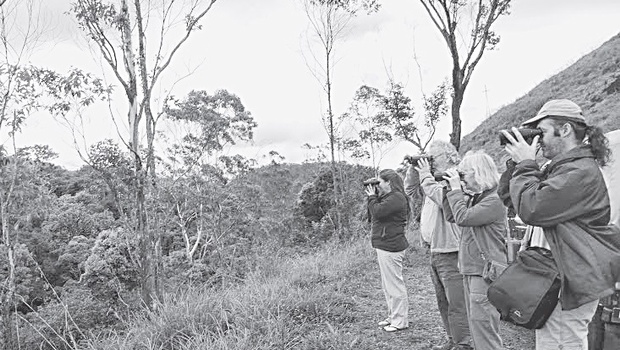
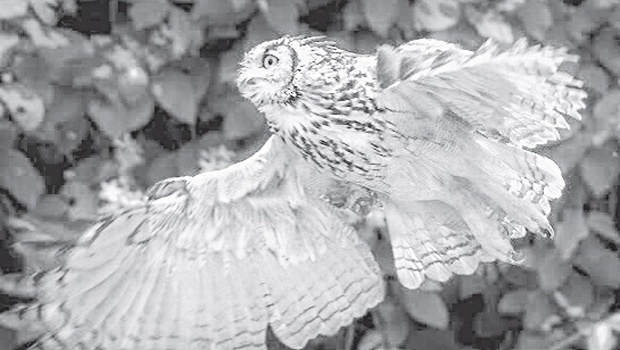
(From left) A kingfisher bird in flight; tourists clicking wildlife; Bopanna Pattada, and a rare sight of flying owl
Bengaluru :
Photographing birds, especially the rare ones in the wild, and spending time outdoors are Bopanna Pattada’s passions. He quit his job as software engineer at Wipro to make his passion a profession. When he realised that he is not the only one in love with birds and Nature, he decided to start India Birding Adventures. Now, Bopanna finds places where photography enthusiasts can get good wildlife and avian shots and arranges trips to these locations. His clients vary from engineers to doctors to businessmen. “I plan one-day trips around Bengaluru. Sometimes we also go on longer trips to Ooty, Masinagudi, Bandipur, Mysuru, Nagarhole and Coorg,” he says. He also takes nature enthusiasts to places like Corbett National Park and Pangot at the foothills of Himalayas.
The best places to spot birds in Bengaluru according to him would be Nandi Hills for winter migrants, Hoskote lake for waterbirds, Ramdevarabetta for vultures, Bannerghatta for forest birds.He doesn’t take more than three to four members at a time. “Firstly, with smaller groups, it is easier to give personal attention and secondly large groups scare the birds away,” he says.
“As a trained photographer and naturalist, I instruct people on photography – what settings to use in which situation, and also help them in spotting birds and wildlife.” The job, for him, is an escape from a sedentary life.
“It takes me closer to nature,” he says. It can be challenging to click birds in flight. Bopanna suggests that the best time to click pictures is either in morning or evening, when they are most active. “Birds tend to be shy. They don’t let you get very close for photographs. Part of my teaching is on how to get closer to birds to take better photographs and also how to position yourself so that the photograph has a nice backdrop.” Bopanna’s images were featured in Sanctuary Asia Magazine and Bombay Natural History Society calendar-2015.
He specialises in photographing birds flying or in action.
Photography enthusiasts can reach Bopanna through his website www.indiabirding.com or bopannap@gmail.com
source: http://www.newindianexpress.com / The New Indian Express / Home> Cities> Bengaluru / by Pratima Shantaveeresh / February 10th, 2016
K. Byrappa, Vice-Chancellor of Mangalore University, said that the dictionary, which was being printed, would probably be released in Kodagu itself.
A minority language unfamiliar to many in the State will finally have a comprehensive dictionary of its own with meanings in Kannada and English.
Kodava vocabulary will be captured in Kodava Arivole, which will be published by Mangalore University in March.
Boverianda C. Uthaiah (77) and wife B.U. Thangamma (66) joined forces and compiled the Kodava-Kodava-Kannada-English, which has about 11,000 words.
Mr. Uthaiah is a former professor of agricultural sciences.
According to the UNESCO, Kodava is a ‘vulnerable’ language, said Lokesh K.M., coordinator, Kodava Samskritika Adhyayana Peetha at Mangalore University.
Those knowing Tulu and Malayalam can grasp Kodava takk (language) better as it has common words with these two languages, as well as Persian.
Though the latest statistics on how many speak Kodava takk is not available, according to the 2001 census, only 92,193 people speak the language, Mr. Uthaiah said.
A handicap he faced was trying to include 2,000 words in the lexicon as no one knew their meanings.
Mr. Lokesh, also a professor of History at Mangalore University, said the lexicon has some rare words such as ‘kaju’ (gold) and ‘aarayu’ (water). It has social and cultural terms, and words relating to folk traditions such as ‘jamma’ (a land tenure system in Kodagu with long-standing hereditary rights held by clans), and ‘okka’ (Kodava clan, all of whom have descended from a common ancestor). The dictionary also has botanical and zoological terms.
Mr. Lokesh said though two Kodava dictionaries have been published earlier, they are not comprehensive. I.M. Muthanna’s Kodava Nudi Artha Kosha, the first dictionary published in 1988, gave the meanings of Kodava words in Kannada. In addition, Karnataka Kodava Sahitya Academy brought out a handbook Kodava-Kannada-English Kaipudi in 1988.
K. Byrappa, Vice-Chancellor of Mangalore University, said that the dictionary, which was being printed, would probably be released in Kodagu itself.
source: http://www.thehindu.com / The Hindu / Home> National> Karnataka / by RaviPrasad Kamila / February 12th, 2016
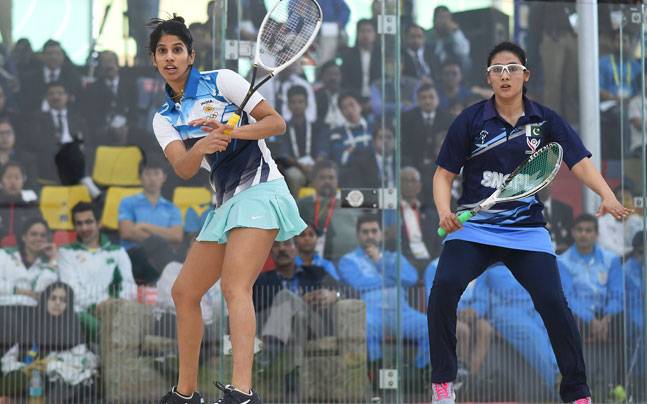
Top seed Joshna Chinappa came back from behind to beat second seeded Toorpaki Wazir of Pakistan to clinch gold at the South Asian Games on Monday.
Star player Joshna Chinappa clinched the gold in women’s individual squash after beating Maria Toorpaki Wazir of Pakistan in a tense and ill-tempered summit clash to make up for India’s disappointment in the men’s event on Monday.
Top seed Chinappa, ranked 14th in the world, recovered from one set down to beat second seeded Wazir 10-12 11-7 11-9 11-7 at the brand new squash facility at the R G Baruah Sports Complex here.(Wrestlers make India proud at SAG)
With Chinappa’s gold, India has so far won three medals in squash with Sourav Ghosal and Harinder Pal Singh Sandhu having grabbed a bronze each after losing to their Pakistani opponents yesterday.
Chinappa, one of the few top Indian players to have opted to play in the SAG, thus gave some solace to the team management after men’s players failed to reach the final.
The women’s final match had all the drama which was witnessed during the men’s semifinals with Chinappa expressing unhappiness to the match officials with the “aggressive” play of Wazir who was seen as trying to be a bit physical with the top-ranked Indian.
Wazir, ranked 50th in the world, won the first set 12-10 after a neck-and-neck contest but she got injured midway in the second set at 7-7 as blood came out of her left eyebrow region after contact with Chinappa and play was stopped for a while to get her treated.
The Pakistani was immediately given first aid and she resumed play after a few minutes. It looked like the break gave Chinappa time to ponder on her game and the glamorous Indian started dominating the match from there on.
Wazir looked tentative just after coming from her injury break and Chinappa did not take much time to take the second set 11-7 and level scores at 1-1.
The third set saw Chinappa taking a 5-2 lead but Wazir came back with some superb shots to make it 6-6 and then 8-6. By then there was tension among the crowd at the stands, but a calm Chinappa just went about her job and brought the score to 9-9 and then 10-9 before taking the set.
In the fourth and final set, Wazir gave some fight initially but later frittered away as Chinappa won it 11-7 to give India the first gold in squash in this edition.
Chinappa later made it known that she was not happy with the way the referees handled the match and that she did not enjoy playing the match as her opponent was “very aggressive” and “not playing fair”.
“Wazir is a good player but she was very aggressive. Fortunately, I won the gold but I did not enjoy playing the final. I play in the professional circuit and there, these kind of things, likes lot of interference and blocking (by rival player) does not happen,” she said after the match.
“I tried to keep myself calm but I had to let them (match officials) know what was happening on the court. I cannot let things happening all the time,” said Chinappa, who argued with the referee on a couple of occasions.
“I am a kind of player who plays fair, without these interfering and blocking etc. Doing all these is not nice for the spectators and also for the game,” she added.
Asked if the referees should have handled the situation better, she said, “I don’t want to be in trouble again but I feel it is their job to control the match and stop all those things. They should have done better.”
source: http://www.indiatoday.intoday.in / IndiaToday.in / Home> News> Sports> Other Sports / PTI / Guwahati – February 08th, 2016
WELCOME. If you like what you see "SUBSCRIBE via EMAIL" to receive FREE regular UPDATES.
Read More »