Category Archives: Famous Personalities of Kodagu / Coorg

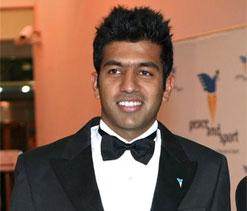
World No.1 ranking and a Slam is priority now: Rohan Bopanna

Rohan-BopannaKF31jul2013
New Delhi:

Rohan Bopanna is content that the sacrifices he made in his tennis journey paid off as he became world number three but the Indian tennis star`s hunger for success has only increased and he now wants to become number one besides notching his first Grand Slam trophy.

Bopanna`s career graph has how a steady rise and in the last two years, he has emerged as a force to reckon with in the doubles arena.

Of his eight titles, six have come in the last three years. Season 2012 was remarkable when he made six finals and won two titles with compatriot Mahesh Bhupathi. In 2011 he won all the three finals with Pakistan`s Aisam-ul-haq Qureshi.

“Discipline has been a key factor to my success. I have always made sure that I put my game ahead of anything else, sometimes even before friends and family. The journey has definitely not been easy but all the sacrifice has paid off very well in terms of my performance on-court. When you get better at your sport, the sacrifices you`ve made in that part don`t really count,” Bopanna said.

Courtesy his semifinal appearance at the Wimbledon, Bopanna, nicknamed `Bofors` for his powerful serve, climbed to number three in rankings early this week, behind formidable American twins Mike and Bob Bryan.

“The number one spot is of priority for me. Though there is no catching up to the Bryan Brothers this year, I am working hard to ensure that I reach the number one spot soon. That ranking is important to me and to get our country up there will certainly be a dream come true,” he said.

Bopanna (5335) is realistic in his calculations as the gap between him and the Bryans is a huge 9125 points. Hence his immediate goal is to add that elusive Grand Slam trophy to his eight ATP Tour titles.

He came close to doing that in the 2010 US Open but ended runners-up with Qureshi to Bryan brothers.

“Right now I have my eyes set on a Grand Slam win. Having reached so far, I want to go all the way and win a Grand Slam for the country,” he said.

Often it is said that Indian players peak late. In fact, Bopanna himself turned pro in 2003 but four of his eight titles have come in the last two years. Asked if at 33, success has come late to him, He said, “Better late than never.”

“As an athlete, success is not just about winning, it is about working hard and giving it all you have. I have always taken one match at a time and worked hard, when I succeeded I worked further on the aspects of the game which worked for me; when I failed, I listed out my weaknesses and worked on them. So, if you look at the bigger picture every game has been a learning curve,” he said.

Bopanna has always played under the shadow of India`s two most remarkable stalwarts — Leander Paes and Bhupathi — who were the team to beat in the late 1990s and early 21st century before parting ways.

They also have an enviable unbeaten run in the Davis Cup since 1997, winning 23 doubles rubbers.

Now that Bopanna has created his own space in the tennis world, does he feel ready to take the baton from Paes and Bhupathi?

“I have been representing the country for more than a decade. My performances have clearly improved leaps and bounds and if this means I am to take the baton on, I am ready.”

Bopanna also said he has worked hard on his game and that has shown on the court.

“My fitness and volleys have definitely improved over time with a lot of practice. For me, I make sure that I have not just played a match, but learned from it as well ensuring a certain degree of improvement in my game from the last match that I`ve played.”

Bopanna has changed a lot of partners. This season alone, he is set to play with his eighth partner in Germany`s Andre Begemann after a successful experiment with Edourad Roger-Vaselin at Wimbledon.

What forces Bopanna to change partners so frequently?

“Vaselin is concentrating on singles and will only be available to play once the Cincinnati Open starts, so I am partnering with Andre Begemann in the meantime. As a doubles player you have to get the right partner to make sure you yield good results and so I have been changing partners frequently.”

“If finding the right partner means trying out different players and tweaking your game, you have to adjust. It`s all about finding out what works best for you.”

Last year his pairing with Bhupathi was tremendous. They won two titles (Paris and Dubai) and were runners-up at six other events. However, after a failed campaign at London Olympics they could not repeat their performance.

“We had been playing well together for quite some time and when you are playing together for long you tend to understand what works out and what doesn`t.

“We took the decision of changing partners keeping in mind that performing our best was one of the most important aspects of being an athlete. So, I paired up with Vasselin and luckily it worked well for us,” he said.

Does he feel tempted to play with Qureshi, with whom he caught attention of the world by forming the Indo-Pak express that won three titles in 2011 and made 2010 US Open final?

“Aisam and I were a great team and we have moved on from there. Whether or not we pair up again is a question that only time can answer.”

Bopanna, who tied the nuptial knot with Supriya recently, said life has “indeed changed for better” after marriage.

“Supriya accompanies me to different tours and keeps me company. She has also been an incredible support system, encouraging me through and through, helping me perform better.”

PTI
source: http://www.zeenews.india.com / ZeeNews.com / Home> Sports> Tennis / by PTI / Sunday – July 28th, 2013
You need to volley well and finish points: Bopanna

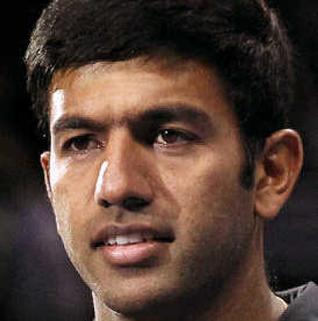
Bopanna. - Photo: AP
Bopanna. – Photo: AP

Rohan Bopanna, who recently reached his career-best doubles ranking, attributed his success to an improved ability to close out points at the net.

“I’ve worked hard on my volleying skills, which has been a key factor to my progress. People say that I have a big serve, but at the end of the day, you need to volley well and finish points,” said Bopanna, who is the world no. 5, here on Thursday.

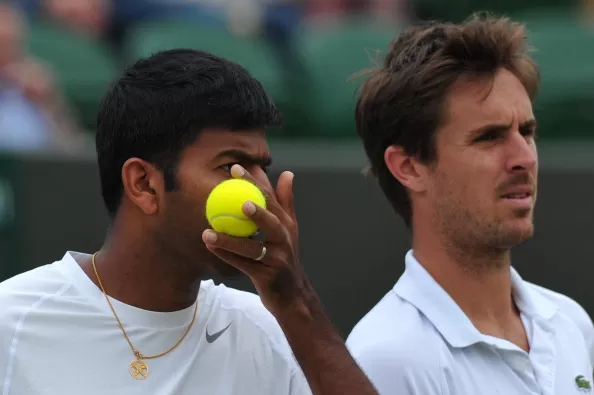
Bopanna partnered Frenchman Edouard Roger-Vasselin to reach the semifinals at Wimbledon recently. Roger-Vasselin is the 33-year-old Indian’s seventh partner this year, and Bopanna said that the frequent shuffling was unavoidable.

“I would like to settle with one partner, but it’s not easy. For example, singles is the number one priority for Roger-Vasselin. “Even if we do well, I cannot force him to play around my schedule. I would definitely like to stick with one partner; I do not enjoy changing partners week in and week out,” he said.

Bopanna said that he would retain his current partner till the end of the season. They communicated well on court, he added.

Asked if his vast experience on the Tour has made him a smarter player, he said: “Absolutely. After playing on the Tour for 10 years, you are bound to become mature.

“You are not a first-timer any longer; the goal is not to just enjoy the moment.”

source: http://www.thehindu.com / The Hindu / Home> Sports> Tennis / by Sports Reporter / Bangalore – July 18th, 2013

Ashwini Ponnappa launches ‘ Shuttle Express ‘ in Mumbai

Mumbai :

CWG doubles gold medalistand IBL ICON Player Ashwini Ponnappa launched the Indian Badminton League’s School Programme initiative – ‘Shuttle Express’ here today at the JamnabaiNarsee School, Mumbai.

The IBL is an initiative of the Badminton Association of India with Sporty Solutionz as the Commercial Partner. JamnabaiNarsee School is the IBL School Partner for the Mumbai leg and the school championship in the city is being held under the aegis of the Maharashtra Badminton Associationat the Badminton Courts in Khar Gymkhana, 15th Road, on July 17-18. An unprecedented number of students in Mumbai will be vying for the titles in both the boys and girls singles categories in the city leg. The city winners will play the All-India Finals during the forthcoming IBL in August.

Speaking during the briefing, Shuttle Sensation Ashwini Ponnappa said, “It’s a happy moment for every Indian badminton player today as this initiative by IBL will see badminton rise in India and hence motivate the future players to achieve more historic feats for everyone to witness, cherish and feel proud of. Wishing the participants‘All the Best’ and may the next champion of India win the Shuttle Express”.

Speaking on the occasion, Mr. AshishChadha, CEO, Sporty Solutionz, said, “We saw a great response during the kick-off ceremony of the ‘Shuttle Express’ in Delhi and we are witnessing the same amount of enthusiasm and participation in Mumbai. The reason behind launching the Shuttle Express is to boost the young talent at grass root level. The overwhelming response from the schools and children gives us the confidence that Shuttle Express will give India its next champion shuttler. We take this opportunity to thank our IBL School Partner for Mumbai leg JamnabaiNarsee Schoolfor their support for this initiative”.

Speaking on Shuttle Express, Badminton Association of India President & MP, Dr. Akhilesh Das Gupta, said, “It gives us immense joy and pride to introduce the IBL School Programme initiative – Shuttle Express, to lakhs of students across the country. We hope the effort taken by our badminton icons and stars to visit schools in six cities will inspire many youngsters to take up the sport.”

Speaking on Shuttle Express, Principal of JamnabaiNarseeSchool, MsSudeshnaChatterjeesaid, “JamnabaiNarseeSchool has always considered sports to be an important attribute of education. So, we are immensely proud of our association with IBL Shuttle Express and thank AshwiniPonnappa for encouraging our sportspersons in the making, to aspire to much more than the ordinary.”

With its launch in Delhi on 12 July, the Shuttle Express is all set to roll in Mumbai today, followed by Hyderabad on July 16, Pune from July 17, Lucknow on July 19 and finally in Bangalore. Each city will witness matches being played over two days and the National finals will be held in Mumbai

which will be beamed LIVE on TV from August 28-31, 2013, as part of theIBL. The Shuttle Express will offer an incentive of Rs 10 lakh in prize money to the National winners in both the boys and girls singles events. The finalists in both the categories will also be given an opportunity to train at the world-class PullelaGopichand Academy.

The path-breaking IBL will be held in six cities from August 14-31. The richest badminton league in the world will feature almost all the top-50 players in the world and will be played under the Sudirman Cup format and televised LIVE to more than 100 countries.

source: http://www.indianbadmintonleague.com / IBL / Home> Big Story / Mumbai – July 15th, 2013

Mangana Kaiyalli Manikya to release on July 26

Sandalwood film Mangana Kaiyalli Manikya, which has Ramesh Aravind and Harshika Poonacha in the lead, is all set to hit the screens on July 26. The film, directed by Rajendra Karanth, has got U/A certificate from the Regional Censor Board.
ManganaKF20jul2013
The film is said to be an out and out comedy, with dialogues written by the director himself. The title trailer of the movie, which was recently released on YouTube, has received a lot of appreciation from audiences. Harshika Poonacha is playing the role of an assistant director in the movie. The movie also has Rangayana Raghu and Ravishankar Gowda in significant roles.

The project is produced by Sandesh Nagaraj and music has been provided by Rajesh Ramanath. Meanwhile, Harshika Poonacha also has Maryade, which is currently under shooting in Mysore and Adwaitha, which has Ajai Rao in the lead role.

source: http://www.articles.timesofindia.indiatimes.com / The Times of India / Home> Entertainment> Regional> Kannada> Assistant Director / by Vinay Lokesh, TNN / July 13th, 2013

Ashwini Ponnappa: Of kill shots and killer looks

Bangalore :

It all began with an innocuous fling of a paper ball. Boisterous and unrestrained like toddlers her age, a two-year-old Ashwini was bringing the roof down at a friend’s place in the hushed hill station town of Madikeri in Kodagu, when her mother Cauvery handed her an old badminton racquet to keep her occupied.

(Experts have lauded Ashwini…)

She then crumpled up a few newspapers, shaped them into balls and tossed them at Ashwini, who swung and latched onto them like a pro. The bonding was immediate, and a star was born. Now, several years of accolades and a cabinet full of medals and trophies later, Ashwini Ponnappa is riding the waves of mainstream stardom with aplomb.

Ashwini’s forte and talent comes from a Kodava lineage rich in sporting culture. Her uncle, Kumar Appachu, was a state-level cricketer while her father, MA Ponnappa, was an exponent in hockey, having represented Karnataka in eight Nationals between 1974 and 1986. He even had a brief foray internationally as a stellar midfielder for Italian club Eur in the European hockey circuit.

The banker, employed with RBI and Cauvery, an assistant manager with New India Assurance, have never hesitated to give Ashwini all the support she needed to scale the peaks of badminton glory. “Being from a sporting background, it was essential that she had a grasp of sports from an early age. So I got her to take part in a few track-and-field events to build her speed and stamina. She showed great progress but her heart was hooked to badminton,” said Ponnappa.

Nation’s future face

Experts have lauded the 23-year-old Kodava lass for her ‘killer instinct’ – something that cannot be coached. Her medal-studded performance at the 2010 Commonwealth Games and 2011 Badminton World Federation World Championships in London led the national media to dub her not just badminton’s future face but its great Indian hope.

By the time London Olympics was on the anvil, Ashwini was a household name. From billboards flashing her million-dollar smile to young badminton aficionados hounding her for autographs whenever she turned up for practice, a genteel Ashwini accepted the newfound attention with grace.

“Life changed quite dramatically,” Ashwini recalls. “The biggest advantage was that the CWG was held at home and in the national capital. People came in large numbers to support us, which really boosted our game. Most importantly, people started to appreciate doubles. Till then, it was all about singles but that gold medal scripted a new path for India’s doubles players,” says Ashwini, who is employed with ONGC.

She and Jwala Gutta became a relentless force on the national and international circuit, which swelled to greater heights after their bronze-winning feat at the Worlds. But following a split earlier this year, Ashwini is looking to replicate the success with her new partners Pradnya Gadre and Tarun Kona (mixed doubles).

“Jwala and I had a great time together on the circuit and I learnt a lot from her. But now I have a new partner and a new set of objectives. I have always wanted to do better than what I achieved earlier and hopefully I can do that at the World Championships in August,” says the former St Francis Xavier’s Girl’s High School student.

If looks could kill, then Ashwini is up to the job. Fresh-faced and with limitless marketing potential, she has been approached with several offers to embrace the reel life. “Movies? Not now, maybe I’ll try a few ads first but only if they don’t affect my game,” says Ashwini, ready to ride the shuttle to success.

Know more

Family: MA Ponnappa, Cauvery and brother Appanna

Sporting hero: Roger Federer

Actor/actress: Anne Hathaway/Ryan Gosling

Food: Kodagu cuisine – koli curry, kadumbuttu and nooputtu

Music: R&B, Empire of the Sun

Dream holiday spot: Greece

Dream match to watch live: Federer versus Nadal.

source: http://www.articles.timesofindia.indiatimes.com / The Times of India / Home> Sports> More Sports> Badminton / by Maxin Mathew, TNN / July 01st, 2013

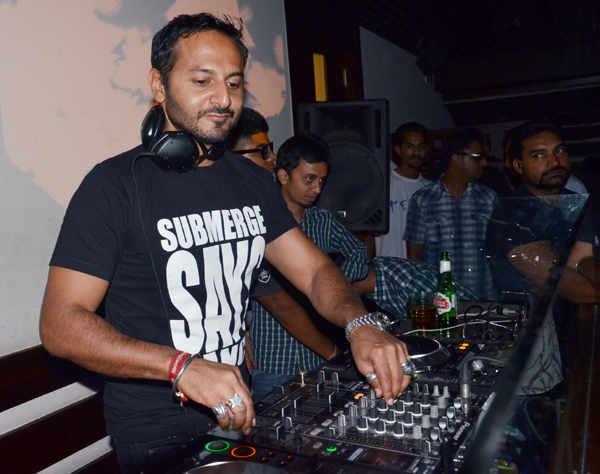
Pics: When DJ Nikhil plays, Chandigarh girls dance to his tunes

NikhilKF19jul2013
Chandigarh:

Known for making others dance to his fusion beats, DJ Nikhil Chinapa recently visited Chandigarh to promote an art aimed at providing a platform to youngsters fond of dance.

Speaking at the inauguration the ‘Submerge Dance Project’ at Blue Blazers pub in Sector-26, the MTV VJ urged all talented dancers to showcase their talent as the burgeoning industry offered many lucrative employment opportunities.

The gathering then danced to the tunes of DJ Chinappa, who played several different genres during his three-hour long performance.

Youngsters dancing to tunes of Nikhil.. Click next..

source: http://www.daily.bhaskar.com / DailyBhaskar.com / Home> Cities> Chandigarh / Bhaskar News / June 26th, 2013

Rohan Bopanna: the man of the moment

RohanBopannaKF18jul2013
One Indian tennis player is emerging as the new crowd favorite at Wimbledon. Not Mahesh Bhupathi, not Leander Paes, not Sania Mirza; its Rohan Bopanna who is wooing the spectators with his BOOM BOOM game! His 3rd round mixed doubles match was watched by a packed audience on Court 12 even as the commentators were keeping a track of his number of aces.

And why not, when only the previous day the 6’3” Bangalorean served 22 aces in the marathon match against 6th seeds, Daniel Nestor and Robert Lindstedt? Not surprisingly, Bopanna is the only Indian who is alive in both men’s and mixed doubles draws.

Grass is traditionally considered the strong point of big serving Indian players. However, no Indian has made the semis of men’s doubles here since Leander Paes in 2008. Thus, when Rohan entered Wimbledon with a new partner, Edouard-Roger Vasselin, not much was expected of the combo.

However, the last few days have changed it all. In Round 3, the Indo-French combo upset 3rd seeds and in-form pair of Bruno Soares/Alexander Peya and followed it up with a 5-setter win over Nestor/Lindstedt. Against the latter, Rohan and Vasselin were up 7-6 7-5 3-1 when they suddenly found themselves in the 5th set, having wasted a match point in the previous set.

Many would have succumbed to the pressure but Team Rohan handled it with ease, keeping their composure to finish off the rain-delayed match 7-6 7-5 6-7 6-7 6-2. They next face the Bryan brothers who are chasing the “Bryan golden slam”- a unique achievement of holding all the 4 slams at the same time along with the Olympic gold medal that they won last year.

Needless to say Rohan and Roger are faced with an uphill task. But if any team can stop the Bryans now, it has to be them. For the record, the Bryans have served 37 aces till now in the entire tournament. And the number for Rohan/Roger stands at 91! They have hammered 31 aces in the last match itself.

Of course, aces alone won’t work against the best pair of all times. But with wife Supriya by his side, Bopanna seems to have found the renewed inspiration that took him to the US Open final in 2010 with Aisam-Ul-Haq Qureshi. And not to forget, the guy has a chance to lift his 1st slam in mixed doubles as well! In the quarter-final, Bopanna/Zhenq will take on Vera Dushevina/Jean-Julian Rojer.

All the best Rohan!

source: http://www.sportskeeda.com / SportsKeeda / Home> Tennis/Grand Slam / by Rajorshi Das / July 04th, 2013

Giving voice to the unheard

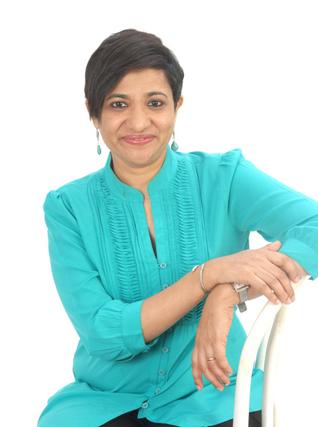
Linking the world of hearing and talking, Radhika Poovayya / By Special Arrangement / The Hindu

Speech and behaviour analyst Radhika Poovayya says people with communication disorders are often neglected because their problems aren’t obvious to the eye

As Radhika Poovayya peeps into each little colourful nook, there’s Yogi, and there’s Nishita — one sitting diligently at a table with the sweetest smile on his face, the other running in abandon around colourful toys — but both trying to give voice to words that the speech therapist is enunciating with great care. Radhika knows what’s happening with each child, what needs to be done next for the smiling four-year-old , and what to do after the three-year-old learns to say her name.

“No one considers a person’s inability to communicate to be a serious problem. It can really harm that person,” says Radhika. It’s been the premise of her work for over 26 years. Radhika Poovayya is many people rolled into one comprehensive resource — a speech pathologist, a consultant specialising in autism, communication disorders, and behaviour analysis for children and adults. “All human beings are the same. Our behaviour has a law. And the behaviour of every child can be set right,” believes Radhika.

At her Samvaad Institute of Speech and Hearing in Hebbal, Radhika’s therapists work with children with hearing impairment, stuttering and stammering problems, cerebral palsy, voice and speech clarity problems, developmental disabilities, patients of head injuries in accidents and patients of stroke who’ve lost their cognitive and speaking abilities. “Because people can’t ‘see’ their disability they do not get empathy. Our approach is right-based, not sympathy-based. We provide organised and individual therapy. We want to give good therapy that is accountable. We set targets, record data regularly, and are goal driven,” explains Radhika. The role parents play in the training and therapy of such children is really huge, reiterates Radhika. So she allows parents to be part of the therapy sessions and trains parents too to help the child at home. “Parents need to have a different approach to raise such kids. Some come to us, having decided already that the child is incapable of doing anything or believing the child is incapable of speaking.”

What got her going in the field was her love for children and a desire to work with them. She completed her masters at the All India Institute of Speech and Hearing in Mysore, and then got married immediately. Her planter husband’s posting with Tata Tea in Munnar turned into a boon — she set up a speech and hearing rehabilitation unit at the estate’s hospital, helping children of estate workers. “It was the first-of-its-kind department in a plantation,” she beams. “I would drive 30 kilometres thrice a week to work in the hospital.” Once her husband moved to Bangalore, she started working at the Dr. SRC Institute for Speech and Hearing in Lingarajapuram, where she also did PR, and helped raise funds for the organisation. “But I missed my clinical work, so after seven years at the Institute, I moved to Hosmat hospital. It was here that I came across 21-year-old Sharath, who had a head injury from an accident. The left side of his brain that controls speech was completely damaged and neurologists had given up on him, but after working with him for one year, he started talking. He gave me the confidence that this field was worth it.”

She started her private practise in 2002 in Indiranagar. But there weren’t too many therapists in the field; her staff moved often. Her family set up a trust and she started the Samvaad Institute with the help of experienced colleagues she had worked with earlier, to offer B.Sc and M.Sc courses in speech pathology and audiology. The courses are affiliated to Bangalore University and recognised by the Rehabilitation Council of India.

During the course of her private practise, she felt her skills as a speech pathologist were inadequate, because children with communication disorders also had behaviour issuesShe came across the concept of ABA — Applied Behaviour Analysis — through some parents she was working with. So at 40, she set out to learn online from the University of Florida, with more than 1,500 hours of mentored practical classes. “It took me four years to save up for the course, but I knew it would be effective. ABA works towards achieving socially-acceptable behaviour,” says Radhika, who’s one of five ABA-certified behaviour analysts in the country.

Speaking of the kind of barriers she faces in helping people with disorders, Radhika says that in the upper middle class, accepting that their child has a problem is the hardest thing. “They live in denial, believing their child is ‘alright’. The middle class is more willing to accept the problem, but lack time and resources for training heir child.” Caregivers very rarely are persistent in bringing their child consistently for therapy. Being an NGO, at the Institute, she’s able to offer nominal and discounted rates to people, depending on their income group. Stroke and head injury patients are rehabilitated free of cost.

Radhika can be reached on 9845018302 or check www.samvaadinstitute.org for details.

source: http://www.thehindu.com / The Hindu / Home> Features> MetroPlus> Society / by Bhumika K / July 09th, 2013

MRC former Chairman M.W. Chinnappa no more

Thithimathi (Kodagu) :

ChinnappaKF15jul2013Maneyapanda W. Chinnappa (89), former Chairman of Mysore Race Club (MRC) and a coffee planter in Devarapura Hebbale village near here, passed away last evening.

He is survived by his wife, two sons, a daughter, grandchildren and a large number of relatives.

Last rites were performed at Devarapura village today.

He was the MRC Chairman during 1985-87. He was also the member of Sports Club and JWGC.

source: http://www.starofmysore.com / Star of Mysore / Home> General News / July 05th, 2013

Wake up, smell hockey

They say you either pick up a gun or a hockey stick as a child in Coorg. For almost every other family from the lush hills has a member either in the armed forces or pushing for a spot in the Indian hockey side.

In a sport that has traditionally been dominated by players from the North — notably the assembly lines from Punjab — serene and picturesque Coorg holds its own as a prolific south-side outpost. A Coorgi player’s silken skills, silent yet strong aggression and technique combined with a meticulously planned fitness regime set him apart from the rest. From the last generation’s pillars like Arjun Halappa and BP Govinda to modern-day stick wielders such as VR Raghunath and SV Sunil, the life-support systems of the Indian national teams have come from Kodagu’s martial clans.

Now, for the first time since 1989, as many as 10 players from Coorg are in contention for spots in the national team. Hockey India announced 48 probables for next month’s Asia Cup earlier this week and the Coorgis make for over one-fifth of the longlist. Of the 10, eight are strikers — MK Muddappa, Nikin Thimmaiah, PL Thimmanna, MG Poonacha, Nithin Thimmaiah, Pradhan Sommanna, SK Uthappa and SV Sunil. The list also includes midfielder MB Aiyappa and a defender VR Raghunath. The promising thing about this is that most are below 25 and are therefore at the perfect age for India’s preparations for the 2016 Olympics. In fact, at the last Nationals 68 Coorgis turned out for different teams.

It’s not new for Coorgis to find a place in the Indian squad. But it is intriguing that such a tiny region has produced almost a dozen players who have the potential to break into the Indian team at the same time. “A lot of credit for this goes to the Sports Authority of India centre in Bangalore. It has provided really good facilities to the players and it is also easily accessible. With the kind of infrastructure that is available, it isn’t surprising that players from this region are flourishing,” says former India captain Halappa, who is now a national team selector.

NORTH vs SOUTH

This leads us to the obvious question: does this indicate a shift in balance of power from the north to the south? Experts suggest otherwise. “I don’t see it as a case of south overtaking north. In fact, the two regions together now seem to control Indian hockey,” former India coach Harendra Singh says.

The Dronacharya Awardee makes a fair point. While players from the south are making rapid strides to break into the national team set-up, Punjab arguably continues to remain the nursery of Indian hockey. The academies that were set up during former India captain Pargat Singh’s regime as the state’s sports director have been reaping benefits. Pargat also ensured that the infrastructure across the state was spruced up and made open to youngsters. Today, Punjab produces the maximum number of players for the junior team, a fact that is reflected in the composition of the junior squad — almost 70 per cent of the members ofthe junior team for the European tour in May consisted of players from the north. In contrast, there was only one player from the south, a Coorgi, who was part of that tour.

At the senior level, though, the trend reverses. “A lot goes into grooming a young talent into India material. There’s a lot of emphasis laid on educating the youngsters about the demands of modern hockey so that he is prepared, physically and mentally, to face the challenges,” says former India goalkeeper AB Subaiah, also a Coorgi. “Over the last few years, we have focussed a lot on developing the youngsters and providing them with the best facilities.This is the main reason why we are seeing so many players succeed from this region.”

The rising dominance of Punjab and Karnataka has coincided with the declining standards in regions such as Uttar Pradesh and Maharashtra, which used to boast a rich hockey culture. A testimony to this is the national championships. For the last three years, Punjab and Karnataka have been among the top three sides. However, in all these editions, the performances of the young players from Karnataka overshadowed those of the ageing stars from Punjab. It was the same case in the World Series Hockey (WSH) as well, where players from Karnataka did quite well and generated a lot of buzz.

THE KODAVA DYNASTY

But then, you expect crowds to pour in for a hockey match in Bangalore, which is home to almost all players from Coorg. Hockey is said to be as deep-rooted in their culture as the coffee plantations. And Coorg plays host to one of the biggest hockey festivals in the world. The Kodava Hockey Festival made its way into the Limca Book of Records for attracting record entries. It’s an inter-family tournament and more than 200 Kodava families take part in it. Last year, the national team played an exhibition match against a Kodava XI and the fixture attracted thousands.

Subaiah claims Karnataka is the only state that provides branded apparel and kits to its players along with accommodation in plush hotels during the national championships.

Understandably, Bangalore is the next big destination which is being targeted for the second edition of the Hockey India League (HIL). The recent buzz is that a Coorgi hockey afficionado, who runs a sports event management firm, will bid to own a team in the cash-rich league. But the huge financial commitments and bank guarantees that have to be submitted means the chances of that happening are pretty low.

That, however, won’t stop Hockey India from entering one of the most lucrative markets. “The region has always produced quality players and is of high importance to us. We are still evaluating a few things. But it’ll be nice to have a team from there,” says Hockey India secretary general Narinder Batra.

source: http://www.newindianexpress.com / The New Indian Express / Home / by Mihir Vasavda, New Delhi / Sunday – July 07th, 2013