Aspiring shooters in Kodagu district may soon have access to state-of-the-art infrastructure. The district deputy commissioner Anurag Tiwari is in discussion with the Department of Youth Empowerment and Sports (DYES) to build a modern range in Madhenadu village, 10 km from Madikeri.
The range has been proposed on a 35-acre land which the authorities recovered from encroachers.
“There are many skilful shooters in the district and if we can provide them the right infrastructure we will soon be able to create an assembly line for the national squad,” said Tiwari.
“The idea of building a shooting range came during my discussions with former DYES director Vikash Kumar Vikash,” said Tiwari. “Most of our shooters winning international medals, belong to the armed forces. So Vikash and I felt building a shooting facility will be a boon for civilian shooters.
Vikash had even requested PN Papanna, father of Glasgow Commonwealth Games silver medalist Prakash Nanjappa and a veteran shooter himself, to design the facility.”
However, the process has slowed down following Vikash’s transfer. “Now that Vikash is no longer in DYES, I have to present the idea to the new director HS Venkatesh to take it forward,” Tiwari added.
When contacted, Venkatesh said: “I am not aware of the proposal as I have just taken charge. If there is any such plan, I will definitely look into it.”
Meanwhile, Papanna is also sharing his expertise in developing an indoor shooting arena at the Sree Kanteerava stadium. The Rs 10-lakh facility is under construction and will be operational in few months.
source: http://www.timesofindia.indiatimes.com / The Times of India / Home> Sports> More Sports> Shooting / Sunil Subbaiah, TNN / August 08th, 2014
Crisp vadais with spicy sambhar and chutney in Coorg / The Hindu
When my cousins and I, a group of 15 youngsters, started planning a trip to Coorg, the first thing we were told is, “Don’t forget to try the pork.” We didn’t need to be told twice, and the search for Pandi curry began the minute we reached there and it was as delicious as promised.
However, it was a much simpler dish which was the highlight of our trip to the beautiful hill town. On our first day there, we walked down the road to find breakfast and stumbled upon a tiny hotel, barely big enough for all of us to squeeze in. Two other customers sniggered as we debated who should eat first and who could wait. Before we reached a consensus, the owner of the place came charging in and asked us, in broken Tamil, to follow him.
Right next to the entrance was a stairway leading downwards – apprehensively, we followed. Much to our surprise, it led to a spacious seating area where all of us could eat at the same time. It was just off the kitchen and provided some much-needed warmth from the incessant rain.
And so we ordered: pooris, idlis, dosas and pongal. All of us ordered vadais on the side. We were served the vadais first, on steel plates with a spoonful of spicy sambhar ladled on top of it and coconut chutney on the side.
Although we’re from the land famous for vadais, we agreed that it was the best we have ever had. They were straight out of the frying pan, but were not oily. Biting into them, there was an audible crunch; they were that crisp. Flavour-wise, they were delicious, without the pesky bits of garlic and chilli. I can’t recall eating a vadai that good in any of the famous “bhavans”.
We ordered another round of vadais and not surprisingly, we ate there every morning for the rest of the trip.
source: http://www.thehindu.com / The Hindu / Home> Features> MetroPlus / by Susanna Myrtle Lazarus / August 08th, 2014
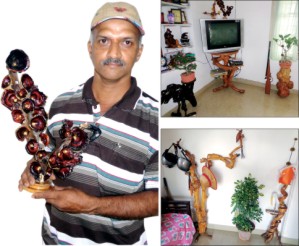
Intro: Imagine we are driving our car from Coorg to Mysore and on the way we find a bark or a branch of a tree on the road, and what do we do? We just keep moving our car! But that’s not the case with Venkataramana, who works as a technician at BEML, Mysore. He brings such naturally available barks and branches of trees and transforms them into show-pieces or even furniture. Venkataramana, who has stepped into his 50th year recently, is from Kodagu district but settled in Mysore from past 24 years. After completing his Bachelors in Arts and ITI, he joined BEML as an apprentice and later got his permanent job there itself. He has developed a keen interest in his art of creating something productive using the waste wooden pieces found here and there since his early teenage.
“I bring home stems, prop roots, branches or even barks which I come across at any place and dip them inside a tank of water or in a lake nearby my native town for two to three months. Then I remove the outer skin using a screw driver and wash the wooden piece with brush to get rid of dust and unwanted materials to smoothen it. Later, I dry the moisture out and prepare the design completely using a hacksaw blade and even an electric wooden cutter when needed. Once the design is done, I apply varnish to it and it is all set to be displayed majestically.”
by Phalgunn Maharishi
When I was in PUC, I frequently saw my grand-father indulging himself in such works and learnt a lot by merely observing him. It always thrilled me to lay my hands on such naturally available wooden pieces and mould them into future antiques and decorative modern art,” says Venkataramana while talking about his early teenage interest in the art. His first work was a small wooden showpiece which resembled a crane for which he had won the first prize in a local exhibition held 25 years ago in Madikeri.
In his home, one can find a number of modern artistic items like TV stand, centre table, helmet stands, dried vegetables hung on the wall in a decorative manner and a lot more. But never get confused and ask where and for how much were they bought ! Each and every piece of such marvelous work has been created by Venkataramana himself after returning home from his work everyday.
While speaking about how he gets the idea for every particular piece of work, Venkataramana says, “Every piece of wood in itself is an inspiration for me. Once I had found a natural wooden piece at my aunt’s place in South Canara which looked a lot more like an elephant head with one side bigger and the other side smaller like a trunk. The moment I saw it, the first thing that struck my mind was that the wooden piece was perfect for an abstract looking showpiece of Lord Ganesha and hence I carried it with me.”
Venkataramana has sold hundreds of wooden showpieces at various exhibitions including JSS Urban Haat, Swadeshi Mela and Dasara Exhibition. He also has sold his showpieces to many wooden furniture dealers from Kerala who have bought from him with the purpose of reselling them in Kerala. His one such modern work can be seen at the city’s Infant Jesus Church on Hunsur Road. A huge wooden candle stand was made by Venkataramana when a devotee approached him in 2006 with the order. He has also been an active member among a group of BEML employees who have worked on the tableau cars every year during Kannada Rajyotsava procession by BEML.
“I bring home the stems, prop roots, branches or even barks which I come across at any place and dip them inside a tank of water or in a lake nearby my native town for two to three months. Then I remove the outer skin using a screw driver and wash the wooden piece with brush to get rid of dust and unwanted materials to smoothen it. Later, I dry the moisture out and prepare the design completely using a hacksaw blade and even an electric wooden cutter when needed.
Once the design is done, I apply varnish to it and it is all set to be displayed majestically”, says Venkataramana while talking about the procedure he follows.
He says that he always completes a showpiece with minimum possible investment and adds “Varnish and time are the main investments for me,” with a mystical smile!
Venkataramana also has his interest in growing herbal plants like Baje, Hippili, Nimbehullu, Madhunashini and Nerugala to name a few. “We never go to doctor or take any other medicine, but we use the herbal juices from our plants and use them as first aid in our family,” Venkataramana proudly says while speaking about his roof top herbal garden. He adds, “My friend B.A. Suresh inspired me in growing plants many years ago when I had visited his home and seen varieties of Bonsai plants. He gave me a few plants to look after and today the number of Bonsai plants in our home has grown to 150.” He says his wife Devaki too helps him a lot and is a moral support for all his hobbies.
He is also a specialist in cross-breeding flowers and fruits. He takes two different types of flower plants, intersects and cross breeds them. He also has received a few awards from various organisations like Dasara Fower Show, BEML Karmikara Samithi, Sthree Shakthi Mahila Prathishtana and more for his vivid interest in his artistic hobbies. Such unique talents and people are to be supported by the citizens more and more.
[Venkataramana can be reached at: 93418-20306]
source: http://www.starofmysore.com / Star of Mysore / Home> Feature Articles / August 08th, 2014
A bundle of talent, a trained sailor , a natural singer, actor Nidhi Subbaiah is trying to make her foothold in Bollywood. Recently in Varanasi to shoot for her second film , Direct Ishq Ho Gaya, the pretty actor is keen to be part of good cinema , cinema which ten years down the lane she is proud to be associated with.
Nidhi Subbaiah
The Gold Rush
A gold medalist in sailing, Nidhi represented her state, Karnataka twice at competitions held in Chilka Lake and Vizag. “I was the helmsman of the team. My love for sailing began in school where I joined the naval wing of NCC, that had sailing as part of the training . For two years I underwent training and even wanted to make a career out of it, but my Commanding Officer, who despite being very happy with my skills, dissuaded me, as there was no future in the sport. Issues like lack of sponsors did not make it a lucrative career choice so I had to give it up. It is unfortunate that in our country sports as a career has limited options.Only cricket for men and tennis for women are viewed as the right career choice , which should change and other sports should also be encouraged, ” she says. I shocked my parents.
Her passion for the sport ensured Nidhi admission in an Engineering college in Mysore, to pursue civil engineering, in the sports quota category. With most of my friends joining the same college, was the reason for getting myself enrolled . I dropped out of the college after the first year as I started getting modelling offers and soon some prestigious assignments came my way . This decision did not go well with my parents as they had some pre conceived notion about the entertainment industry . Being the only child of my parents, my father , a coffee planter and my mother , a lawyer, always wanted me pursue higher studies from US .This came as a shocker to them but later things changed and now they support all my efforts. While exploring possibilities on the silver screen I preferred moving to Bangalore due to it’s familiarity rather than to Mumbai which was an altogether new city for me. I started getting offers for Kannada films ,” she says.
Ajab Gazabb Love taught me patience The actor who forayed into Bollywood with Ajab Gazabb Love with Jackky Bhagnani , says that the film not doing well at BO did bother her initially . “It took me a while to get my second film but it taught me patience which I lacked earlier . I pondered over a lot of things and learned to love my craft .The reason I could shoot for a long stretch of time, even eighteen hours at a time, despite temperatures cross 45 degrees in Banaras for Direct Ishq, when some members of the crew fainted due to heat,” she says. Essaying the role of Dolly Shukla in the film, who is a theth Banarasi, Nidhi feels, that it is a coincidence that the UP connect remains even in her second film . “In Ajab Gazabb Love I portrayed a Luckhnawi girl and now a Banarasi , perhaps it has something to do with my previous birth , “she says with a laugh.
I can scream my lungs out when provoked The character of Dolly, walks in boots and is a rockstar who screams at the slightest pretext and bashes boys with ease .Some crew members were apprehensive whether I will be able to get into the skin of the character since I appear as a soft person at first glance but I told them that you did a good job by selecting me since I can yell my lungs out if provoked,” she adds mischievously.
Want to do cinema that connects with the audience Keen to work with directors like Imtiaz Ali, the actor says that it is the script and her role in the film that is vital to her . “This, along with the director I am working with, has been the criterion so far in my selection of the films. I don’t want to be typecast and wish to do the kind of cinema that connects with the audience, so the boundaries of serious or commercial cinema does not bother me, as five years from now I want to be seen as a self made girl with a space of my own in Bollywood,” she says.
source: http://www.timesofindia.indiatimes.com / The Times of India Home> Entertainment> Hindi> Bollywood / Meera Vohra, TNN / August 05th, 2014
A video reflecting the various facets of Kodagu has been put up on Youtube. The video titled ‘Discover Coorg — Land of the Brave and the Beautiful’ has been produced by freelance journalist and author P.T. Bopanna.
Bopanna’s efforts so far were confined to his books and websites. Now, for the first time Bopanna has used the medium of video to capture the various facets of Kodagu.
The Discover Coorg video features tourist spots, homestays, Coorg jewellery, the Kodava family hockey festival, and the golfing culture in Kodagu. It also captures the traditional tribal folk dances and even a colourful Kodava wedding.
The video has been scripted and made under the creative supervision of Pattamada Sundar Muthanna, an advertising copywriter, who is passionate about Kodagu.
The content for the video has been sourced mainly from Bopanna’s four websites: www.coorgtourisminfo.com, which was started in 2005, www.coorgrecipes.com, www.coorgjewellery.in and www.coorghomestays.co.in
A section of the video on ‘How to wear a Coorg sari’ was produced earlier by Bopanna for his website www.coorgjewellery.in. The video was directed by fashion guru Prasad Bidapa.
One can view the latest video by visiting the website www.coorgtourisminfo.com or through the Youtube link https://www.youtube.com/watch?v=eXN3aer12HY.
source: http://www.starofmysore.com / Star of Mysore / Home> Feature Articles / August 05th, 2014
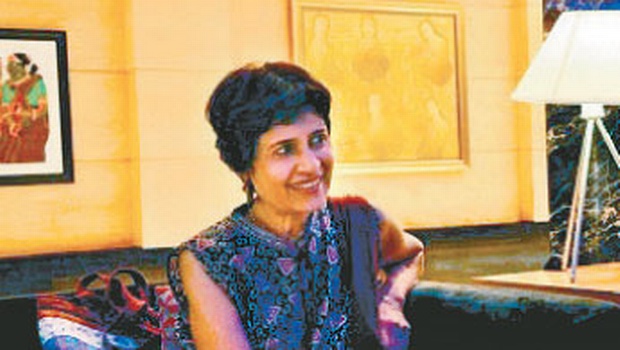
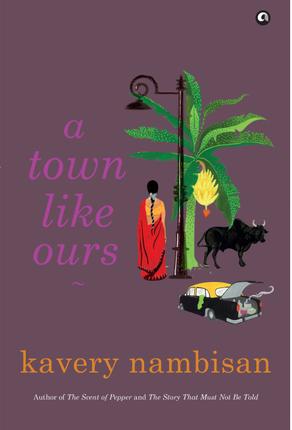
Kavery Nambisan’s poised surgical fingers cut through the heart of rural India in her charming seventh novel, A Town Like Ours. Yes, you read that right. When most people struggle with writing one book (full time), Nambisan has deftly churned out little more than half a dozen books while juggling her day job as a surgeon. If that doesn’t make you envious, then perhaps this will: her last book The Story That Must Not Be Told was shortlisted for the Man Asian Literary Prize and the DSC Prize.
In her latest offering, A Town Like Ours, you get the feeling that Nambisan has been mulling over the idea for years—lodged in her subconscious—before writing it all down in one swift sweep. It is a quiet book with an assured, elegant voice. Set in the fictional small town of Pingakshipura, the novel’s narrator is Rajakumari, a retired whore past her prime, who at one time serviced everyone and the local temple priest. This is a town where water runs black—all thanks to the temple priest—and every child’s head is white. Poignant and aching in parts, Nambisan’s motley crew of characters weave a story of love and loss and the desire to succeed in a ferocious world.
There is Saroja and Sampathu who flee a murder most morbid only to land up in Pingakshipura and raise Gundumani and Rukmini (Rukma) in a battered old taxi. No matter how odd this may seem, the two hold onto this semblance of a home. Then there is Gundumani, the boy with the crooked leg, whose can’t seem to understand his love for the woman whom he has treated as his sister, until well…let’s leave that for you to discover. Then there is Lectric Manu, who is a little too keen on Saroja; Kripa and Manohar, the childless couple who discover something unusual about each other after years of marriage.
A Town Like Ours is a sad tale that negotiates all those uncomfortable emotions gurgling underneath. Here is a little sampling of Rajakumari’s thoughts: ‘The very pith of marriage is carnal, you will do it with your husband or wife and no other. The manliness and womanliness with which couples accept this situation while attempting to imitate happiness is enough to make me weep. So it begins, this wedded happiness which is sometimes also a curse. Couples tire of each other’s bodies without realising it. They proceed to make children who grow up and go to school, the bidi factory or brothel, they live normal lives while their vague disenchantment cooks away and bounces off the walls of their cage like tired moths that slowly-slowly wither to dust.’
The writing is measured and the story unravels itself beautifully as you nudge each page. Nambisan’s book is a slow, lilting little gem that is ought to be relished on a long, monsoon-dappled train journey.
A Town Like Ours
By: Kavery Nambisan
Pages: 256 / Price: Rs 395 / Publisher: Aleph Book Company
source: http://www.newindianexpress.com / The New Indian Express / Home> LifeStyle> Books / by Supriya David / August 10th, 2014
Sandalwood actress Harshika Poonacha who was recently eliminated from the house of popular Kannada reality show Bigg Boss is all set to make her comeback on the show. The reason behind Harshika’s re-entry to Bigg Boss was because audiences have been demanding her comeback on the show.
And the makers of the show had no other choice, but to relent to the audiences demand. She will be once again seen on the TV show from Sunday onwards.
Hope her re-entry will be a pleasant one, and she remains in the show for long.
Recently we saw Sandalwood director Guruprasad making a wild card entry into the controversial reality show currently on air on a popular Kannada TV channel. The show, in its second season, is being hosted by Kannada superstar Sudeep.
Director Guruprasad is mostly known for portraying realistic stories on screen. Thus we wonder whether the filmmaker will be able to fight back against all the allegations and backbiting that happen on the show.
source: http://www.timesofindia.indiatimes.com / The Times of India / Home> Entertainment> Kannada / TNN / August 03rd, 2014
Author Kavery Nambisan / by Special Arrangement / The Hindu
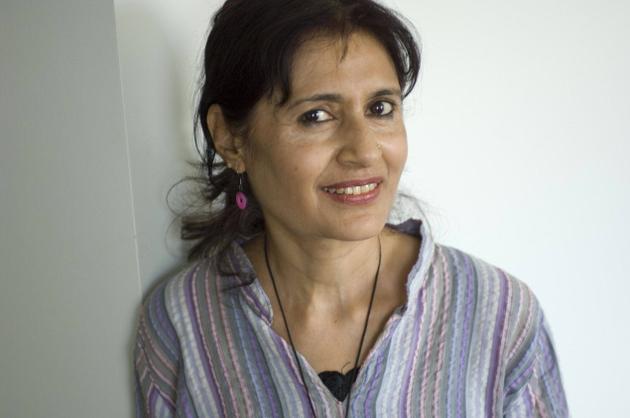
Kavery Nambisan talks to the writer about her book A Town Like Ours, and juggling the roles of writer and surgeon.
Pingakshipura — where the hair on children’s head has turned white and the water runs black — is the town Kavery Nambisan created in her latest book, A Town Like Ours. Though a fictional account of a fictitious place, Nambisan’s words resonate with a dark, uncensored truth that brings to mind the fate of hundreds of villages across the country. Known for her highly perceptive and emotive style, Nambisan talks about her writing and her dual life as author and surgeon.
Excerpts from an interview:
Tell us a little about how you created Pingakshipura.
It grew around the character of Rajakumari. When I created this endearing, coarse-tongued prostitute and tried to imagine her life, the place that came to mind was a shapeless, noisy pell-mell town. I worked backwards from the town to what it must have been a decade or two earlier. I thought I had created Pingakshipura but, in actual fact, it was like the villages of Karnataka where I lived in my childhood that, over the decades, transmogrified into towns. The lopsided modernisation that we so timidly endorse in our greed for wealth leads to a distortion of the intrinsic fabric of society. The deep and abiding wisdom that is a part of village life is forever lost.
You choose to use Rajkumari to tell the story?
She is derived from a real characterYou know how you come across a person and she stays in your mind and cooks away in your imagination until she is no longer a strangerThe important thing about Rajakumari is not her beauty but her ability to think, and to believe in herself. Her unique position as a harlot gives her the fearlessness and the freedom to retain her dignity at all times.
As for using her voice to tell the story, who better than a whore to give an honest account of the goings-on in any place, who better to tease out the absurdities of life and people? Her voice is like the drumbeat of Pingakshipura, the collective voice of the town. She speaks in her language, namely Kannada which is also the language I grew up with in school.
Not every character’s story is resolved. This seems to be deliberate.
It is Rajakumari who speaks. She is keenly interested in the lives of four people; two couples and two children. My own experience is that the lives of seemingly disparate people come together due to the strangest of circumstances. And a novel is only a peeping-hole into something that happens somewhere. Life can be a charming fairy-tale but more often it is a mess. I look in and show what I see.
I am also very interested in the way we keep secrets from each other, the way we speak half-truths and get away with it all the time. We try to shield our own ‘imagined’ dignity or shield that of others. But see what dilemmas we can end up with. Would it not have been easier for Manohar to tell his wife about his longing for children instead of doing what he did? Or for Saroja to be utterly honest with Sampathu?
A Town like Ours seems to underline your own worries about where rural India is headed.
I guess that runs like a theme through the book, although it is not talked about much. Yes, I am depressed about the destruction, the thinning away, of our link with Nature. It is like humanity is steadily losing blood, getting more anaemic by the day and, instead of treating the cause, is trying to pep itself up by using the magic tablet of modernisation.
Is this the kind of fiction you believe in writing, one that reflects on and mirrors reality?
I did not plan anything. When I started, all I knew about writing was that you had to tell a story. I like stories that make me smile or laugh (sometimes with bitterness). But what really moves me is the grand canvas of living. We humans have a greater capacity for grief than for joy, don’t you think? At least, that is the case with me. I try to be honest, that’s what I do when I write. Everything flows from there. Injustice of all sorts fills me with disbelief about our future and I write so I can change that disbelief into something more hopeful.
Are there any similarities/overlaps in the two facets of your life: writer and surgeon?
Surgery is all about knowledge, skill and team-work. Writing, on the other hand, is done in isolation; it is a bizarre mix of observation, experience, memory and imagination, a chipping- away until something comes out on the page. But both writing and surgery require a certain confidence and the ability to take risks. Who knows what your novel will turn out to be like? In surgery, the risk is that each human body behaves differently and, although you think you know it well, it always throws up surprises. When I open an abdomen, or take on something else, I should be prepared to handle the innumerable variations. Especially in a rural area where you cannot cry for help. You succeed by staying abreast of progress, by keeping your faculties sharp and your mind open to learning. Once you say, “Yes, I can do this for you,” to a patient, you go all the way in the best way possible. By nature, I’m a risk-taker. That’s how I’ve survived as a writer and a surgeon.
source: http://www.thehindu.com / The Hindu / Home> Features> Sunday Magazine> The Sunday Interview / by Swati Dastur / August 02nd, 2014
The 26-member committee has to submit its report within three months
The government has set up a 26-member expert committee, headed by the former Law Minister M.C. Nanaiah, to suggest amendments to the law related to sexual assault cases and enhancement of punishment for the crime.
According to a government release on Wednesday, Mr. Nanaiah will have the Cabinet Minister status. As the chairman of the committee, he enjoys powers to invite opinions and suggestions from experts and officers concerned. The committee is expected to submit its report along with its recommendations within three months from the date of its formation, the release said.
Increase in the incidents of sexual assault on women and children, followed by protests both inside and outside the House, prompted the government to constitute the expert committee comprising legislators, representatives of social organisations and women and children’s organisations, and legal experts.
Legislators Shakuntala Shetty, Y.S.V. Datta, Motamma, Jaimala, Tara, V.S. Ugrappa, Basavaraj Horatti, K.B. Shanappa, Govind Karjol, Tanveer Sait and Vinisha Nero, the former Minister Rani Satish, the former MLC Prafulla Madhukar, Leela Sampige, retired IPS officer Jija Hari Singh, writer Suchitra Rao, journalist Gouri Lankesh, Sangeetha Saxena, Krupa Alwa, Chandramouli and M.R. Hegde are members of the committee apart from four government officials from the departments of Home, and Law and Parliamentary Affairs.
source: http://www.thehindu.com / The Hindu / Home> News> National> Karnataka / Special Correspondent / Bangalore – July 31st, 2014
MLC M C Nanaiah has demanded the district administration and the government to hand over the complete operation of river rafting in Cauvery river at Dubare to the government owned Jungle Lodges.
In the letters written to Kodagu Deputy Commissioner Anurag Tewari and State government Chief Secretary Kaushik Mukherjee, he has requested to stop the dangerous rafting and harassment of tourists in Dubare. Permission has been granted by the forest department, tourism department and port and inland department to operate six boats for rafting purpose in Dubare. However, over 30 boats are operating here illegally.
“I have visited the place twice and have witnessed the illegal river rafting taking place in Cauvery river in Dubare. The permission given to private firms for operating this dangerous and adventurous sports has to be withdrawn immediately and hand over the operation to government owned Jungle Lodges for the safety of tourists,” he has said.
Further, he has mentioned that there is an unhealthy competition between the private water sports operators. Lack of safety equipment is another cause of concern.
Thus it will be a good decision to hand over the responsibility to Jungle Lodges, Nanaiah has said.
He has requested the DC to take a decision after discussing with the secretaries of the forest and tourism department.
source: http://www.deccanherald.com / Deccan Herald / Home> District / Madikeri, DHNS – July 30th, 2014
WELCOME. If you like what you see "SUBSCRIBE via EMAIL" to receive FREE regular UPDATES.
Read More »