Category Archives: Arts, Culture & Entertainment

Tata Coffee Plantation Trails celebrates International Women’s Day

A woman efficiently plays the ever changing role of a daughter, wife, mother, entrepreneur, builder and moulder of a nation’s destiny. Plantation Trails is honoured to offer all lady guests a special treat on their special day.

It is the spirit of Womanhood that has inspired generations and we at Plantation Trails would like to celebrate this spirit on the occasion of International Women’s Day. A woman efficiently plays the ever changing role of a daughter, wife, mother, entrepreneur, builder and moulder of a nation’s destiny. Plantation Trails is honoured to offer all lady guests a special treat on their special day.

The celebration would begin from March 1 to March 31, 2012. Every group with at least one woman guest, who makes a booking at Plantation Trails calling on + 91 (080) 23560761 or E-mails: reach.plantationtrails@tatacoffee.com gets to enjoy a special package at Coorg & Chikamagalur.

Christine F. Jamal, Vice President Corporate, Tata Coffee Limited said, “ Woman have played a crucial role over the ages nurturing the social and functional ties of society thus being the real architects in building the strong pillars of human civilization. Their role and tireless contribution across the various stages of life is enormous and immeasurable. Plantation Trails respects women and there can be no better occasion to honour them than on International Women’s Day.”

source: http://www.IndiaInfoline.com / IndiaInfoline> Markets> News> Other News / March 06th, 2012

Harshika Poonacha in Meetru

The lovely looking Harshika Poonacha from the hilly region Coorg of Karnataka is accepting the offers of newcomers and she is forging almost on the lines of Radhika Pandit.

Harshika Poonacha an engineering graduate starting her career from ‘PUC’ Kannada cinema is nearly dozen films old. Her films like ‘Beat’, ‘Pari’ are yet to release. She has now accepted a film with new hero Rocky in ‘Meetru’. The screenplay and direction of Soori a dance master turning director. This Soori is in no way connected to Dhuniya to Anna Bond Soori or recent Dr Soori of ‘Lucky’.

The dialogue king Saikumar is back after a long gap. He is in ‘Kalpana’ a remake of Kanchana with super star Upendra and Shruthi.‘Meetru’ Kannada cinema has the caption of C/O Bengaluru – 21. The pin code indicates that the film belongs to Srirampura the notorious rowdy element area in Bengaluru where Srirampura Kitty created terror in the 80’s. Raghuraj and Chetan Prasad are the producers.

source: http://www.filmglitz.com / Movie News> Kannada / March 06th, 2012

General Thimmaiah birth anniversary on March 31

The 106th birth anniversary of General Thimmaiah will be observed on March 31, said Field Marshal Cariappa and General Thimmaiah Forum office-bearers.

Speaking to presspersons, Forum President Col (Retd) Kandrathanda Subbaiah, convenor Major Biddanda, Secretary Ulliyada M Poovaiah said the programme will be organised at General Thimmaiah’s residence ‘Sunny Side’ which houses RTO office. “If we fail to get space in the RTO office, then the programme will be held at General Thimmaiah Circle at 3 pm,” they said.

Speaker K G Bopaiah, Minister for Kannada and Culture Govinda Karajola, Kannada and Culture department secretary Manu Baligar, MLA M P Appacchu Ranjan, MLC Capt Ganesh Karnik, M C Nanaiah, T John and others would be invited for the programme.

General Thimmaiah’s birth anniversary should also be observed grandeously. To mark the birth anniversary, various Kodava cultural competitions have been organised. They are ‘Bolakat,’ ‘kolat,’ Ummathat.’ The competition will be held from 9 am.

The winners will receive Rs 15,000, Rs 10,000 and Rs 5,000 respectively. Interested teams should register their names with the convenor, Field Marshal Cariappa and General Thimmaiah Forum, General Thimmaiah Museum office, RTO complex, General Thimmaiah Road, Madikeri on or before March 20. For details contact: 9448184559.

‘Vacate the house’

The office-bearers said that the RTO office is functioning from General Thimmaiah’s residence Sunny Side. “Inspite of requesting to vacate the house, the officials are not responding to our demands. If the officials fail to vacate the house, then protest will be held from March 25 to 30. Though former Chief Minister H D Kumaraswamy had asked the transport department to vacate the house six years ago, it has not been fulfilled till today. There are 18 quarters situated around the building. The Forum has already written several letters to the Transport Commissioner and Deputy Commissioner in the past. However, our efforts went in vein.”

source: http://www.DeccanHerald.com / Home> District / DHNS / Madikeri, March 06th, 2012

The Woman in Blue Checks – Cauvery’s Tale dazzles at LFW

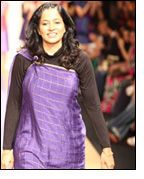
From the looms of Ilkal Karnataka, Deepika Govind wove a magical collection called “The Woman in Blue Checks – Cauvery’s Tale” at Lakmé Fashion Week Summer/Resort 2012. It was a fabric fantasy as cotton and silk checks and stripes from Salem, Chettinad, Narayanpet, Venkatgiri and Kanchivaram created magic with Mushru cotton, Ajrakh and resist prints, silks and Luxe satin.

Deepika’s colour chart was rustic with indigo, sapphire, cerulean blue, ultramarine, dark cyan, green, fern, teal, fuchsia and magenta with some touches of aubergine, carmine, candy apple, cerise, red and black which brought the collection to life.

The silhouettes were contemporary for tunics, dresses and saris giving the collection a marked fusion touch. Appliqués, cutwork, frayed edges along with surface embellishments with a clever design of checks and stripes created a trompe d’oeil effect.

When it came to the construction, Deepika let her creativity move out of the box with asymmetric hemlines and deconstructed seams which were used to create fluid drapes and bring forth a look that was rustic yet elegant.

Opening the show with three saris worn in the Coorgi and mini styles; Deepika moved to tailored summer wear in checks and stripes. The indigo peplum top matched with satin dhoti pants, the tailored long sleeve jacket with the swirling kerchief hemline skirt, the maroon checked kanjari top, and the kimono style electric blue asymmetric tunic over mini skirt and the cross over cover hiding a sheath, were light airy feminine creations.

Matching a variety of patterns and colours, there was a single shift, a stylish wrap-around cape coat with pretty embroidery, the draped maroon midi and the multi check shot silk dress, which had an international flavour. The solitary black velvet cropped top with minute embroidery was teamed with a checked lungi and Deepika even brought in the current rage of colour blocking for a kurta with embroidered sleeves.

The engineered fabrics were imaginatively used by Deepika bringing their beauty to the fore front with her easy on the eye and very relaxed styling. For a wardrobe choice that is unconventional and presents the beauty of Southern textiles, Deepika Govind’s Summer/Resort 2012 line will give a definite fashion direction.

Lakmé Fashion Week

source: http://www.Fibre2Fashion.com / Home> News / March 05th, 2012

India’s homemakers recruited as hotel chefs

A new breed of chefs is taking over hotel kitchens in India. Housewives and mothers are now being recruited to bring “home-cooked” food to five-star plates, as Vasanthi Hariprakash reports from Bangalore.

As I finish my lunch at a restaurant in the city-centre, I reach for the dessert that the steward has recommended.
It turns out to be “obbattu”, a sweet usually made in south Indian homes during festivals and not often seen on upscale hotel menus.
The “flat, wafer-thin chappati with a mix of jaggery and dried coconut, fried gently on a skillet” melts in my mouth and feels light and wholesome – like your mum made it for you.
The irregular shape of the obbattu, unlike the perfect round a chef would have produced, is a clear giveaway.
At Bangalore’s Gateway Hotel, a homemaker has put on the chef’s apron. It is a conscious strategy to woo upwardly-mobile clients who “typically crave home food”, executive chef Naren Thimmaiah says.
“Our guests are increasingly aware of fresh healthy food they ought to eat, but in the midst of their jobs, travel and meetings, they have no time to do that,” chef Thimmaiah says.

‘Foreign Veggies’
So, a couple of years ago, Naren and his team came up with a menu that would put healthier food on their tables.
And who better to bring in as experts than those who have been making it for years and serving it up with love?
Twenty-two women, once queens in their own kitchens, are now working in the kitchens of the Gateway Hotels’ group across India.
From cities like Bangalore, Chennai (formerly Madras) and Vadodara to smaller towns like Khajuraho and Coonoor, these homemakers are now the speciality chefs.
These are women who hold no degrees or qualifications in hotel management, but are trained by life to cook tasty, appetising food, quickly and without fuss.
One of these is 30-year-old Jyoti, mother of two, whose schooling stopped at the fourth grade.
Her specialities – akki rotti (griddle-cooked rice pancakes) eaten with maamsdha saaru (a spicy broth cooked with mutton or chicken, or optionally green leaves for vegetarians) – are rated top grade by not just the guests but colleagues in the kitchen.
“I love the obbattu that akka [sister] makes”, Vipin Rajesh tells us as he stands next to the domestic gas stove and small utensils that were specially brought in to make Jyoti “feel at home”.
Jyoti is not overwhelmed by the sophisticated high-end kitchen equipment around her.
“But some of the vegetables they use here I had never seen before in my life,” she says.
The broccoli, artichokes and courgettes that chefs commonly use for continental dishes are “foreign veggies” for Indian cuisine.
Naren says it was a priority when he selected Jyoti for the job – that what she cooks “should not taste commercial”.

‘Just right’
Thousands of miles away, the Gateway’s kitchen at the tourist town of Khajuraho in central India has been home for a month now to 62-year-old Santosh Pataria.
Otherwise a poet, writer and folk singer at the local radio station, Santosh has been brought in for her expertise in the local Bundelkhandi cuisine.
At an age when many people retire from their daily jobs, taking on a new job cooking the food known for its subtle flavour and mild use of spices comes naturally to Santosh.
“Our cuisine doesn’t have too much mirch-masala (spice). I believe food should neither be too hot, nor too tangy. It should taste just right,” says Santosh.
That “just right” cooking is bringing in the compliments.
Like those from a group of visiting tourists who sent a note into the kitchen asking for the recipe of the rare delicacy, mahue ki doobri, that she had made with mahua (a type of fragrant fruit used mainly for its medicinal properties).

Confidence

In the picture-pretty hill station of Coonoor in the southern state of Tamil Nadu, 51-year-old Indira is busy making the signature dishes of her community, the Badagas.
Indira, a single woman in her first job, says her family has kept the traditions of their centuries-old Badaga cuisine.
Whether it is avarai uttakka – local beans cooked with potato, tomato, onions, garlic and tempered with mustard seeds, or sandagai – roasted tomato sauteed with small onion, garlic and coconut ground to a fine paste – the “masala made carefully after dry-roasting 17 spices and not bought off the shops” is the key, Indira says.
She has the confidence of a professional chef who has fed a president’s entourage.
It is perhaps this passion blended with cool confidence that makes these homemaker-chefs a draw at the dining tables.
However, all of them say the money could be better. Pay ranges from 5-8,000 rupees ($100-162, £64-102) a month and there are no benefits.
For now, the guests are only too happy getting comfort food on a platter.
Sahil Saraf, a doctor by profession, and a regular at the Gateway Bangalore, has no idea who is behind it all.
“I heard somebody’s wife comes to cook here. All I know is that the food tastes yum,” he says.
Award winning chef Naren Thimmaiah has the last word: “We can dish out the most exotic of cuisine, but ultimately simple, homely food is what will win the guest’s heart.”

source: http://www.bbc.co.uk / Home> BBC News> India / March 06th, 2012

Pandya talks about his bridal couture store

BANGALORE:

A bridal couture store in the city with a wide range of wedding wardrobe options, Tamanna retails over fifty of India’s leading young designers as well as their in-store collection of clothes for every marriage ceremony. Lokesh Pandya, Director of Tamanna speaks to Vyas Sivanand about his collection, the demand and his expansion plans.

Tamanna is almost 25 years old. What sets it apart from others?

The first Tamanna store came up on Dispensary road in 1987, which I started with my wife, Dhanya Pandya. From the beginning, we have ensured that the collection which we have at our store is exclusive and not available in any other store.

We source the fabric from Benaras, Lucknow, Dubai and Milan. These fabrics are then given to our designers who design exclusively according to our requirements.

What is the collection on offer at your stores?

The Tamanna collection features options for mehendi, sangeet and bridal ceremonies with Swarovski, Zardozi and other intricate embroideries. We offer traditional saris and ghagras to the modern cocktail collections. We have recently introduced well-fitted ready made designer blouses also.

The grooms collection include suits, bandhgalas and sherwanis.

Who are your designers?
Our designers include Gourav Chabra, Shashank Devsarey, Mohit Kapoor, Sulakshana and Style Guru brand.

What is your price range?

The price range for grooms is between Rs 15,000 to Rs 2 lakhs while for the bride, it is between Rs 12,000 to Rs 2.5 lakhs.

Are you planning to expand with more stores?

We are opening another showroom at Orion Mall, Rajajinagar, which will be our third store.
We have plans to open more stores in Jayanagar, JP Nagar, Koramangala and Whitefield.
We might also look at other cities like Cochin, Chennai and Hyderabad.
Even the tier-II and tier-III cities are showing potential, but all these plans will materialise only after 2015-16.

Are you looking at franchisees?

If somebody is enthusiastic about taking up a franchise route for our store and is willing to invest, then we are also open to explore the option.

What is your promotional strategy?
We organise fashion shows once in every three months. Our fashion choreographer is Prasad Bidappa and we have got great reviews and responses to our shows.

It is a good promotional activity. But our main USP is the display at the store which changes every week.
As and when we get new stocks, we ensure that the display is updated and it has definitely been able to get customers.

Demand must have changed over the years. What is in vogue?

There used to be good demand for artificial georgette, artificial satin, etc. Many fabrics have come and gone in these few years.
Today, the demand is more for nets, chanderi silk, pure chiffon and pure georgette. Benarasi fabric as an add-on is also in great demand.

source: http://www.ibnlive.in.com / South> Bangalore / by Vyas Sivanand / The New Indian Express , Express News Service / Bangalore, March 06th, 2012

AINMANE: Preserve it for Posterity

Ainmane, the house of the elders in Kodagu, has given an opportunity for the families to live without any discrimination. Men and women were considered equal. If a girl whose married life was not happy and if she had a serious problem in her husband’s place, she had a right to leave her in-laws’ house and live at Ainmane as long as she lived. Obviously, Ainmane protected women by providing a shelter with affection.
The pressures of 21st century’s globalisation and urbanisation has made people of Kodagu re-think about their cultural heritage and rich tradition. Today, one can see this healthy growth in their thoughts too with each ‘Vokka’ trying to protect their Ainmane — more as a prestige issue for every family to have their Ainmane renovated, re-built and protected. With some hope towards a prosperous life, let’s preserve our Ainmanes for posterity.

One finds Kodavas’lifestyle unique. Its recorded history dates back to 18th century. The people here live in a hilly region amidst heavy rain, cold and wild animals. Hence they have their own lifestyle and culture that is unique in its nature.

Kodagu people lead their lives in houses that stand apart in architecture. The house that is remarkable in its structure and a place of unique bonding, that ancestral house is called Ainmane. Ainmane has always stood as a mirror reflecting the Kodava culture, life, family practices, worships and festivals according to seasons.

Kodava culture enjoyed joint family system in the past. It is because of Ainmane that Kodava families have a family name. According to the names, the families of Vokka or Vamsha is identified. Under one Vokka, there are many family units. Many Vokkas have more than 500 units. All these families put together has one Ainmane. The family also has its own ornaments, weapons, implements used for agriculture, the gift from the kings who ruled Kodagu etc. These are treasured items that are collected and preserved.

Based on this, Ainmane is not only a living place for families but it acts like a museum of the community that helps to enhance the cultural heritage of Kodavas.

The relationship between Kodagu and Kerala seems to be closely knit since ages. Ainmane stands as a proof to it. Comparing to the house of Nayars of Kerala (that is called as Taravad) and the Ainmane, we can see many similarities. The influence of Malayalam on Kodava language cannot to be ignored. Similarities can be found between the two languages. The festivals, a few rituals, ceremonies performed and some celebrations have a strong Malayalam impact. It is clearly identified that Ainmane has played a significant role and has provided enough room to have a good relationship between Kodagu and Malayalam province. More important is the structure and architecture of Ainmane that is a living example to recognise the relationship from the past between Kodagu and Kerala.

The Kings who ruled Kodagu built their Palaces in the same style of Taravad houses. Towards the North of Kodagu in a place called ‘Yavakapadi,’ king Doddaveera Rajendra, who ruled Kodagu, built a Palace in Nalaknadu village in 1792. Architecture of this Palace resembles Ainmanes of Kodavas. This clearly shows that architecture of Ainmane has been influenced from Kerala and hence instilled the same kind of style to their Palaces.

Likewise, the Palaces that exhibit their majestic nature seem to be unique, like that of Ainmane that which is a link to depict the history of Kodavas of Kodagu. The pivot of joint families was the Ainmane where in the past era, people of different age groups lived together. The centre was always full of life. But today, because of modernisation, the Ainmane is only an epitome depicting Kodava cultural heritage.

Modern education and urbanisation has opened a new lifestyle for Kodavas. Herein they look down upon their own culture and hence the existence of Ainmane has become obsolete. Higher education has made many to take up urban residence. Therefore, elders of the family are the only people who are living in Ainmane; but after their death, Ainmane is sort of abandoned and edge towards dilapidated condition, without any family living there. In a few circumstances, there are modern style houses coming up. Members of the families live in these modern houses near to Ainmane, which is kept locked. They open it at dawn and at dusk to light the traditional lamp at the Nellakki Baade inside it.

As families become financially stable, they try to migrate to the cities either selling their property or asking somebody to look after it. Such families have abandoned Ainmane and hence, most of them are in a neglected state. Growth in economic conditions and the family planning followed by Kodava families has resulted in one or two children in a family. Moreover, the children are brought up in cities. Education is provided there and hence they get employed in the cities itself. The above reasons have led Kodava families to leave their native. All family members have a right on Ainmane, but their lack of interest and their dislike towards rural lifestyle have prevented them to give a serious thought on their ancestral house.

The house of elders has given an opportunity for the families to live without any discrimination. Men and women were considered equal. If a girl whose married life was not happy and if she had problem in her husband’s place, she had a right to live at her parents’ Ainmane. Obviously, Ainmane protected women by providing them shelter and respect.

The pressures of 21st century globalisation and urbanisation has made people of Kodagu re-think about their cultural heritage and rich tradition. Today, one can see this healthy growth in their thoughts too with each Vokka trying to protect their Ainmane — more as a prestige issue for every family to have their Ainmane renovated, rebuilt and protected. With some hope towards a prosperous life, let’s preserve our Ainmanes for posterity.

Significance of Ainmane

Ainmane is not only a part of the culture of Kodavas, but also of Kodava dialect speaking communities. Though Ainmanes of all sects are similar, they are also called Balyagattumane, gurukarana mane, gurumane etc.

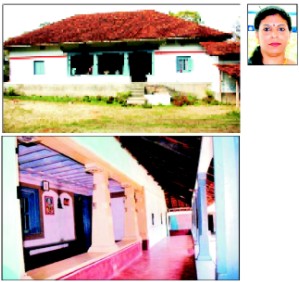
Rev. G. Richter writes in the Gazetteer of Coorg (1870) that Ainmane usually is near paddy fields. Ainmane would be one-storied and square shaped, with an attic. Though east-facing houses are preferred, more emphasis was on houses facing paddy fields. A typical Ainmane will have two doors at the entrance. Entering inside, Nadu mane is found. Living rooms in this square-sha-ped house have small doors and usually no windows.

Ainmane has an open roof space in the middle, so that rain water is collected within and excess water is drained out. The house consists of two doors to go to backyard. Front portion of the house is a canopied open hall called as Kaiyale. It consists of a 2-feet high seater of thick wooden plank which is used as a bench, called Aimara. Daughters-in-law of the house are not allowed to sit on Aimara whereas married daughters of the house can sit on it. Elders of the family usually sit here to exchange cordialities, discuss various issues and take important decisions.

Two massive wooden poles adorn the entrance. The central Nadubaade would consist of three wooden poles. The first pole is called as Kannikamba — it supports the whole roof of Ainmane. The kannikamba is as significant as the thook bolcha (hanging lamp) lit everyday at the Nellakki Baade (prayer room).

During ceremonies, family members would seek blessings by touching the base of kannika-mba and then the feet of elders. Images of sun, moon, flowers etc. adorn Kannikamba and main doors, signifying that Kodavas were nature worshippers.

An integral part of Ainmane is Kaimada — an important structure built in memory of the founder of that family or Vokka. It is a prayer place which is used during happy or sad ceremonies.

At Ainmane, the prime position is given to karona, the head of that particular family. Unique feature about Kodava culture is that men and women share same kind of respect, status and position.

Earlier, families of a Vokka lived together at Ainmane. Later, a few families left Ainmane to live independently and improve their property. The result was joint families gave way to nuclear families. New houses are built in modern architecture. But during festivals and other occasions, Vokka members gather at Ainmane and partake in the ceremonies and feast, symbolising unity.

source: http://www.StarofMysore.com / Feature Articles / March 04th, 2012

Big boys don’t want to spend


Nicole Faria
* Our local hottie has now become one helluva an international one too. Nicole Faria was in Perth to host an exclusive event at Mazzucchelli’s store. This Miss Earth has already been doing so much for the forgotten lakes of Bengaluru and is quite the activist.

Now Faria is travelling the world, as the global brand ambassador for Frederique Constant Geneve and was seen pretty busy rubbing shoulders with Perth’s celebrities and the who’s who of Ozzie land. And she looked beautiful, if we say so ourselves. Kudos to Nicole and should we see a Hollywood venture in the offing too? Let’s hope so.

* This popular coffee and quick snack hangout for youngsters on the busy Church Street, Java City allegedly shut shop a few days ago, owing to bad business. Singer and actor Sunil Raoh was often spotted at Java City most evenings with his gang of friends from the Sandalwood industry. Just next door to Java City is a small but always buzzing wine shop that is thronged by many after work every evening and that is doing brisk business. Just opposite is another eatery, Empire Restaurant that continues to rake in the moolah. Does that say something about our city’s changing preferences?

*February was one lucky month for Sandalwood actress Harshika Poonacha. She took part in two game shows and was crowned the winner in both. The people competing against her were Kavitha Lankesh, actor Suriya’s mother and another actress from their upcoming release Crazy Loka. At the other game show, her competitors were the same as the first, except Suriya’s mother was replaced by Nam Anna Don actress Sana. The tasks were simple but the prizes were extravagant. Harshika won lots of goodies, cash prizes and gift vouchers.

*The three city youngsters who were selected to play lead roles in Malayalam film Cinema Company are on cloud nine. The shooting is done and post-production is underway. But the actors Basil, Shruti and Sanjeev are aggressively promoting their film. They are not going big on promotions. Word of mouth publicity, SMSes and social networking sites are the latest promotion tools for this team of youngsters. The May release will be a first of its kind film in Mollywood where the lead actors were chosen through a reality show format.

Who, what,when, where, why

Who is slowly becoming the personal AD guy of the season? From the “Bold Look of Kohli” to the cartoon of a sad Malinga doing the rounds with a larger than life “Melan-KOHLI”, written across, the Royal Challengers Bangalore lad Virat Kohli is the one everyone relies on for excitement and admiration… on and off the field. These recent ads and cartoons doing the rounds on social networking sites are all about the Kohli quotient!

What can Arundhati Nag’s fans look forward to? Her much-awaited film Chaurahen — Crossroads is finally releasing on March 16. The movie which was shelved for nine years has since travelled to 11 film festivals before releasing in India.

When will we see a new nightclub in the sky? Soon… as the newest mall in the City MG Road One is touted to have one helluva party place on its terrace… but we’ll wait till it opens to decide on that!

Where was Nidhi Subbaiah spotted prancing with her boyfriend, actor Sudhanshu Pandey? In Mumbai, where she is shooting for an upcoming Kannada movie. She was seen spending all her free time with him there.

Why is danseause Madhu Natraj a happy lady? She will be receiving the ‘Ustad Bismillah Khan Yuva Puraskar’ from the Sangeet Natak Akademi? Madhu has been chosen for her contribution to the field of creative dance. The award will be conferred on March 7 in New Delhi.

source: http://www.DeccanChronicle.com / TABLOID / Home> Tabloid> Talk of the Town / DC, Bengaluru / March 02nd, 2012

Things have changed … And remained the same

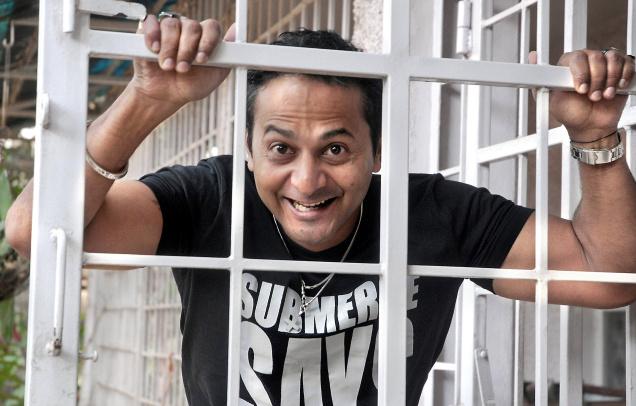
Nikhil Chinapa returns to radio after 15 years to find technology has made a huge difference. However, the MTV host and DJ tells Mini Anthikad-Chhibber there is a sense of homecoming when recording for In the Mix

PLAY ON Nikhil Chinappa Photo: Sampath Kumar G.P.
This interview has been a long time in the making, and sitting at his parents’ lovely house at Langford Road on a Sunday morning, there was a sense of disbelief when Nikhil Chinapa breezed in with a cup of coffee.

“I started my career in Mount Carmel College doing music for the carnival,” Nikhil begins, with an engaging grin. “In ’92 when the first event company was set up, I emceed a personality contest. My first salary was Rs 150. We pretty much made the rules as we went along.”

Nikhil dabbled in theatre, doing four plays with Arjun Sajnani and graduating from tap dancer to sound man. From theatre he moved to radio. “Those were the days of medium wave. When I went to the recording studio, it was love at first sight. I carried the principles of radio to TV. So, it was not ‘all you people out there’, but rather just you and me. I was talking directly to the listener/viewer.”

When Nikhil interviewed Rahul Khanna, who was a veejay for MTV, he thought this could be an interesting job.

“But I am a lazy person, so I didn’t do anything about it. In ’97 MTV announced the first veejay hunt. If you remember then, veejays were already celebrities, people you would look up to. At that time, MTV was looking to changing the profile from aspirational to the boy next door and I fitted the bill.”

Fifteen years, super-successful shows, films and Submerge later, Nikhil returns to radio with “In the Mix” on Radio One on Saturday nights from 10 p.m. to 1 a.m. “Twitter has exploded,” he says, happily scrolling down the comments.

“Radio is so much more intimate. Of course technology has made a difference. Now I have messages on Twitter, while then I had people writing seven-page letters to me. They did that because they felt connected to me. I have kept all the letters. And those days we would physically play the CDs, while now there is something called radio control software where I feed everything into the computer and the show is done!”

The aim of the show, Nikhil says, is to educate and entertain. “There are different sections, such as ‘Sample Example’, ‘A Decade Ago’, ‘Bringing It Back’, ‘Round the World’… When 3,000 songs are created a day in dance music, six months is old. In the ‘Decade Ago’ section, we look at a song that was big a decade ago.”

Nikhil was always fond of dancing. “My friends and I would go out to dance here. It wasn’t about the beer (we couldn’t afford it anyway), it was just about music. I would say dance music chose me. I remember when the DJ played Prodigy’s ‘Firestarter’ for the first time. It was really tough to mix and when the DJ mixed it after two tries, there was silence on the floor for the 15 seconds and then everyone was grooving.”

Talking about the club scene in Mumbai, Nikhil says, “Film music started creeping in. The first song was ‘Kaliyon ka Chaman.’ I became a DJ out of frustration. I am not against Bollywood music, I choose not to play Hindi film songs. There is some amazing work being done in film music, it is just that when a ‘Munni Badnaam Hui’ plays in the middle of a set, it turns the groove. You go ewwww…”

It was the desire to play their kind of music that resulted in Submerge.

“No one goes clubbing in Mumbai on Thursdays. In 2002, we thought of an event, Submerge, on Thursdays where the DJ could play the music he wanted to. There were a few ground rules. The first was requests were not allowed. The DJ was an artist and just like you would not tell MF Husain what to paint, you couldn’t tell the DJ what to play. If you didn’t like the music you could always go to another club. The second rule was we encouraged the DJ not to use the mike and rather let the music do the talking.”

Ten years down the line, Submerge is internationally recognised. “The reputation grew and DJs wanted to play at Submerge. If you got to play at Submerge, you had arrived.”

Far from being the rock capital of India, Bangalore, Nikhil says, “is the cradle of all kinds of music. It is a young city and young people are willing to take risks. You know hip hop was popular in Bangalore much before it became fashionable elsewhere.”

Nikhil feels strongly about piracy. “By downloading music, you are depriving musicians of their bread and butter. If a musician doesn’t get paid, he goes back to being an accountant or whatever he is doing and the quality of music goes down. Also with downloading, music has become less precious. If you were buying a tape or a CD, you would deliberate till kingdom come before deciding on which CD to buy. Now you download 300 songs and don’t listen to any of them!”

He hosts the MTV reality show “Splitsville”. “It is part of the world we live in today. Yes, the emotions are all out there. You need to apply my coffee and tea philosophy to the phenomenon. There are those that like coffee and others that like tea. It does not mean one is right and the other is wrong.”

He grins disarmingly. “So can I now offer you a cup of coffee?”

source: http://www.TheHindu.com / Arts> Radio & TV / by Mini Anthikad-Chhibber / Bangalore, March 01st, 2012

Vineeth Vincent’s road-trip that defined his band as artistes


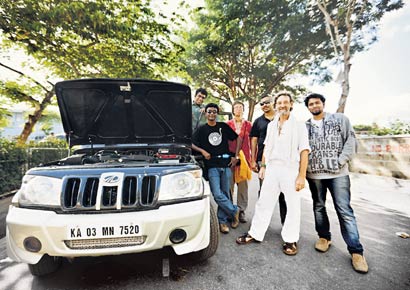
Vineeth Vincent and band with the French couple / DNA
We kicked off with a performance at St John’s Medical College Bangalore, to help spread awareness about breast cancer and cancelled all our gigs for the week. And then it was time to hit the road — with Audi Photography for documentation, Glen Ivan Suchitha, the tour manager, Bhairav Kuttaiah our on road entertainment, Go Untucked,our T-shirt partner and yours truly. Our mission was to find a balance between social responsibility and sustainability as artists.

The NICE road on a cold foggy morning saw us off, whizzing to Mysore, stopping for breakfast at Maddur. We ran into a French couple a little before lunch time and bonded over momos. The sound system was brought out and we had a jam session with the Buddhist Golden Temple in the background. The guy played the flute while I beatboxed. We dropped them off at Coorg afterwards, and as Glen put it, we haven’t heard from them since.

At Coorg, that night, we were at a residential school, performing under the stars, the only light coming from our SUV. The boys had arranged the benches in front of the car and we taught them how to beatbox and got them to sing along with us. The morning brought in beautiful views of Coorg and over cups of teas and the best idlis ever, we discussed our route and set off towards Mangalore. We were there by lunch time and met volunteers from the NGO, Make a Difference (MAD), who took us to one of their centres for children with HIV.

This was a moving experience — to hear of dreams from children who would not live them, not only because of their medical condition, but also because of the socio-economic factors. As musicians, it was a privilege to see the joy they got from our performance. The next day was spent at another MAD centre, an orphanage. It was an eye-opener to see so many children in need of homes. The crowning moment was when they sang, word-perfect, along to Rise Up, wreathed in big smiles.

By sunset, we were on the road to Manipal. Audi Photography added to the thrills by risking life and limb trying to get night shots. Our plan was to head to Goa after a fuel stop, but by then, I had started throwing up due to sleep deprivation from the constant driving. We went to Gokarna instead, where I took a much-needed rest and the rest went off on a trek.

Our next destination was Hubli. Luxury was ours for taking at the fancy resort we were put up in, 13kms from the venue. A few hours of shut-eye and scrumptious vadas for breakfast later, we were all raring to go. Well, almost all. It was Bhairav’s turn to fall sick and stay parked in the loo, as we bid him farewell. Google Maps came to our assistance that day in a big way and we finally reached the venue, only to ge out and stare open-jawed at what could be one of the most gorgeous cafés in the world. This was Seven Beans.
Late as usual, the musicians trickled in one by one and we jammed and made a set-list for the night. The night started with about a hundred people waiting for the performance to start, and we were escorted with a lot of swagger to a rockstar’s entrance (face covered and a lot of security). We were supposed to jam with 10 very talented local musicians. By the time we got to the stage, the crowd had multiplied. With a bit of gentle leg-pulling and a lesson on impromptu beatboxing, I was back off-stage and went back again to jam with each musician. What a crowd and what a night! There was nothing better than being with musicians, music lovers and of course, the people at Seven Beans. When we finally got back to our rooms, it was only to tank up on coffee and start on a very, very long drive to Bangalore for four more shows.

Eight hours of driving later, we finally reached home at nine in the morning. It seemed like my head had barely hit the pillow when the alarm went off and we were on our way to Whitefield to jam with Live Banned. Two of their members joined me on stage dressed in khaki like the auto-drivers and with colourful wigs, to beatbox. The day was over before we knew, and the next day we were performing with my beatboxing partner in crime Vineeth Beep Kumar. We left the laughing, screaming crowd with much reluctance to head for Woodstok, to finish our over-180km-and-more-than-10-shows tour with three hours of beatboxing, Coldplay and Christmas carols!

— Vineeth Vincent is a record-breaking beat boxer

source: http://www.Dnaindia.com / Home> Lifestyle> Report / by Vineeth Vincent / Place: Bangalore / Agency: DNA / Thursday, March 01st, 2012