Category Archives: Coffee News

Meet the women fuelling India’s coffee market growth

Sunalini Menon started working for the Coffee Board of India in 1971. Image Coffeelab

Global Coffee Report meets some of the women who’ve helped pave the way for the rapid expansion of India’s coffee industry.

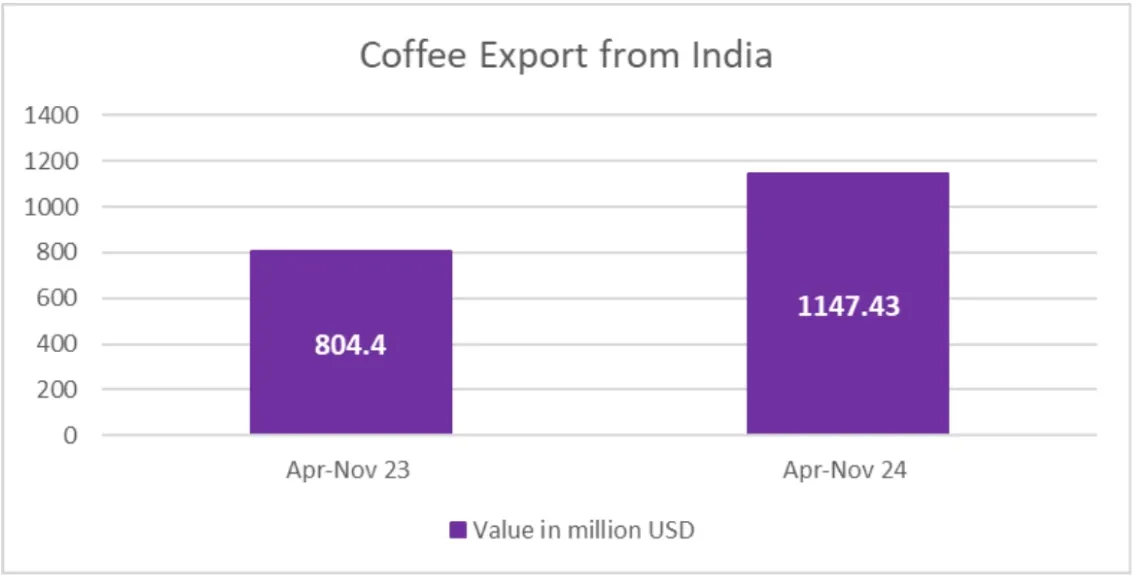
On 1 January 2025, the Centre for Monitoring Indian Economy reported Indian coffee exports had exceeded US$1 billion for the first time, with its value increasing by 29 per cent between April and November in the 2024 fiscal year. This news was a major milestone in the growth of the country’s coffee export industry, which has accelerated over the past five years due to increasing global demand.

As India’s exports expand, so too does its domestic coffee industry. While traditionally a nation of tea drinkers, the almost 1.5 billion people that call it home are increasingly switching leaves for beans. The Coffee Board of India estimated that in 2023 domestic consumption reached 91,000 tonnes of green bean equivalent, up from 84,000 tonnes in 2012.

Now the world’s seventh largest coffee producer – and fifth largest Robusta producer – India is one of the major players. Yet, when Sunalini Menon, Founder of Coffeelab and Member of the Board of Directors of the Specialty Coffee Association, started working at the Coffee Board of India in 1971 the industry was unrecognisable.

“When I was growing up, coffee was only brewed at home and only consumed by the elderly. It was very expensive compared to tea, so that’s what most people drank. On every corner there would be a man selling tea and that’s what you’d have unless it was a special occasion,” Menon says.

“Any coffee that was consumed then was grown in India because the duty was so high that importing coffee for consumption wasn’t a workable position or a requirement at that point in time.”
In 2025, Indian coffee exports exceeded US$1 billion for the first time. Image: Kelachandra Coffee

Women in the field

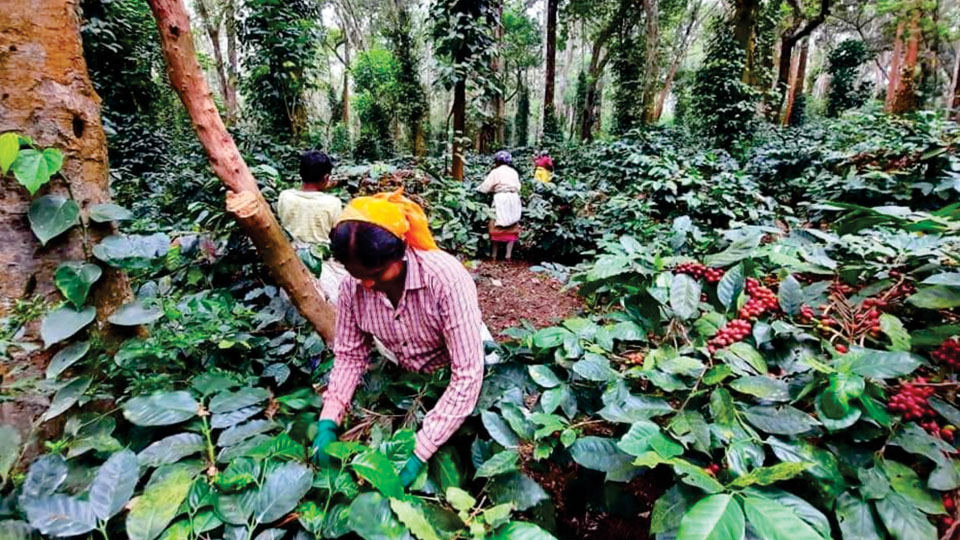
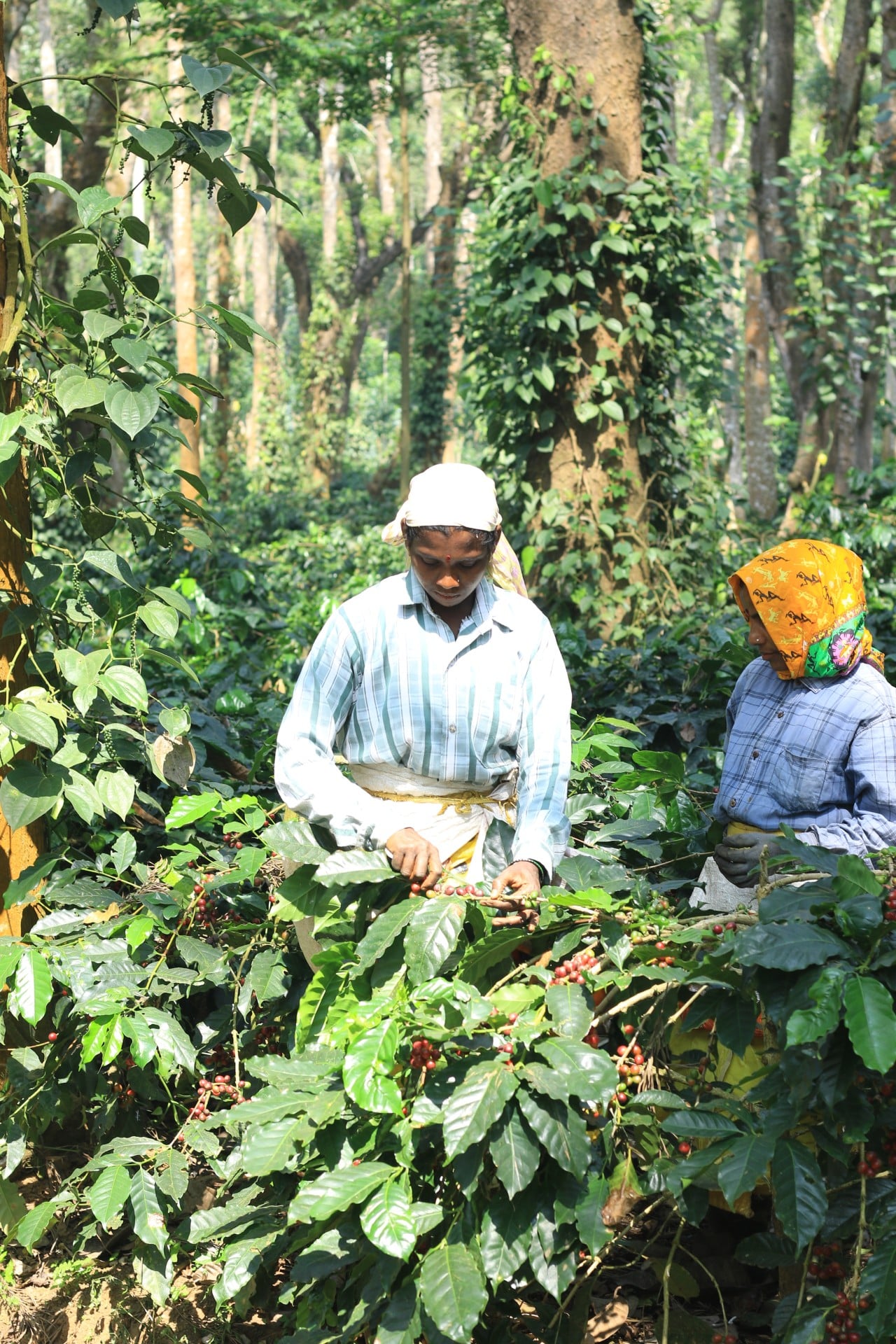
The British East India Company introduced large-scale coffee cultivation to India in the 18th century and since its early origins women have played a role in farming the precious beans. While women have continued to prop up the country’s coffee farming workforce (a 2015 study by the Indian Statistical Institute estimated 34 per cent of workers in the coffee curing and manufacturing sector of India are women), Menon was India and Asia’s first female coffee taster when she assumed the role in the early 1970s.

“At the time, the profession was a completely male pasture. I originally wanted to become a dietician and had a scholarship to study in New York, but as I was waiting for my visa to be approved I applied for a job as a coffee taster at the Coffee Board of India,” she says.

“Part of the hiring process was a taste test which I did very well in, but when it came to the interview they said that despite my abilities they couldn’t hire me because I was a woman. They thought they would spend the time and money training me only for it to be wasted if I then decided to have a family.”

Menon stood her ground and complained that the job advertisement should have specified if it was a male-only role. Thankfully, the Chairman was forward thinking and gave her the opportunity to train as a coffee taster.

Her first few years in the role were tough, with most of her male colleagues ignoring her and not taking notice of her requests.

“I used to cry every day until finally my boss gave me some advice. He told me I had to first acquire my knowledge, have patience, and then my knowledge would become power,” she says.

“These are words I always pass on to young women today. Learn your subject, be very sure of what you are talking about, and then you’ll be firm in what you do. I think that was a turning point in my life, and that’s how I began my journey at the Coffee Board.”
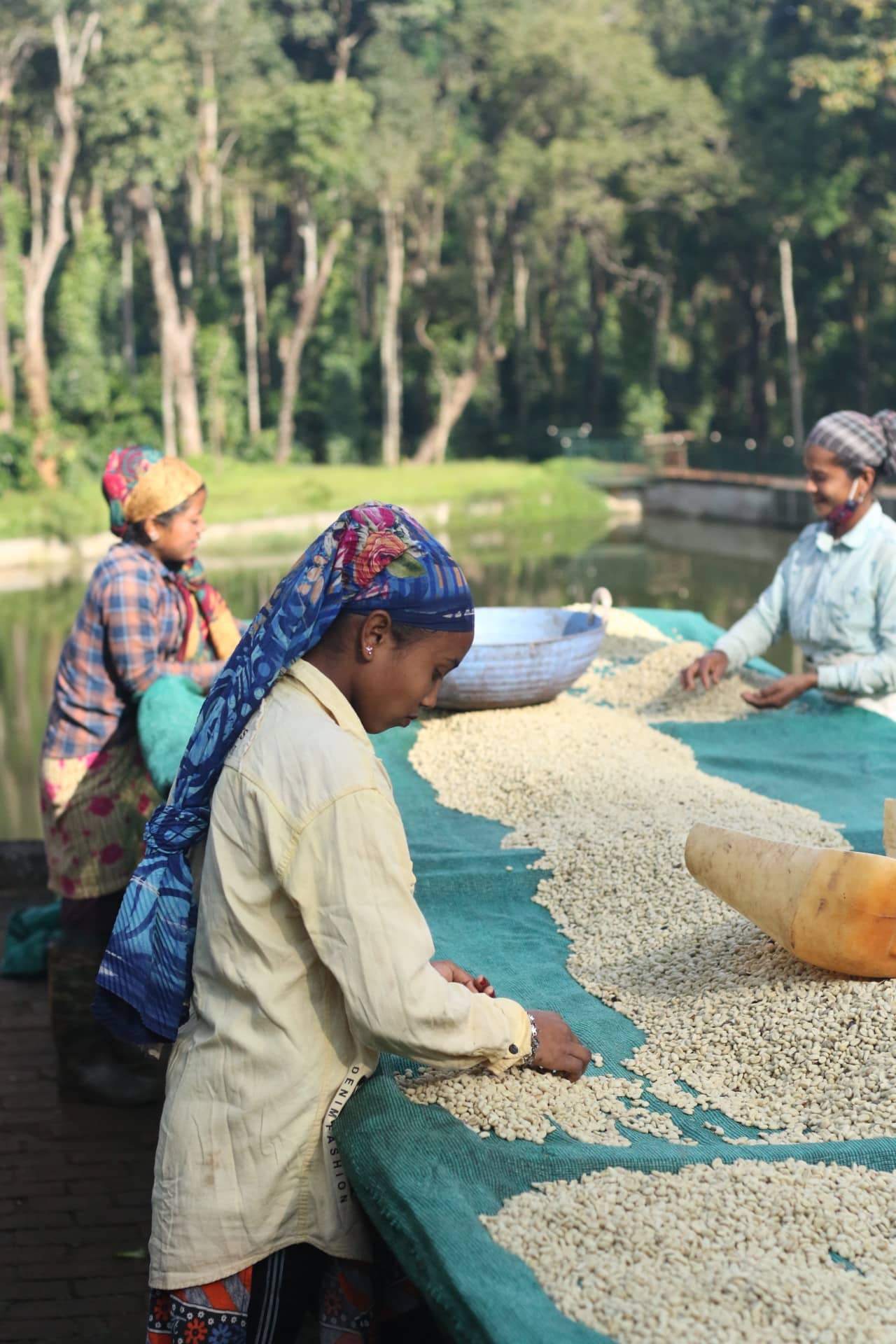
Women have played a role in India’s coffee farming industry since its early origins. Image: Kelachandra Coffee.

Improving cup quality

Over her 50-year career, Menon has witnessed the revolution of the country’s coffee industry. She says the single biggest contributor to its success has been the focus on quality.

“In the 1970s, the Coffee Board took care of marketing Indian coffee and part of my role was assessing quality. This was because the smallholder farmers didn’t understand the market and were unsure of how to sell their coffees, nor understood the international coffee market, especially the pricing for their coffees and hence the government stepped in,” she says.

“I would receive coffee from the farmers and the payment would be decided by the quality of the beans, so they were incentivised to improve the quality of their crop. The farmers didn’t like the setup at first, but when the markets were liberalised in 1996 it meant they had learned what the markets would expect – they saw the value in cupping as a marketing tool.”

Even after the liberalisation of the Indian coffee market, Menon continued to help the farmers asses the quality of their coffee.

“Many of the farmers I worked with came to me and said, ‘How can you leave us? We don’t know much about quality, how to sell, or how to process. You can’t leave us in the lurch’. I thought I’d help them for a couple of weeks, but the months started passing by,” she says.

“It was a great journey because the farmers really started to understand how they could improve quality and get more money for their coffee.”

While in many producing countries Arabica has traditionally been processed more carefully than Robusta to produce a premium product, Menon says that wasn’t the case with the farmers she worked with, nor the other coffee farmers in India.

“We never treated Robusta differently to Arabica. We replicated the processing methods, so we were preparing and offering washed Robustas to the international market too. At the time, farmers asked if they were wasting their time, money, and water, but I assured them it was worth it. That process has created some of the finest coffees in the world market – one that India is now famous for,” she says.

“Through all these years of hard work, today I can hold my head up and say Indian coffee is of a very high quality. What’s more, there are now a lot more women in the industry. I teach a Master’s course in Coffee  Science and Economics at the University of Udine in Italy, under the Ernesto Illy Foundation, and I have students from all over the world. I feel very proud because I see so many of my young women doing so well here in India.”

Left to right: Neleema Rana George, Ryana Kuruvilla, and Rishina Kuruvilla. Image: Kelachandra Coffee.

The female factor

Women’s growing role in the coffee sector is reflected in the number of women who work at Kelachandra Coffee, one of the country’s oldest and largest privately owned coffee plantations. According to Ryana Kuruvilla, Head of People and Culture at Kelachandra Coffee, 55 per cent of its workforce are female.

“Overall, more than half of our workforce are women. That includes our office staff, and the farmers who work on the 6300 acres of coffee estates we manage in Karnataka and Kerala,” says Kuruvilla.

“In India, all coffee is hand-picked, and women have traditionally made up the majority of the pickers. During the harvest season, we have hundreds of families who come to live on the estate and my job is to look after the employees and make their lives easier while they are staying and working with us.”

Kuruvilla is one of a number of women in leadership positions at Kelachandra. The family business, which dates back to 1786 and ventured into coffee in 1995, is invested in the role women play in the growth of India’s coffee industry.

“There is a small but experienced group of women who are changing the Indian coffee industry for the better,” says Neleema Rana George, Head of Coffee Works and Technology at Kelachandra.

“People like Namrata Asthana, Co-Founder of Blue Tokai, and Arshiya Bose, Founder of Black Baza Coffee, are introducing specialty coffee to Indian consumers. Furthermore, Sunalini Menon consults on our farms, sharing her knowledge with our estate managers to ensure the taste and quality of our coffee is the best it can be.”

George believes women are increasingly influencing the industry because of shifting values and the generational nature of coffee businesses in India.

“Coffee is very much a family business, so children often learn a lot about it from a young age. Especially on the estates, it’s a very organic industry for women to get into because they are knowledgeable about the processes and have grown up surrounded by it,” she says.

“In other areas of the supply chain, café groups such as Blue Tokai and Black Baza Coffee Co, are creating a real coffee culture in India. Over the past five years, domestic coffee consumption has increased by around 30 per cent and I think that’s largely due to third-wave coffee shops introducing quality coffee and different flavours.”

Responding to this growing interest in specialty coffee, George says many second- and third-generation farmers have focused their production on specialty-grade crops.

“The increased interest in drinking specialty coffee in India is driving the quality of the coffee grown here,” she says.

“However, when we attend international expos, we often find people assume India only produces commodity coffee. They often haven’t experienced Indian specialty and when we introduce it to them they’re surprised and impressed by it.”

Drive for sustainability

As well as empowering its workforce, Kelachandra Coffee is dedicated to the continued improvement of Indian coffee and believes creating a sustainable future for the industry is paramount to its success.

Rishina Kuruvilla, Head of Sustainability at the company, says India’s tradition of shade growing coffee means it is somewhat shielded from some of the extreme weather events that can decimate coffee yield in other producing countries such as Brazil and Vietnam. However, sustainability is still a major focus for the company.

“We strive to use as few pesticides and chemicals as possible in the coffee production process, so we compost where we can to ensure nutrients go back into the soil. We are also very stringent about our chemical use to protect the natural landscape surrounding the coffee plantations,” she says.

“We also do a lot of intercropping, so our coffee trees are planted alongside citrus and jack fruits. As well as increasing biodiversity, this process improves the flavour of the coffee as the other fruits add unique flavours to the beans as they grow.”

With extreme weather causing production issues in many other countries, Kuruvilla believes India can step in to fill the gap as global demand for coffee continues to rise.

“In India, we have a lot of our natural advantages against these weather issues. Everything is done by hand here, so we’re not using machines to strip the land. Every aspect of our coffee processing method is taken with care to ensure we don’t harm the land so that people can continue to farm coffee this way for generations to come,” she says.

“Last year, India produced 350,000 tonnes of coffee and an increasing number of people are getting into the industry so that’s expected to increase. We’re ready to step up and introduce even more people to the joys of quality Indian coffee.” 

This article was first published in the March/April 2025 edition of Global Coffee Report. Read more HERE.

source: http://www.cgrmag.com / Global Coffee Report / Home> Features> India / by Kathryn Lewis / April 19th, 2025

India International Coffee Festival 2025 brews up buzz in Bengaluru

The festival celebrated India’s growing coffee culture and featured a vibrant mix of food stalls, lifestyle brands, and live music, creating a lively atmosphere for attendees.

The India International Coffee Festival (IICF) 2025 was held from April 25- 27 at Marakata, Chamara Vajra, on Jayamahal Main Road, Bengaluru. Organised by the Specialty Coffee Association of India (SCAI) with support from the Coffee Board of India, the event brought together some of the country’s finest brewers, baristas, and coffee enthusiasts.

Following its successful 2024 editions in Delhi, Mumbai, and Bengaluru, the festival offered three days of competitions, discussions, entertainment, and interactive experiences. Highlights included the semi-finals and finals of the National Barista Championship (NBC), National Latte Art Championship, National Brewers Cup (NBrC), and the grand finale of the National Filter Coffee Championship.

DM Purnesh, President, Specialty Coffee Association of India (SCAI) said, “IICF has always been an inspiration for coffee lovers, industry experts, and brands. As we return with the much-anticipated semi-finals and finals, we’re proud to once again spotlight and celebrate the country’s finest coffee talent. With seasoned baristas, industry pioneers, and even discerning coffee critics in attendance, IICF 2025 promises to be an unmissable event for anyone passionate about the art of coffee.”

The festival celebrated India’s growing coffee culture and featured a vibrant mix of food stalls, lifestyle brands, and live music, creating a lively atmosphere for attendees. Experts, top growers, roasters, and equipment makers participated, sharing insights into brewing trends and innovations.

Sreeram G, Director, Marketing, Specialty Coffee Association of India (SCAI) said, “The India International Coffee Festival is not just about competition; it’s about connection. This festival serves as a dynamic platform for networking, innovation, and celebrating coffee as a lifestyle. It brings together coffee professionals, aficionados, and industry leaders to exchange ideas, explore emerging trends, and experience the rich intersection of coffee, cuisine, and craftsmanship.”

source: http://www.bwhotelier.com / BW Hotelier / Home> F&B / by BW Online Bureau / April 08th, 2025

New ₹1,000-crore coffee project approved for ASR district

The new coffee project has been planned with a budget of over ₹1,000 crore, considering the success of the earlier ₹526 crore coffee development project launched in 2015, which is scheduled to end in 2024–25.

The project will involve not only cultivating coffee but also planting silver oak trees across 75,000 acres to provide shade for the coffee plants.— Internet

Visakhapatnam :

AP government has approved a new coffee development project under which coffee plantations will be raised over one lakh acres in the Alluri Sitharama Raju (ASR) district.

The new project is aimed at socio-economic uplift of tee tribal communities. According to Coffee Board of India additional director G. Appala Naidu, the project will help approximately 150,000 tribal farmers grow coffee over the next seven years.

The project will involve not only cultivating coffee but also planting silver oak trees across 75,000 acres to provide shade for the coffee plants.

The new coffee project has been planned with a budget of over ₹1,000 crore, considering the success of the earlier ₹526 crore coffee development project launched in 2015, which is scheduled to end in 2024–25.

“Raising over ₹1,000 crore for the new project poses challenges. We are making adjustments to raise the necessary resources,” ITDA project officer Abhishek Goud told Deccan Chronicle in an interview.

Since its introduction in 1989, coffee cultivation has been transforming tribal areas, helping curb deforestation and practises like shifting cultivation. Over the years, the combined efforts of state and central governments have resulted in coffee plantations coming up over 242,021 acres, benefiting 236,618 tribal farmers. With ancestral farmers cultivating coffee over approximately 30,000 acres, the tribal region boasts of having 272,000 acres under coffee cultivation.

Each acre generates an annual income of ₹50,000 to ₹60,000, making coffee farming a lucrative and sustainable livelihood option. Moreover, the organic nature of the coffee produced in the region has sparked both domestic and international demand, boosting the region’s economy.

During the recent Collectors’ Conference in Amaravati, ASR district collector A.S. Dinesh Kumar presented detailed insights into this initiative. Chief Minister N. Chandrababu Naidu, present at the conference, approved the coffee area expansion plan. A detailed project report (DPR) is currently under preparation to ensure a smooth rollout of the programme.

With this expansion, the state government aims to solidify the tribal region’s reputation as a hub for producing high-quality organic coffee. Tribal farmers have welcomed the new project, expressing optimism about the continued government support.

source: http://www.deccanchronicle.com / Deccan Chronicle / Home> Southern States> Andhra Pradesh / by Aruna / April 05th, 2025

Coffee Board launches GI-tagged, single-serve drip bags

We are planning to sell coffee online to popularise and promote GI-tagged coffee and make them accessible to consumers across the country, says Coffee Board Secretary and CEO K.G. Jagadeesha.

The GI-tagged coffee drip bags are designed for simplicity and effortless brewing, says the Coffee Board. | Photo Credit: special arrangement

The Coffee Board on Friday (March 29, 2025) introduced premium GI-tagged single-serve coffee drip bags to strengthen the domestic consumption of pure coffee in the country.

These GI-tagged coffee drip bags are designed for simplicity and effortless brewing and require just hot water and no equipment, said Coffee Board Secretary and CEO K.G. Jagadeesha at a media conference. “Only boiled water and a mug are required to brew a quality cup of pure black coffee,” he said.

Each drip coffee pouch contains five GI-tagged Arabica coffee varieties: Coorg Arabica, Chikmagalur Arabica, Bababudangiri Arabica, Araku Valley Arabica and the Monsooned Malabar Arabica coffee.

According to Mr. Jagadeesha, the drip bags being marketed under the India Coffee brand will be made available across all e-commerce platforms. “We are planning to sell coffee online to popularise and promote GI-tagged coffee and make them accessible to consumers across the country,’‘ he added.

Coffee Board also simultaneously launched Indian speciality coffee like GI-tagged Monsooned Malabar Arabica Coffee and Mysore Nuggets Extra Bold Arabica Coffee. Monsoon Malabar, he said, is the only monsoon coffee (where harvested coffee seeds are exposed to the monsoon rain and winds) in the world, Mr. Jagasheesha added.

Coffee culture

Coffee Board chairman M.J. Dinesh said the Board has been taking initiatives such as Kaapi Shastra, Barista Skills training, and participation in domestic exhibitions to promote coffee culture and thereby drive pure coffee consumption.

“Coffee farmers and entrepreneurs are getting training from the conception stage to the product stage. Even private coffee players can benefit from this training and start focusing on promoting GI-tagged pure coffees of India,’‘ said Coffee Board officials.

Under Atal Innovation Vision, the Coffee Board has been offering training to various coffee farmers and coffee entrepreneurs. Some 68 coffee startups, including over 20 start-ups in Karnataka, have come up under this scheme.

As per CRISIL estimates, India’s current coffee consumption is estimated at 95,000 tonnes.

source: http://www.thehindu.com / The Hindu / Home> News> Cities > Bengaluru / by The Hindu Bureau / March 29th, 2025

India’s coffee production next year will be higher than last two years’: Coffee Board

Bengaluru’s coffee production outlook, global prices, and the importance of value addition in the industry discussed by Coffee Board officials.

Coffee Board Secretary and CEO KG Jagadeesha said nature played a critical role in coffee farming and if plantations get 6-7 months without a dry spell, next year’s yield would be substantially higher than the last two years. | Photo Credit: Special Arrangement

Bengaluru India’s coffee production for the crop year ending in March 2025 is likely to be 3.52 lakh metric tonnes, while the yield for next year is expected to be much higher than last two years’ yield as most plantations have already received adequate blossom showers helping a healthy berry setting, said Coffee Board CEO and Secretary, K.G Jagadeesha.

However, he said, nature played a critical role in coffee farming and if plantations get 6-7 months without a dry spell, next year’s yield would be substantially higher than the last two years.

He further said the board was currently in the process of wrapping up harvest (which just concluded) volumes data for the current year and preparing a production outlook for next year based on post blossom-shower assessment conducted on plantations across the country.

Global coffee prices to remain high for a year: ICO

Quoting International Coffee Organisation (ICO), Mr. Jagadeesha said, global coffee prices were likely to remain high for one more year as most major producing countries were facing drastic climatic changes.

“The current coffee prices may hold for one more year with marginal growth, however may not double or treble as they did a couple of years ago for arabica and robusta, respectively. I just attended the ICO meeting and this is the sense I am getting regarding prices,” he said.

Globally, coffee prices remained too low for 10 years, before they started climbing last two years ago.

India should focus on premiumisation in coffee

Highlighting the importance of value addition in coffee, Mr. Jagadeesha said, some 70% of Indian coffee were exported as green beans which meant the country has been losing out on premiums.

“We are producing the best quality coffee in the world and selling it as green beans in the global markets and someone else is blending, value adding and forking out premiums. This situation has to change by increasing our focus on value addition to fetch premium prices in the global markets. Some of our growers have already started focusing on value add and premiumisation, but the trend has to become industry-wide,’‘ he insisted.

According to Mr. Jagdeesha, post covid, there is a spurt in coffee consumption globally and this trend has been quite evident in India as well.

Coffee Board Chairman M.J. Dinesh said additional strengthening of the domestic market was required to protect coffee growers in the wake of any international price fluctuations.

“A robust domestic market will provide a shield to the coffee growers against the volatile international coffee prices. It will also encourage entrepreneurship and boost employment opportunities and bring in overall improvement in the coffee value chain. Such a scenario will act as a buffer for Indian coffee,” he added.

source: http://www.thehindu.com / The Hindu / Home> Business / by MIni Tejaswi / March 29th, 2025

Seventh Coffee Santhe in Bengaluru supports women in coffee plantations

WCAI Secretary Poornima Jairaj highlighted how farmers are expanding beyond cultivation into roasting, retail, and cafe ownership, bridging the gap from farm to cup.

People check a stall at the Coffee Santhe at Freedom Park.Photo | Express, Allen Egenuse J

Bengaluru :

From mocha pots to unique flavours like masala apple-flavoured coffee decoction, the seventh edition of ‘Coffee Santhe’ blended traditional coffee flavours with emerging coffee trends at Freedom Park over the weekend.

Organised by the Bengaluru-based Women’s Coffee Alliance – India (WCAI), the three-day event concluded on Sunday and featured stalls offering flavoured coffee powders, coffee beans from Coorg and Chikkamagaluru, floral-infused brews, and other specialty coffee products that have been gaining traction on social media.

The annual event is WCAI’s main fundraising initiative, aimed at supporting women working in coffee plantations. The funds raised go toward ongoing projects that focus on women and child healthcare, education for girls, nutrition support, skill development, and elder care. The funds help address both the physical and mental well-being of workers.

WCAI Secretary Poornima Jairaj highlighted how farmers are expanding beyond cultivation into roasting, retail, and cafe ownership, bridging the gap from farm to cup.

She also noted the growing trend of home brewing, with more consumers preferring freshly ground beans.

“To showcase this, multiple stalls at the event are dedicated to displaying coffee beans from various plantations, helping consumers understand the coffee brewing process,” she said.

The WCAI, on Sunday, also hosted finals of the Women Stars Brewer Championship featuring participants from coffee chains and home brewers across India, competing for the title of ‘Woman Coffee Brewing Star’ and the finals of the Robusta Brewing Skills Championship which aimed at showcasing the rich flavours of the Robusta bean.

Tricho Cards to protect crops without chemical pesticides

A stall by Krishi Sai Ekatha Private Limited displaying ‘Tricho Cards’ was the centre of attraction at the event. These eco-friendly cards, priced at Rs 200 each, are embedded with “Trichogramma” wasp eggs – a natural pest control solution. Trichogramma are tiny, beneficial insects that destroy the eggs of harmful crop pests like caterpillars and borers before they hatch

source: http://www.newindianexpress.com / The New Indian Express / Home> Bengaluru / by Rishita Khanna / March 24th, 2025

Kodagu coffee growers reap high prices amid yield drop

Madikeri:

In the heartland of coffee cultivation, Kodagu, this year’s harvest tells a tale of mixed fortunes.

While coffee production has seen a significant dip due to erratic weather patterns, farmers are finding relief in skyrocketing prices that have touched record highs. However, rising labour and maintenance costs continue to be a concern, particularly for small-scale growers.

A season of contrasts

Kodagu’s major coffee-growing taluks — Madikeri, Virajpet and Ponnampet — are currently in the thick of the Robusta coffee harvest. However, due to inconsistent rainfall last year, coffee yields have plummeted by 30 percent to 50 percent in several plantations. Some lucky farmers have reported decent harvests, but for most, expectations have fallen short.

Yet, what the season lacks in quantity, it makes up for in price. A 50 kg bag of Robusta coffee (with husk) is now fetching between Rs. 12,000 and Rs. 13,000 — a historic high. In comparison, last year’s rates stood at around Rs. 9,000 per 50-kg bag.

The surge in prices is attributed to a global dip in coffee production, particularly in major coffee-producing nations like Brazil and Colombia. For farmers, this unexpected price hike is a much-needed ‘bumper gift’ after a challenging season.

Labour shortage adds to woes

Despite high prices, farmers are struggling to find enough labourers for harvesting. Kodagu traditionally relies on seasonal workers from Tamil Nadu, Assam, and Bihar, who arrive in December for the coffee-picking season.

This year, however, the declining yield and other factors have deterred many workers from making the journey, leaving farmers in distress.

Adding to the challenge, wages have surged. Two years ago, daily wages ranged between Rs. 400 and Rs. 450. This year, rates have shot up to Rs. 550 to Rs. 600 per day, further escalating the cost of cultivation.

To make matters worse, labourers now start work later than before. Earlier, they would begin harvesting by 8.30 am or 9 am and continue until 5 pm. Now, work starts at 10 am and wraps up by 3.30 pm, cutting valuable work hours.

This is mainly due to labourers being transported from distant locations. Apart from higher wages, estate owners must also bear the additional costs of labour contractors, driver fees and vehicle rentals, increasing the financial strain on growers.

First showers in February

In late February, Napoklu and Kaluru regions received their first rainfall of the year. While rain is usually welcomed in Kodagu’s coffee plantations, its timing is crucial.

The downpour has stalled the harvesting process, as ripened coffee cherries remain on plants alongside delicate new coffee blossoms for the next season.

For those who had already completed their harvest, the rain was a relief. But for those still working in the fields, it has become a frustrating setback.

source: http://www.starofmysore.com / Star of Mysore / Home> News / March 06th, 2025

Can India brew its way to becoming the world’s top coffee exporter?

SUMMARY

In the first few months of FY25, Indian coffee exports surpassed the $1 billion mark, registering an impressive 42.65% YoY growth. India’s diverse coffee regions, high-quality beans and unique farming techniques are increasingly filling gaps traditionally dominated by Brazil, Vietnam, Ethiopia and Colombia. However, strict EU deforestation rules pose challenges for small farmers due to high compliance costs.

India is the fifth-largest coffee exporter in the world. | Image: Shutterstock

A curious question—Are you team chai or coffee?

I’m team coffee by all means! A cup of steaming hot coffee is all I need to kickstart my day!

And not just me, lately the world is waking up to Indian coffee. For context, India’s coffee industry has achieved a significant milestone, with exports surpassing the $1 billion mark for the first time. Between April and November 2024, India’s coffee exports rose to a record high of $1.15 billion compared to $804.4 million during the same period last year, registering an impressive 42.65% growth.

Source: Department of Commerce

Seeing this remarkable growth, it is clear that India is redefining its traditional tea-dominated narrative by emerging as a strong global coffee exporter.

Sounds amazing, isn’t it? So, what’s brewing up India’s coffee exports?

Key markets driving growth

India exports coffee to more than 50 countries around the world. However, the major markets driving India’s coffee exports are Italy, Germany, Russia, UAE, Belgium and Turkey.

Source: Coffee Board of India

India is the world’s seventh-largest coffee producer. It is also the fifth-largest coffee exporter, exporting 403,051 tonnes of coffee between January and December 2024. On average, India exports over 70% of its production.

What is pushing India’s coffee exports?

Various reasons contribute to India becoming a key player in the global coffee market.

Firstly, major coffee-producing countries like Brazil and Vietnam are facing supply constraints due to erratic weather patterns—droughts and extreme heat—caused by climate change. With these giants struggling to meet the demands, India is creating enormous opportunities to step in and fill the gap.

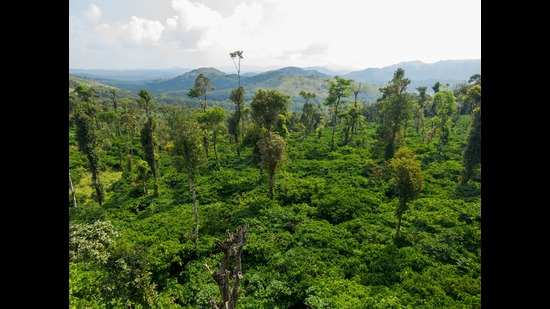
Secondly, Indian coffee has a uniqueness that puts it ahead of its global competitors. It is grown using traditional techniques in natural forests. Interestingly, we are the only country in the world where coffee is grown under natural shade. Moreover, it is uniquely hand-picked without the use of machinery, naturally harvested and sun-dried. While the sun-drying method takes much longer than mechanical drying, it enhances the flavour of the beans. Besides, it is also eco-friendly as it does not contribute to carbon emissions.

Thirdly, coffee farming in other countries often involves chopping off existing vegetation, whereas in India, the forest canopy stays almost intact. This environmentally sustainable way of cultivating coffee aligns perfectly with the European Union’s Deforestation Regulation (EUDR), which prohibits coffee imports from regions that were deforested after 2020. This presents opportunities for Indian exporters.

Now you know the real reasons why Indian coffee typically commands a premium over the global benchmark!

The world looks to India for coffee

India mainly produces two varieties of coffee, Arabica and Robusta. While Arabica coffee has a mild aromatic flavour, Robusta coffee has a strong flavour on the taste buds.

FYI: India’s Robusta coffee is considered the best in the world, and its Arabica coffee is the second best, just after Columbia’s.

India primarily focuses on producing Robusta coffee, which accounts for 72% of India’s total production. Robusta coffee has a huge demand in the international markets, which is another reason for the surge in India’s coffee exports.

Did you know? India is considered the fifth-largest producer of Robusta coffee globally.

Not just this, Robusta beans are a favourite for instant coffee manufacturers worldwide. The rising demand for instant coffee in markets like Russia and Turkey has given a significant boost to India’s instant coffee exports, which make up a third of our total exports.

Besides, supply constraints in Brazil and Vietnam have led to a sharp rise in Robusta coffee prices. The prices have touched multi-decade highs, climbing more than 60% in 2024 alone. For context, Indian Robusta is fetching a premium of nearly $300 a tonne on the London-based ICE Futures Europe market. The surge in demand and prices presents Indian coffee exporters with a unique opportunity.

There is also a bitter reality to it

While Indian coffees are making a mark globally, let’s also accept the fact that the journey is not all that smooth.

Even though global prices are rising, coffee farmers are facing higher production costs due to rising labour costs and scarcity of labour. To put things in perspective, the labour cost in India is a massive 65%, whereas in Brazil it is just 25% of the total production cost. Why you ask? Well, it’s simply because the cultivation process is manual in our country.

Another challenge is growing climate changes and erratic rainfall patterns that severely harm the quality and yield of coffee and interfere with the sun-drying process.

That’s not all!

The EUDR compliance burden is putting extra pressure on farmers who will now need costly technological upgrades and struggle with heaps of paperwork, certifications and audits to meet the compliance requirements.

Having said that, the Coffee Board of India is developing a platform to help coffee producers in India comply with EUDR. While it will take some time to roll out, we might face some time-being challenges in exporting coffee to the EU.

So yeah, there are some challenges that we need to work on before India can climb the ranks to become a top coffee-exporting country.

The bottom line

Looking at the brighter side, India’s diverse coffee regions, high-quality beans and unique production process are increasingly filling gaps traditionally dominated by Brazil, Vietnam, Ethiopia, and Colombia.

By 2032, the Indian coffee market is projected to reach $1,227.47 million, which is huge!

As demand for Indian coffee increases, it’s clear that the Indian coffee industry’s future is bright and full of flavour!

Cheers team coffee!

source: http://www.upstox.com / Upstox / Home> News> Upstox Originals / by Namita Salgiya / February 22nd, 2025

Feasibility report on coffee cultivation in Karnataka’s Dakshina Kannada district to be submitted soon

As part of area expansion, scientists conducted a survey in the district and are likely to recommend coffee cultivation there, Manjunath said during a KDP meeting chaired by District in Charge Minister Dinesh Gundu Rao.

Coffee beans. (Image for representation)Credit: iStock Photo

Mangaluru:

Horticulture department Deputy Director Manjunath said that scientists from Central Coffee Research Institute will submit a feasibility report on cultivating Robusta coffee in high altitude areas in Sullia, Belthangady taluks shortly.

A few farmers in Dakshina Kannada district have been cultivating coffee.

As part of area expansion, scientists conducted a survey in the district and are likely to recommend coffee cultivation there, Manjunath said during a KDP meeting chaired by District in Charge Minister Dinesh Gundu Rao.

Once the report is submitted, they will seek funds from the Coffee Board under area expansion to cultivate coffee.

“About 2000 acres of areca plantations in 10 villages including Aranthodu, Thodikana have been affected by yellow leaf disease. As an alternative, coffee can be promoted once the final report on the feasibility of cultivation is submitted,” he added.

Guarantee scheme implementation authority district president Bharath Mundodi raised the issue of yellow leaf disease and leaf spot diseases and said that though officials have been emphasising on research to find a solution for past 30 years, no concrete steps have been taken to contain the disease.

Sullia MLA Bhagirathi Murulya also urged the government to announce a package for cultivating alternative crops to those whose areca plantations were affected by yellow leaf disease.

Counselling mandatory

Following an increase in drug addiction cases, MLC Dr Dhananjaya Sarji said that there is a need to counsel students in hostels on the ill effects of drugs abuse.

Psychiatric and clinical counselling is essential for students. It can be taken up as a pilot project in the district as there are many educational institutions and hostels in the district, he said.

Dhananjaya said students staying in hostels suffer from ringworm disease. Thus a visit to hostels by a dermatologist atleast twice in a year should be made mandatory.

In addition, he also urged the minister to direct health department to conduct counselling by gynecologists’ for adolescent girl students on personal hygiene.

Vehicular overpass

When MLC Ivan D’Souza sought the status of ongoing works in the Nanthoor area, DK MP Capt Brijesh Chowta said that tender for vehicular overpass was given in 2022.

But the estimate had not included funds for utility shifting. The issue of shifting Miyawaki urban forest near Padua High School is pending.

NHAI officials said that there are issues pertaining to the Kudupu-Bikarnakatte stretch. Many are demanding enhancement in compensation.

About 80 per cent of the land acquisition has been completed for four-laning of the stretch from Bikarnakatte to Moodbidri

source: http://www.deccanherald.com / Deccan Herald / Home> India> Karnataka / by Naina J A, DHNS / February 17th, 2025

Spike in coffee prices in K’taka markets due to severe crop losses in Brazil, Vietnam: Expert

The sharp rise on February 11 was attributed to severe crop losses in Brazil and Vietnam — world’s leading coffee producers — due to adverse weather conditions.

The sharp rise on February 11 was attributed to severe crop losses in Brazil and Vietnam — world’s leading coffee producers — due to adverse weather conditions. (Shutterstock)

Bengaluru:

Coffee prices in Karnataka’s Kodagu and Chikkamagaluru markets that recently surged to historic levels was driven by a global supply crunch, according to officials familiar with the matter. Arabica Parchment, a premium coffee variety, soared to ₹29,600 per 50 kg bag in Chikkamagaluru, while Kodagu recorded an even higher price of ₹29,800, marking an unprecedented peak.

The sharp rise on February 11 was attributed to severe crop losses in Brazil and Vietnam — world’s leading coffee producers — due to adverse weather conditions. Experts predicted that recovery will take at least five to eight years, as new coffee plants require time to mature and yield produce.

“Coffee prices are heavily influenced by weather conditions, and it’s impossible to assume that current prices will remain steady,” Coffee Board president Dinesh Devavrinda told HT. He advised growers, particularly those with outstanding bank loans, to capitalise on the price surge by opting for the One-Time Settlement (OTS) scheme, which covers the principal amount up to ₹5 lakh.

India produces approximately 365,000 tonnes of coffee annually, with 70% of the yield exported to European markets. Karnataka is the country’s largest coffee producer, accounting for 70% of national output, with Kodagu alone contributing 32%. The state has 246,000 hectares of coffee estates, yielding 220,000 tonnes annually, while Kodagu, spanning 4,102 square kilometers, produces around 120,000 tonnes from 110,000 hectares of estates.

At the beginning of the year, coffee prices were volatile, but a steep upward trend emerged over the past 10 days, with daily price hikes ranging between ₹500 and ₹1,000 per bag. On January 1, Arabica Parchment was priced at ₹17,000 per 50 kg bag but by the end of the month, it rose to ₹23,500. Other coffee varieties also saw significant increases: Robusta Parchment reached ₹24,500, Arabica Cherry was sold at ₹17,000, and Robusta Cherry hit ₹13,500 in Kodagu markets.

According to market analysts, the absence of buffer stock this year has further aggravated the supply shortage, pushing prices to record highs.

Rajiv Kushalappa, managing director of Leonflix Fintech Ventures Pvt Ltd, a Bengaluru-based coffee export firm, pointed to the impact of global shortages. “Thousands of coffee estates have been destroyed in Brazil and Vietnam, leading to a severe supply crunch in the international market. With no buffer stock available this year, prices have skyrocketed and are likely to remain high for some time,” he said.

For coffee growers, the soaring prices offer much-needed financial relief. “This is the first time I am getting such record prices. Growers have long struggled with high production costs, disease outbreaks, and labour shortages. Arabica coffee estates require significant manpower, and labor costs have risen due to shortages. These higher prices will help growers maintain their estates,” Sannuvanda Kaverappa, a grower from Napoklu in Madikeri, said.

Kodagu, nestled in the Western Ghats of Karnataka, is India’s largest coffee-producing region, contributing nearly 32% of the country’s total output. The district, spanning 4,102 square kilometers, is home to vast coffee estates spread across 1.1 lakh hectares. Known for its rich biodiversity and hilly terrain, Kodagu primarily cultivates Arabica and Robusta coffee varieties. Coffee farming, introduced by British planters in the 19th century, remains the backbone of the local economy, with thousands of small and large growers dependent on it. The region’s coffee is highly sought after in international markets, with 70% of India’s coffee production being exported.

source: http://www.hindustantimes.com / Hindustan Times / Home / by Coovercolly Indresh / February 18th, 2025