MLC Sunil Subrahmani visits villages in Madikeri

MlcKF06jun2017

Madikeri :

MLC Sunil Subrahmani visited villages in Madikeri taluk on Wednesday and enquired about the problems faced by the villagers.

He visited Bhagamandala, Bhagandeshwara temple and listened to the public about the prevailing problems and also visited the village panchayat. People requested him for a public hospital, college, bus stand and other basic amenities.

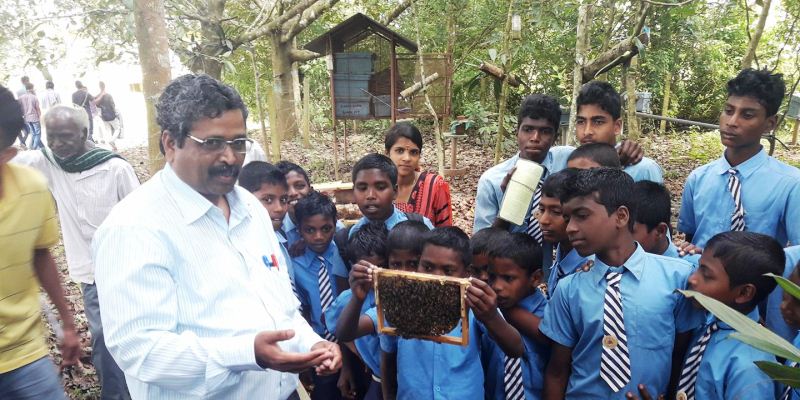
He later visited Aiyangeri village and visited the school which is on the brink of collapse. He assured that he would talk to the officials of education department and contact the minister to solve the problem. He also inspected drinking water project.

He visited Kundacheri village and received the requests from the public regarding society, electricity and other issues.

He assured them of solving the problems with the help and support of the public. He said that he would put pressure on the government to get the work done.

ZP member Kavita Prabhakar, taluk panchayat members Sandhya and Dabbadka Sridhar, Balachandra Nair and officials were present. (MR/KCI).

source: http://www.citytoday.news / City Today / Home> Mysore / CT Bureau / May 10th, 2017

Rs 67.18 lakh spent on Dasara Janotsava

The details of expenses of Madikeri Dasara Janotsava for the year 2016-17 were presented at the audit meeting at Kaveri Kalakshetra in the city on Thursday.

Committee general secretary Chummi Devaiah said Dasara Janotsava was organised at a cost of Rs 67.18 lakh.

He gave the following details: Rs 2 lakh was spent on Karaga, Rs 19 lakh on Dashamantapas, Rs 23 lakh for gallery and lighting arrangements, Rs 40,000 for city decoration and poets’ symposium, Rs 8 lakh for cultural programmes, Rs 4 lakh for medals and prizes, Rs 2.50 lakh for Rasasanje programme, Rs 1 lakh for Dasara Sports meet and Rs 1.20 lakh on food, lodging and travel.

The other expenses were: Rs 50,000 for flower arrangements, Rs 1.9 lakh for banking expenses, Rs 24,000 on travel expenses of the delegation to Bengaluru, Rs 25,000 on CCTV cameras, Rs 10,000 for website maintenance, Rs 20,000 on grill construction around pump lake, Rs 1.13 lakh for tender EMD repayments, Rs 35,000 on puja expenses, Rs 25,000 for parking fee repayments and Rs 20,000 for auditing costs.

Member Umesh Subramani said there is a need to introduce corrections to the Dasara Committee’s bylaw. Chummi Devaiah said the committee members had requested the government for more grants. Though it was assured that Rs 75 lakh will be sanctioned, only Rs 60 lakh was released later and Rs 2.31 lakh was collected from public.

Mahesh Jaini and Arun Kumar urged to make preparations three months in advance for Dasara this time. Committee president Kaveramma Somanna presided over the meeting. secretary Nandakumar and honourary secretary Prakash were present.

source: http://www.deccanherald.com / Deccan Herald / Home> District / DH News Service / Madikeri – June 02nd, 2017

Kodagu : Talacauvery sanctuary declared an eco-sensitive zone

No new hotels or resorts can take shape in the Talacauvery sanctuary

The government has declared the Talacauvery Wild Life Sanctuary spread across 105.59 sq km as an eco-sensitive zone. This comes after the Environment Ministry notification on the proposed ecologically sensitive areas (ESAs) in the Western Ghats. The state has about five national parks and 27 sanctuaries, seven conservation reserve and one community reserve. The draft notification was issued on May 25 last year and the final notification was issued on May 15.

Kodagu Chief Conservator of Forest Manoj Kumar told BM this is an eco-sensitive zone under the Environment Protection Act. As per the Act, the area around the protected area could be heritage sites and others and there has been a provision to declare them as sensitive zones. But this was not being done and the National Wildlife Board based on the Supreme Court direction had stated that it is about 10 km, if not declared. Hence, so far it used to be 10 km. “But we started rationalising the area and had sent a proposal. Each proposal is now being approved and the rest of the sanctuaries in the area around will soon be declared as sensitive zones. It is not the Kasturirangan report. It is a statutory requirement and the state government after discussion with the district administration and representatives had sent a proposal,” he said.

As per the notification the region around the sanctuary from 1-16 km has been declared as the eco-sensitive zone. No commercial activity such as mining can be conducted and no new industries can be set up here. It also prohibits extension of industries that cause pollution, major hydel power plants, saw mills as well as rearing of animals. This declaration is also likely to hamper the union government highway project from Bhagamandala to Kerala’s Panathoor.

source: http://www.bangaloremirror.indiatimes.com / Bangalore Mirror / Home> News> State / Bangalore Mirror Bureau / June 06th, 2017

Olympian MP Ganesh to head National Hockey Academy in Delhi

Till now MP Ganesh was serving as the CEO of Karnataka State Cricket Association (Agency Photo)

_________________________________________________

Highlights

The National Hockey Academy is a joint venture of the Sports Authority of India and the sports ministry

The academy will be a residential project for 40 boys and an equal number of girls below the age of 18

Ganesh last played for India in 1974 before his career was cut short by a knee injury.

___________________________________________________

New Delhi :

Former captain and coach of the national team MP Ganesh on Thursday took charge as the High Performance Director and CEO of the National Hockey Academy to be based at the Major Dhyan Chand Stadium.

“Hockey Olympian MP Ganesh takes over as the High Performance Director & CEO of National Hockey Academy in New Delhi,” Hockey India confirmed the news on its official twitter handle.

Till now Ganesh was serving as the CEO of Karnataka State Cricket Association.

The National Hockey Academy in New Delhi is a joint venture of the Sports Authority of India and the sports ministry aimed at identifying junior hockey talent and facilitating their holistic development.

The National Hockey Academy, which took two years to be set up, will be a residential project for 40 boys and an equal number of girls below the age of 18.

About 70 players from each category have been shortlisted by Hockey India selectors from the sub-junior Nationals held recently. After a few weeks of trials, the numbers will be brought down to 40. There will be three coaches each for the boys and girls.

The 70-year-old Ganesh hails from the famous hockey belt of Kodagu, earlier known as Coorg, district of Karnataka.

An Arjuna awardee, Ganesh played for India at the 1972 Olympic Games in Munich, finishing third. He was one of the coaches of the Indian team that won a gold medal at the 1980 Olympic Games in Moscow.

He represented India in the Asian Games twice, first in 1970 in Bangkok and then in 1974 in Tehran. Both the times India returned home with a silver medal. He was also a part of the Indian team that won bronze at the first World Cup at Barcelona in 1971 and captained the team that won silver at the next World Cup in Amsterdam.

An Arjuna awardee, Ganesh played for India at the 1972 Olympic Games in Munich, finishing third. He was one of the coaches of the Indian team that won a gold medal at the 1980 Olympic Games in Moscow.

He represented India in the Asian Games twice, first in 1970 in Bangkok and then in 1974 in Tehran. Both the times India returned home with a silver medal. He was also a part of the Indian team that won bronze at the first World Cup at Barcelona in 1971 and captained the team that won silver at the next World Cup in Amsterdam.

source: http://www.timesofindia.indiatimes.com / The Times of India / News> Sports> Hockey / PTI / June 01st, 2017

Winning a Commonwealth Games medal an important target, says Ashwini Ponnappa

Ashwini Ponnappa said that although they are looking forward to the next tournament, their focus will be on winning a medal at the Commonwealth Games next year, which will remain as one of the important targets.

Ashwini Ponnappa won medals at the Commonwealth Games in 2010 and 2014. (Source: File photo)

Ashwini Ponnappa, who led India to the knockout stages of the Sudirman Cup last week, said that her target remains the Commonwealth Games, scheduled to take place next year.

In an interview to PTI, Ponnappa said that she was confident that their side would do well as soon as they found out the draw. “Ever since we came to know about the draw, I was confident we were good enough to beat them. Most of the players in the opposition team had top 5 players and when I knew I will have to play two matches, I had the belief that we could do well,” she said.

“Me and Satwik (Satwiksairaj Rankireddy) were training together just a few weeks ahead of the event as we had sent our entry for the Australian Open. So when we got a chance to play at the Sudirman Cup, we were excited as it was our first tournament together.”

The 27-year-old asserted that it was her coaches who decided her partners in various competitions and that she is looking forward to a new one. “Coaches have been the ones who have been deciding my partners after the Olympics and it is about trusting them. Me and Sumeeth had a good partnership. We are both similar players, we have played women’s doubles and men’s doubles respectively and now we are venturing into mixed doubles,” Ashwini said.

“So I am looking forward to the new partnership. Interestingly, I will be playing with Sumeeth at Indonesia and Satwik at Australia, so let’s see how it goes. After playing at the Sudirman Cup, I feel we can achieve much better results together,” she added.

Ponnappa said that winning a medal at the Commonwealth Games will be an important target. She said, “We are looking forward to the next tournament, doing better than what we have done. If we can reach a final of super series this year, that will be good and definitely winning a medal at the Commonwealth Games will be one of the important targets.”

The shuttler also said that she is enjoying the extra responsibility as a senior member.

source: http://www.indianexpress.com / The Indian Express / Home> Sports> Badminton / by Express Web Desk / June 01st, 2017

Camera Camaraderie : Gulshan Devaiah recalls working with the Late Om Puri

GulshanKF06jun2017

Fresh off his latest film, Gulshan Devaiah recalls working with the late Om Puri, and how actors respond to a ‘real’ location as opposed to a set

Wearing a knee brace and hobbling along on a crutch, Gulshan Devaiah still looks dapper in his hat and shorts when we meet at a at a screening of A Death in The Gunj, in the city. Politely obliging selfie requests, Devaiah tells us how he likes to challenge himself. In this film, (Konkona Sen Sharma’s directorial debut) that would have meant playing the part of Vikram – played by Ranvir Shorey. The rough and tumble alpha male who gets drunk and rides his bike, makes fun of everyone around him and talks with a cigarette in his mouth is nothing like Devaiah in real life. “That’s why, if I’d had the freedom to choose, I would have loved to play him,” he says, half-chuckling, half-regretfully.

He has no regrets, however, over his final turn in the film, what he calls, “the best movie I’ve been a part of”. A lot of it has to do with the stellar ensemble cast – from actors such as Kalki Koechlin, Vikrant Massey, Tillottama Shome and Shorey, to stalwarts such as Tanuja and the late Om Puri. But Devaiah admits that the biggest draw was the chance to be directed by Konkona. Turns out, she was a “sensitive director and a capable writer”.

Much of that comes from her years of experience in front of the camera, Devaiah believes. He recounts how she added little details – nuances and colour – to sequences that make a world of difference to the film and its characters. Such as when a friend lights two cigarettes at a time and offers one to his friend, who is driving the car they are in. “He doesn’t give him a cigarette and offer to light it for him – he lights it and gives it to him. These are things only actors will think of; they may not make sense in isolation. But visually, it makes such a difference – it gives you an insight into the nature of the friendship between the two,” Devaiah explains. It’s the sort of detail that he believes pervades the film, to the point that while watching it, he even “forgot” he was in it. “I’ve had more important roles; longer roles in films where I’ve been the protagonist. But I’ve never been as happy with a film as I am with this one.”

It’s high praise from someone who has worked with the likes of Sanjay Leela Bhansali in Ram Leela. Bhansali, Devaiah lets on, is “everything people say he is, but a whole lot more”. Fun, passionate, sensitive and supportive, Bhansali taught him a lot, he says. “He gave me the freedom to experiment. He takes a long time to shoot, and that can be testing for some people, but once you get going it’s fine. I always felt like I wanted to work more with him; I didn’t want the break that came after 10 days of shooting. He lives for his movies – unfortunately, he doesn’t always find people who share the same level of dedication and commitment.”

It’s been an interesting experience going from that kind of grandeur and opulence, to the realism and small budget of A Death In The Gunj. SLB’s sets can be overwhelming, he admits, so the more time you spend on them, the better it is for you, as you cease to be intimidated and become more comfortable. Plus, working on a set is very different from working in a real location, in that actors have to “tailor their process”, he explains. “Each experience is different. I had to make adjustments in the way I approached my craft. SLB’s movies – the visuals, the melodrama, the music – is all larger than life. You have to submit

yourself to that, and it can be difficult.” Calling filmmaking an “unnatural process”, he explains that shooting in real locations is a little easier. Everything from the way the wind blows to the “reality around you” influences you and subtlely enhances the way you play your character. “On a set you have to use your imagination. Here, you can use more impulse. That’s the basic difference.”

The film is also special to him because it marked one of the last projects for Om Puri, who tragically passed away before he could see the film, Devaiah rues. Still, he has fond memories of working with the thespian, who despite not feeling very well on the set, would light up the atmosphere like “a 5,000-watt bulb”. His craft, Devaiah says, has the ease of a hot knife through butter. As it is with Tanuja. He uses a football metaphor to explain: “When a striker hits a goal, he has people running around him and the goalie running at him, but he still scores. He can do that because there’s a calmness in his mind.” Watching Tanuja and Om Puri do their thing was just like that. “They approach a scene with such steadiness and composure. When the mind is calm it’s active, and when it’s active, it’s creative.” That, he feels, has been the biggest lesson from working with the stalwarts.

There are other lessons here too – like the film’s take on machismo and masculinity. It’s a conversation Devaiah agrees is important to have, given the charged atmosphere in the country regarding gender. He recounts how people in the film industry too submit to these unspoken prejudices, questioning everything from why a man is sitting cross legged to how he is holding his glass. The period film both establishes and questions these

concepts through the protagonist’s (played by Massey) struggle with machismo. In all, it’s been a fruitful experience for Devaiah, who is confident the film will communicate what it wanted to, beautifully.

source: http://www.bangaloremirror.indiatimes.com / Bangalore Mirror / Home> Columns> Sunday Read / by Sowmya Rajaram, Bangalore Mirror Bureau / June 03rd, 2017

Parjanya japa held at Talacauvery to propitiate rain god

Water Resources Minister M B Patil, Adichunchanagiri mutt seer Nirmalanandanatha swami, MLA P M Narendraswamy offer baagina at Triveni Sangama in Bhagamandala, Madikeri taluk on Sunday.

To propitiate the rain gods, the officials of Cauvery Neeravari Nigama Ltd (CNNL) chanted Parjanya japa at Talacauvery, the birthplace of River Cauvery on Sunday.

As there was stiff opposition for conducting parjanyahoma using government funds, homa was not performed. Only Parjanya japa and special prayers were held. CNNL Executive Engineer Basavaraj and his wife took part in the special prayers held under the guidance of priest Prashanth Achar. Water Resources Minister M B Patil did not take part in the japa.

Patil, who arrived at Bhagamandala at 3 pm along with the Adichunchanagiri Mutt seer Nirmalanandanatha Swami, offered baagina at the Triveni Sangama in Bhagamandala. Later, he offered prayers at the Bhangadeshwara Temple and Talacauvery.

Speaking to reporters, the minister said “if offering prayers to motheris wrong and a superstititious belief, then I am ready to conduct such prayers several times. Some offer prayers to lifeless stones. Why should one oppose offering prayers to the river Cauvery, the lifeline of crores of people,” he asked.

“The Krishna and the Cauvery are the lifeline of the state. I have offered prayers to mother Cauvery for good rainfall. Offering prayers to rivers is part of our tradition,” he said.

“Chief Minister Siddaramaiah does not believe in Parjanya homa and japa and termed it a superstitious belief. Doesn’t his wife offer prayers at temples? Has he not benefited from it?” Patil retorted.

Though the visit was termed as private, the itinerary given to local elected representatives mentioned it as a government programme. MLA P M Narendraswamy, MLC Veena Acchaiah, Patil’s wife Asha Patil, Water Resources department principal secretary Rakesh Singh, officials Gurupadaswamy, Manjunath and Rangaswamy and Kodava Sahitya Academy President B S Thammaiah were present.

source: http://www.deccanherald.com / Deccan Herald / Home> State / DH News Service / Madikeri – June 05th, 2017

How wildlife-friendly is your brew?

WildKaapi01KF03jun2017 Wild Kaapi, your morning coffee comes from certified estates that support gaurs, elephants and monkeys, along with Arabica beans

Under the cool canopy of native trees in the Western Ghats, coffee bushes spread out, gleaming with red berries. In the early morning hours, if you are lucky, you may spot rare species like the Malabar grey hornbill, water snow flat butterfly or the Asian fairy bluebird among these shade-loving plants. And now, thanks to the efforts of Wild Kaapi — the world’s first ‘certified wildlife-friendly’ coffee brand — you can ensure your morning brew comes from plantations that foster fauna on their lands. Started by wildlife conservationist, Krithi K Karanth — who has has been working in the Western Ghats, a biodiversity hotspot, for the last 19 years — and her husband, Avinash Sosale, the coffee brand got its certification this April and opened its doors to buyers last month.

(photo credit: Ramki Sreenivasan)

Live and let live

Wild Kaapi started as an offshoot of a three-year research project (part of a grant by the National Science Foundation to study coffee, areca and rubber plantations in the Western Ghats). Karanth, of the Centre for Wildlife Studies — with Paul Robbins of the University of Wisconsin-Madison and Dr Ashwini Chhatre of University of Illinois — measured biodiversity, and studied labour practices and market dynamics of the farming areas.

During the project, she interacted with over 1,000 planters in the three coffee growing areas of Karnataka — Kodagu, Chikmagalur, and Hassan — and realised how frustrated they were “because they weren’t getting value for their coffee due to the middlemen involved”. That’s when the idea for Wild Kaapi originated, and the duo is now exploring new ways to get a premium price for products that support wildlife. “This includes social enterprises that can contribute to conservation action. (After all) traditional wildlife conservation relies heavily on donors,” says Sosale, who quit a career in automotive business to be a part of the venture. “At this stage we have two commitments: we have told coffee growers we will pay them the highest price, and, with the profit we generate, we will build a conservation fund to award grants to young conservationists,” he adds.

WildKaapi03KF03jun2017

Animal tales

Millennials are more discerning towards coffee, observes Sosale. “Today’s consumer is informed. Ethical and conscious consumption is what we want to tap into.” To qualify for certification, the coffee not only had to have a good cupping (tasting) score, but the plantation had to support a vast biodiversity. Of the more than 187 farms they audited (recording the species of birds, butterflies, mammals, amphibians and trees), only four made the cut: Agora (with 124 species), Bindiga (137), Hulikere (119) and Cornerstone (120). Wild Kaapi has named their single-origin Arabicas after the plantations they are sourced from.

WildKaapi04KF03jun2017

Shreedev Hulikere, a third-generation coffee grower with 60 acres in Chikmagalur, who is partnering with Wild Kaapi, says he wasn’t aware of the numerous wildlife species on their estate till now. “While my ancestors traditionally hunted, I’m a conservationist. I tell my labourers not to destroy any bird nests. I know that barbets nest here and they eat the borer worms that destroy coffee. Similarly, I’m not going to chase away the monkeys and civets that eat my coffee because I’m being compensated elsewhere. Just because a porcupine destroys a pepper creeper, I’m not going to hunt it down,” he says.

Love thy neighbour

The audit also revealed a few surprises. “We found frogs listed as endangered or threatened in the IUCN Red List (the world’s most comprehensive inventory of global conservation status) at these plantations,” says Karanth. The certification not only places their coffee in a premium space, but also paves the way for a new movement. “If you have wildlife-friendly practices, you can promote sustainable agriculture. We are trying to establish a new model — a profitable enterprise that also enables better livelihoods. This hasn’t been tried before; it’s a new way of thinking,” says Karanth.

(photo credit: Ramki Sreenivasan)

While their immediate goal is to prove that such a model is sustainable, Sosale is also mulling introducing coffee scrubs, soaps, candles and flavourings — all huge product lines in the international space. Moving into pepper and cardamom, which grow hand-in-hand with coffee, also holds much promise.

Prices start at ₹390 for 250 gms.

To know more, and buy the coffee, check out wildkaapi.com.

source: http://www.thehindu.com / The Hindu / Home> Life & Style> Homes and Gardens / by Bhumika K / June 02nd, 2017

Boosting domestic offtake is the key: new chief of Coffee Board

Coffee Board chairman M S Boje Gowda, at a function in Bengaluru on Wednesday. Somashekar GRN

Boje Gowda rues India’s low 200-g consumption compared to 7-8 kg in the West

Bengaluru :

Boosting domestic consumption is crucial to protecting the interests of coffee growers, according to MS Boje Gowda, the newly-appointed coffee Board Chairman.

After 70 years, the Coffee Board has a grower as its chief in Boje Gowda, who is third generation planter. Till recently, bureaucrats headed the apex decision-making body for the coffee sector, under the Ministry of Commerce.

Gowda, of Krishnagiri Estate in Chikmagalur, takes over at a time when growers are grappling with volatile prices, fluctuating output that’s largely being influenced by a changing climatic pattern on account of erratic rainfall, and pest issues such as the white stem borer.

Addressing growers after assuming office, Gowda said the annual per capita coffee consumption in India is not even 200 grams, while in the western world it is 7-8 kg, thereby leaving tremendous scope to boost the domestic offtake. He said there was a need to boost consumption beyond the traditional consuming States of Karnataka, Tamil Nadu, Andhra Pradesh and Kerala. “It would become a difficult situation for the growers unless the domestic consumption expands,” he said.

Gowda, a large planter, said Prime Minister Narendra Modi has set a target of doubling coffee output from the current 3 lakh tonnes to 6 lakh tonnes. India consumes merely a third of the coffee produced in the country as over two-thirds of the output is exported, mainly to Europe and Russia.

Karnataka, the main growing region that accounts for about two-thirds of the country’s coffee output, has been reeling under a drought for the past three years. Gowda said he would focus on improving the water storage facilities and take up the growers’demand for higher subsidy for increasing the coverage of drip irrigation.

Coffee growers gets only 25 per cent subsidy on the equipment cost for taking up drip irrigation, while for other plantation products such as rubber and cardamom, the subsidy component is around 80 per cent, Gowda said.

Drones to forecast crop
Addressing growers, Coffee Board Secretary Srivatsa Krishna said the body was exploring the option of using drones for better crop forecasting. Krishna said the current crop estimation was not right and the Board was looking at ways to improve the crop estimate. The Board has been in talks with 7-8 start-ups on deployment of drones for improving the accuracy of crop forecast.

Krishna said the Board is also working on creating water harvesting solutions and is exploring options such as cloud seeding. On the issue of white stem borer, a pest that attacks plants of arabica coffee, Krishna said the board has reached out to biotech firms to evolve a solution and that pilots are being carried out in some plantations.

Highlighting the importance of branding, Krishna said the growers should come out with region-specific brands such as Chikmagalur and Mysuru.

source: http://www.thehindubusinessline.com / Business Line / Home> Agri Business / by The Hindu Business Line Bureau / Bengaluru – May 17th, 2017

Tata Coffee appoints P.G. Chengappa as an additional director

We would like to inform you that the Board of Directors of the Company at their meeting held today, the 18th May 2017 and appointment of Dr. P.G. Chengappa as an Additional Director with effect from 18th May, 2017.

We would like to inform you that the Board of Directors of the Company at their meeting held today, the 18th May 2017, have considered and approved the following: a.Appointment of Dr. P.G. Chengappa as an Additional Director (Non-executive, Independent) with effect from 18th May, 2017.

A brief profile of Dr. Chengappa is enclosed herewith. Dr. Chengappa is not related to any of the Directors of the Company. b.Re-appointment of Mr. K. Venkataramanan as an Executive Director – Finance and CFO of the Company for a period of 3 years with effect from 25th October, 2017.

This disclosure is made in terms of the requirements of Regulation 30 of SEBI (Listing Obligations & Disclosure Requirements) Regulations, 2015.Source : BSE

source: http://www.moneycontrol.com / Moneycontrol.com / Home> News> Business> Announcements / May 18th, 2017