Indian coffee planters brewing profits

Coonoor (Tamil Nadu) :
Indian coffee planters and exporters are brewing profits like never before due to soaring prices and growing consumption of the aromatic beverage worldwide.

Riding on surging commodity rates globally, producers of the green bean, mainly from Karnataka, and exporters are making a killing as prices in international and domestic auctions rule at historic highs on growing demand despite competition from traditional and new players.

“Indian coffee growers and exporters are on cloud nine as their Arabica and Robusta bean varieties have regained ground and are competing with the best in the world for better prices on growing demand,” a representative of the planters’ body told IANS.

A decade after cyclical highs and lows and lifting of quotas under the World Trade Organization (WTO) regime, the Indian coffee sector is at the cusp of a new era as the latest trends indicate an upward bias in global demand and prices this year too.

“The Indian coffee sector’s export performance last fiscal (2010-11) was outstanding on all counts — quantity exported, value realisation and unit value,” D. Hegde, incoming president of the United Planters’ Association of Southern India (Upasi), said on the margins of its 118th annual meet here, about 70 km from the industrial city of Coimbatore in the plains.

Though production for the coffee year 2010-11 was a tad lower at 302,000 tonnes than the estimated 308,000 tonnes – but 4.3 percent higher than 289,600 tonnes in the previous year (2009-10) – export quantity zoomed to 319,892 tonnes, posting a whopping 63 percent (123,793 tonnes) increase from 196,099 tonnes in the previous year and helping producers to reduce inventory stocks.

Similarly, for seven months from April to mid-October this year, exports were up 20 percent to 201,570 tonnes from 167,624 tonnes in 2010.

The phenomenal increase in export volumes turned into a boom as value shot up by an unprecedented 80 percent to Rs.3,724 crore in 2010-11 from Rs.2,072 crore, an increase of Rs.1,652 crore year-on-year (YoY) as a result of unit value going up 10 percent to Rs.116 per kg from Rs.106/kg in the corresponding period.

In the first seven months (April-October) this fiscal year, export value zoomed to Rs.2,738 crore from Rs.1,681 crore.

“The astonishing increase in export quantity and value augurs well for further consolidation of gains, as prices of other milds (Arabica) are more than double that of Robustas in the auctions conducted by the International Coffee Organisation (ICO),” Hegde asserted.

The upward trend in price of other milds continued to touch 280 cents per pound (lb) during January-September 2011 from 184 cents/lb in 2010, an increase of 53 percent YoY, while that of Robusta rose to 114 cents in the same period from 80 cents in 2010, up 42 percent YoY.

Prices in the domestic auctions conducted by the Indian Coffee Trade Association (ICTA) reflected a similar trend during the first eight months (Jan-Aug) of 2011, with Arabica Cherry beans sold at Rs.199 per kg as against Rs.121 per kg in 2010 and Robusta Cherry at Rs.111 per kg as against Rs.77 in 2010.

With the state-run Coffee Board estimating post-blossom production to be 322,250 tonnes, including 217,725 tonnes of Robustas and 104,525 tonnes of Arabica varieties, the prospect of demand for Indian beans is brighter as consumption in traditional and emerging markets are encouraging.

A steady rise in domestic consumption (108,000 tonnes) notwithstanding, exports constitute over 70 percent of the coffee produced in the country, mostly (98 percent) from southern India, with Karnataka accounting for 71 percent (213,780 tonnes), followed by Kerala at 22 percent (65,650 tonnes) and Tamil Nadu 5.5 percent (16,650 tonnes).

In value too, of the Rs.4,041 crore revenue generated in 2010-11, Karnataka generated Rs.3,018 crore (73 percent), Kerala Rs.693 crore (17 percent) and Tamil Nadu Rs.305 crore (7.4 percent) from exports and domestic sales.

The aromatic beans are grown in the cooler climes of the bio-diverse Western Ghats (mountain region) that straddles across the three southern states.

(Fakir Balaji can be contacted at fakir.b@ians.in)
source: http://www.twocircles.net / by Fakir Balaji > IANS / October 23rd, 2011
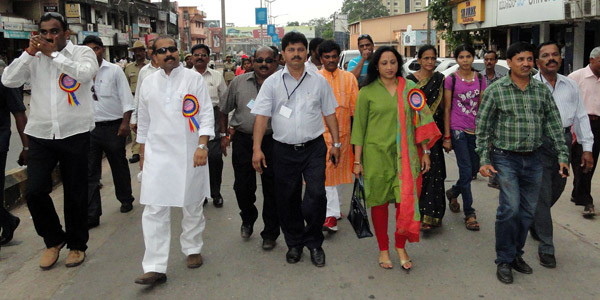
Upasi annual meet delayed, but sees many youngsters taking part

COONOOR: Oct 23rd
Ministers give it a miss at the last minute

The Annual Plantation Conference hosted by the apex association in the South – The United Planters Association of Southern India (Upasi) appears to be losing its sheen in recent years.

Union Ministers, who have confirmed participation, have in the last 4-5 years given the event a go at the last minute leaving Upasi to find either a local Member of Parliament or the Chairperson of one of the commodity boards stand-in to inaugurate the conference.

This year, the association postponed the event by more than a month to October 23 and 24, hoping to get the Union Commerce Minister, Mr Anand Sharma, participate in this annual conference.

People in the know of developments say that for the first time in the history of Upasi has the conference been postponed by over a month. (It has for the last four-five decades been conducting the event by mid-September as a ritual).

When this did not materialise, the association sought time from the Union Minister for Rural Development, Mr Jairam Ramesh, and the Minister for Labour and Employment, Mr Mallikarjun Kharge. Though Mr Jairam Ramesh had confirmed his programme, it is learnt that he could not make it at the last minute.

The postponement of the conference, it now appears has not brought about the desired effect.

The association even departed from its usual format of arranging the commodity outlook session a day-ahead of the annual conference.

Over dependence on the elected representatives and ministers, missing schedule-deadline in the conduct of the annual meet seems to have taken its toll on the attendance at this year’s meet with more than half the members giving it a miss.

YOUNG MINDS

A visible, yet welcome change was the presence of plantation owners’ children taking part in all the deliberations this year, eagerly listening to the older generation.

Mr M.D. Balakrishna, former Upasi President (1988-89) and a coffee planter from Chikmagalur, said, “Earlier, the meets were orderly, for the corporate brought their professional work culture in managing the events and organising them. The annual meets used to be held much early, before the crop year commenced. Now only few corporates are in the sector; many have withdrawn. With their absence, the onus is on the plantation owners and few service providers to managing the meets annually.”

Plantation owners have two issues on hand – manage the trade body and manage their estate besides coping with the changing national and global policies. This has delayed the younger generations to actively involve on both platforms.

Many plantation owners’ children do work in different industries such as banking, managing cafes or at different value chain of commodity processing before going back to managing their estates. This has also delayed them to take a plunge in serving the trade bodies.

Talking about the diverse talent younger generation is bringing to the trade bodies, Mr Marvin Rodrigues, Vice-Chairman, Karnataka Planters’ Association (KPA) and a planter from Hassan, said, “youngsters are coming back to the plantation sector after having worked at industries. For me, managing labour shortages on the estate has taught me good HR skills.”

Mr Bose Mandana, former Vice-Chairman of the Coffee Board and a coffee planter from Kodagu, said: “We have come long way to reach a stage in managing our trade bodies ourselves. When total export controls were in place, we had limited or no role to play in marketing the produce. Now, we are free to manage, but problems are plenty.”

source: http://www.thehindubusinessline.com / L.N. Revathy > Anil Urs / October 23rd

Bopanna-Qureshi in Stockholm Open finals

India’s Rohan Bopanna and his Pakistani partner Aisam-Ul-Haq Qureshi yesterday advanced to the final of men’s doubles competition of the Stockholm Open tennis tournament after a hard-fought victory over Marcos Baghdatis and Juan Martin Del Potro.

The top-seeded Indo-Pak pair beat the duo of Baghdatis of Cyprus and Del Potro of Argentina 2-6 6-2 10-8 in a thrilling semi-final match of the 600,000 Euro tournament, which lasted one hour and eight minutes.

The ‘Indo-Pak Express’ had earlier beaten German pair of Michael Kohlmann and Alexander Wask 7-6(5) 7-5 in the quarter-finals.

In the final, the duo will take on the winner of the semifinal match between Juan Ignacio Chela of Argentina and Brazilian Andre SA and Brazilian pair of Marcelo Melo and Bruno Soares.

Bopanna and Aisam were rusty in the opening set as they struggled with their serves with four double faults to none of their opponents. Baghdatis and Potro were also much better on service returns as they bagged the first set in quick time.

The Indo-Pak pair fought back in the second set with a much improved service game, which put pressure on their opponents in committing unforced errors, and took the match to the decider.

The deciding set saw both the sides sparing no inch to their opponents but Bopanna and Aisam came up with better serves and held their nerves at crucial moments to come out winners.

Bopanna and Qureshi, who had won the Gerry Weber Open in Halle, Germany earlier this year, are currently No 7 for the Battle for London — the ATP World Tour Finals next month — with just three qualifying spots left for grab.

source: http://www.bangaloremirror.com / Bangalore> Sports / PTI / Friday, October 21st, 2011

Coorg is serenity and beauty personified


When three women who have been friends for a decade decide to take their first trip together, we had to make it spectacular; and Coorg was the star of our spectacle.

We set off on a train to Bengaluru and on reaching the station, we unwittingly got into a ‘No English, no Hindi, only Kannada’ auto rickshaw to the Satellite Bus stand. From there, a super clean, very on time KSRTC bus took us to Kushalnagar, which is about 225 km from Bengaluru in four hours.

It was a fantastic drive on superb, pothole free roads. Kushalnagar is a bustling little town with warm and friendly people. There are many hotels which are quite close to the bus stop and also conveniently priced for us budget travellers.

Two places you should definitely visit from here are Bylekuppe and Dubare Forest reserve. Bylekuppe is a Tibetan settlement which houses a beautiful monas-tery. It is such a calming experience to see the monks dressed in maroon and yellow sit down to prayer in the large hall with the gleaming golden Buddhas.

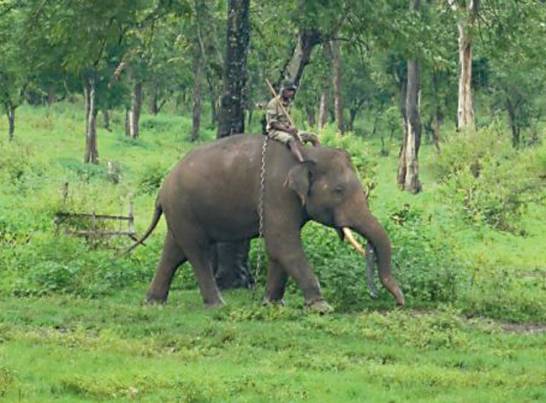
From there we went to Dubare, which was a paradise for the animal lover in me.The high point of the reserve is the elephant interaction programme. You can roll up your sleeves and get dirty as you bathe an elephant, while cavorting around in the Kaveri flowing at your feet and then feed them huge globes of food and finally as a reward for your hard work, get up on the Jumbos and experience the jungle as they see it. It’s a memory that will be etched in your heart forever.

The next day, still talking animatedly about the elephants, we boarded a bus to Madikeri. About 35 km away from Kushalnagar, it is a gentle climb up a hill. Once we got there we were joined by a fourth team member; the rain, who was our constant companion from then on! Undeterred, we whipped out our umbrellas, zipped on our raincoats and headed out to see the Abby falls.

The mighty Kaveri in all her fury, cascading down steep rocks, to become the glorious Abby falls. We could not take our eyes off her, and try as we might, we could not take a picture that did justice to her splendour.

There are many other to-dos in Madikeri that tourist guides will give you but I suggest you slow down, walk through the narrow winding streets of Madikeri, breathe in the fresh mountain air and
experience nature at her pristine best.

Writer is a travel enthusiast

source: http://www.deccanchronicle.com / by Dwithiya. R / Home> Channels> Lifestyle> Wanderlust / October 18th, 2011

Coffee Board to conduct study on consumption pattern

. BANGALORE, OCT. 14:

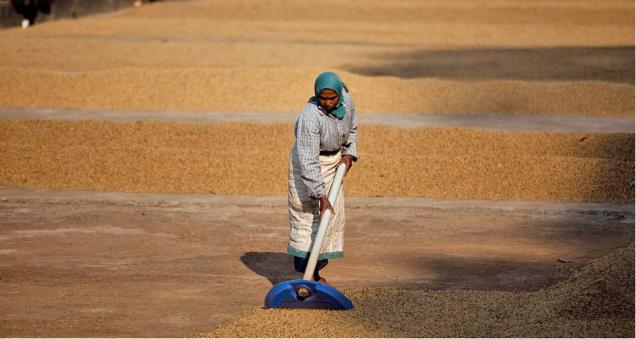
Market research: A labourer dries coffee beans in a field in Coorg, Karnataka. The Coffee Board has invited proposals from market research agencies to carry out a study this year on coffee consumption and attitude to coffee drinking.

The Coffee Board, with a view to capturing the fast changing demographics of coffee drinking in the country, is initiating a study ‘Coffee Consumption and Attitude to Coffee Drinking’.

“The board is planning to carry out a detailed market study with a help of reputed market research agency to understand the patterns of domestic consumption and the attitudes towards coffee consumption,” said a senior Coffee Board official.

“The proposed study titled ‘India coffee market study-2011′ is mainly to capture the key areas of consumption patterns in both urban and rural India with a deliverables of penetration, volumes consumed, and variety of coffee consumed, share of throat, socio-economic groups, awareness of additives,” he said.

As a step towards this, the board has invited proposals from reputed market research agencies to carry out the study this year.

Through the study, the board is expected to collect information from the instant coffee manufacturers, café chains and their growth pattern, roasters and retail segment.

The study comes in the light of increasing domestic consumption. According to the Coffee Board data, country’s coffee production for crop year 2010-11 stood at 302,000 tonnes and provisional domestic consumption for 2010 is estimated at 108,000 tonnes.

The official said: “This year along with other routine market data study, the image of the beverage in the minds of consumers with respect to quality, variety, price, additives, awareness of additives such as chicory, positive and negative associations related to consumption as well as drivers and barriers to coffee consumption is also to be captured.”

The Coffee Board has been conducting such studies since 2001 when it hired Brazilian coffee marketing consultant Carlos Brando to boost domestic consumption and its outcomes have been shaping domestic strategies, especially in non-coffee market areas.

source: http://www.thehindubusinessline.com / agri-biz / by Anil Urs / October 14th, 2011

Udupi: 28th State Athletic Meet Inaugurated in M.G. Stadium

Udupi, 14 October 2011:

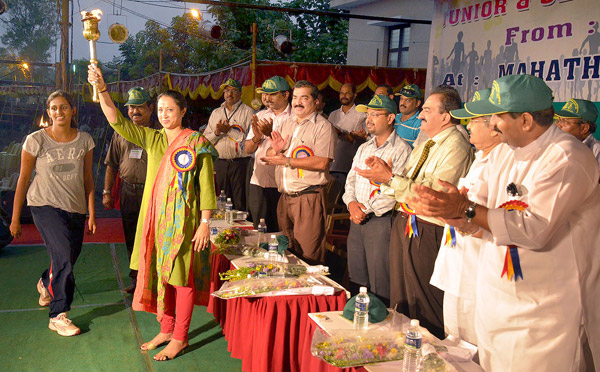
28th State athletic meet for Juniors – Seniors was inaugurated on Thursday at Mahatma Gandhi Stadium Udupi. The 3 day long athletic meet was inaugurated by former International athlete Ashwini Nachappa. Speaking on this occasion, she said that, in the last year’s athletic meet in Mysore, 21 state records were broken. This time more records should be broken, she wished.

Inaugurating the inaugural program, District In Charge Minister Dr. V.S. Acharya said that, Udupi district has been a example in the field of education already. Now that many sports persons of the district are excelling in the International level, the district will go ahead in the sports field also. Already the Indoor Stadium has been constructed in Udupi and is already being used. Foundation stone is already laid for the swimming pool. For the installation of the synthetic tracks to the District Stadium already rupees 4 crores have been allotted. The work will be completed in this financial year, he said.

Chief Guest of the program Dr. Mohan Alva of Alva’s Educational Society Moodbidri conveyed his best wishes to the sports persons in the athletic meet. Other guests and dignitaries present on the dias were; Karnataka Athletics Association Secretary Sathyanarayana, Municipal President Kiran Kumar, Taluk Panchayath President Devdas Hebbar, Jilla Yuvajana Seva and Sports Officer Seethanadi Vittala Shetty, Corporation Bank General Manager B.R. Bhat, Deputy General Manager C.K. Gopal, Uttam Kumar of Mangalore M.R.P.L..

President of the Sports Committee and Udupi MLA K. Raghupathi Bhat welcomed the guests and the gathering. Hon. President Yashpal Suvarna proposed vote of thanks. Prior to the inauguration attractive march past was conducted by the athletes. Deputy Commissioner Dr. T.M. Reju received the guard of honour. Before this school children and Saswahaya Sangha members conducted the Sports Jatha with the still pictures, in the city.

In this athletic meet Alva’s Educational Society Moodbidri who were the champions of the last 4 athletic meets, MEG Bangalore, Sports Clubs such as Sayee, Udupi District team, so all together 23 teams with 2,500 athletes are participating at 4 divisions in the 240 competitions. During this athletic meet in all 3 days evenings Alva’s College Students Moodbidri will be presenting the entertainment programs.

source: http://www.bellevision.com / by Snehalatha, Udupi / Bellevision News Network

Australia’s best coffee hit

Australia’s favourite food blogger, Not Quite Nigella, aka Lorraine Elliott, journeys to the Tablelands, travelling in the footsteps of the likes of Elizabeth Taylor and Lady Spencer.

So after my judging and eating hijinks in Port Douglas, where’s a girl to go but south, literally, in search of some of the Tablelands’ most well-known producers including two coffee plantations, a distillery, a Swiss Italian restaurant, a coffee museum, cheesemakers and a rainforest retreat.

Skybury Coffee Plantation

I always thought that one would have to travel overseas to see a coffee plantation but apparently I was so very wrong. We are at Skybury Coffee Plantation, Australia’s first and largest coffee plantation in the Atherton Tablelands in Queensland, which is about one-and-a-half hours drive from Port Douglas. We have just enough time to have a coffee (and a very good one as you would expect) before we get onto a bus to take a tour of the coffee plantation.

John, our guide, first drives us through the farm – which grows papaya and lady finger bananas as well as coffee beans…

We are soon onto where the coffee bean trees are growing. Coffee is a tropical plant and here they only grow arabica beans (as opposed to the robusta, which is an inferior bean used in less expensive coffees). This arabica coffee bean comes in both red and yellow and is best grown at altitudes of 500-1500 metres high (it is 525 metres here)…

We pluck one of the cherries and they are a rubied red and resemble small, hard berries. There is a thinnish but firm outer layer, like a thick grape skin and inside is a very, very sweet, thin juicy layer which is similar to a longan or lychee. Inside this is the actual coffee bean which is pale yellow in colour and covered in a slippery membrane called a mucosa.

To pick the beans they use an automated picker from Brazil that is very similar to an olive harvesting machine. Fibreglass rods rotate through the trees and the cherries fall off, with harvesting taking about two months in total. Per hectare they get about 1 tonne of wet cherries which are then dried out and lose 75 per cent of their weight to make 250 kilograms of beans. They then lose another 17 per cent in the final drying process to remove as much moisture as possible as moisture can cause mold.

They sort these first through water and the premium beans float to the top. Most of their beans are exported overseas to markets such as London, Paris, Berlin and even Italy and they export a special bean to Japan called a peaberry as the Japanese are drawn to its sweeter taste…

It’s lunch time and having missed breakfast, I’m starving. There is a café-style menu available incorporating a caesar salad with a twist – instead of offering it plain with bacon or with chicken, there is the option for salt and pepper squid. I take that option up along with a papaya shake and a slice of banoffee pie.

The drinks are not cheap but the papaya shake is delicious. It lacks that really strong papaya aroma that divides people and there’s just the right amount of creaminess. I rarely have more than a sip of a milkshake as they can be meals in themselves but I find myself drinking half of this.

The thing about travelling to other areas is seeing great ideas such as salt and pepper squid on a caesar salad and doing it at home. The squid and the salad go well together, but then again the anchovy component and caesar dressing go well with salt and pepper squid. There is also a generous amount of bacon among the cos lettuce leaves and cheese.

When asked if we were ready for dessert there was a resounding yes. We start with the pancakes which were said to be served with maple syrup but instead they put a butterscotch sauce and bananas. Delicious! Four bites later and I was still going.

The caramel and macadamia tart is very sweet, thick and rich and should best be attempted with low blood sugar levels (which never happens on these trips).

I wasn’t such a huge fan of the banoffee pie crust and there was an odd slightly tart chopped up fruit in the caramel part which I didn’t think worked. If they had used the caramel filling from the above tart then it would have been much better. But who’s quibbling, I’m back on the pancakes…

A royal dinner

We’ve arrived at our final destination for the day and our accommodation for the evening, Cedar Park Rainforest Resort, deep in the rainforest.

Christoph, the chef at the resort’s restaurant, has cooked for Elizabeth Taylor, Lady Spencer, Isabel Lucas and the Prince of Malta. Here they don’t do so much fine dining as their clientele is mainly locals who don’t necessarily want it, but it is simple and well executed cuisine.

Rosy and Christoph are excellent hosts and very accommodating and they tell us stories of when guest Daryl Hannah came to stay and how the other guests knew who she was but didn’t bother her as they understood the resort to be a place to escape to. The menu is a mix of European dishes along with some Asian dishes and as it has to cater for locals, they open up the restaurant to the public on Fridays to Sundays.

I’m not a huge eater of dukkah as I find it quite dusty tasting, but this one doesn’t have any ground cumin or ground coriander which usually contributes to the dusty aspect. Instead, this is full of toasted seeds and nuts which make it much more appealing. The ciabatta bread is soft inside and more like Turkish bread and is excellent dipped in the olive oil and dukkah. The chicken liver pate is slightly coarser than how I make it and it is topped with a layer of aspic. It has a great flavour and is so moreish that even though we don’t intend to eat much of it, we end up finishing it.

The pumpkin and coconut soup is served with feathering patterns and is divinely smooth with the right amount of coconut and seasoning. And it is nice to have a big bowl of hot soup because whilst it isn’t what one would call cold, it is chilly at night.

The pan-fried duck breast comes topped with an onion confit and a tangy but sweet balsamic jus served with a lemon risotto cake. It’s a sizeable serve and the duck is cooked right through.

Now what I didn’t quite budget on was the sizes of the dessert. In fact this half scallop shell dish was deep and large. There is a thin toffee crust and the brulee underneath is smooth and redolent with lime and ginger. All I can think is how Mr NQN would love this. It comes with a portion of dragonfruit, which reminds me of a mild kiwifruit (but in a vivid fuchsia shade) and a moreish vanilla butter cookie. The pistachio ice cream is more almond than pistachio (it’s that pistachio paste that is mixed with the almond I presume).

Using Swiss milk chocolate the chocolate mousse is boat-sized! It has swirls of airy, smooth chocolate mousse, whipped cream and a vanilla butter biscuit on top.

I’m a little fuller than I had intended and I soon retire to my room where there’s nothing but the sounds of silence.

source: http://www.businessspectator.com.au / Australia / by Lorraine Elliott / October 14th, 2011

Tracking the carb-free dinner trend

Sidhartha Mallya follows this mantra as do Hollywood’s first family — Angelina Jolie and Brad Pitt. The mantra of carb-free dinners is what we are getting at. Chef Vvivek Salunkhe of Skyye Bar, UB City reveals, “Sidhartha Mallya almost always orders for grilled chicken whenever he comes here. And while he eats a lot of grilled chicken, he absolutely avoids rice.” Celebrities aside, have fitness-conscious Bangaloreans taken a fancy to a carb-free dinner plan to watch the pounds? It is a categorical yes from popular chefs in the city. Chef Naren Thimmaiah of the Gateway Hotel attributes this trend of diet-consciousness to greater awareness.

He says, “Earlier, healthy food was synonymous with bland, un-fried, tasteless food, a reason why people didn’t take to it much. Those days dieting was a fad” he says and reckons that today, “with greater awareness, people have realised that following a healthy diet is essential.” Offering an instance, he says “While earlier, one didn’t know about the logic behind fasting, today easy access to information gives one the scientific reasons behind it,” he says. As a mindful eater, the chef reveals his eating rule: heavy breakfast, normal lunch and very light dinner.” He explains: “While daytime metabolism and being active in the day ensure that your breakfast gets digested quickly, lower metabolism at night justifies going for a light dinner.”

Other Bangaloreans might be prescribing to a similar logic. For instance, Chef Nimish Bhatia of The Lalit Ashok is seeing a perceptible change in the eating pattern of Bangaloreans. He says, “The preference for carb-free dinners is growing to a certain extent. Diners today want low-carb, high-protein dishes, for both lunch and dinner.” “They are eating shorter meals over the day. The portion-size is getting smaller,” is another observation of his. And if the chef is to be believed, it is the soup and salad section in the buffet that’s getting popular. And what’s more, diners avoid bread and thick soups, opting instead for the clearer varieties!

Customising menus
For most of the leading hotels and restaurants,changing dietary preferences of the clientele means changing the menus to suit their needs. Here, the hotels seem to have gone one step ahead. As Chef Naren Thimmaiah says, “Around 90 to 95 per cent of our clientele are 25- 35 years old business travellers who travel for 18 or 20 days a month. Now, while they may be aware of the need to eat healthy et al, time constraints don’t give them the privilege to do so.” That’s a reason why the hotel’s adopted the ‘Active food’ concept. The Active food concept focuses on the ingredients that go into a dish, instead of the cooking style. Foods that are low on starch, high on anti-oxidants and foods that have low glycemic levels go into making a dish.

Skyye’s Vvivek Salunkhe might not exactly have diet-conscious diners streaming in. He points out: “Most of the people who come to Skyye bar have had their drinks and are already high on carbs. I haven’t come across a single guest who asks for help with a no-carb menu.” While that may be the case, Vvivek says that while designing the menu, he consciously decided to have more grilled, low-fat, steamed items. So, while you won’t find French fries in the menu, steamed peanuts and corn in olive oil with cayenne-pepper will certainly be on offer.

Incidentally, supermodel Elle McPherson too credits her flat board abs to following a carb-free dinner. Some food for thought, that?

Recipes for a Carb-free dinner

Mediterranean grilled vegetable platter

Ingredients
(Serves 4)
Zucchini – 200 gm
Yellow squash – 200 gm
Red pepper – 100 gm
Green pepper – 100 gm
Yellow pepper – 100 gm
Mushroom – 100 gm
Egg plant -200 gm
Cherry tomato – 100 gm
Broccoli – 200 gm
Olive oil – 30 ml
Basil shredded – 20 gm
Garlic -30 gm
Balsamic vinegar – 20ml
Salt – to taste
Pepper – 10 gm
Pesto sauce – 30 gm
Basil leaves – few

Method
1. Cut zucchini, yellow squash and eggplant in to thick slices, peppers in to triangles and broccoli in to florets
2. Marinate all the vegetables with basil, garlic, balsamic, salt, pepper and olive oil
3. Grill on a hot griddle till cooked
4. Arrange in a plate and serve garnished with pesto drizzles and basil leaves

Poached fish with spinach & tomato mushroom broth

Ingredients
(Serves 4)
Mushroom – 250 gm
Leeks white and light green parts sliced – 50 gm
Chopped onion – 30 gm
Chopped ginger – 10 gm
Garlic finely chopped – 20 gm
Tomato blanched and chopped – 50 gm
Olive oil – 25 ml
Vegetable stock – 750 ml
Salt – to taste
Poached Fish
Fish fillet (90 gm each)
Ginger julienne – 40 gm
Carrot julienne – 40 gm
Celery julienne – 40 gm
Salt – to taste
Pepper – 5 gm
Lime juice – 10 ml
Spinach base
Olive oil – 15 ml
Garlic – 15 gm
Spinach leaves (cleaned) – 100 gm
Salt – to taste
Dill sprig (for garnish)

Method
1.Trim and discard mushroom stems. Slice caps and set aside.
2. In a large saucepan sautés leek, onion, garlic ginger with little oil. Cook, stirring frequently, for about 5 minutes or until very soft. Add mushrooms and tomato to the stock. Bring to a gentle boil, season with salt, reduce the heat and simmer for 15 minutes.
3. Marinate the fish with salt, pepper and juliennes of ginger carrot and celery and pour little broth and poach till done.
4. Sauté garlic in olive oil, add spinach, sauté till wilted .Drain the excess water season with salt.
5. Arrange the fish in deep dish over spinach and pour more mushroom broth over the fish garnish with julienne vegetables from the fish.

Recipe courtesy – The Gateway Hotel
source: http://www.dnaindia.com / Home> Lifestyle> Report / by Mahalakshmi Prabhakaran / Bangalore / DNA / Tuesday, October 11th, 2011

India’s coffee culture flourishing

India’s coffee culture flourishing. BBC’s Fasttrack features Coorg and the traditions of the Kodavas and coffee country.

India is a country best known for its tea rather than its coffee.
But head to Karnataka in its south-eastern corner and you will find some of the most avid coffee drinkers and growers in the world.

Mike London went to visit them and discovered how coffee has been helping grow local tourism.

Get in touch with Fast Track via e-mail or Facebook.
Watch Fast Track on the BBC World News channel
on Saturdays at 0430, 1230 and 1930 GMT or Sundays at 19:30 GMT.

You can log in directly at the link below to access and watch the programme:

http://news.bbc.co.uk/2/hi/programmes/fast_track/9604546.stm

or on http://www.Facebook.com/Kodagu First
http://www.facebook.com/profile.php?id=100002611604191

Lead source: Aslesha Belliappa /@aslesha1 / www.bbc.com/fasttrack

Uthappa eyes opening slot

NAGPUR:

It’s been a strange career so far for  Robin Uthappa . He was always considered an impact player, someone who could take the game away within no time; someone who could blast any bowling attack; someone who could respond with fire.

Five years ago, when the 20-year-old Uthappa announced his arrival on the international stage with a fluent fifty against the touring England side, everyone felt he was going to stay for a long time.

Five years later, the Karnataka opener is still searching for a permanent spot in the team. Once an integral part of India’s one-day team, Uthappa was used as floater by skipper Mahendra Singh Dhoni but now he is eyeing a comeback as an opener.

Back to his favourite opening position, Uthappa blasted 189 runs in two innings of the Challenger Trophy. On Tuesday, he missed out on a bright start while playing an unnecessary shot.

The next day he showed everyone how dangerous he could be if he bats for a long time. The India Green opener made mockery of India Blue and went on to make a brilliant 132 (103b, 14×4, 3×6).

“I enjoy opening. I play my best at the top order and when things go my way, more often than not I put the team into a good position. I like to open, whichever format I play. When I played for the Indian team, I chose to bat up and down for the sake of the team. But now I will stick to the opening and not anywhere else. It’s a good start to the season. I will try to build on these good starts to big scores,” Uthappa said.

The 25-year-old feels he is coming back to his best because he has again started playing his natural game.

“I have been playing my natural game in the last four five months. I enjoy myself when I open the batting and I really feel I am coming into my own . The season has just begun. It will be a very important one season, especially with Ranji Trophy coming. I am ready for the challenge,” he said.

Uthappa has been a confidence player. When he looks assured, he generally makes any bowling attack look ordinary. India Red and India Blue sides have already suffered at his hands on successive days.

“I am an instinctive player. Instinctively, when I feel like going for a shot, I back myself and go for it. There are advantages and disadvantages of instinctive and aggressive batsman. When it comes up right, it looks beautiful, but the same shot looks ugly when you get out. I am definitely trying to play longer because if I do that it would be beneficial for the side I am playing for. I am working hard on that, but you don’t expect results overnight. It’s a process,” Uthappa said.

His aggressive intents have often led to his downfall but he is unfazed by it. “I have played cricket one way all my life. It’s better for me to continue playing the way I have been playing. If I play like Rahul Dravid or Badrinath, I won’t be very successful. I am going to play aggressively and that brings out the best in me. That’s the way my team and people like to me to bat,” said Uthappa.

source: http://www.timesofindia.indiatimes.com / by Ruchir Mishra / TNN/ Home> Sports> Cricket> Interview / October 13th, 2011