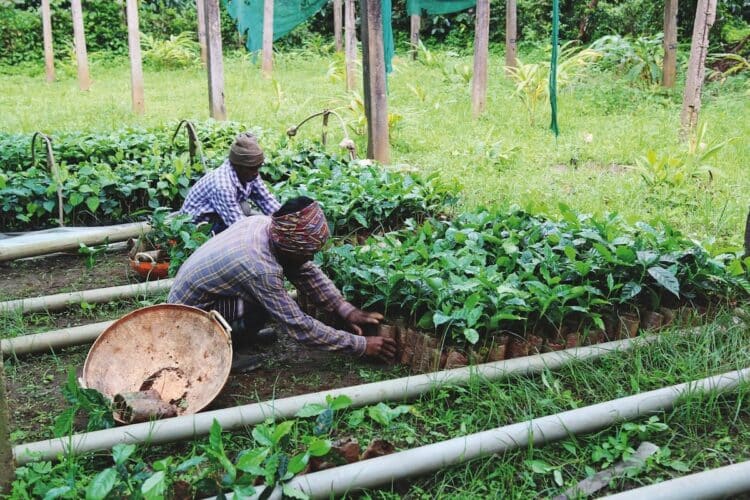
Some Australian roasters are turning to India as an origin as coffee supply from other regions tightens. Image: Ahaana Coffee
As Australian roasters explore alternative origins, Ahaana Coffee is helping showcase India’s diverse coffee offering – from premium Robustas to distinctive Monsooned Malabar Arabic.
Indian coffee is starting to carve out a bigger niche in Australia’s roasting scene.
Smaller-than-expected harvest results out of established origins such as Brazil and Vietnam have left roasters with the need to fill their bags with quality coffees grown elsewhere, and the South Asian nation known for high-quality Robusta is meeting the call.
Melbourne-based green bean importer Ahaana Coffee has seen this boost firsthand, with Founder Rajesh Nair reporting strong interest in Robusta sourced from family-owned plantations in Karnataka.
“Over the past few years, I’ve definitely seen more interest in Indian coffee, especially Robusta,” says Rajesh.
“People are increasingly inclined towards Indian Robusta because the quality is comparatively better than many other origins.”
Driving demand
According to the United States Department of Agriculture (USDA), India was responsible for producing 6.43 million 60-kilogram bags of coffee in 2025-26, which is about four per cent of the world’s total coffee supply.
About 70 per cent of the coffee grown in India is Robusta. Only six nations produce more coffee than the South Asian nation, which also has a strong history in growing Arabica.
Predominantly grown in the southern states of Karnataka, Kerala, and Tamil Nadu, coffee cultivation in India traditionally involved cherries grown in the shade alongside other spice crops.
Rajesh and Ahaana work with family-owned estates around Coorg in Karnataka. These plantations have produced coffee for more than 40 years, and he says ongoing replanting programs are helping rejuvenate the estates while ensuring they remain productive long into the future.
“We need to replant some saplings every year. We regularly replace plants that have declined or died over time across all our estates,” he says.
“This year alone we’re replanting about 3000 trees, but that changes from year to year. It depends on the condition of the plants and how many need to be replaced.”
The estates maintain a clear separation between Arabica and Robusta production, with replanting programs tailored to each variety.
”This year it has mostly been Cauvery (Catimor-type) plantations that have been refreshed, but across the estates we have replanted a number of different varietals,” says Rajesh.
The dwarf Cauvery variety is planted at high density, enabling estates to maximise production from available land.
According to Rajesh, the varietal is valued for its clean and bright cup profile, typically featuring citrus, red berry, and herbal characteristics.
Alongside Cauvery, the estates cultivate traditional Indian Arabica varieties including Selection 6 and Selection 795. Selection 6 is prized for its strong tolerance to coffee leaf rust and balanced cup profile, while Selection 795 remains one of India’s most established varieties, recognised for its high yields and flavour notes of dark chocolate, toasted nuts, maple syrup, and spice.
While those Catimor saplings will take time to mature, Rajesh says Ahaana is working on importing India’s most distinctively processed – Monsooned Malabar – coffee into Australia to round out a productive 2026.
This style of coffee is closely linked to India’s maritime history, with the unique profile developed after coffee was exposed to salty sea air during shipping to Europe in the 18th and 19th century.
This exposure resulted in a coffee with a transformed appearance, density, and cup profile. The beans swell and lose acidity, resulting in a coffee known for heavy body and an earthy flavour profile.
Nowadays, rather than exposing the coffee to humid monsoon air on the open ocean, the effect is achieved by exposing the coffee to the monsoon winds in coastal warehouses.
“It’s a very specific style that is unique to India,” says Rajesh. “It’s a seasonal process that results in a very low-acidity coffee.
“Processing usually starts around August or September, with the coffee normally available from October to March. I’m expecting to secure between 26 and 30 tonnes in total this year.”
Rajesh says there is rising demand for both Indian Arabica and Robusta among Australian roasters, with Robusta demand continuing to level up.
While traditional preferences once positioned Robusta as an inferior coffee to Arabica, limited mostly to commercial blends, the species has seen an improvement in its perception in recent years.
India has long been heralded as a world leader in quality Robusta, and Rajesh says roasters continue to recognise its potential as a high-quality blending coffee and a standalone single origin.
The estates Ahaana works with grow both traditional Old Robusta and Selection 274, a high-yielding cultivar widely associated with India’s Kaapi Royale coffees.
Rajesh says these varieties are sought after for their heavy body and syrupy texture, with cup profiles ranging from earthy and bold through to caramel, toasted nut, and spice notes.
Demand for Arabica is more nuanced, according to Rajesh. Premium-grade lots continue to attract interest, but these coffees are often positioned as a distinctive point of difference coffee, rather than being used in blends.
Like many importers, Ahaana has spent the past year or so navigating challenging macroeconomic conditions. Rising coffee prices, freight disruptions, and ongoing shipping delays continue to strain the supply chain.
“Shipping lines can’t operate at their usual efficiencies because of oil price surges and disruptions to key shipping points. Containers are getting stuck, and that’s affecting everyone who relies on shipping,” he says.
The coffee is ready at origin, but there are no containers. It’s a domino effect from what’s happening in the Middle East.”
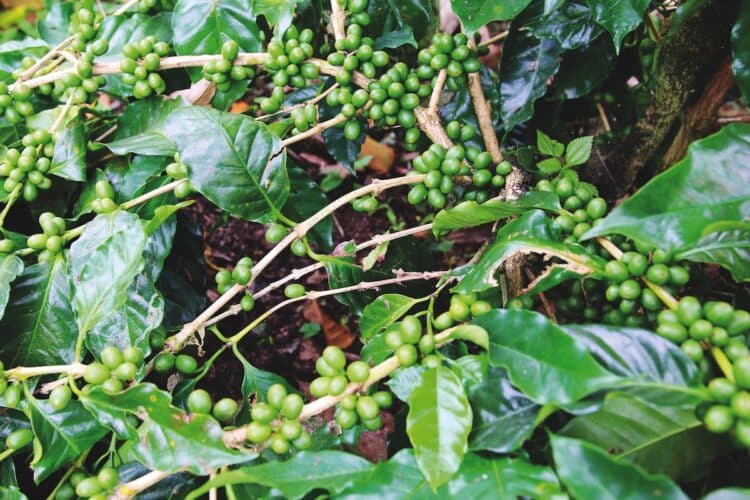
Dwarf Cauvery cherries growing at one of Ahaana’s Indian plantations. Image: Ahaana Coffee
Pushing boundaries
Despite those ongoing logistics hurdles that are influencing the entire industry, Rajesh says the business remains focused on growth.
Launching in 2025, Ahaana Coffee has been steadily growing its capabilities out of Melbourne and is building its business in Sydney and New Zealand.
Now with Sydney-based representative Srini supporting customers in New South Wales, and New Zealand representative Dan helping develop opportunities across the Tasman, the business is beginning to establish the foundations of a bigger presence.
Rajesh says building relationships takes time, but early conversations and sample feedback has been encouraging in both markets.
“Until now, we’ve been more focused on Melbourne, but we’re starting to build into these new areas,” he says.
“Diversifying into multiple regions is very important for us. As a growing business, we want to expand into new territories.”
For more information, visit ahaana.coffee
source: http://www.beanscenemag.com.au / BeanScene Magazine / Home> Features / by Daniel Woods / October 20th, 2026

