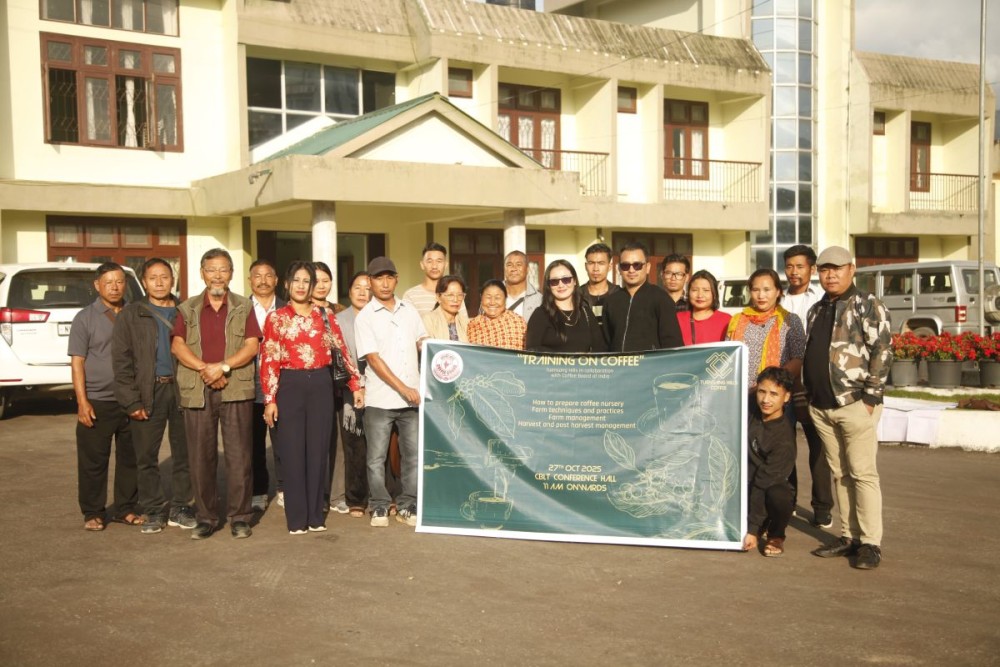
Officials from CBI and Founder and Co-founder of Tuensang Hills with the participants along with the officials of Land Resource Department. (morung photo)
A one-day training programme on coffee cultivation was held in Tuensang to build technical knowledge among local farmers in Nagaland.
The training, organised by Tuensang Hills Coffee in collaboration with the Coffee Board of India (CBI), was conducted at the Chang Baptist LashongThangyen (CBLT) conference hall in Tuensang Town on October 27.
The programme aimed to equip farmers with expertise in key areas, including nursery preparation, advanced farm techniques and practices, farm management, as well as harvest and post-harvest handling.
Around 30 participants took part in the session, which was facilitated by DipanjaliKemprai, Senior Liaison Officer, and N ImtisungchitImchen, Assistant Extension Officer, both from the Coffee Board’s Mokokchung office. Officials from the Land Resources Department, Tuensang, also attended the training, underscoring the department’s continued support in promoting coffee cultivation in the district.
Founder of Tuensang Hills Coffee, PangshaChingmak, said the training was initiated to empower farmers with practical skills and promote coffee as a viable livelihood option in Tuensang district. He highlighted the district’s suitable terrain and climate for coffee cultivation and emphasized plans for sustained follow-up programs and field support to assist farmers after the training.
Responding to questions, Kemprai explained that the collaboration began when Chingmak approached the Coffee Board with details of his startup, Tuensang Hills Coffee, which has been selected for incubation under AIC CCRI-CED. “Our office came forward to boost his startup by providing technical knowledge to the farmers to produce good quality coffee,” she said.
Kemprai added that the Coffee Board continues to support farmers across Nagaland through the Integrated Coffee Development Project, offering subsidies, training, and assistance from “bean to cup.” She also mentioned plans to strengthen market linkages to ensure better prices for local produce and to organize more quality-improvement trainings in the future.
On challenges faced in promoting coffee cultivation in the Northeast, Kemprai noted that small and scattered farm holdings, poor road connectivity, and limited manpower make regular monitoring difficult. To bridge communication gaps, the Board has created WhatsApp groups for quick dissemination of information and encourages farmers to access details of schemes and technical support through the official Coffee Board website.
Highlighting the growing recognition of Naga coffee, Kemprai said, “The future of Naga coffee looks promising. Many entrepreneurs and farmers are coming forward, and Nagaland coffee is gaining recognition for its organic nature and quality.” She cited the state’s achievements at the Aurora International Taste Challenge winning a silver plaque in 2021 and a gold award in 2023 as evidence of its rising reputation in the specialty coffee market.
The training concluded with interactive discussions and a call to strengthen community-based efforts for sustainable coffee cultivation in Eastern Nagaland.
source: http://www.morungexpress.com / The Morung Express / Home / by Morung Express News / October 28th, 2025
Jnanendra Das gives an account of the trajectory of coffee in the Indian Subcontinent as Filter Kaapi makes it to the TasteAtlas’ list at number 2!
Indian Filter Coffee or Kappi was ranked second best on TasteAtlas’s list of the best-rated coffee drinks in the world last month. Among the top three were Espresso Freddo from Greece in the third spot, while Cafe Cubano from Cuba grabbed the top spot. But how did coffee reach India?
Legend has it that coffee reached India in the late 17th century hidden inside the beard of Hazrat Shah Janab Allah Magatabi popular by his Sufi name Baba Budan. During his Hajj at that time, Baba Budan was exploring Yemen on his way back to India. In a port city there, he found people drinking this refreshing beverage that he found kept him sharp and awake. He went to find it was made from the beans of a plant. Unfortunately, the city authorities allowed people to take out only the roasted beans so that they couldn’t be germinated and planted elsewhere.
The name of the port you ask? Al Mokka (hence, mocha) in Yemen. The enterprising gentleman smuggled 7 beans (a number considered sacred in Islam) which he planted in a Chikmaglur (Karnataka) hill that later was named after him, Baba Budangiri or the Budan Hills. Coffee spread to Karnataka and commercial estates came up, gradually gaining popularity in India.
Even before this, ground coffee had reached India via the Mughals, creating a thriving café culture in the 16th century. Inspired by coffee traditions in Islamic cities like Damascus and Istanbul, “qahwa-khanas” or coffee houses sprang up in Old Delhi. Coffee, like the famous sticky-sweet brew at the Arab Serai (built in 1560 by Emperor Humayun’s wife Hamida Banu), became integral to the city’s cultural life.
There, poets and thinkers gathered to sip coffee and engage in animated discussions. However, visual records of these coffee houses are sparse, though Rembrandt, inspired by Mughal art, sketched scenes of coffee-drinking men from India. [Source: Spilling the Beans: The Islamic History of Coffee, by Neha Vermani]
In Southern India, coffee was popularised by the British sometime in the 1800s. First, it was commercially grown by the British for export and later became a choice of the Indian elites. Coffee gained nationwide popularity sometime in the mid-1940s, with the Coffee Board of India establishing the Indian Coffee House (ICH). Indians faced exclusion from British-run coffeehouses. In 1936, the Indian Coffee House (ICH) opened in Churchgate, Bombay [now Mumbai], to address this exclusion, bringing coffee culture to the masses.
Thankfully, instant coffee wasn’t an option back then, so coffee was made from freshly ground, roasted beans, capturing the full depth of flavours and essential oils that make it truly unique. Roasting coffee beans triggers the Maillard reaction, which releases over 800 flavour molecules. This includes pyrazines for a nutty, roasted aroma; aldehydes, adding sweet, fruity, and floral notes; and ketones, which create buttery, caramel-like scents. The South Indian coffee filter method preserves these flavours and essential oils better than other brewing techniques—such as the espresso maker, Aeropress, or pour-over—where paper filters can absorb some of the oils.
To this day, ICH across the country uses the filter coffee method to prepare their coffee beverages.
Coffee has a longer history in India than tea. By the early 20th century, large-scale cultivation had taken root in places like Coorg and Chikmagalur, helped by the rise of South Indian Brahmins, a new social elite in British bureaucracy, who championed filter coffee as a cultural staple. Ironically, while filter coffee became associated with this elite class, it was also blended with chicory, a practice introduced by the British to stretch coffee supplies during shortages. Rather than being seen as “adulteration,” however, chicory gained acceptance for the woody, caramel-like notes it added, creating a distinct flavour that sets filter coffee apart from espresso-style drinks.
Indian filter coffee (as the TasteAtlas ranks) is a preparation technique in which coffee is brewed with the use of a two-chambered coffee filter. The upper one with a perforated bottom is used to hold ground coffee and the bottom one in which brewed coffee is slowly dripped just by the force of gravity. No electricity or external force is required. There is also a tamper or a press that comes along with the filter set.
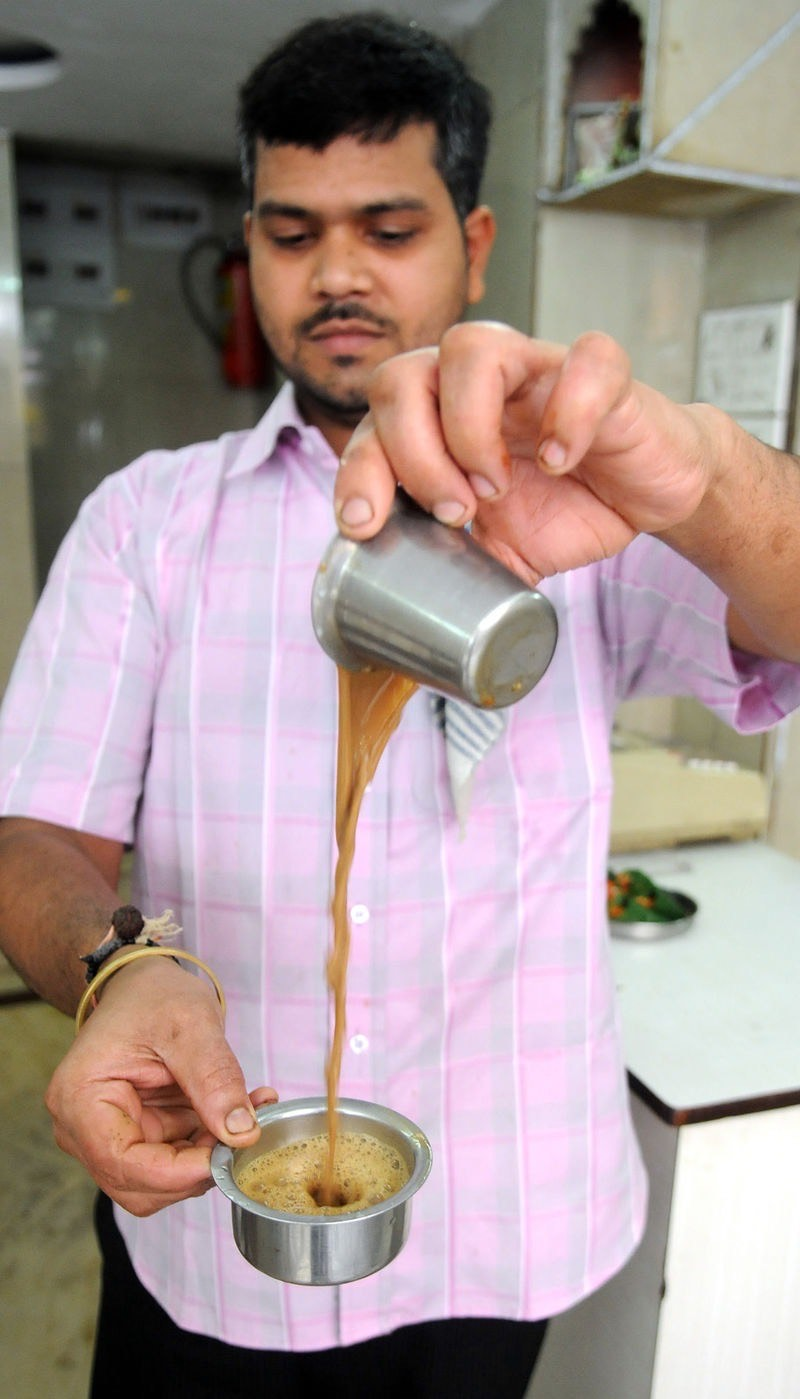
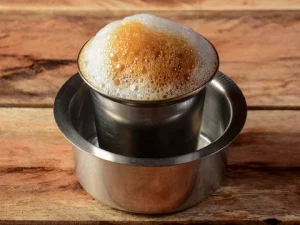
This brewing technique results in a richly-flavoured, full-bodied coffee that is usually mixed with milk and sweetened with sugar. It is traditionally served in a tumbler with an accompanying saucer (davara). Sometimes, the combination of coffee and warm milk is continuously poured from one vessel to another until it is aerated and becomes frothy.
Here’s a quick and simple recipe that many southern Indian households follow for authentic filter coffee, traditionally made with a mix of coffee and chicory (ideally an 80:20 ratio).
Ingredients (Serves 2)
1. 4 tbsp ground coffee
2. 200 ml boiling water
3. Sugar (optional)
4. Hot milk
Brewing Method
Step 1: Pack 4 tbsp ground coffee in the upper perforated chamber of your coffee filter, press it with the tamper and let it sit there.
Step 2: Slowly pour boiled water into the top chamber and let gravity do its magic.
Step 3: Wait 15–20 minutes for the decoction to collect in the lower chamber.
Serving
Add 1 tbsp of sugar to your tumbler, if desired.
Pour the decoction into the tumbler until it fills about one-third of the way.
Top up with warm milk. If you prefer it black, you can replace the milk with warm water for a bold, undiluted taste.
Pour the coffee back and forth between the tumbler and saucer to mix and create froth.
Enjoy your strong, frothy filter coffee, crafted with care and tradition!
There is life before and after you filter coffee. Once you have had great filter coffee, it is nearly impossible to go back to instant coffee. Coffee is a complex subject where every little thing matters but ‘Indian Filter Coffee’ makes it simple where you don’t have to buy expensive brewing kits or gadgets.
Finding a traditional filter and davara in Meghalaya may be challenging, but they’re available on various online stores for under a thousand rupees. As for the coffee itself, Meghalaya is blessed with altitudes over 4,000 feet and a unique climate, making it ideal for cultivating distinctive, high-quality coffee. Local brands like Smoky Falls Tribe Coffee, endorsed by the Meghalaya Basin Development Authority, are bringing Meghalaya’s indigenous coffee to the global stage. Other notable North Eastern brands like 7000 Steps and Naga Coffee are also producing some of the region’s finest coffee blends.
Consumption of caffeine should be in moderation. The Mayo Clinic recommends that most healthy adults consume less than 400 milligrams (mg) of caffeine per day. This is roughly the amount of caffeine in four cups of brewed coffee.
Over centuries, coffee has seamlessly woven itself into India’s social and culinary fabric, where its preparation has become an art form, encapsulating flavours, aromas, and a distinct frothy texture that makes it unique. Today, Indian filter coffee is an evolving taste offering coffee lovers worldwide a simple yet deeply satisfying brew.