Innovative daily programme revives tribal student attendance in Kodagu government school

In the past two years, admissions have increased significantly, and from the current academic year, the school has started recording 100% attendance.

Chennangi Government Primary School, located in a tribal settlement in South Kodagu, has introduced a unique concept called Dinnakondu Karyakram, a special programme held every day.(Photo | Express)

Madikeri :

In a heartening initiative aimed at ensuring 100% attendance among tribal students, a government school in Kodagu has taken an extraordinary approach.

Chennangi Government Primary School, located in a tribal settlement in South Kodagu, has introduced a unique concept called Dinnakondu Karyakram, a special programme held every day, which has now made school a fun and welcoming space for all its students. The result: students who once refused to attend classes are now turning up enthusiastically each day.

The school currently has 52 students, all from tribal families. While government schools across the state are allegedly witnessing a sharp fall in admissions due to various issues, this institution is seeing a positive shift. In the past two years, admissions have increased significantly, and from the current academic year, the school has started recording 100% attendance.

“Several tribal students stayed away from the institution. When their parents left for daily wage work, these students sat at home. However, we conducted a survey before the start of this academic year and have ensured that all the children from the tribal colony attend classes at the institution,” shared Susha K K, the headmistress of the institution.

Over five students who had previously discontinued schooling have now returned and are attending classes without hesitation. Last year, the school had introduced Thingaligondu Karyakrama (a special programme every month), where students were encouraged to exhibit their talents through various performances. However, despite this, some students still remained absent.

This prompted the school to implement a new daily programme. As soon as students arrive at the school each morning, they are engaged in various fun activities ranging from yoga, singing, dancing, craft, and literature, to unique games.

“This has resulted in all the students attending classes without fail. To encourage them further, we have started a YouTube channel and we regularly upload the talent shows of the students onto the channel. It is like an incentive to these students, as the entire village watches and celebrates them after watching the YouTube channel,” the headmistress shared.

Admissions have gone up from 39 students to 52 in the past two years. Some students who had even taken transfer certificates were allegedly convinced by the headmistress to return. In addition, the school management conducted awareness meetings with parents, urging them to ensure their children attend school regularly to build a better future.

Despite facing an acute shortage of teaching staff and deteriorating infrastructure, the school management is doing its best to provide quality education to the tribal students.

source: http://www.newindianexpress.com / The New Indian Express / Home> Karnataka / by Prajna GR / August 07th, 2025

Harangi fills up for first time in October

The catchment areas in the district are receiving heavy rainfall every day, and the reservoir is filled to its full capacity for the first time in a non-monsoon month.

Water level in Harangi stands at 2,858.09 ft, against its capacity of 2,859 ft on Friday. / Photo | Express

Madikeri :

For the first time, Kodagu’s Harangi reservoir has filled up to the brim in October. Following increasing inflow to the dam, over 5,000 cusecs of water is being let out to the rivers. The catchment areas in the district are receiving heavy rainfall every day, and the reservoir is filled to its full capacity for the first time in a non-monsoon month.

“In the wake of heavy rainfall in the Harangi basin for the past one week, additional water is being released into the river for the dam’s safety,” said Harangi Irrigation Department Executive Engineer IK Puttaswamy.

He confirmed that the inflow into the dam has been increasing day by day for the last five months. The water level as of Friday stood at 2,858.09 feet against its full capacity of 2,859 feet.

Kodagu district has been facing monsoon showers since May this year, and the district continued to receive heavy rainfall every day. Several parts of the district have already received more than 7,600 mm of rainfall this year. The district recorded 2,998.59 mm of rainfall this year from January.

source: http://www.newindianexpress.com / The New Indian Express / Home> Karnataka / by Express News Service / October 25th, 2025

Genetic study traces origin of Coorgis to three ancestral populations spanning millennia

The Kodavas, while a socio-culturally homogenous community, have evoked considerable interest among anthropologists as their origins and demographic history are much debated.

The Coorgi, or Kodava, community in Karnataka can trace its origins to at least three different ancestral populations, including as geographically diverse as the Palliyar, a tribe from the South Western Ghats, to north Indian Sikh-Jat. The oldest of these can be traced to roughly 3,000 years ago, and the most recent, to about 330 years, reports a first-of-its-kind study analysing genetic data from native Coorgis.

The study, published in the latest edition of the peer-reviewed Communications Biology, underlines that the several ethnic communities in India are not homogenous and are a result of the mixing of diverse ethnic groups over millennia.

The Coorgis, while a socio-culturally homogenous community, have evoked considerable interest among anthropologists whose origins and demographic history are much debated “due to their stark socio-cultural contrast with surrounding populations”, the study notes.

Their population comprises around 3,00,000 individuals, with 1,200 extended families.

Based on studying the genetic history from 144 individuals, the authors, comprising those from the University of Delhi, South Campus, and the Centre for Cellular and Molecular Biology, Hyderabad, have found that the oldest — called Coorg 3 — had a shared genetic history with the Palliyar population and this lineage came into being about 98 generations before present (GBP).

One GBP is about 25 to 30 years, thus dating them to about 3,000 years ago. Then the Coorg-1 branched away 64 generations, or around 1,900 years ago. The third group, Coorg-2, is relatively recent — about 330 years ago — from the admixture of Coorg-1 and Coorg-3.

The authors came to their conclusions by comparing the frequency of certain genes in the Kodavas to the database of the genetic structure of other caste groups and tribes. The frequency distributions of variations in certain genes enable educated guesses at the times during which certain populations combined, or whether the individuals of a group were largely isolated from surrounding populations.

Traditionally a group of agriculturists with martial customs interlacing their day-to-day lives, the Coorgis practise family exogamy and caste endogamy, the paper notes.

However, the community’s various customs prevalent among the Coorgis “notably deviate from the Hindu way of life” and their cultural origin stories trace them to the Indus Valley during the Mohenjodaro period as well as migratory groups such as the Indo-Greek army of Alexander’s India chapter, pre-Muslim Kurds or pre-Christian Georgian, and an off-shoot of the Indo-Scythian Sakas.

“These being entirely anecdotal or from the early population dating, scientific evidence is lacking,” the authors B.K. Thelma, K. Thangaraj, Anirban Mukhopadhyay, Loumos Kumar, and Kiran Sran note.

“These insights into ancient and diverse genealogies among Coorgis not only explain their unique status in the Indian diaspora but also encourage further research to identify unknown migrations to the Indian subcontinent and thus further unravel its unique demography,” the authors note.

India’s population groups, several of whom maintain distinct physical and cultural practices, trace their ancestry to two large population groups: Ancestral South Indian (ASI) and Ancestral North Indian (ANI). The former trace their lineage to a hunter-gatherer Ancient Ancestral South Indian (AASI) group from 65,000 years and the lineages from the Indus Valley Civilisation. The latter, or the ANI, are a mix of IVC and late Bronze Age Steppe culture (of Central Asian origin).

The mixing of ASI and ANI intermixing between 1,900 and 4,200 years make up the main caste and tribe groups of North and South India.

source: http://www.thehindu.com / The Hindu / Home> News> Cities> Bengaluru / by Jacob Koshy / May 20th, 2025

CNC Conducts 16th Human Chain in Ammathi

Madikeri: 

The Codava National Council (CNC) held its 16th human chain awareness campaign in Ammathi of Virajpet taluk on Tuesday, October 21, rallying for the indigenous Codava community’s constitutional recognition and territorial sovereignty.

Under the leadership of Chairman N.U. Nachappa Codava, an advocate, the event spotlighted demands for Codavaland’s political autonomy, Scheduled Tribe (ST) designation, reserved seats in Parliament and State Assembly similar to Sikkim’s “Sangha” model, and enduring rights to ancestral properties and the Animistic “thok-gun” firearm tradition integral to Codava ceremonies.

Nachappa stressed that Codava survival hinges on securing a distinct ethnic identity in the 2026-27 national census through a dedicated column and code, enabling constitutional protections for their mono-ethnic, Animistic faith, which venerates the Cauvery River, forest deities, and ancestral graves without mainstream religious or caste affiliations.

Unlike conventional practices, Codava weddings feature a sacred “patthak” tied by the bride’s mother and obligatory offerings of alcohol and pork, aligning with global indigenous groups like Jharkhand’s Santal (proclaimed Sarna by CM Hemant Soren) or the Kalash, protected by UNESCO’s heritage framework.

From 1871 to 1931, colonial censuses acknowledged Codavas as a unique non-religious, non-caste entity, a status lost post-1947 as they were merged into dominant categories, obliterating their distinctiveness. Nachappa warned that without census reinstatement, their political and cultural voice risks permanent suppression, undermining self-determination.

The CNC voiced concerns over alleged plots to integrate Bangladeshi Rohingyas into Kodagu’s voter rolls, inflating demographics for political gain, and criticised unauthorised land conversions for resorts, such as a 16-acre township within a 2,400-acre estate, enabled by lax governance.

To address labour needs without compromising local rights, Nachappa suggested a guest worker permit system, modelled on the 2015 Modi-Sheikh Hasina Dhaka agreement, mandating seasonal migrants’ return to their regions.

The peaceful chain, joined by Codava leaders like Udianda Chondamma, Badumanda Sanvi Dechamma, and Inanda Prakash Ganapathy, vowed to continue the struggle in the name of sacred Codava symbols and the Constitution, closing with the National Anthem.

The 17th chain is scheduled for Monday, October 27, 2025, in Srimangala, building on events in places like Madapur and Chettalli to amplify Codava advocacy for justice and recognition.

source: http://www.hansindia.com / The Hans India / Home> News> State> Karnataka / by The Hans India / October 21st, 2025

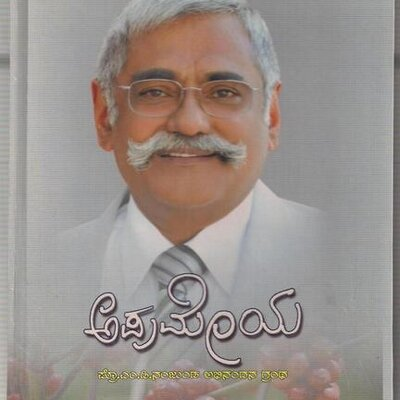
Dr. K.B. Ganapathy Memorial Road Race held in Mysuru

Mysuru : (MK&VNS)-

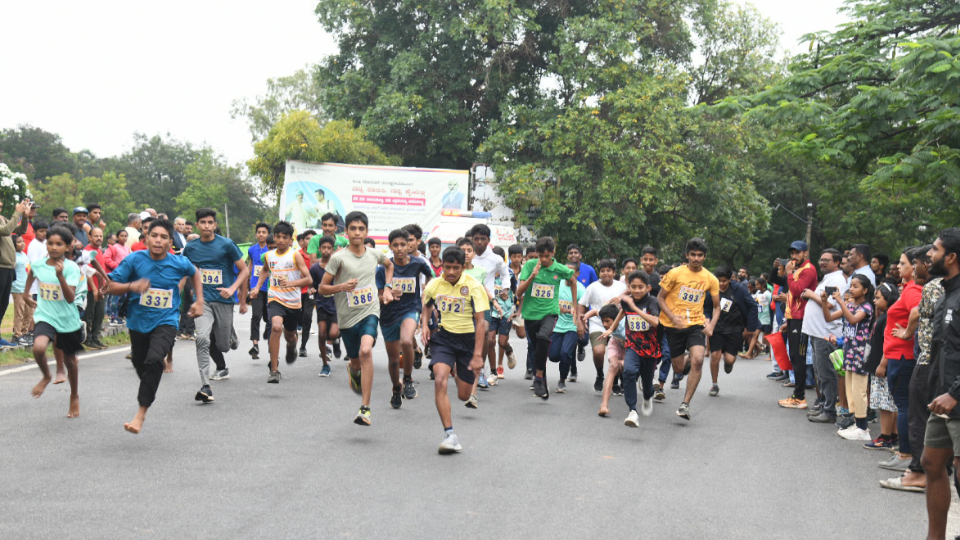
Hundreds of school and college students took part in the Star of Mysore and Mysuru Mithra Founder-Editor Dr. K.B. Ganapathy (KBG) Memorial Road Race organised by Mysore Athletics Club at University of Mysore Athletic Ground (Oval Grounds) in city this morning.

The event was inaugurated by senior journalist Amshi Prasannakumar.

The event was held in five categories — Children below 5 years (100 mts), Primary School (Boys and Girls – 400 mts), Higher Primary School (Boys and Girls – 800 mts), High School (Boys and Girls – 1.5 km) and PUC (Boys and Girls – 2 km). Winners were awarded with medals and cash prizes.

Mysore Athletics Club President Dr. Chainsingh Rajpurohit presided. Senior Journalist Narasimhamurthy, University of Mysore’s Department of Physical Education (DPE) Director Dr. C. Venkatesh, KSA (Bengaluru) Pistol Sharp Shooter H.D. Aravind Gowda, Social Worker Harish Moganna, Mysore Athletics Club Patron Dr. C. Krishna, Secretary M. Yogendra, Organising Secretary G.R. Prabhakar and Executive Committee Members were present.

Results

Primary School (400 mts Run) Boys: 1. N. Pavan (BVB, Mysuru), 2. U. Rishaan (St. Joseph’s School), 3. Aryan Kavan (DPIRS), 4. S. Kashish (BVB), 5. S. Surya (MWLSS), 6. Sayug Kuttappa (Podar International School) and 7. Ganvith. G. Gowda (KNC).

Girls: 1. E. Uthra (BVB, Mysuru), 2. B.P. Vriddhi Ponnanna (Gnanaganga School), 3. C. Sinchana (Kurubur), 4. Sinchana (Kurubur), 5. Sanvi (Kurubur) and 6. Lalitya (Christ Public School).

Higher Primary School (800 mts) Boys: 1. N. Subash Gowda (New Oxford Public School), 2. M.S. Vishal (Baden Powell Public School), 3. N. Tanmay (BVB, Mysuru), 4. Janvik (DAV Public School), 5. K.S. Anush (BVB) and 6. S.M. Ayush (BVB).

Girls: 1. R. Niha (St. Joseph’s School), 2. K.M. Pragathi (Vidya Darshini, Kurubur), 3. M. Meghna (Vidya Darshini, Kurubur), 4. S. Prakruthi (Vidya Darshini, Kurubur), 5. Bindu (Vidya Darshini, Kurubur) and 6. M.K. Gowri (BVB, Mysuru).

High School (1.5 km) Boys: 1. P. Lasith Kishore (Vijaya Vittala Vidyashala), 2. S. Shreyas (Rotary West), 3. H.V. Chirag (VVS B.M. Shree School), 4. Chiranth H.G. Gowda (KNCIGS, Mysuru), 5. V. Sudarshan Jain (Capital Public School) and 6. M. Meghanath Gowda (K.P. Convent).

Girls: 1. Inchara (Kurubur Club), 2. Mamatha (Kurubur Club), 3. S. Jayashree (Sri Chamundeshwari Sports Club), 4. H. Saha (St. Joseph’s School), 5. Divyashree (Sri Chamundeshwari Sports Club) and 6. Varsha (DAV Public School).

PUC (2 km) Boys: 1. K.U. Omkar (SBRR Mahajana PU College), 2. Varun (Vidya Jyothi PU College), 3. M. Dileep (Vivekananda College), 4. R. Srujan (Vivekananda College), 5. P. Yashwanth (Vivekananda College) and 6. R. Koushik (Vijaya Vittala PU College).

Girls: 1. N. Manasa (Kurubur), 2. S. Ankitha (Kurubur), 3. Deepashree (Kurubur), 4. M. Ananya (Kurubur), 5. Manasa (Kurubur) and 6. N. Vaishnavi (Mysuru).

source: http://www.starofmysore.com / Star of Mysore / Home> Sports News / October 19th, 2025

Udupi: Renowned Educationist Prof M D Nanjunda Gets Alevoor Group Award

pix: X.com / M.D.Nanjunda @sarojmdn

Udupi : 

“India needs committed teachers who believe in their career development,” opined Professor M D Nanjunda, renowned educationist and secretary of Kodagu Academy for Education and Culture, Gonikoppal.
 
He was speaking after receiving the prestigious Alevoor Group Award instituted by Alevoor Group for Education at the annual day celebrations of Shanthiniketan English Medium School, Alevoor, on Sunday January 29.

“Unfortunately, many teachers did not take up the teaching profession as a choice, but somehow they landed up in the profession. Now they believe only in bell and the bill,” he added.
 
Meanwhile, Prof Nanjunda advised the teachers to develop a professional attitude or to quit the profession. He also said that government’s effort to get the state syllabus on par with the central syllabus through a bridge course would be a futile attempt.
 
Presenting the award, Lions district governor Jayakar Shetty Indrali called upon the parents to instill the qualities of respecting elders and teachers in their wards.
 
DDPI Nagendra Madhyastha released the annual bulletin of the group,
 
Alevoor Group president A Ganapathi Kini welcomed the gathering. Secretary A Dinesh Kini introduced the awardee.  Principal Roopa D Kini presented the annual report.  Teacher Vibha Adiga proposed the vote of thanks. Srinivas Upadhya and Sudha S Puthraya compered the programme.

source: http://www.daijiworld.com / DaijiWorld.com / Home> Karnataka / by Shubalaxmi / Daijiworld Media Network – Udupi (RD) / January 31st, 2012

Chasing Gold through Snow. Kodagu’s Thekkada Bhavani becomes the first Indian woman to win international skiing medals

Kodagu’s Thekkada Bhavani becomes the first Indian woman to win international skiing medals

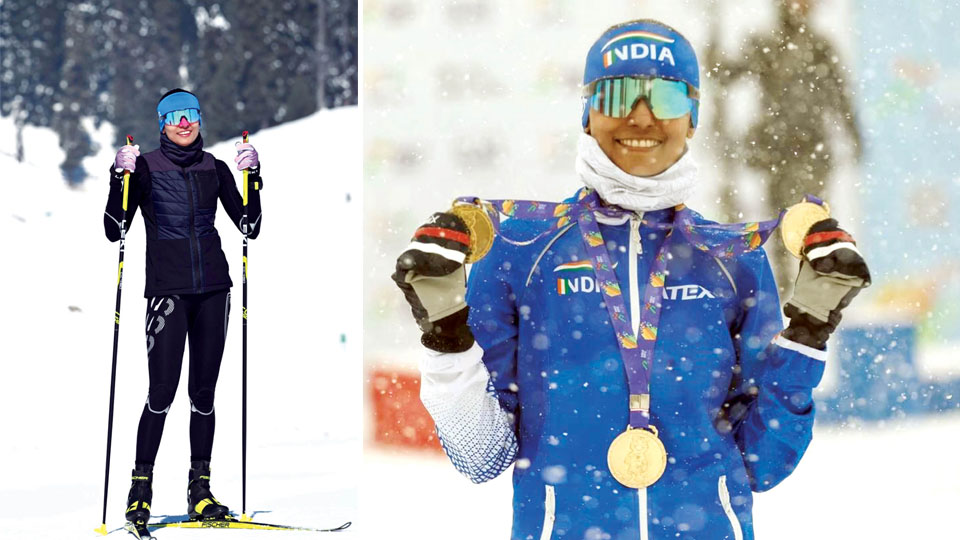
While many youngsters influenced by Bollywood dream of entering the world of glamour and fame, here is a girl who chose a very different path — the icy slopes of the mountains. Inspired by adventure and driven by determination, she turned her passion for mountaineering into a historic achievement, becoming the first Indian woman to win medals at an international-level cross-country skiing championship.

A native of Napoklu in Kodagu district, Thekkada Bhavani Nanjunda defied all odds to make not just her hometown, but the entire State and Nation proud. She clinched bronze medals in the 5 km distance race and 1.3 km sprint at the South American Cross-Country Skiing FIS Competition held at Corralco, Chile, in September this year.

Bhavani has represented India at several prestigious international events, including the Nordic World Championships and the Asian Winter Games. A multiple medal winner at the Khelo India Games and the National Skiing Championship, she is now rigorously training to qualify for the 2026 Winter Olympics in Italy.

Daughter of Thekkada Nanjunda (Shambu) and Parvathi (Divya) of Perur village near Napoklu, Bhavani draws her strength from her roots and family support. Her younger sister, Thekkada Seethamma, works for a private firm in Bengaluru.

Star of Mysore caught up with the trailblazing athlete to learn more about her journey, challenges and preparations for the upcoming Olympics. Excerpts…

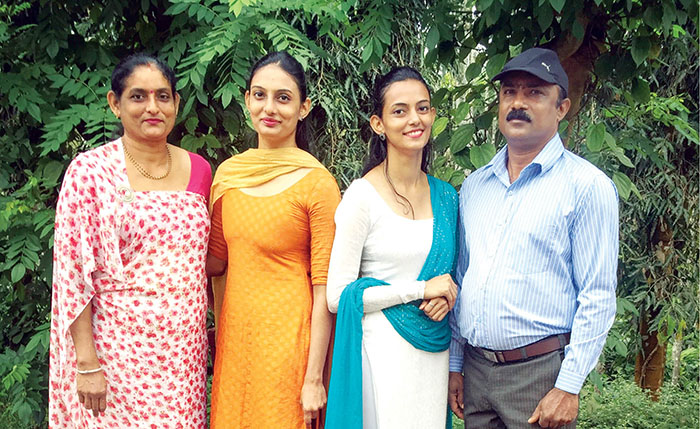
Bhavani (second from right) seen with her father Thekkada Nanjunda (Shambu), mother Parvathi (Divya) and younger sister Thekkada Seethamma.

Star of Mysore (SOM): How did your journey in cross-country skiing begin?

Bhavani: It all started after I watched the movie ‘Yeh Jawaani Hai Deewani’. That’s when I first learned about the majestic Himalayan mountain range, which inspired me to join the NCC Air Wing during my college days.

In 2014, I attended a mountaineering camp in Manali — that was my first encounter with snow, something we never see back home in Kodagu. The experience changed my life completely. I wanted to explore the mountains more deeply and decided to take up skiing so I could glide down the peaks I climbed. Over time, I discovered cross-country skiing and fell in love with it for the endurance, precision, and mental strength it demands.

SOM: What inspired you to pursue adventure sports, and cross-country skiing in particular?

Bhavani: I’ve always been drawn to the outdoors and adventure. But my biggest inspiration came from Marit Bjørgen of Norway — one of the greatest cross-country skiers in history. Her strength, determination, and consistency truly motivated me. Watching her made me want to follow that path and represent India in a sport that very few from our country have even attempted.

SOM: Cross-country skiing is known for its toughness. How did you master such a demanding sport?

Bhavani: It’s been a long and challenging journey. I had no background in snow sports and limited access to proper facilities in the beginning. But I stayed consistent — training first in India, then in New Zealand, and later in Europe. Each season taught me something new — from refining my technique to building endurance and mental resilience. It’s a constant process of learning, and even today, every single day on the snow feels like an opportunity to improve.

SOM: How does it feel to be the only Indian woman to win cross-country skiing medals at an international event?

Bhavani: It’s an incredibly proud and emotional feeling. Standing on the podium with the Indian flag was one of the most special moments of my life. But beyond the medals, it’s about proving that Indian athletes can compete in winter sports at the highest level. I hope my journey inspires more youngsters, especially girls, to explore lesser-known sports and believe that nothing is impossible.

SOM: How have your parents supported you throughout your journey?

Bhavani: My parents have been my biggest strength. Even though they didn’t fully understand the sport initially, they always believed in me and supported my dreams. Their encouragement gave me the courage to pursue such an unconventional path. Every achievement of mine belongs to them as much as it does to me.

SOM: Now that you have reached the international stage, what is your next goal?

Bhavani: My primary focus is the 2026 Winter Olympics in Italy. I want to qualify and represent India with strong performances on the world stage. At the same time, I hope to raise awareness about winter sports and help build better infrastructure in India, so the next generation has opportunities I didn’t have.

SOM: What advice would you give to youngsters wanting to take up cross-country skiing?

Bhavani: I would say, just start. Don’t wait for perfect conditions or ideal facilities. Passion and perseverance can take you a long way. Cross-country skiing challenges you physically and mentally, but it also teaches resilience, patience, and self-belief. If I could do it, coming from a small town in South India, anyone can.

source: http://www.starofmysore.com / Star of Mysore / Home > Feature Articles / October 19th, 2025

Inside story – Celebrating a new bond

A walk about Virajpet in Coorg throws up interesting tales.

STEEPED IN HISTORY: Virajpet. / Photo: Lakshmi Sharath

I was lost in Virajpet looking for an address. The quaint town in Coorg was a welcome break en route to Madikeri. Traditionally-dressed Kodava women were shopping in the vegetable markets, and the main street was bursting with traffic.

I looked around and saw houses with tiled sloping roofs transformed into eateries and retail outlets. I stopped by the auto stand and asked for Telugu Street, but was met with puzzled glances.

I walked around the main street, lost in the old world charm, when a Kodava came to my assistance.

“You are standing in Telugu Street Madam; go a bit further and you may find Bengali Street, but no one refers to the streets by these names now.” We had coffee at a local eatery as Ponappa, a retired Army man, provided a glimpse of Virajpet’s history.

The great escape

Our story starts in the middle of the 18th Century when Madikeri, the capital of Coorg, ruled by the Haleri kings, was invaded by Hyder Ali and his son Tipu Sultan. The young Haleri prince, Dodda Veerarajendra, and his brothers were virtually held prisoners, while the father-son duo was busy fighting the British.

The story goes that Dodda Veerarajendra finally escaped from Tipu’s prison and regained his kingdom. The British sensed an ally in the Haleri king and decided to support him in the war against Tipu.

It was in this scenario that Virajpet, barely 30 km from Madikeri, was founded by Dodda Veerarajendra.

As kings have a penchant for naming places after them, this town too was called Veerarajendrapette.

Ironically, it was established as a settlement to celebrate the relationship forged by the Haleri kings with the British. Ironic, because it was the British who finally deposed the Haleri dynasty later.

Virajpet belonged to Veerarajendra, who built a fort here with a palace, and a pond for his cavalry. Although the remnants of this can be seen even now, Virajpet is largely reminiscent of the Colonial era.

The landmarks today are the St Anne’s church, built initially during Veerarajendra’s reign and the clock tower, established in the 20th Century to commemorate the coronation of King George V.

I quiz Ponappa about Telugu Street, and he smiles. “When Veerarajendra built the town, many Kodavas were imprisoned by Tipu, and so he invited people from neighbouring kingdoms to come over.

There were several communities living here — the Christians, Moplas, Tamilians, Jains and Telugus, among others.”

Cosmopolitan town

Adds Ponnappa: “Virajpet is what you would have then called a cosmopolitan town. For instance, the Bengali Street was filled with those who came down here after the British defeated the Nawab of Bengal in another battle.”

I finally manage to find my destination, and Ponappa takes leave. It’s amazing how stories bring strangers together!

source: http://www.thehindu.com / The Hindu / Home> Features> Metroplus> Travel / by Lakshmi Sharath / May 23rd, 2010


Thousands witness sacred Cauvery Tula Sankramana at Talacauvery, Karnataka

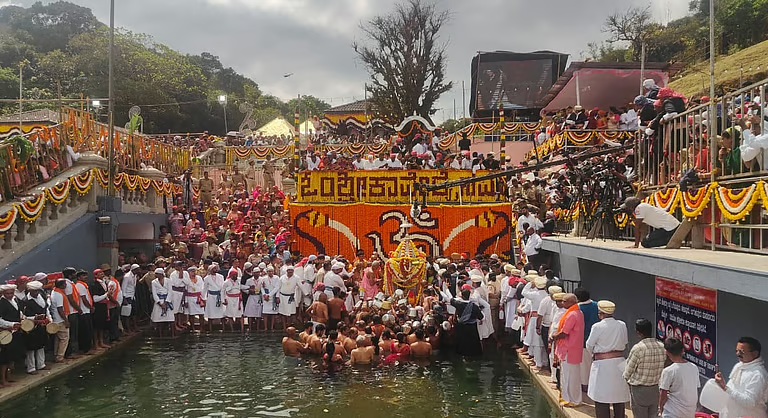
The auspicious moment when the holy river Cauvery gushed out from the sacred Kundike occurred at the predicted time of 1.44 p.m., marking the highlight of the annual ritual.

Hundreds of Kodavas, dressed in their traditional attire, walked barefoot for about 8 km from Bhagamandala to Talacauvery in a display of devotion.(Photo | Express)

Madikeri : 

The chants of “Kaveramme Ukki Baa” filled the air across Talacauvery as thousands of devotees witnessed the sacred Cauvery Tula Sankramana on Thursday.

The auspicious moment when the holy river Cauvery gushed out from the sacred Kundike occurred at the predicted time of 1.44 p.m., marking the highlight of the annual ritual.

The rituals were led by chief priest Prashanth Achar along with a team of 11 other priests. Devotees from across Kodagu district and neighbouring states, including Kerala and Tamil Nadu, gathered in large numbers to take part in the holy festivity.

Hundreds of Kodavas, dressed in their traditional attire, walked barefoot for about 8 km from Bhagamandala to Talacauvery in a display of devotion.

Elders, also clad in traditional Kodava attire, led the way playing the traditional dudi and singing baalo paat as they made their way to Talacauvery. Devotees from various communities, including members of the Are Baashe community from across the district, also participated in the rituals with reverence.

Among the participants were Mysuru-Kodagu MP Yaduveer Wadiyar, who adorned the traditional white royal attire, and Virajpet MLA A.S. Ponnanna, who was dressed in traditional Kodava wear.

Both walked the 8 km stretch from Bhagamandala to Talacauvery and took part in the rituals. Madikeri MLA Dr Mantar Gowda, Deputy Commissioner Venkat Raja, Superintendent of Police K. Ramarajan and several others were also present at the ceremony.

Enhanced security measures and improved arrangements were in place at the temple premises to manage the large crowd. While a few devotees allegedly demanded the removal of barricades, the issue was resolved amicably, ensuring smooth movement for all.

A medical team from the Kodagu Institute of Medical Sciences was stationed at both Bhagamandala and Talacauvery to attend to any emergencies.

‘Annadhana’ (mass feeding) arrangements were made for devotees at both temples, while the Kodagu Ekikarana Ranga will host a month-long mass feeding programme at the centre.

Cultural programmes are also being organised at Talacauvery by the Kodava and Are Baashe Sahitya Academies.

Deputy Chief Minister D.K. Shivakumar and Muzrai Minister Ramalinga Reddy were scheduled to attend the event; however, their visit was cancelled due to unforeseen reasons.

source: http://www.newindianexpress.com / The New Indian Express / Home> Karnataka / by Express News Service / October 17th, 2025

Squash: Joshna Chinappa wins Japan Open 2025

New Delhi (UNI) :

Two- time Asian champion Joshna Chinappa continued her remarkable comeback by winning the women’s singles title at the Japan Open 2025 squash tournament at Yokohama in Japan yesterday.

The 39-year-old Indian squash player, 117th in the women’s singles rankings and unseeded in Japan, defeated third seed and world No. 53 Haya Ali of Egypt 11-5, 11-9, 6-11, 11-8 to cap off an impressive run at the PSA Challenger event.

This triumph marked Joshna’s 11th career PSA title and her first since returning to full fitness after undergoing knee surgery after the Asian Games 2023 in Hangzhou, where she was also part of India’s bronze-winning women’s team.

Joshna teamed up with teenage prodigy Anahat Singh earlier this year to win the women’s doubles title at the Asian Championships in June and also reached the semi-finals of the Indian Open, where she lost to eventual champion Anahat.

At the Japan Open, Joshna displayed dominant form throughout the tournament. She defeated Malaysia’s Anrie Goh 11-6, 11-6, 11-6 in her tournament opener, followed by a straight game win over French fifth seed Lauren Baltayan 11-7, 11-4, 11-9 in the second round.

In the quarter finals, she overcame Egypt’s second seed Nardine Garas 11-8, 15-13, 11-9 and then overwhelmed fourth-seeded Egyptian Rana Ismail 11-7, 11-1, 11-5 in the semi-finals.

Squash will make its Olympic debut at the LA 2028 Games.

source: http://www.starofmysore.com / Star of Mysore / Home> Sports / October 15th, 2025