India International Coffee Festival kicks off this week, and it promises a packed calendar for javaphiles in Mumbai.
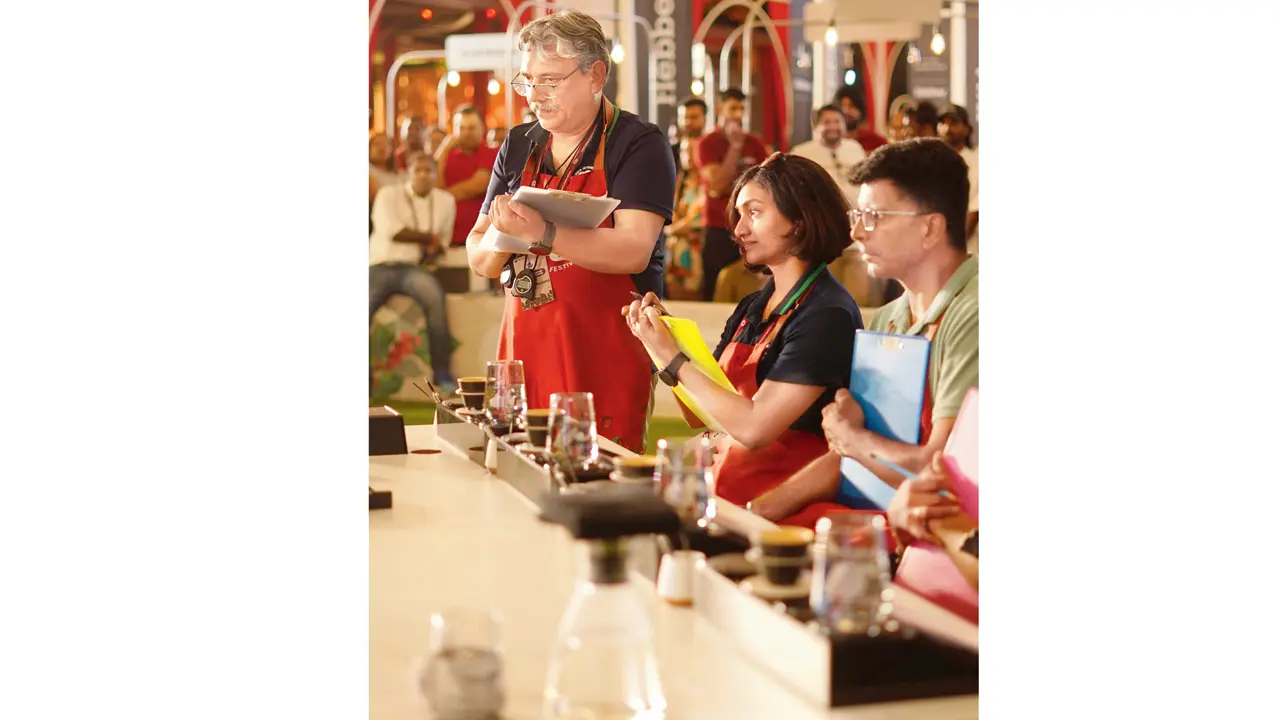
The competitions receive participating entries from home brewers and professional baristas. Pics courtesy/IICF
If you are a coffee lover, and take keen interest in its craft, India International Coffee Festival (IICF) to be held within the Bakery & HoReCa Industry Show is where you should be from October 30 to November 1.
Organised by Speciality Coffee Association of India (SCAI), the event will see six preliminary rounds of competitions including flagship National Barista Championship, Brewer’s Cup Championship, Coffee in Good Spirits, and Latte Art Championship. The final will be held in Bengaluru later this year. It is a great spot to network and engage with representatives from the entire coffee value chain across India.
The jury consists of qualified tasters
DM Purnesh, a fourth-generation coffee grower from Chikmagalur and immediate past president, SCAI, part from industry folks, the event is a great place for entrepreneurs, aspiring professionals, and enthusiasts to understand about coffee and its process. Over the last 23 years that we have been running competitions, we have seen a lot of interest from home brewers.
A participant takes part in a filter coffee making challenge
A qualified jury judges the competitions. Winners at Indian Barista Champion 2025 to be held in Bengaluru later this year will go on to represent at global competition World Barista Championship 2025,” says Purnesh.
Exhibiting brands include Kaapi Machine and Solutions, caffeine superstore Benki, Brewing Gadgets and Trufrost & Butler.
Serious about coffee
(Left) Suhas Dwarkanath; (right) a participant takes part in a previous coffee-making championship
Hamsini Appadurai, president, SCAI, is happy consumers are more aware in recent years and want to know where their coffee comes from. “Gone are the days when we would order a cup of coffee.
We also have a Brewers Cup and Filter Coffee Championship, which sees participation from home brewers as well. We want everybody to catch the coffee bug,” she tells us.
Micro communities around coffee are thriving on social media, WhatsApp and offline. “Makers discuss brewing and brewing techniques. The competitions are becoming a sort of value badge, allowing homebrewers to showcase their talent of working with different kinds of coffees and techniques,” adds Appadurai.
DM Purnesh and Hamsini Appadurai
Suhas Dwarkanath, last year’s winning barista who recently notched the 15th spot at the World Barista Championship 2025, says the festival is a great place to meet with the community exchanging ideas, networking and most importantly learning from others. “Trends today include coffee mocktails and Coffee Omakase sessions where barista-led Omakase coffee sessions are hosted over a multi-course tasting experience just like an omakase sushi dinner. It is a unique journey of coffee beverages for the diner. The expert highlights unique flavours, origins, and innovative preparations, sometimes with accompanying food pairings.”
On October 30 to November 1 At Bakery and HoReCa Business, Jio World Convention Centre, Bandra Kurla Complex. Time 9.30 am to 5.30 pm Register www.bakerybusiness.in Entry Rs 500
source: http://www.mid-day.com /mid-day / Home> Mumbai Guide News> Things to do News> Articles / by Phorum Pandya (smdmail@mid-day.com) / Mumbai, October 28th, 2025
Shot across stunning locations in Madikeri, the song from Peter has been simultaneously released in Kannada, Telugu, Tamil, and Malayalam.
A still from Sundari Sundari
Peter is about creating hope, says director Sukesh Shetty, describing his upcoming sensitive crime drama that blends love, action, and local traditions. “We made sure the film meets expectations, and we worked as one team. About 50 per cent of the shooting was done in the rain. Music had to be a highlight, so Ritvik Muralidhar worked on a song that could become a trend,” Sukesh added, speaking on the sidelines of the recent launch of the film’s first song, ‘Sundari Sundari’.
Talking about the intent of the song, Ritvik says, “Our goal was to make the song feel original in every language, using all live instruments. The credit goes to the entire team. Three more songs will be released soon.”
The visuals of the song feature Rajesh Dhruva and Raviksha Shetty in a romantic sequence, with lyrics by Nagarjun Sharma, and sung by Kapil Kapilan and Sunidhi Ganesh. Shot across stunning locations in Madikeri, the song has been simultaneously released in Kannada, Telugu, Tamil, and Malayalam.
Actor Rajesh Dhruva, who stars in the film, described the journey as special: “Sukesh wanted something extraordinary, and producers Ravi Hiremath and Rakesh Hegde supported the vision. Every note of Sundari Sundari lands on your heart. It’s the kind of song that will stay on everyone’s playlist.”
Peter is a sensitive crime drama rooted in tradition, highlighting the Chende Mela — a 300-year-old drum ensemble integral to Kerala’s cultural performances such as Yakshagana and Bhutakola. The film promises an immersive theatre experience, bringing this centuries-old folk rhythm to life on screen.
Produced under the Vruddhi Studios banner, the ensemble cast includes Janvi Rayala, Pratima Nayak, Raghu Pandeshwar, and Ram Nadagouda, with cinematography by Guruprasad Narnad, collection by Naveen Shetty, and art direction by Devaraj Kala.
source: http://www.cinemaexpress.com / Cinema Express / Home> News / b y A Sharadhaa / September 13th, 2025
MLA for Madikeri Mantar Gowda has sanctioned a grant of ₹3 lakh from the MLA Local Area Development Fund for the development of the statue of Field Marshal K.M. Cariappa, the first Commander-in-Chief of the Indian Army, and its surrounding park in Madikeri.
During their visit to Madikeri on Tuesday, Tennira Maina, district president of the Rajiv Gandhi Panchayat Raj Organisation, and Mandira Sada Muddappa, nominated member of the Madikeri City Municipal Council, submitted an estimate for the proposed development works. Responding to their proposal, Dr. Gowda announced the grant.
Speaking on the occasion, Dr. Gowda said that Field Marshal Cariappa and General K.S. Thimayya were exceptional military leaders and it is the duty of every Indian to honour their contributions.
The MLA said that he would continue to extend full support to all programmes and initiatives associated with these great leaders.
source: http://www.thehindu.com / The Hindu / Home> News> India> Karnataka / by The Hindu Bureau / October 28th, 2025
The Bungalow 1934 is a 91-year-old family home where traditional Kodava cooking and hospitality are the order of the day.
On a hilltop in Coorg, sandwiched between a coffee estate and the Brahmagiri range, Bungalow 1934 is Amrith Thimmaiah’s home and a living chronicle of Kodava culture.
In 1934, Ketolira Diwan Bahadur Chengappa built a home in the typical Kodava-British style of bungalows, set against the backdrop of the Ballyatra hill. When Chengappa became the first Chief Commissioner of Coorg in 1943, the home became the venue for lavish parties for state guests and British officials.
In 2010, the fourth-generation of the family, Amrith Thimmaiah, and his parents Gappu and Fancy Ganapathi, opened their 91-year-old family home as a heritage homestay.
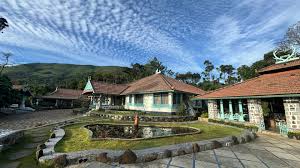
View of Bungalow 1934 set against the Ballyatra Hill / Amrith Thimmaiah
About the homestay
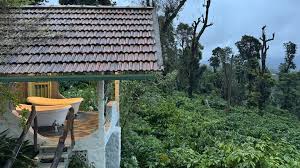
The Bungalow is located in Yavakapadi village, roughly 30km from Virajpet and Madikeri. There are sweeping valley views, as well as a clear view of the Igguthappa temple, a deeply significant site for Kodavas who visit the deity for a bountiful harvest.
Bedrooms at the Bungalow 1934 / Amrith Thimmaiah
With mud walls, pillars, and beams, the home is a true depiction of Coorg ‘s ainmané or ancestral homes, where vaastu dictates aspects like where the owner’s room should be located (in the kubéra moolé, or south west direction). A sprawling fig tree stands out front, and you enter into a pillared, elevated open veranda where, traditionally, Kodava families gathered for tea, family meetings or an evening drink.
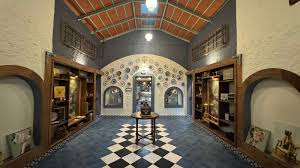
The hall in the Bungalow 1934, with old plates passed from generations in Amrith’s family / Amrith Thimmaiah
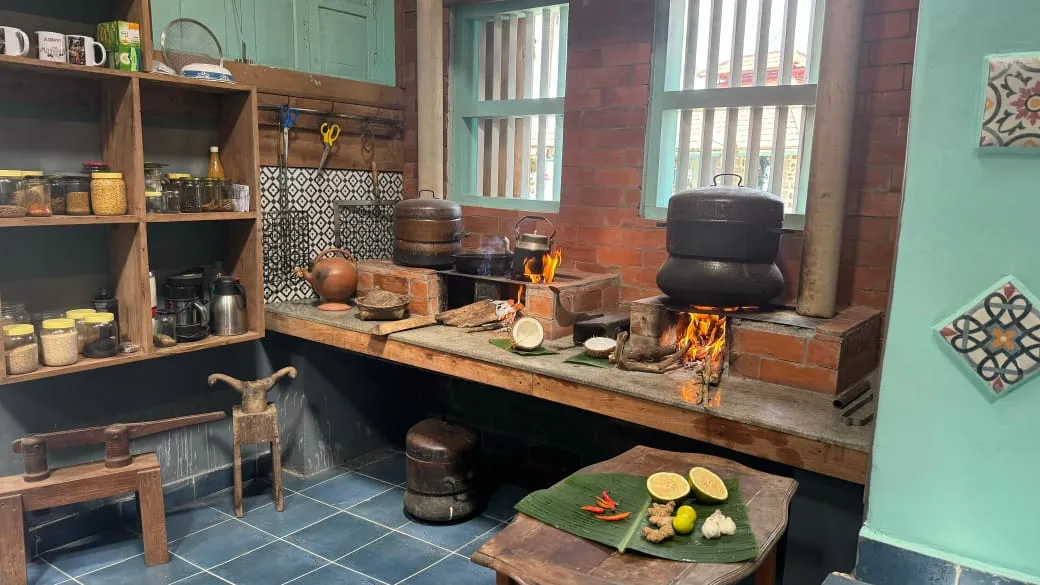
Peppered with antiques and with mosaic tile floors, the main bungalow features living spaces, a large common dining area, a room where Amrith stays, and four guest bedrooms. An annexe beside the main bungalow houses two more guest bedrooms. The six spacious rooms are rustic and cosy , with blue tiles, beamed ceilings, in-built fireplaces, and four poster beds. Large windows offer ample sunlight and views of the mountains. When the temperature drops in these misty mountains, there are plenty of fireplaces across the home and porches to curl up with some homegrown coffee.
Kitchen at the Bungalow 1934 / Amrith Thimmaiah
The home is surrounded by rosewood, jackfruit and mango trees, and the grounds lead into the 70-acre Green Acres coffee estate. Arabica and Robusta coffee plants grow under a light canopy of Silver Oak, Cedar, and Benteak, dotted with pepper vines and cardamom plants. The buzz of cicadas and birdsong fill the air. Birders will be able to spot hornbills, white-bellied treepies, and the crow pheasant or the chombuka, considered lucky by the Kodavas.
About the hosts
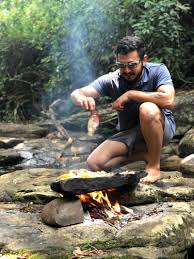
Amrith at the BBQ lunch spread by the stream / Amrith Thimmaiah
Amrith is a rally driver by profession and a passionate host at the homestay, managing bookings personally (the homestay is not listed on any booking platforms), helping with logistics and recommendations. Guests usually come through word of mouth or as repeat visitors, and bookings are confirmed only for days a family member is present at the homestay. Staff leaves and village festivals are respected, and no bookings are made during this time.
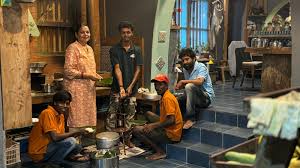
Fancy Ganapathi making Noolputt (steamed rice noodles) with Subbu, Krishna, Chethan & Pavithra / Amrith Thimmaiah
Amrith’s mother, Fancy Ganapathi, is a powerhouse who oversees the food at the homestay. The former lecturer of Kannada literature is a horticulturalist by passion, and a catalyst in forming the 700-member Nature’s Best Food Cluster in Kodagu. The organisation trains grassroot level farmers and enables them to sell their products at outlets in Coorg. “At the Bungalow, I love to share recipes with guests and if someone wants to purchase local produce, I ensure the cluster family provides their products,” she says. Gappu Ganapathi, Amrith’s father, is the backbone of the bungalow and manages the entire coffee plantation.
The Bungalow has 8 to 10 staff members, whose families have been associated with the Ketolira family for generations. Janaki Saraswati, the cook, used to be Amrith’s nanny and was taught heirloom recipes by Amrith’s grandmother.
The food
Frozen Mulberry Crush / Amrith Thimmaiah
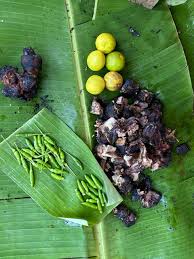
Koli Chuttadh (Chicken woodfire roasted) with bird’s eye chilies and lime / Amrith Thimmaiah
Food at the homestay stays true to any traditional Kodava home, with classic local dishes like khaima undae (mutton keema balls), kori erachi pulao (mutton pulao), pandhi curry and otti (pork curry with rice flatbread). Buffet style meals served in the dining area are generous and take into account dietary preferences. There are numerous vegetarian options within the gamut of Coorg cuisine, featuring seasonal produce like kaaké thopp (black nightshade leaves), kumm curry (mushroom), and kaad maangé curry, a tangy, sweet curry made with Coorg wild mangoes.
Fancy ensures that all dishes are served in the traditional Kodava style: baimbalé with otti (tender bamboo shoot curry with rice flat bread) served with ghee is a common Coorg breakfast; rice cakes or putt with meat curry; chutneys or pajjis made from seasonal produce.
Pomfret Fish Grilled / Amrith Thimmaiah
Onak Meen Barthadh (Dried Fish fry) / Amrith Thimmaiah
She also makes fruit wine and chocolates, and her mulberry and pomegranate wines are a hot favourite. This year, she has started to make oil and tea out of the rosemary growing in her small garden. The pathaya or granary on the homestay premises houses the products she makes, and make for perfect souvenirs to take home.
Amrith Thimmaiah
Amrith Thimmaiah
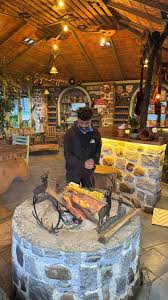
At dusk, Amrith has a house rule: he will host a typical Coorg-style barbeque for guests. Meat is roasted the traditional way over an open wood fire, mixed with finely chopped bird’s eye chili and the juice of bitter lime, to serve up Coorg’s favourite starter, pork chuddals. The family and staff tell stories by the fire, while you can sip cocktails under a star-studded sky with the lights of Madikeri town in the distance.
How to spend 48 hrs at The Bungalow 1934
Sparko at Charandi Polé / Amrith Thimmaiah
The homestay offers plenty of cosy nooks to read, write and while away the hours, but if you want to venture out, Amrith organizes treks to Thadiandamol peak and Chelavara Waterfalls. For those interested, Fancy conducts workshops for chocolate, wine, or jam making (4 people minimum, Rs5,000 per person). Sparko, the family dog, may take you down to a stream a short walk from the bungalow, where you can enjoy a barbeque picnic lunch by the stream.
Amrith Thimmaiah
Take a leisurely 2km walk or a guided plantation tour with Gappu at the coffee estate. Gappu and Fancy live in a home close by, with fish ponds, a cow shed, a coffee drying and storage area, and are happy to invite you over with advance notice.
In his monthly radio broadcast, Modi lauded the distinctive character and diversity of Indian coffee, saying it has carved a ‘unique identity’ on the world stage.
For many growers in Kodagu, the Prime Minister’s mention has brought a sense of pride but also renewed hope for government intervention. | Photo Credit: For many growers in Kodagu, the Prime Minister’s mention has brought a sense of pride but also renewed hope for government intervention.For many growers in Kodagu, the Prime Minister’s mention has brought a sense of pride but also renewed hope for government intervention.
Planters in Karnataka have welcomed Prime Minister Narendra Modi’s praise for the global recognition earned by coffee from the State’s key producing regions Kodagu, Chikkamagaluru, and Hassan during his ‘Mann Ki Baat’ address on Sunday. However, growers have urged the government to take concrete steps to address persistent challenges affecting the sector.
Coffee Board of India chairman M.J. Dinesh thanked the Prime Minister for recognising the efforts of lakhs of growers and said the acknowledgment would inspire renewed enthusiasm in the sector. “The Prime Minister’s words will encourage planters, traders, and exporters alike. It comes at a time when the board has undertaken several initiatives to boost both productivity and domestic consumption,” he said.
For many growers in Kodagu, the Prime Minister’s mention has brought a sense of pride but also renewed hope for government intervention. “It is heartening that the Prime Minister has spoken about coffee from Kodagu, which produces the largest share of India’s coffee. His words reaffirm the importance of our work,” said coffee planter Ravi Chengappa from Virajpet in Kodagu.
However, Mr. Chengappa noted that the sector continues to face serious difficulties. “Coffee growers are struggling with rising input costs, labour shortages, damage caused by erratic rainfall, and wild animal attacks. Fluctuating international prices and a lack of adequate crop insurance have also left many growers financially vulnerable,” he said.
Another farmer Dinesh H. from Chikkamagaluru urged both the Central and the State governments to take immediate steps to protect the livelihood of coffee farmers. “We hope the Prime Minister’s appreciation will translate into stronger policy support. The government must address these long-standing issues from better price realisation to support for sustainable cultivation so that the next generation of planters can continue this legacy,” he added.
source: http://www.thehindu.com / The Hindu / Home> News> India> Karnataka / by Darshan Devaiah B P / October 27th, 2025
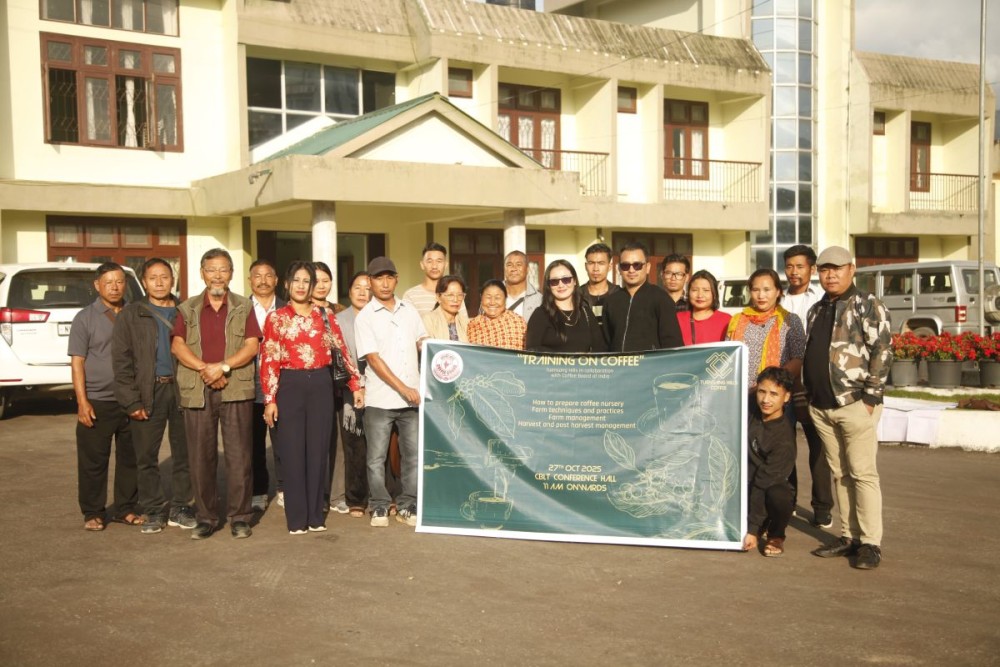
Officials from CBI and Founder and Co-founder of Tuensang Hills with the participants along with the officials of Land Resource Department. (morung photo)
A one-day training programme on coffee cultivation was held in Tuensang to build technical knowledge among local farmers in Nagaland.
The training, organised by Tuensang Hills Coffee in collaboration with the Coffee Board of India (CBI), was conducted at the Chang Baptist LashongThangyen (CBLT) conference hall in Tuensang Town on October 27.
The programme aimed to equip farmers with expertise in key areas, including nursery preparation, advanced farm techniques and practices, farm management, as well as harvest and post-harvest handling.
Around 30 participants took part in the session, which was facilitated by DipanjaliKemprai, Senior Liaison Officer, and N ImtisungchitImchen, Assistant Extension Officer, both from the Coffee Board’s Mokokchung office. Officials from the Land Resources Department, Tuensang, also attended the training, underscoring the department’s continued support in promoting coffee cultivation in the district.
Founder of Tuensang Hills Coffee, PangshaChingmak, said the training was initiated to empower farmers with practical skills and promote coffee as a viable livelihood option in Tuensang district. He highlighted the district’s suitable terrain and climate for coffee cultivation and emphasized plans for sustained follow-up programs and field support to assist farmers after the training.
Responding to questions, Kemprai explained that the collaboration began when Chingmak approached the Coffee Board with details of his startup, Tuensang Hills Coffee, which has been selected for incubation under AIC CCRI-CED. “Our office came forward to boost his startup by providing technical knowledge to the farmers to produce good quality coffee,” she said.
Kemprai added that the Coffee Board continues to support farmers across Nagaland through the Integrated Coffee Development Project, offering subsidies, training, and assistance from “bean to cup.” She also mentioned plans to strengthen market linkages to ensure better prices for local produce and to organize more quality-improvement trainings in the future.
On challenges faced in promoting coffee cultivation in the Northeast, Kemprai noted that small and scattered farm holdings, poor road connectivity, and limited manpower make regular monitoring difficult. To bridge communication gaps, the Board has created WhatsApp groups for quick dissemination of information and encourages farmers to access details of schemes and technical support through the official Coffee Board website.
Highlighting the growing recognition of Naga coffee, Kemprai said, “The future of Naga coffee looks promising. Many entrepreneurs and farmers are coming forward, and Nagaland coffee is gaining recognition for its organic nature and quality.” She cited the state’s achievements at the Aurora International Taste Challenge winning a silver plaque in 2021 and a gold award in 2023 as evidence of its rising reputation in the specialty coffee market.
The training concluded with interactive discussions and a call to strengthen community-based efforts for sustainable coffee cultivation in Eastern Nagaland.
source: http://www.morungexpress.com / The Morung Express / Home / by Morung Express News / October 28th, 2025
Indian coffee of different varieties grown in diverse regions was the theme of a “Mann Ki Baat” address by Prime Minister Narendra Modi. Besides the traditional areas like Karnataka (Chikmagalur, Coorg, Hassan), Tamil Nadu, and Kerala, he talked about the North-East as the new frontier of coffee cultivation.
Prime Minister also talked about the revolutionary effect of coffee plantation on the living of the people, especially tribal farmers and women, by giving the example of Koraput coffee which not only revived the degraded forest but also ensured the income of the people. The Ministry of Commerce and Industry added that Indian coffee is a highly export-oriented product, as 70% of the production is going to more than 120 countries, resulting in a $1.80 billion revenue in 2024-25.
Indian coffee exports have been on a dramatic rise over the last three years, in fact, the value of exports has gone up from $1.29 billion in 2023-24 to $1.81 billion in 2024-25. The increase is more than 40%, and it is solely due to the increased global demand for both raw and value-added coffee products like roasted and instant coffee. India is the seventh-largest coffee producer, and the coffee plantations cover 4.9 lakh hectares while the production is 3.63 lakh metric tonnes.
Demand for the Indian coffee in the international markets is primarily due to the introduction of specialty tribal coffees like Koraput and Araku, which have started to command premium prices. These coffees attract highly selective international markets that put quality, sustainability, and traceability at the forefront.
The Coffee Board’s intervention in the form of support to farmers and new market linkages has not only raised the farmer’s income but also their living standards, especially in the tribal communities. In India, the culture of coffee consumption has grown significantly in the last 4-5 years. Average coffee consumption increased step by step from 1,180 thousand 60-kg bags in 2020 to roughly 1,235 thousand bags in 2022.
The change in consumer behaviour, caused mainly by millennials and GenZ, has made the coffee consumption gradually comparable with the traditionally dominant tea consumption. The demographic change combined with the advent of specialty coffee chains like Blue Tokai, Third Wave Coffee, and the extension of internationally recognised brands such as Costa Coffee and Starbucks is driving a dynamic coffee market growth that is expected to continue for the next 10 years at a CAGR of around 7.5%.Merchants and startups in the Indian coffee industry have created a culture around specialty coffee focusing on domestic bean sourcing and the generation of higher consumer awareness.
Specialty coffee brands in India have attracted a substantial amount of funding from global investors such as Verlinvest, who sees India becoming not only a major coffee-consuming country but also a hub for coffee exports. In addition to ready-to-drink coffee beverages and urban café culture, the Indian coffee market has deepened in terms of variety and has more potential consumers to target.
Beyond economic metrics, the coffee sector has delivered significant environmental benefits. Koraput coffee has helped restore degraded forest land, reduced soil erosion, and provided tribal farmers with steady cash income in place of subsistence farming. This sustainable approach aligns with global trends favoring environmentally responsible sourcing, further enhancing Indian coffee’s international appeal.
In conclusion, the points of Prime Minister Modi about Indian coffee going global are supported by solid facts: the rapidly growing and diversifying coffee farming landscape, robust export performance, changing domestic consumption pattern, and the rise of new premium coffee brands. With the backing of government schemes, eco-friendly farming methods, and rising foreign demand, Indian coffee is set to realise further market penetration, higher farmer incomes, and improved global standing over the next ten years.
source: http://www.thepamphlet.in / The Pamphlet / Home> Economy> Opinion / by Surabhi Singh / October 28th, 2025
Mr.Ajoy Thipaiah has been elected as President of The United Planters Association of Southern India (UPASI) for the year 2025-26 at the Annual General Meeting of the Association held on 20th September 2025 at Kochi.
As a fourth generation coffee planter attached to the traditional coffee grower family, he joined the family owned and run plantations of Guddadamane and Kerehaklu Estates situated in Aldur of Chikkamagaluru District, Karnataka, after completing his under graduation at Christ College, Bangalore in the year 1983. He was actively involved in the Karnataka Planters Association (KPA) from the late eighties and had a long stint as its Executive Committee member, culminating in heading the Association as Chairman in the year 2008-09. He was also actively involved with the UPASI and KPA Sports Clubs and served as the President of both clubs.
Mr.Ajoy Thipaiah was nominated to the Coffee Board of India in the year 2009 and served a full term as a representative of Coffee growers from Karnataka State. He served in the UPASI Executive Committee during the year 2007-08 and 2008-09, and has been in the Committee since 2017-18. He served as the Chairman of the UPASI Coffee Committee for the period 2021-22 to 2023-24.
Mr.Abhishek Poddar of Matheson Bosanquet Enterprises Pvt Ltd has been elected as Vice President of UPASI for the year 2025-26.
source: http://www.afternoonnews.in / Afternoon / Home> Tamil Nadu / by Staff / September 23rd, 2025
Bringing Coorg’s rich stories, soil, and spirit to every cup
Bengaluru :
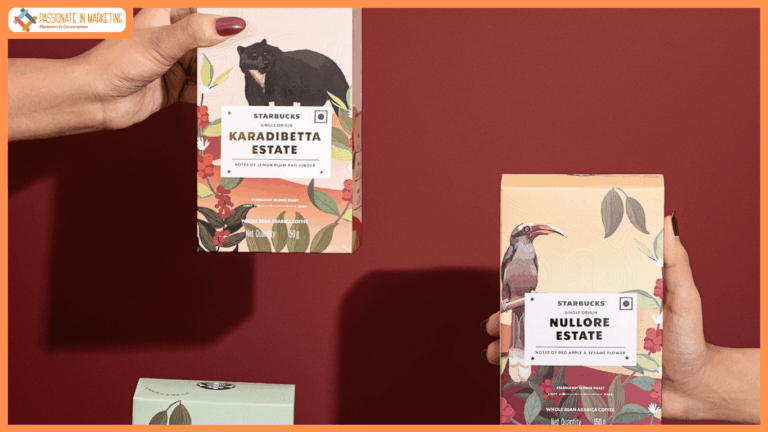
Tata Starbucks is celebrating India’s deep-rooted coffee heritage with the launch of its first-ever estate-exclusive single-origin coffees, sourced from the Nullore, Margolly, and Karadibetta Estates of Coorg, Karnataka.
Building on the success of the India Estates Blend, which first spotlighted the country’s coffee origins, this new range brings the focus even closer to the land and the people behind each bean. Through this launch, Starbucks shines a light on India’s coffee-growing heartlands and the generations of farmers whose craft and care shape every cup. As one estate manager expresses on the coffee pack, “This coffee is our legacy – I warmly welcome you to experience it in your cup.”
Joining Starbucks celebrated lineup from coffee growing regions of Africa, Asia Pacific, and Latin America, this curated trio underscores the brand’s commitment to showcasing the world’s most distinctive coffees while championing India’s own specialty coffee estates.
Rooted in the heart of Coorg’s coffee belt, the Nullore, Margolly, and Karadibetta estates each embody a unique legacy of craftsmanship, biodiversity, and care passed down through generations.
India Nullore Estate: Growing at an altitude of 910 meters above sea level this Arabica coffee offers tasting notes of red apple and nutty sesame flower, with a sweet lemon acidity, a medium-light body, and medium-high acidity creating a balanced yet vibrant cup. Nestled in Madikeri’s mist-covered hills, the estate is a model of circular farming, where nature nurtures every bean under a two-tier canopy of native trees.
India Margolly Estate: With roots dating back to the 1850s, Margolly Estate is in the undulating highlands of southern Coorg. Grown at 980 meters above sea level, this washed Arabica features Barhi date and cinnamon bark notes, rounded by a forest honey finish. The estate’s dense canopy, thriving pepper vines, and rainwater harvesting practices mirror the cool, humid conditions of evergreen forests, producing beans with balanced acidity, clean finish, and distinct character.
India Karadibetta Estate: Perched at 1000 meters above sea level, Karadibetta Estate produces high-altitude Arabica with tasting notes of jamun plum, ginger, and sweet tulsi herbal. Its high acidity and medium body create a layered, aromatic profile that reflects the biodiversity and lush terrain of Coorg’s highlands.
From the Grey Hornbill of Nullore, a natural seed-sower of Coorg’s forests, to wandering elephants through Margolly’s lush pepper trails and the vibrant flora of Karadibetta’s highlands, each package has been thoughtfully designed with illustrations that celebrate the wildlife, biodiversity, and ethical sourcing practices that define these estates and the communities that sustain them.
Mitali Maheshwari, Head of Product & Marketing, Tata Starbucks, said, “India’s coffee origins carry the rich legacy of their people, with stories spanning centuries. We’re proud to share the distinct flavors and craftsmanship of Coorg through these iconic estates that have been harvested for the first time for Tata Starbucks. Each single origin coffee in this range reflects its unique terroir, biodiversity, and the passion of its farmers, brought to life in every cup.”
source: http://www.passionateinmarketing.com / Passionate in Marketing / Home> Marketing / October 28th, 2025
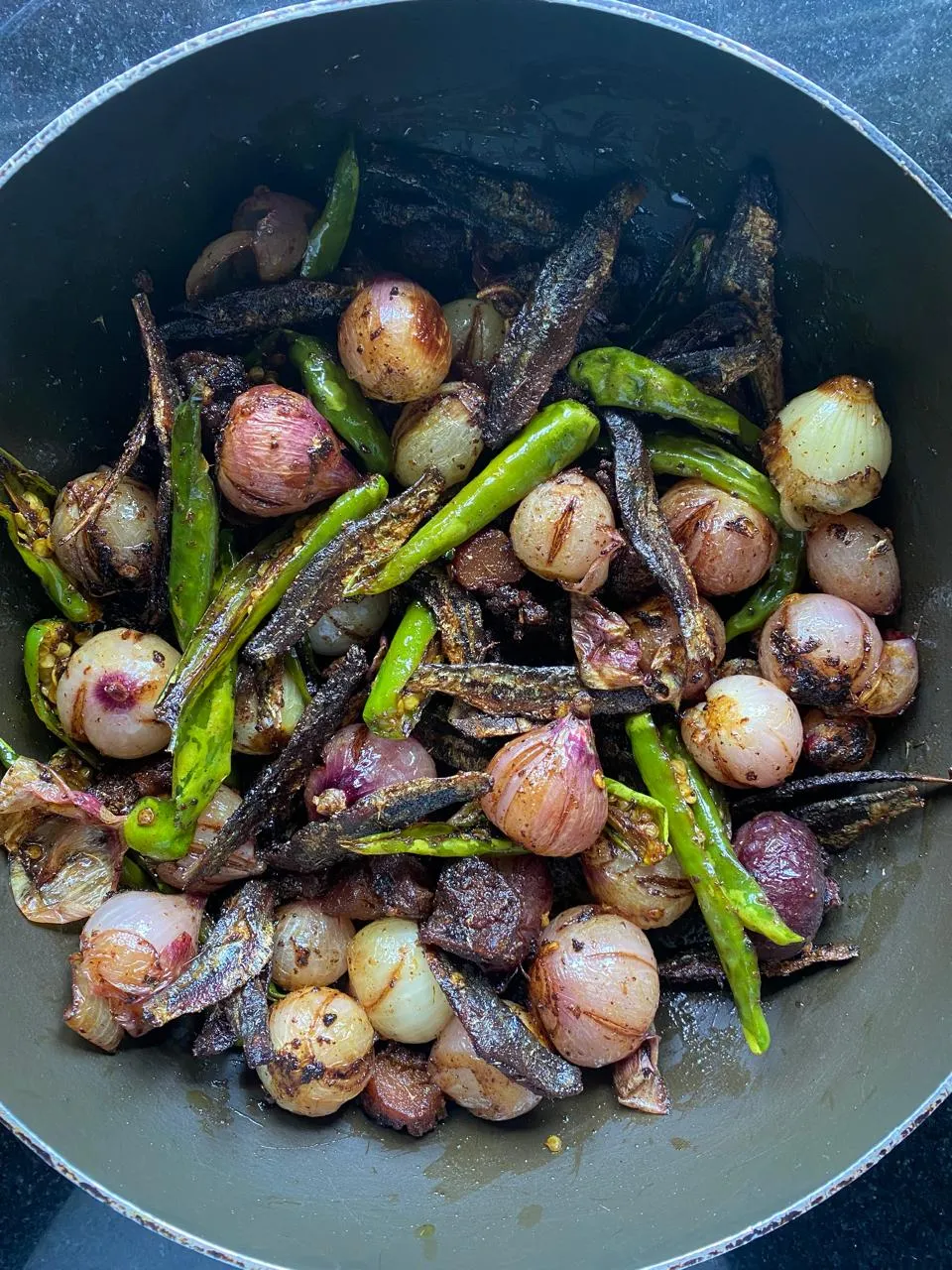
And one such way, followed traditionally and scientifically, is consumption of dishes made from a highly medicinal plant.
Dishes prepared from bamboo shoot are also the highlight of ‘Kakkada padinent’ I Prajna GR
Madikeri :
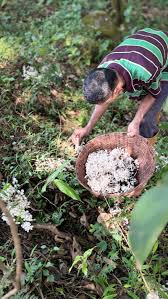
Monsoon in Kodagu is synonymous with chilly weather due to continuous rainfall. While the traditional houses in the district are equipped with fireplaces to warm up the ambience, the people of Kodagu follow certain indigenous ways to stabilise the body temperature. And one such way, followed traditionally and scientifically, is consumption of dishes made from a highly medicinal plant, locally known as ‘Maddu thoppu’ (medicinal leaves). And this festival of leaves was celebrated on August 3.
With scientific name ‘Justicia Wynaadensis’, ‘Maddu thoppu’ grows abundantly as a bushy shrub in the humid tropical belts of Kodagu. “In 1921, botanist J S Gamble, former official of the forest department, had recorded the abundance of this plant in the evergreen forests of the Western Ghats – from South Canara, Kodagu to Wayanad, Eastern Nilgiris and South Malabar,” says Ulliyada Daty Poovaiah, ex-president of Kodava Academy.
With slender stems and hunter green leaves, they grow like an army of soldiers at places where there is scanty sunlight. They earn special status during ‘Aashada masa’ in the Hindu calendar, also known as ‘Kakkada masa’ in Kodava calendar. This month begins on July 17 and ends on August 16. “The ‘Kakkada’ month is considered inauspicious and no important ceremonies or celebrations take place during this one month,” says historian Bacharaniyanda Appanna.
While tradition says that this month is inauspicious, there is a reason behind it. This monsoon month demands complete attention in the paddy fields and since Kodagu is an agriculture-based district, every household involved themselves in agricultural activities and there was no time for any other kind of celebrations,” explains Daty.
And the continuous work on farmlands in cold weather demanded one to be fit, which is when ‘Maddu thoppu’ came into attaining special status during this inauspicious season. ‘The presence of numerous phyto components lends credence to the use of the plant as a medicinal herb by the local community,” states Dr Latha D in a study conducted on this medicinal plant. With anti-microbial effects, they fight various pathogens that spread widely during the monsoons. “While Justicia Wynaadensis has high medicinal value and is used widely in Ayurveda medicine, the plant attaining maximum medicinal value on the 18th day of ‘Aashada’ month is more of a belief,” explains Ayurveda doctor Udayashankar.
And hence the people of Kodagu religiously follow the ritual of plucking the leaves of ‘Maddu thoppu’ on the 18th day of ‘Kakkada’ and indulge in a variety of elaborate cuisines. “The plant is believed to give 18 types of medicines during this month and a variety of dishes including ‘Maddu thoppu halva’ and ‘Maddu thoppu’ porridge are prepared using pure, traditionally extracted honey. (The plant is believed to lose its medicinal components one by one after the 18th day).
Along with this, a variety of dishes are prepared from country chicken, colocasia leaves, bamboo shoot, crabs, jackfruit and are laid alongside paddy-arrack, which are all believed to stabilise the body heat during chilly monsoons,” explains Daty. This marks the celebrations of ‘Aati padinent’ (padinent translating into 18th day in Kodava language), which falls on August 3 every year. While the presence of Justicia Wynaadensis in the backyards of houses is reducing after urbanisation, they are still widely present on the peaks in the district.
source: http://www.newindianexpress.com / The New Indian Express / Home> Bengaluru / by Prajna GR / Express News Service / August 05th, 2018
WELCOME. If you like what you see "SUBSCRIBE via EMAIL" to receive FREE regular UPDATES.
Read More »