Get the inside story as MacBeans Aberdeen launches its Indian coffee trilogy.
All Indian coffee from MacBeans is farmed organically.
MacBeans in Aberdeen explores the world of Indian coffee, offering fresh blends, single origins and new flavour experiences.
MacBeans Coffee Roasters in the corner of Little Belmont Street in Aberdeen has been open for 37 years. It’s now one of the oldest surviving High Street coffee roasters in Scotland. And unlike most other retailers, it roasts its coffee right on its premises.
For the past several weeks, MacBeans has been roasting coffee freshly delivered from India, which the proprietor, Brian Milne visited early this year.
About 20% of the coffee sold at MacBeans is sourced from India. The shop carries single origin coffees from the South Asian country. But it also uses Indian coffee in many of its own MacBeans blends.
As a former oilfield chemist with a passion for coffee, Brian Milne does not source his coffee blindly. With direct connections to producers all around the world, Brian is able to work closely with them to deliver the highest quality beans to use in every customer’s cup of coffee.
A Passage to India
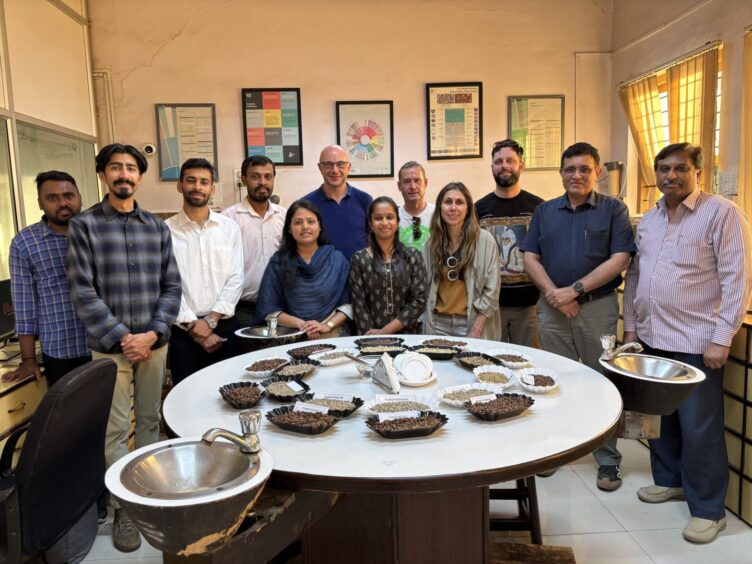
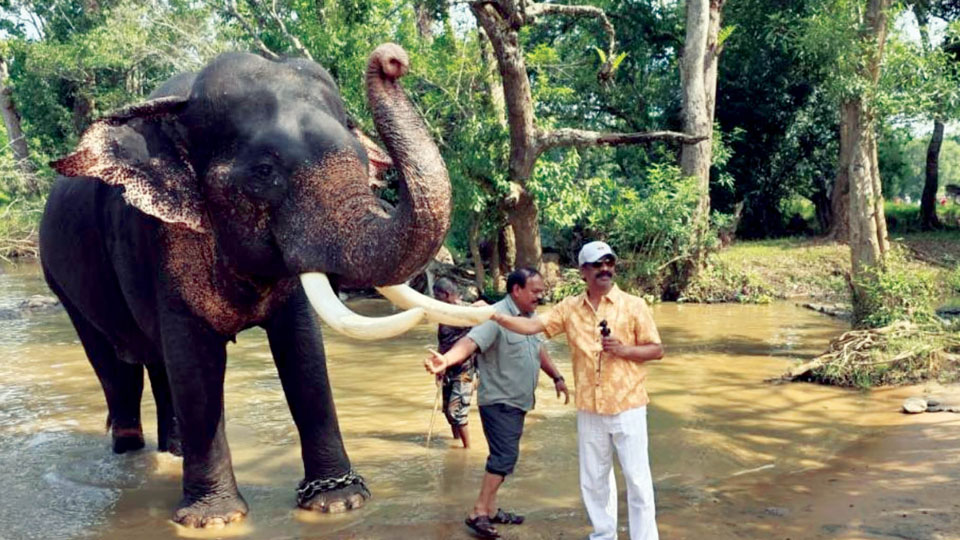
MacBeans’ proprietor, Brian Milne (center) meets with coffee producers in India
Last January, Brian went on a ten-day trip to South India, facilitated by MacBeans’ coffee importer, to visit different coffee plantations and meet with local producers.
Brian says: “A big part of my drive with our coffee is to make sure I understand where the coffee comes from. Going on these trips is a good opportunity to learn more about what’s happening in each country and finding things that we can support.”
In Bangalore, he met with agricultural communities and local cooperatives, even India’s coffee minister.
Brian shares: “We got to tour The Coffee Board of India’s facility and that really appealed to my background in analytical chemistry. I got very excited over some of the lab equipment because they were doing a lot of work to develop and standardise the quality of the coffee that comes out of India.
“They had an artificial nose and an artificial tongue – analytical instruments designed to analyse the coffee for the compounds that contribute to its aromas and its flavour profile.
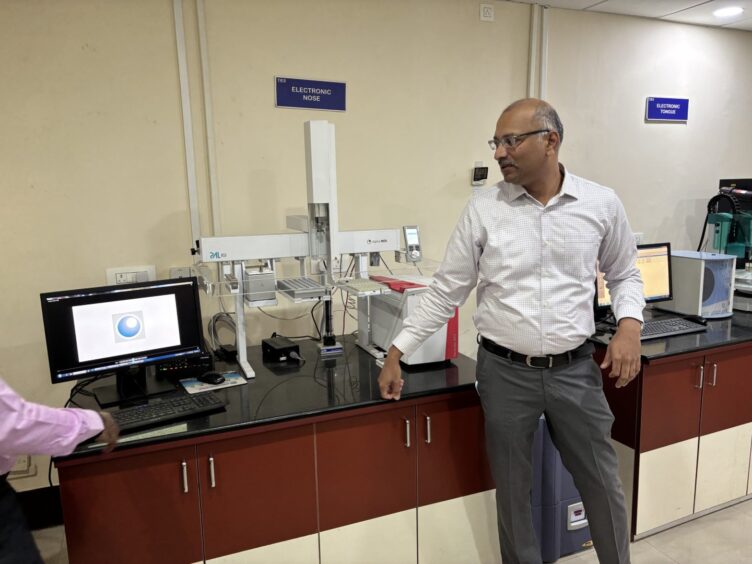
An electronic nose analyses coffee for compounds that contribute to its aroma.
“They are building a library of their coffees to keep track of the quality, which was very interesting.
“They also do a lot of agricultural training. A lot of the agronomists who support the farmers have all been trained by or worked with the Coffee Board of India. So there’s a lot of governmental support at that level to help the local coffee producers.”
Caring for the environment
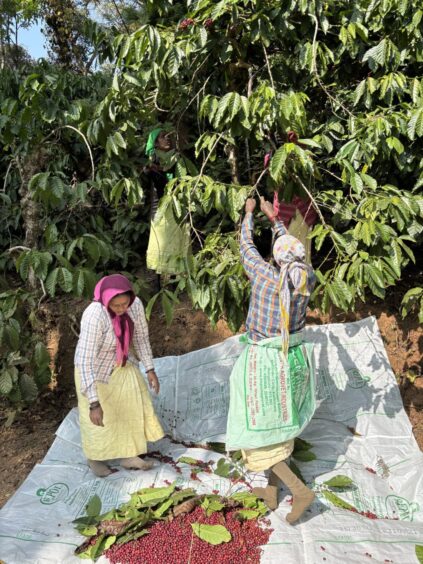
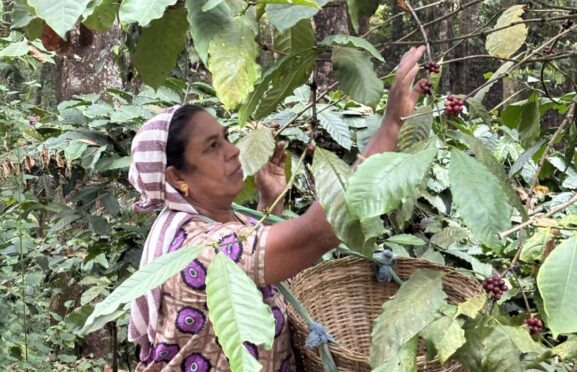
Coffee beans are handpicked by workers in India.
Brian observed that Indian producers followed strict environmental practices. This aligns with the principles of MacBeans, where all the coffee is free of pesticides and farmed organically.
Brian notes: “They reuse a lot of the biomaterials like leaves that have dropped. When they pulp the coffee cherries, all the fruit flesh is composted. That’s what they put back onto the land to help fertilise the crop.
“Because water can be scarce, the processors also collect and recycle the water used from washing the coffee. That’s purified through reed bed processes and reused. So they’re very considerate of the environment.”
People at the heart of the business
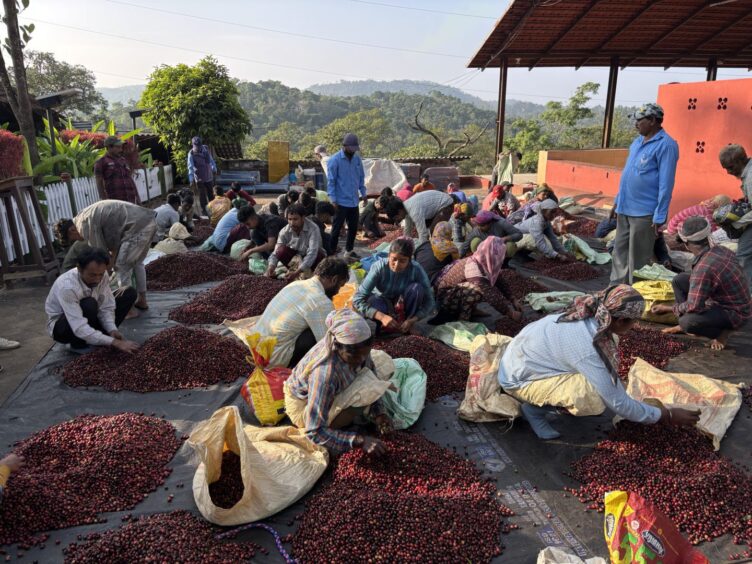
Hundreds of people are employed in Indian estates to produce coffee.
Before his visit, Brian knew that India was among the top 10 coffee producers in the world. But he didn’t understand the scale of the production until he saw it for himself.
“During harvest time, the estates we visited would employ about 1,000 people – pickers, processors. But even outside the harvest, there would be 600 or 700 people employed to tend to the land and maintain the plants.
“People are at the heart of the whole process. There are estates owned by families or cooperatives working with small landowners. They all work together to produce their coffee to manage it and support it. It’s a people business.”
The story behind the Monsoon Malabar
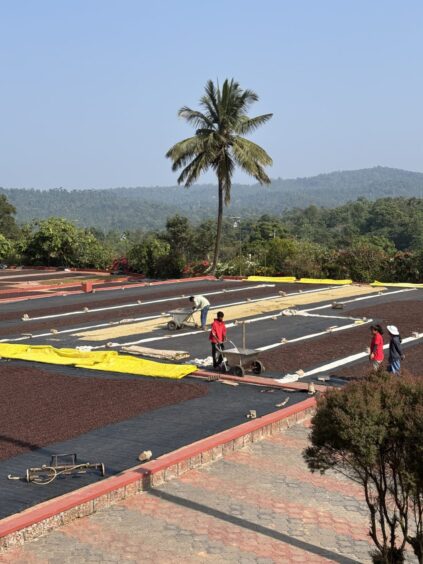
Indian workers dry coffee beans in the sun.
On his trip, Brian discovered more about one of MacBeans’ more popular coffees – the Monsoon Malabar.
“What I knew about it was that it was just an aged coffee. Apparently, that came about a hundred years ago when they were shipping coffee from India on long journeys on sailing ships.
“Researchers found that when the coffee got to Europe, it tasted a lot more mellow than it did when it was at origin. They worked out that it was attributed to the damp environment in ships and the extended time the coffee spent in that environment.
“Today, coffee makers in India are replicating that aging process now called monsooning. They harvest the coffee then wash and dry it as normal. But afterwards, it is aged in the monsoon rains then dried in warehouses on the Malabar coast, resulting in a very smooth and mellow coffee.”
This ageing method as well as the production zones are strictly defined by regulations to protect the production and authenticity of the Monsoon Malabar. It’s a system that’s similar to the DOC system for Italian wines.
Busting the Robusta myth
Brian also travelled to Chikmagalur, the heartland of coffee production in South India, right at the tail end of the Robusta crop harvest and the beginning of the Arabica harvest.
MacBeans does not sell Robusta as a single origin coffee. It’s so intensely flavoured that it can be bitter and even unpalatable.
“In India, producers are investing a lot of time and effort into how they treat Robusta coffee when it’s harvested to improve its flavour and develop it into a specialty coffee.
“There’s a method sometimes called the honey process where you pulp the cherries. But you don’t wash off the little bits that stick. So then you still get all kind of fruitiness to the coffee, but it’s a much milder effect.
“They’re also co-fermenting coffees with other fruits in barrels from a few days to a few weeks. The amount of time makes a huge difference to the flavour.
“The trip was an eye-opener for me. I always thought of Robusta as a low-grade coffee that we added to some of our blends to make them stronger in caffeine and in flavour. But we had to be careful about how much we put in because it can affect the taste detrimentally.
“Now I have a much bigger appreciation for the quality of Indian Robusta and its potential to broaden people’s profiles and expectations of coffee. So I’ve committed to use only Indian Robusta. The coffee that I saw being harvested is now in the shop, ready to sell.”
A reminder, though, to those who favour the milder Arabica coffee but would like to explore speciality Robusta. Brian says: “It’s like tasting wine and comparing it to beer; they’re very different – different in the mouth, different flavour profiles.”
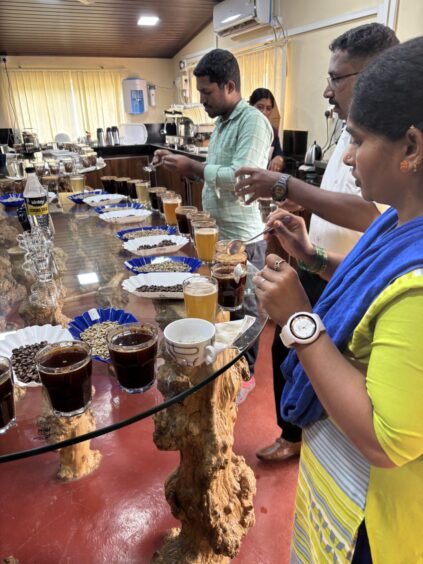
The taste of coffee depends on the beans and roasting methods used.
Try MacBeans’ new India coffee trilogy
Of course, Brian was also able to sample Arabica coffee produced at many of the estates.
“There was a huge variety in the flavours that we tried. Some were very fruity, sharp, distinctive flavours that would be great to try.
“We’ve now got Indian Mysore, an Arabica coffee that forms part of our blends. We also roast it as a single origin Indian coffee. The coffee we have now is from the harvest period that started from the end of 2025 and finished up in February this year.”
The Mysore will be combined with Monsoon Malabar and India Tiger Stripes to form MacBeans’ newest coffee trilogy. Inspired by Brian’s recent trip to India, each bag is bursting with flavours just waiting to be explored by eager coffee aficionados.
To order, pop into MacBeans’ Aberdeen shop or visit the store’s website.
source: http://www.pressandjournal.co.uk / T P&J / Home> In Partnership with MacBean’s Coffee Roasters / May 21st, 2026